


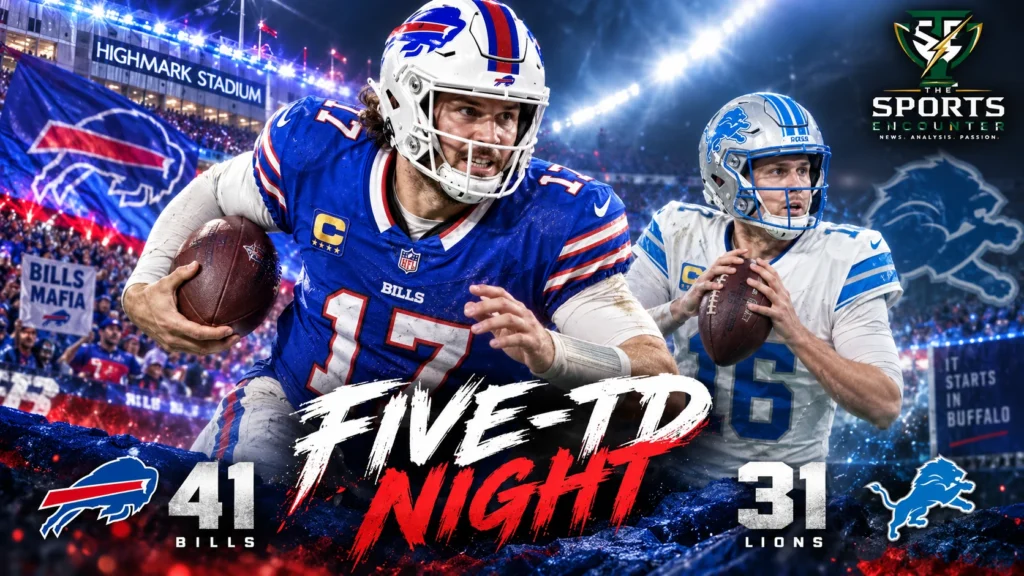
ORCHARD PARK, United States, September 19, 2026: Josh Allen made sure the first regular-season game at the new Highmark Stadium belonged to Buffalo from the opening drive, accounting for five touchdowns as the Bills beat the Detroit Lions 41-31 on Thursday Night Football.
Allen threw for 248 yards and three touchdowns, added 69 yards and two scores on the ground, and directed an offense that reached the end zone on its first four possessions. Buffalo led 21-0 early in the second quarter and 27-10 at halftime before repeatedly answering every Detroit attempt to get back into the game.
James Cook III added 135 rushing yards and a late touchdown, while Dalton Kincaid caught seven passes for 95 yards and a score. Buffalo finished with 446 total yards, including 203 on the ground, and improved to 2-0 under new head coach Joe Brady.
Detroit found plenty of offense after its slow start. Jared Goff completed 26 of 38 passes for 327 yards, four touchdowns and no interceptions. Amon-Ra St. Brown caught nine passes for 142 yards and two touchdowns, but the Lions never recovered from the early three-score deficit and fell to 1-1.
The Buffalo Bills’ official game recap confirms the final score, Allen’s five-touchdown performance and Buffalo’s dominant first half. The Detroit Lions’ official report details Goff’s four-touchdown response and Detroit’s difficulty slowing Buffalo’s offense. The NFL’s official postgame analysis also places the performance in the context of the stadium opening and Buffalo’s 2-0 start.
Follow the developing season through The Sports Encounter’s NFL coverage.
Bills 41-31 Lions: Match at a Glance
| Game Detail | Information |
|---|---|
| Competition | NFL 2026 Regular Season, Week 2 |
| Date | September 17, 2026 |
| Venue | Highmark Stadium, Orchard Park, New York |
| Final Score | Buffalo Bills 41, Detroit Lions 31 |
| Halftime Score | Buffalo 27, Detroit 10 |
| Buffalo Record | 2-0 |
| Detroit Record | 1-1 |
| Josh Allen | 20/31, 248 passing yards, 3 passing TDs; 69 rushing yards, 2 rushing TDs |
| Jared Goff | 26/38, 327 passing yards, 4 TDs, 0 interceptions |
| James Cook III | 21 carries, 135 yards, 1 TD |
| Amon-Ra St. Brown | 9 catches, 142 yards, 2 TDs |
Bills vs Lions Scoring Summary
| Quarter | Scoring Play | Score |
|---|---|---|
| 1st | Josh Allen 1-yard rushing touchdown | BUF 7-0 |
| 1st | Joshua Palmer 43-yard touchdown reception from Josh Allen | BUF 14-0 |
| 2nd | Dawson Knox 1-yard touchdown reception from Josh Allen | BUF 21-0 |
| 2nd | Jahmyr Gibbs 11-yard touchdown reception from Jared Goff | BUF 21-7 |
| 2nd | Dalton Kincaid 16-yard touchdown reception from Josh Allen | BUF 27-7 |
| 2nd | Jake Bates 31-yard field goal | BUF 27-10 |
| 3rd | Amon-Ra St. Brown 2-yard touchdown reception from Jared Goff | BUF 27-17 |
| 3rd | Josh Allen 2-yard rushing touchdown | BUF 34-17 |
| 4th | Sam LaPorta 1-yard touchdown reception from Jared Goff | BUF 34-24 |
| 4th | James Cook III 1-yard rushing touchdown | BUF 41-24 |
| 4th | Amon-Ra St. Brown 27-yard touchdown reception from Jared Goff | BUF 41-31 |
Josh Allen Scores the First Touchdown in the New Highmark Stadium
Buffalo won the coin toss and immediately gave the night to Allen.
The quarterback moved the Bills 85 yards on the opening possession, using both his arm and legs before pushing across from one yard for the first regular-season touchdown in the new stadium.
That opening drive set the tone.
Allen’s mobility forced Detroit to defend every part of the field. When the Lions tried to apply pressure, Buffalo found space behind them. When Detroit became more cautious, Allen moved the chains himself.
The second touchdown arrived through the air.
Joshua Palmer raced up the right seam, separated from the secondary and caught a 43-yard strike from Allen. Buffalo had scored twice before Detroit had established any offensive rhythm.
The start continued a pattern already visible in The Sports Encounter’s NFL Week 1 analysis, where Allen had accounted for four touchdowns during Buffalo’s 36-31 victory at Houston.
Across the opening two games, Buffalo’s offense has now scored 77 points.
The Controversial Penalty That Helped Buffalo Reach 21-0
Detroit briefly appeared to have found the turnover capable of changing the first half.
With Buffalo already leading 14-0, Allen tried to find Kincaid in the end zone. Roger McCreary deflected the pass and rookie defensive lineman Skyler Gill-Howard intercepted it at the Detroit five-yard line.
The play did not stand.
Rock Ya-Sin was flagged for defensive holding, giving Buffalo a new set of downs.
Three plays later, Allen found Dawson Knox for a one-yard touchdown.
The score became 21-0 instead of Detroit taking possession with a chance to cut into a two-touchdown deficit.
That sequence did not decide the entire game. Buffalo still produced 446 yards and repeatedly moved the football throughout the night. It did make Detroit’s already difficult start considerably harder to repair.
Buffalo Scores Touchdowns on Its First Four Possessions
The Bills’ opening offensive stretch was exceptionally efficient.
Detroit’s defense could not force a punt before Buffalo had already scored four touchdowns.
Allen led drives ending with:
- A 1-yard rushing touchdown
- A 43-yard touchdown pass to Joshua Palmer
- A 1-yard touchdown pass to Dawson Knox
- A 16-yard touchdown pass to Dalton Kincaid
By halftime, Buffalo had generated 299 total yards and 20 first downs.
Cook was particularly damaging on the ground, reaching 101 rushing yards on only 11 first-half carries.
The Bills’ ability to run and pass from the same personnel groups repeatedly prevented Detroit from finding a defensive answer.
That balance was one of the major questions surrounding Buffalo entering 2026. The Sports Encounter’s NFL 2026 season curtain-raiser identified Joe Brady’s promotion as one of the coaching changes capable of reshaping the AFC.
Two games into his tenure, the early evidence is difficult to ignore.
Dalton Kincaid Has Become One of Buffalo’s Most Dangerous Weapons
Kincaid followed his 130-yard performance against Houston with another major night.
The tight end caught seven passes for 95 yards and Buffalo’s fourth touchdown.
Through two games he has accumulated 225 receiving yards, immediately giving Allen a consistent target over the middle of the field.
That matters because Buffalo’s receiving structure changed during the offseason.
DJ Moore’s arrival was among the moves referenced in The Sports Encounter’s NFL training-camp analysis, which examined how Moore’s departure from Chicago affected both teams.
Buffalo does not appear dependent on a single receiver.
Palmer supplied the explosive touchdown. Kincaid consistently moved the chains. Keon Coleman added six catches for 63 yards. Cook stressed the defense from the backfield.
That distribution makes Allen’s offense much harder to scheme against.
James Cook Gives Buffalo the Ground Game Detroit Could Not Match
The difference between the rushing attacks was substantial.
Buffalo ran for 203 yards.
Detroit managed 66.
Cook accounted for 135 of Buffalo’s total on 21 carries, averaging 6.4 yards per attempt.
His production made Allen’s job easier on early downs and repeatedly kept the Bills ahead of the chains.
The final touchdown came from one yard with 2:53 remaining, taking Buffalo’s lead back to 17 points after Detroit had reduced it to 34-24.
It was the final meaningful answer in a game where Detroit kept forcing Buffalo to respond.
Cook’s dominance also contrasted sharply with the questions around Detroit’s backfield entering the season. The Lions had spent August dealing with multiple injuries behind Jahmyr Gibbs, a situation covered in The Sports Encounter’s report on Detroit’s interest in Kareem Hunt.
Gibbs remained dangerous as a receiver against Buffalo, catching six passes for 61 yards and a touchdown, but he was held to 52 rushing yards on 16 carries.
Jared Goff Refuses to Let the Lions Disappear
Detroit’s offense could easily have folded after falling behind 21-0.
Goff prevented that from happening.
He found Gibbs for an 11-yard touchdown late in the second quarter, then directed another drive into field-goal range before halftime.
Detroit opened the second half with its best sustained possession of the game. Eleven plays and 74 yards ended with Goff finding St. Brown for a two-yard touchdown.
The lead was suddenly 27-17.
Buffalo immediately responded with an eight-minute touchdown drive.
That exchange captured the frustration of Detroit’s night. Every time the Lions produced enough offense to change the emotional direction of the game, Buffalo generated another answer.
Amon-Ra St. Brown Produces Another Elite Receiving Performance
St. Brown was Detroit’s most damaging skill-position player.
He caught nine of 13 targets for 142 yards and two touchdowns.
His first touchdown reduced Buffalo’s lead to 10 in the third quarter. His second came from 27 yards with 1:48 remaining.
The first score also carried franchise significance. It was St. Brown’s 48th career touchdown, moving him ahead of Billy Sims for fifth place on Detroit’s all-time list.
Detroit entered the year expecting St. Brown to remain the reliable center of the passing offense while the roster dealt with uncertainty elsewhere.
The Sports Encounter’s preseason Week 1 bulletin focused heavily on Detroit’s defensive injury problems involving Brian Branch and Kerby Joseph.
Those absences have become more significant after two games in which the Lions have conceded 72 points.
Detroit’s Defense Has Now Survived One Shootout and Lost Another
The Lions opened their season by beating New Orleans 31-30 in overtime.
Four days later, they gave up 41 to Buffalo.
The total is uncomfortable: 72 points conceded across the first two games.
Detroit’s Week 1 victory already contained warning signs. The Saints generated 469 total yards and nearly completed a comeback after trailing 21-0.
The Sports Encounter’s Week 1 review identified the Lions’ ability to survive that comeback as both a strength and a warning.
Buffalo provided less room for recovery.
The Bills recorded 34 first downs, 446 yards and six touchdowns. They punted only twice.
Detroit’s defense was not simply beaten by Allen improvising. Buffalo won through structure, explosive plays, rushing efficiency and repeated red-zone execution.
Detroit’s Missing Secondary Pieces Matter
Branch and Joseph began the season on Reserve/PUP and must miss at least four games.
That was already expected to test Detroit’s communication and depth in the secondary.
The Sports Encounter outlined that problem before Week 1 in its analysis of the Lions’ injury situation.
Buffalo attacked the consequences directly.
The Palmer touchdown created a huge vertical gain. Kincaid repeatedly found space between zones. Knox scored in tight quarters. Coleman supplied reliable intermediate catches.
Those problems cannot all be placed on injured defensive backs, but the context matters.
Buffalo’s Pass Rush Made Goff’s Life Much Harder
Goff’s statistical line was excellent.
The pocket environment was not.
Buffalo sacked him four times, with Greg Rousseau producing two in the opening 13 minutes.
Rousseau’s second sack also forced a fumble, although Detroit recovered.
Bradley Chubb recorded his first sack as a Bill, while Michael Hoecht and Chubb combined for another late in the game.
The Bills were without Ed Oliver, who injured his hip during warmups, but the front still generated consistent disruption.
Second-year defensive lineman Deone Walker also influenced the passing game by batting down three passes at the line.
Detroit’s offensive-line depth had already become part of the early-season concern around the team. Broader NFL roster instability was one of the themes of The Sports Encounter’s late-preseason injury and signing roundup.
Josh Allen Makes NFL History Through Two Games
Allen’s first two games have produced an extraordinary statistical combination.
Against Houston he threw two touchdown passes and ran for two more.
Against Detroit he threw three and ran for two.
That gives him five passing touchdowns and four rushing touchdowns through Buffalo’s first two games.
According to the Bills, Allen became the first player in NFL history to record at least five passing touchdowns and three rushing touchdowns through the opening two games of a season.
The record says something about how difficult he remains to defend near the goal line.
Teams can protect against designed quarterback runs and open passing lanes behind the defense. They can devote more defenders to coverage and create room for Allen to run.
Buffalo’s expanded rushing attack makes that choice even harder.
Joe Brady Is 2-0 and Buffalo’s Offense Already Looks Different
Brady became the first head coach in Bills history to begin his tenure 2-0.
The record is obviously too small to define a season.
The offensive identity is more interesting.
Buffalo scored 36 at Houston and 41 against Detroit.
The first victory required a late comeback and decisive defensive takeaway.
The second was built through early offensive dominance and the ability to answer every Detroit rally.
Good teams eventually need both kinds of wins.
The wider AFC has already begun producing its own early statements. Kansas City’s new-look running game overwhelmed Denver in a result examined in The Sports Encounter’s report on Kenneth Walker III’s explosive Chiefs debut.
Buffalo’s answer has been Allen playing at an elite level inside an offense that appears less dependent on him doing everything alone.
The New Highmark Stadium Could Not Have Asked for a Better First Night
The stadium storyline mattered because of what Buffalo has invested emotionally and organizationally in the transition.
The first regular-season touchdown belonged to Allen.
The first passing touchdown belonged to Allen and Palmer.
The first win belonged to a Bills team that scored 41 points in prime time.
There will be bigger games in the building.
There may be playoff games that eventually define its identity.
For an opening night, however, Buffalo created the kind of result supporters will remember whenever the stadium’s early history is discussed.
Detroit’s Larger Questions Extend Beyond One Loss
The Lions remain 1-1.
There is no reason to frame September 17 as a season crisis.
There are clear problems requiring attention.
Detroit has allowed more than 400 yards in consecutive games and surrendered 72 points in four days.
The secondary is missing important players. The run defense allowed Buffalo to control the game. The pass rush could not consistently disrupt Allen. Penalties hurt Detroit at critical moments.
The organization was already entering a period of wider change after appointing Richard Haddad as its new president and CEO, a transition covered by The Sports Encounter in its Detroit Lions leadership report.
Football operations now have more immediate concerns.
The offense is capable of scoring enough to win difficult games.
The defense has to stop making every week require one.
Bills vs Lions Team Statistics
| Statistic | Detroit Lions | Buffalo Bills |
|---|---|---|
| Total Yards | 355 | 446 |
| Rushing Yards | 66 | 203 |
| Net Passing Yards | 289 | 243 |
| First Downs | 24 | 34 |
| Turnovers | 0 | 0 |
| Possession | 26:15 | 33:45 |
| Penalties | 10 | 5 |
What Comes Next for the Bills and Lions?
Buffalo now receives an extended break after the Thursday night game.
The Bills return on September 27 when the Los Angeles Chargers visit Highmark Stadium.
Detroit also returns on September 27, hosting the New York Jets at Ford Field.
For Buffalo, Week 3 becomes another test of whether this offensive pace can be sustained once opponents have two full games of film on Brady’s structure.
For Detroit, the break is badly timed emotionally and perfectly timed tactically.
The Lions need the extra preparation days.
They have just played two exhausting games in four days, allowed 72 points and asked Goff to produce increasingly ambitious passing performances to keep them alive.
September is still young.
The direction of these two teams already feels very different.
Buffalo have begun 2-0 with 77 points and a quarterback accounting for nine touchdowns.
Detroit have shown enough offense to remain dangerous but enough defensive vulnerability to make every lead and every comeback feel fragile.
Bills vs Lions FAQs
Who won the Bills vs Lions game?
The Buffalo Bills beat the Detroit Lions 41-31 at Highmark Stadium on September 17, 2026.
How many touchdowns did Josh Allen score against Detroit?
Allen accounted for five touchdowns. He threw three touchdown passes and rushed for two more.
What were Josh Allen’s passing stats?
Allen completed 20 of 31 passes for 248 yards, three touchdowns and no interceptions.
How many rushing yards did Josh Allen have?
Allen rushed 14 times for 69 yards and two touchdowns.
How did Jared Goff play against Buffalo?
Goff completed 26 of 38 passes for 327 yards, four touchdowns and no interceptions.
How many receiving yards did Amon-Ra St. Brown have?
St. Brown caught nine passes for 142 yards and two touchdowns.
How many rushing yards did James Cook have?
Cook carried 21 times for 135 yards and scored one touchdown.
Was this the first regular-season game at the new Highmark Stadium?
Yes. Buffalo’s 41-31 victory over Detroit was the first regular-season Bills game played at the new Highmark Stadium.
What are the Bills’ and Lions’ records?
Buffalo improved to 2-0. Detroit fell to 1-1.
Who do the Bills and Lions play next?
Buffalo hosts the Los Angeles Chargers on September 27. Detroit hosts the New York Jets on the same day.
For more game reports, scores, player performances, injuries and analysis, visit The Sports Encounter’s NFL section.