
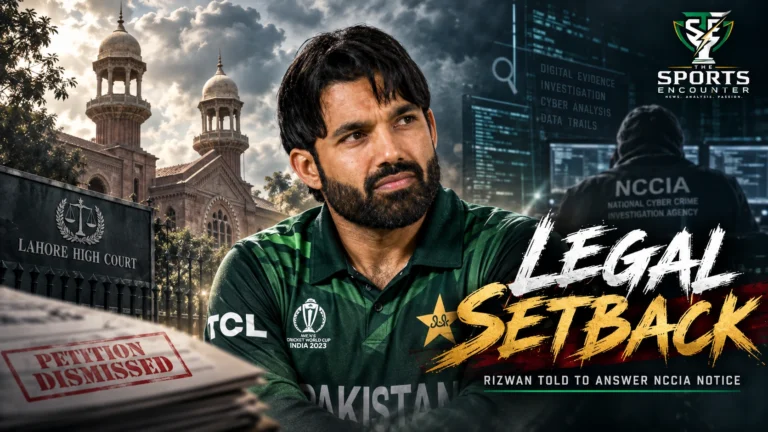
LAHORE, Pakistan, September 17, 2026: Mohammad Rizwan has lost his attempt to stop the National Cyber Crime Investigation Agency proceedings through the Lahore High Court, but the decision does not answer the most serious question surrounding the case: what, if anything, has actually been established against him?
Chief Justice Aalia Neelum dismissed the Pakistan wicketkeeper-batter’s petition challenging the NCCIA notices on Thursday and directed him to respond to the agency and appear before it.
That moves the case forward procedurally. It does not amount to a finding that Rizwan was involved in betting, gambling, information leaks, match corruption or any other wrongdoing.
The distinction is essential because the public discussion around the case has repeatedly blurred three separate issues: the Pakistan Cricket Board’s disciplinary concerns after the England tour, the NCCIA’s investigation, and the cricket-specific anti-corruption framework administered by the International Cricket Council.
Story at a glance
What Did the Lahore High Court Actually Decide?
The court declined to intervene in the NCCIA proceedings at this stage.
Why Did Mohammad Rizwan Challenge the NCCIA?
Rizwan’s challenge raised several issues.
ICC Jurisdiction and NCCIA Jurisdiction Are Not Necessarily the Same Question
The ICC Anti-Corruption Code unquestionably covers players such as Rizwan.
What Powers Does the NCCIA Say It Has?
The National Cyber Crime Investigation Agency’s official mandate describes it as Pakistan’s specialist agency for cybercrime investigation and digital forensics.
Rizwan’s Mobile Phone Remains One of the Most Sensitive Issues
Rizwan’s petition also brought the handling of his mobile phone into public view.
The Sports Encounter examined those unresolved questions before the hearing in our analysis of Rizwan’s original court challenge and Pakistan cricket’s wider player-management problem. The High Court dismissal answers one procedural question. Most of the underlying questions remain.
Mohammad Rizwan Case: What Is Confirmed?
| Issue | Confirmed Position |
|---|---|
| Lahore High Court petition | Dismissed on September 17, 2026 |
| Court direction | Rizwan was directed to respond to NCCIA notices and appear before the agency |
| NCCIA proceedings | Continue after dismissal of the petition |
| Finding of wrongdoing | No public finding has established wrongdoing by Rizwan |
| Previous NCCIA appearance | Rizwan appeared before the agency on September 10 |
| Mobile phone | Rizwan’s petition challenged the circumstances in which his phone was taken and questioned why it had not been returned |
| PCB position after Lord’s | Rizwan was one of seven players officially released from Pakistan’s Test squad |
| Appeal against High Court dismissal | No appeal had been publicly confirmed at the time of publication |
What Did the Lahore High Court Actually Decide?
The court declined to intervene in the NCCIA proceedings at this stage.
Rizwan had challenged the notices issued to him and questioned the legal basis on which the cybercrime agency was requiring his participation.
His counsel argued that the notices lacked sufficient justification and that the subject matter did not properly fall within the NCCIA’s jurisdiction.
The court did not accept that route.
Instead, Rizwan was directed to engage with the agency, respond to its show-cause notice and appear before investigators.
The Dismissal Is Not a Finding of Guilt
This is the most important point in assessing the development.
A court declining to stop an investigation is not the same thing as a court determining that the person under investigation committed the alleged conduct.
No publicly announced NCCIA finding has established that Rizwan bet on cricket, leaked dressing-room information, misused inside information or participated in corruption.
The investigation must therefore continue to be reported as an investigation.
Procedure Has Moved Forward, Evidence Has Not Yet Been Adjudicated
The practical consequence is that Rizwan no longer has the protection he sought through this particular High Court petition.
He must now continue dealing with the notices while the agency determines whether the evidence supports further proceedings.
That is materially different from saying the case against him has been proved.
Why Did Mohammad Rizwan Challenge the NCCIA?
Rizwan’s challenge raised several issues.
According to accounts of his petition and submissions by his counsel, he questioned why he had been summoned, the nature of the allegations, the NCCIA’s jurisdiction and the continued retention of his mobile phone.
His side also argued that allegations concerning betting or corruption in international cricket properly belong within cricket’s anti-corruption system.
That argument brings the ICC into the discussion, but it does not settle the jurisdiction question by itself.
ICC Jurisdiction and NCCIA Jurisdiction Are Not Necessarily the Same Question
The ICC Anti-Corruption Code unquestionably covers players such as Rizwan.
The global code identifies several forms of prohibited conduct, including betting on cricket, match or spot fixing, misuse of inside information, failing to report corrupt approaches and obstructing anti-corruption investigations.
For corrupt conduct connected to international cricket, the ICC has an important investigative and disciplinary role.
But the ICC’s own code also makes another point that is highly relevant to Rizwan’s jurisdiction argument.
It states that the Anti-Corruption Code is a professional disciplinary framework rather than criminal law and that it is intended to supplement applicable national laws rather than replace or undermine them.
The ICC Code Does Not Claim Exclusive Control Over National Law
This means two propositions can exist at the same time.
The ICC can possess authority to investigate corruption within international cricket.
A national law-enforcement agency can separately possess powers under domestic legislation where alleged conduct falls within its lawful mandate.
Whether the specific allegations against Rizwan properly fall within the NCCIA’s jurisdiction is ultimately a legal question based on the facts, statutes and notices involved.
But describing the ICC Anti-Corruption Unit as the only institution that could ever examine conduct involving a cricketer would go further than the ICC’s own rules.
What Powers Does the NCCIA Say It Has?
The National Cyber Crime Investigation Agency’s official mandate describes it as Pakistan’s specialist agency for cybercrime investigation and digital forensics.
Its official guidance states that, under Pakistan’s Prevention of Electronic Crimes framework, the NCCIA is authorized to conduct inquiries, investigations and prosecutions involving cybercrime.
The agency also lists digital-forensics work, including the recovery, preservation and examination of electronic data, among its functions.
That general authority helps explain why electronic devices and digital information have become part of the Rizwan case.
It does not, by itself, prove that every step taken in this particular investigation was lawful or that every allegation falls within that mandate.
Those are separate questions.
Rizwan’s Mobile Phone Remains One of the Most Sensitive Issues
Rizwan’s petition also brought the handling of his mobile phone into public view.
According to his account presented through the legal proceedings, a government official approached him at the Pakistan team hotel during the England tour and took possession of his phone after telling him it would be returned within several hours.
Rizwan subsequently complained that the device had still not been returned.
That issue matters regardless of whether the eventual investigation produces evidence against him.
Digital searches involve questions about authority, notice, scope, retention, privacy and evidentiary handling.
The High Court’s dismissal of Rizwan’s petition should therefore not be interpreted as a public judicial finding on every factual allegation he made about the phone.
The Story Began Before Rizwan Reached a Courtroom
The sequence cannot be separated from Pakistan’s disastrous Test tour of England.
England won at Headingley by an innings and 103 runs before defeating Pakistan by 194 runs at Lord’s.
The PCB then made extraordinary mid-series changes.
Rizwan, Imam-ul-Haq, Salman Ali Agha, Ali Usman, Aamir Jamal, Muhammad Awais Zafar and Khurram Shahzad were released from the squad.
The PCB’s official squad update confirmed all seven departures along with changes to the coaching staff.
The scale of that response was examined in The Sports Encounter’s report on England’s Lord’s victory and Pakistan’s emergency rebuild.
The Official Squad Release Did Not Establish Misconduct
This distinction remains important.
The PCB publicly confirmed that the seven players were released.
Release from a touring squad is not itself proof that those players committed disciplinary or criminal offenses.
As Pakistan’s tour deteriorated, our examination of the subsequent disciplinary crisis warned against merging selection decisions, disciplinary allegations and unverified social-media claims into a single narrative.
The current Rizwan case demonstrates exactly why that separation matters.
Pakistan Lost the Series, Then the Story Moved Beyond Cricket
The final Test did not repair the damage.
England completed a 3-0 whitewash at Edgbaston, leaving Pakistan with major questions over selection, preparation, leadership and administration.
TSE’s full series review distinguished Pakistan’s proven cricketing failures from the investigations surrounding individual players.
That distinction should remain intact now.
Pakistan’s batting failures are recorded in scorecards.
Rizwan’s alleged misconduct has not been established by a final public investigative finding.
The PCB’s Player-Management Problem Has Not Disappeared
The High Court ruling also does not remove the governance questions surrounding how Pakistan reached this point.
The same England tour produced seven mid-series player changes, coaching changes, criticism from former internationals, a disciplinary inquiry and eventually external investigative involvement.
Our earlier analysis, Pakistan Cricket Has Become the Story in England, documented how discussion around the team shifted from poor batting and bowling toward institutional instability.
The later decision to fly Saim Ayub from the Caribbean Premier League directly into the Edgbaston Test intensified those questions after he recorded a pair, leading to further scrutiny of Pakistan’s selection and preparation process.
Even after the tour finished, the administrative problems continued. Pakistan were docked additional World Test Championship points for their slow over rate at Edgbaston, covered in our analysis of another avoidable management failure.
None of those issues determines the Rizwan investigation.
They explain why this case has become larger than one player answering one notice.
Rizwan’s Position Has Changed Dramatically in a Matter of Weeks
Before the England tour, Rizwan remained one of Pakistan’s most recognizable senior cricketers.
At Headingley, he top-scored in Pakistan’s second innings with 41 after making 12 in the first.
Before Lord’s, The Sports Encounter argued that replacing him was not Pakistan’s most urgent selection problem.
One week later, he was released from the tour.
Within weeks, he had appeared before the NCCIA.
Now his attempt to challenge those proceedings through the Lahore High Court has been dismissed.
That rapid sequence does not establish guilt.
It does demonstrate how quickly a sporting crisis has become a legal and institutional one.
What Happens Next for Mohammad Rizwan?
The immediate next step is straightforward.
Rizwan must continue engaging with the NCCIA proceedings after failing to obtain relief through this High Court petition.
The agency can continue its inquiry and assess the information and responses before it.
What happens after that depends on the evidence.
Several Questions Remain Unanswered
- What precise conduct is the NCCIA investigating?
- What evidence supports the notices issued to Rizwan?
- How does the alleged conduct relate to Pakistan’s cybercrime laws?
- What is the status of Rizwan’s mobile phone?
- Will the matter also be referred to the ICC Anti-Corruption Unit?
- Will the NCCIA ultimately close the inquiry, seek further action or reach another conclusion?
- Will Rizwan challenge the High Court dismissal through another legal route?
Until those questions receive evidence-based answers, conclusions about guilt or innocence would move ahead of the process.
The Court Decision Narrows the Dispute but Does Not End It
Rizwan went to the Lahore High Court hoping to stop or invalidate the NCCIA proceedings.
That route has failed for now.
The investigation therefore continues.
But the most important editorial distinction remains exactly where it was before Thursday’s hearing.
There is an investigation.
There are allegations.
There are disputed questions about jurisdiction and procedure.
There is not yet a publicly established finding that Mohammad Rizwan committed the conduct being investigated.
That is why the next meaningful development will not simply be another summons or another headline.
It will be evidence.
Follow The Sports Encounter’s cricket coverage for continuing developments involving Pakistan, Rizwan and the wider consequences of the England tour.
Continue the Cricket Story
Frequently Asked Questions
Did the Lahore High Court dismiss Mohammad Rizwan’s petition?
Yes. The Lahore High Court dismissed Rizwan’s petition challenging the proceedings and notices issued by the National Cyber Crime Investigation Agency.
What did the Lahore High Court tell Mohammad Rizwan to do?
Rizwan was directed to respond to the NCCIA’s notice and appear before the agency rather than use the petition to halt the proceedings.
Does the court dismissal mean Mohammad Rizwan is guilty?
No. The dismissal allows the investigative process to continue. It is not a public judicial finding that Rizwan committed betting, gambling, corruption or information-leak offenses.
Why did Mohammad Rizwan challenge the NCCIA proceedings?
His legal challenge questioned the basis of the notices, the agency’s jurisdiction, the specific allegations being investigated and the handling of his mobile phone.
What is the NCCIA?
The National Cyber Crime Investigation Agency is Pakistan’s specialist federal agency for cybercrime inquiries, investigations, digital forensics and related prosecutions under the country’s cybercrime framework.
Does the ICC investigate betting and corruption in cricket?
Yes. The ICC Anti-Corruption Code covers conduct including betting on cricket, match fixing, misuse of inside information and failure to cooperate with anti-corruption investigations.
Does ICC jurisdiction prevent Pakistan authorities from investigating a cricketer?
The ICC’s own Anti-Corruption Code states that its disciplinary framework does not replace applicable criminal laws. Whether a Pakistani agency has jurisdiction over a specific allegation depends on domestic law and the facts of the case.
Why was Mohammad Rizwan released from Pakistan’s England Test squad?
The PCB officially confirmed that Rizwan and six other players were released following the Lord’s Test. The squad announcement itself did not state that their release amounted to a finding of misconduct.
Has the NCCIA found Mohammad Rizwan guilty of anything?
No final public finding establishing wrongdoing by Rizwan had been announced at the time of publication.
What happens next in the Mohammad Rizwan case?
Rizwan is expected to continue responding to the NCCIA proceedings. The agency must then determine what, if any, further action is supported by the evidence.