

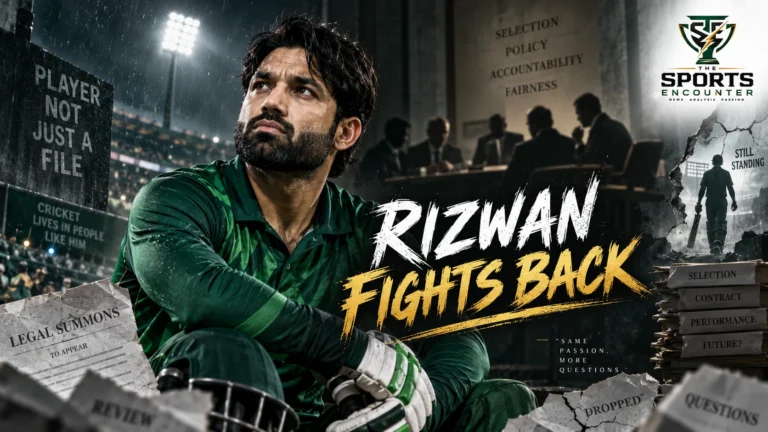
LAHORE, Pakistan, September 17, 2026: Mohammad Rizwan has spent much of his international career answering questions with runs, catches, leadership and endurance. This time, the question he is asking is directed at the system that governs his career.
Why was he summoned?
Why is his mobile phone still being held?
What disciplinary violation is he accused of committing?
Story at a glance
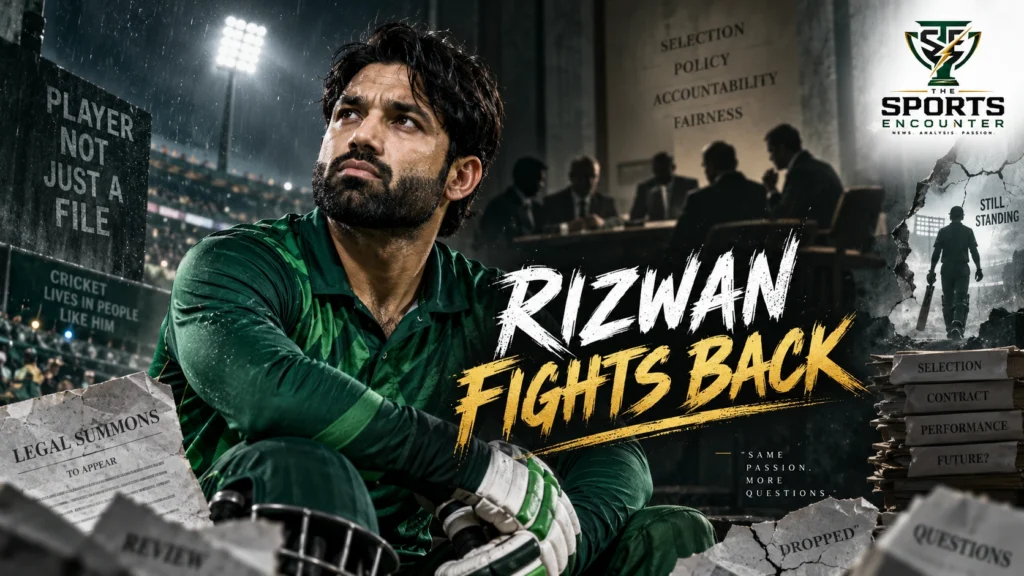
Why Has Mohammad Rizwan Challenged the NCCIA Summons?
Rizwan has challenged the summons after questioning the basis of the investigation and the NCCIA’s authority to require his appearance.
How Did Mohammad Rizwan Go From Pakistan Test Player to Cybercrime Inquiry?
The chain began during Pakistan’s Test tour of England.
PCB’s Handling of Rizwan Raises a Question About Accountability
Pakistan’s players deserved criticism for the cricket played in England.
Mohammad Rizwan’s Rise Makes the Current Situation More Striking
Rizwan is not a fringe player who briefly moved through Pakistan’s system.
Shaheen Afridi Shows How Quickly PCB Can Change a Player’s Role
Shaheen Shah Afridi offers perhaps the clearest recent example of institutional whiplash.
And why should the National Cyber Crime Investigation Agency have jurisdiction over him in the first place?
Those questions now sit before the Lahore High Court after the Pakistan wicketkeeper-batter challenged an NCCIA summons issued in the aftermath of Pakistan’s disastrous 3-0 Test series defeat in England.
The case is still developing, and no finding has established wrongdoing by Rizwan. That point is essential. What can already be examined is how a senior Pakistan cricketer moved within a matter of weeks from Test-team member to one of seven players sent home, then into an internal disciplinary controversy, an external cybercrime inquiry, questions over his mobile phone and domestic availability, and finally a constitutional challenge before the Lahore High Court.
Viewed alone, it is an extraordinary sequence.
Viewed against Pakistan cricket’s recent history, it looks disturbingly familiar.
Why Has Mohammad Rizwan Challenged the NCCIA Summons?
Rizwan has challenged the summons after questioning the basis of the investigation and the NCCIA’s authority to require his appearance.
According to reporting on his petition, Rizwan appeared before the agency after being summoned alongside Imam-ul-Haq. Both were given detailed questionnaires following their appearance.
Rizwan subsequently sought clarification over several fundamental issues: why he had been summoned, what specific disciplinary violation he was alleged to have committed, why his mobile phone had not been returned, and what legal basis supported the agency’s involvement.
He then approached the Lahore High Court.
The latest reporting on Rizwan’s written response says he explicitly sought the reason for his summons and information about the alleged violation being investigated.
This matters because disciplinary systems depend on clarity.
A player can answer an allegation. A player can appeal a sanction. A player can challenge evidence. The process becomes more difficult when the subject is left asking what exactly he is accused of doing.
How Did Mohammad Rizwan Go From Pakistan Test Player to Cybercrime Inquiry?
The chain began during Pakistan’s Test tour of England.
England beat Pakistan by an innings and 103 runs at Headingley before winning the second Test at Lord’s by 194 runs. The defeats gave England an unassailable 2-0 lead.
The Pakistan Cricket Board responded by releasing seven players from the squad before the third Test:
- Mohammad Rizwan
- Imam-ul-Haq
- Salman Ali Agha
- Ali Usman
- Aamir Jamal
- Muhammad Awais Zafar
- Khurram Shahzad
The Board also removed head coach Sarfaraz Ahmed and bowling coach Umar Gul.
The PCB’s official squad update confirmed the scale of the overhaul. Five of the incoming players were uncapped at Test level.
The Sports Encounter documented the immediate aftermath in its Lord’s Test analysis after England sealed the series and PCB began an emergency rebuild.
The more troubling question emerged afterward.
Why had seven players suddenly become expendable when the same selection structure had approved them for the tour only weeks earlier?
That question became sharper because five of the seven players released had not even played in the first Test.
Selector Aaqib Javed later defended the changes by arguing that Pakistan had failed to compete and required a different mindset. Misbah-ul-Haq subsequently resigned from the selection committee amid reports that he had not been properly consulted over the shake-up.
Pakistan then lost the third Test anyway.
The full collapse was examined in The Sports Encounter’s series review after England completed the 3-0 whitewash.
PCB’s Handling of Rizwan Raises a Question About Accountability
Pakistan’s players deserved criticism for the cricket played in England.
Rizwan scored 12 in the first innings at Headingley and was part of a batting unit that repeatedly failed to build competitive totals. Pakistan did not reach 200 in any of their first four completed innings of the series.
Performance scrutiny is therefore legitimate.
The governance question begins with where responsibility stops.
Selectors chose the squad.
Administrators approved the coaching structure.
The Board designed the preparation.
The same institution then responded to defeat by removing players and coaches before the series had finished.
That dynamic was already central to The Sports Encounter’s analysis of PCB accountability during the England tour.
When cricketing failure quickly expands into disciplinary investigation, phone examination and external agency involvement, the burden on players changes completely.
A poor series becomes a career-management issue.
A selection question becomes a disciplinary question.
A dressing-room problem becomes a legal one.
Mohammad Rizwan’s Rise Makes the Current Situation More Striking
Rizwan is not a fringe player who briefly moved through Pakistan’s system.
He was named ICC Men’s T20I Cricketer of the Year for 2021 after producing one of the greatest calendar years by a wicketkeeper-batter in the format, a distinction recorded in The Sports Encounter’s 10-year ICC awards review.
In October 2024, the PCB appointed him Pakistan’s white-ball captain and publicly praised his leadership, commitment and passion.
Four months later, Salman Ali Agha replaced him as T20I captain.
Rizwan continued as ODI captain until October 2025, when Shaheen Shah Afridi took over that role.
His 2024-25 central contract placed him in Category A alongside Babar Azam. The next cycle moved both players down to Category B.
None of those individual decisions has to be unreasonable in isolation.
Taken together, they illustrate how quickly status changes inside Pakistan cricket.
| Period | Mohammad Rizwan’s position |
|---|---|
| 2021 | ICC Men’s T20I Cricketer of the Year |
| October 2024 | Appointed Pakistan white-ball captain |
| March 2025 | Removed as T20I captain, retained ODI role |
| October 2025 | Replaced as ODI captain |
| August 2026 | Selected for England Test tour |
| August 31, 2026 | Released midway through the series |
| September 2026 | Questioned by NCCIA |
| September 2026 | Challenges summons in Lahore High Court |
The sequence does not prove that every decision was wrong.
It does show why players can struggle to understand what long-term role the institution has actually planned for them.
Shaheen Afridi Shows How Quickly PCB Can Change a Player’s Role
Shaheen Shah Afridi offers perhaps the clearest recent example of institutional whiplash.
On November 15, 2023, the PCB appointed the 23-year-old as Pakistan’s T20I captain after Babar Azam stepped down.
His first assignment was a five-match series in New Zealand.
By March 31, 2024, he had been replaced.
Babar returned as white-ball captain after Shaheen had led Pakistan in one bilateral T20I series.
Former Pakistan captain Misbah-ul-Haq publicly criticized the handling of both men, saying the way Babar had originally been removed and the speed with which Shaheen was replaced were harmful to the team’s environment. The criticism was reported in detail by Dawn’s account of the captaincy controversy.
Shaheen’s wider career then entered another period of uncertainty.
He later became ODI captain, lost his automatic place in Pakistan’s Test plans and increasingly moved toward white-ball specialization.
The Sports Encounter explored the physical and institutional strain around his career in our analysis of Shaheen’s LPL move and red-ball crossroads.
The issue is bigger than whether Shaheen should captain Pakistan.
A young fast bowler was given national leadership, stripped of it almost immediately, pushed back toward pure bowling responsibility and later asked to redefine his format priorities.
That is a lot of institutional movement around one career.
Haris Rauf’s Contract Was Terminated and Then Restored as a ‘Misunderstanding’
The Haris Rauf case is even harder to ignore because the Board effectively reversed its own punishment.
In February 2024, the PCB terminated Rauf’s central contract after a dispute over his decision not to join Pakistan’s Test tour of Australia.
The Board also said he would not receive an NOC for overseas league cricket until June 30.
Rauf’s position was that workload and white-ball priorities had shaped his decision. Then-chief selector Wahab Riaz argued that his refusal hurt Pakistan cricket.
Weeks later, the punishment disappeared.
PCB chairman Mohsin Naqvi announced that Rauf’s contract had been reinstated and described the controversy as a “misunderstanding.”
That reversal deserves more attention than it received.
If terminating a player’s national contract was justified, restoring it weeks later raises questions about what changed.
If the matter was genuinely a misunderstanding, the original punishment had potentially serious consequences for the player’s earnings, league opportunities and reputation.
This is the central governance problem Pakistan cricket repeatedly encounters: decisions arrive with maximum force and are sometimes reconsidered only after the damage has already begun.
Fakhar Zaman Learned the Cost of Publicly Questioning Selection
Fakhar Zaman’s 2024 dispute with the PCB showed another side of the same culture.
When reports emerged that Babar Azam could be dropped from the Test side, Fakhar publicly argued that Pakistan should protect its leading players during periods of poor form.
The PCB responded with a show-cause notice.
Officials said a centrally contracted player could not publicly criticize selection policy.
Fakhar was subsequently absent from the next central contracts list, with PCB chairman Mohsin Naqvi saying fitness was the more significant issue while acknowledging the social-media dispute remained part of the situation.
The episode created a clear message for players.
Selection decisions belonged to the institution.
Publicly challenging those decisions could become a contractual matter.
That approach may protect administrative authority, but it can also discourage experienced players from publicly raising concerns about how teammates are managed.
Mohammad Amir Once Walked Away While Accusing Management of Mental Torture
Mohammad Amir’s career contains its own serious controversies and cannot be reduced to a dispute with administrators.
His involvement in the 2010 spot-fixing scandal led to a five-year ban and remains an important part of his record.
What happened a decade later still matters to this discussion.
In December 2020, Amir retired from international cricket at only 28 and said he could no longer play under the existing Pakistan management.
He publicly described the environment as mental torture and said he had been repeatedly reminded that the PCB had invested in his rehabilitation.
He eventually returned to international cricket in 2024 after the administrative environment changed.
A player retiring, returning and again leaving international cricket can have many explanations. In Amir’s case, the relationship between player and management had clearly deteriorated to a point where cricketing ability alone could no longer sustain the career.
Fawad Alam Lost a Decade Despite First-Class Numbers That Demanded Attention
Not every damaged career involves disciplinary action.
Sometimes the problem is simply institutional neglect.
Fawad Alam made his Test debut in 2009 and then spent approximately a decade outside Pakistan’s Test side despite piling up domestic runs.
When he finally returned to the Test squad in 2019, his first-class average stood at 56.84.
That is the kind of number most selection systems are designed to reward.
Fawad instead spent much of his prime outside Test cricket.
He continued scoring, continued waiting and eventually returned at an age when many international careers are already approaching their final phase.
Selectors across several regimes had different explanations for leaving him out. The outcome remained the same: Pakistan lost years of access to one of its most productive domestic batters.
That case still matters because it demonstrates how careers can be damaged without a suspension, disciplinary hearing or public controversy.
Unclear pathways can be enough.
Babar Azam’s Captaincy Cycle Shows the Cost of Constant Reversal
Babar Azam’s leadership history has become another symbol of Pakistan cricket’s short institutional memory.
He stepped down from all three formats in November 2023.
Shaheen was appointed T20I captain.
Four months later, Babar returned as white-ball captain.
He resigned again in October 2024.
By July 2026, Pakistan had returned to him once more, this time as Test captain.
The Sports Encounter examined the full cycle in our analysis of Babar’s return to the Test captaincy.
The question was never simply whether Babar was a good captain.
The larger issue was whether any player could build a stable leadership environment while the structure above him changed direction so frequently.
Captaincy affects preparation, dressing-room relationships, batting responsibility, media pressure and selection influence.
Changing it repeatedly creates consequences that extend far beyond the toss.
Pakistan Cricket’s Problem Is Bigger Than Mohammad Rizwan
The Rizwan case should therefore be understood as the latest chapter in a much longer institutional story.
Pakistan continues to produce international-class players.
The Sports Encounter’s 30-player Test rebuild assessment showed how much talent remains available across domestic cricket, emerging pathways and the established national pool.
The weakness lies in continuity.
Continue the Cricket Story


Roles change quickly.
Selection committees change.
Captains change.
Coaches change.
Contract status changes.
Policies change.
And when results deteriorate, personnel often change before the underlying structure does.
Pakistan’s England tour illustrated that cycle again. Seven players and two coaches were changed before the third Test. The replacement side still lost, and Pakistan completed a 3-0 defeat before later losing additional World Test Championship points for a slow over rate, another management failure examined in The Sports Encounter’s analysis of Pakistan’s WTC penalties.
Changing people can be necessary.
Changing people without fixing decision-making simply restarts the cycle.
Does PCB Ruin Pakistan Cricketers?
The evidence supports a more precise conclusion.
The PCB has not destroyed every career that passed through its system, and many selection or disciplinary decisions have legitimate cricketing or contractual arguments behind them.
The recurring problem is institutional volatility.
Pakistan cricket has repeatedly allowed abrupt decisions, unclear communication, disciplinary escalation and short-term crisis management to shape careers that should have been managed through predictable pathways.
Fawad Alam lost years waiting for selectors.
Mohammad Amir walked away after his relationship with management collapsed.
Haris Rauf lost his contract and regained it after the Board called the dispute a misunderstanding.
Shaheen Afridi received a captaincy project that lasted one series.
Fakhar Zaman learned that publicly defending a teammate could trigger disciplinary proceedings.
Babar Azam has moved repeatedly in and out of leadership roles.
Rizwan went from white-ball captain to former captain, then from Test player to mid-tour release, investigative questioning and court proceedings.
Those careers are different. Their circumstances are different. Their responsibilities are different.
The common thread is a system that often reacts faster than it plans.
What PCB Should Change After the Mohammad Rizwan Case
Rizwan’s legal challenge may ultimately establish whether the NCCIA acted within its authority. The court should determine that question.
Pakistan cricket’s governance problem does not require a court ruling to identify.
The Board needs defined selection cycles, written role expectations, transparent disciplinary procedures, clear NOC rules, stable leadership planning and a genuine separation between poor performance and misconduct.
A player should know whether he has been dropped for form, rested for workload, removed for tactical reasons or investigated for an alleged breach.
Those categories should never blur simply because a tour has gone badly.
The same principle applies to selectors and coaches.
If officials choose a squad and that squad fails, accountability should examine the selection process as seriously as the selected players.
The Sports Encounter’s pre-Lord’s analysis identified Pakistan’s problems with planning and squad construction before the current crisis fully developed. The results since then have made those structural questions harder to avoid.
Mohammad Rizwan Has Forced the Conversation Beyond Selection
Rizwan’s most important move this week was not a cover drive, a captaincy decision or a wicketkeeping dismissal.
It was asking the system to explain itself.
His petition does not prove that the PCB or the NCCIA acted improperly. It does something equally important for Pakistan cricket’s wider governance debate: it requires the institutions involved to define what they are investigating, why they are investigating it and under what authority.
That level of clarity should be normal.
Pakistan cricket has too often reached it only after a player, coach or former captain publicly pushes back.
If the Rizwan case becomes another episode followed by another selection committee, another captain and another emergency reset, little will change.
If it forces the PCB to build clearer boundaries between performance management, discipline and legal investigation, then a difficult episode could finally produce something Pakistan cricket has lacked for years.
Institutional memory.
Follow The Sports Encounter’s continuing Cricket coverage for developments in the Mohammad Rizwan case, Pakistan’s Test rebuild and the wider governance questions shaping the national team.
PCB
- Mohammad Rizwan’s Court Challenge Puts PCB’s Player-Management Record Back on Trial
- Disrespect to Test Cricket: Nasser Hussain Tears Into PCB After Saim Ayub’s Test Gamble Ends in a Pair
- Pakistan U19 Caught in Portsmouth Protest Mix-Up as ECB Reviews Team Security
- Pakistan Cricket Has Become the Story in England, and the Criticism Is No Longer About Losing
- England Crush Pakistan at Lord’s to Seal Series as PCB Begins Emergency Test Rebuild