

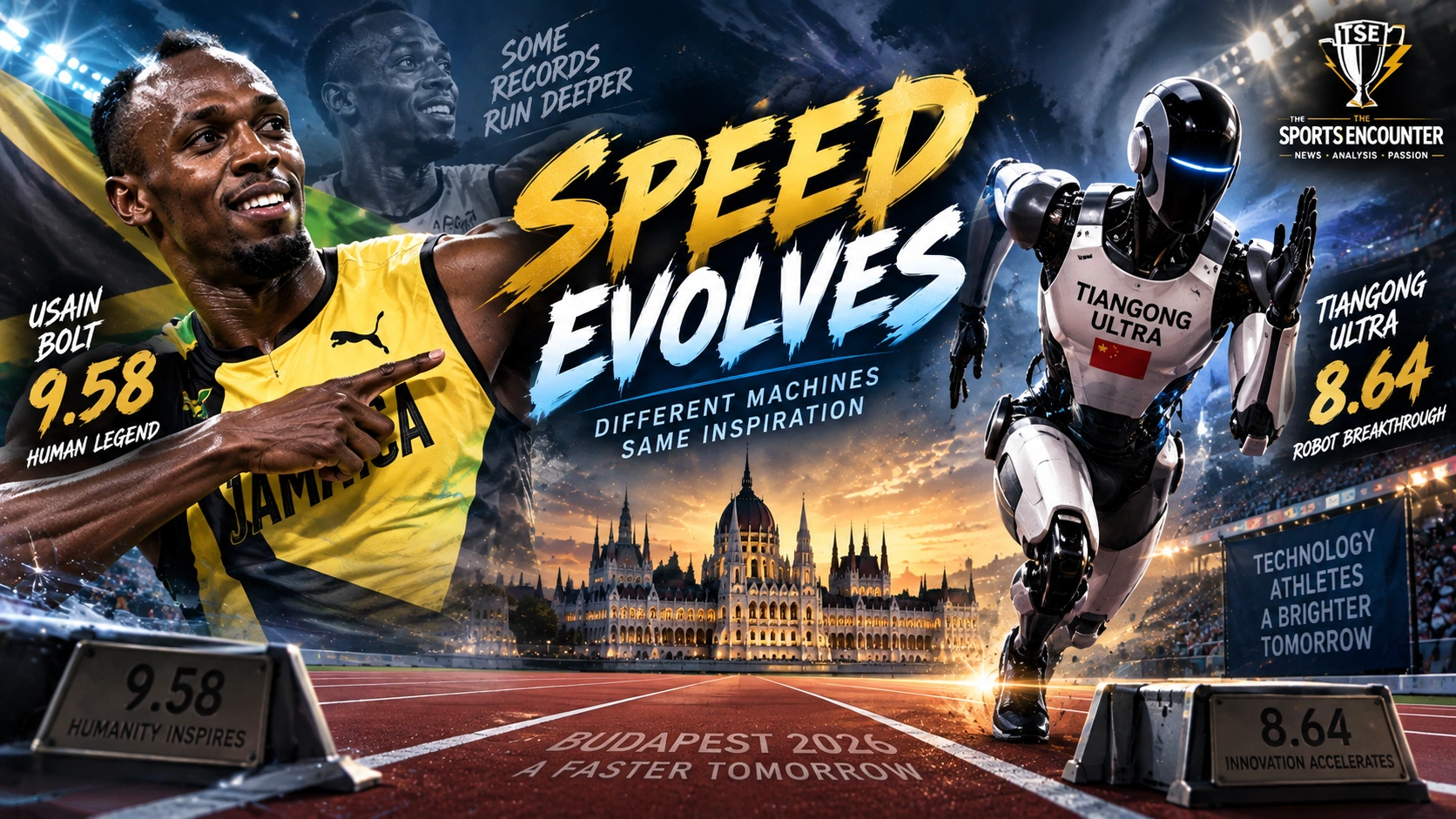
BUDAPEST, Hungary, September 14, 2026: A humanoid robot has now covered 100 meters faster than Usain Bolt ever did.
The record books have not changed.
TianGong Ultra, developed by the Beijing Humanoid Robot Innovation Center, won the 100m large-humanoid final at the second World Humanoid Robot Games in 8.64 seconds, nearly a full second faster than Bolt’s famous 9.58.
Bolt’s reaction was laughter rather than alarm.
Story at a glance
Usain Bolt, TianGong Ultra and the 100m Numbers
The official World Athletics profile for Usain Bolt continues to list 9.58 as the men’s 100m world record and 19.19 as the 200m world record.
The Robot Was Faster, but It Did Not Break Bolt’s Record
This is the point most likely to disappear inside an attention-grabbing headline.
TianGong Ultra’s 8.64 Shows How Quickly Humanoid Robotics Is Moving
TianGong Ultra’s performance should not be dismissed because it cannot claim Bolt’s record.
Bolt’s Reaction Revealed Why the Comparison Does Not Threaten His Legacy
Bolt reportedly laughed when told the robot had gone faster than his 9.58.
Why 9.58 Still Looks Almost Impossible for Human Sprinters
Bolt set the record on August 16, 2009.
The 40-year-old Jamaican remains the official men’s 100m world-record holder because athletics records measure human competition under World Athletics rules. TianGong Ultra’s 8.64 belongs to an entirely different competitive category.
That distinction makes the story considerably more interesting than a simple claim that a robot has “broken” Bolt’s record.
The robot demonstrated how rapidly humanoid motion engineering is developing.
Bolt’s mark still measures the fastest officially recognized human 100m performance in history.
And when reporters raised the machine’s achievement with him during the inaugural World Athletics Ultimate Championship in Budapest, Bolt seemed considerably more interested in something else happening hundreds of miles away.
Manchester United were playing Manchester City.
The lifelong United supporter wanted to watch.
The Sports Encounter has spent 2026 revisiting exactly why Bolt’s records continue to survive. Our analysis of Bolt’s 10 fastest 100m races shows that 9.58 was not an isolated anomaly. It belonged to a body of sprinting performances that modern athletes are still trying to approach.
Usain Bolt, TianGong Ultra and the 100m Numbers
| Performance | Time | Category | Status |
|---|---|---|---|
| TianGong Ultra | 8.64 seconds | Humanoid robot 100m | Robot competition performance |
| Usain Bolt | 9.58 seconds | Men’s human 100m | Official World Athletics world record |
| Usain Bolt | 9.69 seconds | 2008 Olympic 100m | Former world record |
| Usain Bolt | 9.63 seconds | 2012 Olympic 100m | Olympic record |
The official World Athletics profile for Usain Bolt continues to list 9.58 as the men’s 100m world record and 19.19 as the 200m world record.
The developer of TianGong Ultra separately confirmed the robot’s 8.64-second victory at the World Humanoid Robot Games.
The Robot Was Faster, but It Did Not Break Bolt’s Record
This is the point most likely to disappear inside an attention-grabbing headline.
A robot can cover 100 meters in less time than Bolt without becoming the men’s 100m world-record holder.
World records are governed by competition classifications.
Bolt ran 9.58 in the men’s 100m final at the 2009 World Athletics Championships in Berlin. His performance was produced by a human athlete under recognized athletics rules, timing systems, wind regulations and competition procedures.
TianGong Ultra competes in humanoid robotics.
The robot is therefore not eligible to appear in the men’s athletics record book any more than a motorcycle, racing car or powered exoskeleton would be.
The comparison is still fascinating.
It simply measures something different.
TianGong Ultra’s 8.64 Shows How Quickly Humanoid Robotics Is Moving
TianGong Ultra’s performance should not be dismissed because it cannot claim Bolt’s record.
The technical achievement is substantial.
The Beijing Humanoid Robot Innovation Center said TianGong Ultra defended its title in the large-humanoid 100m event and finished in 8.64 seconds.
The machine’s performance reflects rapid advances in motion control, balance, mechanical efficiency and the ability to sustain high-speed movement without losing stability.
Those problems are considerably harder for humanoid robots than they appear.
Walking robots have existed for years.
Running quickly requires continuous coordination of power, foot placement, body position and recovery from each ground contact.
At higher speeds, braking becomes another engineering challenge.
A robot that can accelerate impressively but cannot safely stop, turn or respond to changing conditions has far less practical value outside a controlled race.
That is why the 8.64 matters as a robotics milestone even without changing athletics history.
Bolt’s Reaction Revealed Why the Comparison Does Not Threaten His Legacy
Bolt reportedly laughed when told the robot had gone faster than his 9.58.
That reaction makes sense.
The Jamaican built his legacy against people.
He beat Tyson Gay.
He beat Yohan Blake.
He beat Asafa Powell.
He dominated Olympic finals and World Championships under the same rules available to the athletes beside him.
A mechanical system operating under an entirely different set of physical conditions cannot erase that.
It can provide a new comparison point.
The distinction resembles the difference between a cyclist riding under human power and a motorcycle covering the same distance much faster.
The machine’s speed can be extraordinary without diminishing the athlete.
Why 9.58 Still Looks Almost Impossible for Human Sprinters
Bolt set the record on August 16, 2009.
Seventeen years later, nobody has legally reached 9.60.
The official World Athletics all-time list still places Bolt’s 9.58 first, followed by Tyson Gay and Yohan Blake at 9.69.
That 0.11-second gap between first and second is enormous in elite sprinting.
The Sports Encounter examined the scale of Bolt’s advantage when revisiting his 9.69 world record at the Beijing Olympics.
That race was already historic.
Bolt then removed another 0.11 seconds from the record exactly one year later in Berlin.
World Athletics described the improvement at the time as an extraordinary leap for an event where records normally move by hundredths.
Modern Sprinters Are Getting Faster Without Reaching Bolt
The distance between Bolt and today’s elite is not caused by a lack of quality.
Modern sprinting remains exceptionally strong.
The 2026 season has produced fast times across major competitions, including the Diamond League and the new World Athletics Ultimate Championship.
Kenny Bednarek entered Budapest after running 19.62 over 200m in Zurich and repeating the mark at the Diamond League Final.
TSE’s full Zurich review showed a sport producing world records and historic performances across multiple disciplines.
A week later, the Brussels Diamond League Final sent another warning about the quality arriving in Budapest.
Yet Bolt remains untouched at both 100m and 200m.
The Ultimate Championship Was the Perfect Place for the Robot Question
Bolt was speaking in Budapest because World Athletics had brought him into the inaugural Ultimate Championship as one of the event’s most recognizable ambassadors.
The setting was appropriate.
The Ultimate Championship itself was designed around experimentation.
World Athletics changed presentation formats, shortened sessions, introduced new competition procedures and built the meeting around faster television delivery.
The Sports Encounter’s guide to the championship’s new rules described Budapest as a test laboratory for the future of track and field.
Then Bolt arrived and was asked about another version of the future.
A humanoid robot that could cover his signature distance faster than he could.
TSE Analysis: The Interesting Question Is Not Whether Robots Will Get Faster
They almost certainly will.
The harder question is what those advances tell us about human sport.
Machines can be engineered for greater power output.
Components can be redesigned.
Software can be refined.
Weight distribution can be altered.
Motion-control systems can be optimized from one race to the next.
The human body does not allow the same engineering freedom.
A sprinter must work inside biological constraints involving muscle fiber, tendons, reaction, coordination, energy systems and injury risk.
That is why the two races are interesting precisely because they are different.
TianGong Ultra represents an engineering question: how efficiently can a machine replicate and eventually exceed human running mechanics?
Bolt represents a biological one: how fast can a human being cover 100 meters unaided?
For now, 9.58 remains the best official answer to the second question.
Bolt Wanted to Talk About Muhammad Ali More Than a Machine
The robot discussion also led into a broader conversation about Bolt’s legacy.
His goal, he explained, was never limited to becoming the greatest sprinter of his generation.
He wanted his name to belong in broader sporting conversations alongside figures such as Muhammad Ali.
That ambition helps explain why Bolt remains unusually visible almost a decade after retiring from athletics.
Records create one kind of legacy.
Cultural reach creates another.
Bolt possesses both.
People who rarely follow track and field know his name, his pose and the basic meaning of 9.58.
Few track athletes have ever reached that level of global recognition.
Bolt’s Numbers Still Give the Legacy a Hard Statistical Core
The personality can sometimes make it easy to forget how severe his competitive résumé was.
Bolt won eight Olympic gold medals.
World Athletics credits him with 11 world titles.
He owns the 100m world record at 9.58.
He owns the 200m world record at 19.19.
He was also part of Jamaica’s 36.84 world-record 4x100m relay team in 2012.
His greatest achievement may be how long the individual marks have survived.
Track technology has improved.
Training has improved.
Sports science has improved.
New sprint stars have emerged.
The numbers still read 9.58 and 19.19.
The Sports Encounter Has Already Put Bolt’s 9.58 Against Modern Speed
The robot comparison is not the first time Bolt’s numbers have been placed against something that appears faster.
In our recent analysis of Bolt’s fastest career races and peak speed, TSE examined the distinction between peak velocity and completing an official 100m race.
That difference matters here too.
A machine’s maximum speed does not automatically tell us how effectively it accelerates, maintains control, reacts from a stationary start or handles the exact competitive conditions faced by a human sprinter.
TianGong Ultra has now completed the race in 8.64.
That makes the comparison much more substantial than a laboratory top-speed claim.
It still remains a robotics comparison rather than a human world-record challenge.
The Manchester Derby Was Apparently More Urgent
The funniest part of Bolt’s Budapest appearance had little to do with robotics.
Manchester United were playing Manchester City while he was talking to reporters.
Bolt has supported United throughout his public life and has repeatedly spoken about the club.
He made clear that the derby demanded his attention.
The result did not give him much to celebrate.
Manchester City won 1-0 at Old Trafford through Erling Haaland’s second-half goal despite playing most of the game with 10 men following Phil Foden’s first-half red card.
United had entered the fixture after beating Sabah 4-0 in Europe. TSE’s report on that Champions League victory described it as potentially useful preparation for the derby.
City arrived with even stronger domestic momentum.
Their 4-1 win at Crystal Palace had already shown how dangerous the new-look side could become once a match opened up.
Bolt’s United Obsession Has Always Outlived His Football Career
Football has never been a casual interest for Bolt.
After retiring from athletics in 2017, he explored whether his speed and athleticism could translate into professional soccer.
The most serious attempt came with Central Coast Mariners in Australia in 2018.
Bolt spent roughly two months with the club and scored twice during a friendly appearance.
A permanent professional career never followed.
The experiment still reflected how seriously he took the idea.
His interest in Manchester United was part of that story too.
There Is No Wythenshawe Comeback Coming
Recent speculation had linked Bolt with Wythenshawe Vets FC, a South Manchester amateur side that has attracted attention through former professional players.
Bolt dismissed the idea.
He indicated that he first became aware of the story after his longtime agent contacted him about it.
That does not sound like the beginning of a comeback.
Bolt appears much happier watching football than attempting to restart a playing career at 40.
He Also Says He Is Still Training Every Day
Bolt used the Budapest appearance to correct another narrative around his retirement.
Comments made previously about his fitness had been interpreted as evidence that the former sprinter had fallen badly out of shape.
Bolt said the remarks had been a joke and added that he still works out daily.
That distinction is unsurprising.
Retirement fitness and 9.58 fitness are two completely different standards.
An athlete can remain in excellent physical condition without retaining anything close to elite sprint readiness.
Bolt has given no indication that he intends to test that difference competitively.
The Manchester Derby Connection Gives the Story Another Twist
Bolt’s determination to follow United came during a particularly interesting phase of the club’s season.
Michael Carrick’s side had returned to the Champions League and entered the derby trying to slow City’s perfect domestic start.
The wider context was laid out in TSE’s 2026-27 Premier League curtain-raiser, which identified September 13 as one of the first major dates of the campaign.
City ultimately took the points.
The official Manchester United match report confirms the 1-0 result at Old Trafford.
Bolt may have handled the robot story with a smile.
The derby result was probably harder to enjoy.
The Robot Comparison Actually Makes Bolt’s Human Record More Interesting
There is an irony in the entire story.
A machine finally running a faster 100m does not make 9.58 look smaller.
It can make the number feel more remarkable.
Consider what separates the two performances.
TianGong Ultra was built.
Bolt trained.
The robot’s engineers can change components and rewrite control systems.
Bolt had to improve force production, acceleration, technique, coordination and conditioning inside the limits of one human body.
That does not make the machine less impressive.
It explains why comparing them produces fascination rather than a genuine record dispute.
Could a Human Still Break 9.58?
Yes.
Nothing in World Athletics rules makes the record theoretically unreachable.
The evidence shows how difficult it is.
The official all-time list still has nobody else below 9.69 legally.
Tyson Gay and Yohan Blake share that mark.
Asafa Powell’s best is 9.72.
Justin Gatlin ran 9.74.
Current elite sprinters continue to attack the event, but the gap at the top remains unusual.
At the 2026 Ultimate Championship, Bolt’s 9.58 still appeared in World Athletics’ official men’s 100m preview as the world-record benchmark.
Robot or no robot, that is the number the world’s fastest humans are chasing.
Budapest Was Already Showing How Athletics Is Trying to Modernize
The timing of the robot conversation fits a wider theme.
World Athletics is deliberately experimenting with the sport’s presentation.
The Ultimate Championship used a condensed three-day format, large prize money, streamlined competition, new visual presentation and a faster broadcast rhythm.
The goal was to make track and field easier to consume without sacrificing elite competition.
That process matters because athletics is competing for attention in an environment increasingly shaped by short-form media, technology and entertainment.
Bolt was one of the obvious ambassadors for such an experiment.
Few athletes have ever understood the entertainment side of sprinting better.
He Made Athletics Feel Like an Event Before the Sport Needed Reinvention
Bolt understood instinctively what World Athletics is now trying to formalize.
A sprint race lasts seconds.
The occasion around it can last much longer.
Bolt danced.
He joked with cameras.
He interacted with crowds.
He made starting-line introductions feel like theater.
Then he produced times nobody else could match.
That combination was commercially powerful because the personality never had to compensate for weak performance.
It amplified greatness that already existed.
World Athletics Is Still Living With the Standard Bolt Created
The sport continues searching for athletes who can combine competitive dominance with cross-sport recognition.
Mondo Duplantis has built extraordinary global visibility through repeated pole-vault records.
Noah Lyles has deliberately embraced showmanship.
New champions continue to emerge across the sprint events.
The inaugural Ultimate Championship itself was created partly to provide those athletes with a more dramatic stage.
Bolt remains the comparison because he solved both problems at once.
He was the fastest.
He was also impossible to ignore.
TSE Verdict
TianGong Ultra ran 100 meters in 8.64 seconds.
That is a remarkable achievement in humanoid robotics.
It is faster than Usain Bolt’s 9.58.
It is not a men’s 100m world record.
The distinction should make the story more interesting rather than less.
One number measures what engineers have been able to make a humanoid machine do.
The other measures what one human being did with his own body on a Berlin track in 2009.
Seventeen years later, no human has gone faster.
Bolt seems comfortable with that distinction.
He laughed when the robot comparison arrived and quickly turned his attention toward Manchester United.
That may be the most Bolt-like response imaginable.
The technology has changed.
The sport around him is experimenting with a new future.
A robot has even run the distance faster.
Yet whenever the question remains specifically about the fastest human 100m in history, the answer is still the same.
9.58.
Usain Bolt.
Continue the Athletics Story
 AthleticsUsain Bolt’s 10 Fastest 100m Races: The Flash-Like Superhuman Who Redefined Human Limits
 AthleticsJefferson-Wooden and Bednarek Complete Budapest Sprint Doubles, Bag $300,000 Each
 World Athletic Ultimate ChampionshipTara Davis-Woodhall Crash Puts Budapest 2026 Return in Doubt as Ultimate Championship Faces Its First Human Test
Frequently Asked Questions
Did a robot break Usain Bolt’s 100m world record?
No. TianGong Ultra ran 8.64 seconds in a humanoid robot competition, but Bolt’s 9.58 remains the official men’s 100m world record recognized by World Athletics.
Which robot ran 100m in 8.64 seconds?
TianGong Ultra, developed by the Beijing Humanoid Robot Innovation Center, ran 8.64 seconds at the second World Humanoid Robot Games.
What is Usain Bolt’s 100m world record?
Bolt ran 9.58 seconds at the World Athletics Championships in Berlin on August 16, 2009.
Does Bolt still hold the 200m world record?
Yes. His 19.19 from the 2009 World Championships remains the official men’s 200m world record.
How old is Usain Bolt in 2026?
Bolt turned 40 on August 21, 2026.
Is Usain Bolt returning to football?
There is no indication of a football comeback. Bolt dismissed speculation linking him with Wythenshawe Vets FC and appears content in retirement.
Did Usain Bolt play professional football?
After retiring from athletics, Bolt spent time on trial with Australia’s Central Coast Mariners in 2018 and scored twice in a friendly, but he did not establish a professional soccer career.
Which football club does Usain Bolt support?
Bolt is a longtime Manchester United supporter.
What happened in the 2026 Manchester derby?
Manchester City defeated Manchester United 1-0 at Old Trafford on September 13 through an Erling Haaland goal.
Where can readers follow more athletics coverage?
Follow The Sports Encounter for athletics news, records, major championships, sprint analysis and the biggest stories across global sport.
The Sports Encounter’s athletics coverage follows world records, championship performances, athlete legacies, innovation, technology and the developments changing how track and field is understood.