


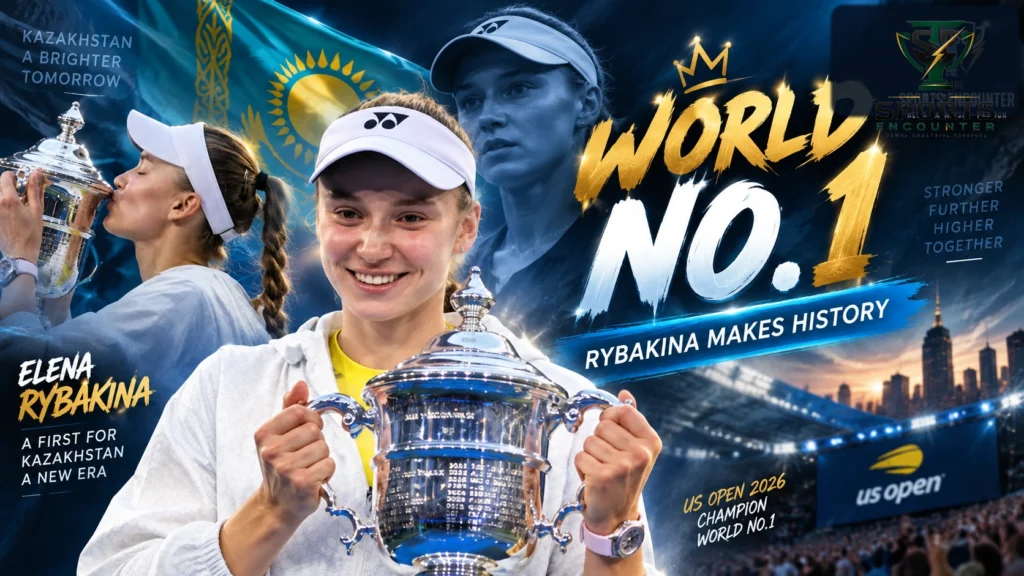
ST. PETERSBURG, United States, September 14, 2026: Elena Rybakina no longer needs a projected ranking, a qualification scenario, or another result to go her way.
She is officially the best-ranked women’s tennis player in the world.
The updated WTA rankings released Monday placed the 27-year-old at No. 1 for the first time in her career, completing a rise that became mathematically secure during the US Open and emotionally complete when she defeated Aryna Sabalenka in the final two days later.
Rybakina becomes the 30th woman in WTA history to reach the top of the singles rankings and the first player from Kazakhstan, male or female, to hold the world No. 1 position.
The ranking change ends Aryna Sabalenka’s latest reign at the summit and confirms what the 2026 season had increasingly suggested: Rybakina has become the most complete and consistent player in women’s tennis across the current ranking cycle.
The WTA officially confirmed Rybakina’s elevation to No. 1, calling the achievement historic for Kazakhstan and noting that she is the 30th woman to reach the position since the rankings were introduced.
For The Sports Encounter, the milestone completes a storyline we have followed through Toronto, Cincinnati, New York, and every ranking calculation in between.
Elena Rybakina’s World No. 1 Milestone at a Glance
| Milestone | Detail |
|---|---|
| New Ranking | World No. 1 |
| Ranking Date | September 14, 2026 |
| WTA History | 30th woman to reach No. 1 |
| Kazakhstan History | First male or female player from Kazakhstan to become world No. 1 |
| Age | 27 |
| Grand Slam Titles | 3 |
| 2026 Grand Slam Titles | Australian Open and US Open |
| US Open Final | Beat Aryna Sabalenka 6-4, 5-7, 6-2 |
The Ranking Was Secured Before the Trophy Was Won
The official No. 1 ranking arrived Monday.
The decisive mathematical moment actually came five days earlier.
Rybakina entered her US Open quarterfinal against Zheng Qinwen knowing that one more victory would guarantee the top ranking regardless of what Sabalenka, Coco Gauff, Jessica Pegula, or anyone else did later in the tournament.
Zheng made the route difficult.
Rybakina lost the first set 3-6 before responding 6-1, 6-4 to reach her first US Open semifinal.
That victory ended the ranking race.
The Sports Encounter’s quarterfinal report identified that match as the point where projection became certainty.
From that moment, Sabalenka could continue winning in New York, but she could no longer prevent the ranking change.
Winning the US Open Turned a Ranking Calculation Into a Coronation
Rybakina could have become No. 1 after losing in the semifinal or final.
Instead, she completed the story with the biggest result available.
She defeated Coco Gauff 3-6, 6-4, 6-4 in the semifinal and then beat Sabalenka 6-4, 5-7, 6-2 in the championship match.
The official US Open report confirmed that Rybakina not only captured her first New York title but accumulated enough ranking points during the tournament to replace Sabalenka at No. 1.
The title was Rybakina’s third Grand Slam championship.
She had already won Wimbledon in 2022 and the Australian Open earlier this year.
New York therefore did two things at once.
It completed her rise to No. 1 and expanded her major résumé from two very different surfaces.
Rybakina’s Road to No. 1 Was Already Taking Shape Before New York
The US Open finished the job.
The ranking was built much earlier.
Rybakina entered 2026 with momentum from the previous season and quickly turned it into something more substantial.
She won the Australian Open in January, defeating Sabalenka 6-4, 4-6, 6-4 in the final.
The official Australian Open report documented how Rybakina recovered from the pressure of another three-set final to claim the second major title of her career.
That victory created the ranking foundation.
Every strong result after Melbourne added weight to it.
The Sports Encounter’s detailed examination of Rybakina’s road to No. 1 showed how the season evolved from a strong start into a sustained ranking challenge.
Australian Open 2026 Changed the Direction of the Season
The significance of Melbourne goes beyond the 2,000 ranking points attached to a Grand Slam title.
Rybakina defeated Sabalenka in a championship match that required her to respond after losing the second set.
She had suffered one of the most painful defeats of her career against the same opponent in the 2023 Australian Open final.
Three years later, the result reversed.
Rybakina also finished strongly enough to demonstrate that her ability to manage difficult matches had grown alongside the power game that first made her a major champion.
That quality would repeatedly appear again later in the year.
Stuttgart Added Another Important Layer
Rybakina’s season was never dependent entirely on Grand Slams.
She continued accumulating high-value results across the tour, including another strong Stuttgart campaign.
The importance of those results is easy to overlook because majors dominate the conversation.
World No. 1 is not awarded to the player with the most memorable single victory.
It is built through a rolling ranking system that rewards sustained performance.
That makes every deep run important.
Every semifinal matters.
Every final matters.
Every title matters.
The accumulation is what eventually creates separation.
Toronto Showed Rybakina Could Win Matches in More Than One Way
The North American hard-court season gave the ranking chase another acceleration.
Rybakina reached the National Bank Open final after surviving a demanding run through the draw.
Her semifinal against Gauff offered one of the clearest examples of how her game had evolved.
Rybakina did not dominate every point behind the first serve.
She adjusted.
She absorbed pressure.
She found a way to win.
TSE’s Toronto semifinal analysis highlighted how her ability to recover from difficult positions had become almost as important as her raw power.
That development mattered enormously once matches became more stressful at the US Open.
Cincinnati Nearly Delayed the Entire Story
Then came the warning.
Sabalenka’s early Cincinnati defeat opened another mathematical route to No. 1.
Rybakina needed to reach the final.
Instead, her quarterfinal against Iga Swiatek ended with a left ankle problem.
She received treatment, struggled to move, and eventually retired.
The immediate consequence was clear.
Her Cincinnati ranking opportunity disappeared.
The larger concern was whether she would even be physically ready for the US Open.
Our Cincinnati report documented both the injury and the ranking impact.
Only days before New York, the question had changed from when Rybakina would become No. 1 to whether her ankle would allow her to challenge at all.
The US Open Ranking Race Began With Four Contenders
Rybakina did not enter Flushing Meadows with the ranking already guaranteed.
Sabalenka still held No. 1.
Gauff remained involved.
Pegula remained involved.
Different combinations of results could still affect the final outcome.
Yet the most important part of the equation belonged to Rybakina.
If she reached the semifinals, the ranking was hers regardless of anybody else.
TSE’s full US Open World No. 1 ranking analysis explained why she controlled her own fate.
That independence was crucial.
She did not need Sabalenka to lose early.
She did not need Gauff to eliminate somebody.
She did not need Pegula to alter the draw.
She needed wins.
Naomi Osaka Was the First Major New York Test
Rybakina’s fourth-round meeting with Naomi Osaka represented more than another step through the draw.
Osaka is a multiple major champion whose first-strike hard-court game can punish even elite defenders.
Rybakina won and reached her first US Open quarterfinal.
At that point, the ranking equation became extraordinarily simple.
One more win.
Our Osaka-Rybakina analysis framed the quarterfinal as effectively a championship point for the world No. 1 ranking.
Zheng Made Her Earn the Ranking
That championship point was anything but straightforward.
Zheng won the first set.
Rybakina responded by dominating the second.
The third became a genuine pressure contest.
Trailing 4-3, Rybakina faced a break point that could have placed Zheng within one game of victory.
She survived.
Then she won the final three games.
The WTA subsequently confirmed that the semifinal qualification mathematically secured the No. 1 ranking.
That sequence matters because it fits the broader story of Rybakina’s year.
Her ranking rise has increasingly been built on surviving matches that do not begin cleanly.
Coco Gauff Created Another Comeback Test
The semifinal followed the same pattern.
Gauff won the opening set 6-3.
Rybakina again had to adjust.
She improved her first-serve effectiveness, put more pressure on Gauff’s service games, and took the next two sets 6-4, 6-4.
The Sports Encounter’s semifinal analysis found that the match turned through control rather than a sudden explosion of winners.
By then, Rybakina already knew No. 1 was guaranteed.
That did not reduce her ambition.
It gave her another target.
Beating Sabalenka Made the Ranking Change Feel Definitive
There would have been nothing illegitimate about becoming No. 1 while somebody else won the US Open.
The ranking system rewards a full body of results.
Yet defeating Sabalenka in the final gave the transition an unusually clean ending.
Rybakina beat the player she was replacing.
She took the trophy.
She took the ranking.
She ended Sabalenka’s attempt to win a third consecutive US Open title.
The matchup also reinforced one of the defining rivalries of the current WTA era.
Rybakina and Sabalenka Have Defined Each Other’s Biggest Moments
The rivalry has now shaped multiple major finals.
Sabalenka beat Rybakina in the 2023 Australian Open final.
Rybakina defeated Sabalenka at the 2025 WTA Finals.
She then beat her in the 2026 Australian Open final.
Sabalenka responded during the season.
New York brought them together again.
The US Open final therefore felt appropriate as the last step in a ranking transition that had developed across the year.
Sabalenka remained one of the strongest players in the sport.
Rybakina simply accumulated enough results to move past her.
TSE Analysis: World No. 1 Confirms Rybakina Has Expanded Beyond Her Original Identity
Rybakina first became famous for a simple reason.
Power.
The serve.
The first strike.
The ability to shorten points before opponents could establish rally patterns.
That identity was powerful enough to win Wimbledon.
It was not enough by itself to create this ranking season.
The 2026 version of Rybakina has become better at surviving imperfect tennis.
She has learned how to win after losing first sets.
She has become more patient in extended exchanges.
She has become more comfortable playing through return pressure.
She has shown greater emotional stability when matches stop following her preferred rhythm.
Those changes are difficult to quantify with one statistic.
They are visible in the results.
The Most Important Development May Be Her Ability to Recover Mid-Match
Toronto supplied examples.
New York supplied more.
Zheng won the first set.
Gauff won the first set.
Sabalenka won the second set in the final.
Rybakina still won every match.
That is a different competitive profile from a player who needs a dominant serving day to control a tournament.
The serve remains essential.
The difference is that it is no longer her only reliable route.
New York Was Historically Rybakina’s Weakest Major
This is another reason the ranking breakthrough belongs in New York.
Before 2026, Rybakina had not reached the later rounds of the US Open with the regularity expected of a player of her level.
Wimbledon had already delivered a title.
Melbourne had delivered multiple major runs.
New York remained the missing piece.
This year she did not merely repair the résumé.
She won the tournament.
That makes the World No. 1 milestone look less like an accumulation trick and more like competitive expansion.
Wimbledon 2026 Had Looked Like a Setback
The season was not a straight line.
Rybakina’s Wimbledon campaign ended earlier than expected when Elise Mertens defeated her in the third round.
TSE’s Wimbledon Day 6 report documented how the result ended her hopes of building a second major title run immediately after Melbourne.
At the time, that defeat created legitimate questions about consistency.
Two months later, she is No. 1 and US Open champion.
The contrast explains why rankings are better evaluated across months rather than individual weeks.
Kazakhstan Now Has a Milestone No Other Player From the Country Had Reached
Rybakina’s ranking carries national significance that goes beyond her individual career.
She is the first player representing Kazakhstan to reach world No. 1 in either the ATP or WTA rankings.
That makes September 14 one of the most important dates in the country’s tennis history.
Rybakina switched representation to Kazakhstan in 2018.
Her success has since become closely connected with the growth and visibility of tennis inside the country.
After securing the ranking in New York, she spoke about the number of young players she now sees when she returns to Kazakhstan and what it means to show them that reaching the top is possible.
That is one of the few aspects of No. 1 that extends beyond points and trophies.
The Ranking Also Changes How Every Future Tournament Looks
Being No. 1 changes the mechanics around a player.
Rybakina will now enter tournaments carrying the No. 1 designation.
Her draws will be built around that seeding status where applicable.
Every opponent will measure a victory against her differently.
Every difficult loss will receive more attention.
Every title defense will be evaluated against the expectations of the top-ranked player.
The tennis does not physically change.
The environment does.
Rybakina Now Moves From Chasing No. 1 to Defending It
Reaching the top ranking is one achievement.
Remaining there requires something different.
A rolling 52-week ranking means points eventually have to be defended as old results fall away.
Rybakina will carry significant points from the strongest period of her career.
The challenge becomes replacing them.
This is where Sabalenka, Gauff, Iga Swiatek, Pegula and the rest of the leading field remain relevant.
World No. 1 is not a permanent title.
It is a live competition.
The Season-Long Race Had Already Been Telling the Story
One of the clearest signals before the official ranking change came from the annual WTA Race.
Unlike the rolling rankings, the Race measures results accumulated only during the current season.
Rybakina had already moved to the top of that competition before the US Open.
That mattered because it showed that her challenge to Sabalenka was not being created by old ranking points.
Across 2026 alone, Rybakina was producing the strongest accumulation of results.
The official ranking eventually caught up.
She Has Won Two of the Three Majors She Has Finished Deep in This Year
The Australian Open title was the first major.
Wimbledon ended early.
The US Open delivered another championship.
Winning two hard-court majors in the same season creates an obvious narrative around Rybakina’s preferred conditions.
Her game is particularly suited to faster hard courts where the serve and flat groundstrokes receive greater reward.
The more interesting question is what comes next on clay.
The French Open Is Now the Missing Major
Rybakina owns Wimbledon.
She owns the Australian Open.
She owns the US Open.
Roland-Garros is now the only Grand Slam singles title missing from her résumé.
That creates the next obvious historical target.
A French Open title would complete the career Grand Slam.
The challenge is substantial because clay demands different movement, rally tolerance and point construction.
Yet the broader evolution of Rybakina’s game makes the possibility less unrealistic than it might once have appeared.
What Comes Next for Rybakina?
The immediate calendar will give her time to recover from the US Open before returning to competition.
She is also expected to represent Kazakhstan at the Billie Jean King Cup Finals later this month.
That appearance will give her first post-ranking competition an additional national dimension.
She has also indicated that she intends to bring the US Open trophy back to Kazakhstan so supporters can share in the achievement.
The gesture fits naturally with the historic nature of the ranking.
Sabalenka Has Not Disappeared From the No. 1 Conversation
The ranking change should not be mistaken for the end of the rivalry.
Sabalenka reached the US Open final.
She remains one of the sport’s most consistent major contenders.
She also knows exactly what it takes to hold No. 1 across a long stretch of the season.
Rybakina’s challenge therefore changes immediately.
The chase is over.
The defense begins.
The Women’s Tour Now Has Another Established Power Center
For several seasons, conversations about the top of women’s tennis have revolved heavily around Swiatek and Sabalenka.
Gauff has repeatedly pushed into that space.
Rybakina has always possessed the game to belong there.
The ranking now removes any ambiguity.
No. 1 is not a projection of what she could become.
It is her current position.
TSE Verdict
The most important part of Elena Rybakina becoming World No. 1 is not that the WTA computer finally changed the number beside her name.
It is how much had to happen before that change became inevitable.
She won the Australian Open.
She accumulated results across the season.
She pushed through Toronto.
She recovered from an ankle injury in Cincinnati.
She arrived at the US Open with four players still connected to the ranking equation.
Then she removed everyone else from it herself.
Osaka fell.
Zheng pushed her and fell.
Gauff took the opening set and fell.
Sabalenka took a set in the final and fell.
The ranking was mathematically secured before championship night.
The trophy made it feel complete.
September 14 therefore represents more than an administrative update.
It is the official recognition of the player who produced the strongest accumulation of results when the season demanded them.
For Kazakhstan, it is unprecedented.
For Rybakina, it is the summit she spent a decade reaching.
The next stage begins immediately.
She no longer has to prove she can reach No. 1.
Now everybody else gets to chase her.
Frequently Asked Questions
Is Elena Rybakina officially World No. 1?
Yes. Elena Rybakina officially became the WTA World No. 1 when the updated rankings were released on September 14, 2026.
Who did Rybakina replace as World No. 1?
Rybakina replaced Aryna Sabalenka at the top of the WTA singles rankings.
How many women have been WTA World No. 1?
Rybakina is the 30th woman in WTA history to reach the No. 1 singles ranking.
Is Elena Rybakina the first Kazakh World No. 1?
Yes. She is the first player representing Kazakhstan, male or female, to reach world No. 1 in singles.
How did Rybakina secure the No. 1 ranking?
She mathematically guaranteed the ranking by reaching the US Open semifinals after defeating Zheng Qinwen in the quarterfinals.
Did Rybakina win the 2026 US Open?
Yes. She defeated Aryna Sabalenka 6-4, 5-7, 6-2 in the final to win her first US Open title.
How many Grand Slam titles has Elena Rybakina won?
Rybakina has won three Grand Slam singles titles: Wimbledon 2022, the Australian Open 2026, and the US Open 2026.
Which major does Rybakina still need for a career Grand Slam?
Roland-Garros is the only Grand Slam singles title missing from her résumé.
Who did Rybakina beat at the Australian Open 2026?
She defeated Aryna Sabalenka 6-4, 4-6, 6-4 in the Australian Open final.
Where can readers follow more Elena Rybakina coverage?
Readers can follow The Sports Encounter’s complete Rybakina World No. 1 timeline and our wider tennis coverage across the Grand Slam season.
The Sports Encounter’s tennis coverage focuses on Grand Slam results, rankings, player development, tactical analysis, major rivalries, and the wider stories shaping the ATP and WTA tours.