


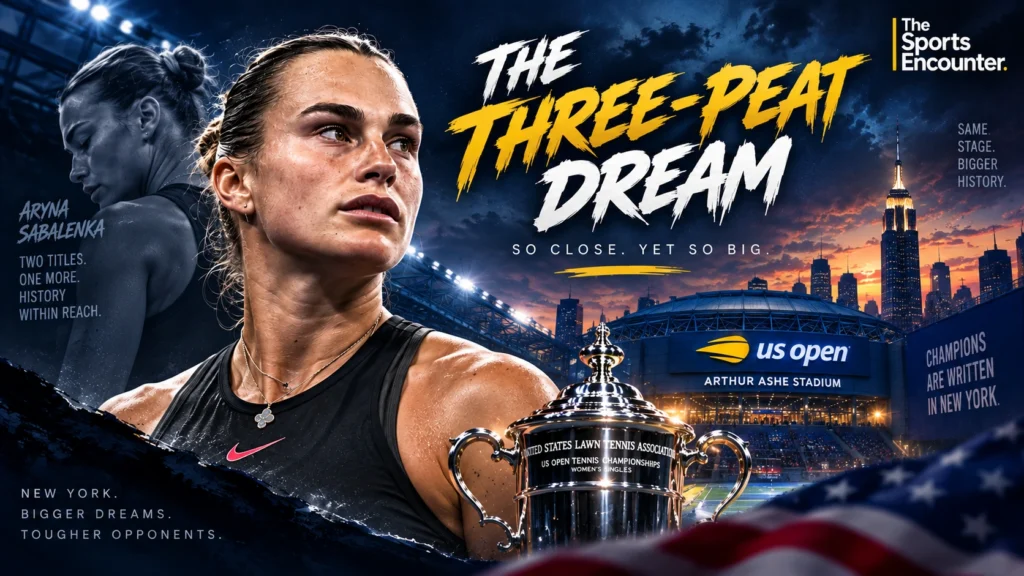
NEW YORK, United States, September 13, 2026: Aryna Sabalenka arrived at the 2026 US Open chasing something that sounds simple until the history behind it is examined: win the same Grand Slam tournament three years in succession.
She had won the US Open women’s singles championship in 2024. She successfully defended it in 2025. Six victories at the 2026 tournament then carried her back into the final, leaving only Elena Rybakina between Sabalenka and a third consecutive New York championship.
That was Sabalenka’s three-peat dream.
Victory would have placed her alongside Chris Evert and Serena Williams as the only women in the Open Era to win at least three consecutive US Open singles titles.
Instead, Rybakina defeated Sabalenka 6-4, 5-7, 6-2 at Arthur Ashe Stadium, ending a 19-match US Open winning streak and stopping the defending champion one victory short of joining one of the most exclusive groups in women’s tennis.
What Does a US Open Three-Peat Mean?
A three-peat means winning the same championship in three consecutive editions.
For Sabalenka, the sequence would have been:
| US Open | Sabalenka’s Result | Final Opponent |
|---|---|---|
| 2024 | Champion | Jessica Pegula |
| 2025 | Champion | Amanda Anisimova |
| 2026 | Runner-up | Elena Rybakina |
Winning in 2026 would therefore have completed three consecutive championships.
The phrase became one of the central storylines of the women’s tournament because Sabalenka was attempting something that had happened only twice in the women’s game during the US Open’s Open Era.
Who Has Won Three Consecutive Women’s US Open Titles?
Before Sabalenka’s attempt, only two women had completed the feat during the Open Era.
Chris Evert: 1975, 1976, 1977 and 1978
Chris Evert established the standard.
She actually went beyond a three-peat by winning four consecutive US Open women’s singles championships from 1975 through 1978.
The run crossed an important period in tournament history. Evert won the first three championships on clay at Forest Hills before winning again in 1978, when the tournament moved to the USTA National Tennis Center and was played on hard courts.
Her sequence ultimately reached 31 consecutive US Open match victories before Tracy Austin defeated her in the 1979 final.
Serena Williams: 2012, 2013 and 2014
More than three decades passed before another woman managed three consecutive championships.
Serena Williams won in 2012, successfully defended her title in 2013 and completed the three-peat by defeating Caroline Wozniacki in the 2014 final.
That third consecutive championship was also Williams’ sixth US Open women’s singles title.
No woman completed another New York three-peat between Williams in 2014 and Sabalenka’s attempt in 2026.
Why Is Winning Three Consecutive US Opens So Difficult?
The list of players who tried and failed helps explain the scale of the challenge.
Margaret Court, Billie Jean King, Martina Navratilova, Steffi Graf, Monica Seles, Venus Williams and Kim Clijsters all won consecutive US Open titles but were unable to extend those sequences to three.
Several came painfully close.
Navratilova reached the 1985 final after winning in 1983 and 1984. Graf reached the 1990 final after championships in 1988 and 1989. Venus Williams returned to the final in 2002 after winning in 2000 and 2001.
All three lost the match that would have completed the three-peat.
Sabalenka has now joined that group.
That history matters because defending a Grand Slam once is difficult enough. Winning it three times consecutively requires a player to remain healthy, maintain elite form and repeatedly solve a changing field over roughly 24 months.
There is also no guarantee that the conditions, draw or opponent profile that suited a champion one year will remain favorable the next.
How Sabalenka Started Her New York Reign in 2024
Sabalenka’s pursuit began with her breakthrough US Open championship in 2024.
She defeated Jessica Pegula 7-5, 7-5 in the final to claim her first New York singles title and third Grand Slam championship overall.
That season established Sabalenka as the dominant women’s player at the two hard-court majors. She had already successfully defended her Australian Open title earlier in the year.
New York had previously brought disappointment. Sabalenka had reached the US Open final in 2023 but lost to Coco Gauff after taking the opening set.
The 2024 championship therefore changed her relationship with Arthur Ashe Stadium.
She was no longer trying to prove she could win there.
She became the player everyone else had to remove.
Sabalenka Defended the Title in 2025
The second championship made the three-peat possible.
Sabalenka defeated Amanda Anisimova 6-3, 7-6(3) in the 2025 final to retain her crown.
She became the first woman since Serena Williams in 2014 to successfully defend the US Open women’s singles title.
That distinction immediately changed the historical stakes for 2026.
Another title would no longer represent simply another Grand Slam victory. It would create a three-year New York dynasty.
Sabalenka Entered the 2026 US Open With History Following Her
By the time the 2026 tournament began, the three-peat was unavoidable.
Sabalenka was the World No. 1 and two-time defending champion. She had already established herself as one of the defining hard-court players of her generation.
There was another complication, however.
Her No. 1 ranking was under serious pressure from Rybakina.
The Sports Encounter’s analysis of the World No. 1 race showed why the ranking mathematics favored Rybakina as the tournament progressed. Sabalenka was defending 2,000 points from her 2025 championship, while Rybakina had far fewer points to protect.
Rybakina eventually secured the No. 1 ranking by reaching the semifinals.
Sabalenka therefore entered the closing stages of the tournament facing an unusual possibility: losing the top ranking but retaining New York by winning the championship for a third straight year.
Sabalenka Made Her Preference Clear: She Wanted the Trophy
Before the tournament had reached its conclusion, Sabalenka was asked to consider a choice between preserving the World No. 1 ranking and winning the US Open three-peat.
Her preference was the championship.
That response revealed why the three-peat mattered beyond rankings mathematics.
A ranking measures performance across a defined period. A third consecutive US Open title would have been a historical achievement permanently attached to her career.
Rybakina eventually took the ranking out of Sabalenka’s hands by reaching the semifinals.
The trophy remained available.
Linda Noskova Nearly Ended the Dream in the Quarterfinals
Sabalenka came extremely close to losing before reaching the final.
Wimbledon champion Linda Noskova pushed her through one of the tournament’s most dramatic quarterfinals.
Sabalenka eventually survived 7-6(1), 3-6, 7-6(7).
TSE’s analysis of the Noskova quarterfinal showed how narrow Sabalenka’s escape had become. Noskova won more games and repeatedly pushed the defending champion toward elimination, but Sabalenka won both tiebreaks.
The three-peat remained alive.
Jessica Pegula Was the Final Obstacle Before the Final
The semifinal brought another familiar opponent.
Jessica Pegula had lost to Sabalenka in the 2024 US Open final and again in the 2025 semifinal.
They met for a third consecutive year in the latter stages of the tournament.
Sabalenka won again, 7-5, 6-2.
The decisive tactical difference was her pressure on Pegula’s second serve. TSE’s semifinal breakdown found that Pegula won only 24% of her second-serve points while Sabalenka repeatedly created opportunities on return.
That victory sent Sabalenka into her fourth consecutive US Open final.
More importantly for the historical chase, only one player remained.
Why Elena Rybakina Was Such a Dangerous Final Opponent
Rybakina was hardly an ordinary final challenger.
She had already secured the World No. 1 ranking during the tournament and had beaten Sabalenka in the 2026 Australian Open final.
Her route through New York also showed increasing resilience.
Rybakina defeated Naomi Osaka to reach her first US Open quarterfinal, then survived Zheng Qinwen in three sets to guarantee the No. 1 ranking.
The Zheng victory settled the ranking question.
Rybakina then recovered from losing the first set against Coco Gauff to win 3-6, 6-4, 6-4. Her semifinal comeback created a final between the two players who had increasingly defined the top of women’s tennis during 2026.
Sabalenka Was One Match From Joining Evert and Williams
The final transformed an already important rivalry into a historical crossroads.
If Sabalenka won, she would have:
- won three consecutive US Open women’s singles titles;
- joined Chris Evert and Serena Williams as the only women to achieve that feat in the Open Era;
- extended her New York winning streak to 20 matches;
- won her fifth Grand Slam singles championship;
- completed a three-year period of dominance at the final major of the season.
Rybakina was pursuing history of her own.
She was trying to win her first US Open, capture her third Grand Slam championship and complete an Australian Open-US Open double in the same season.
Something significant had to give.
Rybakina Ended the Three-Peat in Three Sets
Rybakina won the opening set 6-4.
Sabalenka responded 7-5 in the second, meaning the entire three-peat pursuit eventually came down to one deciding set.
Rybakina then took control.
She won the third set 6-2 to claim the championship.
The underlying statistics show why Sabalenka could not complete the comeback.
| Final statistic | Aryna Sabalenka | Elena Rybakina |
|---|---|---|
| Aces | 6 | 12 |
| First-serve points won | 69% | 85% |
| Second-serve points won | 54% | 64% |
| Break points converted | 1/3 | 3/12 |
| Receiving points won | 25 | 41 |
| Total points won | 90 | 103 |
Rybakina’s first-serve efficiency was particularly damaging. Although she landed only 53% of her first serves, she won 85% of the points when the first delivery went in.
She also generated 12 break opportunities to Sabalenka’s three and finished with a 103-90 advantage in total points.
The final result, 6-4, 5-7, 6-2, ended Sabalenka’s 19-match US Open winning streak.
What Exactly Did Rybakina Stop?
The answer extends beyond a third trophy.
Rybakina prevented Sabalenka from becoming only the third woman in the Open Era to win at least three consecutive US Open singles championships.
She also stopped the first women’s US Open three-peat since Serena Williams completed hers 12 years earlier in 2014.
Sabalenka had gone as far as a player can go without completing the feat.
She won twice, returned to the third final, took that final into a deciding set and then lost.
That places her alongside Navratilova, Graf and Venus Williams among the champions who reached the final while attempting to complete a third consecutive title run but could not finish it.
Sabalenka’s Four Consecutive Finals Still Belong in the Story
The failed three-peat should not reduce Sabalenka’s New York record to what she did not accomplish.
She has reached four consecutive US Open finals:
| Year | Result |
|---|---|
| 2023 | Runner-up to Coco Gauff |
| 2024 | Champion |
| 2025 | Champion |
| 2026 | Runner-up to Elena Rybakina |
She therefore reached the championship match every year from 2023 through 2026.
Before the 2026 final, no woman had reached four consecutive US Open finals since Serena Williams did so from 2011 through 2014.
That is the larger measure of Sabalenka’s consistency in New York.
A three-peat would have turned an exceptional sequence into a historically rare championship dynasty. Rybakina prevented that final step, but she did not erase the run that preceded it.
The Ranking Change Added Another Layer to the Final
The championship also represented an unusual transfer of power.
Sabalenka arrived in New York as World No. 1.
Rybakina had already guaranteed that she would replace her before they walked onto court for the final.
TSE traced the season-long sequence behind Rybakina’s rise, from earlier ranking opportunities to the breakthrough she finally completed in New York.
The final therefore offered Sabalenka a chance to lose the ranking but retain the championship that had become synonymous with her recent Grand Slam success.
Rybakina took both sides of the argument instead.
She left New York as US Open champion and will begin the next ranking week as World No. 1.
Why Sabalenka’s Three-Peat Dream Mattered
Sports history tends to remember sustained dominance differently from isolated championships.
Winning one US Open establishes a champion.
Defending it demonstrates that the first victory was repeatable.
Winning three consecutively creates a run that survives comparison across generations.
That is why Sabalenka’s pursuit mattered.
She was not chasing a marketing phrase. She was trying to enter a part of US Open history occupied in the Open Era only by Evert and Williams.
Seven other multiple major champions had already discovered how difficult the third title could be.
Sabalenka discovered it in the final set of the 2026 championship match.
Rybakina’s victory consequently means more when viewed through that history. Her path through Gauff earned the opportunity. Her performance against Sabalenka ended one of the tournament’s defining historical pursuits.
What Comes Next for Sabalenka?
The three-peat is gone permanently because consecutive-title streaks cannot be restarted retroactively.
That does not mean Sabalenka’s relationship with New York is finished.
At 28, she already owns two US Open singles titles, four consecutive final appearances and one of the strongest sustained records at Arthur Ashe Stadium of the current generation.
She can return in 2027 and try to regain the championship.
What she cannot do is recreate the exact opportunity she had against Rybakina.
That is what made the third set of the 2026 final historically consequential.
Sabalenka was six games away from joining Evert and Williams.
Rybakina won those six games first.
Frequently Asked Questions About Sabalenka’s US Open Three-Peat
What was Aryna Sabalenka’s three-peat dream?
Sabalenka was trying to win the US Open women’s singles championship for a third consecutive year after winning in 2024 and 2025.
Did Aryna Sabalenka complete the US Open three-peat?
No. Elena Rybakina defeated Sabalenka 6-4, 5-7, 6-2 in the 2026 US Open final.
Who was the last woman to win three consecutive US Open titles?
Serena Williams won the US Open women’s singles championship in 2012, 2013 and 2014.
Which women have won at least three consecutive US Open titles in the Open Era?
Chris Evert and Serena Williams are the only women to have done so. Evert won four consecutive titles from 1975 through 1978, while Williams won three from 2012 through 2014.
How many consecutive US Open matches did Sabalenka win?
Sabalenka’s winning streak reached 19 matches before Rybakina defeated her in the 2026 final.
How many consecutive US Open finals has Sabalenka reached?
Sabalenka reached four consecutive finals from 2023 through 2026.
Who did Sabalenka beat to win the 2024 US Open?
Sabalenka defeated Jessica Pegula 7-5, 7-5 in the 2024 women’s singles final.
Who did Sabalenka beat in the 2025 US Open final?
She defeated Amanda Anisimova 6-3, 7-6(3) to successfully defend her championship.
Who stopped Sabalenka from winning three US Opens in a row?
Elena Rybakina stopped the three-peat by beating Sabalenka in three sets in the 2026 final.
Can Sabalenka still complete a US Open three-peat later?
She could begin another sequence of consecutive titles in the future, but the 2024-26 three-peat opportunity is over because Rybakina won the 2026 championship.