


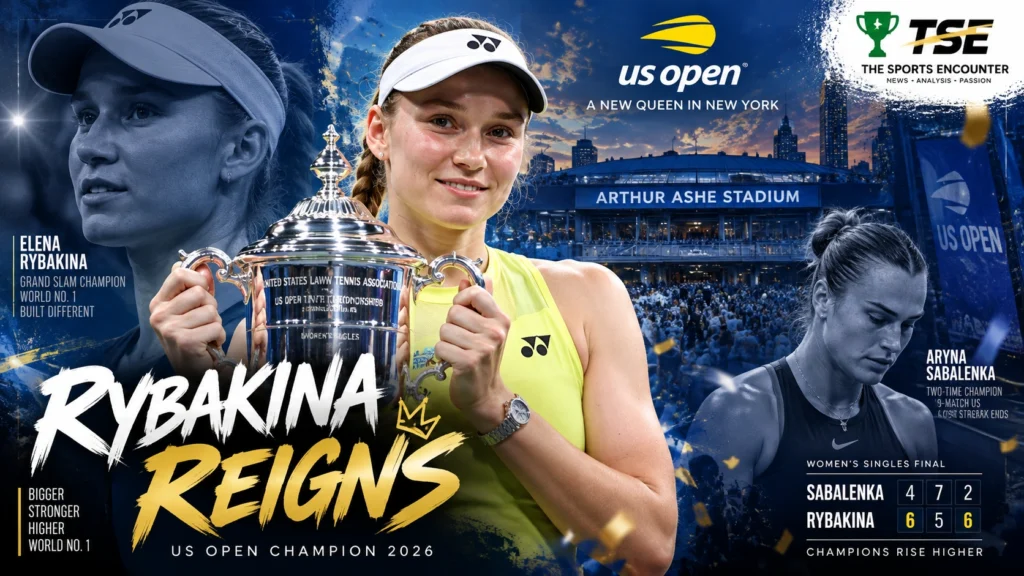
NEW YORK, United States, September 12, 2026: Elena Rybakina finished the Grand Slam season the way she began it, beating Aryna Sabalenka in another major final and leaving Arthur Ashe Stadium with the US Open trophy, the World No. 1 ranking waiting for her on Monday, and perhaps the strongest claim of anyone to having owned women’s tennis in 2026.
Rybakina defeated the two-time defending champion 6-4, 5-7, 6-2 in two hours and 21 minutes, ending Sabalenka’s bid for a third consecutive US Open title and claiming her first championship in New York.
The score tells the story of three separate battles. Rybakina took control of the opening set, Sabalenka fought back to force a decider, and then Rybakina produced her cleanest stretch of the final when the trophy was actually there to be won.
Her serving numbers explain much of it.
Rybakina landed only 53% of her first serves compared with Sabalenka’s 58%, yet won an extraordinary 85% of the points behind that first delivery. She also won 64% of her second-serve points, hit 12 aces and created 12 break opportunities.
Sabalenka, by comparison, won 69% behind her first serve and 54% behind her second while converting only one of three break points.
Rybakina finished with 103 total points to Sabalenka’s 90 and won 41 receiving points compared with 25 for the defending champion.
Those numbers show why this final belonged to Rybakina even though Sabalenka managed to drag it into a third set.
Sabalenka vs Rybakina: 2026 US Open Final at a Glance
| Statistic | Aryna Sabalenka | Elena Rybakina |
|---|---|---|
| Final score | 4-6, 7-5, 2-6 | 6-4, 5-7, 6-2 |
| Aces | 6 | 12 |
| Double faults | 3 | 5 |
| First serve % | 58% | 53% |
| First-serve points won | 69% | 85% |
| Second-serve points won | 54% | 64% |
| Break points converted | 1/3 | 3/12 |
| Receiving points won | 25 | 41 |
| Total points won | 90 | 103 |
| Games won | 13 | 17 |
| Service points won | 65 | 62 |
| Service games won | 12 | 14 |
| Match duration | 2 hours, 21 minutes | |
Rybakina Took the First Set by Making Her First Serve Count
The opening set immediately established the pattern that would eventually decide the championship.
Rybakina did not need to overwhelm Sabalenka with serving percentage. She needed to make the serves she landed difficult to attack.
That difference is important against Sabalenka because few players in women’s tennis punish an ordinary first ball more aggressively. When Rybakina found her spots, Sabalenka was often forced to begin rallies from positions that denied her the immediate initiative.
Rybakina took the set 6-4 and, for stretches, looked closer to the player who had already beaten Sabalenka in the biggest matches of their recent rivalry than someone appearing in her first US Open final.
Her calmness was hardly surprising by this stage of the tournament.
Rybakina had already recovered from losing the opening set against Zheng Qinwen in the quarterfinals, winning 3-6, 6-1, 6-4 to reach the semifinals and secure the World No. 1 ranking.
She then did it again against Coco Gauff.
After dropping the first set to the American, Rybakina turned the semifinal around to win 3-6, 6-4, 6-4. TSE’s analysis of that semifinal focused on how her first-serve efficiency and return pressure gradually changed the match.
The final followed the same underlying principle.
Rybakina stayed committed to first-strike tennis even when the percentage itself was imperfect.
Sabalenka Found Her Response in the Second Set
Sabalenka did what champions do when the match begins moving away from them.
She found another route into it.
The Belarusian had arrived in the final carrying a 19-match US Open winning streak and trying to become the first woman since Serena Williams to win three consecutive women’s singles titles in New York.
Her route to the championship match had also shown how difficult she had become to remove from Arthur Ashe Stadium.
In the quarterfinals, Sabalenka survived a brutal three-set match against Linda Noskova, a contest TSE examined in our breakdown of her 7-6, 3-6, 7-6 escape.
She then produced a far cleaner semifinal against Jessica Pegula, using sustained pressure on the American’s second serve to win 7-5, 6-2. That tactical shift was central to TSE’s semifinal analysis.
Against Rybakina, Sabalenka needed that same persistence.
The second set stayed tight deep into its closing stages before Sabalenka finally created enough return pressure to take it 7-5 and force the final into a third set.
At that point, the momentum could easily have belonged to the defending champion.
Instead, Rybakina reset.
The Third Set Was Where Rybakina Separated Herself
The deciding set contained the most important information in the match.
Sabalenka had taken the second set and restored belief inside Arthur Ashe Stadium. Rybakina could have allowed that swing to become an emotional one as well.
She did the opposite.
Rybakina tightened her service games, remained aggressive on return and kept forcing Sabalenka to play points under pressure.
The final-set score, 6-2, reflected how quickly the match moved once Rybakina regained control.
Her advantage in receiving points across the final was substantial: 41 to 25.
That is one of the clearest explanations for the result.
Sabalenka won slightly more service points overall, 65 to 62, but Rybakina consistently extracted more from the return games. She generated 12 break points and converted three, while Sabalenka created only three opportunities.
That volume of pressure matters even when many break points are saved.
Every deuce game extends the server physically. Every repeated return game asks another question. Against one of the best servers and first-strike players in the sport, Rybakina made Sabalenka play too many of those points.
Rybakina’s 12 Aces Were Only Part of the Serving Story
The easiest statistic to notice is 12 aces.
The more revealing number is 85%.
That was Rybakina’s success rate when her first serve landed.
For comparison, Sabalenka won 69% of her first-serve points.
Rybakina also won 64% behind her second serve despite committing five double faults.
That meant Sabalenka rarely received the kind of second serve she could routinely attack.
The matchup has increasingly become one of the most demanding serving duels on the WTA Tour because both women understand that a weak second delivery can immediately become a forehand or backhand attack.
Rybakina handled that equation better on Saturday.
The Rivalry Has Changed in the Matches That Matter Most
Sabalenka still entered the final leading their overall rivalry 10-7.
Rybakina’s victory cuts that advantage to 10-8.
The more interesting pattern sits inside those numbers.
Rybakina’s latest three victories over Sabalenka have come in the 2025 WTA Finals championship match, the 2026 Australian Open final and now the 2026 US Open final.
Sabalenka beat Rybakina in their first Grand Slam final at the 2023 Australian Open.
Rybakina has now answered with victories in their two major finals in 2026.
Their New York meeting was the 18th match of a rivalry that has become increasingly important to the shape of women’s tennis.
TSE’s US Open World No. 1 ranking analysis showed before the quarterfinals that Rybakina controlled the ranking equation even while Sabalenka remained No. 1.
Rybakina settled that race by reaching the semifinals.
She has now settled the US Open title as well.
From First US Open Quarterfinal to Champion in Six Days
Rybakina’s previous record in New York makes this title particularly striking.
Before this tournament, she had never reached the US Open quarterfinals.
That barrier disappeared when she beat Naomi Osaka 6-1, 6-4 in the Round of 16, a performance covered in TSE’s report on her breakthrough into the final eight.
Then came Zheng.
Then Gauff.
Then Sabalenka.
Three increasingly difficult matches followed, and Rybakina won all three in deciding sets.
That is a significant detail because her reputation is often built around serve, first-strike aggression and apparently effortless power.
Her route through the second week required much more than that.
She had to recover from losing sets, survive momentum changes and repeatedly make better decisions late in matches.
TSE’s broader US Open quarterfinal race analysis identified the women’s draw as increasingly concentrated around the leading contenders.
Rybakina ultimately beat two of the strongest players remaining, Gauff and Sabalenka, to finish the tournament.
World No. 1 Was Already Secured. The Trophy Made It Complete
Rybakina did not need to beat Sabalenka to become the new World No. 1.
Her quarterfinal victory over Zheng had already guaranteed that she would replace Sabalenka when the rankings are updated on Monday.
She will become the 30th woman to reach No. 1 in WTA rankings history and the first player representing Kazakhstan to reach the top of the singles rankings.
The official WTA match report confirms that the 27-year-old will now combine that ranking with her first US Open championship.
The ranking was earned across an entire season.
The final gave it a fitting image.
Rybakina did not become No. 1 while watching someone else lift the trophy. She beat the woman whose ranking she was taking and whose tournament she was trying to win.
Rybakina Has Now Won Three Grand Slam Titles
The US Open becomes Rybakina’s third major championship.
- Wimbledon 2022
- Australian Open 2026
- US Open 2026
Only Roland Garros is now missing from a career Grand Slam.
The WTA also confirmed that Rybakina becomes only the third woman since 2000 to win the Australian Open and US Open in the same season, joining Angelique Kerber in 2016 and Sabalenka in 2024.
It is her third title of the 2026 season and the 14th of her career.
The official US Open final preview had framed the match around two possible histories: Sabalenka completing a New York three-peat or Rybakina putting the finishing touch on the finest season of her career.
The second possibility won.
Sabalenka’s Three-Peat Ends One Match Short
Sabalenka’s defeat should not obscure the scale of her New York run.
She had won the 2024 and 2025 titles and reached four consecutive US Open finals.
The US Open’s official semifinal statistics showed that Sabalenka entered the championship match carrying 19 consecutive victories at the tournament.
She was trying to join Serena Williams and Chris Evert among the women to win at least three consecutive US Open singles titles in the Open Era.
Rybakina stopped that pursuit at the final hurdle.
Sabalenka also loses the World No. 1 ranking after a 99-week reign.
It is therefore difficult to imagine a single opponent changing more about Sabalenka’s immediate tennis landscape than Rybakina has during this tournament.
Rybakina’s 2026 Grand Slam Season Ends With Two Titles
The Grand Slam season began with Rybakina defeating Sabalenka in Melbourne.
It ends with Rybakina defeating Sabalenka in New York.
Between those two finals came months of movement in the rankings race, different champions at Roland Garros and Wimbledon, and repeated questions about who would ultimately emerge from 2026 with the strongest body of major results.
Rybakina has supplied a powerful answer.
Two hard-court majors.
The World No. 1 ranking.
Three consecutive high-stakes victories over Sabalenka dating back to the WTA Finals.
And now the biggest trophy she had never previously come close to winning.
TSE has followed that progression throughout the tournament, from the decisions and results behind Rybakina’s rise to her breakthroughs against Osaka, Zheng and Gauff.
New York has completed the story.
Frequently Asked Questions
Who won the 2026 US Open women’s singles title?
Elena Rybakina won the 2026 US Open women’s singles championship by defeating Aryna Sabalenka in the final.
What was the score in the Sabalenka vs Rybakina US Open final?
Rybakina defeated Sabalenka 6-4, 5-7, 6-2.
How long did the 2026 US Open women’s final last?
The match lasted two hours and 21 minutes at Arthur Ashe Stadium.
How many aces did Rybakina hit against Sabalenka?
Rybakina hit 12 aces, twice Sabalenka’s total of six.
How many break points did Rybakina convert?
Rybakina converted three of 12 break opportunities. Sabalenka converted one of three.
Will Elena Rybakina become World No. 1?
Yes. Rybakina had already secured the No. 1 ranking by reaching the US Open semifinals and will officially replace Sabalenka when the WTA rankings are updated on Monday.
How many Grand Slam titles has Elena Rybakina won?
Rybakina now has three major singles titles: Wimbledon 2022, the 2026 Australian Open and the 2026 US Open.
Did Sabalenka win three consecutive US Open titles?
No. Sabalenka won the tournament in 2024 and 2025 but lost the 2026 final to Rybakina, ending her three-peat attempt.
How many times have Rybakina and Sabalenka played?
The US Open final was their 18th tour-level meeting. Sabalenka now leads the rivalry 10-8.
Has Rybakina won the Australian Open and US Open in the same year?
Yes. Rybakina won both hard-court Grand Slams in 2026, beating Sabalenka in both finals.