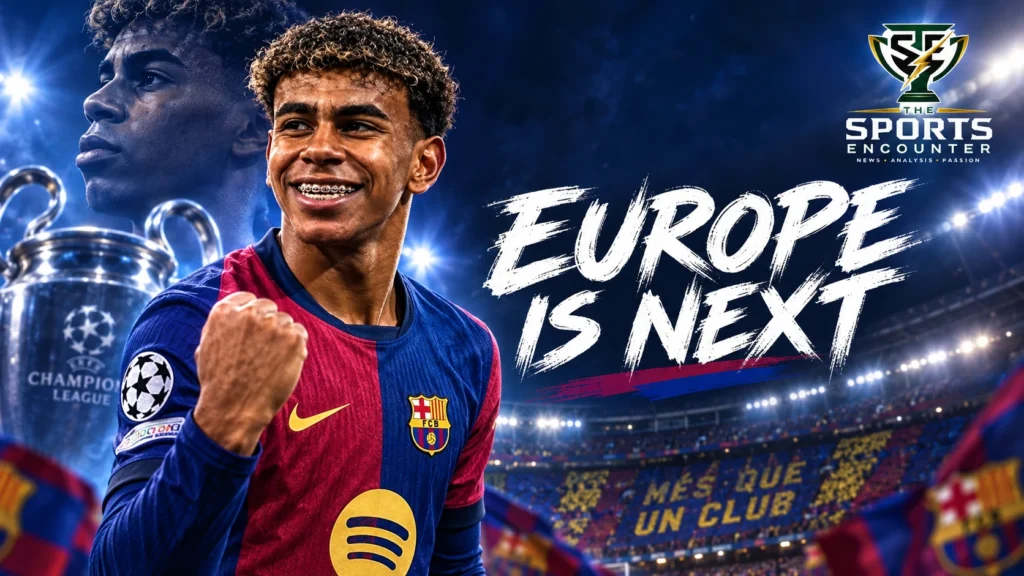
Barcelona, Spain: Lamine Yamal has already won a World Cup, become one of Barcelona’s most important attacking players and, at 19, earned the trust of his teammates to join the club’s captaincy group.
There is still one achievement missing from his rapidly expanding résumé.
The UEFA Champions League.
Speaking before Barcelona begin their 2026-27 European campaign against Feyenoord at the Spotify Camp Nou, Yamal identified winning the Champions League as the major objective still driving him. His comments arrive at an interesting point in Barcelona’s development because the club are no longer approaching Europe as a rebuilding team hoping to rediscover its place among the elite.
Story at a glance
Barcelona Have Given Yamal Something More Than Star Status
Yamal becoming part of Barcelona’s leadership group may be almost as significant as what he said about the Champions League.
The Champions League Is the Obvious Missing Piece
Yamal’s ambition makes sense when viewed against what he has already accomplished.
Barcelona’s 11-Year Wait Changes the Meaning of Yamal’s Target
Barcelona have won the European Cup or Champions League five times.
Flick Knows Barcelona’s European Problem Has Been Defensive
One detail from the previous two Champions League eliminations stands out.
Barcelona’s Summer Recruitment Was Built for This Problem
The squad surrounding Yamal is stronger than it was a year ago.
Hansi Flick now has a deeper squad, an established domestic structure, one of world football’s most influential young players and a team that has started the new La Liga season with four consecutive victories.
For Yamal, the target is therefore becoming more specific. Barcelona have already demonstrated that they can dominate domestically. Now they have to prove that their high-risk, aggressive football can survive the matches that have repeatedly ended their European campaigns.
That makes Wednesday’s opener against Feyenoord about more than three league-phase points. It begins the next test of a Barcelona generation that increasingly believes its time to win Europe has arrived.
Opening-night result: Barcelona answered that challenge by beating Feyenoord 5-1, turning Yamal’s pre-match Champions League ambition into an immediate statement. Read TSE’s Barcelona vs Feyenoord match report for the performance that followed.
Lamine Yamal’s Champions League Challenge at a Glance
| Key Detail | Context |
|---|---|
| Age | 19 |
| Barcelona role | Vice-captain, elected by teammates |
| Other vice-captains | Eric García, Frenkie de Jong |
| Captains selected by Hansi Flick | Raphinha, Pedri |
| Main stated target | Winning the UEFA Champions League |
| Barcelona’s last Champions League title | 2014-15 |
| 2026-27 Matchday 1 opponent | Feyenoord |
| Venue | Spotify Camp Nou |
| Kickoff | September 9, 2026, 18:45 CEST |
Barcelona Have Given Yamal Something More Than Star Status
Yamal becoming part of Barcelona’s leadership group may be almost as significant as what he said about the Champions League.
Flick confirmed that Raphinha and Pedri were his choices as captains, while the dressing room voted for Eric García, Frenkie de Jong and Yamal to join them.
The significance lies in how that responsibility was awarded.
Yamal was not included because of age, marketing value or his status as one of Barcelona’s most recognizable players. His teammates voted him into the leadership structure.
That represents a different type of recognition.
Barcelona’s official confirmation of the captaincy group shows how quickly Yamal’s place inside the dressing room has evolved.
The teenager acknowledged the responsibility that comes with the role while describing his selection as a source of pride.
The situation is especially unusual because Barcelona have traditionally associated the armband with players who have accumulated years of senior experience.
Yamal has reached that level of internal authority before turning 20.
The Champions League Is the Obvious Missing Piece
Yamal’s ambition makes sense when viewed against what he has already accomplished.
He has become a central player for Barcelona.
He has won major international honors with Spain.
His 2026 World Cup transformed him from a gifted young attacker into a player capable of shaping the biggest matches on the international stage.
The Sports Encounter examined that progression in our analysis of how Lamine Yamal came of age at the 2026 FIFA World Cup.
That tournament matters to Barcelona now because Yamal returned from international duty with a different level of responsibility.
He had already experienced high-pressure football before the World Cup. What changed was the scale of his influence.
Spain increasingly trusted him not simply to produce moments of individual skill, but to occupy defenders, create space, carry the ball under pressure and make decisions when opponents had specifically designed their defensive plans around him.
Barcelona are asking him to do the same thing in Europe.
Barcelona’s 11-Year Wait Changes the Meaning of Yamal’s Target
Barcelona have won the European Cup or Champions League five times.
The most recent came in 2015, when Luis Enrique’s side defeated Juventus 3-1 in Berlin.
UEFA’s official Barcelona Champions League history confirms that the club have not lifted the trophy since that 2014-15 campaign.
Eleven years is a substantial drought for a club that once reached the latter stages of the competition almost by expectation.
Barcelona came particularly close in 2025, losing a dramatic semifinal to Inter after extra time. Last season ended at the quarterfinal stage against Atlético Madrid.
Those exits produced different football but a similar outcome.
Barcelona reached the point where tactical conviction alone was no longer enough.
Flick Knows Barcelona’s European Problem Has Been Defensive
One detail from the previous two Champions League eliminations stands out.
Barcelona failed to keep a clean sheet in any of the four knockout matches that ultimately eliminated them.
That is why the debate around Flick’s approach is more complicated than asking whether Barcelona can score enough goals.
They clearly can.
The bigger question is whether their aggressive defensive line, pressing structure and willingness to commit numbers forward can remain stable against opponents capable of exploiting space quickly.
Flick’s position is that Barcelona can adapt when necessary without abandoning their identity.
That balance could define this campaign.
A team cannot spend eight months building one style and then completely abandon it because the Champions League becomes uncomfortable. At the same time, European knockout football repeatedly punishes teams that refuse to recognize when a match requires a different level of risk management.
Barcelona’s Summer Recruitment Was Built for This Problem
The squad surrounding Yamal is stronger than it was a year ago.
Rodri’s arrival may be the most important structural change.
The former Manchester City midfielder gives Barcelona a player capable of controlling tempo, reading transitions and protecting attacking teammates when possession breaks down.
The Sports Encounter examined the scale of that move in our analysis of Rodri’s move to Barcelona after winning 14 major trophies with Manchester City.
His experience also matters in this particular competition.
Rodri has already won the Champions League and scored the decisive goal in a final.
That is exactly the type of European knowledge Barcelona’s younger core can use.
Gordon and Adeyemi Give Yamal More Space to Work
Barcelona have also added attacking profiles that reduce the burden on Yamal.
Anthony Gordon offers direct running from wide positions.
Karim Adeyemi brings explosive acceleration against defensive lines.
Those additions change how opponents can prepare for Barcelona.
Last season, slowing Yamal often meant committing an additional defender toward his side and accepting greater risk elsewhere.
That approach becomes harder when Gordon, Adeyemi, Raphinha and Fermín López can attack the spaces created by that extra attention.
Barcelona’s early league performances already suggest the variety is working. Our opening La Liga weekend analysis highlighted how Flick’s new attacking depth immediately changed the range of problems Barcelona could create.
Cancelo Adds Another Layer of Positional Risk and Reward
João Cancelo’s permanent return gives Flick yet another option.
Cancelo can operate as a conventional fullback, move into midfield or become an additional creator around the penalty area.
The Sports Encounter explored that flexibility in our analysis of Cancelo’s permanent Barcelona return through 2029.
The connection with Rodri is particularly interesting.
Cancelo becomes easier to use aggressively when Barcelona have a midfielder capable of identifying danger before transitions fully develop.
Those relationships matter much more in the Champions League than the individual names alone.
Barcelona’s Domestic Start Has Raised the Standard
Barcelona enter Europe after taking maximum points from their opening four La Liga matches.
They have already scored 17 league goals.
The latest statement came at Mestalla, where Barcelona beat Valencia 5-0 with Yamal scoring twice.
The Sports Encounter’s La Liga Matchday 4 analysis showed just how quickly Flick’s side have established an early advantage over several expected title rivals.
The unbeaten domestic start gives Barcelona confidence.
It also removes excuses.
This is no longer a team trying to discover whether its new pieces fit together.
The evidence suggests they do.
Yamal Is Already Carrying the Form Into Barcelona’s Season
The World Cup did not leave Yamal looking physically or emotionally drained.
His club form suggests the opposite.
Against Rayo Vallecano, Yamal scored twice as Barcelona won 5-2 after twice being forced to respond to an opponent that threatened to turn the match.
The Sports Encounter covered that performance in our Barcelona vs Rayo analysis.
The most encouraging part was not simply the goals.
Yamal continued influencing the match after Barcelona had been disrupted.
That is the quality Champions League knockout games require.
Athletic Club Showed Barcelona Can Win With Control Too
Barcelona’s attack has attracted most of the attention because of the volume of goals.
The 2-0 victory over Athletic Club provided another useful signal.
Flick’s side controlled the match, kept a clean sheet and showed they could win without turning the contest into an attacking shootout.
Our Barcelona-Athletic analysis highlighted how Rodri, Gordon, Adeyemi and the existing core were already beginning to complement each other.
That kind of performance may ultimately matter more in Europe than another five-goal domestic victory.
Barcelona Have One of the Most Interesting Champions League Schedules
Feyenoord are only the beginning.
Barcelona’s league-phase opponents also include Galatasaray, Paris Saint-Germain, Aston Villa, Sabah, Manchester City, Sporting CP and Como.
The Sports Encounter’s complete Champions League draw analysis identified Barcelona’s schedule as one containing both major tests and several matches they should expect to control.
| Match | Venue |
|---|---|
| Feyenoord | Home |
| Galatasaray | Away |
| Paris Saint-Germain | Away |
| Aston Villa | Home |
| Sabah | Away |
| Manchester City | Home |
| Sporting CP | Away |
| Como | Home |
UEFA’s official 2026-27 Champions League fixture list confirms Barcelona begin at home against Feyenoord on September 9.
The PSG and Manchester City Games Will Tell Us More
Barcelona should expect to beat Feyenoord at home.
The deeper assessment of their European ceiling will come later.
Paris Saint-Germain away will test the space behind Flick’s press.
Manchester City at home will test Barcelona’s ability to control possession against a side comfortable denying them the ball for extended periods.
Aston Villa offer another physical and transitional problem.
The league phase therefore gives Barcelona several opportunities to test the exact weaknesses that have previously surfaced in knockout football before the knockout rounds actually begin.
Yamal Is Close to Another Champions League Record
Yamal enters Matchday 1 within striking distance of another age-related European benchmark.
UEFA notes that he needs two goals to equal Kylian Mbappé’s record of 13 Champions League goals scored at the age of 20 or younger.
That record is interesting, but it is not the part of Yamal’s development that matters most now.
The conversation around him has moved beyond whether he is unusually productive for his age.
Barcelona need him to become decisive regardless of age.
Vice-Captaincy Changes the Expectations Around Yamal
The armband does not automatically make a player more influential.
In Yamal’s case, it formalizes something that had already begun happening.
Barcelona increasingly look toward him when matches tighten.
Opponents increasingly design their defensive plans around him.
The crowd increasingly expects him to produce something when Barcelona need invention.
His teammates have now added another layer by voting him into the captaincy group.
That responsibility will be tested most clearly when Barcelona face adversity.
This Is Also a Test of Flick’s Barcelona Project
Yamal may have defined the Champions League as his principal target, but the competition will ultimately judge the entire project.
Flick has had time.
He has won domestically.
Barcelona have invested in the squad.
Rodri has arrived.
Gordon and Adeyemi have increased the attacking depth.
Cancelo gives the team greater positional flexibility.
Yamal is becoming a leader.
At this stage, reaching Europe’s latter rounds is no longer enough to demonstrate progress.
Barcelona have to show they can manage the defining moments that separated them from the trophy in recent seasons.
Why Feyenoord Is a Useful First Test
A home opener against Feyenoord gives Barcelona an opportunity to establish control before the schedule becomes more difficult.
UEFA notes that these clubs have met only once previously in European competition, during the 1974-75 European Cup. The first leg finished 0-0 before Barcelona won 3-0 at the Camp Nou.
The history is distant enough to carry little tactical relevance.
The current relevance is much clearer.
Barcelona want an efficient start.
Flick wants evidence that the defensive structure remains stable when European intensity rises.
Yamal wants the first step toward the one major club trophy still absent from his career.
The Sports Encounter Verdict
Lamine Yamal saying the Champions League is his main target sounds ambitious until Barcelona’s current position is considered properly.
He is a World Cup winner.
Barcelona are defending domestic champions.
The squad is deeper.
Rodri gives the midfield greater control.
Gordon and Adeyemi diversify the attack.
Cancelo adds another creative route.
Yamal himself is now trusted enough inside the dressing room to become a vice-captain at 19.
The Champions League is therefore the logical next benchmark.
Barcelona’s biggest obstacle may not be talent. The last two European exits suggest the real challenge is learning when their aggression needs adjustment, when possession needs protection and when knockout football demands control rather than another attack.
Yamal can provide the individual moments that decide European nights. Barcelona’s prospects will depend on whether the structure around him can survive long enough for those moments to matter.
Wednesday against Feyenoord begins that examination.
For continuing coverage of Barcelona, the Champions League and European football, visit The Sports Encounter’s Soccer coverage.
Continue the UEFA Champions League 2026-27 Story
 UEFA Champions League 2026-27UEFA Champions League Returns: Man City vs. PSG Headlines Barcelona’s Istanbul Test Amid High Stakes
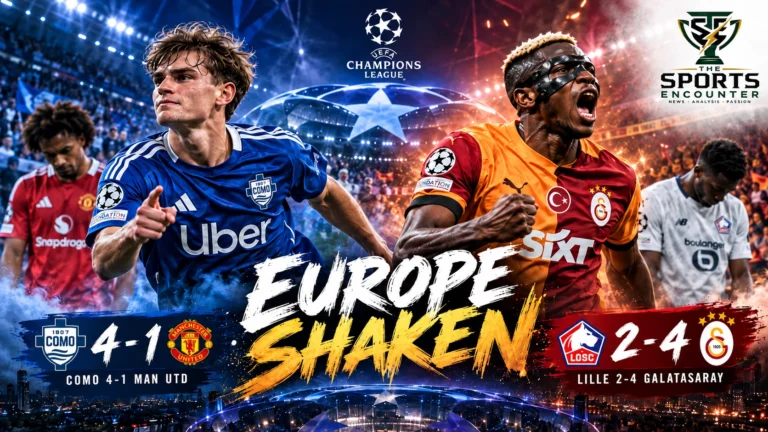 UEFA Champions League 2026-27Champions League: Nico Paz Tears Manchester United Apart as Galatasaray Explode in a 4-Goal Comeback
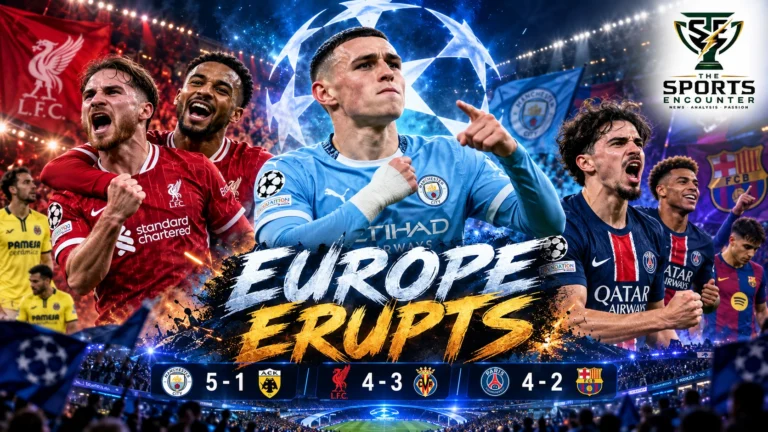 UEFA Champions League 2026-27Champions League: Foden’s Hat-Trick, Liverpool Comeback and PSG’s Barcelona Rout Steal the Show
Frequently Asked Questions
What has Lamine Yamal said about the Champions League?
Yamal said winning the Champions League is the major trophy he still wants to achieve and identified it as his leading motivation for the season.
Is Lamine Yamal a Barcelona captain?
Yamal is part of Barcelona’s five-player captaincy group. He was elected by his teammates alongside Eric García and Frenkie de Jong, while Hansi Flick selected Raphinha and Pedri.
How old is Lamine Yamal?
Yamal is 19 years old.
When did Barcelona last win the Champions League?
Barcelona last won the UEFA Champions League in the 2014-15 season, defeating Juventus 3-1 in the final in Berlin.
How many Champions League titles have Barcelona won?
Barcelona have won five European Cup or Champions League titles.
Who do Barcelona play in their first 2026-27 Champions League match?
Barcelona begin their league-phase campaign at home against Feyenoord at the Spotify Camp Nou on September 9.
Who else will Barcelona face in the league phase?
Barcelona also face Galatasaray, Paris Saint-Germain, Aston Villa, Sabah, Manchester City, Sporting CP and Como.
What Champions League record could Yamal equal?
UEFA says Yamal needs two more goals to equal Kylian Mbappé’s record of 13 Champions League goals scored by a player aged 20 or younger.
Why is Barcelona’s defensive structure important this season?
Barcelona failed to keep a clean sheet across the four matches that ended their previous two Champions League campaigns, making defensive control one of the major issues Flick must solve.
Lamine Yamal
- La Liga: Barcelona Equal Historic Nine-Win Start as Madrid Hit Four Before Clásico
- Yamal Sends Spain Clear as England Recover and Switzerland Take Control in Nations League
- Raphinha’s Perfect Hat Trick Turns Sevilla’s Early Punch Into Barcelona’s Seventh Straight Win
- La Liga: Barcelona Hit Seven as Raphinha Hat-Trick Tears Racing Apart
- Spain Trust the Architect: De la Fuente Set to Lead World Champions Into 2030