


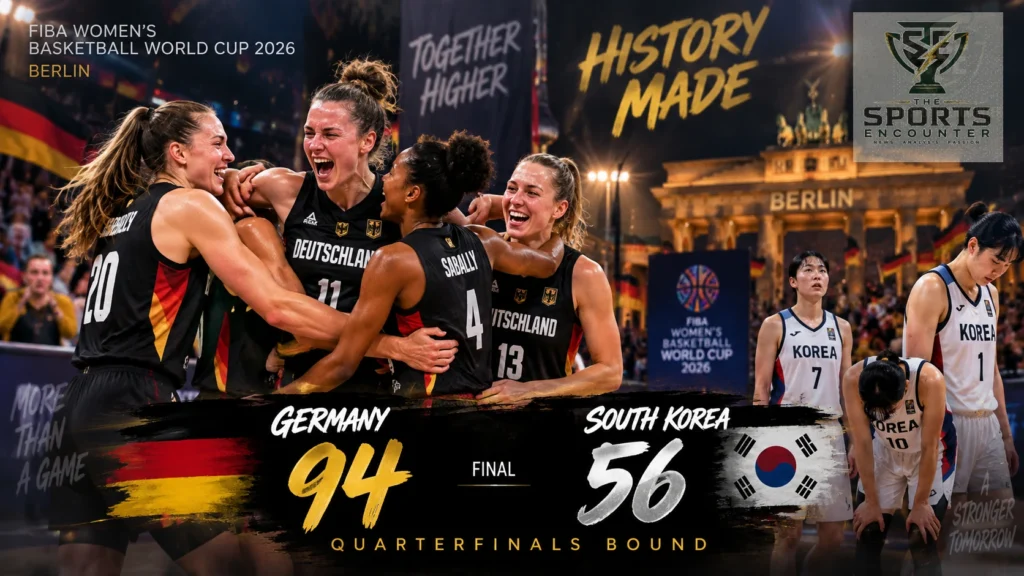
Berlin, Germany: Germany began their home FIBA Women’s Basketball World Cup with a 30-point defeat that threatened to turn expectation into pressure almost immediately.
Four games later, they have made history.
Germany overwhelmed South Korea 94-56 at Berlin Arena on Tuesday, dominating every quarter and reaching the Women’s World Cup quarterfinals for the first time.
The transformation has been striking.
Germany scored only 53 points against Spain on opening night. They followed with 74 against Japan, 83 against Mali and now 94 against Korea. Their offense has improved in every game while their defense has become increasingly difficult to break.
The hosts led 23-14 after the first quarter, extended the margin to 46-29 by halftime and then removed any realistic possibility of a Korean comeback with a 22-11 third quarter.
Germany finished the job by winning the fourth 26-16.
The final margin was 38 points.
The reward is considerably bigger.
What happened next: Germany carried that momentum into the quarterfinals and beat Belgium 93-74, winning every quarter in another home-court statement. Read TSE’s Germany vs Belgium quarterfinal report for the next stage of their historic run.
Germany will face Belgium in the quarterfinals after completing one of the strongest tournament recoveries in Berlin.
The wider journey had already begun to take shape in The Sports Encounter’s analysis of Germany’s recovery through Group A, where consecutive victories over Japan and Mali erased much of the damage from the opening defeat against Spain.
Germany vs South Korea: Match at a Glance
| Match Detail | Information |
|---|---|
| Competition | FIBA Women’s Basketball World Cup 2026 |
| Stage | Qualification to Quarter-Finals |
| Result | Germany 94-56 South Korea |
| Venue | Berlin Arena |
| City | Berlin, Germany |
| Quarter scores | 23-14, 23-15, 22-11, 26-16 |
| Germany field goals | 30/65, 46.2% |
| South Korea field goals | 23/65, 35.4% |
| Germany three-pointers | 5/22, 22.7% |
| South Korea three-pointers | 7/26, 26.9% |
| Germany free throws | 24/26, 92.3% |
| South Korea free throws | 3/4, 75% |
| Rebounds | Germany 46-30 South Korea |
| Next opponent | Belgium |
The official FIBA Germany vs Korea game page lists the matchup as a single-elimination Qualification to Quarter-Finals game, while the official Final Phase bracket confirms Belgium as Germany’s quarterfinal opponent.
Germany Controlled Every Quarter
This was not a game decided by one explosive run.
Germany won every quarter.
| Quarter | Germany | South Korea | Margin |
|---|---|---|---|
| Q1 | 23 | 14 | Germany +9 |
| Q2 | 23 | 15 | Germany +8 |
| Q3 | 22 | 11 | Germany +11 |
| Q4 | 26 | 16 | Germany +10 |
The consistency is what made the result so convincing.
Korea never produced a quarter where Germany’s control genuinely loosened.
The hosts built a nine-point advantage after 10 minutes, added another eight before halftime and then produced their strongest defensive quarter immediately after the break.
By the beginning of the fourth quarter, Germany led 68-40.
At that point, the question had changed from whether they would reach the quarterfinals to how emphatically they would arrive there.
The Third Quarter Removed the Last Possibility of a Korean Comeback
Halftime offered Korea one remaining opportunity.
A 17-point deficit was significant but not impossible.
The first few minutes after the break therefore carried enormous importance.
Germany responded by holding Korea to only 11 points in the third quarter.
The hosts scored 22 themselves.
That 11-point swing pushed the overall lead to 28 and effectively ended the competitive phase of the game.
Germany then continued attacking rather than protecting the margin, scoring 26 points in the final quarter.
That mentality is important when evaluating where this team now stands.
The hosts no longer look like a team simply surviving the pressure of playing a World Cup at home.
They are beginning to use it.
The Rebounding Battle Was Exactly Where FIBA Expected Germany to Dominate
Before the game, FIBA identified rebounding as the largest statistical mismatch between the teams.
Germany entered averaging 47.3 rebounds per game.
Korea were averaging only 23.7.
The concern for Korea was whether they could keep Germany’s larger frontcourt away from repeated second-chance opportunities and control enough possessions to allow their perimeter offense to matter.
The answer was no.
Germany won the rebounding battle 46-30.
That 16-rebound advantage gave the hosts greater control over the number and quality of possessions available across the game.
The official FIBA preview had identified Germany’s size as the central matchup problem Korea needed to solve.
It remained unsolved for 40 minutes.
Germany Did Not Need Great Three-Point Shooting
One of the most revealing parts of the result is what Germany did not do particularly well.
They made only five of 22 three-pointers.
That is 22.7%.
Korea actually shot better from deep, making seven of 26 for 26.9%.
Germany still won by 38 points.
That matters because it shows how many other parts of the game they controlled.
The hosts shot 46.2% overall compared with Korea’s 35.4%, dominated the rebounding battle and created a huge advantage at the free-throw line.
A poor three-point shooting night did not become a structural problem.
Germany found other ways to score.
The Free-Throw Line Became an Enormous Difference
Germany attempted 26 free throws.
Korea attempted four.
The hosts converted 24 of their 26 attempts for an exceptional 92.3%.
Korea made three of four.
That means Germany scored 21 more points from the free-throw line.
In a game decided by 38, no single statistic explains everything, but the free-throw disparity reveals how consistently Germany attacked situations that forced Korea into defensive decisions.
Korea committed 20 personal fouls.
Germany committed only eight.
That combination made it extremely difficult for Korea to establish the rhythm their offense needed.
Germany’s World Cup Has Completely Changed Since Opening Night
September 4 now feels much further away than four days.
Spain defeated Germany 83-53 in front of a sold-out Berlin Arena.
The hosts shot below 30% from the field and looked overwhelmed by Spain’s movement and efficiency.
The Sports Encounter’s opening-day World Cup analysis documented how sharply that result increased the pressure on Germany.
The response has been remarkable.
| Opponent | Result | Germany Points | Opponent Points | Margin |
|---|---|---|---|---|
| Spain | Loss | 53 | 83 | -30 |
| Japan | Win | 74 | 58 | +16 |
| Mali | Win | 83 | 58 | +25 |
| South Korea | Win | 94 | 56 | +38 |
The pattern is extraordinary.
Germany’s scoring has increased in every game.
53.
74.
83.
94.
Their winning margin has also increased with each victory.
Sixteen against Japan.
Twenty-five against Mali.
Thirty-eight against Korea.
The Sports Encounter’s World Cup weekend analysis first identified Germany’s defensive correction after the Japan win.
The hosts have now extended that correction into something considerably more dangerous.
Germany Have Allowed 58, 58 and 56 Points in Their Last Three Games
The offensive improvement will naturally attract attention because the scoring totals have kept rising.
The defense may be even more important.
Germany conceded 83 against Spain.
Since then, Japan scored 58.
Mali scored 58.
Korea scored 56.
Three consecutive opponents have failed to reach 60.
That is the type of defensive consistency that can survive knockout basketball.
The quarterfinal against Belgium will present a considerably harder challenge, but Germany are entering it with evidence that their defensive structure is becoming more reliable rather than less.
Korea’s Tournament Began With 99 Points and Ended With 56
Korea opened the World Cup by scoring 99 points against Nigeria.
Park Ji-hyun produced 27 points, six rebounds and six steals as Korea won 99-81.
That performance was one of the defining individual stories from the opening day and featured prominently in The Sports Encounter’s Day 1 World Cup wrap.
The tournament became much harder immediately afterward.
France beat Korea 95-69.
Hungary won 82-73.
Germany have now held them to 56.
Korea’s scoring therefore declined across each successive game after the explosive opener.
| Opponent | Korea Points | Result |
|---|---|---|
| Nigeria | 99 | Win |
| France | 69 | Loss |
| Hungary | 73 | Loss |
| Germany | 56 | Loss, eliminated |
France Had Already Exposed Korea’s Vulnerability Against Elite European Size
Korea’s first major warning came against France.
The French won 95-69 and eventually completed Group B with three victories and an average winning margin above 40 points.
The Sports Encounter’s analysis of France’s record-breaking group stage showed how thoroughly they overwhelmed opponents through size, shooting and depth.
Germany presented Korea with a different European challenge.
The outcome was even more decisive.
Korea’s perimeter ability gave them a theoretical route into the game, but they could not compensate for the rebounding difference, the free-throw disparity and Germany’s increasingly confident offense.
Germany Have Reached Territory They Have Never Occupied Before
FIBA described the Korea game before tipoff as Germany’s opportunity to claim a maiden Women’s World Cup quarterfinal ticket.
That opportunity is now history.
Germany’s only previous appearance as World Cup hosts came in 1998.
Their return as hosts in 2026 has already taken the national team further than that previous campaign.
This is therefore more than another home victory.
It is a program milestone.
The host nation is now among the final eight teams in the world.
Belgium Will Test Everything Germany Have Improved
The quarterfinal provides a dramatic increase in difficulty.
Belgium won Group C with a perfect 3-0 record.
The reigning European champions defeated Türkiye, Puerto Rico and Australia to qualify directly for the last eight.
Emma Meesseman and Julie Allemand have once again provided the foundation of one of international basketball’s most intelligent offensive systems.
The Sports Encounter’s September 7 World Cup analysis examined how Belgium’s 80-68 victory over Australia secured first place in Group C while Allemand moved to the top of the Women’s World Cup career assists list.
Germany will therefore face an opponent that is comfortable playing through both half-court structure and individual creation.
The rebounding advantage they enjoyed against Korea will be harder to reproduce.
The defensive discipline they showed Tuesday will need to become even sharper.
Germany’s Path Now Runs Directly Into One of Europe’s Best Teams
The matchup also creates a fascinating European collision.
Germany are growing into the tournament.
Belgium arrived already looking settled.
Germany have won three consecutive games after opening with a heavy defeat.
Belgium have not lost.
Germany’s scoring has increased with every appearance.
Belgium have relied on one of the competition’s most cohesive offensive systems.
Something will have to give.
The Quarterfinal Field Is Becoming Much More Interesting
Germany are not the only team to emerge from the additional Qualification to Quarter-Finals round.
Hungary defeated Japan earlier Tuesday to earn a last-eight meeting with defending champions USA.
The United States arrived in the knockout stage after an unusual group campaign.
They crushed China 94-61, survived Italy 55-52 and then responded with a 105-64 victory over Czechia.
The Sports Encounter followed that progression through our USA-China opener analysis, the extraordinary Italy-USA defensive battle and the subsequent USA response against Czechia.
Germany now enter that same knockout landscape with arguably the strongest upward trajectory of any team in Berlin.
The Expanded 16-Team Format Has Given Germany Room to Grow
The 2026 Women’s World Cup is the first edition featuring 16 teams.
Under the new format, the four group winners qualify directly for the quarterfinals while second- and third-place teams meet in single-elimination qualification games.
The official FIBA competition system explains how the additional knockout round creates a different path toward the last eight.
Germany have become one of the clearest beneficiaries of that structure.
They did not win Group A.
They did not even begin the tournament well.
They finished second, earned another opportunity and then produced their best performance of the competition when elimination became immediate.
Home Pressure Has Become Home Energy
The emotional transformation may be as important as the tactical one.
Opening night carried enormous expectation.
Germany were hosting the World Cup in Berlin for the first time since 1998 and played Spain in front of a sold-out crowd.
The 83-53 defeat created immediate disappointment.
The win against Japan changed the mood.
The victory over Mali deepened belief.
Germany have now produced their most dominant performance when the tournament gave them no second chance.
That is how home pressure becomes home advantage.
Germany’s World Cup Is No Longer About Recovery
The first three days of the tournament were about fixing what Spain exposed.
That phase is over.
Germany are now in the quarterfinals.
The questions are different.
Can their rebounding hold up against Belgium?
Can they continue creating offense if their three-point shooting remains inconsistent?
Can they keep opponents below 60 when facing a team with Meesseman and Allemand?
Can the scoring progression continue against one of the strongest defensive units in Europe?
Those are much better problems to have than the ones Germany faced after opening night.
The Sports Encounter Verdict
Germany’s 94-56 victory is significant because of where it has taken them.
It becomes more impressive when viewed against where they started.
Spain beat them by 30.
Germany responded by beating Japan by 16.
They beat Mali by 25.
They have now beaten Korea by 38.
Every victory has been larger than the previous one.
Every offensive performance has produced more points.
The defense has conceded fewer than 60 in three consecutive games.
The rebounding advantage against Korea was decisive.
The free-throw execution was almost flawless.
The three-point shot was poor and it did not matter.
That last point may be the most encouraging of all.
Germany are no longer relying on one thing going right.
They are finding several ways to control games.
Belgium will provide the most difficult examination yet.
Germany have already earned the right to take it.
For continuing World Cup and international basketball coverage, follow The Sports Encounter’s Basketball and NBA Hub.
Frequently Asked Questions
Who won Germany vs South Korea at the FIBA Women’s World Cup 2026?
Germany defeated South Korea 94-56 in the Qualification to Quarter-Finals round in Berlin.
Did Germany qualify for the Women’s World Cup quarterfinals?
Yes. Germany reached the quarterfinals for the first time in program history.
Who will Germany play in the quarterfinals?
Germany will face Belgium, the undefeated winner of Group C.
What was the halftime score?
Germany led South Korea 46-29 at halftime.
How many rebounds did Germany have?
Germany collected 46 rebounds compared with South Korea’s 30.
How well did Germany shoot from the free-throw line?
Germany made 24 of 26 free throws, shooting 92.3%.
How did Germany shoot from three-point range?
Germany made five of 22 three-pointers for 22.7%.
How many points did Germany score in each quarter?
Germany scored 23 points in the first quarter, 23 in the second, 22 in the third and 26 in the fourth.
How has Germany performed since losing to Spain?
Germany have won three consecutive games, beating Japan 74-58, Mali 83-58 and South Korea 94-56.
Is South Korea eliminated?
Yes. The defeat ends South Korea’s FIBA Women’s Basketball World Cup 2026 campaign.