


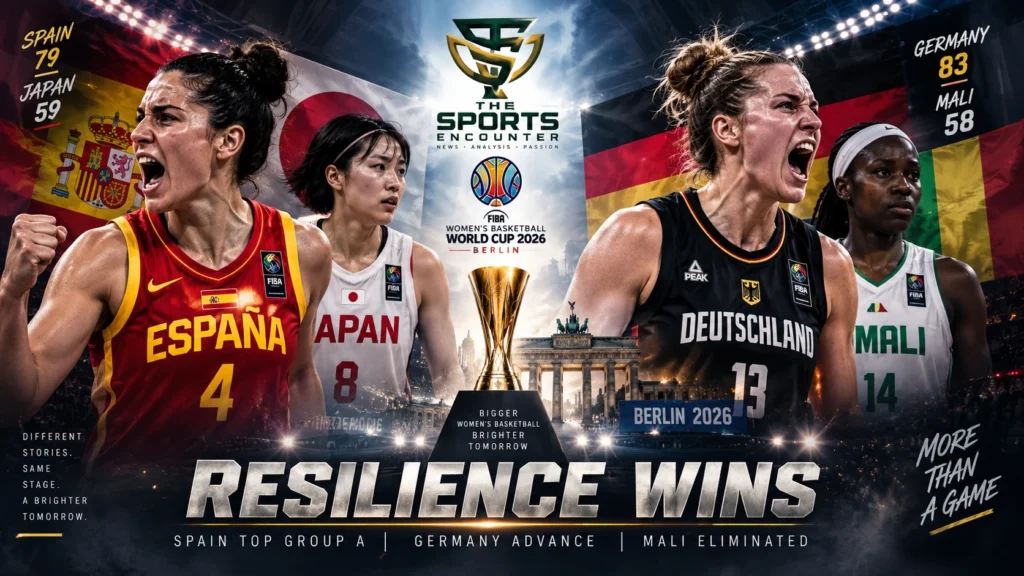
BERLIN, Germany: Group A spent three days refusing to make sense.
Japan opened the FIBA Women’s Basketball World Cup 2026 by breaking the tournament’s three-point record. Spain then crushed host nation Germany by 30 points. Mali responded by producing one of the biggest upsets of the competition against Spain, while Germany completely disrupted Japan’s perimeter offense.
By Monday afternoon, all four teams had one victory, one defeat and a realistic path either to first place or elimination.
Spain and Germany finally imposed some order.
Spain defeated Japan 79-59 to recover from its stunning loss to Mali and finish first in Group A, earning direct passage to the quarterfinals. Germany followed with an emphatic 83-58 victory over Mali in front of another sold-out Berlin Arena, securing second place and a Qualification to Quarter-Finals matchup against Korea.
Japan finish third and remain alive despite losing their final two group games.
Mali are out.
That last outcome is particularly harsh after the African side defeated Spain 82-73 only two days earlier and came within five points of Japan during one of the wildest games of the opening round.
Yet Group A ultimately rewarded the teams that responded best once the stakes became unavoidable.
Spain rediscovered its control.
Germany found momentum.
Japan’s historic shooting cooled dramatically.
Mali’s historic upset could not become sustained qualification form.
FIBA Women’s World Cup 2026 Group A Final Results
| Team | Record | Points For | Points Against | Point Differential | Final Status |
|---|---|---|---|---|---|
| Spain | 2-1 | 235 | 194 | +41 | 1st, direct quarterfinal qualification |
| Germany | 2-1 | 210 | 199 | +11 | 2nd, Qualification to Quarter-Finals |
| Japan | 1-2 | 219 | 250 | -31 | 3rd, Qualification to Quarter-Finals |
| Mali | 1-2 | 237 | 258 | -21 | 4th, eliminated |
Under the official FIBA Women’s Basketball World Cup 2026 competition structure, each group winner advances directly to the quarterfinals. Second- and third-place teams must survive an additional Qualification to Quarter-Finals game, while fourth place is eliminated.
Spain 79-59 Japan: The Response Spain Needed After the Mali Shock
Spain’s World Cup had already changed dramatically before Monday’s game began.
The tournament opened with an 83-53 destruction of Germany that made Spain look like one of the most composed teams in Berlin.
Twenty-four hours later, Mali tore apart that impression.
Spain lost 82-73 after allowing Mali to dictate tempo, attack early and turn a close game into one of the biggest upsets of the tournament.
The Sports Encounter examined that collapse in our complete FIBA Women’s World Cup weekend analysis, when Group A reached its extraordinary four-way 1-1 tie.
Monday therefore required more than a routine victory.
Spain needed proof that the Mali defeat had identified correctable problems rather than exposed something structurally wrong with the team.
The 20-point win over Japan supplied that proof.
Awa Fam Changed the Game Through Second Chances
Spain led throughout the opening half, but Japan remained close enough to create uncertainty.
The halftime margin was only three points, the smallest halftime gap between Spain and Japan across their six Women’s World Cup meetings, according to FIBA.
Awa Fam helped prevent that tension from becoming another Spanish collapse.
She collected five offensive rebounds before halftime alone, repeatedly extending possessions that might otherwise have allowed Japan to increase the game’s pace.
Then she attacked immediately after the break.
Fam scored seven unanswered points to begin the second half and helped Spain restore a double-digit advantage.
She finished with 16 points and 10 rebounds.
FIBA’s official Spain-Japan game report identified that third-quarter burst as the sequence that allowed Spain to create meaningful separation.
Iyana Martin Is Becoming One of Spain’s Most Important Scorers
Iyana Martin supplied the finishing work.
She scored 20 points and hit the three-pointer with fewer than three minutes remaining that pushed Spain’s advantage to 15 and effectively ended Japan’s challenge.
The performance gave Martin consecutive 20-point games.
According to FIBA, she became only the third player in the 21st century to score at least 20 points in consecutive Women’s World Cup games.
That matters because Spain’s offensive identity cannot depend exclusively on one established star.
The tournament is compressed.
Opponents change quickly.
Different defensive coverages remove different options.
Martin’s emergence gives Spain another player capable of carrying scoring responsibility without forcing the offense into isolation basketball.
Spain Learned the Lesson Mali Forced Them to Learn
The tactical difference between Spain’s final two group games was striking.
Against Mali, Spain repeatedly allowed its opponent to attack before the defense was properly organized.
Mali gained confidence from transition opportunities and broken possessions, then punished Spain from three-point range during an extraordinary third quarter.
Against Japan, Spain controlled the rhythm much more effectively.
They protected possessions.
They attacked the offensive glass.
They forced Japan to work through established defensive coverage instead of allowing the game to become a shooting contest.
That was crucial because Japan entered the tournament having already demonstrated how dangerous a fast, perimeter-heavy game could become.
The Sports Encounter’s report on Saki Hayashi’s record-breaking performance against Mali documented Japan making 20 three-pointers while Hayashi hit nine herself.
Spain could not allow that version of Japan to reappear.
It did not.
Japan’s World Cup Has Changed Since Its Record-Breaking Opening Night
Japan’s first game produced one of the tournament’s defining statistical performances.
They beat Mali 102-97.
Hayashi made nine threes.
Japan made 20 as a team.
Both were World Cup records at the time.
The Sports Encounter’s opening-day World Cup wrap identified Japan as one of the most dangerous perimeter teams in Berlin.
The next two games changed the scouting report.
Germany held Japan to 3-of-27 from three-point range in a 74-58 victory.
Spain then prevented Japan from recreating its opening-night offensive rhythm.
The lesson is increasingly clear.
Japan can become extraordinarily dangerous when its perimeter offense forces opponents to defend far beyond the paint.
When those shots stop falling, however, the offense still needs another dependable route to points.
Kokoro Tanaka Continues to Give Japan Something Beyond the Three
Kokoro Tanaka provided one of the stronger individual performances in defeat.
She scored 15 points and made three three-pointers against Spain.
Her emergence matters because Japan cannot realistically build every knockout possession around Hayashi shooting at historic levels.
Tanaka can attack with the ball, create movement and give Japan another decision-maker when opponents aggressively chase perimeter shooters.
Japan will need more of that in the Qualification to Quarter-Finals round.
The margin for a poor shooting game now disappears completely.
Germany 83-58 Mali: The Hosts Have Completely Changed Their Tournament
Germany’s first night in Berlin could hardly have gone worse.
Spain beat the hosts 83-53 in front of 12,550 spectators.
Germany shot poorly, struggled to contain Spain’s movement and carried the emotional burden of losing its home World Cup opener by 30.
Two games later, that defeat feels considerably further away.
Germany beat Japan 74-58.
Now they have beaten Mali 83-58.
They have moved from the bottom of Group A to second place and enter the Final Phase with consecutive 16-point and 25-point victories.
That is arguably the strongest momentum shift produced by any team in the group stage.
Frieda Bühner Is Growing With Germany’s Tournament
Frieda Bühner scored 21 points against Mali after producing 19 against Japan.
Her rise has coincided almost perfectly with Germany’s recovery.
The opening-night defeat could have left the hosts waiting for their established stars to solve everything.
Instead, players such as Bühner and Luisa Geiselsöder have taken greater responsibility.
Geiselsöder scored 17 against Mali and established Germany’s interior attack early.
Alexis Peterson contributed nine points and five assists while helping organize the offense.
The official FIBA report on Germany’s victory noted that Nyara Sabally and Leonie Fiebich are still building toward full force, making the supporting production even more valuable.
Germany Are Winning Before Their Best Version Has Fully Arrived
This may be the most encouraging part of Germany’s recovery.
The hosts are not yet dependent on everything being perfect.
Sabally and Fiebich remain central to the team’s ceiling, but Germany’s last two wins have come through a broader contribution.
Bühner has scored.
Geiselsöder has attacked inside.
Peterson has helped restore structure at point guard.
The defense has improved sharply.
Germany conceded 83 points to Spain.
They have allowed only 116 combined across their next two games.
| Germany Group A Game | Result | Points Allowed |
|---|---|---|
| vs Spain | Lost 53-83 | 83 |
| vs Japan | Won 74-58 | 58 |
| vs Mali | Won 83-58 | 58 |
That defensive correction deserves as much attention as the scoring.
Germany conceded exactly 58 points in consecutive games after allowing Spain to reach 83.
The Berlin Crowd Is Becoming Part of Germany’s World Cup
Germany played Mali in front of 12,550 spectators at Berlin Arena.
It was another sellout.
The World Cup has repeatedly shown that host advantage in women’s basketball can become more than branding when the home team gives the crowd something to respond to.
Germany’s first match created disappointment.
The Japan win created belief.
The Mali performance allowed the atmosphere to build from the opening stages rather than wait for a comeback.
Even German basketball royalty was watching.
Dennis Schröder, MVP of Germany’s 2023 men’s Basketball World Cup triumph and EuroBasket 2025 success, attended the game.
Germany now have a chance to turn that growing home energy into a deeper tournament run.
Mali’s World Cup Ends Two Days After Its Greatest Win
Mali’s elimination may be the cruelest outcome of Group A.
The team leaves Berlin having achieved something it had never done before.
The 82-73 victory over Spain was only Mali’s second Women’s World Cup win in history and its first against European opposition.
Sika Koné produced 19 points and 10 rebounds in that game, becoming the first player in Women’s World Cup history to register five consecutive double-doubles.
For several hours, Mali appeared capable of winning the group.
Two days later, they are eliminated.
That does not erase what happened against Spain.
It does explain the unforgiving nature of the new 16-team competition.
One historic result can change a group.
It cannot guarantee survival.
Mali Were Competitive Enough to Frighten Everyone but Not Consistent Enough to Advance
Mali’s three results tell an unusual story.
| Opponent | Result | What Happened |
|---|---|---|
| Japan | Lost 97-102 | Led for long stretches before Japan’s record three-point shooting decided the game |
| Spain | Won 82-73 | Historic first World Cup victory over European opposition |
| Germany | Lost 58-83 | Unable to match Germany’s interior control and home-court momentum |
Mali scored 179 points across its first two games.
Against Germany, it managed only 58.
That drop illustrates why tournament basketball is about adaptability as much as peak performance.
Japan challenged Mali with shooting.
Spain allowed Mali to play fast.
Germany gave them neither route.
Group A Was the Best Argument Yet for the Expanded World Cup Format
Before Monday’s games, Spain, Mali, Japan and Germany were all 1-1.
Every team could still finish first.
Every team could still finish fourth.
There were no meaningless games.
There was no comfortable qualification scenario.
The group winner would skip an elimination round.
Fourth place would go home.
The result was essentially a miniature knockout round inside the group stage.
The Sports Encounter identified that possibility in our weekend analysis of the four-way Group A tie.
The final games justified the attention.
Spain Now Gain the Most Valuable Reward Available in the Group Stage
Spain do not merely receive first place.
They receive rest.
That matters enormously in a tournament running from September 4 through September 13.
Germany and Japan must play another elimination game before the quarterfinals.
Spain can prepare directly for the last eight.
That means fewer minutes.
Less physical exposure.
Less injury risk.
More preparation time.
One fewer opportunity for an upset.
France and Belgium have already earned the same advantage through their groups. France’s increasingly formidable tournament has included a 22-three-pointer performance against Nigeria, extending a broader rise already visible when France became the first team to secure direct quarterfinal qualification.
Spain now join that group of teams able to watch the qualification games rather than participate in them.
Germany vs Korea Now Becomes a Serious Elimination Test
Germany’s reward for finishing second is considerably more dangerous.
The hosts will face Korea in the Qualification to Quarter-Finals round.
Korea showed its offensive potential immediately in Berlin by scoring 99 points against Nigeria on opening day.
Park Ji-hyun scored 27 points in that victory, an individual performance highlighted in The Sports Encounter’s Day 1 tournament analysis.
Germany will enter with greater momentum.
Korea will enter knowing there is no second opportunity.
The winner advances to a quarterfinal against Belgium.
That potential matchup would place Germany against one of the most organized teams in the competition, led by Emma Meesseman and World Cup career assists leader Julie Allemand.
Japan’s Knockout Path Depends on Solving the Shooting Problem Quickly
Japan also remain alive.
Their tournament now looks very different from the opening-night celebration.
The record-setting victory against Mali created enormous attention.
The following two defeats exposed the danger of an offense whose ceiling and floor can move dramatically with three-point efficiency.
Japan do not need to abandon perimeter basketball.
It remains their most dangerous weapon.
They need a second solution when opponents extend toward shooters and force possessions inside the arc.
Tanaka may become central to that adjustment.
So will Japan’s willingness to create easier shots before defenses become settled.
The knockout round will not allow them to spend an entire game waiting for another historic shooting night.
Spain’s Recovery Adds Another Contender Back Into the Championship Conversation
The Mali loss briefly changed the way Spain was being evaluated.
That was reasonable.
Championship contenders are supposed to control teams they are favored to beat, and Spain allowed Mali to dictate the game.
But tournament evaluation should also include how teams respond when something goes wrong.
The United States provided its own example after Italy dragged the defending champions into a 55-52 game, their lowest World Cup scoring total of the three-point era. The Sports Encounter’s analysis of Italy’s defensive performance against USA showed why even favorites can be exposed during a short competition.
Spain have now experienced their version of that warning.
The response against Japan was considerably better than the original failure against Mali.
The World Cup Is Producing Several Different Versions of a Contender
France are overwhelming opponents through depth, defensive pressure and perimeter volume.
Belgium are controlling games through continuity, Emma Meesseman’s versatility and Julie Allemand’s playmaking.
USA possess the deepest individual talent but have already been forced through a 55-point offensive struggle.
Spain have now demonstrated both extremes within three games: a 30-point opening win, a historic upset defeat and a controlled 20-point recovery.
The Americans entered Berlin with additional roster uncertainty after losing A’ja Wilson and Kelsey Plum shortly before the tournament, something examined in our analysis of Team USA’s late personnel changes.
Caitlin Clark then responded with 14 points and 11 assists in her senior World Cup debut, covered in our USA-China opening-game analysis.
Spain’s route has been different.
The Spanish have already been forced to prove that they can recover psychologically and tactically from a major failure.
That experience may become valuable later.
TSE Analysis: Group A Rewarded Adjustment More Than Reputation
Spain entered Group A with the strongest recent international pedigree.
Germany entered as the host.
Japan arrived with one of the clearest stylistic identities.
Mali carried the least historical World Cup success.
None of those descriptions predicted how the group actually developed.
Japan were the first team to make history.
Mali then produced the biggest upset.
Germany went from a 30-point defeat to two comfortable victories.
Spain went from apparent control to vulnerability and back again.
What separated the final standings was not which team avoided problems.
Every team had them.
Spain adjusted after Mali exposed its transition defense.
Germany changed its defensive approach after Spain overwhelmed it.
Japan never fully solved what happened when opponents removed its perimeter rhythm.
Mali could not reproduce the speed and shooting efficiency that carried it past Spain.
That is why the final table feels fair even after such an unpredictable group.
Spain were the best team across three games.
Germany became the most improved.
Japan did enough early to survive.
Mali gave the tournament one of its great moments but could not turn that moment into the consistency required to stay.
The quarterfinal picture now has another confirmed contender in Spain.
Germany and Japan still have work to do.
And Group A, after refusing to make sense for most of the weekend, has finally delivered its verdict.
Frequently Asked Questions
Who won Spain vs Japan at the FIBA Women’s World Cup 2026?
Spain defeated Japan 79-59 in their final Group A game on September 7, 2026.
Did Spain qualify directly for the quarterfinals?
Yes. Spain finished first in Group A with a 2-1 record and advanced directly to the FIBA Women’s World Cup quarterfinals.
Who led Spain against Japan?
Iyana Martin scored 20 points, while Awa Fam recorded 16 points and 10 rebounds.
How did Japan’s Kokoro Tanaka perform against Spain?
Tanaka scored 15 points and made three three-pointers in Japan’s 79-59 defeat.
What was the Germany vs Mali score?
Germany defeated Mali 83-58 in front of a sold-out Berlin Arena.
Who led Germany against Mali?
Frieda Bühner scored 21 points, Luisa Geiselsöder added 17, and Alexis Peterson contributed nine points and five assists.
Did Germany qualify for the FIBA Women’s World Cup quarterfinals?
Germany finished second in Group A and advanced to the Qualification to Quarter-Finals round. The hosts must defeat Korea to reach the quarterfinals.
Is Japan still alive in the tournament?
Yes. Japan finished third in Group A and advances to the Qualification to Quarter-Finals round despite losing to Germany and Spain.
Is Mali eliminated from the FIBA Women’s World Cup?
Yes. Mali finished fourth in Group A with a 1-2 record and were eliminated despite their historic 82-73 victory over Spain.
Who will Germany play next?
Germany will face Korea in the Qualification to Quarter-Finals round. If Germany win, Belgium will await in the quarterfinals.