


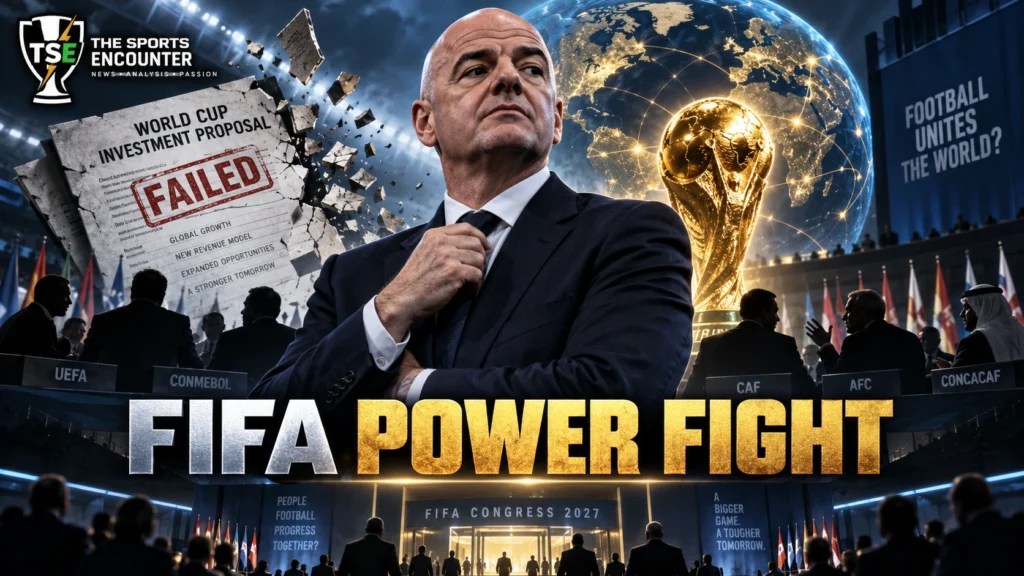
KATOWICE, Poland: Gianni Infantino is not stepping aside.
After six turbulent weeks that transformed an ambitious FIFA commercial proposal into one of the most serious governance disputes of his presidency, the 56-year-old has confirmed that he still intends to seek another term as FIFA president in March 2027.
The confirmation matters because the political environment around him has changed dramatically since he first announced his candidacy at the FIFA Congress in Vancouver earlier this year.
At that point, Infantino looked positioned for another relatively comfortable election. FIFA had just completed preparations for a commercially powerful World Cup cycle, development spending remained central to his pitch to member associations, and no serious challenger had emerged.
Then came FIFA Forward Enterprise.
The proposed structure would have brought private investors into a new commercial entity connected to the World Cup and other FIFA competitions. The plan envisioned selling roughly a 20% stake in a business valued at around $20 billion, potentially generating billions of dollars that FIFA argued could ultimately support football development around the world.
Instead, the proposal triggered opposition from UEFA, the Asian Football Confederation and Concacaf, created boycott threats, divided national associations, exposed disagreements inside FIFA and was abandoned before the end of July.
The Sports Encounter has followed that breakdown from the beginning. Our earlier analysis of why FIFA’s World Cup stake plan collapsed within days concluded that the commercial proposal could disappear much faster than the political damage it created.
That assessment now looks increasingly important.
The plan is dead.
The election battle it helped create is not.
Gianni Infantino’s 2027 Re-Election Bid: Key Facts
| Issue | Current Position |
|---|---|
| FIFA President | Gianni Infantino |
| Age | 56 |
| First elected | February 2016 |
| Previous re-elections | 2019 and 2023 |
| 2027 candidacy | Confirmed |
| Election date | March 18, 2027 |
| Election venue | Rabat, Morocco |
| Formal challenger | None announced as of September 6, 2026 |
| Central political issue | Fallout from FIFA Forward Enterprise and wider governance concerns |
| Major opposition blocs | UEFA, AFC and Concacaf have led criticism of the failed proposal and its process |
| Major support base | Infantino retains substantial backing, particularly across Africa and parts of the wider global membership |
FIFA had already formally announced Infantino’s candidacy during the 76th Congress in Vancouver. The official FIFA announcement records his intention to stand again, while the 77th FIFA Congress has been scheduled for March 18, 2027 in Rabat.
Infantino’s Message From Poland Was Carefully Chosen
The latest confirmation arrived after Infantino attended the opening of the FIFA U-20 Women’s World Cup in Poland, where hosts Poland faced Argentina in Katowice.
It was his first appearance at a FIFA-organized tournament since the private-investment proposal collapsed.
That made the occasion politically significant even though Infantino tried to keep attention on the football.
Asked about the controversy surrounding the previous six weeks and whether he regretted the handling of the abandoned proposal, he declined to engage with the substance of the dispute.
He said there would be a time and place to discuss the issue, but Poland was not it.
His public message instead returned to the theme that has defined much of his FIFA presidency: global development.
Infantino spoke about creating opportunities for players, expanding participation and helping football grow in countries that historically received fewer resources and fewer opportunities to compete internationally.
The location strengthened that argument.
The 2026 U-20 Women’s World Cup has 24 participants, including six tournament debutants. For Benin and New Caledonia, qualification represents their first appearance at any FIFA women’s tournament.
That is exactly the type of expansion Infantino frequently uses to explain his political and economic philosophy.
More teams compete.
More countries receive development money.
More member associations believe they have something tangible to gain from FIFA’s growth.
The challenge for Infantino is that the same argument now sits at the center of the controversy threatening his presidency.
What Was FIFA Forward Enterprise?
FIFA Forward Enterprise, commonly referred to as FFE, was presented as a way to unlock additional commercial value from FIFA’s portfolio of competitions.
The concept involved creating a commercial structure connected to major FIFA tournament rights and introducing private investment into that business.
The World Cup was the central asset.
The proposed structure was valued at approximately $20 billion, with around 20% potentially available to outside investors.
Infantino argued that bringing new capital into FIFA’s commercial ecosystem could help generate far greater development funding for national associations.
That argument reflected the philosophy behind the FIFA Forward program, through which the governing body distributes money for pitches, academies, competitions, national teams, women’s football and other development projects.
But the proposal encountered a problem that ultimately overwhelmed its commercial logic.
Many of FIFA’s own stakeholders believed they had not been properly consulted.
The Sports Encounter documented that breakdown in our report on UEFA’s unanimous rejection of the World Cup stake plan.
The issue was no longer simply whether private capital could make FIFA richer.
It became a question of who had the authority to make a decision involving football’s most valuable tournament.
UEFA, AFC and Concacaf Turned a Commercial Dispute Into a Governance Crisis
The opposition escalated rapidly.
UEFA’s 55 national associations unanimously rejected the proposal.
The Asian Football Confederation publicly complained that it had not been consulted before details entered the public domain.
Concacaf said it had serious concerns about due process and later rejected the proposal through its 41 member associations.
Those responses mattered because three of FIFA’s six continental confederations were no longer arguing about the financial mechanics of one project.
They were questioning the process by which FIFA leadership had attempted to advance it.
That shift was explored in our analysis of the coordinated UEFA, AFC and Concacaf revolt.
The Asian federation went further when the possibility of national teams boycotting FIFA tournaments entered public discussion.
For a governing body built around bringing the world together through competitions, the possibility that major regions might refuse to participate represented an extraordinary institutional risk.
UEFA later welcomed FIFA’s decision to withdraw the plan. Its official statement on the withdrawal said European national associations had unanimously rejected placing an interest in FIFA competitions into private hands.
The Plan Collapsed, but FIFA Also Admitted the Process Went Wrong
FIFA initially defended the concept strongly.
Infantino described the proposed commercial vehicle as an opportunity to generate substantially greater development resources.
FIFA also insisted that the proposal remained subject to consultation and approval and argued that football itself was not being sold.
The resistance did not disappear.
By early August, FIFA’s position had changed.
The proposal was withdrawn.
More importantly, FIFA acknowledged mistakes in how the process had been handled.
Senior leadership said the FIFA Council and member associations should not have felt excluded and accepted that the proposal should have been managed differently.
An apology was sent to FIFA’s governing bodies and member associations, with a review promised.
The organization’s official statement following leadership talks in Rabat confirmed both the withdrawal and the acknowledgment of mistakes.
The Sports Encounter examined that moment in our analysis of FIFA’s apology after the proposal collapsed.
An apology solved the immediate commercial confrontation.
It did not settle the political question.
The Crisis Then Moved Inside FIFA
Another damaging development followed.
The revolt stopped being purely external.
Senior figures associated with FIFA distanced themselves from the project, while questions emerged about who had developed the proposal, who had been consulted and how much internal knowledge existed before it became public.
That internal fracture mattered because FIFA could no longer easily characterize the dispute as a predictable fight between competing continental interests.
The Sports Encounter tracked that phase in Crisis Plagues FIFA as Wenger, Grafstrom and Federations Break Ranks.
We also examined how the controversy moved directly into FIFA’s own leadership structure as senior figures publicly questioned the process.
That distinction remains important heading toward the election.
A president can survive criticism from external rivals.
Internal questions about governance are harder to dismiss because they challenge the claim that the organization itself remains united behind the leadership model.
National Associations Began Withdrawing Their Support
The next stage was politically more dangerous.
Individual football associations began reconsidering their endorsements of Infantino’s 2027 candidacy.
England withdrew its support.
Ireland followed.
Italy later moved away from Infantino.
New Zealand withdrew its backing and called for an independent review of the commercial proposal.
These decisions did not remove Infantino from the ballot.
They exposed the weakness of treating continental statements as automatic presidential votes.
Each eligible FIFA member association ultimately holds its own vote.
That is why our analysis of Ireland’s withdrawal focused on the election association by association rather than simply counting confederations.
Our subsequent report on New Zealand withdrawing support demonstrated that the same political fragmentation was beginning to appear outside Europe.
Infantino Still Has Something His Opponents Do Not: A Declared Candidacy
For all the anger surrounding FIFA, one fact remains crucial.
No challenger has formally announced a candidacy.
That changes the political meaning of almost every statement calling for change.
Opposition can weaken an incumbent.
It cannot defeat one without a candidate.
The 2027 FIFA election is conducted through the organization’s member associations, which means any challenger would need more than support from powerful European leagues or prominent football administrators.
A viable opposition campaign would require relationships across Africa, Asia, North America, South America and Oceania.
That is precisely where Infantino’s development strategy becomes politically important.
Why FIFA Forward Has Always Been More Than a Development Program
Infantino has consistently argued that FIFA’s responsibility is to redistribute the wealth generated by global competitions so that smaller football nations can build infrastructure and compete.
At the Vancouver Congress, he highlighted roughly $5 billion in development investment over the previous decade and said the next FIFA Forward cycle would distribute at least $2.7 billion.
For wealthy federations with major domestic television contracts, those transfers may represent only one part of the football economy.
For smaller associations, FIFA money can fund training centers, youth competitions, women’s programs, pitches, technical staff and national-team infrastructure.
Those associations also vote for the president.
This does not automatically mean development funding purchases political support.
It does explain why the political map around FIFA rarely mirrors the economic power structure of European club football.
Infantino can lose support from England, Italy or Ireland and still remain electorally strong if dozens of smaller associations believe his presidency has materially improved their ability to develop football.
That is the political case he appears ready to make again.
The U-20 Women’s World Cup Shows the Campaign Message Infantino Is Likely to Use
Infantino’s appearance in Katowice provided an early preview.
He did not spend his time publicly relitigating the failed investment plan.
He spoke about opportunity.
He spoke about participation.
He spoke about giving every part of the world a chance to develop.
The tournament itself helps that argument.
Twenty-four national teams are competing in Poland.
Six are making their tournament debuts.
FIFA has expanded access to youth tournaments and the senior World Cups across both the men’s and women’s game during Infantino’s presidency.
Critics see expansion as part of an increasingly commercial FIFA model.
Supporters see it as democratization of global football.
That philosophical divide may ultimately become more important to the 2027 election than the technical details of FFE.
FIFA’s Political Map Is More Complicated Than Europe Against Infantino
The easiest way to describe the current dispute would be Infantino versus UEFA.
It would also be incomplete.
The AFC and Concacaf joined European football in challenging the Forward Enterprise process.
Within those same regions, individual associations have not always moved together.
Africa remains an important source of support for Infantino, with CAF having endorsed his re-election earlier in the year.
Other federations across the Middle East, Oceania and elsewhere have taken different positions from their continental leadership.
The Sports Encounter explored the resulting fracture inside Asian football in our analysis of the AFC-Qatar disagreement over Infantino.
That is what makes the election difficult to predict through public statements alone.
A confederation president can criticize FIFA.
A national association can still vote for Infantino.
A national association can also withdraw support without automatically endorsing an alternative candidate.
The Boycott Threat May Be Fading, but the Election Problem Is Not
One immediate danger has eased.
UEFA moved toward dropping its threat to boycott FIFA competitions once assurances emerged that the abandoned private-investment proposal would not return in the same form.
That development was significant for the U-20 Women’s World Cup and future FIFA tournaments because it reduced the risk of the governance crisis directly disrupting international competition.
But there was an important contradiction.
As the boycott threat receded, individual associations continued withdrawing political support from Infantino.
Our August 26 analysis identified that split clearly: institutional confrontation over tournament participation was easing while the leadership contest was intensifying.
That remains the situation heading into September.
The Fight Has Also Moved Into the Courts
The collapse of FIFA Forward Enterprise did not end questions about how the proposal was developed.
The dispute has since entered a legal phase involving efforts to obtain information connected to the proposed transaction.
FIFA has accused UEFA of pursuing a political smear campaign through legal channels, while UEFA-linked efforts have focused on obtaining documents and testimony that could shed more light on the conception, valuation and governance of the abandoned deal.
Our latest investigation, FIFA Accuses UEFA of “Smear Campaign” as Infantino Fight Enters US Courts, explains why the conflict now extends well beyond the original commercial proposal.
This matters for the election because legal and governance questions can continue generating damaging information long after the plan itself has disappeared.
Infantino’s Re-Election Bid May Become a Referendum on Two Different Visions of FIFA
The emerging campaign is beginning to reveal a fundamental argument about what FIFA should be.
Infantino’s likely case
- FIFA has generated unprecedented commercial revenue.
- More money is being redistributed into football development.
- More countries are participating in global competitions.
- Women’s football and youth football have expanded.
- The World Cup has become more global geographically and commercially.
- Smaller member associations have received greater financial support.
The opposition case
- Commercial growth does not justify bypassing established governance processes.
- The World Cup should remain controlled entirely by football institutions.
- Major decisions require meaningful consultation with confederations and member associations.
- FIFA leadership needs stronger internal checks and transparency.
- The FFE controversy exposed deeper questions about executive authority.
Both sides can point to evidence supporting their argument.
FIFA is financially powerful.
Its global development programs are larger than they were when Infantino took office.
At the same time, FIFA itself has acknowledged mistakes in the FFE process.
The election will therefore not simply ask whether FIFA has grown.
It may ask whether the way FIFA is governed has kept pace with that growth.
Is This Really Infantino’s Fourth Term?
Infantino was first elected in February 2016 following the crisis that ended Sepp Blatter’s presidency.
He was re-elected in 2019 and again in 2023.
If he wins in 2027, it will be his fourth period holding the FIFA presidency.
There is an important technical distinction.
FIFA described the 2019-2023 period as Infantino’s first full four-year term because his initial 2016 election completed the unfinished presidential cycle that followed Blatter’s departure.
That distinction is relevant when discussing FIFA term limits and explains why Infantino is eligible to stand again under the governing framework.
If elected, the new mandate would run from 2027 to 2031.
What Happens Between Now and March 2027?
The next six months could reshape the race several times.
A challenger must emerge
This is the most obvious requirement for opponents of Infantino.
Criticism without a candidate leaves the incumbent in control of the electoral process.
Opposition must cross continental lines
A purely European challenge is unlikely to be enough.
Any serious rival will need member associations across several confederations.
FIFA’s internal review matters
The promised examination of the FFE process could influence perceptions of whether the problem was poor execution, a failure of consultation or something more serious.
The legal battle may produce new information
Disputes involving documents, testimony and potential proceedings could keep the controversy alive throughout the campaign.
Infantino will continue emphasizing development
The Poland appearance strongly suggests that global participation, women’s football, youth tournaments and financial redistribution will remain central to his political message.
Why Infantino Is Still Difficult to Beat
Presidential politics inside FIFA rarely resemble elections in domestic politics.
The richest or most famous football countries do not receive additional votes because of their size.
A global football superpower and a tiny football association each participate within the same member-association structure.
That gives incumbents with established relationships across the entire FIFA membership a powerful advantage.
Infantino has spent a decade cultivating exactly those relationships.
His opponents may have influential institutions, prominent federations and serious governance arguments.
They still need to turn that influence into votes.
Until they produce a candidate capable of doing that, Infantino remains the only person actually running for president.
The Sports Encounter Verdict
The most important development is not that Gianni Infantino has decided to seek re-election.
He had already announced that intention months ago.
The important development is that the most serious political crisis of his presidency has not changed it.
FIFA Forward Enterprise collapsed.
Confederations revolted.
National associations withdrew support.
FIFA acknowledged procedural mistakes and apologized.
The dispute entered legal territory.
Calls for different leadership grew louder.
Infantino is still running.
That tells us something important about how he views the current balance of power.
He evidently believes the support he retains across FIFA’s global membership is stronger than the opposition currently visible in Europe and elsewhere.
His critics now face a different challenge.
Stopping a commercial proposal required coordinated resistance.
Stopping a president requires a candidate, an electoral coalition and enough votes across FIFA’s 211-member political map.
No one has yet completed even the first part of that task.
The abandoned World Cup investment plan therefore produced an outcome nobody expected when it was introduced.
Private investors never acquired a piece of FIFA’s biggest competitions.
But the attempt to bring them in may have created the first real contest over who should control FIFA after March 2027.
Frequently Asked Questions
Is Gianni Infantino running for FIFA president again in 2027?
Yes. FIFA has confirmed that Infantino remains a candidate for re-election in 2027.
When is the 2027 FIFA presidential election?
The election is scheduled for March 18, 2027 at the 77th FIFA Congress in Rabat, Morocco.
Has anyone announced a challenge to Gianni Infantino?
No formal challenger had announced a candidacy as of September 6, 2026.
What was FIFA Forward Enterprise?
FIFA Forward Enterprise was a proposed commercial structure designed to bring private investment into a business connected to major FIFA competitions, including the World Cup, while generating additional money for football development.
How much of the FIFA commercial business was proposed for private investors?
The abandoned proposal contemplated selling roughly a 20% stake in a commercial structure valued at around $20 billion.
Why did UEFA oppose the FIFA proposal?
UEFA and its national associations objected to both private investment in FIFA competitions and the way the proposal had been developed and communicated. UEFA’s associations unanimously rejected the plan.
Did FIFA admit mistakes over the proposal?
Yes. FIFA acknowledged that the process should have been handled differently, apologized for errors and committed to conducting a review.
Which confederations opposed the proposal?
UEFA, the Asian Football Confederation and Concacaf were among the strongest institutional critics of the proposal and its governance process.
Does Gianni Infantino still have support?
Yes. Infantino continues to retain substantial support across FIFA’s global membership, including strong backing in Africa and support from associations in other regions.
How long has Gianni Infantino been FIFA president?
Infantino was first elected in February 2016. He was re-elected in 2019 and 2023 and is now seeking another mandate beginning in 2027.
Would 2027 be Infantino’s fourth term?
It would be his fourth period serving as FIFA president since 2016. FIFA treated the 2019-2023 period as his first full four-year term because the 2016 election filled the remainder of an existing presidential cycle.
What is the main issue in the 2027 FIFA election?
The election is increasingly shaping up as a debate between FIFA’s record of commercial growth and global development under Infantino and concerns about governance, consultation and executive authority exposed by the failed FIFA Forward Enterprise proposal.