


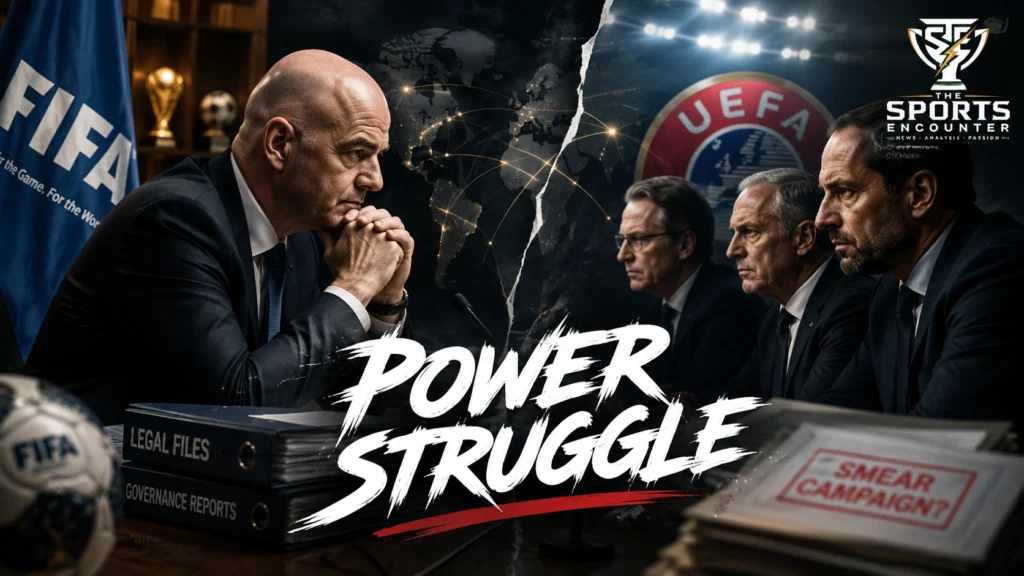
The battle over Gianni Infantino’s abandoned FIFA Forward Enterprise plan has entered a more dangerous phase.
FIFA is now accusing UEFA of using U.S. court proceedings as part of a “smear campaign” against the organization and its president after European soccer’s governing body sought access to documents and testimony connected to the failed World Cup commercial-rights proposal.
The legal fight matters because the original plan is already dead.
Infantino withdrew FIFA Forward Enterprise, or FFE, on July 31 after a global revolt that included UEFA’s 55 associations, CONCACAF, other confederations, national federations and senior figures inside FIFA itself.
What remains is a fight over how the proposal was conceived, who knew about it, whether FIFA’s governance processes were followed, whether its commercial assets were properly valued, and whether the conduct surrounding the plan could justify legal action in Switzerland.
UEFA has asked U.S. courts for permission to obtain evidence from entities connected to FIFA and the proposed transaction for use in a contemplated Swiss criminal complaint against Infantino and potentially other FIFA officials or advisers.
FIFA has responded aggressively.
In its latest filing, the governing body argues that UEFA’s applications are less about obtaining evidence than damaging FIFA and Infantino politically. FIFA also disputes UEFA’s characterization of the legal situation, arguing that the criminal proceedings referenced by UEFA do not currently exist.
The Sports Encounter has followed this crisis from the moment FIFA’s commercial plan triggered a revolt. Our analysis of why the World Cup stake plan collapsed concluded that the damage would outlive the proposal itself. The latest court fight is the clearest confirmation yet.
FIFA vs UEFA Legal Fight: What Is Happening Now?
| Issue | Current position |
|---|---|
| Original dispute | FIFA Forward Enterprise, a plan to place major FIFA commercial rights into a new subsidiary and sell a minority stake to private investors |
| Status of FFE | Withdrawn by FIFA on July 31, 2026 |
| UEFA’s latest move | Seeking U.S. court-authorized discovery for a contemplated Swiss criminal complaint |
| Potential target | Gianni Infantino and potentially other FIFA officials or advisers |
| UEFA’s concern | How the deal was conceived, valued, structured and approved |
| FIFA’s response | Accuses UEFA of a smear campaign and fishing expedition |
| FIFA’s legal argument | Says UEFA is describing contemplated proceedings as if an existing criminal investigation already exists |
| Political backdrop | Infantino is seeking re-election in March 2027 |
What Exactly Is UEFA Asking U.S. Courts to Do?
UEFA is attempting to use American discovery procedures to obtain documents and testimony that it believes could be relevant to a future criminal complaint in Switzerland.
The requests concern entities and individuals with connections to the proposed FIFA Forward Enterprise transaction.
Earlier filings sought evidence from FIFA-linked entities in the United States and from parties involved in the potential investment structure.
UEFA argues that evidence held in America may help establish how FFE was developed, how the proposed valuation was reached, what advice FIFA received, which officials participated, and whether the appropriate FIFA governance bodies were consulted.
The contemplated Swiss complaint is understood to concern possible criminal mismanagement.
That wording is important.
UEFA has not obtained a criminal conviction, and the latest developments do not establish that Infantino committed a crime. UEFA is gathering material it believes could support a complaint, while FIFA is contesting both the legal basis and the political motivation behind the requests.
Why Is FIFA Calling UEFA’s Court Strategy a “Smear Campaign”?
FIFA’s response goes beyond technical legal objections.
The organization argues that UEFA is using court filings to reinforce a public narrative against Infantino.
According to FIFA’s filing, UEFA’s applications resemble public-relations documents more than neutral efforts to collect evidence.
FIFA also disputes the premise that UEFA is seeking evidence for an existing criminal proceeding.
The distinction is central to FIFA’s defense.
A contemplated complaint is not the same thing as an open criminal prosecution or a formal finding by Swiss authorities.
FIFA therefore argues that UEFA is presenting allegations in a way that risks creating the public impression that criminal wrongdoing has already been established.
This is consistent with FIFA’s broader defense since August.
In an official statement earlier in the crisis, FIFA said there was a “concerted and ongoing effort” to undermine the organization and its president, while insisting that leadership changes must occur through FIFA’s statutes and democratic processes.
Why Does UEFA Believe Further Investigation Is Necessary?
Because UEFA believes withdrawing the proposal did not answer the governance questions that the plan exposed.
The European confederation’s criticism has consistently focused on process as much as economics.
UEFA argues that a project involving FIFA’s most valuable commercial properties was developed without sufficient consultation with the FIFA Council, confederations, national associations and wider stakeholders.
When the plan became public, UEFA’s 55 associations unanimously opposed it.
The Sports Encounter covered that extraordinary vote in our report on UEFA’s 55-0 boycott decision.
UEFA’s official position was unusually blunt.
Its joint statement with all 55 national associations argued that the World Cup should not be treated as an investment product and said Europe would refuse to participate in FIFA competitions while the proposal remained alive.
FIFA eventually withdrew FFE, removing the immediate boycott threat.
UEFA’s position is that cancellation does not remove the need to understand how the plan reached such an advanced stage.
What Was FIFA Forward Enterprise?
FFE was the proposed commercial subsidiary at the center of the conflict.
FIFA wanted to bring together commercial rights and operational activities connected to major competitions, including:
- broadcast rights,
- sponsorship,
- ticketing,
- hospitality,
- licensing,
- new commercial ventures,
- and tournament-related operations.
Private investors could then have acquired a minority stake in the company while FIFA retained majority ownership and sporting control.
The proposed enterprise was discussed at a valuation of approximately $20 billion, with outside investment potentially raising billions in immediate capital.
Infantino argued that the money could transform global soccer development.
FIFA’s official explanation of the proposal said standard FIFA Forward distributions could rise dramatically during the 2027-2030 cycle, helping fund pitches, youth development, women’s soccer and national-team infrastructure.
The economic argument was powerful.
The governance argument proved stronger.
Why Did the FFE Proposal Collapse So Quickly?
The plan failed because opposition spread beyond UEFA before FIFA could build a stable coalition around it.
CONCACAF rejected the proposal, widening the revolt beyond Europe. The Sports Encounter documented that moment in our analysis of CONCACAF’s rejection.
Resistance also moved inside FIFA.
Senior adviser Carlos Cordeiro resigned, while then-chief operating officer Kevin Lamour publicly challenged how the project had been handled.
Our report on the internal revolt examined how criticism from FIFA insiders made it harder for Infantino to portray the dispute simply as a familiar power struggle between Zurich and UEFA.
FIFA withdrew the proposal on July 31.
Infantino’s official statement said the project would not proceed because the level of division had become inconsistent with its stated objective of strengthening football globally.
The withdrawal statement also pledged renewed consultation with FIFA stakeholders.
Why Did Withdrawal Fail to End the Crisis?
Because the dispute had already moved beyond the commercial merits of FFE.
By the time FIFA abandoned the project, critics were asking deeper questions about institutional authority.
Who initiated the proposal?
Which departments evaluated it?
When did the FIFA Council receive the full details?
Who approved the proposed valuation?
How were investors selected?
Why did major confederations claim they had not been adequately consulted?
Why did senior FIFA officials distance themselves from the process?
Those questions survived the withdrawal.
The Sports Encounter’s report on FIFA officials and federations breaking ranks argued that the crisis had changed form. The project was gone, but confidence in how FIFA was being governed had become the real issue.
Why Does FIFA Reject UEFA’s Version of the Governance Story?
FIFA says its proposal was still part of a consultation process and had not reached final approval.
Infantino repeatedly argued that FFE would proceed only if FIFA’s member associations and formal governing bodies ultimately supported it.
FIFA also contends that critics have exaggerated the idea that control of the World Cup itself would have been sold.
Under the proposal, FIFA maintained that it would retain sporting authority and majority control while private investors participated in a commercial subsidiary.
That distinction was always central to FIFA’s argument.
Opponents responded that commercial control and sporting control cannot be completely separated when the value of a company depends on how tournaments are expanded, scheduled, marketed and monetized.
Why Is the $20 Billion Valuation Still Important?
Because valuation is one of the areas UEFA reportedly wants examined.
If FIFA’s commercial assets were worth considerably more than the proposed enterprise valuation, selling a permanent minority stake could have raised questions about whether FIFA was receiving adequate long-term value.
If the valuation was reasonable, FIFA could argue that opponents inflated concerns about a transaction designed to unlock capital for development.
This is why documents from advisers and prospective investors matter.
Valuation is not simply an abstract number.
It determines what percentage of future FIFA commercial income private investors would receive in exchange for their initial capital.
Why Does Joshua Kushner’s Thrive Capital Matter?
Thrive Capital was connected to the proposed investment group through an affiliated vehicle.
The involvement became politically sensitive because Joshua Kushner is the brother of Jared Kushner, a prominent political figure with close connections to the Trump family.
There is no evidence in the material reviewed by The Sports Encounter that Thrive or Joshua Kushner committed wrongdoing.
Kushner has since said his firm underestimated the political complexity surrounding global soccer governance and would not have entered the process had it understood how divisive the transaction would become.
That admission matters because it reinforces the idea that FFE became politically toxic even for investors who believed the underlying economic logic was defensible.
Why Is the Fight Becoming More Personal Between FIFA and UEFA?
The language has changed.
At the beginning, UEFA opposed a commercial proposal.
Then it questioned FIFA’s governance.
Now FIFA is accusing UEFA of deliberately attempting to damage the reputation of Infantino and the institution itself.
That escalation makes reconciliation more difficult.
UEFA’s legal strategy indicates it no longer considers internal FIFA review sufficient.
FIFA’s response indicates it views UEFA’s campaign as politically motivated rather than neutral oversight.
The dispute therefore contains two fundamentally incompatible narratives.
| UEFA’s position | FIFA’s position |
|---|---|
| The proposal exposed potential governance failures requiring independent scrutiny | The project was a consultation-stage development initiative unfairly portrayed as misconduct |
| External evidence gathering is necessary | UEFA is using courts to create political pressure |
| Withdrawal does not answer how the proposal was created | The proposal was withdrawn after stakeholder feedback |
| FIFA cannot credibly investigate itself | FIFA’s democratic institutions and statutes should govern accountability |
| Infantino’s leadership requires deeper examination | Infantino retains a mandate from FIFA’s 211 associations |
How Does This Affect Gianni Infantino’s 2027 Re-Election?
The timing is impossible to separate from the politics.
Infantino has formally announced that he will seek another term when FIFA elects its president in March 2027.
Before the FFE crisis, he appeared to be entering that election from a position of considerable strength.
The 2026 World Cup had delivered enormous commercial success, FIFA revenues were strong and Infantino maintained deep relationships with national federations around the world.
FFE changed the political environment.
European federations withdrew support. Other confederations challenged the project. Senior officials departed. Calls for governance reform grew louder.
The Sports Encounter explored those dynamics in our analysis of the emerging no-confidence movement.
A criminal complaint, even if never converted into charges, would inevitably become part of the election debate.
Can UEFA Remove Infantino Through Political Pressure Alone?
No.
FIFA’s structure gives Infantino an important political defense.
Each of FIFA’s 211 member associations has one vote.
Germany has one vote.
Brazil has one.
Cameroon has one.
Maldives has one.
Commercial power does not translate directly into electoral power.
That is why support from Africa, Asia, the Caribbean and smaller associations remains so important.
Samuel Eto’o recently urged African federations to continue supporting Infantino, arguing that FIFA’s development policies have benefited countries that operate with dramatically fewer resources than Europe’s biggest associations.
The Sports Encounter examined that political divide in our analysis of Infantino’s support among smaller football nations.
Why Is FIFA Development Funding Central to Infantino’s Defense?
Because Infantino’s strongest political argument is that FIFA should redistribute more of global soccer’s commercial value beyond wealthy markets.
FFE was built around that proposition.
Many national federations depend heavily on FIFA funding to build pitches, run youth programs, support women’s teams, improve national training centers and finance international competition.
Infantino’s supporters argue that Europe’s financial power creates a structural imbalance.
They see additional FIFA development money as a way to narrow that gap.
UEFA does not dispute the need for development funding.
The disagreement concerns whether selling a permanent equity interest in FIFA’s commercial structure was an appropriate way to produce it.
Why Are Nordic Federations Taking the Fight Beyond Football?
Finland, Sweden and Denmark have asked for discussions with the European Commission over FIFA governance concerns.
That move matters because it pushes the dispute outside traditional soccer institutions.
The federations have raised issues involving transparency, consultation and decision-making and have referred to the response to the failed European Super League as an example of wider institutional intervention in soccer governance.
If European political institutions begin treating FIFA governance as a regulatory concern rather than an internal sports dispute, the pressure on Zurich could expand significantly.
Could UEFA Still Boycott FIFA Competitions?
The immediate boycott threat has receded because FFE was withdrawn.
UEFA originally said its national teams would refuse to participate in FIFA competitions while the proposal remained active.
Once FIFA abandoned the project, that specific condition disappeared.
However, the underlying confrontation has not been resolved.
A future proposal resembling FFE, an escalation in legal proceedings or another breakdown in consultation could revive discussion of stronger measures.
For now, UEFA appears to be pursuing legal and governance pressure rather than competition withdrawal.
What Happens Next in the U.S. Courts?
The immediate question is whether the judges hearing UEFA’s applications allow the requested discovery.
FIFA is seeking to challenge or delay those efforts.
If discovery is granted, relevant entities could be required to produce documents, communications or testimony connected to the FFE proposal.
That evidence could then influence UEFA’s decision on whether to proceed with a criminal complaint in Switzerland.
If discovery is denied or significantly narrowed, FIFA would gain an important legal victory and could argue that UEFA’s strategy had overreached.
Does a UEFA Criminal Complaint Mean Infantino Would Be Charged?
No.
This distinction should remain clear.
A complaint is an allegation submitted for consideration.
Swiss authorities would still have to assess the material and determine whether any investigation, prosecution or other legal action is justified.
FIFA is emphasizing precisely this gap between allegation and established criminal proceedings.
UEFA believes independent scrutiny is necessary.
Neither position determines what Swiss authorities would ultimately conclude.
Why This Crisis Matters Beyond Infantino and Čeferin
The dispute goes to the heart of who controls soccer’s commercial future.
FIFA owns and administers some of the most valuable sporting competitions on earth.
But their value depends on players developed by clubs, national teams supplied by associations, calendars shared with confederations, stadiums supported by governments, and audiences created over generations.
That makes major commercial restructuring inherently political.
FFE tested how far FIFA could move on its own before the institutions around it demanded a veto.
The answer was clear.
Not very far.
Why FIFA’s “Smear Campaign” Claim Changes the Story
Because FIFA is no longer defending only a failed proposal.
It is defending the legitimacy of its president against an organized political and legal challenge.
That is a much larger fight.
UEFA believes the abandoned transaction exposed governance problems that require external examination.
FIFA believes UEFA is using allegations and court filings to weaken a president it cannot easily defeat through FIFA’s electoral structure.
The Sports Encounter’s earlier analysis of FIFA’s claim that Infantino was being undermined showed that this defense was already developing before the latest legal filing.
Now the accusation has moved into court.
Final Verdict: The World Cup Stake Plan Is Dead, but the Fight Over FIFA’s Power Is Getting Bigger
FIFA Forward Enterprise lasted only days as a public proposal.
Its consequences may last considerably longer.
The original argument concerned whether FIFA should sell a minority interest in a commercial company built around the World Cup and other competitions.
That question has already been answered.
FIFA withdrew the plan.
The new argument is about how the proposal existed in the first place.
UEFA wants documents, testimony and potentially a Swiss legal examination of the process.
FIFA says those efforts are part of a political campaign designed to damage Infantino and weaken his position before the 2027 election.
Both sides now have incentives to keep pushing.
UEFA cannot easily retreat after arguing that FIFA is incapable of investigating itself.
FIFA cannot accept UEFA’s narrative without allowing the abandoned proposal to become evidence against the legitimacy of its own leadership.
That makes compromise increasingly difficult.
The legal outcome remains uncertain. No court has established that Infantino committed criminal wrongdoing, and UEFA’s contemplated complaint should not be confused with a conviction or even a prosecution.
But politically, the damage is already measurable.
A commercial project intended to generate more development money has triggered a boycott threat, confederation revolt, executive departures, demands for governance reform, European political involvement and now litigation in the United States.
The most important question is no longer whether FIFA Forward Enterprise will return.
It is whether the institutions fighting over it can still agree on who has the authority to shape FIFA’s future.
Frequently Asked Questions
Why is FIFA accusing UEFA of a smear campaign?
FIFA says UEFA is using U.S. court applications and allegations surrounding the abandoned FIFA Forward Enterprise proposal to damage FIFA and President Gianni Infantino politically.
Is Gianni Infantino facing criminal charges?
No criminal conviction or formal prosecution has been established. UEFA is seeking evidence for a contemplated criminal complaint in Switzerland, while FIFA disputes UEFA’s characterization of the legal situation.
What is FIFA Forward Enterprise?
FIFA Forward Enterprise was a proposed FIFA-controlled commercial subsidiary that would have consolidated commercial and operational rights linked to major FIFA competitions while allowing private investors to acquire a minority stake.
Why did FIFA withdraw the FFE proposal?
FIFA withdrew the plan on July 31 after widespread opposition from confederations, national associations and FIFA insiders made the proposal politically unsustainable.
Why did UEFA oppose FIFA Forward Enterprise?
UEFA argued that the World Cup should not be treated as an investment asset and objected to what it considered inadequate consultation, governance safeguards and transparency around the proposal.
What is UEFA asking U.S. courts for?
UEFA is seeking permission to obtain documents and testimony from U.S.-based entities connected to FIFA and the proposed FFE transaction for potential use in Switzerland.
Could UEFA still boycott FIFA competitions?
UEFA suspended the immediate boycott threat after FIFA withdrew FFE. The broader dispute over governance and Infantino’s leadership remains unresolved.
Is Gianni Infantino running for FIFA president again?
Yes. Infantino has announced that he intends to seek re-election in 2027.
Why does the 2027 FIFA election matter to this dispute?
The legal and governance controversy is unfolding months before FIFA’s presidential election, making Infantino’s leadership and the support of FIFA’s 211 national associations central to the political battle.
Who decides whether Infantino remains FIFA president?
FIFA’s member associations elect the president. Each eligible association has one vote, regardless of the size or commercial power of its national soccer market.