


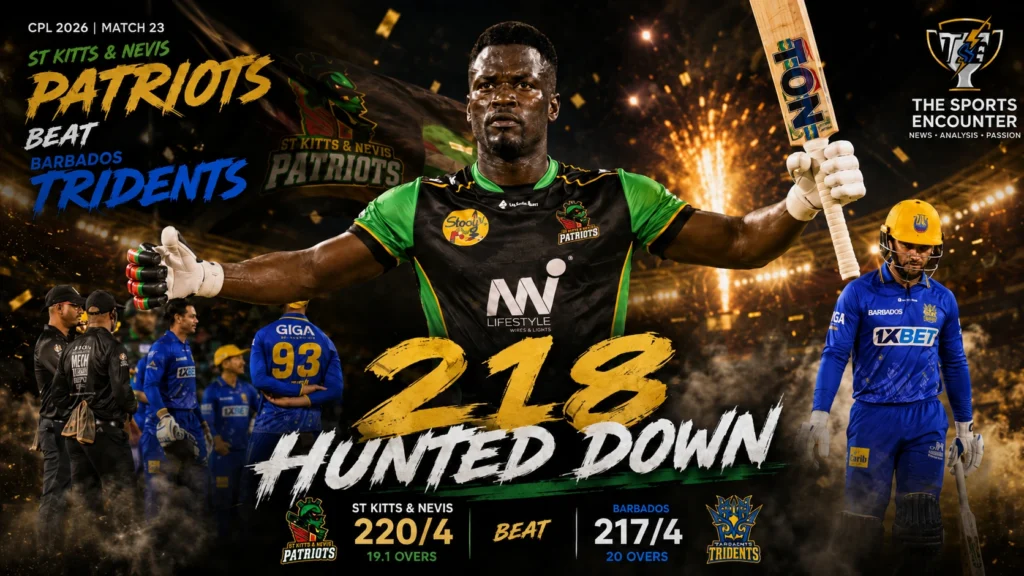
St Kitts and Nevis Patriots produced one of the greatest run chases in Caribbean Premier League history, hunting down 218 against Barbados Tridents with five balls remaining as Johnson Charles, Andre Fletcher and Wanindu Hasaranga turned Warner Park into a celebration.
Barbados appeared to have built a winning total when Quinton de Kock smashed 106 from 57 balls and Zachary Carter added 57 from 36 to lift the Tridents to 217 for four.
The Patriots responded with 220 for four in 19.1 overs.
Charles led the chase with 78 from 45 balls, Kyle Mayers helped establish a 112-run opening partnership, Dasun Shanaka and Jason Holder kept the required rate under control through the middle and death overs, and Fletcher finished the game with an unbeaten 22 from eight balls.
Hasaranga’s contribution was even more explosive: 18 not out from only four deliveries.
The winning moment came when Fletcher drove Gudakesh Motie straight back over the boundary for six, ending a chase that became the fourth-highest successful pursuit in CPL history.
The score alone makes this one of the matches of the tournament.
The manner of the chase matters even more.
St Kitts entered the night with their playoff chances shrinking rapidly. Barbados entered with games in hand and far greater room to maneuver. By the end, the Patriots had produced the kind of victory that can change the emotional direction of a season.
By The Sports Encounter Editorial Desk
Published: September 2, 2026
Updated: September 2, 2026
St Kitts Patriots vs Barbados Tridents: Match 23 at a Glance
| Match Detail | Information |
|---|---|
| Competition | Caribbean Premier League 2026 |
| Match | Match 23 |
| Date | September 1, 2026 |
| Venue | Warner Park, Basseterre, St Kitts |
| Toss | St Kitts and Nevis Patriots elected to field |
| Barbados Tridents | 217/4 in 20 overs |
| St Kitts and Nevis Patriots | 220/4 in 19.1 overs |
| Result | Patriots won by 6 wickets with 5 balls remaining |
| Player of the Match | Johnson Charles, 78 from 45 balls |
| Highest scorer | Quinton de Kock, 106 from 57 balls |
| Best bowling | Wanindu Hasaranga, 1/22 from 4 overs |
| Historical note | Fourth-highest successful chase in CPL history |
Fans can follow official tournament scores, fixtures and competition information through the Caribbean Premier League Match Center.
Quinton de Kock Gave Barbados 217 and Every Reason to Believe
Barbados did very little wrong with the bat.
Brandon King fell early for two, caught by Mayers off Jason Holder, but the wicket became little more than an interruption because Zachary Carter and Quinton de Kock immediately took control.
Carter supplied the first major acceleration.
He reached his half-century from 30 balls, striking six sixes before eventually falling for 57 from 36.
His innings mattered because it prevented de Kock from carrying the entire early scoring burden.
Barbados reached 96 for one after 10 overs.
The platform was already substantial.
De Kock then turned a strong innings into an elite T20 performance.
He reached fifty from 31 balls and accelerated even harder in the second half of his stay. His century arrived from 54 deliveries.
By the time Naseem Shah finally removed him for 106 from 57 balls, de Kock had struck 11 fours and six sixes.
His strike rate of 185.96 tells only part of the story.
He had also survived dropped chances.
Patriots captain Jason Holder admitted after the match that his team had put down important opportunities in the field, and Johnson Charles also acknowledged that Barbados had been allowed to keep de Kock alive.
That usually ends badly when the player receiving those chances is de Kock.
It almost did.
Zachary Carter Gave Barbados Something Beyond de Kock’s Hundred
The danger in reducing Barbados’ innings to de Kock’s century is that it ignores how important Carter was.
The 22-year-old attacked early enough to prevent the Patriots from concentrating entirely on de Kock.
His seven sixes came from only 36 deliveries.
Holder later described Carter as one of the most dynamic young players emerging in the Caribbean setup and praised the opportunity Barbados have given him.
That praise was justified.
When Carter departed at 119 for two in the 13th over, he had already ensured Barbados were operating above nine runs per over without requiring a reckless finish.
Sherfane Rutherford then contributed 26 from 16.
Chris Green added an unbeaten 18 from seven, including two sixes.
The Tridents reached 200 in the 20th over before closing at 217 for four.
It was comfortably their largest total of the tournament.
The innings looked particularly impressive after Barbados had struggled badly in recent matches.
The Sports Encounter previously examined their collapse when Antigua and Barbuda Falcons dismantled the Tridents in Match 16, and their batting was again squeezed when Sunil Narine inspired Trinbago Knight Riders to a seven-wicket win.
Against St Kitts, Barbados appeared to have solved those problems emphatically.
They still lost.
Wanindu Hasaranga’s 1/22 Was Easy to Miss in a 435-Run Match
One of the most important performances of the night came from a bowler.
That sounds strange in a match containing 435 runs.
Hasaranga conceded only 22 from his four overs and dismissed Carter.
Every other regular Patriots bowler went for at least eight runs per over.
Naseem Shah took two wickets but conceded 43.
Holder went for 42.
Jeremiah Louis conceded 55.
Kyle Mayers went for 26 from two overs.
Hasaranga’s economy rate was 5.50.
In a match where both teams scored above 10.8 runs per over, that was exceptional control.
Without those four overs, Barbados could easily have moved beyond 230.
That would have materially changed the chase.
The Sports Encounter has seen this pattern repeatedly during CPL 2026: one economical spin spell can matter almost as much as a fifty because it removes scoring opportunities from an otherwise high-scoring innings.
That dynamic also shaped Barbados’ earlier victory when Gudakesh Motie and Mujeeb Ur Rahman strangled St Lucia Kings.
This time, Hasaranga performed the same job against Barbados.
A Chase of 218 Needed a Fast Start, and the Patriots Got One
Chasing 218 creates a psychological problem before it creates a mathematical one.
The batting side knows that two quiet overs can push the required rate above 13 or 14.
One early cluster of wickets can end the contest.
The Patriots removed that danger immediately.
Charles and Mayers scored 58 without loss in the six-over powerplay.
They reached 50 from only 26 balls.
At the halfway point, St Kitts were 110 without loss.
They had almost exactly half the target with all 10 wickets available.
That was the phase that changed the chase.
Barbados had 217 on the board.
Yet after 10 overs, the Patriots had managed to make the equation feel normal.
Chris Green admitted afterward that this was where the Tridents allowed the chase to move too far in St Kitts’ direction.
He was right.
Barbados recovered with the ball later.
The damage from the opening partnership was already enormous.
Johnson Charles Finally Produced the Innings the Patriots Had Been Waiting For
Johnson Charles arrived at Match 23 carrying confidence without the numbers to prove it.
He said afterward that he had been seeing the ball well throughout the tournament but had not converted that feeling into a meaningful innings.
Against Barbados, conversion arrived quickly.
Charles reached fifty from 29 deliveries.
At that stage he had already struck five fours and four sixes.
He eventually finished with 78 from 45 balls, containing six fours and seven sixes.
The boundary distribution reveals something about his approach.
Charles did not simply wait for short balls.
He repeatedly punished anything straight or drifting into his hitting arc on the leg side.
Barbados struggled to move him away from those areas consistently.
His strike rate of 173.33 was exactly what the chase required.
He attacked hard enough to keep St Kitts ahead of the asking rate while Mayers played the more stabilizing role.
That balance mattered.
The Patriots had previously produced isolated batting contributions without enough collective structure.
Their first win of the season against St Lucia Kings had also been built around a more controlled chase, with Andre Fletcher staying unbeaten on 48.
Against Barbados, they needed a completely different level of aggression.
Charles supplied it.
Kyle Mayers’ 29 Was More Valuable Than the Score Suggests
Mayers made 29 from 27 balls.
In a chase of 218, a strike rate of 107.40 normally looks like a problem.
It was not.
Holder’s post-match explanation captured why.
Mayers understood what Charles was doing and avoided competing with him for control of the innings.
He kept the partnership intact.
He rotated the strike.
He gave the Patriots a left-right combination.
Most importantly, he prevented Barbados from breaking the opening pair while Charles attacked.
The result was a 112-run partnership.
Mayers was finally run out in the 11th over.
The partnership had already done its work.
That is an important T20 lesson.
Strike rate cannot always be evaluated independently from partnership function.
If Mayers had attempted to match Charles shot for shot and been dismissed for a quick 10, Barbados could have reached the middle order earlier.
Instead, the Patriots went past 100 before losing a wicket.
The Waist-High No-Ball Controversy Changed the Atmosphere
The chase also contained the night’s most controversial moment.
Charles was initially ruled out after a delivery that was subsequently reviewed as a possible waist-high no-ball.
He had already begun leaving the field before the decision was reversed and he was called back.
The incident frustrated Barbados.
Green said afterward that communication around the decision was poor and criticized the way the situation was managed.
Holder also described the episode as messy, while stressing that umpires are human and calling for greater consistency.
Charles believed from the beginning that the delivery should have been called a no-ball because of the point of contact.
The technical outcome therefore became less controversial than the process surrounding it.
That distinction matters.
The issue was not simply whether the ball was above waist height.
It was how a player could begin leaving the field before being recalled after further review.
For a tournament trying to maintain high broadcast and officiating standards, the sequence deserves review.
The cricket itself remained compelling.
The administration of the moment was far less clean.
Barbados Actually Fought Their Way Back Into the Match
It would be unfair to describe the chase as straightforward after the opening partnership.
Barbados created a genuine recovery.
Mayers was run out for 29 at 112.
Charles followed at 132, caught by Green off Mujeeb Ur Rahman.
The Patriots had lost both openers within 20 runs.
Green correctly identified Mujeeb and Motie as central to Barbados’ recovery through the middle overs.
Sherfane Rutherford also contributed a surprisingly useful over, conceding only seven and adding pressure during a phase when Barbados were trying to pull the required rate upward.
St Kitts still had work to do.
Dasun Shanaka and Jason Holder responded with a partnership that kept the chase moving.
Neither needed to produce Charles’ level of dominance.
They needed to prevent a collapse.
They did.
Daniel Sams Gave Barbados One Final Opening
The 18th over suddenly gave Barbados hope.
Sams dismissed Holder for 18 from 11 balls.
Four deliveries later, he removed Shanaka for 36 from 22.
The Patriots were 185 for four after 17.5 overs.
Two set batters had disappeared.
Thirty-three runs were still required.
This was the first moment since the opening stand when the chase looked capable of slipping away.
Barbados had exactly the kind of scenario they wanted.
New batters were entering under immediate boundary pressure.
St Kitts still needed almost 16 runs per over from the remaining deliveries.
Hasaranga and Fletcher then destroyed the comeback in less than two overs.
Hasaranga and Fletcher Turned 33 Required Into a Celebration
The finishing sequence was brutal.
Hasaranga made 18 from four balls.
Three of those deliveries went for four.
Another went for six.
His strike rate was 450.
Fletcher made 22 from eight balls with three sixes.
The pair added 35 unbeaten runs from only nine deliveries.
A chase that had briefly become tense ended with five balls unused.
Fletcher’s final six off Motie was particularly fitting.
Warner Park had seen the Patriots win only twice at home since 2021.
The crowd had watched enough frustrating endings.
When Fletcher launched the full delivery straight down the ground, he removed his helmet and celebrated as the stadium erupted.
The Sports Encounter had already seen Fletcher become central to the Patriots’ season when he anchored their first victory against St Lucia.
Match 23 required another kind of contribution.
This time, he was the closer.
Why This Chase Was Better Than a Simple Power-Hitting Contest
The scorecard contains plenty of sixes.
The Patriots’ chase was more sophisticated than relentless hitting.
There were four different functions inside it.
Charles supplied the initial violence
His 78 ensured the required rate never became overwhelming.
Mayers supplied partnership stability
His slower scoring allowed Charles to attack without exposing the middle order early.
Shanaka and Holder protected the chase
After both openers disappeared, they prevented Barbados from turning two wickets into four.
Fletcher and Hasaranga supplied the final acceleration
When Sams created late pressure, the two finishers responded immediately.
That structure is what the Patriots have lacked in several earlier defeats.
The Sports Encounter’s reports on their 51-run defeat against Jamaica and Saim Ayub’s century in another Jamaica victory over St Kitts both exposed how isolated contributions had failed to become complete innings.
Match 23 looked different.
Roles connected.
That is why Holder sounded more interested in what the victory might unlock than in the historical chase itself.
Barbados Lost Despite Scoring 217 Because Their Margin for Error Disappeared Early
There will be understandable frustration inside the Tridents camp.
A total of 217 should win a large majority of T20 matches.
The Patriots forced Barbados into defending with almost no margin for error after reaching 110 without loss in 10 overs.
Green’s bowlers did pull the innings back.
Sams took two wickets.
Mujeeb removed Charles.
Motie helped slow the middle overs.
Rutherford contributed a useful over.
The problem was that recovery came after St Kitts had already banked too many runs and preserved too many wickets.
Once the Patriots entered the final five overs with hitters still available, the conditions at Warner Park favored the chasing side.
Green also mentioned the dew.
Bowling second in the Caribbean often becomes more difficult when the ball gets wet and gripping slower deliveries becomes less reliable.
That did not make the chase inevitable.
It made Barbados’ early bowling discipline even more important.
They did not control that phase well enough.
Barbados’ Playoff Position Is Still Better Than the Table May Suggest
The defeat leaves Barbados on four points from five matches.
That sounds dangerous.
The Tridents still possess something several rivals do not: games in hand.
The Sports Encounter’s full CPL 2026 playoff race analysis showed why Barbados’ position near the bottom of the standings can be misleading.
They entered Match 23 having played only four games, considerably fewer than Antigua, Jamaica and St Lucia.
This defeat uses one of those games in hand without adding points, which increases the pressure.
Green said Barbados still believe four wins from their remaining five games would guarantee qualification, while three could leave the equation dependent on net run rate.
Their home leg now becomes critical.
Barbados have enough talent to recover.
The problem is that every unused opportunity makes the margin smaller.
The official CPL Barbados Tridents team page provides squad and franchise information as their campaign moves into the home phase.
The Patriots Are Alive, but They Still Need More Than One Miracle
For St Kitts, the victory moves them from three points to five after seven matches.
That changes the mood.
It does not completely solve the mathematics.
The Patriots had entered the game at the bottom of the table and with little remaining room for defeats.
The abandoned Match 21 against Antigua gave them one point but removed an opportunity to win two.
Match 23 finally supplied the result they needed.
The challenge is repetition.
The Patriots previously beat St Lucia and still followed that victory with another sequence of defeats.
They need this result to become the beginning of a run rather than another isolated highlight.
Holder said his side had struggled historically to close tight games and viewed this victory as proof they can now do it.
That may be the most valuable takeaway.
The official St Kitts and Nevis Patriots squad page underlines the amount of experience available to Holder, Charles, Fletcher, Mayers, Shanaka and Hasaranga.
The question has never been whether those players can produce individual match-winning performances.
The question is whether enough of them can connect on the same night.
Against Barbados, they finally did.
Johnson Charles’ Player of the Match Award Was Deserved, but the Win Was Collective
Charles was the obvious Player of the Match.
His 78 gave the chase its shape.
Without that innings, the Patriots would probably have spent the entire night running behind the required rate.
His award should not hide the supporting performances.
| Player | Team | Performance | Impact |
|---|---|---|---|
| Johnson Charles | Patriots | 78 from 45 | Established the chase and dominated the opening phase |
| Kyle Mayers | Patriots | 29 from 27 | Helped build the 112-run opening stand |
| Dasun Shanaka | Patriots | 36 from 22 | Protected momentum after both openers fell |
| Andre Fletcher | Patriots | 22* from 8 | Finished the chase with three sixes |
| Wanindu Hasaranga | Patriots | 18* from 4 and 1/22 | Outstanding all-round impact |
| Quinton de Kock | Tridents | 106 from 57 | Produced the match’s highest score |
| Zachary Carter | Tridents | 57 from 36 | Built the platform with seven sixes |
| Daniel Sams | Tridents | 2/40 | Created the late opening by dismissing Holder and Shanaka |
Hasaranga May Have Been the Match’s Most Complete Performer
Charles won the official award.
Hasaranga deserves separate attention.
He conceded only 22 runs in a match where the opposition scored 217.
Then he came out with the Patriots still requiring 33 after Barbados had taken two quick wickets.
Four balls later, Hasaranga had scored 18.
This is exactly why all-rounders with genuine boundary-hitting ability carry such value in T20 cricket.
His bowling reduced the target.
His batting shortened the chase.
A specialist bowler producing 1/22 would have played an excellent game.
A specialist batter finishing 18 not out from four balls would have produced a decisive cameo.
Hasaranga did both.
What Match 23 Tells Us About the CPL 2026 Playoff Race
The wider tournament remains extremely compressed.
Guyana Amazon Warriors are still unbeaten after Shimron Hetmyer’s extraordinary century carried them past Trinbago Knight Riders in Match 22.
Antigua have accumulated points but have nearly exhausted their league schedule.
St Lucia and Jamaica remain firmly involved.
Trinbago’s title defense is under pressure.
Barbados possess games in hand.
St Kitts have now forced themselves back into the conversation.
The Sports Encounter’s earlier analysis of Guyana’s victory over St Lucia identified the Warriors as the side with the strongest early balance and tournament flexibility.
The Patriots are operating from a very different position.
They do not have the luxury of waiting for the table to come toward them.
They need wins.
Match 23 supplied one of them.
The Sports Encounter Verdict: The Patriots Finally Played a Complete Chase
The temptation after a 218 chase is to focus entirely on power.
St Kitts won because they combined power with structure.
Charles attacked.
Mayers supported.
Shanaka and Holder absorbed the dangerous phase after the openers fell.
Hasaranga and Fletcher finished.
That sequence gave the Patriots something they have often lacked this season: an innings in which one player’s success made the next player’s job easier.
Barbados will leave frustrated because de Kock’s 106 deserved a winning result.
Carter’s 57 deserved more too.
In most matches, 217 for four would have been enough.
At Warner Park, it was not.
The Patriots scored 58 in the powerplay, 110 without loss after 10 overs and reached 200 in the 19th.
Even when Sams removed Holder and Shanaka in the same over, they still had finishers capable of turning 33 required into nine balls of chaos.
Fletcher’s final six provided the visual ending.
The more important outcome may be what happened inside the Patriots dressing room afterward.
A team that had repeatedly failed to finish tight games now has evidence that it can chase 218 under playoff pressure.
Holder called it a potential turning point.
For once, that does not sound like routine post-match optimism.
Match 23 gave St Kitts a reason to believe it.
Frequently Asked Questions About Patriots vs Barbados Tridents, CPL 2026 Match 23
Who won CPL 2026 Match 23?
St Kitts and Nevis Patriots defeated Barbados Tridents by six wickets in Match 23 of the Caribbean Premier League 2026.
What did Barbados Tridents score against St Kitts?
Barbados Tridents scored 217 for four from their 20 overs.
What was the Patriots’ score in the chase?
St Kitts and Nevis Patriots reached 220 for four in 19.1 overs, completing the chase with five balls remaining.
Who was Player of the Match?
Johnson Charles was named Player of the Match after scoring 78 from 45 balls with six fours and seven sixes.
How many runs did Quinton de Kock score?
Quinton de Kock scored 106 from 57 deliveries, hitting 11 fours and six sixes.
How many runs did Johnson Charles score?
Johnson Charles made 78 from 45 balls at a strike rate of 173.33.
What was the opening partnership between Charles and Mayers?
Johnson Charles and Kyle Mayers added 112 runs for the first wicket before Mayers was run out for 29.
How did Andre Fletcher finish the match?
Fletcher finished unbeaten on 22 from eight balls and struck the winning six straight down the ground off Gudakesh Motie.
What did Wanindu Hasaranga score?
Hasaranga smashed an unbeaten 18 from only four deliveries after earlier taking 1 for 22 from four overs.
Was the 218 chase a CPL record?
The chase was the fourth-highest successful run chase in Caribbean Premier League history.