


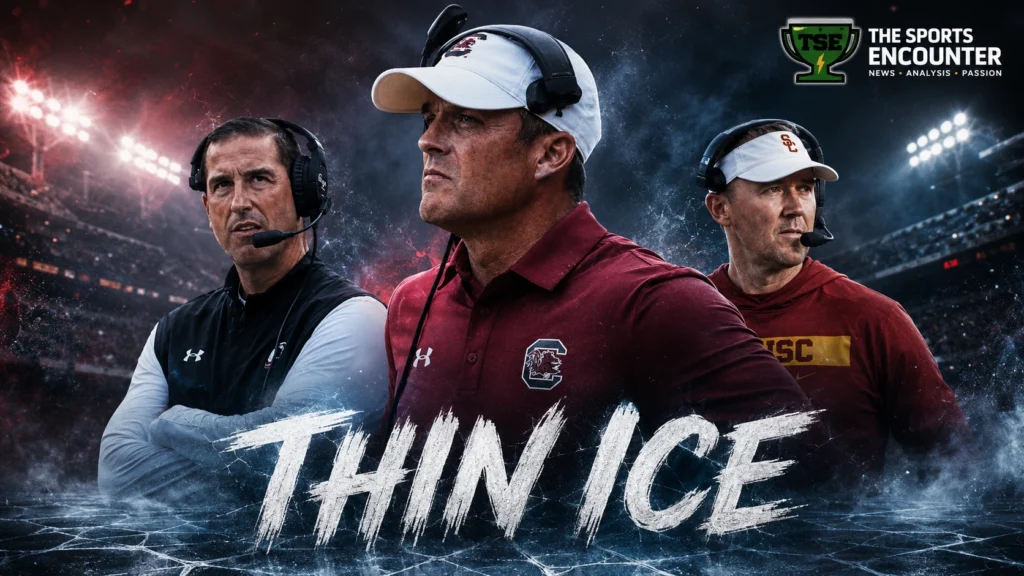
The 2026 college football season has barely begun, yet several high-profile coaches are already working under conditions where an ordinary losing streak could become a career-changing event.
Shane Beamer enters his sixth season at South Carolina after a 4-8 collapse. Luke Fickell survived another losing year at Wisconsin and now opens against Notre Dame at Lambeau Field. Lincoln Riley has already won USC’s first game, but the standard attached to his salary, recruiting reach and program resources remains considerably higher than merely producing winning seasons.
Mike Norvell at Florida State, Bill Belichick at North Carolina and Deion Sanders at Colorado add three more very different examples of coaching pressure.
The temptation is to place all of them on one generic “hot seat” list.
That misses what makes the 2026 coaching market interesting.
These coaches are under pressure for different reasons. Their schools expect different things. Their schedules offer different escape routes. Their previous achievements buy different amounts of patience.
College football’s modern coaching economy has also shortened the time available to prove that a program is moving somewhere useful. Transfer portal movement accelerates roster turnover. NIL resources make talent acquisition more immediate. Conference realignment has altered schedules. The expanded College Football Playoff has raised expectations at programs that believe national relevance should now be easier to reach.
A coach can therefore have a respectable résumé and still reach September knowing that seven or eight wins may no longer settle the argument.
By The Sports Encounter Editorial Desk
Published: September 2, 2026
Updated: September 2, 2026
College Football Coaches Under Pressure in 2026
| Coach | School | Recent Position | Main Pressure Point | Early 2026 Test |
|---|---|---|---|---|
| Mike Norvell | Florida State | 2-10 in 2024, 5-7 in 2025 | Collapse after 13-win season | SMU, Alabama, Louisville, Miami stretch |
| Shane Beamer | South Carolina | 4-8 in 2025, 1-7 SEC | Need to prove 2025 was a setback rather than direction of travel | Alabama followed later by Tennessee, Oklahoma and Texas A&M |
| Luke Fickell | Wisconsin | 4-8 in 2025 | Program identity and offensive decline | Notre Dame at Lambeau Field |
| Bill Belichick | North Carolina | 4-8 in first season | Proving NFL greatness translates to college program building | Early road test at Clemson |
| Lincoln Riley | USC | 9-4 in 2025, 1-0 in 2026 | Playoff-level expectations and resource advantage | Oregon, Penn State, Wisconsin, Ohio State |
| Deion Sanders | Colorado | 3-9 in 2025 | Rebuilding momentum after major regression | Early Big 12 schedule |
The important distinction is that “hot seat” does not mean every coach listed above is equally likely to be fired.
It means the 2026 season can materially change how the administration, boosters, players and supporters evaluate the direction of the program.
Shane Beamer Has Reached the Hardest Stage of a Rebuild
South Carolina presents one of the most interesting cases because Beamer has already shown that he can elevate the program.
The problem is proving that elevation can be sustained.
Beamer enters his sixth season with a 33-30 record. South Carolina’s official coaching biography notes that he has produced three wins over top-10 opponents and seven against top-25 teams during his first five seasons, along with three bowl appearances.
Those achievements matter because South Carolina is not operating with the same historical baseline as Alabama, Georgia or LSU.
The program plays inside the SEC, where a competitive team can improve considerably and still lose four or five games because the schedule offers so few soft landings.
That context also cannot excuse everything.
South Carolina finished 4-8 last season and went 1-7 in SEC play.
The school’s own profile of Beamer acknowledges that fourth-quarter problems contributed heavily to the 2025 record.
That changes the 2026 evaluation.
If South Carolina had been comprehensively outclassed every week, the issue would be straightforward talent deficiency. Losing competitive games late creates a different question about game management, roster depth, conditioning, execution and the ability to close.
Those problems fall closer to coaching responsibility.
South Carolina’s Schedule Gives Beamer a Chance to Build Momentum
The opening three weeks offer something Beamer desperately needs: room to establish confidence before the SEC schedule becomes severe.
South Carolina opens at home against Kent State, hosts Towson and then begins conference play against Mississippi State.
That gives the Gamecocks a plausible pathway to 3-0.
The next section will tell us much more.
The official South Carolina schedule sends the Gamecocks to Alabama on September 26. October eventually brings Tennessee at home and Oklahoma away, followed by Texas A&M in early November and Georgia later that month.
A good September could therefore stabilize the program.
A poor September would make the second half of the schedule extremely uncomfortable.
This is the central challenge for coaches entering a season under pressure.
They rarely receive the luxury of slowly discovering what their team is.
The first month can determine how every later result is interpreted.
Beamer’s Job Is to Restore Belief Before the Difficult Games Arrive
South Carolina does not need to become an SEC championship favorite overnight.
It needs to look like a team moving forward again.
That means avoiding games in which late execution repeatedly wastes three quarters of competitive football.
It means developing enough offensive consistency to prevent the defense from spending entire afternoons protecting narrow margins.
It also means making Williams-Brice Stadium difficult again when Tennessee, Texas A&M and Georgia arrive.
The modern college environment places enormous value on perception.
Players considering the transfer portal watch how programs are trending. Recruits see whether stadiums are full and whether coaches appear secure. Donors judge whether their investment is producing progress.
Momentum therefore becomes partly self-reinforcing.
That principle appears throughout American football. The Sports Encounter’s coverage of Fernando Mendoza, Drew Allar and other young quarterbacks entering the NFL shows how rapidly college performance can shape the next level. Programs need to convince elite players they can develop that same pathway.
Luke Fickell Faces a More Fundamental Question at Wisconsin
Wisconsin’s situation feels different.
The argument is no longer simply about whether Luke Fickell can improve the Badgers’ record.
It is about what Wisconsin football is supposed to be under him.
Fickell arrived with one of the strongest coaching reputations in the country after turning Cincinnati into a College Football Playoff program.
Wisconsin appeared to have found an ideal modernizer.
The results have not followed smoothly.
The Badgers went 5-7 in 2024 and 4-8 in 2025.
Wisconsin’s official biography of Fickell notes that last year’s team played seven ranked opponents and ten eventual bowl-eligible programs. Injuries also created major quarterback instability, with four quarterbacks used during the season.
Those are legitimate mitigating factors.
They do not erase 4-8.
The Badgers also struggled badly to score consistently, which matters at a program historically built on knowing exactly what kind of football it wanted to play.
Wisconsin’s Identity Crisis Matters as Much as the Record
Wisconsin spent decades establishing one of the clearest identities in major college football.
Powerful offensive lines. Productive running backs. Physical defense. Tight games. Player development. A roster that frequently produced more than recruiting rankings predicted.
Modernization was necessary because the Big Ten changed.
USC, UCLA, Oregon and Washington expanded the conference’s geographic and stylistic range. Ohio State and other elite programs continued recruiting at national-title levels. Passing offenses became increasingly sophisticated.
Wisconsin had to evolve.
The problem appears when evolution removes the old strengths before the new ones become reliable.
That is where Fickell’s tenure currently sits.
The university hired him to raise Wisconsin’s ceiling.
The immediate concern is whether the program has lowered its floor.
The distinction is why the 2026 season carries so much weight.
Notre Dame at Lambeau Is an Uncomfortable Opening Test
Wisconsin begins its season against Notre Dame on September 6 at Lambeau Field.
The Badgers officially confirmed the primetime opener, giving Fickell a major national stage before his team has had time to establish rhythm against lesser opposition.
That could work both ways.
Beat Notre Dame and much of the conversation changes immediately.
Wisconsin would suddenly possess a signature victory, national momentum and evidence that offseason adjustments worked.
Lose competitively and the season remains intact.
Lose badly, particularly if familiar offensive problems return, and every subsequent game becomes part of a referendum.
Pressure is rarely created by a single defeat.
The damaging losses are the ones that confirm an existing suspicion.
Fickell Cannot Depend on Schedule Difficulty Forever
There is another reason 2026 feels decisive.
Wisconsin’s Big Ten slate avoids Indiana, Ohio State, Oregon and Michigan.
That removes several of the conference’s most dangerous opponents.
Schedule arguments therefore become less persuasive if the record remains poor.
Fickell deserves credit for the circumstances Wisconsin faced in 2025. Seven ranked opponents and major quarterback injuries would test almost any team.
This season provides a cleaner evaluation.
The Badgers do not need perfection.
They need evidence of a functioning program.
Player development matters here as well. Former Wisconsin players continue to populate professional rosters, and The Sports Encounter recently examined the career consequences of that pipeline through Matt Henningsen’s brutal second Achilles injury during Denver Broncos camp.
Programs such as Wisconsin have historically sold recruits on development as much as five-star glamour.
That proposition becomes harder to maintain when the college team stops winning.
Lincoln Riley’s Hot Seat Is About Expectations Rather Than Collapse
USC requires a completely different standard.
Riley is not coming off a 4-8 season.
His Trojans went 9-4 in 2025 and 7-2 in Big Ten play.
USC’s official biography notes that the Trojans finished fifth nationally in third-down conversion rate, fifth nationally in passing offense and eighth in total offense last season.
Those are strong numbers.
They also demonstrate why Riley’s pressure is unusual.
USC did not hire him to build a consistently respectable nine-win program.
He arrived in Los Angeles with a résumé built around conference championships, Heisman-caliber quarterbacks and College Football Playoff appearances at Oklahoma.
The expectation was that USC would become nationally elite again.
That has not happened consistently enough.
USC’s Opening Win Was Good Enough to Reveal Both Sides of the Riley Debate
USC opened 2026 by defeating San Jose State 42-26.
Quarterback Jayden Maiava completed 25 of 29 passes for 286 yards and two touchdowns while also rushing for a score.
USC generated 505 total yards, converted nine of 13 third downs and led 35-3 after three quarters.
The official USC match report described a strong debut for several new playmakers.
Then San Jose State scored 23 points in the fourth quarter.
Many of those late points came against backups, so treating the final margin as evidence of a defensive collapse would overstate the concern.
It still created a familiar kind of discomfort around Riley’s USC teams.
The offense looks dangerous.
The real question is whether the entire team can remain dependable once Big Ten games become physical, close and strategically uncomfortable.
Jayden Maiava Gives Riley Something Every Coach on the Hot Seat Wants
A reliable quarterback can change the temperature around an entire program.
Maiava entered 2026 after leading the Big Ten with 3,711 passing yards last season and posting a 91.2 QBR, according to USC.
He looked extremely comfortable in the opener.
That matters because coaching pressure frequently accelerates when quarterback instability makes every other problem more difficult to diagnose.
Wisconsin experienced exactly that in 2025.
USC begins this season from the opposite position.
Riley has an experienced quarterback operating within a system widely associated with quarterback production.
That removes one excuse.
It also creates opportunity.
The NFL continues to reward elite college quarterback development enormously. The Sports Encounter followed that pathway during preseason through Fernando Mendoza’s first NFL touchdown and Drew Allar’s strong Pittsburgh performance.
If Maiava performs at a similar trajectory, USC should possess enough offense to challenge the conference’s elite.
USC’s Schedule Will Decide Whether Nine Wins Are Enough
The upcoming schedule explains why Riley remains under scrutiny despite respectable recent results.
USC hosts Fresno State and Louisiana before traveling to Rutgers.
Then the season becomes considerably harder.
The official USC schedule includes Oregon, Washington and Ohio State at the Coliseum, plus road trips to Penn State, Wisconsin, Indiana and UCLA.
There is opportunity in that difficulty.
Riley does not need voters or administrators to imagine that USC is moving toward national contention.
The schedule gives him chances to prove it.
Beat Oregon.
Win at Penn State.
Defeat Ohio State.
Those results would instantly change the narrative surrounding his tenure.
Another season built primarily on victories over teams USC is expected to beat would leave the central question unresolved.
USC Also Has a Fan-Engagement Problem Worth Watching
The opener drew 51,144 spectators at the Los Angeles Memorial Coliseum, USC’s smallest home attendance since Riley took over in 2022.
Extreme heat clearly contributed. Temperatures were above 90 degrees, the heat index exceeded 100, and the university took additional cooling measures.
That context is important.
Attendance still matters.
Major college programs sell belief as much as football.
A packed stadium tells recruits, players and television viewers that the program feels important.
Empty sections create the opposite impression, even when practical circumstances help explain them.
USC possesses one of American college sports’ strongest brands.
Riley’s challenge is to make Saturday at the Coliseum feel nationally consequential again.
Mike Norvell May Have the Most Dangerous Hot Seat of All
If the three headline coaches represent different kinds of pressure, Mike Norvell represents the fastest fall.
Florida State went 13-1 in 2023.
That team was controversially left outside the four-team College Football Playoff after quarterback Jordan Travis was injured.
The program then collapsed to 2-10 in 2024.
Last season brought a 5-7 finish.
Norvell opened 2026 with a 34-17 victory over New Mexico State, but the schedule quickly becomes revealing.
SMU and Alabama arrive later in September.
Louisville and Miami come consecutively in October.
This is where recent achievement collides with recent trajectory.
A coach who produced a 13-win season has demonstrated that he can build an excellent football team.
Two subsequent losing seasons can still destroy institutional confidence.
Bill Belichick Is Being Judged Against His Name as Much as His Record
North Carolina presents perhaps the strangest case.
Belichick’s six Super Bowl championships do not automatically solve the problems of recruiting, NIL management, transfer portal retention, booster relationships and college roster development.
His first season ended 4-8.
North Carolina then opened 2026 with an uninspiring 15-10 victory over TCU in Ireland.
Belichick deserves time to develop a college program because the job is substantially different from managing an NFL roster.
His age complicates the timeline.
At 74, the argument cannot simply be that a five-year reconstruction will eventually mature.
North Carolina needs evidence that the model can work soon enough to justify the unusual project.
The widening connection between college and professional football is one reason this experiment remains fascinating. TSE has covered that bridge extensively through stories such as Jeremiyah Love’s transition from Notre Dame star to Arizona Cardinals top-three draft pick and Jordyn Tyson’s move from Arizona State to the New Orleans Saints.
Belichick is attempting to operate on the other side of that pipeline.
Deion Sanders Needs to Recover the Energy Colorado Once Had
Colorado’s pressure is less about one particular number and more about the direction of the program.
Sanders initially transformed Colorado into one of the most watched teams in American sport.
Attention arrived instantly.
Recruiting changed.
Television audiences followed.
The Buffaloes eventually produced a nine-win season.
Then came 3-9 in 2025.
A charismatic rebuild can survive one difficult season.
Repeated losing seasons change the conversation from transformation to sustainability.
That is why 2026 matters.
Colorado does not need to become a national champion for Sanders to stabilize his position.
It needs to show that the program remains capable of producing competitive Big 12 football after the original surge of attention.
College Football’s Coaching Market Has Become Less Patient
The broader environment explains why these discussions begin so early.
Arkansas, Auburn, Florida, LSU, Oklahoma State, Penn State, UCLA and Virginia Tech all changed coaches during or after the 2025 season.
That turnover reflects something larger than impatient fan bases.
College football is becoming a more expensive enterprise.
Schools spend heavily on coaching staffs, facilities, recruiting departments, strength programs and player acquisition.
Conference distributions and television contracts have increased the financial consequences of winning.
The College Football Playoff has expanded access to national relevance.
When administrators believe their program has the resources to contend, patience contracts.
This mirrors what happens at the professional level.
The Sports Encounter’s analysis of NFL franchise values reaching extraordinary levels demonstrated how commercial growth raises expectations around football operations.
College programs operate under different ownership structures, but the economic principle is similar.
More resources create greater expectations for return.
NIL and the Transfer Portal Have Changed the Meaning of “Give Him Time”
Coaches once argued that rebuilding required several recruiting classes.
There was logic behind that.
Freshmen needed to mature.
Offensive linemen required years of physical development.
Depth charts reflected long recruiting cycles.
The transfer portal has shortened that process.
A coach can now change major sections of a roster in one offseason.
NIL resources create another recruitment tool.
Veteran quarterbacks can arrive immediately.
Experienced linemen can solve depth problems.
Players who are blocked elsewhere can become instant starters.
This does not mean every rebuild should happen overnight.
It means administrations are increasingly skeptical when coaches ask for four years before basic progress appears.
The roster can change faster.
Expectations have changed with it.
Player Development Still Separates Sustainable Programs From Expensive Ones
Portal activity can improve a roster rapidly.
It cannot replace development.
The strongest college programs still turn inexperienced recruits into reliable starters and reliable starters into professional prospects.
The NFL reveals the value of that process every year.
The Sports Encounter recently covered Trystan Colon’s six-year professional career after entering the league undrafted from Missouri.
His path illustrates the type of developmental credibility college coaches need when speaking to recruits who may never become five-star celebrities.
Another example appears in our coverage of Kion Smith earning another NFL opportunity after entering professional football undrafted from Fayetteville State.
Good college programs create NFL players at multiple levels of the recruiting hierarchy.
That development builds trust.
Trust helps recruiting.
Recruiting helps winning.
When development stalls, the cycle begins moving in the opposite direction.
What Each Coach Actually Needs in 2026
Shane Beamer: Get Back Above .500 and Beat Someone Important
Seven wins with a significant SEC victory would probably change the mood considerably.
Eight wins would make 2025 look far more like an isolated collapse.
Another four- or five-win season would make a sixth year difficult to defend.
Luke Fickell: Show Wisconsin Has a Football Identity Again
Six wins may technically represent improvement.
The performance level will matter nearly as much.
Wisconsin needs a functioning offense, stronger week-to-week consistency and evidence that Fickell’s model fits the institution.
Lincoln Riley: Beat Elite Teams
USC already knows Riley can produce good offenses and winning seasons.
The next step requires signature Big Ten victories and legitimate playoff contention.
Nine wins without meaningful progress against Oregon, Penn State or Ohio State may feel less satisfying than the raw record suggests.
Mike Norvell: Stop the Decline Immediately
Norvell probably has the smallest margin for another poor start.
Florida State cannot follow 2-10 and 5-7 with another season outside bowl relevance.
Bill Belichick: Prove the Project Has a Direction
North Carolina needs visible improvement in competitiveness, talent development and conference results.
A second 4-8 season would make the experiment increasingly difficult to justify.
Deion Sanders: Restore Competitive Relevance
Colorado needs enough wins to demonstrate that 2025 was regression rather than the beginning of a deeper decline.
The Most Important Games for the Hot-Seat Coaches
| Coach | Game or Stretch | Why It Matters |
|---|---|---|
| Shane Beamer | at Alabama | First major measuring stick after favorable opening stretch |
| Shane Beamer | Tennessee, Oklahoma, Texas A&M | Three-game run could define the season |
| Luke Fickell | Notre Dame at Lambeau | Immediate national test with no warm-up game |
| Luke Fickell | USC | Home opportunity against another pressured coach |
| Lincoln Riley | Oregon | Chance to prove USC can beat a conference heavyweight |
| Lincoln Riley | at Penn State | One of the season’s clearest playoff-level measuring sticks |
| Lincoln Riley | Ohio State | The kind of home game USC expects to matter nationally |
| Mike Norvell | SMU and Alabama | Early stretch can stabilize or accelerate pressure |
| Bill Belichick | at Clemson | Early evidence of whether UNC can compete with ACC power |
Wisconsin vs USC Could Become One of the Season’s Most Fascinating Coaching Games
October 24 offers a matchup that may carry far more meaning than anyone can know in early September.
USC travels to Wisconsin.
Riley and Fickell could arrive in completely different circumstances by then.
USC might be chasing the playoff.
Wisconsin might be fighting to establish bowl eligibility.
Both could be under significant pressure.
Or one of them could have already changed the entire season with an unexpected upset.
That uncertainty is why coaching hot-seat lists should be treated as snapshots rather than predictions.
College football can change reputations in three Saturdays.
Why Winning Eight Games Means Something Different at Every School
This is one of the most misunderstood parts of coaching evaluation.
Eight wins at South Carolina can represent an excellent season depending on the victories and schedule.
Eight wins at USC can feel disappointing if the Trojans never enter the national playoff conversation.
Seven wins at Wisconsin might save a program after two losing seasons because it restores trajectory.
Seven wins at Florida State could still feel inadequate after consecutive collapses following a 13-win campaign.
Context determines the standard.
History determines another part.
Resources determine another.
The promises made when the coach was hired matter too.
This is why raw records cannot tell us who deserves another season by themselves.
Fans Are Evaluating Direction as Much as Wins
Supporters generally understand when their team loses to a better opponent.
What they struggle to accept is repetition.
The same late collapse.
The same protection breakdown.
The same inability to stop the run.
The same failure to develop a quarterback.
The same recruiting weakness.
The same explanation afterward.
A coach survives difficult seasons more easily when fans can see what the finished product is supposed to become.
That is why identity matters so much for Fickell.
It explains why progress against elite opponents matters for Riley.
It explains why closing games matters for Beamer.
The record tells supporters where the team finished.
Repeated behavior tells them where it may be going.
The NFL Pipeline Adds Another Layer of Accountability
College football programs also compete through player outcomes.
Elite recruits want championships, NIL opportunities, exposure and preparation for professional football.
Coaches therefore sell development alongside victories.
The Sports Encounter’s coverage of the 2026 Pro Football Hall of Fame class illustrated how varied the route from college to professional greatness can become.
At the other end of that pipeline, rookies such as Mendoza, Jeremiyah Love and Jordyn Tyson show why college programs constantly advertise NFL preparation.
A coaching staff that regularly develops professional players gains an important recruiting advantage.
When both the win total and development pipeline weaken, administrations have fewer reasons to remain patient.
Who Is Under the Most Pressure Right Now?
If job security were measured purely by immediate danger, Mike Norvell probably enters September in the most precarious position.
Florida State’s fall from 13-1 to two consecutive losing seasons is difficult to absorb indefinitely.
Fickell follows closely because Wisconsin has already endured back-to-back seasons without a winning record and because the 2026 conference schedule offers fewer obvious excuses.
Beamer has more positive history at South Carolina than last year’s record alone suggests, but a second consecutive collapse would create a major decision.
Riley belongs in a different category.
His issue is ceiling rather than basic competence.
USC can win nine games and still leave supporters asking whether the program is receiving enough return for its resources.
Belichick’s status depends partly on how North Carolina defines the timeline of an unusual experiment.
Sanders needs to reverse Colorado’s decline before the original energy around the project disappears completely.
The Sports Encounter Verdict
College football’s 2026 hot-seat conversation is really six different conversations happening at once.
Shane Beamer needs to prove South Carolina’s 4-8 season did not expose a permanent ceiling.
Luke Fickell needs to show that Wisconsin still possesses a recognizable competitive identity after two losing seasons.
Lincoln Riley needs to turn good USC teams into nationally consequential ones.
Mike Norvell needs to stop one of the most dramatic program declines in recent college football memory.
Bill Belichick needs to demonstrate that championship-level NFL knowledge can become sustainable college program building.
Deion Sanders needs to prove Colorado’s national relevance did not depend on one wave of star power and attention.
The fascinating part is that none of their seasons requires a championship to change the story.
A victory over Notre Dame could transform Wisconsin’s confidence before September is a week old.
A South Carolina upset of Alabama could restore momentum around Beamer almost instantly.
A USC victory over Oregon, Penn State or Ohio State would give Riley the kind of result his tenure has been waiting for.
Florida State could calm the Norvell conversation by surviving its difficult September.
That is how quickly pressure moves in college football.
The coaches most at risk are rarely the ones who simply lose one game.
They are the ones whose losses keep confirming the same unresolved problem.
For Beamer, Fickell and Riley, 2026 is therefore less about escaping a label applied in September than controlling what the evidence looks like by November.
Frequently Asked Questions About the 2026 College Football Coaching Hot Seat
Is Shane Beamer on the hot seat at South Carolina?
Beamer enters 2026 under increased pressure after South Carolina finished 4-8 overall and 1-7 in SEC play in 2025. His earlier success gives him credibility, but another losing season would intensify questions about the program’s direction.
What is Shane Beamer’s record at South Carolina?
Beamer begins his sixth season with a 33-30 record through his first five years as South Carolina head coach.
Is Luke Fickell on the hot seat at Wisconsin?
Yes, Fickell faces significant pressure after Wisconsin finished 4-8 in 2025 following a 5-7 season in 2024. The Badgers need visible improvement during his fourth full season.
What is Luke Fickell’s record at Wisconsin?
Fickell enters the 2026 season with a 16-21 record across his first three seasons at Wisconsin.
Is Lincoln Riley on the hot seat at USC?
Riley’s situation is less severe than those of coaches coming off losing seasons, but expectations remain extremely high. USC went 9-4 in 2025, and the program is expected to become a regular College Football Playoff contender.
What is Lincoln Riley’s record at USC?
Riley entered the 2026 season 36-18 through four years at USC and opened the new campaign with a 42-26 victory over San Jose State.
Who is on the hottest seat in college football in 2026?
Mike Norvell is among the coaches facing the greatest immediate pressure after Florida State followed a 13-1 season in 2023 with records of 2-10 in 2024 and 5-7 in 2025.
Could Bill Belichick be fired by North Carolina?
There is no confirmed indication that North Carolina has decided to move on from Belichick. However, improvement will be important after a 4-8 first season, particularly because the long-term timeline of the program is unusual for a coach in his mid-70s.
What does Lincoln Riley need to achieve at USC in 2026?
USC needs more than another respectable winning record to change the perception around Riley. Victories against top Big Ten opponents and genuine College Football Playoff contention would provide the clearest evidence of progress.
When do Wisconsin and USC play in 2026?
Wisconsin hosts USC in Madison on October 24, 2026, in a Big Ten matchup that could carry major implications for both programs and their head coaches.