


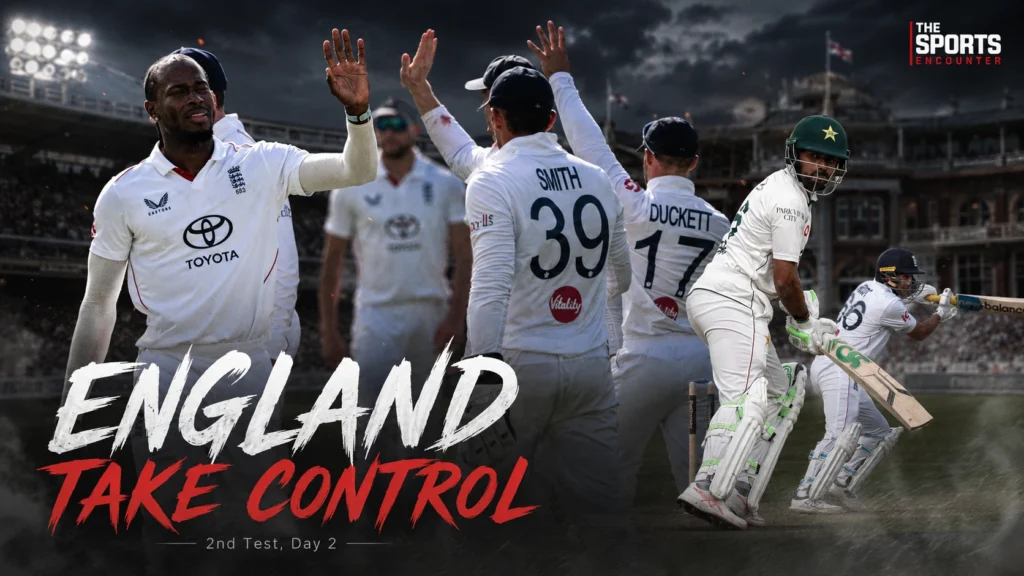
Pakistan walked back into Lord’s on Friday morning needing one wicket.
By the time bad light stopped play, England were 261 runs ahead and Pakistan were staring at another Test match rapidly moving beyond their control.
That transformation tells the story of Day 2.
England turned an overnight 248 for 9 into 290 before Ollie Robinson, Jofra Archer and Josh Tongue dismantled Pakistan for only 110. The hosts then reached 81 for 3 in their second innings, with Emilio Gay unbeaten on 30 and Harry Brook on 7.
Captain Joe Root fell for 24, while Ben Duckett and Jordan Cox were also dismissed, but those wickets did little to alter the balance of the match. England already had a 180-run first-innings advantage. Every second-innings run has since pushed Pakistan further toward a defeat that could settle the three-match series before Edgbaston.
For a Pakistan side that had appeared genuinely competitive during an encouraging opening day at Lord’s, Friday was a brutal reminder of how quickly Test cricket can punish a team that fails to convert a strong position.
England vs Pakistan 2nd Test Day 2: Score at Stumps
| Match situation | Score |
|---|---|
| England first innings | 290 all out |
| Pakistan first innings | 110 all out |
| England second innings | 81/3 |
| England lead | 261 runs |
| Emilio Gay | 30 not out |
| Harry Brook | 7 not out |
| Ollie Robinson | 4/11 |
| Jofra Archer | 3/26 |
| Josh Tongue | 2/27 |
| Azan Awais | 46 |
Atkinson and Tongue Turn 248/9 Into 290
Pakistan’s first problem arrived before they had even begun batting.
England resumed on 248 for 9 with Gus Atkinson on 34 and Josh Tongue on 1. Pakistan had spent much of Day 1 creating the conditions for a sub-260 total after Mohammad Abbas took four wickets and Mohammad Ali claimed three.
The final wicket refused to arrive cheaply.
Atkinson moved to 45 from 46 balls, Tongue produced a valuable unbeaten 30 from 48, and their tenth-wicket partnership carried England to 290.
England therefore added 42 runs to their overnight total with only one wicket remaining.
Those runs looked useful when they were scored. A few hours later, after Pakistan’s batting disintegrated, they looked enormous.
Jamie Smith’s 61 and Jordan Cox’s 55 had already rescued England from the instability of 120 for 5 on Day 1. Atkinson and Tongue completed the recovery by ensuring Pakistan had to confront a total approaching 300 rather than beginning their innings with the psychological lift of an immediate dismissal.
It completed a striking reversal from the position examined in our Lord’s Test build-up, when Pakistan’s ability to turn competitive periods into sustained control was identified as one of the central questions of the match.
Ollie Robinson Produces a Ruthless 4/11 Spell
England needed only four bowlers to dismiss Pakistan.
Robinson was comfortably the most economical and destructive of them.
His figures of four wickets for 11 runs from 13 overs included six maidens, an extraordinary level of control against a batting order already struggling to survive England’s seam attack.
Saud Shakeel was trapped lbw for 16. Mohammad Rizwan followed for seven. Khurram Shahzad made one before Robinson removed him, and Azan Awais’ resistance finally ended when he was caught by Brook for 46.
Robinson conceded fewer than one run per over.
It continued a remarkable series for the England seamer after his five-wicket performance helped destroy Pakistan during the opening Test at Headingley.
Pakistan have now seen Robinson repeatedly attack the same weaknesses: uncertain judgment around off stump, batters becoming trapped on the crease, and an inability to absorb prolonged periods of accurate seam bowling without eventually offering a chance.
Archer and Tongue Give Pakistan No Escape
If Robinson suffocated Pakistan, Archer supplied the additional threat that prevented them from finding a release.
Archer removed Shan Masood for one, later bowled Ali Usman for one and finished the innings by dismissing Mohammad Abbas for two. He ended with 3 for 26 from 11.2 overs.
Tongue took the other two available wickets, dismissing Abdullah Shafique for five and captain Babar Azam for eight.
Babar’s dismissal was particularly damaging.
Pakistan had waited for their captain to return after the hand injury that ruled him out at Headingley, a setback covered in our report on Babar missing the first Test. His comeback at Lord’s was supposed to strengthen the middle order and provide the calm Pakistan lacked in Leeds.
Instead, he lasted ten balls.
Pakistan were 30 for 3 when Cox caught him off Tongue.
The responsibility shifted almost immediately to Azan Awais.
Azan Awais Fights While Pakistan Collapse Around Him
Azan was the only Pakistan batter who looked capable of building a meaningful innings.
The young opener faced 102 balls for his 46, struck seven fours and survived while wickets disappeared around him. At one stage, with rain interrupting Pakistan at 81 for 4, Azan was unbeaten on 43 and had given his team at least a possibility of limiting the damage.
That possibility disappeared quickly.
Rizwan fell at 91. Ali Usman was dismissed at 104. Khurram followed at 105. Robinson then removed Azan at 106.
Pakistan eventually finished on 110.
From 91 for 5, their remaining available wickets produced only 19 runs.
Azan therefore accounted for more than 41 percent of Pakistan’s entire total himself.
His innings deserves recognition because it required patience and judgment against a relentless seam attack. It also exposed the scale of the problem around him. Pakistan did not need every batter to score a fifty. They needed partnerships capable of keeping England in the field long enough for the first-innings deficit to remain manageable.
None arrived.
Imam-ul-Haq Injury Leaves Pakistan Effectively a Batter Short
Pakistan’s problems were compounded by the absence of Imam-ul-Haq, who could not bat after suffering a calf injury while fielding on Day 1.
The Pakistan Cricket Board confirmed that scans showed a low-grade strain to his left calf. His availability for the remainder of the Test depends on his recovery.
That meant Pakistan’s innings ended after nine wickets had fallen, with Imam listed as absent hurt.
The injury does not explain the collapse. Pakistan still had Babar, Shan, Abdullah, Saud and Rizwan available. None reached 20.
It does, however, make an already difficult second-innings assignment even harder if Imam cannot recover sufficiently to bat later in the match.
Pakistan’s Batting Problem Is Becoming a Series Pattern
Lord’s can no longer be treated as an isolated batting failure.
Pakistan made 171 and 135 at Headingley. They have now followed those totals with 110 in their first innings at Lord’s.
That is three consecutive innings below 200.
The series preview identified Pakistan’s ability to survive England’s moving ball as one of the defining contests of the tour. Two Tests into the series, England’s seamers are decisively winning it.
The problem extends beyond dismissals.
Pakistan are struggling to create periods in which England’s bowlers are forced away from their preferred lengths. There have been individual contributions, but too few partnerships, too little sustained resistance and almost no opportunity for one batter to build an innings around support from the other end.
England consequently continue attacking rather than being forced to defend.
Khurram Shahzad Gives Pakistan Something to Fight With
Pakistan did find early wickets when England began again.
Khurram Shahzad removed Duckett for one and Cox for 11, leaving the hosts 13 for 2.
For a brief period, Pakistan had the chance to create another top-order wobble.
Gay and Root instead added 47 for the third wicket. Root reached 24 before Mohammad Ali trapped the England captain lbw at 60 for 3.
Pakistan reviewed successfully to remove him, giving them their third wicket and preventing Root from turning another start into a major innings.
Root’s second period as England captain began with an innings victory at Headingley and has already included another personal milestone after he became Test cricket’s leading outfield catcher, a record examined in our feature on Root’s record-breaking 219th Test catch.
His wicket offered Pakistan some encouragement on Friday.
The scoreboard offered considerably less.
Harry Brook Remains, and England Have Time on Their Side
Brook survived the closing period alongside Gay before bad light halted proceedings with England on 81 for 3.
The lead had already reached 261.
England still have seven wickets available.
That leaves Root’s side with several possible approaches on Day 3.
They can bat Pakistan completely out of the contest by extending the advantage beyond 350. They can accelerate if Brook settles quickly. Or they can decide that the condition of the pitch and Pakistan’s repeated batting collapses justify an earlier declaration.
There is little reason to rush.
England lead the series 1-0 after winning the Headingley Test by an innings and 103 runs, a result that also strengthened their position in the ICC World Test Championship. The ICC confirmed the importance of that victory to England’s WTC campaign.
A second victory would secure the series with the Edgbaston Test still to come.
Day 2 Completely Reversed Pakistan’s Strong Start at Lord’s
This is what should concern Pakistan most.
They played genuinely good cricket on Day 1.
Abbas was outstanding with the new ball. Mohammad Ali provided wickets. England fell to 36 for 3, then 77 for 4 and later 120 for 5. Pakistan had several opportunities to dismiss the hosts cheaply and build the response their series comeback desperately required.
Twenty-four hours later, they trail by 261.
That gap was created through England’s depth as much as Pakistan’s failures.
Smith, Cox, Atkinson and Tongue rescued the first innings. Robinson then dominated with the ball. Archer and Tongue supported him. Gay absorbed pressure when England batted again.
Different players kept solving different problems.
Pakistan have not been able to do the same.
The contrast also fits the wider stretch of red-ball cricket examined in The Sports Encounter’s feature on 19 consecutive scheduled days of Test cricket in August. Test matches often turn on whether teams can survive difficult sessions rather than dominate every one of them.
England survived theirs.
Pakistan did not.
What Pakistan Need on Day 3
Pakistan’s immediate task is obvious: take wickets quickly.
If Gay and Brook add another substantial partnership, England could move beyond a 300-run lead early in the day with seven wickets still available.
Khurram has already shown that England’s top order can be disturbed. Mohammad Abbas remains Pakistan’s most reliable bowler in these conditions, while Mohammad Ali removed Root and took three wickets in England’s first innings.
The bowlers therefore still have something to work with.
The larger question is what happens afterward.
Even if Pakistan dismiss England relatively cheaply on Saturday, they will probably face a substantial fourth-innings target against Robinson, Archer, Tongue and Atkinson on a Lord’s surface where they have already been dismissed for 110.
Imam’s fitness creates another uncertainty.
Babar’s return has restored Pakistan’s preferred captain, following the broader red-ball leadership reset explored when he returned to the Test captaincy. Leadership, however, cannot compensate for repeated batting collapses.
Pakistan entered Lord’s trying to keep the series alive.
They enter Day 3 trying to keep the match alive.
Frequently Asked Questions
What is the score after Day 2 of England vs Pakistan’s second Test?
England are 81 for 3 in their second innings after scoring 290 in the first innings. Pakistan were dismissed for 110, leaving England 261 runs ahead when bad light stopped play.
How many runs do England lead Pakistan by at Lord’s?
England lead Pakistan by 261 runs after Day 2 of the second Test.
How many runs did Pakistan score in their first innings?
Pakistan were bowled out for 110 in 37.2 overs. Imam-ul-Haq was unable to bat because of a calf injury and was recorded as absent hurt.
Who took the most wickets for England against Pakistan on Day 2?
Ollie Robinson took 4 for 11 from 13 overs, including six maidens. Jofra Archer claimed 3 for 26 and Josh Tongue took 2 for 27.
Who was Pakistan’s top scorer in the first innings?
Azan Awais top-scored with 46 from 102 balls, including seven fours.
What happened to Imam-ul-Haq?
Imam suffered a left calf strain while fielding on Day 1. The PCB later confirmed that scans showed a low-grade strain, and his further participation depends on his recovery.
Who is unbeaten for England going into Day 3?
Emilio Gay is unbeaten on 30 and Harry Brook is not out on 7.
How many runs did Joe Root score in England’s second innings?
England captain Joe Root made 24 from 37 balls before Mohammad Ali trapped him lbw.
Who took England’s three second-innings wickets for Pakistan?
Khurram Shahzad dismissed Ben Duckett and Jordan Cox, while Mohammad Ali removed Joe Root.
When does Day 3 of the England vs Pakistan second Test begin?
Day 3 is scheduled for Saturday, August 29, 2026 at Lord’s, with England holding a commanding 261-run advantage.