


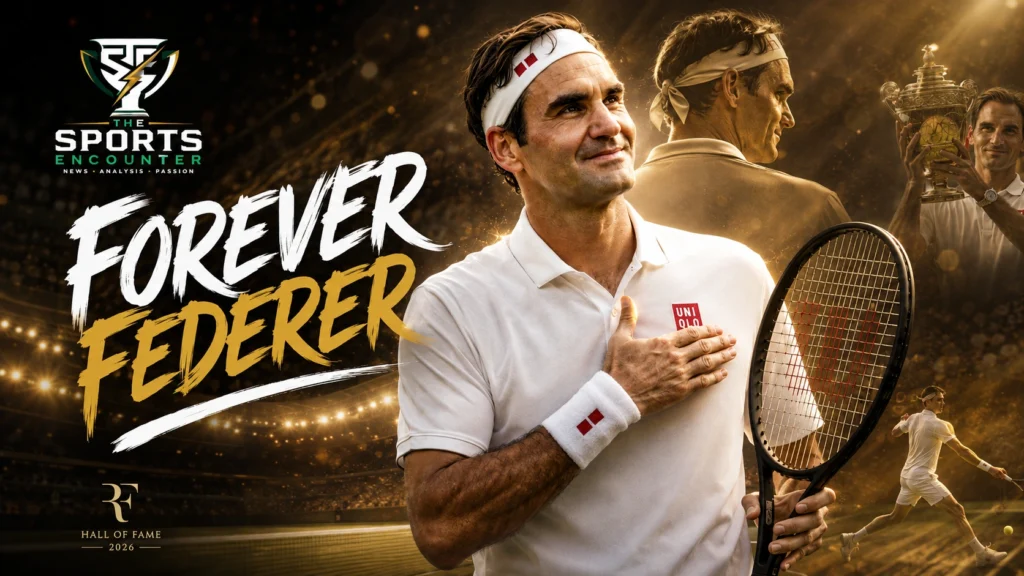
Roger Federer spent much of his career making difficult tennis look strangely simple.
The footwork rarely appeared rushed. The forehand seemed to arrive before opponents understood where the ball was going. His one-handed backhand could move from defense to attack in a single swing, while the serve disguised direction without relying on overwhelming speed.
That elegance became such a large part of Federer’s identity that it sometimes obscured the harder truth beneath it.
He was one of the most relentless winners tennis has ever produced.
Federer finished his career with 103 ATP Tour singles titles, 20 Grand Slam championships, six ATP Finals trophies, 28 Masters 1000 titles, 310 weeks as world No. 1, 1,251 tour-level victories and a record 237 consecutive weeks at the top of the rankings. Only Jimmy Connors finished the Open Era with more ATP singles titles and tour-level match wins. :contentReference[oaicite:1]{index=1}
On Saturday, August 29, Federer will officially enter the International Tennis Hall of Fame in Newport, Rhode Island, where the Class of 2026 will be honored on the historic Horseshoe Court. The ceremony begins at 6:30 p.m. ET. :contentReference[oaicite:2]{index=2}
The moment feels inevitable.
The career that led there never was.
Roger Federer’s Career at a Glance
| Category | Federer Record |
|---|---|
| ATP Tour singles titles | 103 |
| Grand Slam singles titles | 20 |
| Australian Open titles | 6 |
| Roland Garros titles | 1 |
| Wimbledon titles | 8 |
| US Open titles | 5 |
| ATP Masters 1000 titles | 28 |
| ATP Finals titles | 6 |
| Weeks at World No. 1 | 310 |
| Consecutive weeks at No. 1 | 237 |
| Tour-level match wins | 1,251 |
| Olympic medals | Gold in doubles, silver in singles |
| Davis Cup titles | 1 |
The International Tennis Hall of Fame also lists Federer as a six-time ATP Finals champion, a Davis Cup winner, Olympic doubles gold medalist, Olympic singles silver medalist and three-time Laver Cup champion. :contentReference[oaicite:3]{index=3}
The 20 Grand Slam Titles That Built the Federer Era
Federer’s 20 majors no longer stand as the men’s record. Novak Djokovic has 24 and Rafael Nadal finished with 22.
That later context should not diminish what Federer’s number meant when he built it.
When Federer won Wimbledon in 2009 for his 15th Grand Slam title, he moved past Pete Sampras’ then-record of 14. For a period, Federer had pushed the historical standard so far forward that the rest of men’s tennis appeared to be chasing a number that might not be reached for decades.
It was reached because Federer’s own rivals were historically exceptional.
Australian Open: Six Titles
Federer won in Melbourne in 2004, 2006, 2007, 2010, 2017 and 2018.
The first established him as the clear No. 1 of his generation.
The last two changed how his career was remembered.
By 2017, Federer was 35 years old, returning from six months away because of a knee injury, seeded 17th and entering his first competitive event since Wimbledon 2016.
He still reached the final.
Rafael Nadal was waiting.
Federer won 6-4, 3-6, 6-1, 3-6, 6-3, recovering from a break down in the final set to claim major No. 18. It was his first Grand Slam title since Wimbledon 2012. :contentReference[oaicite:4]{index=4}
A year later, he beat Marin Cilic for Australian Open title No. 6 and major No. 20.
He was 36.
Roland Garros: One Title That Meant More Than the Number
Federer reached four consecutive French Open finals from 2006 through 2009.
Rafael Nadal defeated him in the first three.
Then 2009 changed everything.
Robin Soderling stunned Nadal in the fourth round, removing the opponent who had blocked Federer repeatedly in Paris.
Federer still had to survive the tournament.
He eventually reached the final and beat Soderling 6-1, 7-6(1), 6-4.
The victory gave Federer his 14th major and completed the career Grand Slam, making him only the sixth man at the time to win all four majors. :contentReference[oaicite:5]{index=5}
Among Federer’s 20 majors, that one may have removed the largest historical question.
Wimbledon: Eight Titles and the Place Most Closely Connected to Federer
Federer won Wimbledon in 2003, 2004, 2005, 2006, 2007, 2009, 2012 and 2017.
Eight men’s singles titles remain a Wimbledon record.
The first came in 2003 against Mark Philippoussis.
It was Federer’s first Grand Slam championship.
Four years later, he had won five consecutive Wimbledon titles.
His eighth arrived in 2017 without dropping a set.
That title turned Centre Court into the clearest physical symbol of his career.
The relationship remains so strong that even when Novak Djokovic passed Federer’s Wimbledon men’s match-win record in 2026, Federer’s eight championships remained the standard Djokovic was still chasing. The Sports Encounter covered that milestone in our Wimbledon 2026 Day 7 report.
US Open: Five Consecutive Titles
Federer won the US Open every year from 2004 through 2008.
Five straight championships.
Forty consecutive match victories.
Six consecutive finals through 2009.
The Sports Encounter recently revisited that dynasty when Federer returned to Arthur Ashe Stadium for the farewell New York never properly received in our Federer US Open tribute.
The five finals Federer won came against Lleyton Hewitt, Andre Agassi, Andy Roddick, Novak Djokovic and Andy Murray.
That opponent list matters.
His New York dominance did not happen in a transitional vacuum.
Federer’s 103 Titles Were Built Across Every Surface
Federer’s 103 ATP Tour singles titles remain the second-highest total in Open Era men’s tennis, behind Connors’ 109. :contentReference[oaicite:6]{index=6}
The number came through dominance in very different conditions.
His Most Successful Tournaments
| Tournament | Federer Titles |
|---|---|
| Basel | 10 |
| Halle | 10 |
| Wimbledon | 8 |
| Cincinnati Masters | 7 |
| Australian Open | 6 |
| ATP Finals | 6 |
| US Open | 5 |
ATP records identify Federer as the tournament record-holder for championships at Basel, Halle, Wimbledon and Cincinnati. :contentReference[oaicite:7]{index=7}
Basel had emotional significance because it was home.
Halle became his grass-court laboratory.
Wimbledon became his stage.
Cincinnati became one of the places where his attacking tennis worked with almost unnatural efficiency.
His seven Cincinnati titles remain more than he won at any other Masters 1000 tournament. :contentReference[oaicite:8]{index=8}
Six ATP Finals Titles Proved Federer Could Beat the Best Repeatedly
The ATP Finals are different from ordinary tournaments.
There is no early-round opponent ranked outside the elite.
Every match is against one of the season’s strongest players.
Federer won the event six times and recorded 59 victories there, both tournament records at the time of his retirement. He also reached 10 finals. :contentReference[oaicite:9]{index=9}
That part of the résumé matters because it confirms something the aesthetics can obscure.
Federer did not simply dominate weaker fields.
He repeatedly beat the best players in the world at an event designed specifically to gather them together.
Twenty-Eight Masters Titles Completed the Resume
Federer won 28 ATP Masters 1000 titles.
He became particularly dominant at Cincinnati and also built major championship runs at Indian Wells, Miami, Hamburg, Madrid and other elite stops.
In 2005, he won Indian Wells, Miami, Cincinnati and the US Open in the same season, completing a sweep of the four biggest American hard-court tournaments he played that year. :contentReference[oaicite:10]{index=10}
That season finished with an 81-4 record.
Those numbers are easier to understand when placed beside the eye test.
Federer’s peak was not merely beautiful.
It was brutally efficient.
The Rivalry With Rafael Nadal Changed Federer’s Career
Federer and Nadal played 40 times.
Nadal finished ahead 24-16. :contentReference[oaicite:11]{index=11}
The statistics tell one story.
The surfaces tell another.
Nadal led 14-2 on clay.
Federer led 11-9 on hard courts and 3-1 on grass.
Their styles could hardly have been more different.
Federer wanted to shorten points, take time away and move forward.
Nadal’s heavy left-handed forehand attacked Federer’s one-handed backhand relentlessly, particularly on clay.
That tactical imbalance became one of the defining problems of Federer’s career.
It also forced him to evolve.
2008 Wimbledon Final: The Loss That Became Part of Federer’s Legacy
Not every iconic Federer match was a victory.
The 2008 Wimbledon final against Nadal became one of the greatest matches ever played.
Nadal won 6-4, 6-4, 6-7, 6-7, 9-7.
Federer had been Wimbledon champion for five consecutive years.
The match ended that reign.
Its importance lies partly in what happened afterward.
Federer returned to New York weeks later and won his fifth consecutive US Open.
He then regained Wimbledon in 2009.
The losses mattered because they showed what the smoothness sometimes hid.
Federer absorbed enormous defeats and kept returning.
2017 Australian Open Final: Federer Finally Changes the Nadal Pattern
Melbourne 2017 may be the victory that best explains Federer’s late-career evolution.
He had lost six of their previous eight Grand Slam meetings.
He had not beaten Nadal at a major since Wimbledon 2007.
In the fifth set, Federer fell behind 3-1.
Then came five consecutive games.
The backhand, historically the side Nadal had targeted, became the shot Federer used to take time away.
The victory gave Federer his 18th major. :contentReference[oaicite:12]{index=12}
More importantly, it showed that a 35-year-old champion could still reengineer his game.
Novak Djokovic Became Federer’s Other Great Historical Problem
Federer and Djokovic played 50 times.
Djokovic finished ahead 27-23. :contentReference[oaicite:13]{index=13}
The rivalry developed differently from Federer-Nadal.
Nadal confronted Federer at his peak and challenged his tactical comfort.
Djokovic gradually became the player capable of absorbing Federer’s best tennis and still surviving the final few points.
They met in 19 finals, with Djokovic winning 13. :contentReference[oaicite:14]{index=14}
2007 US Open Final: Federer Beats the Rising Djokovic
Djokovic was already becoming a major force when Federer beat him in straight sets in the 2007 US Open final.
Federer’s victory completed his fourth consecutive New York championship.
At the time, the rivalry still belonged to the established champion.
It would not stay that way.
2011 Roland Garros: Federer Stops Djokovic’s Run
Djokovic entered the 2011 French Open semifinal undefeated for the season.
Federer beat him in four sets.
The victory remains one of Federer’s most important wins because it came against Djokovic during one of the Serbian’s most dominant seasons.
Federer did not win the tournament. Nadal beat him in the final.
The semifinal nevertheless remains one of the clearest examples of Federer producing elite tennis when the opponent appeared almost unbeatable.
2019 Wimbledon Final: The Match Federer Could Not Close
Federer held two championship points against Djokovic while serving at 8-7 in the fifth set.
He lost both.
Djokovic eventually won the final-set tiebreak.
Federer was 37 years old.
The defeat became one of the cruelest endings of his career.
It also became part of why fans connected so strongly with him late in his career.
The man associated with control had become visibly vulnerable to time, pressure and margins measured in inches.
Andy Roddick Was the Rival Federer Repeatedly Denied
The Federer-Roddick rivalry was statistically one-sided.
Its emotional importance was much larger.
Roddick had the serve, athleticism and personality to become the dominant American star of the post-Sampras and Agassi era.
Federer repeatedly stood in his way.
They met in four Grand Slam finals.
Federer won all four.
The last was the one everybody remembers.
2009 Wimbledon Final: 16-14 and Major No. 15
Roddick served magnificently.
Federer struggled to break him for almost the entire match.
The final reached 14-14 in the fifth set.
Federer eventually won 5-7, 7-6(6), 7-6(5), 3-6, 16-14.
It was his 15th major, moving him past Sampras’ record. :contentReference[oaicite:15]{index=15}
For Federer, it was history.
For Roddick, it became one of the most painful near-misses in tennis history.
The match remains iconic because both truths exist at once.
Pete Sampras Gave Federer the First Great Victory
Before Federer became Federer, Pete Sampras owned Wimbledon.
Sampras had won seven of the previous eight championships when the 19-year-old Swiss faced him in the fourth round in 2001.
Federer won in five sets.
The Hall of Fame describes that victory as one of the earliest signals of what was coming. :contentReference[oaicite:16]{index=16}
The symmetry became obvious later.
Federer defeated the seven-time Wimbledon champion before eventually winning eight Wimbledon titles himself.
The match became less important for what it achieved immediately and more important for what it revealed.
The 2009 French Open Completed the Missing Piece
The biggest pressure around Federer before 2009 was straightforward.
Could he win Roland Garros?
The debate followed him for years.
Nadal had denied him repeatedly.
Federer finally received a different opponent in the final and did not waste the opening.
Beating Soderling completed the career Grand Slam and removed the one obvious surface-based criticism of his résumé. :contentReference[oaicite:17]{index=17}
Weeks later, he won Wimbledon and broke Sampras’ major record.
No short stretch better captures Federer’s historical ambition than Paris and London in 2009.
2017 Was the Season Federer Was Supposed to Be Finished
Federer missed the second half of 2016 because of injury.
He returned at 35.
That should have been the beginning of a gradual farewell.
Instead, he won the Australian Open.
Then Indian Wells.
Then Miami.
Then Halle.
Then Wimbledon.
He finished the year with seven titles.
The backhand had become more aggressive. His court position moved forward. Points shortened.
Federer did not return by recreating his younger self.
He returned by changing what was necessary and protecting what remained elite.
That season may be the best evidence of his adaptability.
2019 Dubai: Title No. 100
Federer beat Stefanos Tsitsipas 6-4, 6-4 in the 2019 Dubai final to become only the second man in the Open Era to win 100 ATP Tour singles titles.
Tsitsipas had beaten Federer at the Australian Open only weeks earlier.
Federer answered in Dubai.
He later added three more trophies to finish with 103, with his final title appropriately coming in Basel. :contentReference[oaicite:18]{index=18}
Olympic Gold, Davis Cup and Playing for Switzerland
Federer’s career was built primarily around individual competition, but several of his most emotional achievements came while representing Switzerland.
He won Olympic doubles gold with Stan Wawrinka in Beijing in 2008.
Four years later, Federer won singles silver at the London Olympics.
Then came the Davis Cup.
Switzerland won the competition in 2014, giving Federer one of the few major team trophies missing from his résumé.
The Hall of Fame lists his Davis Cup record at 40-8 in singles and 12-10 in doubles. :contentReference[oaicite:19]{index=19}
Federer’s Records Once Looked Permanent
They were not.
Djokovic passed his Grand Slam total.
Nadal passed it first.
Djokovic later passed his weeks at No. 1.
In 2026, Djokovic moved beyond Federer’s Wimbledon men’s match-win total, a milestone The Sports Encounter covered during Wimbledon 2026.
That is what happens to statistical records.
Great players turn them into targets.
Federer’s legacy becomes more interesting when the conversation moves beyond which numbers survived.
Federer Changed the Standard Before Nadal and Djokovic Changed It Again
Federer, Nadal and Djokovic spent a combined 947 weeks at world No. 1.
The ATP describes their shared era as one of the defining periods in men’s tennis history. :contentReference[oaicite:20]{index=20}
Federer reached the top first.
From February 2004 through August 2008, he held the No. 1 ranking for 237 consecutive weeks.
No one has matched that streak. :contentReference[oaicite:21]{index=21}
Nadal forced Federer to confront a style built to attack his weaknesses.
Djokovic later created a different problem through return quality, movement, defense and mental resilience.
Federer’s numbers eventually became part of the chase that motivated both.
That is one reason evaluating the Big Three entirely through final totals misses something.
Federer changed the record book first.
Nadal and Djokovic then changed what seemed possible after him.
The Federer Style Became Its Own Form of Influence
Tennis players influence later generations through results.
Federer also influenced them through aspiration.
Young players wanted the forehand.
They wanted the one-handed backhand.
They wanted the serve motion.
They wanted to move through the court without appearing rushed.
The reality was more complicated.
Federer’s tennis worked because several unusual skills existed together: early ball recognition, foot speed, hand skills, disguise, serve placement, transition play and the confidence to take the ball earlier than most opponents.
Imitating the shape of the strokes was much easier than reproducing the system behind them.
His Longevity Changed the Meaning of a Tennis Prime
Federer won his first Wimbledon at 21.
He won his final major at 36.
He returned to world No. 1 at 36 years and 320 days, becoming the oldest man to hold the ranking at the time. :contentReference[oaicite:22]{index=22}
That second phase of his career mattered because it challenged the assumption that elite tennis had a narrow expiration date.
Federer’s late career depended on selective scheduling, shorter points and technical adaptation.
Modern veterans use similar principles now.
The Sports Encounter’s recent analysis of Novak Djokovic’s continuing late-career pursuit of Wimbledon history explored the same problem from the next generation in our Djokovic Wimbledon 2026 feature.
Federer Made Sportsmanship Commercially Powerful
Federer received the Stefan Edberg Sportsmanship Award 13 times.
Fans voted him ATP Fans’ Favourite for 19 consecutive years from 2003 through 2021. :contentReference[oaicite:23]{index=23}
Those awards matter because Federer’s public image became part of the sport’s global commercial expansion.
He could be presented equally comfortably in London, Shanghai, Dubai, New York, Melbourne or Basel.
His personality remained controlled without appearing distant.
His rivalry with Nadal developed into genuine friendship.
His retirement at the 2022 Laver Cup became unforgettable partly because Nadal sat beside him crying.
Competition had evolved into shared history.
The Laver Cup Became Part of Federer’s Post-Playing Legacy Before He Even Retired
Federer helped create the Laver Cup, giving men’s tennis a team event built around Europe against the rest of the world.
He played in the first three editions and was part of the winning Team Europe side each time.
His final competitive match came at the event in 2022, when he partnered Nadal in doubles.
That ending would have sounded almost artificially symbolic if it had been written years earlier.
The two defining rivals finished Federer’s career on the same side of the net.
Federer’s Career Also Changed the Business of Being a Tennis Star
The global appeal continued after retirement.
In 2026, ATP reported that Federer had joined Forbes’ World’s Billionaires List, reflecting the scale of the commercial empire built around endorsements, investments and business ventures after a career already worth hundreds of millions in prize money and partnerships. :contentReference[oaicite:24]{index=24}
That does not make him a greater tennis player.
It demonstrates how far his influence extended beyond matches.
Federer became a global sports brand without losing his connection to the sport itself.
New York Recently Gave Federer the Farewell It Missed
Federer’s relationship with tennis remains active.
Only days before his Hall of Fame induction, he returned to Arthur Ashe Stadium for a special US Open exhibition alongside Andy Roddick, Andre Agassi and John McEnroe.
The Sports Encounter described that event as the farewell New York never received because Federer’s final US Open appearance in 2019 passed without anyone knowing it would be his last.
Read our complete feature: Roger Federer Returns to Flushing Meadows for the Farewell New York Never Got.
The timing feels appropriate.
New York closed one unfinished chapter.
Newport will formalize the legacy.
Roger Federer’s Most Iconic Victories
| Year | Match | Why It Matters |
|---|---|---|
| 2001 | Federer def. Pete Sampras, Wimbledon fourth round | The breakthrough victory over the seven-time champion signaled a changing of generations. |
| 2003 | Federer def. Mark Philippoussis, Wimbledon final | His first Grand Slam title. |
| 2004 | Federer def. Marat Safin, Australian Open final | Helped establish Federer as world No. 1 and the dominant force of the era. |
| 2005 | Federer def. Rafael Nadal, Miami final | Federer recovered from two sets down in an early classic of the rivalry. |
| 2007 | Federer def. Rafael Nadal, Wimbledon final | Federer survived five sets to claim his fifth consecutive Wimbledon. |
| 2007 | Federer def. Novak Djokovic, US Open final | Federer completed a fourth consecutive US Open title. |
| 2009 | Federer def. Robin Soderling, Roland Garros final | Completed the career Grand Slam. |
| 2009 | Federer def. Andy Roddick, Wimbledon final | Won 16-14 in the fifth set and broke Sampras’ major record with title No. 15. |
| 2011 | Federer def. Novak Djokovic, Roland Garros semifinal | Stopped Djokovic during one of the most dominant starts to a season in tennis history. |
| 2012 | Federer def. Andy Murray, Wimbledon final | Returned Federer to No. 1 and delivered his seventh Wimbledon title. |
| 2017 | Federer def. Rafael Nadal, Australian Open final | Won major No. 18 after six months away and transformed the final phase of his career. |
| 2017 | Federer def. Marin Cilic, Wimbledon final | Won a record eighth Wimbledon without dropping a set. |
| 2018 | Federer def. Marin Cilic, Australian Open final | Claimed his 20th and final major at age 36. |
| 2019 | Federer def. Stefanos Tsitsipas, Dubai final | Became the second Open Era man to reach 100 ATP singles titles. |
Roger Federer’s Biggest Rivalries
| Rival | Final Head-to-Head | What Defined It |
|---|---|---|
| Rafael Nadal | Nadal 24-16 | Contrasting styles, clay vs grass, repeated Grand Slam finals and one of sport’s defining friendships. |
| Novak Djokovic | Djokovic 27-23 | Elite shotmaking against extraordinary defense, return quality and mental pressure across 50 meetings. |
| Andy Roddick | Federer dominated the series | Federer repeatedly blocked America’s leading star from additional Grand Slam glory. |
| Andy Murray | One of Federer’s key late-2000s and early-2010s matchups | Variety, anticipation and tactical problem-solving, including major finals at the US Open, Australian Open and Wimbledon. |
| Lleyton Hewitt | Federer turned an early rivalry into sustained dominance | Hewitt represented the world No. 1 standard Federer had to pass before establishing his own era. |
Federer’s Legacy Cannot Be Reduced to the GOAT Argument
The temptation is obvious.
Twenty majors versus 22.
310 weeks at No. 1 versus 428.
103 titles versus other historical totals.
Those comparisons matter.
They are not sufficient.
Federer’s role in tennis history was partly numerical and partly transformational.
He arrived after Sampras and Agassi had defined the previous era.
Then he accelerated everything.
He won majors at a rate that seemed unreasonable.
He held No. 1 for 237 consecutive weeks.
He made 23 consecutive Grand Slam semifinals and 36 consecutive quarterfinals.
He turned baseline tennis into attacking geometry while still remaining one of the last great serve-and-volley-capable champions.
Then Nadal arrived.
Then Djokovic.
The numbers changed again.
The standard never went backward.
The Most Important Federer Record May Be the One Nobody Can Measure
Federer made people want to watch tennis who were not necessarily tennis fans.
That matters.
Some athletes dominate their sport.
A smaller group expand its audience.
Federer’s appeal crossed geography, language and surface.
Fans who preferred Nadal still watched Federer.
Fans who later supported Djokovic still measured matches against the Federer era.
Young players copied the backhand even when coaches advised against it.
Tournaments marketed his presence as an event rather than an entry.
That kind of influence rarely survives in a statistical database.
Why the Hall of Fame Induction Feels Different From Retirement
Federer retired in 2022.
The emotional farewell has already happened.
Newport serves a different purpose.
The International Tennis Hall of Fame exists to turn careers into permanent historical record.
Federer will join the institution on August 29 alongside Mary Carillo, with the ceremony scheduled for 6:30 p.m. ET on the Horseshoe Court. :contentReference[oaicite:25]{index=25}
The Hall has described induction as tennis’ ultimate honor.
For Federer, it also completes a circle.
He spent his career openly respecting the history of tennis.
When he learned of his election, he said being recognized alongside the sport’s great champions was “deeply humbling.” :contentReference[oaicite:26]{index=26}
The Sports Encounter Verdict: Federer Changed What Greatness Looked Like
Roger Federer did not finish with every record.
That does not weaken the career.
It explains the era.
Federer raised the standard.
Nadal attacked it.
Djokovic pushed it further.
Together, they created the greatest sustained competitive period men’s tennis has seen.
Federer’s place inside that story remains distinct.
He was the first of the three to break the old record book open.
He was the player whose style made dominance look artistic.
He was the champion who lost some of the most painful matches imaginable and still returned to win majors in his mid-30s.
He won Wimbledon eight times.
He won the US Open five years in a row.
He completed the career Grand Slam.
He reached 100 titles before finishing with 103.
He stayed No. 1 for 237 consecutive weeks.
He won 1,251 matches without ever retiring from a singles match during his career. ATP records note that Federer never retired in any of his 1,526 singles or 224 doubles matches. :contentReference[oaicite:27]{index=27}
That final detail may say as much about him as any trophy.
Federer’s tennis was remembered for grace.
The career underneath it was built on durability, stubbornness, adaptation and an extraordinary appetite for competing again.
On Saturday in Newport, the trophies will already be known.
The records will already be written.
The rivalries will already belong to tennis history.
The Hall of Fame induction simply gives the sport a permanent place to put the name.
Roger Federer has belonged there for a very long time.
Frequently Asked Questions
When will Roger Federer be inducted into the International Tennis Hall of Fame?
Roger Federer will be inducted on Saturday, August 29, 2026, in Newport, Rhode Island. The ceremony is scheduled to begin at 6:30 p.m. ET.
How many titles did Roger Federer win?
Federer won 103 ATP Tour singles titles, the second-highest total in the Open Era behind Jimmy Connors’ 109.
How many Grand Slam titles did Roger Federer win?
Federer won 20 Grand Slam singles titles: six Australian Opens, one Roland Garros, eight Wimbledons and five US Opens.
How many Wimbledon titles did Roger Federer win?
Federer won eight Wimbledon men’s singles titles, a tournament record.
How many US Open titles did Federer win?
Federer won five consecutive US Open titles from 2004 through 2008.
Did Roger Federer win the career Grand Slam?
Yes. Federer completed the career Grand Slam by winning Roland Garros in 2009.
What was Federer’s record against Rafael Nadal?
Nadal led their final head-to-head series 24-16 across 40 matches.
What was Federer’s record against Novak Djokovic?
Djokovic finished their rivalry with a 27-23 advantage across 50 meetings.
What was Roger Federer’s most iconic victory?
Several qualify, but the 2017 Australian Open final against Rafael Nadal, the 2009 Roland Garros final against Robin Soderling and the 2009 Wimbledon final against Andy Roddick are among the strongest candidates.
How long was Federer world No. 1?
Federer spent 310 total weeks at world No. 1, including a record 237 consecutive weeks from February 2004 through August 2008.
Did Roger Federer win Olympic gold?
Yes. Federer won Olympic doubles gold with Stan Wawrinka at Beijing 2008. He also won singles silver at London 2012.
Did Federer win the Davis Cup?
Yes. Federer helped Switzerland win the Davis Cup in 2014.
What was Federer’s final Grand Slam title?
Federer’s 20th and final major came at the 2018 Australian Open, where he defeated Marin Cilic in the final.
What was Federer’s 100th ATP title?
Federer won his 100th tour-level title at Dubai in 2019 by defeating Stefanos Tsitsipas in the final.
Why is Roger Federer’s legacy important?
Federer combined historic results with technical influence, global popularity, longevity and sportsmanship. His dominance helped redefine the statistical standard of men’s tennis before Rafael Nadal and Novak Djokovic pushed that standard even further.