


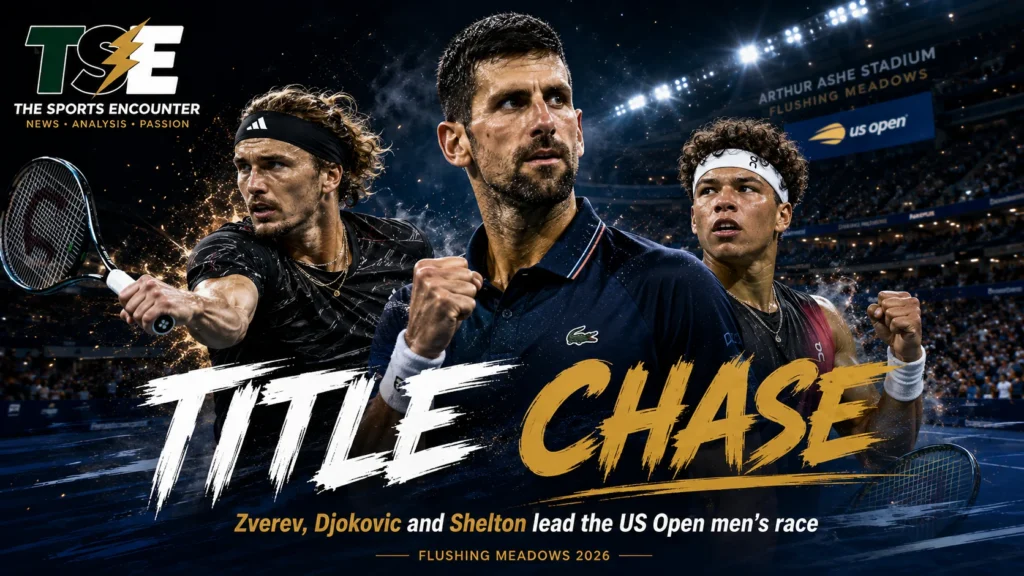
NEW YORK: The 2026 US Open men’s title race has changed before the singles draw has even been revealed.
World No. 1 Jannik Sinner is out because of a persistent right-knee injury. Defending champion Carlos Alcaraz is returning after more than four months away from competition because of a wrist problem. That has created an unusual opening at the top of the men’s game, and three players arrive in New York with very different reasons to believe this could be their tournament.
Alexander Zverev finally knows what it feels like to win a Grand Slam and is expected to lead the field as the top seed. Novak Djokovic is chasing the 25th major title that would leave him alone at the top of the all-time singles list, although Cincinnati provided another reminder that the 39-year-old’s greatest opponent may now be the physical cost of two weeks of best-of-five tennis. Ben Shelton arrives carrying the strongest recent hard-court momentum of the three after defending his National Bank Open title without losing a set.
Each case is persuasive. Each also contains a weakness capable of ending the run before championship weekend.
That is what makes this men’s tournament so different from the one we expected a few weeks ago.
The Sports Encounter’s original US Open 2026 curtain-raiser identified Sinner and Alcaraz as the central forces around which the men’s championship would likely revolve. Injuries have since altered that hierarchy. Sinner will not play, and Alcaraz must rediscover elite match rhythm while already defending a Grand Slam title.
The opportunity has moved outward.
US Open 2026 Men’s Title Race at a Glance
| Player | Strongest Case | Biggest Question |
|---|---|---|
| Alexander Zverev | Roland Garros champion, Wimbledon finalist, likely top seed | Can he overcome uneven North American hard-court form? |
| Novak Djokovic | 24 major titles, four US Open crowns, unmatched Grand Slam experience | Can his body withstand heat, humidity and seven best-of-five matches? |
| Ben Shelton | Four titles in 2026, dominant Montreal defense, home-crowd energy | Can Masters-level control translate into consistent Grand Slam tennis? |
| Carlos Alcaraz | Defending champion, seven-time major winner, elite hard-court ceiling | How quickly can he find match rhythm after four months away? |
| Jannik Sinner | World No. 1 and defending Wimbledon champion | Withdrawn because of a right-knee injury |
Why the US Open Men’s Race Has Opened So Quickly
Sinner’s withdrawal is the development that changed the tournament most dramatically.
The Italian successfully defended Wimbledon in July and had established himself as the strongest current force in men’s tennis. His right knee then prevented him from playing either of the major North American Masters 1000 warm-up events.
TSE tracked the warning signs when Sinner pulled out of Cincinnati after already skipping Montreal. At that stage, the question was whether he could arrive in New York without competitive preparation.
The answer eventually became irrelevant.
The US Open confirmed on August 21 that the world No. 1 had withdrawn from the tournament because of the knee problem.
That removed a five-time Grand Slam champion who had beaten Djokovic at Wimbledon and Zverev in the final.
Alcaraz’s situation creates a different kind of uncertainty.
The Spaniard has confirmed that he will defend his title, but his next singles match will be his first competitive appearance since April. The official US Open announcement confirmed that the right wrist injury kept him out for more than four months.
Our detailed analysis of Alcaraz’s return examined the central problem: fitness for training and readiness to survive seven Grand Slam matches are two different standards.
His presence keeps one of the sport’s highest ceilings in the draw.
His preparation gives everyone else reason to believe.
Alexander Zverev Finally Arrives Without the First-Major Question
For most of Alexander Zverev’s career, every deep Grand Slam run eventually returned to the same subject.
Could he finish one?
He had won Masters titles, Olympic gold and ATP Finals championships. He had defeated the best players in the world across every surface. The major remained missing.
New York supplied the most painful example in 2020, when Zverev led Dominic Thiem by two sets and a break in the US Open final before losing in five.
Two more Grand Slam final defeats followed.
Paris finally changed the conversation.
Zverev defeated Flavio Cobolli 6-1, 4-6, 6-4, 6-7(5), 6-1 in the 2026 Roland Garros final to win his first major championship on his fourth attempt in a final.
The ATP described it as the completion of a lifelong ambition, and the emotional importance should matter when he reaches difficult moments in New York.
Zverev no longer has to imagine how he would react with a Grand Slam trophy one set away.
He has done it.
Wimbledon strengthened the case that Paris changed something
The French Open could have remained an isolated breakthrough.
Zverev made sure it did not.
Five weeks later, he reached his first Wimbledon final. Sinner eventually defeated him 6-7(7), 7-6(2), 6-3, 6-4, but reaching consecutive Grand Slam finals across clay and grass provided evidence that Zverev had entered a different stage of his career.
His serve survived the transition.
His backhand remained one of the most reliable elite shots in men’s tennis.
Most importantly, he arrived repeatedly at the final weekend of majors without carrying the same psychological burden.
That makes him a serious New York favorite regardless of what happened during the North American swing.
The Zverev Problem: His Hard-Court Form Has Not Matched His Grand Slam Form
This is where the German’s case becomes complicated.
The surface should suit him.
His recent results have been less convincing.
Zverev entered Montreal as the top seed and lost his opening match to Tallon Griekspoor 6-7(3), 6-2, 6-4. The defeat became part of a remarkable early collapse among leading men’s seeds that TSE examined in its National Bank Open analysis.
Cincinnati offered more match play.
Zverev needed three sets against Cameron Norrie and two tiebreaks against Terence Atmane before meeting Tommy Paul in the fourth round.
That match became another missed opportunity.
Paul saved a match point in the second-set tiebreak and recovered to win 4-6, 7-6(6), 6-4.
The result does not erase what Zverev accomplished in Paris or London. It does prevent his US Open case from becoming too comfortable.
The best version of Zverev should be extremely difficult to beat on a hard court.
He can dominate service games without taking large physical risks. His backhand absorbs pace from both wings. His height allows him to attack high balls without retreating deep behind the baseline.
The weakness remains familiar.
When pressure rises, Zverev can still become more passive than his weapons justify.
Paris proved he can overcome that instinct across a major final.
New York will test whether the change has become permanent.
This May Be the Best US Open Opportunity of Zverev’s Career
Zverev is 29.
He is entering the tournament as a Grand Slam champion for the first time.
Sinner is absent.
Alcaraz has not played singles since April.
Djokovic has physical questions.
Shelton has yet to reach a major final.
There have been US Opens where Zverev arrived with strong tennis. There have been tournaments where the draw created opportunity. There have been seasons where his body looked ready for seven matches.
The unusual part of 2026 is how many of those conditions have come together at the same time.
That creates opportunity and responsibility.
If Zverev believes his Roland Garros title genuinely changed his career, New York is the tournament where that belief should become visible.
Novak Djokovic’s Chase for 25 Is Now an Endurance Story
Djokovic has reached the stage where his records require very little introduction.
He owns 24 Grand Slam singles titles.
He has won the US Open four times.
He has reached 10 men’s singles finals in New York.
A fifth championship would move him beyond Margaret Court’s 24 major singles titles and give him sole possession of the all-time record.
At 39, that pursuit has become inseparable from a different question.
How much elite tennis can his body still support over two weeks?
Djokovic reached the Australian Open final earlier this year and the Wimbledon semifinals. Those results demonstrate that his championship-level tennis has not disappeared.
The difficulty is maintaining it repeatedly.
Cincinnati Exposed the Physical Variable Djokovic Cannot Ignore
Djokovic’s only singles appearance between Wimbledon and New York ended against Thiago Agustin Tirante.
The match began normally.
Djokovic won the first set 6-2.
Then the Cincinnati heat and humidity became increasingly difficult for him to manage.
He dropped to his knees during a long service game, received treatment and visibly struggled through sections of the match before Tirante completed a 2-6, 6-4, 6-4 victory.
The ATP later reported that Djokovic attributed the problem to a health condition that becomes worse in high heat and humidity.
TSE’s post-match analysis identified the real US Open concern. Djokovic’s tennis was still competitive. The physical cost required to produce that tennis had become harder to ignore.
The distinction matters.
This is not a discussion about whether Djokovic can beat an elite opponent in one match.
He can.
The US Open requires seven victories.
Why the first week matters more for Djokovic than ever
A younger Djokovic could spend four hours solving a second-round problem and treat the match as another test completed.
The 2026 version has to think about what that match takes away from the next one.
Every unnecessary set matters.
Every 20-minute service game matters.
Every afternoon session in oppressive conditions matters.
His ideal opening week therefore looks different from the one that defined his prime.
Djokovic needs efficient service holds, quick returns of serve, limited physical drama and as few long matches as possible.
A straight-sets victory does more than move him into another round.
It preserves the body that must still be available the following week.
Djokovic’s Experience Still Gives Him Something Nobody Else Owns
The physical warning should not become an argument for writing him off.
No player in this field understands Grand Slam problem-solving better.
Djokovic has spent more than 15 years adjusting within matches when Plan A stopped working.
He changes return position.
He alters rally height.
He begins serving wider instead of chasing pace.
He uses a drop shot to force movement forward.
He accepts temporary periods of defensive tennis while waiting for the opponent’s level to fall.
Those decisions become especially valuable in best-of-five matches because a player can lose an hour without losing the contest.
Djokovic also understands Arthur Ashe Stadium in a way Shelton, Zverev and most of the rest of the draw cannot yet replicate.
If he reaches the second week healthy, the conversation changes immediately.
A quarterfinal Djokovic with five matches of timing behind him is very different from the player who arrived in Cincinnati without a singles appearance since Wimbledon.
Ben Shelton Arrives With the Best Recent Hard-Court Performance
Shelton’s 2026 season makes very little sense if viewed only through Grand Slam results.
It makes much more sense when viewed as the development of a player still learning how to make his best tennis appear every week.
The American reached the Australian Open quarterfinals.
Roland Garros ended in the second round.
Wimbledon ended in the first after Otto Virtanen saved match point and won a five-set battle.
Those major disappointments sit beside four ATP titles.
Montreal provided the clearest evidence yet of what Shelton can become when his power and decision-making work together.
He defeated Brandon Nakashima 6-3, 7-6(4) in the final to successfully defend the National Bank Open crown.
TSE’s Montreal final report documented a six-match run in which Shelton did not drop a set.
The ATP noted that he became only the fourth man this century to successfully defend the Canadian Masters title, joining Andy Murray, Novak Djokovic and Rafael Nadal.
What Changed in Montreal Was More Important Than the Trophy
Shelton’s serve has never required explanation.
At its best, it is one of the most destructive left-handed deliveries on the tour.
The problem with reducing Shelton to his serve is that it misses what made Montreal significant.
He returned better.
He defended with more patience.
He stopped treating every neutral rally as an invitation to end the point immediately.
He attacked second serves with purpose rather than simply swinging harder.
Those changes appeared throughout the tournament.
Against Learner Tien, Shelton faced an opponent who had beaten him in both previous meetings and whose consistency naturally exposes rushed decision-making. Shelton responded with one of his most controlled performances of the year, winning 6-2, 6-3.
Our analysis before the Montreal semifinals had already identified Shelton’s cleaner balance between aggression and patience as one of the tournament’s most important developments.
That evolution matters far more for the US Open than another trophy photograph.
Why Return Games Could Decide Shelton’s Grand Slam Ceiling
A great serve protects a player.
A great return game allows him to control tournaments.
Shelton has spent much of his young career relying on service dominance to create scoreboard pressure. When return games produced little resistance, opponents could settle into their own service patterns and wait for one loose Shelton game.
Montreal interrupted that cycle.
He created pressure earlier in return games and found ways to move from defense into offense without immediately taking reckless risk.
That is the version of Shelton that could become a genuine Grand Slam champion.
His serve can get him through difficult sets.
His improving return game could stop those sets becoming difficult in the first place.
Cincinnati Added an Important Warning to Shelton’s Momentum
Montreal did not carry seamlessly into Ohio.
Jaime Faria defeated Shelton 6-4, 6-4 in his first Cincinnati match only days after the American lifted the Canadian trophy.
The result ended Shelton’s six-match winning streak and gave Faria his first career Top-10 victory.
TSE included Shelton among Cincinnati’s most significant early exits, while also making an important distinction.
The defeat looked more like a missed opportunity than evidence that Montreal had been misleading.
Shelton had just completed six matches in Canada.
The turnaround was short.
Faria played clean tennis and repeatedly escaped pressure.
The US Open gives Shelton a longer reset.
The responsibility now is to recover the disciplined version of his game rather than react emotionally to one poor night in Cincinnati.
New York Gives Shelton Something His Rivals Cannot Borrow
The home crowd will matter.
No American man has won the US Open singles championship since Andy Roddick beat Juan Carlos Ferrero in 2003.
That drought has followed several generations through Flushing Meadows.
Roddick believes Shelton can challenge for the title if the leading players are vulnerable.
Sinner is already out.
Alcaraz’s readiness remains uncertain.
The conditions are beginning to resemble the scenario Roddick described.
Shelton also has personal evidence that New York suits him.
He reached the US Open semifinals in 2023, announcing himself to a much wider audience before losing to Djokovic.
His relationship with Arthur Ashe Stadium has developed since then.
Shelton feeds off noise rather than withdrawing from it. His emotion can pull spectators into service games and tiebreaks. The left-handed serve becomes even more difficult to handle when every unreturned delivery is followed by another surge from the stands.
The crowd cannot correct poor shot selection.
It can amplify a player who is already playing well.
Shelton’s Biggest Challenge Is Still Grand Slam Consistency
Montreal showed that Shelton can dominate an elite tournament.
The US Open asks for a different type of consistency.
Best-of-five matches offer opponents more time to adjust.
A player can survive Shelton’s first 45 minutes, change his return position and force him into patterns he did not need in a two-set Masters match.
The American’s disappointing Roland Garros and Wimbledon results remain relevant because they show how quickly a Grand Slam can disappear when his decision-making becomes impatient.
That is why his US Open case is so interesting.
The talent is already enough.
The serve is already enough.
The crowd will already be there.
The remaining question is whether the control displayed in Montreal lasts for two weeks rather than six matches.
Zverev, Djokovic and Shelton Are Competing Against Different Problems
| Area | Alexander Zverev | Novak Djokovic | Ben Shelton |
|---|---|---|---|
| Recent major evidence | French Open champion, Wimbledon finalist | Australian Open finalist, Wimbledon semifinalist | Australian Open quarterfinalist |
| Recent hard-court evidence | Early Montreal loss, Cincinnati fourth round | One Cincinnati match, physical struggle | Montreal champion, early Cincinnati exit |
| Serve | Elite first serve and strong free-point potential | Efficient placement increasingly important | One of the tour’s biggest weapons |
| Return | Solid, especially from backhand side | Historically elite and still a major strength | Improved significantly in Montreal |
| Physical question | Relatively low | Major concern across seven matches | Generally strong |
| Psychological question | Can he remain aggressive under pressure? | Can he manage body and history simultaneously? | Can he remain patient when Plan A fails? |
| New York advantage | 2020 finalist with unfinished business | Four-time champion and 10-time finalist | 2023 semifinalist with home support |
Carlos Alcaraz Still Has the Highest Ability to Rearrange the Entire Race
Any discussion of Zverev, Djokovic and Shelton needs one major qualification.
Alcaraz is playing.
The defending champion may have missed four months, but the level he can reach remains higher than almost anyone in the sport.
His movement changes defensive points into attacking ones.
His forehand can end rallies from positions where other players would simply reset.
His drop shot forces opponents to defend two different dimensions of the court.
His willingness to attack the net prevents baseline specialists from becoming comfortable.
The wrist and the lack of competition create the uncertainty.
The first week will tell us whether Alcaraz can swing freely.
The second week, if he gets there, will tell us whether repeated recovery has become a problem.
If both answers are positive, the entire discussion changes.
Zverev may have the cleanest opportunity on paper.
Djokovic may possess the greatest history.
Shelton may carry the best momentum.
A healthy Alcaraz can still beat all of them.
The Draw Will Matter More Than Usual
The official men’s singles draw will be revealed on August 27.
The US Open draw page will determine where the leading contenders land and which early-round dangers appear in their sections.
This year, those placements carry unusual weight.
Djokovic needs an efficient first week.
An early opponent capable of extending rallies for four hours would be much more dangerous to him than the same matchup might have been five years ago.
Alcaraz could benefit from opponents who allow him time to rediscover match timing rather than forcing immediate high-intensity movement.
Shelton needs to avoid the kind of experienced returner who can make every service game physical and frustrate him into forcing low-percentage shots.
Zverev would prefer a route that allows him to build hard-court confidence after relatively modest results in Montreal and Cincinnati.
Seeding protects elite players from one another early.
It does not protect them from uncomfortable styles.
What Zverev Needs to Win the US Open
Zverev’s challenge is primarily tactical and psychological.
He needs to trust the version of himself that won Roland Garros.
That means serving aggressively when protecting leads rather than reducing pace to avoid double faults. It means using his backhand down the line when opponents lean toward the crosscourt exchange. It means moving forward when shorter balls appear instead of allowing rallies to reset.
The hard court naturally rewards those choices.
His most dangerous opponent may be the instinct to retreat into safety when the scoreboard becomes uncomfortable.
Paris proved that safety is no longer his only response.
What Djokovic Needs to Win the US Open
Djokovic needs to manage a tournament before he can dominate it.
His first serve must generate enough easy points to reduce physical load.
Return games should be aggressive early so opponents cannot settle into long holds.
His team will have to pay close attention to heat management, recovery, hydration and the cumulative effect of long sessions.
The Serbian can still solve almost every tennis problem.
He needs to avoid turning every round into one.
What Shelton Needs to Win the US Open
Shelton needs Montreal’s discipline to travel with him.
The serve will create opportunity on its own.
The critical moments will arrive when opponents begin returning it.
Can Shelton tolerate neutral rallies?
Can he defend three or four extra balls without attempting a desperate winner?
Can he break serve consistently enough that every set does not depend on one tiebreak?
His title defense in Canada suggested the answers are improving.
New York provides the largest possible test.
The Wider Field Should Not Be Reduced to Three Names
The opening created by Sinner’s absence extends beyond Zverev, Djokovic and Shelton.
Taylor Fritz remains one of the most experienced American hard-court contenders and understands the pressure that comes with trying to end the country’s US Open drought.
Daniil Medvedev has already won the tournament and remains capable of turning hard-court matches into uncomfortable positional battles.
Alex de Minaur’s speed and returning can expose players who arrive short of match fitness.
Felix Auger-Aliassime possesses enough serve and first-strike power to become dangerous if confidence builds.
Flavio Cobolli has already played a major final this year.
The North American swing also produced younger challengers who have become increasingly comfortable against established names.
Montreal offered one of the clearest examples of that changing depth as multiple leading seeds disappeared early and the younger group moved deeper into the tournament.
The men’s field is no longer waiting politely behind four or five established stars.
That increases the danger of every early round.
Why the US Open Conditions Could Decide More Than the Rankings
New York tests a combination of skills that ranking points cannot fully measure.
Late-summer heat can turn a routine baseline match into a physical negotiation.
Humidity changes recovery.
Night sessions change ball speed and bounce.
The crowd can transform an ordinary service game into a pressure moment.
Players may finish late and return less than 48 hours later.
The official US Open schedule confirms that the men’s singles main draw begins on August 30, with two weeks of competition leading into championship weekend.
That environment is why Djokovic’s Cincinnati experience matters.
It is why Alcaraz’s four-month layoff matters.
It is why Shelton’s summer fitness work matters.
It is also why Zverev’s ability to generate short service games could become one of the most valuable weapons in the tournament.
Could an American Man Finally Win New York?
The question has existed for 23 years.
Andy Roddick remains the last American man to win the US Open, taking the 2003 championship.
American tennis has produced finalists, semifinalists and deep generations since then without another champion.
Shelton is one of several home hopes, but his case feels different after Montreal.
He is no longer being discussed purely because he is American and dangerous.
He is arriving after winning one of the biggest hard-court tournaments available before New York.
That does not automatically place him above Zverev, Djokovic or Alcaraz.
It does give the home crowd evidence that their expectations are grounded in current performance.
If Shelton reaches the second week, the national pressure will grow quickly.
How he handles that attention could become as important as his serve.
The Final Word: This US Open Will Be Won by the Player Who Manages His Weakness Best
The obvious strengths are already known.
Zverev has the serve, backhand and new confidence of a Grand Slam champion.
Djokovic has the greatest body of major-tournament knowledge in the draw.
Shelton has power, momentum and a home crowd ready to believe.
Alcaraz possesses the most varied attacking game among the leading contenders if his wrist and conditioning allow him to use it fully.
The championship may therefore be decided by something less glamorous.
Zverev needs to resist the passive stretches that have complicated important matches throughout his career.
Djokovic needs to prevent physical exhaustion from arriving before the final rounds.
Shelton needs to keep making sensible decisions after opponents survive his first wave of power.
Alcaraz needs to rediscover competitive rhythm before the tournament becomes too demanding to provide him the time.
Sinner’s withdrawal has opened the draw, but an open draw does not mean an easy Grand Slam.
It means more players can realistically see a path.
Zverev probably owns the clearest structural opportunity. Djokovic owns the largest historical prize. Shelton arrives with the strongest recent statement on a North American hard court. Alcaraz remains capable of overturning every prediction if his comeback accelerates quickly enough.
The men’s draw on August 27 will tell us where those paths begin.
The next two weeks will tell us which weakness survives longest.
For continuing tournament coverage, results, player analysis and Grand Slam reporting, visit The Sports Encounter Tennis Hub.
Frequently Asked Questions
Who is the favorite to win the 2026 US Open men’s title?
There is no overwhelming favorite after Jannik Sinner’s withdrawal. Alexander Zverev has a strong case because he won Roland Garros and reached the Wimbledon final, while Carlos Alcaraz remains the defending champion. Novak Djokovic and Ben Shelton are also major contenders for very different reasons.
Is Jannik Sinner playing the 2026 US Open?
No. Sinner withdrew because of a persistent right-knee injury after previously missing the National Bank Open and Cincinnati Open.
Is Carlos Alcaraz playing the US Open?
Yes. Alcaraz has confirmed his return after more than four months away with a right wrist injury. The US Open will be his first singles tournament since April.
Can Novak Djokovic win a 25th Grand Slam at the US Open?
Yes. Djokovic remains a serious contender and has won four US Open titles, but his ability to manage heat, humidity and physical recovery across seven best-of-five matches is a major concern after his Cincinnati experience.
Why is Alexander Zverev considered a major US Open contender?
Zverev won his first Grand Slam title at Roland Garros in June and followed it by reaching the Wimbledon final. He also reached the US Open final in 2020 and has a serve and backhand well suited to hard courts.
How good is Ben Shelton’s form before the US Open?
Shelton successfully defended his National Bank Open title in Montreal without losing a set across six matches. He then lost his opening Cincinnati match to Jaime Faria, but Montreal remains one of the strongest recent hard-court performances among the leading New York contenders.
When did Ben Shelton reach the US Open semifinals?
Shelton reached the men’s singles semifinals in 2023, where Novak Djokovic defeated him in straight sets.
When was the last time an American man won the US Open?
Andy Roddick won the men’s singles title in 2003. No American man has lifted the US Open singles trophy since.
When is the 2026 US Open men’s singles draw?
The official men’s singles draw is scheduled to be revealed on August 27, 2026.
When does the 2026 US Open singles main draw begin?
The men’s and women’s singles main draws begin on Sunday, August 30, at the USTA Billie Jean King National Tennis Center in New York.