


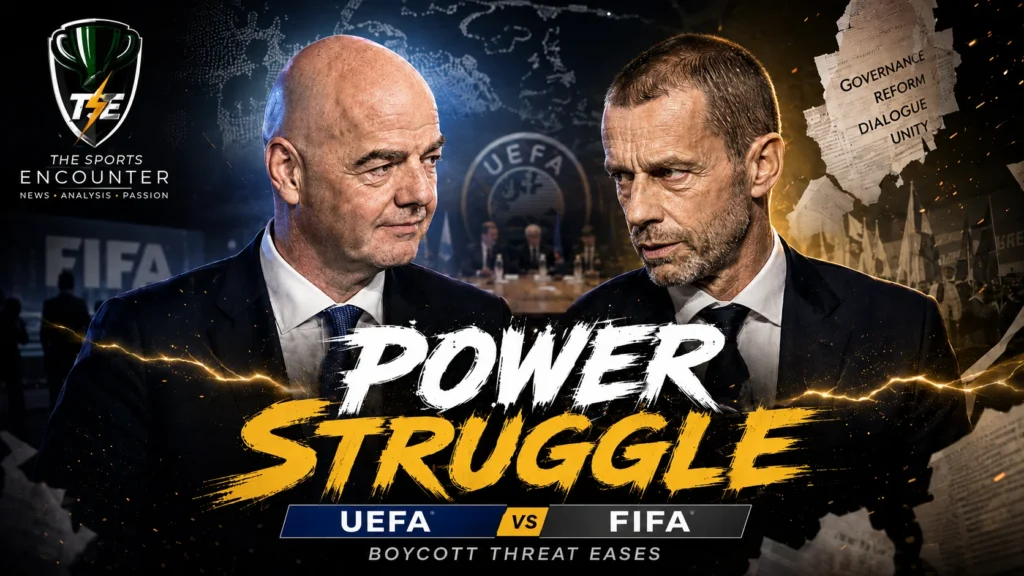
MONACO: European national teams appear to be stepping back from the brink of an unprecedented boycott of FIFA competitions.
Gianni Infantino’s political problems are moving in the opposite direction.
UEFA is expected to lift its threat to withdraw European teams from FIFA tournaments after receiving assurances that the abandoned plan to sell private stakes connected to the World Cup and other FIFA competitions will not return, according to Reuters.
The anticipated move removes the most immediate danger to FIFA’s international tournament calendar and means the upcoming FIFA U-20 Women’s World Cup in Poland should proceed with all qualified European teams participating.
At almost the same moment, however, the Italian Football Federation has withdrawn its support for Infantino’s re-election as FIFA president, aligning itself with UEFA President Aleksander Ceferin and adding another influential national association to the revolt against the FIFA chief.
European Leagues President Claudius Schäfer has gone further, publicly arguing that Infantino has no future at FIFA and that the governing body’s problems require structural reform rather than another period of institutional confrontation.
The developments reveal where the FIFA crisis has arrived after almost a month of escalating conflict.
The argument over whether European teams will participate in FIFA tournaments is moving toward resolution.
The argument over whether Infantino should continue running FIFA is intensifying.
FIFA-UEFA Crisis: Where Things Stand
| Issue | Current Position |
|---|---|
| UEFA boycott threat | Expected to be lifted after FIFA provided assurances over future private-investment plans |
| Formal UEFA confirmation | Expected at meetings in Monaco on August 27 |
| FIFA Forward Enterprise | Withdrawn by FIFA President Gianni Infantino on July 31 |
| Original UEFA vote | 55 national associations unanimously backed conditional non-participation |
| Italy’s position | FIGC has withdrawn support for Infantino’s 2027 re-election bid |
| European Leagues position | President Claudius Schäfer says FIFA requires new leadership and governance reform |
| UEFA, AFC and CONCACAF | Remain highly critical of Infantino’s handling of the FFE proposal |
| CAF position | Continues to support Infantino |
| Infantino’s position | Intends to seek another term |
| FIFA presidential election | March 18, 2027, in Rabat, Morocco |
| Immediate tournament affected | FIFA U-20 Women’s World Cup, Poland, September 5-27 |
TL;DR
- UEFA is expected to lift its threat to boycott FIFA competitions after receiving assurances that FIFA will not revive its abandoned World Cup stake-sale plan.
- The decision is expected to be communicated during UEFA meetings in Monaco on Thursday, August 27.
- UEFA’s 55 associations had unanimously threatened non-participation unless FIFA abandoned the proposal completely and guaranteed that similar private-ownership plans would not return.
- FIFA withdrew the FIFA Forward Enterprise proposal on July 31.
- All qualified teams are now expected to participate in the FIFA U-20 Women’s World Cup in Poland beginning September 5.
- Italy has withdrawn its support for Gianni Infantino’s 2027 FIFA presidential campaign.
- European Leagues President Claudius Schäfer has said Infantino has no future at FIFA and called for structural governance reform.
- UEFA, the AFC and CONCACAF remain aligned in their criticism of FIFA’s decision-making culture.
- CAF continues to support Infantino, showing that the FIFA president retains an important global political base.
- The immediate boycott crisis may be easing, but the fight over FIFA’s leadership is increasingly moving toward the March 2027 election.
UEFA Appears Ready to End the Boycott Threat
The breakthrough addresses the two conditions UEFA established when the conflict exploded at the end of July.
First, FIFA had to abandon the FIFA Forward Enterprise proposal completely.
Second, European associations wanted assurances that FIFA would not recreate the same model later under another structure or name.
UEFA and all 55 of its national associations had made those conditions explicit when they unanimously backed non-participation in FIFA competitions on July 30.
The Sports Encounter reported at the time that UEFA’s 55-0 decision placed participation in FIFA tournaments directly into the dispute, creating a level of institutional confrontation rarely seen between world soccer’s governing body and its most commercially powerful confederation.
UEFA’s official July 30 statement said European national teams would remain outside FIFA competitions while the private-investment proposal survived, unless it was abandoned in its entirety and binding safeguards prevented a comparable structure from returning.
Infantino withdrew the proposal the following night.
That ended the commercial project.
It did not immediately satisfy UEFA.
European officials continued to seek stronger assurances about what FIFA might attempt in the future, leaving youth tournaments and eventually senior competitions exposed to the possibility of non-participation.
Reuters now reports that those assurances have been received and that UEFA officials are expected to tell the Executive Committee and presidents of most European associations in Monaco on Thursday that the conditions for lifting the boycott have been met.
Until that meeting takes place, the withdrawal should be treated as expected rather than formally completed.
Why UEFA Can Lift the Boycott Without Ending Its Fight With Infantino
This distinction is the most important part of the latest development.
UEFA’s boycott was built around specific conditions connected to FIFA Forward Enterprise.
FIFA has now moved far enough on those conditions for European teams to return to competitions.
Trust in Infantino’s leadership is a much broader question.
The two issues were once connected because FFE triggered the confrontation. They have now developed separate political lives.
One concerns whether players and national teams should lose access to FIFA competitions because of a governance dispute.
The other concerns whether the events that produced the dispute revealed a leadership culture that national associations are prepared to accept for another presidential term.
UEFA can answer the first question by allowing teams to play.
It can continue challenging Infantino on the second.
That appears to be exactly where European soccer is heading.
The U-20 Women’s World Cup Made the Boycott Increasingly Difficult to Sustain
The approaching FIFA U-20 Women’s World Cup gave the dispute a human deadline.
The tournament begins in Poland on September 5 and runs through September 27.
FIFA lists 24 qualified teams, including European representatives England, France, Italy, Portugal, Spain and host Poland.
Under the original UEFA position, those players could have become the first athletes directly affected by the confrontation.
The political target was FIFA governance.
The practical consequence would have fallen on young footballers who may receive only one opportunity to play at an Under-20 World Cup.
A source familiar with the UEFA discussions told Reuters that ending the boycott should not be interpreted as a defeat for the European governing body because protecting those opportunities had become part of the calculation.
FIFA has now said all qualified teams will participate in Poland.
The governing body said it welcomes the prospect of every qualified nation taking part and emphasized football’s ability to unite during institutional disagreements.
The FIFA U-20 Women’s World Cup will therefore become the first practical test of whether the institutional truce holds.
FIFA Forward Enterprise Is Dead
The commercial project that created this crisis no longer exists.
FIFA Forward Enterprise was designed as a new entity bringing together valuable commercial and event-related activities connected to FIFA competitions.
The proposal contemplated outside investment in a minority stake while FIFA retained formal sporting and governance authority.
Reports placed the proposed company at roughly a $20 billion valuation, with FIFA potentially raising around $4.2 billion through the sale of approximately 20 percent.
FIFA argued that the structure could dramatically expand development funding for its 211 member associations, particularly smaller countries whose football systems depend heavily on FIFA investment.
Opponents focused on different questions.
Why had a proposal involving the World Cup’s commercial future advanced so far without meaningful consultation?
What long-term influence would private investors acquire through an ownership interest tied to FIFA’s competitions?
And why did FIFA require outside capital when UEFA argued that the organization already held billions of dollars in reserves?
The Sports Encounter examined how the World Cup stake proposal collapsed within days after resistance spread across confederations, federations and senior football figures.
Infantino formally killed the proposal on July 31.
In his official statement withdrawing FFE, the FIFA president said the project had created divisions that no longer served its intended purpose and confirmed that it would not proceed.
Withdrawing FFE Did Not Repair the Political Damage
The speed of the retreat actually intensified scrutiny of how the project had reached such an advanced stage.
Questions emerged inside FIFA as well as outside it.
Senior figures distanced themselves from the proposal. Officials questioned consultation and decision-making. National associations began reconsidering their electoral support.
The Sports Encounter documented how senior officials and former allies began breaking ranks after the project collapsed, shifting the crisis from commercial policy into institutional authority.
FIFA subsequently acknowledged that mistakes had been made in the process.
Its leadership met in Rabat on August 5 and accepted that communication and internal processes surrounding FFE required improvement.
FIFA’s apology to its member associations provided an important concession over process while the organization’s senior management publicly reaffirmed support for Infantino.
That support stabilized FIFA internally.
It did not stop external opposition.
Italy’s Withdrawal Shows Why the Crisis Is Now About the 2027 Election
Italy’s decision carries weight because it happened after the original commercial proposal had already disappeared.
The FIGC has withdrawn its support for Infantino’s candidacy in the presidential election scheduled for March 2027.
The Italian federation said its position reflects concern over recent FIFA initiatives involving governance and the development of international competitions and aligns it with UEFA and Ceferin.
The timing is politically significant.
Italy is no longer withholding support in order to stop FFE. The project has already been withdrawn.
Its decision therefore amounts to a judgment about leadership.
That is the larger danger for Infantino.
Every federation that changes its electoral position after the FFE withdrawal strengthens the argument that the crisis cannot be repaired simply by promising never to revive the commercial structure.
Ireland had already withdrawn its endorsement of Infantino, while other European associations have taken increasingly hostile positions.
The movement has also extended beyond Europe. New Zealand’s withdrawal of support exposed divisions inside Oceania and demonstrated that the argument over FIFA governance is increasingly being decided federation by federation.
European Leagues Makes the Argument More Explicit
Claudius Schäfer, president of European Leagues, has now pushed the debate directly toward Infantino’s future.
European Leagues represents 53 professional leagues and associations of clubs across 34 European countries, covering more than 1,300 clubs.
Schäfer told The Athletic that FIFA requires change and that he sees no future for Infantino at the organization.
His criticism reaches beyond the failed investment structure.
European Leagues has repeatedly argued that FIFA makes decisions affecting domestic leagues, players, clubs and supporters without giving those groups a meaningful formal role in the process.
The organization made that criticism explicit in its official response to the FFE collapse, saying the episode raised deeper questions about FIFA’s governance, internal culture and decision-making.
It has also linked those concerns to discussions about further World Cup expansion and the international match calendar.
That gives the opposition a broader argument heading toward 2027.
FFE may have triggered the revolt.
The reform movement is increasingly focused on presidential power, consultation and who receives a meaningful voice when FIFA makes decisions affecting the global game.
UEFA, AFC and CONCACAF Remain an Unusual Coalition
Infantino’s biggest political problem remains the coalition created by UEFA, the Asian Football Confederation and CONCACAF.
Those three organizations rarely approach global soccer politics from identical positions.
The FFE dispute brought them together.
On August 10, their presidents and general secretaries issued a joint open letter sharply criticizing FIFA’s handling of the proposal and demanding an independent examination of how it had been developed.
The AFC’s own publication of the joint letter confirmed the depth of the alignment.
That matters because Infantino has traditionally benefited from divisions between football’s regional power centers.
A sustained UEFA-AFC-CONCACAF alignment would make the 2027 election far less predictable.
The Boycott Ending Could Actually Help UEFA Politically
Continuing the tournament boycott indefinitely carried risks for UEFA.
The longer it lasted, the easier it became for FIFA to frame the dispute around athletes losing opportunities rather than governance failures.
The U-20 Women’s World Cup illustrated that danger.
If European teenagers had missed a global tournament, Infantino could have argued that UEFA’s political strategy was punishing players.
Removing that possibility allows Europe to separate competition participation from the leadership campaign.
European teams can play FIFA tournaments.
European federations can continue challenging Infantino through FIFA’s political and electoral structures.
That potentially produces a cleaner battleground.
Infantino Still Has Powerful Support
The pressure should not be mistaken for evidence that Infantino is already close to losing office.
He retains substantial support.
The Confederation of African Football has formally backed him.
CAF’s Executive Committee reconfirmed its support for Infantino on August 6, thanking him for his contribution to African football.
CAF’s 54 member associations had also unanimously agreed earlier in 2026 to support his re-election.
Infantino has spent much of his presidency building relationships with smaller and developing football nations through FIFA Forward and other development programs.
That constituency is central to his political strength.
Every FIFA association receives one presidential vote.
Commercial size, World Cup history and population do not change that basic democratic structure.
Germany receives one vote.
Brazil receives one.
A small island association receives one.
The system means losing powerful European federations damages Infantino politically and symbolically without automatically defeating him numerically.
Infantino’s Defense Is Built Around Global Development
The FIFA president has increasingly responded to the crisis by emphasizing the economic divide between major football nations and smaller associations.
During recent appearances, he has argued that FIFA exists partly to redistribute global soccer revenue into countries that cannot generate comparable resources through domestic television, sponsorship and ticketing markets.
The position is consistent with the original justification for FFE.
Infantino argued that unlocking additional commercial value could increase development funding dramatically.
FIFA says its Forward program has invested billions of dollars in infrastructure, grassroots development, women’s soccer, coaching and national-team structures across its membership.
The political implication is straightforward.
Infantino wants the 2027 election to become a debate over whether FIFA should continue shifting more resources toward smaller associations.
His opponents want it to become a referendum on governance, transparency and presidential authority.
Who successfully defines that argument may matter as much as individual federation endorsements.
Donald Trump Has Given Infantino an Unusual Political Ally
Infantino also retains prominent support outside football administration.
U.S. President Donald Trump publicly defended the FIFA president as the institutional revolt intensified, warning against replacing him after the commercial success of the 2026 World Cup.
The Sports Encounter examined how Trump’s intervention gave Infantino a powerful public ally at a moment when European, Asian and CONCACAF officials were increasing pressure.
That support does not translate directly into FIFA Congress votes.
It does reinforce the international political dimension surrounding a presidential contest that is increasingly extending beyond soccer administration.
Could Infantino Face a No-Confidence Challenge Before March?
The election is one possible route.
An earlier confrontation remains possible.
Senior figures across UEFA, the AFC and CONCACAF have discussed whether Infantino could face some form of no-confidence move before March 2027.
The Sports Encounter’s examination of the potential no-confidence strategy found that FIFA’s statutes do not provide a simple stand-alone mechanism equivalent to a parliamentary confidence vote.
They do, however, allow member associations to force an Extraordinary Congress.
Under FIFA’s statutes, one-fifth of the organization’s membership can require the FIFA Council to convene an Extraordinary Congress.
With 211 member associations, that threshold is 43.
UEFA alone contains 55 associations.
That does not mean all 55 would automatically support an attempt to remove Infantino, and FIFA’s statutes would still govern what an Extraordinary Congress could legally decide.
The numbers nevertheless explain why discussions of an early institutional challenge cannot simply be dismissed.
The March 2027 Election Is Becoming the Real Deadline
FIFA has confirmed that the 77th FIFA Congress will take place in Rabat, Morocco, on March 18, 2027.
Infantino has already announced his intention to stand again.
UEFA President Aleksander Ceferin says he will not challenge him personally.
Ceferin has nevertheless indicated that he expects another candidate could emerge.
That remains the biggest unanswered question surrounding the opposition.
Being against Infantino is politically different from agreeing on who should replace him.
UEFA, the AFC and CONCACAF contain different interests, different regional priorities and different relationships with FIFA.
A challenger capable of uniting those constituencies would need to offer more than criticism.
They would need a development policy credible to Africa, Asia, Oceania and smaller CONCACAF nations while also satisfying European demands for institutional reform.
Until such a candidate appears, Infantino retains the enormous advantage of incumbency.
FIFA Says Its Democratic Structure Must Be Respected
FIFA has repeatedly defended the legitimacy of its president through the organization’s electoral structure.
After the crisis intensified earlier this month, FIFA emphasized that Infantino is the only official directly elected by all 211 member associations.
That argument will become increasingly important as the boycott disappears.
With the immediate tournament threat removed, the fight moves closer to FIFA’s formal political machinery.
What Thursday’s Monaco Meeting Could Clarify
UEFA officials are expected to brief the Executive Committee and presidents of most European national associations in Monaco on Thursday.
Several questions should become clearer.
- Whether the boycott threat is formally and completely withdrawn.
- What assurances FIFA has provided about future private investment in its competitions.
- Whether those assurances are written, binding or politically enforceable.
- Whether UEFA continues pursuing an independent examination of the FFE process.
- How aggressively European associations intend to campaign against Infantino’s re-election.
- Whether discussions about a potential alternative presidential candidate are accelerating.
The first question matters for tournaments.
The others matter for FIFA’s future.
Why Italy Matters Beyond One Vote
Italy contributes only one of 211 presidential votes.
Its political weight extends considerably further.
The FIGC represents one of soccer’s historic powers, operates inside UEFA’s central political structure and will co-host Euro 2032 with Turkey.
Its decision therefore adds institutional credibility to Ceferin’s argument that dissatisfaction with Infantino has moved beyond a small group of hostile associations.
The significance becomes greater because the decision has arrived after the immediate commercial dispute began cooling.
If more federations follow Italy while UEFA simultaneously ends the boycott, a clearer pattern will emerge.
European associations may be willing to normalize FIFA competition participation while refusing to normalize Infantino’s presidency.
The Crisis Has Changed From an Economic Fight Into a Governance Election
The evolution of this story can now be traced through four phases.
Phase One: The Stake-Sale Proposal
FIFA explored outside investment through FIFA Forward Enterprise, arguing that new capital could expand global development funding.
Phase Two: The Global Revolt
UEFA, the AFC, CONCACAF, leagues, clubs and national associations challenged the proposal and the process behind it.
Phase Three: FIFA Retreats
Infantino withdrew FFE, FIFA acknowledged process failures and internal management publicly attempted to restore unity.
Phase Four: The Presidency Becomes the Issue
Associations continued withdrawing electoral support, confederations discussed possible institutional action and football organizations increasingly called for leadership and governance reform.
Italy’s decision belongs squarely in that fourth phase.
TSE Analysis: UEFA Can Claim a Tactical Victory Without Declaring the War Over
The disappearance of the boycott threat is good for players and good for international soccer.
A political dispute between governing bodies was approaching the point where young athletes could lose World Cup appearances despite having no role in creating the conflict.
UEFA now appears to have achieved the conditions it originally demanded.
The private-investment proposal has been withdrawn.
Assurances against a repeat have reportedly been provided.
European teams can return without UEFA having to abandon its underlying governance argument.
That gives Ceferin and his allies the ability to move the confrontation onto ground where Infantino cannot answer simply by accusing Europe of damaging competitions.
Italy’s withdrawal illustrates the next battleground.
Votes.
The 2027 election will ultimately be decided by national associations rather than public statements from confederation presidents, league executives or politicians.
Infantino still has substantial support, particularly through CAF and among federations that credit his presidency with dramatically increasing football development funding.
His opponents have momentum, powerful institutions and an increasingly coherent governance argument.
What they still lack is the most important component of any electoral challenge.
A candidate capable of turning dissatisfaction into a majority.
The FIFA boycott crisis therefore appears closer to its ending.
The Infantino crisis does not.
Thursday’s meeting in Monaco could close one of the most dramatic chapters in the dispute.
March 18 in Rabat may decide the one that matters most.
Follow The Sports Encounter’s soccer coverage for continued reporting on FIFA governance, the 2027 presidential race, international competitions and the major political forces shaping world soccer.
Frequently Asked Questions
Has UEFA officially ended its FIFA boycott?
Not yet. Reuters reports that UEFA officials believe the conditions for lifting the boycott have been met and are expected to communicate that position during meetings in Monaco on August 27.
Why did UEFA threaten to boycott FIFA competitions?
UEFA’s 55 national associations unanimously opposed FIFA’s proposal to allow private investment in a new commercial entity connected to the World Cup and other FIFA competitions. They demanded that the proposal be abandoned completely and that similar plans should not return.
What was FIFA Forward Enterprise?
FIFA Forward Enterprise was a proposed commercial entity that would have consolidated valuable FIFA competition-related business activities and allowed minority outside investment. Reports placed the proposed valuation near $20 billion.
Did FIFA withdraw the World Cup stake-sale proposal?
Yes. Gianni Infantino announced on July 31 that the FIFA Forward Enterprise proposal would not proceed after it created severe divisions across world soccer.
Why is UEFA lifting the boycott threat?
UEFA has reportedly received assurances that FIFA will not revive the private-investment model that triggered the dispute. European officials are expected to conclude that their original conditions have been satisfied.
Will European teams play at the FIFA U-20 Women’s World Cup?
Yes. FIFA says all qualified teams will participate in the tournament, which begins in Poland on September 5, 2026.
Has Italy withdrawn support for Gianni Infantino?
Yes. The Italian Football Federation has withdrawn its support for Infantino’s 2027 presidential candidacy, citing concerns over recent FIFA governance and competition initiatives.
Who else is opposing Infantino?
UEFA, the AFC and CONCACAF have jointly criticized the handling of FIFA Forward Enterprise. Several individual national associations have also withdrawn electoral support, while European Leagues has called for leadership and governance reform.
Does Gianni Infantino still have support?
Yes. The Confederation of African Football has formally reaffirmed its support for him, and Infantino continues to have backing among a significant number of national associations outside Europe.
When is the next FIFA presidential election?
The presidential election will take place at the 77th FIFA Congress in Rabat, Morocco, on March 18, 2027.
Is Aleksander Ceferin running against Infantino?
No. The UEFA president has ruled out standing for FIFA president, although he has said another challenger could emerge.
Can FIFA member associations force an Extraordinary Congress?
Yes. FIFA statutes require the Council to convene an Extraordinary Congress if one-fifth of the 211 member associations submit a written request. That threshold is 43 associations.
Is Gianni Infantino certain to lose the 2027 election?
No. His political position has weakened, but he retains substantial international support and no consensus challenger has yet emerged. FIFA’s one-association, one-vote electoral structure also means opposition from Europe’s largest federations alone cannot determine the result.