


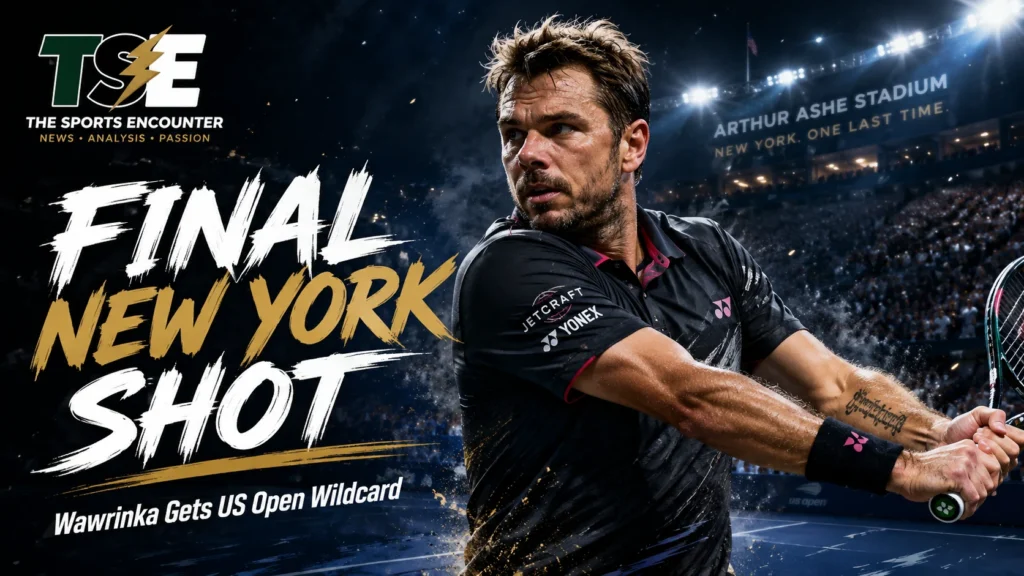
NEW YORK: Twenty-four hours after Stan Wawrinka appeared to have said goodbye to the US Open for the final time, New York has given him another match to fight for.
The 41-year-old Swiss has received a wildcard into the 2026 US Open men’s singles main draw, restoring one of the most significant farewell stories of the tournament after his original omission triggered widespread criticism from tennis fans.
Wawrinka, the 2016 US Open champion and a three-time Grand Slam winner, had posted an emotional farewell to New York on Tuesday after being left out of the completed wildcard allocation.
On Wednesday, everything changed.
American Patrick Kypson, who had received the final men’s main-draw wildcard on August 22, withdrew because of injury. The US Open then awarded the vacant place to Wawrinka, who immediately accepted.
“I’m incredibly excited to accept the wild card for the 2026 US Open and look forward to competing in front of the fans in New York once again,” Wawrinka said in a statement released by the tournament.
The timing makes the reversal remarkable. Wawrinka is playing the final season of a professional career that began more than two decades ago, and his exclusion had appeared to close his relationship with the Grand Slam where he won the last of his three major titles.
Now he will return to Flushing Meadows exactly 10 years after defeating Novak Djokovic in the 2016 final.
The comeback also needs to be described carefully. The US Open’s official announcement identifies Kypson’s injury withdrawal as the reason a wildcard became available. Organizers have not said that the fan reaction caused them to reverse their original decision.
The criticism created the public pressure surrounding the story. The injury created the opening.
Stan Wawrinka US Open Wildcard: What Happened?
| Detail | Information |
|---|---|
| Player | Stan Wawrinka |
| Age | 41 |
| Nationality | Switzerland |
| US Open status | 2026 men’s singles main-draw wildcard |
| Why a wildcard became available | Patrick Kypson withdrew through injury |
| US Open title | 2016 |
| US Open career record | 46-16 |
| Career Grand Slam singles titles | 3 |
| Career-high ATP ranking | World No. 3 |
| Last US Open appearance | 2024 |
| Career status | Retiring after the 2026 season |
| 2026 US Open main draw begins | August 30 |
TL;DR
- Stan Wawrinka has received a wildcard into the 2026 US Open men’s singles main draw.
- The 2016 champion was originally omitted from the tournament’s wildcard list.
- His exclusion generated significant criticism among tennis fans during his farewell season.
- Wawrinka posted an emotional goodbye to New York on Tuesday after believing he would not compete.
- Patrick Kypson then withdrew because of injury, freeing a main-draw wildcard.
- The US Open awarded that place to Wawrinka on Wednesday.
- The tournament has not said fan criticism caused the change.
- Wawrinka owns a 46-16 career record at the US Open.
- He defeated Novak Djokovic to win the 2016 championship.
- The 41-year-old will retire from professional tennis at the end of 2026.
Tuesday Looked Like the End of Wawrinka’s US Open Story
Wawrinka’s position looked settled only a day earlier.
The US Open had announced most of its men’s main-draw wildcards on August 18, balancing several competing priorities that regularly shape Grand Slam wildcard decisions.
American players received places through domestic pathways, collegiate achievements and the US Open Wild Card Challenge. Reciprocal agreements also provided main-draw opportunities for players nominated through the French and Australian tennis federations.
Gael Monfils received France’s reciprocal wildcard for what is also expected to be his final US Open, while Australia’s allocation eventually went to Dane Sweeny following changes elsewhere in the main-draw list.
Wawrinka was absent.
The final unallocated place eventually went to Kypson on August 22.
That appeared to settle the matter.
Wawrinka was not entered into qualifying either, leaving no obvious route into the tournament.
For a player whose 2026 season has been built around final appearances at the tournaments that shaped his career, the omission carried unusual emotional weight.
The Sports Encounter had already followed Wawrinka’s farewell journey when Cincinnati gave him a wildcard alongside Monfils, Grigor Dimitrov and Jack Draper. At that stage, another New York appearance still seemed possible.
By Tuesday, Wawrinka appeared to have accepted that it would not happen.
Wawrinka Said Goodbye Before New York Called Him Back
His farewell message captured why the initial decision generated such a strong reaction.
Wawrinka remembered arriving in New York from Switzerland and gradually developing a connection with the noise, intensity and late-night atmosphere that define the US Open.
He described winning there as one of the greatest moments of his life and thanked the crowd for the support he had received across two decades.
The message ended with a simple expression of gratitude to New York.
At the time, it sounded final.
The ATP documented that farewell on August 25, noting that Wawrinka had accumulated a 46-16 US Open record since making his tournament debut in 2005.
Within a day, the farewell had become premature.
Patrick Kypson’s Injury Changed the Wildcard Equation
The decisive development was Kypson’s withdrawal.
The 26-year-old American had been awarded the final main-draw wildcard after several earlier changes to the tournament’s entry list.
Once injury removed him, organizers had a place to reallocate.
They chose Wawrinka.
That sequence matters because it prevents the story from being reduced to a simple claim that angry fans forced the US Open into a U-turn.
The fan reaction was real and substantial enough to become part of the international coverage of Wawrinka’s exclusion.
The official record provides a more precise explanation for how he ultimately entered the draw.
Kypson withdrew.
A wildcard became available.
The US Open gave it to a former champion playing his final season.
That decision resolved the controversy without requiring organizers to remove another player who had already earned or received a place.
Why Wawrinka’s Initial Exclusion Became Such a Debate
Wildcard decisions are rarely based on one criterion.
Grand Slam organizers use them to support domestic players, reward junior and collegiate achievement, honor reciprocal agreements with other federations, assist players returning from injury, recognize former champions and create compelling tournament stories.
That inevitably means worthy players can miss out.
The 2026 US Open men’s allocation demonstrated the complexity.
J.J. Wolf earned a place through the US Open Wild Card Challenge. Michael Zheng brought elite collegiate credentials. Sebastian Gorzny and Jack Kennedy emerged through other American development pathways. Reciprocal agreements covered international selections.
Monfils received France’s reciprocal place during his own farewell season.
Kei Nishikori, the 2014 US Open finalist, was originally placed into qualifying rather than the main draw.
So Wawrinka did not possess an automatic entitlement simply because he had won the tournament before.
The discomfort came from the combination of his history and timing.
He was the reigning former champion playing his final professional season who had already received wildcards from the Australian Open, Roland Garros and Wimbledon.
New York was the major most closely associated with one of his career’s defining nights.
Leaving that relationship without a final appearance felt unusually abrupt to many supporters.
The debate also followed the US Open’s decision to give 46-year-old Venus Williams another main-draw wildcard, showing how differently tournaments can balance current ranking, history, public interest and the opportunity to honor established champions.
2016 Was the Night Wawrinka Became a New York Champion
Wawrinka’s relationship with the US Open would already have been significant without the trophy.
He reached the semifinals in 2013 and again in 2015.
Then came 2016.
His championship run almost ended in the third round.
Britain’s Dan Evans pushed Wawrinka to match point in a fourth-set tiebreak before the Swiss survived, won the breaker 10-8 and eventually escaped 4-6, 6-3, 6-7, 7-6, 6-2.
The US Open later noted that Wawrinka became only the seventh player in the Open era to save match point during a tournament and then go on to win the US Open singles title.
He grew stronger from there.
Juan Martín del Potro fell in four sets in the quarterfinals.
Kei Nishikori took the opening set of their semifinal before Wawrinka recovered to reach the championship match.
Novak Djokovic waited in the final.
Wawrinka Beat Djokovic When Djokovic Was Still the Standard
The context of the 2016 final remains central to Wawrinka’s legacy.
Djokovic entered New York as the defending champion and world No. 1. He had dominated major tennis through much of the preceding period and won six of the previous nine Grand Slam tournaments he had entered.
He also won the first set of the final.
Wawrinka responded with the type of sustained baseline power that made his peak years so dangerous for the sport’s greatest players.
His one-handed backhand absorbed Djokovic’s pressure and redirected it. His forehand generated enough depth to prevent Djokovic from controlling every exchange. As the match developed, Wawrinka increasingly dictated the physical terms of the rallies.
He won 6-7(1), 6-4, 7-5, 6-3.
It gave him his third Grand Slam title.
It also completed one of the most unusual achievements of his generation.
Wawrinka defeated a member of tennis’ Big Three in every major final he won.
Rafael Nadal was his opponent when he won the 2014 Australian Open.
Djokovic stood across the net for the 2015 Roland Garros final.
Djokovic was there again in New York in 2016.
For a player whose prime overlapped almost entirely with Roger Federer, Nadal and Djokovic, those titles explain why Wawrinka’s career carries significance far beyond the raw number of Grand Slams he collected.
This Final Season Has Never Been Designed as a Ceremonial Tour
Wawrinka announced in December that 2026 would be his final year as a professional.
He has repeatedly made clear that retirement does not mean he wants exhibitions disguised as competitive matches.
He still wants to win.
That distinction has shaped his final season.
At the Australian Open, Wawrinka reached the third round and became the oldest man to progress that far in Melbourne since Ken Rosewall in 1978.
His final appearances at Roland Garros, Gstaad, Monte Carlo, Dubai and other long-standing stops have combined competitive ambition with the reality that each defeat closes another chapter.
The Cincinnati wildcard fitted that pattern.
Our Cincinnati wildcard analysis argued that veterans such as Wawrinka and Monfils were still entering these events as competitors rather than ceremonial guests.
New York will now offer the same test on the biggest stage.
Wawrinka and Monfils Give the Men’s Draw Two Major Farewell Stories
The men’s tournament now includes two of the most recognizable veterans of the past two decades entering their final US Opens.
Monfils already had his place through the French reciprocal wildcard.
His farewell season has repeatedly produced emotional scenes, including his final Cincinnati appearance, which ended with a three-set defeat to Rinky Hijikata.
Wawrinka’s return creates a different kind of farewell.
Monfils’ relationship with crowds has always been built around creativity, athleticism and personality.
Wawrinka’s strongest connection with New York comes from winning through physical, punishing tennis against some of the greatest players ever produced.
Both careers belong to the same era.
They reached their importance through very different paths.
The 2026 US Open Men’s Draw Already Has Bigger Questions
Wawrinka will not arrive as a realistic favorite for the championship at 41.
His presence still strengthens a men’s tournament already carrying an unusual number of compelling stories.
Defending champion Carlos Alcaraz is returning from a long wrist-related absence. TSE’s analysis of Alcaraz’s US Open return examined the challenge of defending a Grand Slam after months without competitive tennis.
Novak Djokovic enters New York chasing a 25th major with questions around his preparation after his heat-affected Cincinnati defeat raised concerns about fitness and match sharpness.
World No. 1 Jannik Sinner has faced his own physical uncertainty after withdrawing from Cincinnati because of a knee problem.
Jack Draper’s disrupted preparation has added another question, while younger players emerging through Montreal and Cincinnati have made the men’s draw harder to predict.
For the full tournament picture, The Sports Encounter’s US Open 2026 curtain-raiser tracks the schedule, contenders, injury stories and major New York narratives.
What Should Fans Expect From Wawrinka?
Expectation needs to be separated from possibility.
A seven-match run to another US Open title would require a level of physical durability and consistency that would be extraordinary at 41.
An early-round opponent will almost certainly be younger, faster or better positioned in the rankings.
Wawrinka’s tennis still gives opponents specific problems when he finds rhythm.
His first serve can shorten points. His backhand remains capable of changing rallies immediately. His experience allows him to manage pressure and best-of-five-set momentum in ways that many younger players have never encountered.
The Australian Open provided evidence that he can still make Grand Slam matches physically and tactically uncomfortable.
That is enough to make his first-round draw interesting regardless of the opponent.
Wawrinka does not need to contend for the title for this wildcard to justify itself.
He needs the opportunity to compete.
What happens after that belongs to the match.
Why the Wildcard Debate Will Continue
The Wawrinka episode will probably strengthen calls for more transparency around Grand Slam wildcard decisions.
There is no simple formula that would satisfy every interest involved.
If tournaments prioritize rankings, many young domestic players lose development opportunities.
If they prioritize former champions, emerging players can be blocked by nostalgia.
If they prioritize local players, international stars may be excluded.
Reciprocal agreements complicate the allocation further because several places are effectively committed through relationships among Grand Slam host federations.
The US Open’s 2026 process demonstrates why each wildcard can carry a different rationale.
The difficulty comes when the public tries to compare them as though every recipient competed for the same place under the same criteria.
Wawrinka’s eventual entry avoided one of the hardest choices.
No existing recipient had to be removed.
Kypson’s injury created an opening.
The tournament used it on one of its former champions.
A Farewell That Now Gets to Happen on Court
The strongest part of this story has little to do with wildcard administration.
Wawrinka thought his New York career had ended without another match.
He wrote his farewell accordingly.
Now he gets to say goodbye in whites, with a racquet in his hand and an opponent across the net.
That suits the way he has approached his final year.
Wawrinka has consistently resisted the idea that his last season exists purely as a celebration of what has already happened.
He still measures himself through competition.
The US Open now gives him one more opportunity to do exactly that.
TSE Verdict: The Right Outcome Arrived Through an Unexpected Door
There was a reasonable argument behind the original wildcard allocation.
The US Open has obligations to American development, reciprocal agreements, collegiate pathways and players who earned access through designated challenges.
There was also a powerful argument for finding room for Wawrinka.
He is a former champion, one of only a small group of players who consistently disrupted the Big Three at their peak, and a 41-year-old playing his final season.
Those two realities created the controversy.
Kypson’s injury ultimately removed the need to choose between them.
The most responsible interpretation is therefore more nuanced than saying fan outrage forced the US Open to reverse its decision.
The backlash showed how much Wawrinka’s final New York appearance mattered to supporters.
The withdrawal created the vacancy that made it possible.
The tournament then made the obvious call.
Ten years after Wawrinka stood inside Arthur Ashe Stadium holding the US Open trophy, he will walk onto the grounds again as a competitor.
This time there is no expectation that he must win the tournament.
There is simply another match to play.
For Stan Wawrinka, that has always been enough reason to keep fighting.
Follow The Sports Encounter’s tennis coverage for US Open 2026 news, match reports, player stories, results and analysis throughout the final Grand Slam of the season.
Frequently Asked Questions
Did Stan Wawrinka receive a wildcard for the 2026 US Open?
Yes. The US Open awarded Wawrinka a men’s singles main-draw wildcard on August 26, 2026.
Why did Stan Wawrinka get the US Open wildcard?
Patrick Kypson withdrew because of injury, leaving a main-draw wildcard available. The US Open then awarded that place to Wawrinka.
Did fan backlash force the US Open to give Wawrinka a wildcard?
The US Open has not said that. Wawrinka’s original exclusion generated significant fan criticism, but the tournament’s official announcement states that Patrick Kypson’s injury withdrawal created the available wildcard.
Was Stan Wawrinka originally left out of the US Open?
Yes. Wawrinka was not included in the original men’s main-draw wildcard allocation and was not entered into qualifying. He posted an emotional farewell to the tournament before the later wildcard became available.
When did Stan Wawrinka win the US Open?
Wawrinka won the US Open men’s singles championship in 2016, defeating Novak Djokovic 6-7(1), 6-4, 7-5, 6-3 in the final.
How many Grand Slam titles has Stan Wawrinka won?
Wawrinka has won three Grand Slam singles titles: the 2014 Australian Open, 2015 Roland Garros and 2016 US Open.
What is Stan Wawrinka’s US Open record?
Wawrinka owns a 46-16 career singles record at the US Open.
When did Wawrinka last play the US Open?
His most recent appearance at Flushing Meadows before 2026 came in 2024.
Is Stan Wawrinka retiring?
Yes. Wawrinka announced that the 2026 season will be his final year as a professional tennis player.
When does the 2026 US Open singles main draw begin?
The men’s and women’s singles main draws begin on Sunday, August 30, at the USTA Billie Jean King National Tennis Center in New York.