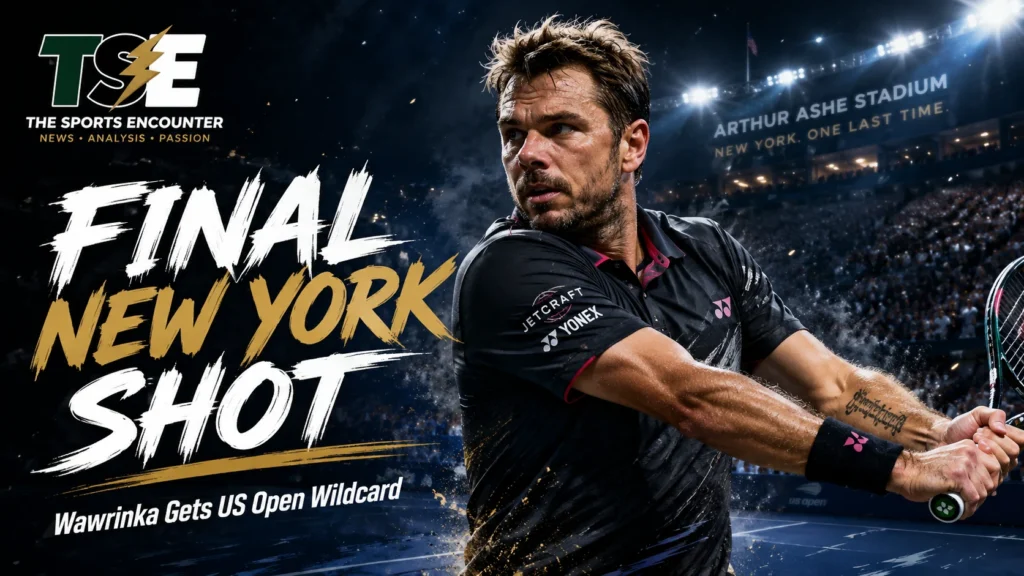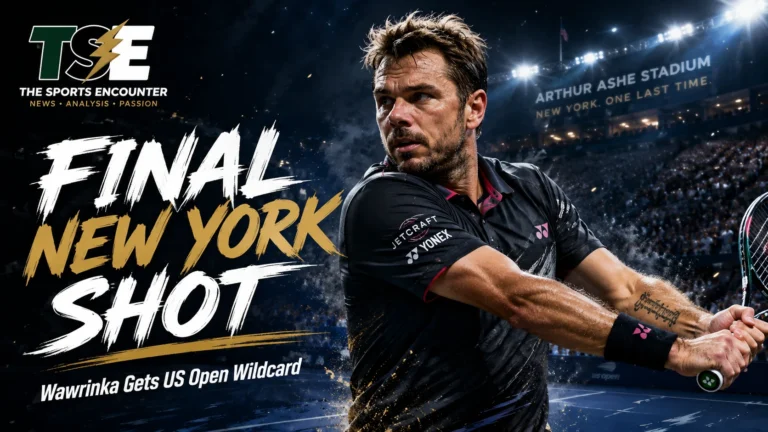
Fan Support Gives Stan Wawrinka His Last Shot at the US Open Title
Stan Wawrinka will return to the US Open one final time after receiving a late main-draw wildcard following Patrick Kypson’s injury withdrawal. The 2016 champion had appeared to say goodbye to New York only a day earlier after his initial omission sparked widespread fan criticism.
NEW YORK: Twenty-four hours after Stan Wawrinka appeared to have said goodbye to the US Open for the final time, New York has given him another match to fight for.
The 41-year-old Swiss has received a wildcard into the 2026 US Open men’s singles main draw, restoring one of the most significant farewell stories of the tournament after his original omission triggered widespread criticism from tennis fans.
Wawrinka, the 2016 US Open champion and a three-time Grand Slam winner, had posted an emotional farewell to New York on Tuesday after being left out of the completed wildcard allocation.
On Wednesday, everything changed.
American Patrick Kypson, who had received the final men’s main-draw wildcard on August 22, withdrew because of injury. The US Open then awarded the vacant place to Wawrinka, who immediately accepted.
“I’m incredibly excited to accept the wild card for the 2026 US Open and look forward to competing in front of the fans in New York once again,” Wawrinka said in a statement released by the tournament.
The timing makes the reversal remarkable. Wawrinka is playing the final season of a professional career that began more than two decades ago, and his exclusion had appeared to close his relationship with the Grand Slam where he won the last of his three major titles.
Now he will return to Flushing Meadows exactly 10 years after defeating Novak Djokovic in the 2016 final.
The comeback also needs to be described carefully. The US Open’s official announcement identifies Kypson’s injury withdrawal as the reason a wildcard became available. Organizers have not said that the fan reaction caused them to reverse their original decision.
The criticism created the public pressure surrounding the story. The injury created the opening.
Stan Wawrinka US Open Wildcard: What Happened?
| Detail | Information |
|---|---|
| Player | Stan Wawrinka |
| Age | 41 |
| Nationality | Switzerland |
| US Open status | 2026 men’s singles main-draw wildcard |
| Why a wildcard became available | Patrick Kypson withdrew through injury |
| US Open title | 2016 |
| US Open career record | 46-16 |
| Career Grand Slam singles titles | 3 |
| Career-high ATP ranking | World No. 3 |
| Last US Open appearance | 2024 |
| Career status | Retiring after the 2026 season |
| 2026 US Open main draw begins | August 30 |
TL;DR
- Stan Wawrinka has received a wildcard into the 2026 US Open men’s singles main draw.
- The 2016 champion was originally omitted from the tournament’s wildcard list.
- His exclusion generated significant criticism among tennis fans during his farewell season.
- Wawrinka posted an emotional goodbye to New York on Tuesday after believing he would not compete.
- Patrick Kypson then withdrew because of injury, freeing a main-draw wildcard.
- The US Open awarded that place to Wawrinka on Wednesday.
- The tournament has not said fan criticism caused the change.
- Wawrinka owns a 46-16 career record at the US Open.
- He defeated Novak Djokovic to win the 2016 championship.
- The 41-year-old will retire from professional tennis at the end of 2026.
Tuesday Looked Like the End of Wawrinka’s US Open Story
Wawrinka’s position looked settled only a day earlier.
The US Open had announced most of its men’s main-draw wildcards on August 18, balancing several competing priorities that regularly shape Grand Slam wildcard decisions.
American players received places through domestic pathways, collegiate achievements and the US Open Wild Card Challenge. Reciprocal agreements also provided main-draw opportunities for players nominated through the French and Australian tennis federations.
Gael Monfils received France’s reciprocal wildcard for what is also expected to be his final US Open, while Australia’s allocation eventually went to Dane Sweeny following changes elsewhere in the main-draw list.
Wawrinka was absent.
The final unallocated place eventually went to Kypson on August 22.
That appeared to settle the matter.
Wawrinka was not entered into qualifying either, leaving no obvious route into the tournament.
For a player whose 2026 season has been built around final appearances at the tournaments that shaped his career, the omission carried unusual emotional weight.
The Sports Encounter had already followed Wawrinka’s farewell journey when Cincinnati gave him a wildcard alongside Monfils, Grigor Dimitrov and Jack Draper. At that stage, another New York appearance still seemed possible.
By Tuesday, Wawrinka appeared to have accepted that it would not happen.
Wawrinka Said Goodbye Before New York Called Him Back
His farewell message captured why the initial decision generated such a strong reaction.
Wawrinka remembered arriving in New York from Switzerland and gradually developing a connection with the noise, intensity and late-night atmosphere that define the US Open.
He described winning there as one of the greatest moments of his life and thanked the crowd for the support he had received across two decades.
The message ended with a simple expression of gratitude to New York.
At the time, it sounded final.
The ATP documented that farewell on August 25, noting that Wawrinka had accumulated a 46-16 US Open record since making his tournament debut in 2005.
Within a day, the farewell had become premature.
Patrick Kypson’s Injury Changed the Wildcard Equation
The decisive development was Kypson’s withdrawal.
The 26-year-old American had been awarded the final main-draw wildcard after several earlier changes to the tournament’s entry list.
Once injury removed him, organizers had a place to reallocate.
They chose Wawrinka.
That sequence matters because it prevents the story from being reduced to a simple claim that angry fans forced the US Open into a U-turn.
The fan reaction was real and substantial enough to become part of the international coverage of Wawrinka’s exclusion.
The official record provides a more precise explanation for how he ultimately entered the draw.
Kypson withdrew.
A wildcard became available.
The US Open gave it to a former champion playing his final season.
That decision resolved the controversy without requiring organizers to remove another player who had already earned or received a place.
Why Wawrinka’s Initial Exclusion Became Such a Debate
Wildcard decisions are rarely based on one criterion.
Grand Slam organizers use them to support domestic players, reward junior and collegiate achievement, honor reciprocal agreements with other federations, assist players returning from injury, recognize former champions and create compelling tournament stories.
That inevitably means worthy players can miss out.
The 2026 US Open men’s allocation demonstrated the complexity.
J.J. Wolf earned a place through the US Open Wild Card Challenge. Michael Zheng brought elite collegiate credentials. Sebastian Gorzny and Jack Kennedy emerged through other American development pathways. Reciprocal agreements covered international selections.
Monfils received France’s reciprocal place during his own farewell season.
Kei Nishikori, the 2014 US Open finalist, was originally placed into qualifying rather than the main draw.
So Wawrinka did not possess an automatic entitlement simply because he had won the tournament before.
The discomfort came from the combination of his history and timing.
He was the reigning former champion playing his final professional season who had already received wildcards from the Australian Open, Roland Garros and Wimbledon.
New York was the major most closely associated with one of his career’s defining nights.
Leaving that relationship without a final appearance felt unusually abrupt to many supporters.
The debate also followed the US Open’s decision to give 46-year-old Venus Williams another main-draw wildcard, showing how differently tournaments can balance current ranking, history, public interest and the opportunity to honor established champions.
2016 Was the Night Wawrinka Became a New York Champion
Wawrinka’s relationship with the US Open would already have been significant without the trophy.
He reached the semifinals in 2013 and again in 2015.
Then came 2016.
His championship run almost ended in the third round.
Britain’s Dan Evans pushed Wawrinka to match point in a fourth-set tiebreak before the Swiss survived, won the breaker 10-8 and eventually escaped 4-6, 6-3, 6-7, 7-6, 6-2.
The US Open later noted that Wawrinka became only the seventh player in the Open era to save match point during a tournament and then go on to win the US Open singles title.
He grew stronger from there.
Juan Martín del Potro fell in four sets in the quarterfinals.
Kei Nishikori took the opening set of their semifinal before Wawrinka recovered to reach the championship match.
Novak Djokovic waited in the final.
Wawrinka Beat Djokovic When Djokovic Was Still the Standard
The context of the 2016 final remains central to Wawrinka’s legacy.
Djokovic entered New York as the defending champion and world No. 1. He had dominated major tennis through much of the preceding period and won six of the previous nine Grand Slam tournaments he had entered.
He also won the first set of the final.
Wawrinka responded with the type of sustained baseline power that made his peak years so dangerous for the sport’s greatest players.
His one-handed backhand absorbed Djokovic’s pressure and redirected it. His forehand generated enough depth to prevent Djokovic from controlling every exchange. As the match developed, Wawrinka increasingly dictated the physical terms of the rallies.
He won 6-7(1), 6-4, 7-5, 6-3.
It gave him his third Grand Slam title.
It also completed one of the most unusual achievements of his generation.
Wawrinka defeated a member of tennis’ Big Three in every major final he won.
Rafael Nadal was his opponent when he won the 2014 Australian Open.
Djokovic stood across the net for the 2015 Roland Garros final.
Djokovic was there again in New York in 2016.
For a player whose prime overlapped almost entirely with Roger Federer, Nadal and Djokovic, those titles explain why Wawrinka’s career carries significance far beyond the raw number of Grand Slams he collected.
This Final Season Has Never Been Designed as a Ceremonial Tour
Wawrinka announced in December that 2026 would be his final year as a professional.
He has repeatedly made clear that retirement does not mean he wants exhibitions disguised as competitive matches.
He still wants to win.
That distinction has shaped his final season.
At the Australian Open, Wawrinka reached the third round and became the oldest man to progress that far in Melbourne since Ken Rosewall in 1978.
His final appearances at Roland Garros, Gstaad, Monte Carlo, Dubai and other long-standing stops have combined competitive ambition with the reality that each defeat closes another chapter.
The Cincinnati wildcard fitted that pattern.
Our Cincinnati wildcard analysis argued that veterans such as Wawrinka and Monfils were still entering these events as competitors rather than ceremonial guests.
New York will now offer the same test on the biggest stage.
Wawrinka and Monfils Give the Men’s Draw Two Major Farewell Stories
The men’s tournament now includes two of the most recognizable veterans of the past two decades entering their final US Opens.
Monfils already had his place through the French reciprocal wildcard.
His farewell season has repeatedly produced emotional scenes, including his final Cincinnati appearance, which ended with a three-set defeat to Rinky Hijikata.
Wawrinka’s return creates a different kind of farewell.
Monfils’ relationship with crowds has always been built around creativity, athleticism and personality.
Wawrinka’s strongest connection with New York comes from winning through physical, punishing tennis against some of the greatest players ever produced.
Both careers belong to the same era.
They reached their importance through very different paths.
The 2026 US Open Men’s Draw Already Has Bigger Questions
Wawrinka will not arrive as a realistic favorite for the championship at 41.
His presence still strengthens a men’s tournament already carrying an unusual number of compelling stories.
Defending champion Carlos Alcaraz is returning from a long wrist-related absence. TSE’s analysis of Alcaraz’s US Open return examined the challenge of defending a Grand Slam after months without competitive tennis.
Novak Djokovic enters New York chasing a 25th major with questions around his preparation after his heat-affected Cincinnati defeat raised concerns about fitness and match sharpness.
World No. 1 Jannik Sinner has faced his own physical uncertainty after withdrawing from Cincinnati because of a knee problem.
Jack Draper’s disrupted preparation has added another question, while younger players emerging through Montreal and Cincinnati have made the men’s draw harder to predict.
For the full tournament picture, The Sports Encounter’s US Open 2026 curtain-raiser tracks the schedule, contenders, injury stories and major New York narratives.
What Should Fans Expect From Wawrinka?
Expectation needs to be separated from possibility.
A seven-match run to another US Open title would require a level of physical durability and consistency that would be extraordinary at 41.
An early-round opponent will almost certainly be younger, faster or better positioned in the rankings.
Wawrinka’s tennis still gives opponents specific problems when he finds rhythm.
His first serve can shorten points. His backhand remains capable of changing rallies immediately. His experience allows him to manage pressure and best-of-five-set momentum in ways that many younger players have never encountered.
The Australian Open provided evidence that he can still make Grand Slam matches physically and tactically uncomfortable.
That is enough to make his first-round draw interesting regardless of the opponent.
Wawrinka does not need to contend for the title for this wildcard to justify itself.
He needs the opportunity to compete.
What happens after that belongs to the match.
Why the Wildcard Debate Will Continue
The Wawrinka episode will probably strengthen calls for more transparency around Grand Slam wildcard decisions.
There is no simple formula that would satisfy every interest involved.
If tournaments prioritize rankings, many young domestic players lose development opportunities.
If they prioritize former champions, emerging players can be blocked by nostalgia.
If they prioritize local players, international stars may be excluded.
Reciprocal agreements complicate the allocation further because several places are effectively committed through relationships among Grand Slam host federations.
The US Open’s 2026 process demonstrates why each wildcard can carry a different rationale.
The difficulty comes when the public tries to compare them as though every recipient competed for the same place under the same criteria.
Wawrinka’s eventual entry avoided one of the hardest choices.
No existing recipient had to be removed.
Kypson’s injury created an opening.
The tournament used it on one of its former champions.
A Farewell That Now Gets to Happen on Court
The strongest part of this story has little to do with wildcard administration.
Wawrinka thought his New York career had ended without another match.
He wrote his farewell accordingly.
Now he gets to say goodbye in whites, with a racquet in his hand and an opponent across the net.
That suits the way he has approached his final year.
Wawrinka has consistently resisted the idea that his last season exists purely as a celebration of what has already happened.
He still measures himself through competition.
The US Open now gives him one more opportunity to do exactly that.
TSE Verdict: The Right Outcome Arrived Through an Unexpected Door
There was a reasonable argument behind the original wildcard allocation.
The US Open has obligations to American development, reciprocal agreements, collegiate pathways and players who earned access through designated challenges.
There was also a powerful argument for finding room for Wawrinka.
He is a former champion, one of only a small group of players who consistently disrupted the Big Three at their peak, and a 41-year-old playing his final season.
Those two realities created the controversy.
Kypson’s injury ultimately removed the need to choose between them.
The most responsible interpretation is therefore more nuanced than saying fan outrage forced the US Open to reverse its decision.
The backlash showed how much Wawrinka’s final New York appearance mattered to supporters.
The withdrawal created the vacancy that made it possible.
The tournament then made the obvious call.
Ten years after Wawrinka stood inside Arthur Ashe Stadium holding the US Open trophy, he will walk onto the grounds again as a competitor.
This time there is no expectation that he must win the tournament.
There is simply another match to play.
For Stan Wawrinka, that has always been enough reason to keep fighting.
Follow The Sports Encounter’s tennis coverage for US Open 2026 news, match reports, player stories, results and analysis throughout the final Grand Slam of the season.
Frequently Asked Questions
Did Stan Wawrinka receive a wildcard for the 2026 US Open?
Yes. The US Open awarded Wawrinka a men’s singles main-draw wildcard on August 26, 2026.
Why did Stan Wawrinka get the US Open wildcard?
Patrick Kypson withdrew because of injury, leaving a main-draw wildcard available. The US Open then awarded that place to Wawrinka.
Did fan backlash force the US Open to give Wawrinka a wildcard?
The US Open has not said that. Wawrinka’s original exclusion generated significant fan criticism, but the tournament’s official announcement states that Patrick Kypson’s injury withdrawal created the available wildcard.
Was Stan Wawrinka originally left out of the US Open?
Yes. Wawrinka was not included in the original men’s main-draw wildcard allocation and was not entered into qualifying. He posted an emotional farewell to the tournament before the later wildcard became available.
When did Stan Wawrinka win the US Open?
Wawrinka won the US Open men’s singles championship in 2016, defeating Novak Djokovic 6-7(1), 6-4, 7-5, 6-3 in the final.
How many Grand Slam titles has Stan Wawrinka won?
Wawrinka has won three Grand Slam singles titles: the 2014 Australian Open, 2015 Roland Garros and 2016 US Open.
What is Stan Wawrinka’s US Open record?
Wawrinka owns a 46-16 career singles record at the US Open.
When did Wawrinka last play the US Open?
His most recent appearance at Flushing Meadows before 2026 came in 2024.
Is Stan Wawrinka retiring?
Yes. Wawrinka announced that the 2026 season will be his final year as a professional tennis player.
When does the 2026 US Open singles main draw begin?
The men’s and women’s singles main draws begin on Sunday, August 30, at the USTA Billie Jean King National Tennis Center in New York.
Breaking News
Saudi Pro League: Al-Nemer’s Impact Rescues Point After Diriyah Dominate Without Punch
Al Diriyah controlled possession but struggled to create clear chances before Al Kholood struck through Abdulaziz Al-Aliwah. Substitute Meshari Al-Nemer then scored within two minutes of coming on to rescue a 1-1 Saudi Pro League draw.
RIYADH: Al Diriyah had more of the ball, more corners and considerably more star power on the field.
Al Kholood still came closer to leaving Al-Awwal Park with all three points.
Abdulaziz Al-Aliwah gave the visitors the lead in the 71st minute before substitute Meshari Fahad Al-Nemer rescued Al Diriyah with an 83rd-minute equalizer, just two minutes after entering the match, as the two sides settled for a 1-1 draw in the Saudi Pro League on Wednesday night.
The result itself was balanced.
The performance was not.
Al Diriyah controlled 58 percent of possession, attempted 10 shots and won seven corners to Al Kholood’s one. Yet only one of those 10 attempts found the target.
That one shot became the equalizer.
Al Kholood, meanwhile, put four of their nine attempts on target and repeatedly looked more dangerous whenever they found space to attack.
That contrast tells the real story of the night.
Al Diriyah have assembled a squad featuring Darwin Núñez, Idrissa Gana Gueye, Enzo Millot, Berat Djimsiti and Chancel Mbemba. They looked capable of controlling the match for long stretches. Turning that control into clean chances remains a much more complicated problem.
Al Kholood showed the opposite quality. They needed less possession to create more meaningful threat, and for 12 minutes after Al-Aliwah’s opener, they were heading toward another impressive result in an unbeaten start to the league season.
Then Al-Nemer changed everything almost immediately.
Al Diriyah vs Al Kholood: Match at a Glance
| Match Detail | Information |
|---|---|
| Competition | Saudi Pro League 2026-27 |
| Matchweek | 3 |
| Result | Al Diriyah 1-1 Al Kholood |
| Venue | Al-Awwal Park, Riyadh |
| Al Kholood scorer | Abdulaziz Al-Aliwah 71′ |
| Al Kholood assist | Iker Kortajarena |
| Al Diriyah scorer | Meshari Fahad Al-Nemer 83′ |
| Al Diriyah assist | Abdulaziz Al-Faraj |
| Possession | Al Diriyah 58% – 42% Al Kholood |
| Total shots | Al Diriyah 10 – 9 Al Kholood |
| Shots on target | Al Diriyah 1 – 4 Al Kholood |
| Corners | Al Diriyah 7 – 1 Al Kholood |
The fixture was part of Matchweek 3 of the 2026-27 Roshn Saudi League, which officially began on August 13 and will run across 34 rounds. The Saudi Pro League confirmed a 306-match season running through May 29, 2027.
For continuing coverage of Saudi and international football, readers can follow The Sports Encounter’s Soccer hub.
Diriyah Controlled the Match Without Controlling the Danger
The possession numbers initially suggested a familiar pattern.
Al Diriyah had more of the ball and spent longer operating in the attacking half.
They also accumulated corners, territorial pressure and enough possession to force Al Kholood into extended defensive phases.
Yet the most important attacking statistic remained stubbornly poor.
One shot on target.
That matters more than possession percentages.
A team can dominate the ball without dominating a match if that possession never develops into clear scoring opportunities.
Al Diriyah repeatedly moved the ball into promising areas but struggled to turn those positions into shots that actually tested Hamed Al-Shanqiti.
The hosts had seven corners and 10 attempts.
Al Kholood goalkeeper Al-Shanqiti finished without a registered save.
That is the statistic Al Diriyah will need to examine most closely.
A Squad Full of Famous Names Still Needs Functional Chemistry
Al Diriyah’s summer recruitment has given the promoted club one of the most recognizable squads outside the traditional Saudi giants.
The Saudi Pro League’s official summer transfer tracker lists arrivals including former Everton midfielder Idrissa Gana Gueye, former Liverpool striker Darwin Núñez, Enzo Millot, Berat Djimsiti and Chancel Mbemba.
Bruno Lage therefore has no shortage of experience.
The difficulty is converting names into relationships.
Gueye provides control and defensive intelligence.
Millot offers creativity between the lines.
Núñez gives the attack pace and physical presence.
Djimsiti and Mbemba bring years of European experience to the defensive line.
Against Al Kholood, however, the pieces did not consistently connect in the final third.
Diriyah could progress the ball.
They could hold possession.
They could force corners.
What they could not do often enough was create separation inside the penalty area.
That difference becomes especially important against compact opponents prepared to concede possession without conceding space.
Al Kholood Were Comfortable Without the Ball
Al Kholood’s 42 percent possession did not reflect panic.
It reflected a different strategy.
Des Buckingham’s side were willing to allow Diriyah longer spells on the ball while protecting the central areas and waiting for opportunities to attack with greater directness.
The outcome was revealing.
Al Kholood produced four shots on target from nine attempts.
Diriyah produced one from 10.
The visitors therefore created four times as many on-target efforts despite seeing considerably less of the ball.
That efficiency has already become part of Al Kholood’s early-season identity.
They opened the campaign with a 1-1 draw away to Al-Ittihad before beating Al-Taawoun 3-2.
That earlier point against Al-Ittihad became even more meaningful when Al-Ittihad later defeated Al-Qadsiah despite playing with 10 men.
Al Kholood have now taken points from three different opponents without losing a league match.
Abdulaziz Al-Aliwah Rewards Al Kholood’s Patience
The breakthrough finally arrived in the 71st minute.
Iker Kortajarena created the opening and Abdulaziz Al-Aliwah finished the move to put Al Kholood 1-0 ahead.
The goal was consistent with everything the visitors had been trying to do.
They had spent much of the match without control of possession, but they had still forced Diriyah goalkeeper Nikola Vasilj into work.
When the decisive opportunity arrived, they converted it.
That immediately changed the pressure inside Al-Awwal Park.
Diriyah had enjoyed the majority of possession without finding a goal.
Now they had less than 20 minutes to prevent that dominance from becoming a defeat.
Lage needed something different.
He eventually found it on his bench.
Meshari Al-Nemer Needed Two Minutes to Change the Match
Meshari Fahad Al-Nemer entered in the 81st minute.
Two minutes later, the game was level.
Abdulaziz Al-Faraj supplied the assist and Al-Nemer converted in the 83rd minute to make it 1-1.
The timing gave the substitution far greater significance than a routine equalizer.
Diriyah had spent more than 80 minutes searching for the final action that their established attacking players had failed to produce.
A Saudi substitute found it almost immediately.
That is exactly why squad depth should never be judged purely by transfer fees or famous names.
Matches are often decided by the player who enters at the right moment and understands what the situation requires.
Al-Nemer did that.
His equalizer also created an interesting selection question for Lage.
Players who change games from the bench eventually earn arguments for more minutes.
Darwin Núñez and Diriyah’s Attack Still Need Time
Much of the international attention surrounding Diriyah this season will naturally follow Núñez.
The Uruguay international is one of the biggest names to join the club and gives the attack a profile far beyond what would normally be associated with a newly promoted Saudi side.
His presence alone, however, does not solve attacking structure.
Diriyah’s difficulty against Al Kholood was not simply a finishing problem.
It was a chance-creation problem.
One shot on target across an entire match leaves very little margin for any center-forward.
That is where the relationships around Núñez become important.
Millot, Adil Boulbina, Hattan Bahebri and the deeper midfielders have to create better connections between possession and penetration.
If they do, Núñez becomes significantly more dangerous.
If they do not, Diriyah risk becoming a team that looks impressive on the team sheet but predictable around the penalty area.
Diriyah’s Opening Three Matches Show Both Promise and Limitation
Three league matches are too small a sample for major conclusions.
They are enough to identify early themes.
Diriyah opened their first Saudi Pro League campaign with a 1-0 defeat to Al-Ahli.
They responded by beating Al-Hazem 1-0 away from home.
The draw with Al Kholood now gives them four points from three matches.
For a newly promoted club, that is a respectable beginning.
The context makes it more complicated.
This is not a conventional promoted squad built around survival.
Diriyah have recruited international players with Champions League, Premier League, Bundesliga and Serie A experience.
The expectations attached to that investment will inevitably rise.
The Saudi Pro League itself categorized Diriyah among its Level D clubs when constructing the 2026-27 fixture model, based on sporting performance over previous seasons.
Their recruitment suggests they intend to outgrow that classification quickly.
Matches like this show why that process may take time.
Al Kholood’s Unbeaten Start Deserves More Attention
Al Kholood now move to five points from their opening three league matches.
They have drawn with Al-Ittihad, beaten Al-Taawoun and drawn away with Diriyah.
That is a quietly impressive opening.
It becomes even more interesting when placed beside some of the league’s more heavily publicized results.
Al-Nassr’s explosive start has naturally attracted attention around Cristiano Ronaldo, while Al-Hilal, Al-Ahli and Al-Ittihad remain central to the championship conversation.
Al Kholood are operating in a different space.
They do not need to dominate headlines.
They need to accumulate points.
Five from three without defeat is exactly the kind of early foundation that can transform the mood around a season.
The Midfield Battle Was More Important Than the Possession Stat
Diriyah’s midfield contained considerable experience.
Gueye and Abdulelah Al-Malki provided the base, with Millot and Boulbina operating in more advanced areas.
That structure helped the hosts control territory.
Al Kholood’s midfield did something less visible but equally valuable.
Seydouba Cissé and John Buckley protected the defense and helped prevent Diriyah from turning midfield possession into repeated central entries.
That is why the match became a useful example of the difference between territorial control and attacking control.
Diriyah controlled where much of the game was played.
Al Kholood controlled the quality of chances for long enough to nearly win it.
One Shot on Target Is the Number Diriyah Cannot Ignore
Possession can flatter teams.
Corners can flatter teams.
Shot totals can even flatter teams.
Shots on target are harder to dismiss.
Diriyah had 58 percent possession.
They had seven corners.
They attempted 10 shots.
Only Al-Nemer’s equalizer tested the goalkeeper.
That is the clearest area for improvement before the next league match.
Bruno Lage does not necessarily need more possession.
He needs that possession to produce cleaner final passes, more movement inside the box and more attempts from positions where the goalkeeper is genuinely threatened.
The Result Fits a Saudi Pro League Becoming Harder to Predict
The early weeks of the season have already produced several results that challenge simple assumptions about hierarchy.
Al-Kholood took a point from Al-Ittihad.
Al-Ittihad then showed their own resilience by beating Al-Qadsiah with 10 men.
Al-Nassr have started quickly, including the dramatic 3-2 comeback against Al-Ettifaq.
At the same time, promoted and middle-tier clubs are recruiting more aggressively and becoming harder to dismiss.
The league’s wider transformation is not limited to the traditional giants either. Saudi football’s continuing ownership and investment reforms are changing the competitive environment across the domestic game.
Diriyah themselves are one of the clearest examples.
A promoted club starting Núñez, Gueye, Millot, Djimsiti and Mbemba would have seemed almost impossible only a few years ago.
Now the more interesting question is whether those players can turn investment into results quickly enough.
What the Draw Means for Both Teams
For Al Diriyah
Four points from three matches represents a stable start, especially after losing to Al-Ahli on opening night.
The concern is attacking efficiency.
Diriyah have now experienced three very different tests and still look like a team learning how to connect its star names consistently.
Al-Nemer’s immediate impact gives Lage another option and perhaps a reason to reconsider how he uses his bench.
For Al Kholood
The unbeaten league run continues.
Five points from matches against Al-Ittihad, Al-Taawoun and Diriyah is a strong return.
The visitors also leave Riyadh knowing they created the better on-target threat despite having less possession.
The disappointment comes from being 12 minutes away from a second league victory before Al-Nemer intervened.
The Final Word: Diriyah Had the Names, Al Kholood Had the Sharper Plan
Al Diriyah will probably leave this match frustrated because the numbers suggest they controlled enough of the game to win it.
That interpretation only works if possession is mistaken for danger.
Al Kholood were the more efficient attacking team.
They put four shots on target, scored first and forced Diriyah to chase the game despite spending less time on the ball.
Diriyah’s response came from an unexpected source.
Meshari Al-Nemer entered in the 81st minute and scored in the 83rd.
In a team filled with internationally recognized names, the most decisive contribution came from a substitute who needed barely two minutes to make himself impossible to ignore.
That is the lesson Diriyah should take from the night.
The squad has enough talent.
The next stage is turning that talent into sharper attacking relationships.
Al Kholood’s lesson is different.
They have already shown they can compete without controlling possession and can take points from teams with considerably more expensive squads.
Three league matches in, they remain unbeaten.
That deserves attention.
For more coverage from Saudi Arabia and across world football, visit The Sports Encounter’s Soccer section and the TSE home page for the latest match reports, analysis and breaking stories.
Frequently Asked Questions
What was the Al Diriyah vs Al Kholood score?
Al Diriyah and Al Kholood drew 1-1 in their Saudi Pro League Matchweek 3 fixture on August 26, 2026.
Who scored for Al Kholood against Al Diriyah?
Abdulaziz Al-Aliwah scored for Al Kholood in the 71st minute after an assist from Iker Kortajarena.
Who scored Al Diriyah’s equalizer?
Meshari Fahad Al-Nemer scored the equalizer in the 83rd minute from Abdulaziz Al-Faraj’s assist.
How long was Al-Nemer on the field before scoring?
Al-Nemer entered in the 81st minute and scored two minutes later.
Did Darwin Núñez play against Al Kholood?
Yes. Darwin Núñez started for Al Diriyah alongside several other high-profile summer additions.
How much possession did Al Diriyah have?
Al Diriyah had approximately 58 percent possession compared with Al Kholood’s 42 percent.
How many shots on target did Al Diriyah have?
Al Diriyah recorded only one shot on target from 10 attempts. That shot produced Al-Nemer’s equalizer.
How many shots on target did Al Kholood have?
Al Kholood recorded four shots on target from nine attempts.
How many points do Al Kholood have after three matches?
Al Kholood have five points from three Saudi Pro League matches after drawing with Al-Ittihad and Al Diriyah and beating Al-Taawoun.
How many points do Al Diriyah have?
Al Diriyah have four points from three league matches after losing to Al-Ahli, beating Al-Hazem and drawing with Al Kholood.
Breaking News
Carabao Cup: Bradford Stun Burnley as Everton, Spurs and Brentford Light Up the Night
Bradford City knocked Burnley out on penalties, Thierno Barry hit a hat-trick for Everton, Tottenham scored five and Brentford struck six as Carabao Cup Round Two delivered shocks, statements and standout performances.
ENGLAND: Bradford City delivered the shock, Thierno Barry supplied the individual masterpiece, Tottenham rediscovered their attacking pulse and Newcastle needed Harvey Barnes to rescue them from a genuine scare.
The latest wave of Carabao Cup second-round action had almost everything the competition promises at this stage of the season: a Premier League casualty, a hat-trick, a debut goal, late drama and enough evidence to show that squad depth can matter just as much as league status once knockout football begins.
Bradford produced the headline result by holding Burnley to a goalless draw before winning 4-2 on penalties. Everton were far more comfortable, dismantling Preston North End 4-0 as Barry scored the first hat-trick of his Everton career and created the fourth goal for Brennan Johnson.
Tottenham responded to their difficult start to the Premier League season with a 5-1 victory over Charlton Athletic, with Mikey Moore, Dominic Solanke, Kevin Danso, Sávio and Ben Davies all scoring. Newcastle’s evening was considerably less comfortable. West Brom twice threatened an upset at St James’ Park before substitute Harvey Barnes completed a second-half brace to secure a 3-2 win.
Those results followed another emphatic display earlier in Round Two when Brentford destroyed Birmingham City 6-1 despite making eight changes from the side that had beaten Tottenham in the Premier League.
The pattern running through these ties was difficult to miss.
The teams that treated rotation as an opportunity generally prospered. The ones unable to translate reputation into control discovered again why the Carabao Cup can become uncomfortable remarkably quickly.
Carabao Cup Round Two: Latest Results
| Fixture | Result | Key Story |
|---|---|---|
| Bradford City vs Burnley | 0-0, Bradford won 4-2 on penalties | Bradford eliminate Burnley after Joe McCracken’s shootout intervention |
| Newcastle United vs West Brom | 3-2 | Harvey Barnes scores twice as Newcastle survive |
| Preston North End vs Everton | 0-4 | Thierno Barry scores hat-trick and assists Brennan Johnson |
| Tottenham Hotspur vs Charlton Athletic | 5-1 | Sávio scores on debut as Spurs respond emphatically |
| Birmingham City vs Brentford | 1-6 | Eight-change Brentford side exposes its squad depth |
| Nottingham Forest vs Leeds United | 0-2 | Leeds beat Forest for the second time in days |
| Ipswich Town vs Leicester City | 3-1 | Marcelino Núñez scores twice, including a spectacular long-range goal |
The wider competition schedule and official Round Two information can be followed through the English Football League’s Carabao Cup coverage.
Bradford Turn Burnley’s Escape Act Into an Exit
There was something especially fitting about the way Burnley left the competition.
Earlier in the Carabao Cup, Burnley had needed penalties to survive Notts County after a 1-1 draw. That narrow escape formed part of The Sports Encounter’s Round One North review, where the early warning was already obvious: divisional status offers little protection once a knockout tie becomes uncomfortable.
This time, the shootout turned against them.
Bradford resisted for 90 minutes without conceding and then handled the pressure from the spot with considerably greater composure.
Zeki Amdouni failed to convert for Burnley before Bradford goalkeeper Joe McCracken saved Jacob Bruun Larsen’s penalty. Ibou Touray strengthened Bradford’s position before Marcus Edwards temporarily kept Burnley alive.
Adam Phillips then finished the job.
His successful penalty sealed a 4-2 shootout victory and sent Bradford into the third round.
The upset was built before the penalties
Shootouts naturally dominate the memory of games like this, but Bradford’s achievement began much earlier.
Keeping Burnley scoreless across 90 minutes required organisation, concentration and enough defensive discipline to prevent the stronger squad from turning possession into a decisive moment.
Burnley had already experienced the danger of this competition in Round One. Bradford made sure the warning became elimination in Round Two.
That is what gives this result genuine giant-killing value.
Bradford did not require a freak early goal and an hour of desperate survival. They remained level long enough to move the contest into the part of knockout football where reputation stops carrying any weight.
Four Bradford penalties later, Burnley’s Carabao Cup campaign was over.
Thierno Barry Gives Everton Something Far More Valuable Than Progression
Everton were never interested in penalties at Deepdale.
David Moyes returned to Preston, the club he left for Everton in 2002, and watched his current side produce one of the cleanest performances of the round.
The 4-0 scoreline tells only part of the story.
Thierno Barry scored three times and then created Everton’s fourth for Brennan Johnson.
For a striker who managed eight goals across 41 appearances last season, the timing could hardly have been better.
Barry had already scored against Crystal Palace in Everton’s Premier League opener. His hat-trick at Preston took him to four goals in the early stages of the new campaign and offered Moyes something every manager wants to discover in August: a forward who appears to have returned sharper, more confident and more decisive.
Barry’s hat-trick showed three different striker instincts
The first arrived in the 25th minute.
Kiernan Dewsbury-Hall lifted an intelligent pass beyond Preston’s defense for Vitalii Mykolenko, whose control allowed him to square across goal. Barry arrived where a center-forward should and converted.
Preston emerged with greater purpose after halftime, but their resistance lasted only until the 59th minute.
Dewsbury-Hall again played a central role, combining in the buildup before forcing a save. Barry reacted quickest to the rebound and finished from close range.
The hat-trick arrived 11 minutes later when Johnson crossed unselfishly toward the far post and Barry tapped in.
Then came the detail that completed the performance.
Barry could have ended the evening satisfied with three goals. Instead, he split Preston’s defense with the pass that allowed Johnson to score Everton’s fourth.
Three goals and an assist made Barry the outstanding individual performer from the latest group of ties.
Everton may have found an early-season attacking answer
Cup performances can mislead when opponents rotate heavily, and Preston made seven changes.
Even allowing for that context, Everton’s attacking fluency mattered.
They controlled the match, created chances repeatedly and avoided the kind of awkward second-round contest that can drain confidence from a team still finding its rhythm.
For broader context on where Everton and the rest of England’s top-flight clubs stand at the start of the campaign, see The Sports Encounter’s complete 2026-27 Premier League preview.
Tottenham Needed a Response and Found Five Goals
Tottenham’s situation carried a different kind of pressure.
Roberto De Zerbi’s team had opened its Premier League campaign with a bruising 3-0 defeat at Brentford.
Early-season setbacks rarely become crises after one match, but a new-look side trying to establish confidence does not want another difficult night four days later.
Charlton therefore arrived at Tottenham Hotspur Stadium with an opportunity to create genuine discomfort.
For 40 minutes, they stayed in the game.
Then Tottenham accelerated.
Mikey Moore opened the scoring in the 41st minute before Dominic Solanke doubled the advantage just before halftime.
Kevin Danso made it 3-0 after the break.
The fourth provided the evening’s most obvious headline.
Sávio needed only minutes to introduce himself
Tottenham completed the signing of Sávio shortly before the tie, and De Zerbi had admitted beforehand that he was unsure how much the Brazilian would be able to play.
The answer was enough.
Sávio came from the bench and scored on his debut, offering supporters an immediate glimpse of the one-on-one threat Tottenham believe they have added to their attack.
His influence did not stop with the goal. He remained heavily involved as Spurs continued to stretch Charlton late in the contest.
Ben Davies scored the fifth before Lloyd Jones headed Charlton’s consolation.
The final score read 5-1.
For a team coming directly from a three-goal defeat, the emotional value of the result was obvious.
Mikey Moore’s contribution should not disappear behind the new signing
Sávio will naturally command attention because of his transfer fee and debut goal, but Moore’s performance deserves its own recognition.
The academy product scored the opener and repeatedly carried attacking threat.
His development also gives De Zerbi something valuable during a season in which Tottenham’s senior attacking options will inevitably encounter injuries, rotation and fixture congestion.
The result cannot erase what went wrong against Brentford.
It did show that Tottenham were capable of responding immediately rather than allowing that defeat to define the beginning of their season.
Tottenham’s broader challenge forms part of our Premier League coverage, where managerial changes, squad construction and the early shape of the 2026-27 campaign remain central themes.
Harvey Barnes Saves Newcastle From a Much More Difficult Night
If Tottenham and Everton enjoyed relatively comfortable progress, Newcastle had to earn every part of theirs.
West Brom arrived at St James’ Park prepared to compete rather than simply admire Premier League opposition.
Isaac Price gave the visitors the lead after 19 minutes with a 25-yard free kick that Newcastle goalkeeper Ewen Jaouen got a hand to but could not keep out.
The home side responded before halftime.
Teenager Sean Steur helped release Amar Dedic, whose cross was finished at close range by Bazoumana Touré for his first Newcastle goal.
The equalizer carried particular significance because several of Newcastle’s newer players combined in its creation.
That development matters for Matthias Jaissle, who inherited a club undergoing significant change and has had limited time to build his preferred structure.
Our earlier analysis of Jaissle’s Newcastle rebuild focused on precisely that problem: integrating new players quickly enough to produce competitive results before the season gathered speed.
Barnes changed the tie after halftime
Touré was replaced by Harvey Barnes at the interval.
Three minutes later, Newcastle were ahead.
Barnes reacted after a corner broke inside the penalty area and converted at the second attempt.
West Brom refused to disappear.
Lewis Hall handled inside the area, allowing Price to score his second of the match from the penalty spot in the 78th minute.
At 2-2, Newcastle were suddenly facing the possibility of penalties and another frustrating night under their new coach.
Barnes prevented it.
Dedic delivered another dangerous low cross, and Barnes swept home the winner in the 82nd minute.
Newcastle had their first competitive victory under Jaissle.
The performance raised questions even as the result delivered relief
A 3-2 cup win over Championship opposition is not evidence that Newcastle’s transition is complete.
West Brom caused serious problems and scored twice. Price repeatedly found ways to hurt the home side, while Newcastle needed a substitute to rescue them after the break.
There was also plenty to encourage Jaissle.
Dedic influenced multiple goals, Touré scored, Steur played a role in the first and Barnes looked decisive when introduced.
For a team still putting together a new identity, progression accompanied by contributions from several different players is more useful than a comfortable win built entirely around familiar names.
Brentford’s 6-1 Rout Was the Round’s Clearest Squad-Depth Statement
Brentford had already set an intimidating benchmark before Wednesday’s ties began.
Keith Andrews changed eight players from the starting lineup that had beaten Tottenham 3-0 in the Premier League.
Such rotation can sometimes turn League Cup nights into disjointed performances.
Brentford instead scored six.
Callum Wilson marked his first competitive start for the club with a goal after only six minutes.
Birmingham equalized through Demarai Gray, but the response from the Premier League side was ruthless.
Aaron Hickey restored the lead, Nathan Collins scored twice, Mikkel Damsgaard added another and Igor Thiago completed the rout.
The 6-1 result was significant beyond progression.
Brentford rotated without losing their identity
The most impressive part of the performance was not simply the number of goals.
Only Collins, Vitaly Janelt and Dango Ouattara retained their places from the league victory over Spurs.
Brentford still pressed aggressively, attacked quickly and exposed Birmingham whenever the Championship side attempted to play through pressure.
New players contributed immediately.
Wilson scored. Hickey scored. Damsgaard scored. Thiago scored. Collins, the captain, scored twice.
That is exactly what managers hope cup competitions will reveal.
Rotation did not weaken Brentford’s structure. It exposed how many players already understand it.
The contrast with Tottenham’s Premier League defeat only days earlier also sharpened the picture. Brentford had beaten Spurs 3-0 with one lineup and then dismantled Birmingham 6-1 with another.
That is an early warning for the rest of the domestic season.
Leeds Beat Nottingham Forest Again
Leeds United’s second-round victory carried a particularly uncomfortable message for Nottingham Forest.
Daniel Farke’s side had already beaten Forest 1-0 in the Premier League.
Days later, Leeds returned to the City Ground and won again.
This time the margin was 2-0.
Dan James opened the scoring in the 50th minute before Lukas Nmecha added the second in the 75th, according to Leeds United’s official match report.
Two defeats against the same opponent in such a short period inevitably tell both clubs something.
Leeds have discovered an early matchup they can control.
Forest have already been shown twice where the problems lie.
Marcelino Núñez Produces the Goal of the Round Candidate
Ipswich’s 3-1 victory over Leicester contained one of the most memorable individual moments of Round Two.
The first half ended goalless before Sindre Walle Egeli put Ipswich ahead in the 62nd minute.
Leicester responded five minutes later when 19-year-old Olabade Aluko scored his first senior goal.
Then Marcelino Núñez took over.
The Chilean restored Ipswich’s lead in the 71st minute before producing the moment everyone will remember.
Deep into stoppage time, Núñez saw goalkeeper Jakub Stolarczyk away from his line and struck from close to the halfway line.
The ball flew over the goalkeeper and completed a 3-1 win.
Leicester’s own official match center records Núñez’s brace at 71 and 90+1 minutes.
Cup football often needs one moment to turn an ordinary second-round result into something supporters remember months later.
Núñez supplied it.
What the Latest Carabao Cup Results Actually Tell Us
Looking at these matches together reveals more than a collection of scores.
1. Squad depth is already becoming visible
Brentford provided the clearest example.
Eight changes produced six goals.
Everton rotated without losing attacking control. Tottenham were able to introduce an expensive new signing from the bench and immediately receive a goal. Newcastle used Barnes as a halftime replacement and watched him decide the match.
This is what the League Cup can expose very early in a season.
First-choice teams tell us how strong a club’s starting XI is. Cup rotation begins revealing whether the second layer can preserve the same standards.
2. Reputation still offers no protection
Burnley entered their tie with a stronger recent top-flight pedigree than Bradford.
Bradford sent them home.
The penalty shootout was simply the final stage of a contest Burnley had already failed to control over 90 minutes.
That is why the Carabao Cup remains useful even when some managers make wholesale changes.
Once the match begins, the name of the league on a club’s fixture list cannot score for them.
3. New signings are being asked to contribute immediately
Sávio scored on his Tottenham debut.
Wilson scored on his first competitive Brentford start.
Touré opened his Newcastle account.
Johnson scored for Everton after Barry returned the favor following the winger’s assist for the hat-trick goal.
August traditionally allows managers to talk about players needing time.
The fixture calendar rarely offers much of it.
4. The cup can repair confidence quickly
Tottenham needed that badly.
A 3-0 league defeat to Brentford raised immediate questions about De Zerbi’s new-look team.
Five goals against Charlton do not answer every one of them, but football psychology rarely operates in neat tactical categories.
Players who have just suffered a heavy defeat benefit from seeing passes connect, forwards score and supporters enjoy the evening again.
Everton gained something similar through Barry’s performance.
Newcastle gained it through Jaissle’s first competitive win.
A cup tie can therefore become more useful than its place on the calendar initially suggests.
The Biggest Winner of the Latest Round Two Action
Bradford owned the biggest result.
Brentford produced the strongest collective performance.
Tottenham scored five and introduced Sávio successfully.
Newcastle survived the most dramatic contest.
Yet if one individual stands above the rest, it is difficult to look beyond Thierno Barry.
A hat-trick would have been enough.
Adding an assist made the night exceptional.
What gives the performance additional significance is what came before it.
Barry’s first Everton season was difficult. Eight goals in 41 games left plenty of room for doubt over whether he could become the consistent finisher the club required.
He has now started the new campaign with four goals in his opening matches.
That does not prove a complete transformation.
It gives Everton a reason to believe one may be developing.
The Biggest Loser: Burnley Had Been Warned Already
Burnley’s elimination is the result most difficult to explain away.
They had already needed a penalty shootout to survive Notts County in the previous round.
The second warning arrived against Bradford.
There was no survival this time.
For a club trying to rebuild after relegation from the Premier League, early cup elimination is not automatically disastrous. League priorities will carry much greater long-term importance.
Still, losing without scoring against Bradford and then failing from the spot removes an opportunity for competitive minutes, momentum and a potentially valuable cup run.
More importantly, it gives Burnley’s coaching staff another early indication that greater attacking authority is required.
Why These Nights Still Matter in the Carabao Cup
The Carabao Cup’s early rounds often arrive while transfer windows remain open and managers are still learning what their squads can actually do.
That makes them unusually revealing.
League tables after one or two matches tell very little.
A knockout game asks a different question.
Can a changed lineup maintain the team’s identity?
Can a young player handle senior responsibility?
Can a new signing influence a competitive game immediately?
Can a stronger club respond when a lower-ranked opponent refuses to follow the expected script?
This week’s answers were varied.
Brentford’s second team looked frighteningly comfortable.
Everton discovered a striker in ruthless form.
Spurs found a response and a promising debut.
Newcastle found enough quality on the bench to escape trouble.
Bradford found belief when Burnley could not find a goal.
That is a useful amount of information from a competition some supporters are tempted to treat as secondary until the later rounds.
For continuing English football coverage, follow The Sports Encounter’s Soccer hub and our dedicated Premier League section.
The Final Word: Bradford Owned the Shock, Barry Owned the Night
Carabao Cup Round Two has already reminded several clubs that August does not provide immunity from consequences.
Burnley are out because Bradford stayed disciplined for 90 minutes and then handled the shootout better.
Everton are through because Barry turned a potentially awkward trip to Preston into his personal showcase.
Tottenham are through because their attack finally found the freedom that disappeared at Brentford a few days earlier.
Newcastle are through because Barnes entered a level contest and changed it.
Brentford had already made perhaps the loudest squad-depth statement of the round by scoring six with eight changes.
Leeds demonstrated repeatable superiority over Nottingham Forest, while Ipswich received a moment of extraordinary quality from Núñez.
The competition will become harder from here. Bigger clubs will enter, rotations will become more strategic and the consequences will carry greater weight.
That can wait.
The latest results deserve their own conclusion.
Bradford produced the upset everybody will remember.
Barry delivered the performance nobody at Preston could stop.
And across several grounds, the Carabao Cup again showed why seemingly routine early-round fixtures have a habit of becoming anything but routine.
Frequently Asked Questions
Who knocked Burnley out of the Carabao Cup?
Bradford City eliminated Burnley in Round Two. The match finished 0-0 after 90 minutes before Bradford won the penalty shootout 4-2.
Who scored Everton’s goals against Preston?
Thierno Barry scored a hat-trick and Brennan Johnson added Everton’s fourth in the 4-0 victory at Deepdale.
How many goals did Thierno Barry score against Preston?
Barry scored three goals and also assisted Johnson, giving him direct involvement in all four Everton goals.
Who scored for Tottenham against Charlton?
Mikey Moore, Dominic Solanke, Kevin Danso, Sávio and Ben Davies scored for Tottenham in the 5-1 victory. Lloyd Jones scored Charlton’s late consolation.
Did Sávio score on his Tottenham debut?
Yes. Sávio came off the bench and scored during Tottenham’s 5-1 Carabao Cup victory over Charlton.
What was the Newcastle vs West Brom score?
Newcastle defeated West Brom 3-2 at St James’ Park. Harvey Barnes scored twice after coming on at halftime, while Bazoumana Touré scored Newcastle’s other goal. Isaac Price scored both West Brom goals.
Was this Matthias Jaissle’s first competitive Newcastle win?
Yes. The 3-2 victory over West Brom gave Jaissle his first competitive win as Newcastle head coach.
What was the Birmingham vs Brentford Carabao Cup score?
Brentford defeated Birmingham City 6-1 despite making eight changes from their previous Premier League starting lineup.
Who scored for Brentford against Birmingham?
Callum Wilson, Aaron Hickey, Nathan Collins, Mikkel Damsgaard and Igor Thiago scored. Collins finished with two goals.
Who won Nottingham Forest vs Leeds in the Carabao Cup?
Leeds won 2-0 at the City Ground through second-half goals from Dan James and Lukas Nmecha.
What happened in Ipswich vs Leicester?
Ipswich beat Leicester 3-1. Sindre Walle Egeli scored the opener before Olabade Aluko equalized. Marcelino Núñez then scored twice, including a spectacular long-range goal in stoppage time.
Breaking News
Stanford Tops NCAA Soccer Rankings: Why the Double No. 1 Matters More Than an August Poll
Stanford now sits at No. 1 in both the NCAA Division I men’s and women’s soccer rankings. The achievement goes beyond an early-season poll, highlighting sustained program strength, recruiting depth, national relevance and the possibility of another historic dual championship run.
STANFORD, California: College soccer rankings in August usually come with an obvious warning.
The season is young. Rosters are still settling. Conference play has barely started. The NCAA Tournament remains months away, and the United Soccer Coaches rankings themselves make clear that the polls are designed to reflect week-to-week standing rather than predict who will eventually win a national championship.
That context matters.
It also makes what Stanford has done worth examining rather than dismissing.
Stanford now sits at No. 1 in both the United Soccer Coaches NCAA Division I men’s and women’s national rankings, placing the Cardinal at the top of the college game on both sides at the same moment.
The men’s team climbed eight places from No. 9 after opening 2-0-0, receiving all eight available first-place votes and 200 points in the latest poll. The women’s team remained No. 1 at 3-0-0 after beginning the season as the preseason leader.
Viewed narrowly, these are rankings released after only a handful of matches.
Viewed properly, they tell us something much more interesting about Stanford soccer.
This is not one outstanding team carrying an athletic department. Two separate programs, with different coaches, different players and different competitive histories, are simultaneously producing national-level results while operating inside arguably the deepest soccer conference in the country.
That is why the double No. 1 matters.
Stanford’s Double No. 1 at a Glance
| Category | Stanford Men | Stanford Women |
|---|---|---|
| Current national ranking | No. 1 | No. 1 |
| 2026 record at latest poll | 2-0-0 | 3-0-0 |
| Preseason ranking | No. 9 | No. 1 |
| Goals scored | 5 | 9 |
| Goals conceded | 2 | 0 |
| Notable early result | 2-1 vs. No. 21 Grand Canyon | 2-0 vs. No. 14 Georgetown |
| 2025 NCAA finish | Third round | National runner-up |
| Next major test | No. 2 San Diego | UCLA |
The rankings can be followed through the official NCAA men’s United Soccer Coaches rankings and the United Soccer Coaches women’s poll.
The Men’s Rise From No. 9 to No. 1 Is the First Reason This Matters
Stanford’s men’s team did not inherit the top ranking.
It earned one of the most dramatic early moves in the poll.
The Cardinal began the season at No. 9 after finishing 14-4-2 in 2025 and reaching the third round of the NCAA Tournament for a fourth consecutive season.
The opening two matches gave voters reason to reconsider that preseason position quickly.
Stanford first defeated No. 21 Grand Canyon 2-1 at Cagan Stadium.
Eric Frintu broke the deadlock with a bicycle kick before Alex Chow scored the winner in the 71st minute. Grand Canyon tested Stanford seriously, finishing with 16 shots to Stanford’s 15, but the Cardinal found the decisive moments against a ranked opponent immediately.
Three days later, the performance became much more dominant.
Stanford beat Denver 3-1 and outshot the Pioneers 32-4.
That statistic is difficult to ignore.
Thirty-two shots against four tells us much more than the final score. Stanford did not simply survive another early-season match. It controlled territory, possession and attacking opportunity to the extent that Denver spent long periods trying to escape pressure.
Logan Tsopanoglou scored twice in only his second career collegiate match.
The combination of a ranked opening victory and an overwhelming second performance explains why Stanford jumped directly to No. 1.
It also suggests the team may be developing faster than expected after welcoming 12 newcomers for 2026.
Stanford Is Rebuilding and Competing at the Same Time
That roster turnover makes the men’s ranking more significant.
Jeremy Gunn added 10 freshmen and two transfers before the season.
Eight players made their Stanford debuts in the opener against Grand Canyon.
A team carrying that many new pieces would normally be expected to require time before reaching its best level.
Instead, Stanford has already defeated a ranked opponent, dominated another strong program and moved to the top of the national poll.
This is one of the clearest signs of a mature college program.
Strong programs can produce an excellent team.
The strongest programs can lose players, recruit again, change roles and remain nationally competitive without requiring a complete reset.
Stanford’s 2025 men’s season already showed that kind of continuity. The Cardinal spent five weeks ranked No. 1, finished second in the ACC regular season and reached the NCAA third round before losing 1-0 to eventual national champion Washington.
Now another group has returned immediately to the same national conversation.
The Women’s No. 1 Is Different Because Stanford Never Really Left
The women’s story carries a different kind of significance.
Stanford did not surge unexpectedly to the top.
It started there.
The Cardinal entered 2026 as the preseason No. 1 after finishing as national runner-up in 2025.
Through three matches, Stanford has justified that position emphatically.
A 1-0 road victory over Cal Poly opened the season.
Then came a 2-0 win over No. 14 Georgetown.
Stanford followed that with a 6-0 demolition of UC Irvine.
The totals after three matches are striking: nine goals scored, none conceded.
That balance matters because dominant attacking teams can sometimes hide defensive weaknesses early in the season. Stanford has done the opposite. It has created goals while denying opponents any scoreboard reward.
The Georgetown result was particularly useful evidence.
Freshman Ella Kral scored in the sixth minute, Charlotte Kohler doubled the lead four minutes later, and Stanford controlled the remainder of the match without conceding.
Against UC Irvine, Stanford scored four times before halftime and added two more after the break.
Different opponents required different types of performance.
The outcome remained the same.
This Women’s Program Has Already Established a National Standard
Calling Stanford’s women’s ranking an early-season surprise would ignore everything that came before it.
The Cardinal are the only women’s program to have reached the College Cup in each of the last three seasons.
They were national runners-up in 2023 and again in 2025, with a semifinal appearance between those runs in 2024.
Stanford has won three NCAA women’s soccer championships, in 2011, 2017 and 2019.
Under Paul Ratcliffe, the program has reached seven NCAA finals and established a level of continuity that few teams can match.
The 2025 season added another layer.
Stanford won both the ACC regular-season and tournament titles during only its second season in the conference before reaching the NCAA championship match against Florida State.
The Cardinal also produced extraordinary attacking numbers last season, scoring 96 goals and leading the nation in several offensive categories.
That is the context behind the current No. 1 ranking.
The 2026 team is not attempting to create a national identity from scratch.
It is trying to finish a job that has come painfully close to completion multiple times.
The Double No. 1 Has Happened in a Program That Already Made NCAA History
Stanford has seen men’s and women’s soccer excellence converge before.
In 2017, the university became the first Division I school to win the men’s and women’s NCAA soccer championships in the same season.
The men’s team completed a historic three-peat that year, becoming only the second program to win three consecutive NCAA men’s titles.
The women’s team won its second national championship during the same campaign.
That historical reference changes the meaning of the current rankings.
Stanford is not discovering that simultaneous men’s and women’s soccer success is possible.
It has already demonstrated the highest version of it.
The 2026 rankings therefore revive a question the rest of college soccer has encountered before.
Could both Stanford programs become genuine College Cup contenders in the same season again?
August cannot answer that.
It can tell us that the possibility is credible.
The ACC Context Makes Stanford’s Position Harder to Dismiss
The rankings also reveal how concentrated elite college soccer has become inside the Atlantic Coast Conference.
The latest men’s poll includes six ACC programs:
- No. 1 Stanford
- No. 5 SMU
- No. 16 Clemson
- No. 19 Duke
- No. 20 NC State
- No. 21 North Carolina
That means the original observation that five ACC programs made the Top 25 actually understates the conference’s presence when Stanford itself is counted.
Stanford plus five additional ACC teams are ranked nationally.
The women’s picture is equally demanding.
Stanford sits at No. 1, Duke at No. 2, Wake Forest at No. 5, North Carolina at No. 9, Virginia at No. 13, Florida State at No. 16 and Notre Dame at No. 25.
Conference play will therefore expose every weakness.
Stanford’s women’s team already learned that lesson during its first seasons in the ACC. The league contains multiple programs capable of becoming national No. 1 during the same campaign.
In fact, Stanford noted that during the last 37 weeks of the United Soccer Coaches women’s poll dating back to 2023, an ACC team occupied No. 1 in all but three polls.
The conference does not simply contain ranked teams.
It repeatedly produces the national benchmark.
SMU’s Jump Shows How Quickly the Men’s Hierarchy Is Moving
Stanford is not the only men’s program making a dramatic early move.
SMU climbed from No. 15 to No. 5.
San Diego moved from No. 18 all the way to No. 2.
Clemson entered the Top 25 at No. 16 after being unranked.
That volatility should prevent anyone from treating the current rankings as fixed tiers.
The men’s game has opened with established programs being challenged quickly.
Defending national champion Washington began the year at No. 1 and has already fallen to No. 11 after a 1-1-0 start.
The biggest reason was San Diego.
The Toreros traveled to Seattle and beat top-ranked Washington 2-1, earning the fifth victory over a No. 1 team in program history.
They then came from behind to beat Liberty 3-1.
Those two results explain the enormous rise from 18th to second.
They also set up the most important consequence of this week’s rankings.
No. 1 Stanford vs. No. 2 San Diego Arrives Immediately
Rankings become much more interesting when the top teams have to play each other.
Stanford does not have weeks to enjoy No. 1.
It hosts No. 2 San Diego at Cagan Stadium on August 27.
The matchup gives college soccer an immediate national measuring stick between two undefeated teams that climbed dramatically because of what they accomplished during opening weekend.
Stanford is 2-0.
San Diego is 2-0.
Stanford beat ranked Grand Canyon and overwhelmed Denver.
San Diego beat the defending national champion and then recovered from a halftime deficit against Liberty.
The rankings have therefore created something better than an argument over ballots.
They have created a No. 1 versus No. 2 match capable of testing whether the early evaluations were justified.
Stanford carries a 7-1-1 historical record against San Diego, but this will be the first meeting between the programs during Jeremy Gunn’s tenure.
The past provides context.
Thursday provides evidence.
Marshall at No. 12 Shows Another Kind of Program Strength
The rankings also contain a story that deserves more attention than a single number.
Marshall has climbed from No. 17 to No. 12 after beating Fairfield 2-1 in its opener.
The winning goal came with only five seconds remaining.
Yet the more meaningful statistic concerns how long Marshall has remained inside the national conversation.
The university says its men’s program has spent more than 2,400 consecutive days inside the United Soccer Coaches Top 25 after first entering the poll on October 19, 2019.
That is sustained relevance rather than a temporary spike.
Marshall has also reached seven consecutive NCAA Tournaments.
For college soccer, that matters because the national landscape is healthier when top-level performance is not restricted to traditional power conferences or major coastal institutions.
Marshall has built a program that now expects to appear in national rankings rather than celebrates a ranking as an unusual achievement.
The Women’s Newcomers Show That the Poll Is Still Being Disrupted
The women’s Top 25 is showing similar movement.
UCF entered at No. 14.
Florida returned at No. 20.
Texas State arrived at No. 21.
Florida’s inclusion is particularly notable because it ended a remarkable absence from the poll.
The Gators had not appeared in the United Soccer Coaches Top 25 since the third week of the 2020 season, a run of 81 consecutive polls outside the rankings.
The return came after Florida defeated defending national champion Florida State 3-1.
Texas State’s rise gives the poll another geographically important storyline as the program enters the national Top 25.
These changes reinforce why Stanford’s No. 1 position cannot be treated as protected status.
Teams can rise quickly when results justify it.
Stanford has to keep winning.
Why Being No. 1 in Both Programs Matters for Recruiting
College soccer is built on a constant cycle of replacement.
Players graduate.
Others transfer.
Elite prospects leave early for professional opportunities.
International recruiting expands the player pool.
Coaches must rebuild while continuing to compete.
National visibility matters enormously inside that cycle.
Stanford’s men’s team added 12 players before this season.
The women’s program brought in a recruiting class ranked No. 2 nationally by TopDrawerSoccer.
The women’s roster also entered 2026 with six players on TopDrawerSoccer’s preseason Top 100 list, tied for the most of any program nationally, while Charlotte Kohler and Y-Lan Nguyen were both ranked inside the top 10.
Rankings do not sign players by themselves.
They reinforce the wider proposition offered to recruits.
Come here and you will compete for championships.
Come here and you will play high-level conference matches.
Come here and national-team scouts, professional clubs and major media outlets will know who you are.
When both programs can make that argument simultaneously, the institutional effect becomes stronger.
Stanford Shows Why Program Infrastructure Matters
The easiest explanation for a successful college team is talent.
The deeper explanation usually involves infrastructure.
Recruiting has to identify the right players.
Coaches have to develop them.
Sports science has to keep them available.
Academic support has to help them manage Stanford’s classroom demands.
Facilities have to support training and recovery.
Roster succession has to be planned before departures occur.
Culture has to survive when influential seniors leave.
When one team succeeds, extraordinary players can sometimes explain much of the result.
When separate men’s and women’s programs sustain national relevance across many years, individual talent alone becomes an incomplete explanation.
The common denominator is the institution supporting those programs.
That is one reason this week’s dual No. 1 carries more weight than an ordinary poll update.
The Rankings Also Matter for the Wider American Soccer Pipeline
College soccer occupies an unusual place in the United States.
Professional academies, MLS development systems and direct-to-professional pathways have expanded rapidly.
Young American players no longer need college soccer in the same way previous generations did.
Yet the NCAA remains a major competitive and developmental environment for players who mature on a different timeline, value education or need more years before entering professional football.
That wider American development conversation has become even more important after the United States’ home World Cup.
The Sports Encounter’s analysis of the USA’s 2026 World Cup elimination highlighted the gap that still exists when American talent meets elite international opposition.
The next cycle has already begun, with Mauricio Pochettino preparing the USMNT for the road toward 2030.
College soccer will not supply every future international.
It does not need to.
Its relevance comes from supplying another high-level development route inside an increasingly diverse American soccer ecosystem.
Cavan Sullivan Represents the Alternative Path
The changing landscape becomes clearer when we look at players such as Philadelphia Union teenager Cavan Sullivan.
Sullivan has developed directly inside the professional club system rather than following a traditional college route.
His increasing visibility in MLS, including the recent disciplinary controversy during Philadelphia’s match with Inter Miami that The Sports Encounter covered after Sullivan’s red card was rescinded, illustrates how quickly elite American prospects can enter the professional spotlight.
Stanford’s success does not challenge that pathway.
It demonstrates why American soccer benefits from having several pathways operating successfully at once.
Some players will be ready for professional football at 16 or 17.
Others may reach their best level at 20, 21 or 22 after hundreds of training sessions and meaningful NCAA matches.
A healthy system should develop both.
The Women’s Ranking Matters Beyond Stanford
There is also a broader women’s sports dimension.
Stanford’s women’s team has produced players who moved from college soccer to the highest levels of the international game.
Former Cardinal such as Naomi Girma, Sophia Smith, Tierna Davidson and Catarina Macario demonstrate the direct connection between NCAA excellence and professional or international success.
The visibility surrounding women’s sport has also changed dramatically.
Audiences increasingly expect women’s competitions to be covered for performance, tactics, development and competitive meaning rather than treated as supplementary programming.
That wider shift is something The Sports Encounter recently examined through the changing standards around how female athletes are presented by broadcasters.
A No. 1 Stanford women’s team deserves attention because it is one of the country’s strongest soccer programs, regardless of gender.
The simultaneous men’s ranking reinforces that equality of competitive significance.
The World Cup Has Given American Soccer More Attention, but College Soccer Must Earn Its Share
The United States has just staged the largest men’s World Cup in history alongside Canada and Mexico.
That tournament created another surge of soccer attention across North America.
The scale of the organizational challenge surrounding the 2026 World Cup showed how far the sport’s footprint has expanded in the region.
That attention will not automatically flow toward college soccer.
The NCAA game has to produce matches, players and narratives strong enough to attract viewers.
A Stanford double No. 1 provides exactly that type of storyline.
A No. 1 versus No. 2 men’s match days after the rankings are released gives it an immediate sporting consequence.
Two nationally elite programs operating from the same campus provide a longer-term institutional story.
And a conference filled with ranked teams ensures that the rankings will repeatedly be tested.
Readers looking for wider coverage of the game can follow The Sports Encounter’s soccer news and analysis hub.
We Should Still Be Careful With August Rankings
There is one argument this analysis should not make.
Stanford has not proved that it owns college soccer in 2026.
The men’s team has played two regular-season matches.
The women’s team has played three.
Neither has entered the most difficult section of ACC play.
Injuries, form, travel, academic pressure, roster adjustments and tournament randomness will affect both seasons.
The United Soccer Coaches organisation itself describes its rankings as an indicator of weekly status and specifically warns that they should not be treated as a guide to championship selection.
That caveat protects us from turning a meaningful achievement into a premature championship declaration.
No trophy is awarded for being No. 1 on August 25.
The significance lies elsewhere.
Stanford has placed both teams in the strongest possible national position while the season is beginning to reveal its contenders.
What Would Turn the Double No. 1 Into Something Historic?
The answer is obvious.
December.
If both Stanford teams remain in the national championship conversation when the NCAA Tournament reaches its decisive stages, this week’s rankings will look less like an early-season curiosity and more like the beginning of another exceptional year on The Farm.
The men have already shown they can handle a ranked opponent and dominate a quality team.
The women have shown scoring depth and defensive control without conceding through three matches.
The ACC will test both.
The NCAA Tournament will test them again.
Stanford’s history means we should take the possibility seriously.
In 2017, both programs finished the season as national champions.
That is the standard against which a genuine dual run would eventually be measured.
The Final Word: This Ranking Is About More Than Two Numbers
Stanford being ranked No. 1 in men’s soccer and No. 1 in women’s soccer does not make either team a national champion.
It does reveal something important before the season has fully developed.
The men’s program has reloaded after another NCAA Tournament season, integrated a large group of newcomers and immediately produced enough quality to jump eight places in the national poll.
The women’s program has carried years of sustained national excellence into another season, opening 3-0 with nine goals scored and none allowed.
Both programs now sit at the top while competing inside an ACC landscape filled with nationally ranked opponents.
The achievement also reflects something larger than individual results.
Stanford is showing the difference between building one great team and building an environment capable of repeatedly producing great teams.
That environment influences recruiting, player development, expectations, professional pathways and national visibility.
The men’s ranking will face an immediate test against No. 2 San Diego.
The women’s team will soon enter the deeper ACC schedule carrying the pressure that comes with being everybody’s target.
By December, these August rankings may have been replaced many times.
That is how college soccer works.
What should not be overlooked is the position Stanford has created for itself right now.
At this moment, every Division I men’s program is looking up at Stanford.
Every Division I women’s program is doing the same.
For one university to command both views simultaneously is worth far more attention than a routine rankings update normally receives.
Frequently Asked Questions
Is Stanford ranked No. 1 in both men’s and women’s NCAA soccer?
Yes. Stanford holds the No. 1 position in the latest United Soccer Coaches NCAA Division I men’s and women’s national rankings.
What is Stanford men’s soccer’s 2026 record?
Stanford was 2-0-0 when the latest men’s rankings were released after defeating No. 21 Grand Canyon 2-1 and Denver 3-1.
Why did Stanford men’s soccer jump from No. 9 to No. 1?
The Cardinal opened with a ranked victory over Grand Canyon and then produced a dominant performance against Denver, outshooting the Pioneers 32-4. Those results helped Stanford jump eight places from its preseason No. 9 ranking.
What is Stanford women’s soccer’s 2026 record?
Stanford opened 3-0-0 with wins over Cal Poly, Georgetown and UC Irvine. The Cardinal scored nine goals across those matches without conceding.
Who does No. 1 Stanford men’s soccer play next?
Stanford hosts No. 2 San Diego at Cagan Stadium on August 27 in an early-season matchup between the two highest-ranked men’s teams in Division I.
How many ACC men’s soccer teams are currently ranked?
Six ACC programs appear in the latest men’s Top 25 when Stanford is included: Stanford, SMU, Clemson, Duke, NC State and North Carolina.
Has Stanford ever won the men’s and women’s NCAA soccer titles in the same year?
Yes. Stanford became the first Division I school to win the men’s and women’s NCAA soccer championships in the same season in 2017.
How many NCAA women’s soccer championships has Stanford won?
Stanford has won three NCAA women’s soccer national championships, in 2011, 2017 and 2019.
How many NCAA men’s soccer championships has Stanford won?
Stanford won three consecutive NCAA men’s soccer championships from 2015 through 2017.
Do the United Soccer Coaches rankings determine NCAA Tournament selection?
No. United Soccer Coaches states that its rankings reflect week-to-week program status and should not be used as a guide or indicator of NCAA championship selection or eligibility.
Why does Stanford being No. 1 in both rankings matter?
The dual ranking shows simultaneous national-level performance across two independently operated programs. It reflects sustained recruiting, coaching, player development and institutional strength rather than the success of one exceptional team alone.
-
Cricket4 weeks agoIs The Hundred Losing Its Oomph Among English Cricket Fans?
-
Editor's Choice3 weeks agoPremier League 2026–27 Curtain Raiser: Fixtures, Teams, Title Contenders, Transfers and Season Predictions
-
Editor's Choice4 weeks agoUS Open 2026 Curtain-Raiser: Players, Schedule, Title Contenders, New York Storylines and Everything Fans Need to Know