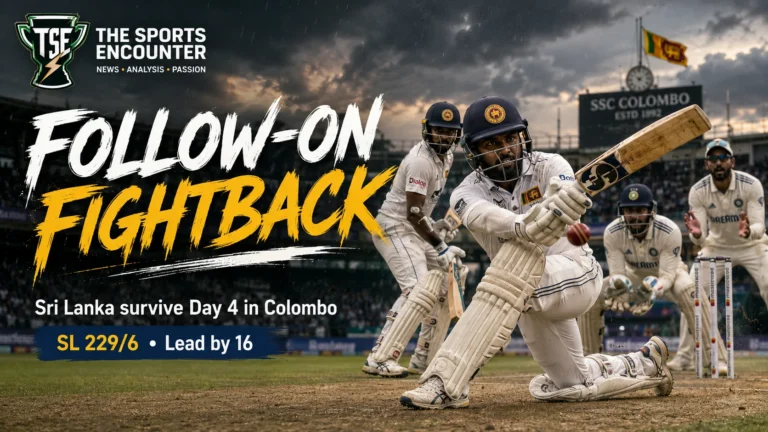
Sri Lanka Avoid Innings Defeat as Sooriyabandara Leads Colombo Fightback
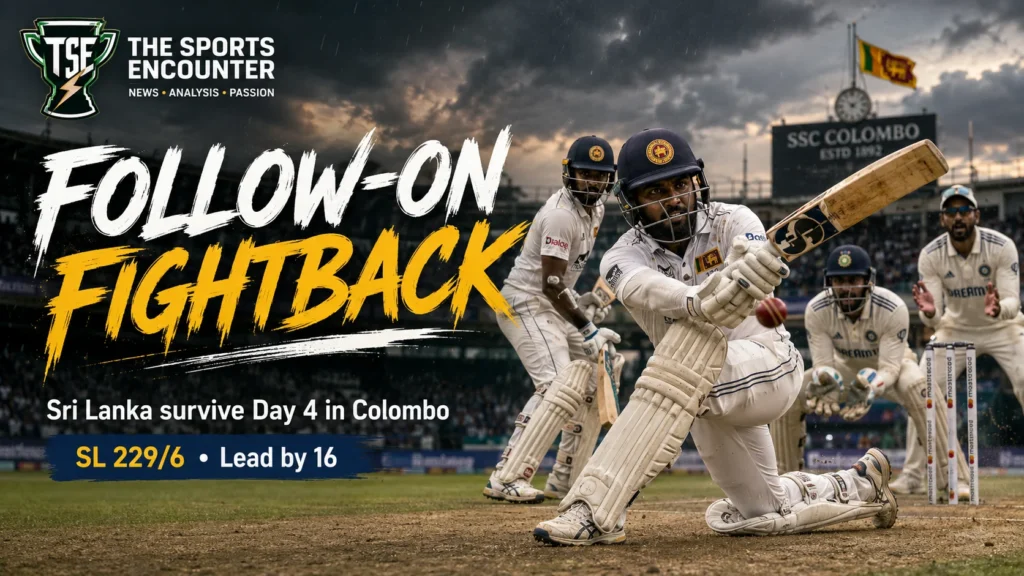
Sri Lanka avoided an innings defeat in Colombo after being forced to follow on by India, with Pasindu Sooriyabandara’s 92 and Kamindu Mendis’ 55 driving a spirited Day 4 recovery. The hosts closed on 229/6, leading by 16 runs before rain ended play.
COLOMBO: Sri Lanka began the fourth day of the second Test trying to delay an innings defeat. By the time rain covered the Sinhalese Sports Club Ground, they had removed that possibility completely and forced India to return on Thursday needing four more wickets before they can even think about completing a 2-0 series sweep.
Asked to follow on after being bowled out for 290 in reply to India’s imposing 503 for nine declared, Sri Lanka reached 229 for six in their second innings before rain ended play after 72.4 overs. They now lead by 16 runs.
The scoreboard still favors India. Sri Lanka have only four wickets remaining, their lead is small, and the visitors could yet finish the match quickly on the final morning.
But Day 4 changed the nature of the contest.
Pasindu Sooriyabandara produced a superb 92 from 173 balls, Kamindu Mendis made 55, and their 115-run third-wicket partnership transformed a follow-on innings that had begun under enormous pressure. Sri Lanka were 63 for two when the pair came together. By the time India finally separated them, the possibility of an innings victory had started slipping away.
India eventually fought back through Prasidh Krishna, Manav Suthar and Saransh Jain, reducing Sri Lanka from 178 for two to 218 for six. Rain then intervened at 229 for six, leaving Sonal Dinusha unbeaten on seven and Keshara Nuwantha on three.
The final day now begins with a simple equation carrying several possible endings: Sri Lanka lead by 16 with four wickets left. India still control the Test, but they must complete the job.
Sri Lanka vs India 2nd Test: Day 4 at a Glance
| Match Detail | Position |
|---|---|
| Match | Sri Lanka vs India, 2nd Test |
| Venue | Sinhalese Sports Club Ground, Colombo |
| India first innings | 503/9 declared |
| Sri Lanka first innings | 290 |
| First-innings deficit | 213 runs |
| Follow-on | Enforced by India |
| Sri Lanka second innings | 229/6 in 72.4 overs |
| Current lead | Sri Lanka lead by 16 runs |
| Top scorer | Pasindu Sooriyabandara 92 |
| Kamindu Mendis | 55 |
| India’s second-innings wickets | Suthar 2, Siraj 1, Prasidh 1, Jadeja 1, Jain 1 |
| Overnight batters | Sonal Dinusha 7*, Keshara Nuwantha 3* |
| Day 5 situation | India need four wickets before beginning any chase |
TL;DR
- India bowled Sri Lanka out for 290 after declaring their first innings on 503 for nine.
- Sri Lanka therefore trailed by 213 runs and were asked to follow on.
- Lahiru Udara fell for three and Kamil Mishara made 32 before Sri Lanka slipped to 63 for two.
- Pasindu Sooriyabandara and Kamindu Mendis added 115 for the third wicket.
- Sooriyabandara scored 92 from 173 balls after making 80 in the first innings.
- Kamindu contributed 55 from 92 balls.
- Prasidh Krishna broke the partnership by removing Kamindu.
- Manav Suthar then dismissed Dhananjaya de Silva and Sooriyabandara as India regained control.
- Sri Lanka closed on 229 for six, leading by 16 runs.
- Rain ended play early, leaving India four wickets away from setting up a final-innings chase.
Dinusha Completes His Century Before India Enforce the Follow-On
Day 4 began with Sri Lanka still completing the first innings that had occupied most of the previous day.
They resumed on 265 for eight, with Sonal Dinusha unbeaten on 85 and Lahiru Kumara on eight. India had already done enough to ensure the follow-on remained available unless Sri Lanka could extend their resistance considerably.
Dinusha nevertheless gave the home crowd another reason to appreciate what has been an outstanding series for him.
He reached his hundred from 147 deliveries, hitting eight fours and three sixes, and eventually finished with 103 from 162 balls. Kumara contributed 12 before Saransh Jain removed him, while Dinusha became the final wicket at 290.
India had a 213-run advantage.
Shubman Gill enforced the follow-on.
The decision followed logically from the position India had constructed across the opening three days. Their 503 for nine declared had been built around Devdutt Padikkal’s 117, Dhruv Jurel’s unbeaten 115, Rishabh Pant’s 63 and contributions throughout the batting order.
The Sports Encounter’s earlier report from Colombo detailed how Jurel and Pant turned India’s already strong first innings into a total that placed Sri Lanka under sustained scoreboard pressure.
By the start of the second innings, Sri Lanka were effectively being asked to bat again with one objective before anything else mattered: make India bat again.
Sri Lanka Lose Udara Again but Mishara Counterattacks
The follow-on started badly.
Mohammed Siraj removed Lahiru Udara for three from 15 balls, leaving Sri Lanka five for one.
India had taken three wickets for just 13 runs across the end of Sri Lanka’s first innings and the beginning of the second. Another collapse appeared possible.
Kamil Mishara refused to allow the innings to become completely defensive.
The Test debutant made 32 from 39 balls, hitting three fours and a six. His scoring rate mattered because it stopped India from immediately settling into a cycle of attacking fields and maiden overs.
Ravindra Jadeja eventually trapped Mishara lbw at 63 for two. Sri Lanka reviewed the decision, but umpire’s call preserved the wicket.
Lunch arrived with the hosts on 83 for two.
The deficit remained enormous, but Sri Lanka had survived the most dangerous phase after being sent straight back out to bat.
Sooriyabandara Takes the Fight to India
The defining innings of the day belonged to Pasindu Sooriyabandara.
He had already made 80 in Sri Lanka’s first innings, one of the few substantial scores around Dinusha’s century. Asked to begin again almost immediately, he produced an even better innings under much greater pressure.
Sooriyabandara did not simply occupy the crease.
He challenged India’s spinners.
Against Manav Suthar in particular, he repeatedly used the sweep and reverse sweep to disturb length and field placement. When the opportunity appeared, he also came down the pitch rather than allowing India’s slow bowlers to dictate where he could score.
It was intelligent counterattacking Test batting rather than uncontrolled aggression.
He reached fifty from 78 balls with seven fours.
By then, Sri Lanka had passed 100 and the innings had begun to look substantially different from the desperate follow-on survival exercise India had expected.
Kamindu Mendis Gives Sri Lanka the Partnership They Needed
Kamindu Mendis provided the ideal partner.
The left-hander took time to settle before gradually becoming more assertive. His fifty came from 87 balls and contained two fours and three sixes.
More importantly, he gave Sooriyabandara stability at the other end.
The partnership reached 50 from 102 deliveries and then crossed 100 from 156 balls.
At drinks in the afternoon session, Sri Lanka were 163 for two. Sooriyabandara had 69 and Kamindu was on 54.
India had entered the day expecting to use a 213-run first-innings lead to finish the Test without batting again. Instead, they were suddenly spending another long session in the field against two batters prepared to attack spin rather than merely survive it.
It was the strongest passage Sri Lanka produced during Day 4.
The resistance also followed a pattern already visible during this series. In the first Test at Galle, Sri Lanka recovered from 90 for five through a major middle-order stand, a fightback covered in our Day 3 report from Galle.
Colombo demanded another rescue.
This time, Sooriyabandara and Kamindu supplied it.
Prasidh Turns to the Short Ball and Finally Breaks Through
There was little conventional assistance available for India’s fast bowlers.
The surface offered neither significant movement nor the kind of consistent seam response that would allow Prasidh Krishna and Siraj to attack through traditional methods.
India therefore used the short ball repeatedly as a change of pace and method.
Prasidh eventually made it work.
Kamindu moved to 55 before a short delivery produced the breakthrough, with Shubman Gill completing the catch.
Sri Lanka were 178 for three.
The wicket ended a 115-run partnership and changed the final part of the day.
India had spent much of the second session being pushed backward. Now there was a new batter at the crease and Sooriyabandara was approaching a century.
The visitors had an opening again.
Sooriyabandara Reaches 90 but Misses a Deserved Century
By tea, Sooriyabandara had reached 90.
Sri Lanka were 199 for three.
An innings defeat was almost gone, and a maiden Test century appeared within touching distance.
Neither milestone arrived quite the way Sooriyabandara would have wanted.
Dhananjaya de Silva was dismissed for 23 when Suthar struck at 209 for four.
Three runs later came the day’s most painful moment for Sri Lanka.
Sooriyabandara advanced to Suthar, was beaten, and Rishabh Pant completed the stumping.
He was out for 92 from 173 balls.
His innings included 10 fours and a six.
The missing eight runs will hurt, particularly after he had reached 80 in the first innings without converting that start either.
But the significance of the innings was much larger than the century he missed.
When Sooriyabandara began his second innings, Sri Lanka were 213 runs behind and facing the prospect of losing without India batting again.
When he departed, they had reached 212 for five.
The innings defeat had effectively disappeared.
Manav Suthar Takes Two Quick Wickets as India Hit Back
Suthar had been put under more pressure than any Indian spinner during Sooriyabandara’s attack.
His final figures reflected that contest. He conceded 81 runs from 18 overs, comfortably more expensive than India’s other frontline bowlers.
But he also took two of the wickets that stopped Sri Lanka from turning resistance into genuine control.
Dhananjaya fell for 23.
Sooriyabandara followed three runs later.
Then Saransh Jain trapped Niroshan Dickwella lbw for six, reducing Sri Lanka to 218 for six.
India had suddenly taken four wickets for 40 runs after the hosts reached 178 for two.
That late spell shifted the balance back toward the visitors.
By this stage, Sri Lanka had achieved their first target. India would have to bat again.
The next question was how large a chase they could create.
Rain Protects Sri Lanka’s Last Four Wickets
Sonal Dinusha and Keshara Nuwantha slowed the game dramatically after Dickwella’s dismissal.
Dinusha, who had scored 103 earlier in the day, moved to seven from 37 balls.
Nuwantha reached three from 29.
The final 10 overs of the day produced only 11 runs for the loss of one wicket.
There was nothing mysterious about the approach.
Sri Lanka no longer needed to chase the deficit aggressively. Every delivery survived increased the possibility of extending the game and every additional run increased the target India may eventually have to chase.
Then the sky changed.
Conditions had been growing darker before rain arrived at 4:37 p.m. local time. Ground staff quickly covered the pitch and surrounding areas, and heavier rain followed.
With the ground almost entirely covered and light deteriorating further, play was eventually called off.
Sri Lanka finished on 229 for six.
India Have Bowled More Than 160 Overs in Two Sri Lankan Innings
There is another element India must manage on Day 5.
Workload.
The visitors bowled 89.4 overs during Sri Lanka’s first innings and another 72.4 in the second. That is more than 162 overs in the field across consecutive innings.
India are also without Jasprit Bumrah and Kuldeep Yadav in Colombo, while the squad entered the tour with several availability and injury issues. The wider personnel pressure around the series was one of the central themes of The Sports Encounter’s pre-series analysis.
Siraj has remained extremely economical in the second innings, taking one for 11 from nine overs. Prasidh has one for 31 from 10. Jadeja has one for 48 from 18, while Jain has one for 55 from 17.4 overs.
Those workloads are manageable individually, but the cumulative effect of bowling across almost two complete Sri Lankan innings matters.
India need four wickets quickly enough to leave themselves comfortable time for the chase.
Why the Final Morning Could Still Become Complicated
India remain overwhelming favorites from the current position.
Four wickets separate them from Sri Lanka’s final total.
The lead is only 16.
Three of the four remaining batters are Prabath Jayasuriya, Lahiru Kumara and Asitha Fernando.
But Test matches become awkward when the expected ending does not arrive on schedule.
If Dinusha and Nuwantha can survive the first hour and push the lead toward 50 or 60, India will have to spend more time bowling before beginning a chase.
If rain removes another portion of the final day, the clock becomes relevant again.
If Sri Lanka lose two wickets immediately, India could be chasing a very small target before lunch.
That range of possibilities is why the first hour matters so much.
Sri Lanka Have Repeatedly Made India Work for the Final Wickets
The resistance of the lower order has already been visible twice during this Test.
In the first innings, Sri Lanka were 230 for eight before Dinusha and Kumara added 58 runs for the ninth wicket. Dinusha reached his century during that stand and stretched the innings to 290.
Now Dinusha is there again.
He has already faced 199 deliveries across the two innings and scored 110 runs in the match.
India therefore know that dismissing the recognized top order has not automatically ended Sri Lanka’s resistance.
That theme also appeared during the final stages of the opening Test in Galle, where India entered Day 5 needing six wickets before eventually completing a 165-run victory.
Colombo now presents a different version of the same challenge.
Sooriyabandara Has Changed His Place in This Sri Lankan Team
Whatever happens on Day 5, Pasindu Sooriyabandara leaves this Test with a stronger claim to a permanent role in Sri Lanka’s batting order.
He made 80 from 133 balls in the first innings.
He followed it with 92 from 173 in the second.
That gives him 172 runs in the match.
More importantly, both innings came with Sri Lanka under substantial pressure.
The methods were different enough to matter.
The first innings required recovery after early wickets.
The second demanded immediate mental reset after the follow-on, followed by tactical aggression against spin.
His willingness to sweep, reverse sweep and use his feet prevented Suthar and Jadeja from settling into uninterrupted attacking rhythms during the middle session.
For a Sri Lankan batting group still searching for greater stability, that adaptability could matter long after this match is finished.
India Still Hold the Advantage, but the Innings Victory Is Gone
India should still expect to win this Test.
They have controlled most of the match since compiling 503 for nine declared. Padikkal, Jurel and Pant built the scoreboard advantage. Prasidh, Suthar and the rest of the attack then bowled Sri Lanka out for 290.
Enforcing the follow-on was therefore entirely justified.
Sri Lanka’s response simply made India work much harder than the first-innings deficit suggested they would have to.
The hosts now lead by 16.
That means one result has already disappeared.
India cannot win by an innings anymore.
They need four wickets and then a successful chase.
Sri Lanka need time, runs and preferably more help from the weather.
This series forms part of the ICC World Test Championship 2025-27, which makes the result more important than the series score alone. India entered the Colombo Test already 1-0 ahead after their victory in Galle and are pursuing valuable WTC points as they attempt to move back toward the championship’s top two.
The unusual scheduling context is also part of a larger month of red-ball cricket. Colombo is one component of 19 consecutive calendar days with Test cricket scheduled during August, alongside Australia against Bangladesh and England against Pakistan.
TSE Verdict: Sri Lanka Won the Middle of Day 4, India Still Own the Match
Sri Lanka did something important on Wednesday.
They changed the manner in which this Test can end.
An innings defeat appeared entirely realistic when India enforced the follow-on with a 213-run lead. Sooriyabandara and Kamindu then produced the partnership the hosts needed, scoring with enough freedom to prevent India from simply surrounding the bat and waiting for mistakes.
For one full session, India looked frustrated rather than dominant.
The response after Kamindu’s dismissal was equally important.
Suthar recovered from being attacked to remove Dhananjaya and Sooriyabandara. Jain dismissed Dickwella. Four wickets fell between 178 and 218, preventing Sri Lanka from turning a rescue into a serious attempt to build a match-winning lead.
Rain ultimately froze the contest at 229 for six.
India remain in front.
Sri Lanka have finally made them look toward the clock as well as the wickets.
That is enough to give the second Test one meaningful final day.
Follow The Sports Encounter’s cricket coverage for the Day 5 report, international Test cricket, tournament news, player performances and analysis from across the game.
Frequently Asked Questions
What is the score after Day 4 of the Sri Lanka vs India second Test?
Sri Lanka are 229 for six in their second innings after following on. They lead India by 16 runs with four wickets remaining.
Did Sri Lanka avoid an innings defeat?
Yes. Sri Lanka moved past India’s 213-run first-innings advantage during their second innings, which means India must bat again to win the Test.
Why did India enforce the follow-on?
India scored 503 for nine declared before bowling Sri Lanka out for 290. The 213-run deficit exceeded the 200-run requirement for enforcing the follow-on in a five-day Test.
How many runs did Pasindu Sooriyabandara score?
Sooriyabandara scored 92 from 173 balls in Sri Lanka’s second innings, with 10 fours and one six. He had already made 80 in the first innings.
How many runs did Kamindu Mendis score?
Kamindu made 55 from 92 deliveries, hitting two fours and three sixes.
How many runs did Sooriyabandara and Kamindu add?
They shared a 115-run partnership for the third wicket, taking Sri Lanka from 63 for two to 178 for three.
Who took the wickets for India in Sri Lanka’s second innings?
Manav Suthar has two wickets, while Mohammed Siraj, Prasidh Krishna, Ravindra Jadeja and Saransh Jain have taken one each.
Who is unbeaten for Sri Lanka?
Sonal Dinusha is unbeaten on seven and Keshara Nuwantha is three not out.
How many runs did Sonal Dinusha score in Sri Lanka’s first innings?
Dinusha scored 103 from 162 balls, including eight fours and three sixes.
Can Sri Lanka still win the second Test?
Yes, mathematically. Sri Lanka would need to build a substantially larger lead with their remaining four wickets and then dismiss India while defending that target. India remain in the much stronger position.
What does India need to win?
India must take Sri Lanka’s remaining four wickets and then successfully chase whatever target the hosts set.
Why did play end early on Day 4?
Rain arrived late in the afternoon with Sri Lanka on 229 for six. Conditions became increasingly dark, the ground was covered, and no further play was possible.
When is Day 5 of the Sri Lanka vs India second Test?
The fifth and final day is scheduled for Thursday, August 27, 2026, at the Sinhalese Sports Club Ground in Colombo.

Breaking News
First Brydon Carse, Now Raheem Sterling: What’s Wrong with English Sportsmen?
Brydon Carse ended up in police handcuffs while Raheem Sterling now faces dangerous-driving and other charges. Their cases are legally different, but together they raise a wider question about whether professionalism among elite English sportsmen is carrying far enough beyond the playing arena.
LONDON: Brydon Carse should have been preparing for England’s second Test against Pakistan at Lord’s. Instead, images of the 31-year-old fast bowler in police handcuffs outside a Derby nightclub became one of the biggest stories surrounding the team.
Three days later, another 31-year-old English sports star appeared in a very different kind of headline.
Former England footballer Raheem Sterling was charged with dangerous driving, possession of nitrous oxide for wrongful inhalation and failing to provide a specimen following a single-vehicle collision involving a Lamborghini on the M3 in May.
No injuries were reported in Sterling’s crash. Carse was released without charge after the Derby incident. Their legal situations are therefore very different and must be treated that way.
The professional question connecting them is harder to avoid.
Two high-profile English sportsmen, both old enough and experienced enough to understand the consequences of their actions, have within days become the subject of serious off-field stories that raise legitimate questions about judgment, personal responsibility and what professionalism actually means once an athlete leaves the stadium.
Carse ended a celebration in handcuffs and lost his place in an England Test squad while the Cricket Regulator investigates. Sterling now faces three criminal charges and a court appearance on September 15.
These are not academy teenagers learning how fame works.
They are established international sportsmen who have spent years inside some of the most sophisticated professional environments in world sport.
That is precisely why the question deserves asking.
Brydon Carse and Raheem Sterling: Two Very Different Cases, One Professional Question
| Issue | Brydon Carse | Raheem Sterling |
|---|---|---|
| Age | 31 | 31 |
| Sport | Cricket | Football |
| Latest incident | Seen in police handcuffs outside a Derby nightclub | Charged following an M3 motorway collision |
| Legal status | Released without charge | Charged with three offences, not convicted |
| Professional consequence | Removed from England squad for second Pakistan Test | Faces court hearing while currently without a club |
| Next step | Cricket Regulator investigation | Basingstoke Magistrates’ Court on September 15 |
Carse Managed to Turn an England Victory Into Another Conversation About Behaviour
The timing of the Carse episode made it especially damaging.
England had just beaten Pakistan by an innings and 103 runs at Headingley, giving Joe Root a commanding victory at the beginning of his second spell as permanent Test captain.
The cricket should have dominated the build-up to Lord’s.
Instead, Root found himself answering questions about another late-night incident involving an England player.
Carse had been released from the England group to represent Durham against Derbyshire in the County Championship. Durham won comfortably, and the players went out afterward.
Footage then emerged showing Carse outside a Derby nightclub with his hands cuffed behind his back while police officers surrounded him.
Reports subsequently confirmed that he was released without charge.
The ECB responded by referring the matter to the Cricket Regulator and making Carse unavailable for the second Test against Pakistan while the facts are established. Sonny Baker replaced him in the squad.
That response matters.
Carse may ultimately face no criminal consequences from what happened in Derby. England still decided that the circumstances were serious enough to remove a centrally contracted international player from Test selection.
Professional sport has standards that extend beyond criminal law.
A player does not have to be convicted of an offence before an employer or governing body decides that his conduct has become damaging, distracting or inconsistent with the standards expected of an international representative.
Joe Root Said What Many Supporters Were Already Thinking
Root’s reaction stripped away any attempt to treat Carse’s situation as a harmless night out that simply attracted too much attention.
The England captain said he was “hacked off” and disappointed.
More importantly, he identified the wider problem.
“We continually keep making stupid mistakes away from the game and it’s detracting from what we’re doing on the field.”
That sentence should sit at the center of this discussion.
Root was not complaining about hostile journalists, social media or intrusive cameras.
He was talking about the decisions being made by his own players.
England had already spoken internally about standards. Root had publicly emphasized the importance of building a culture people could respect. The team had entered the Pakistan series attempting to reset after the turmoil that ended the previous leadership era.
The Sports Encounter’s England vs Pakistan series preview framed Root’s return around the need to restore judgment and stability after England’s cricket had become increasingly chaotic.
Our Headingley first-Test analysis made the same point more directly: England had enough talent, but could no longer afford to waste credibility.
They then won emphatically.
Within hours, Carse gave Root another off-field problem.
Being Off Duty Does Not Remove Professional Responsibility
One defense has appeared repeatedly around the Carse incident: he was not representing England when it happened.
That is factually true.
He had played for Durham and was celebrating a county victory.
It does not make the professional issue disappear.
Carse remains an England international and centrally contracted cricketer whose next scheduled assignment was an international Test match.
The standards attached to elite sport cannot realistically switch on at the dressing-room door and disappear when a player changes clothes.
A doctor remains responsible for serious professional misconduct outside a hospital. A senior executive can damage a company through behavior that happens away from the office. A politician does not become completely detached from public standards because Parliament has finished for the evening.
Elite athletes occupy a similar space.
They deserve private lives. They deserve holidays, dinners, celebrations and nights out.
Personal freedom still carries consequences when private choices develop into police involvement, disciplinary investigations or headlines that drag teammates and national organisations into the story.
Carse’s loss of selection demonstrates that reality more clearly than any lecture on professionalism could.
Carse Had Already Received One Serious Lesson About Responsibility
The Derby incident also carries extra weight because Carse has previously been through a formal disciplinary process.
In 2024, he received a 16-month suspension, with 13 months suspended, after admitting to placing 303 bets on cricket between 2017 and 2019.
The regulator found no evidence that he bet on matches in which he participated and found no wider integrity concerns. Carse cooperated with the investigation and served three months away from cricket.
The Cricket Regulator’s official ruling made clear that his cooperation and remorse were considered in determining the sanction.
The betting case has no factual connection to what happened in Derby and should not be presented as though it does.
It remains relevant to the question of professional judgment.
Carse already knows what it feels like for an off-field decision to remove cricket from his life.
He rebuilt his standing, returned to the England side and developed into an important bowler.
Only weeks ago, Carse was producing one of The Hundred’s strongest bowling performances for SunRisers Leeds.
Now another non-cricket episode has again removed him from an England squad.
At some point, experience has to become judgment.
Carse Is Hardly the First Warning England Cricket Has Received
This would be easier to dismiss if Carse’s case existed by itself.
England cricket has spent much of the past year discussing behaviour away from the field.
Harry Brook was fined around £30,000 and placed on a final warning after an incident involving a nightclub bouncer in Wellington during England’s tour of New Zealand.
Brook later acknowledged that he had stayed out too late and accepted responsibility for putting himself in the situation.
Ben Stokes and Gus Atkinson were subsequently suspended after breaking England’s midnight curfew following another nightclub episode during the New Zealand Test series.
The ECB later introduced additional player-behaviour guidelines covering curfews, public intoxication and the requirement to inform management when players remain away from the hotel late at night.
Stokes himself has acknowledged the wider cultural issue. Speaking after his retirement, he argued that cricket has retained a deeply embedded relationship with alcohol even as almost every other aspect of the game has become more professional.
That is a significant admission from someone who spent years leading England.
Our recent look at Stokes’ potential future as an England coach focused heavily on leadership and responsibility because those questions have become impossible to separate from England’s next era.
The end of his playing career had already arrived alongside wider questions over direction and discipline, as explored when New Zealand completed its series comeback at Trent Bridge.
Carse’s handcuffs therefore landed in a dressing room that had already been warned, disciplined, briefed and given new rules.
That makes the incident harder to excuse as simple naivety.
Then Raheem Sterling Put English Football Into the Same Conversation
Sterling’s situation is legally more serious.
Hampshire and Isle of Wight Constabulary said the former England forward has been charged following a single-vehicle collision involving a Lamborghini on the M3 southbound near the Minley Interchange on May 28.
The 31-year-old faces charges of dangerous driving, possession of nitrous oxide for wrongful inhalation and failing to provide a specimen.
No other vehicle was involved and no injuries were reported.
Sterling is due to appear at Basingstoke Magistrates’ Court on September 15.
Those remain allegations until the court process determines otherwise. Sterling has not been convicted of the offences.
The reported police charges against Sterling nevertheless create a legitimate professionalism issue before any verdict is reached.
Dangerous driving is not a football mistake.
Failing to provide a specimen is not a tactical decision.
Possession of nitrous oxide for wrongful inhalation has nothing to do with a poor first touch or a badly timed run.
These are allegations concerning an adult’s choices away from football.
That is exactly why the case belongs in a broader discussion about athletes and personal responsibility.
Sterling Has Spent Most of His Adult Life Inside Elite Football
Sterling has experienced professional sport at its highest level since he was a teenager.
He came through Queens Park Rangers, made his senior Liverpool debut at 17, moved to Manchester City and developed into one of the Premier League’s leading attackers under Pep Guardiola.
He won four Premier League titles with City and became one of Gareth Southgate’s most important England players.
Sterling earned 82 senior England caps and scored 20 international goals. He played a major role in England’s run to the 2018 World Cup semifinal and the Euro 2020 final.
His career later took him to Chelsea, Arsenal and Feyenoord.
He is now without a club.
Few footballers have spent more time surrounded by elite-level support systems.
Premier League players receive access to coaches, doctors, nutritionists, psychologists, analysts, security advisers, player-liaison staff and professional guidance that would have been unimaginable a generation ago.
The modern competition itself has become an enormous global operation. Our 2026-27 Premier League curtain-raiser reflects the scale, wealth and sophistication now surrounding England’s leading clubs.
Yet all of that professional structure eventually reaches a limit.
A club can provide advice.
It cannot make every adult decision for a player.
These Men Are 31, and That Matters
Age should be part of this discussion because the usual explanation of young athletes struggling with sudden fame does not comfortably fit either case.
Carse and Sterling are both 31.
They have each spent years inside professional sport.
They have travelled internationally, operated in dressing rooms full of senior players, worked with coaches and media teams, signed professional contracts and lived through the intense scrutiny attached to representing England.
They know cameras exist.
They know police involvement becomes news.
They know national-team selection and commercial reputations can be affected by what happens away from competition.
They also know that athletes are judged differently because their careers come with extraordinary visibility and privilege.
None of that means they should live like prisoners inside their homes.
It does mean that the excuse of youthful inexperience becomes increasingly difficult to sustain.
Elite Athletes Show Extraordinary Discipline When Sport Demands It
This is perhaps the strangest contradiction in professional sport.
An elite cricketer will spend months strengthening hamstrings, monitoring workload, analysing bowling footage, weighing meals and altering sleep patterns to gain a tiny competitive advantage.
A Premier League footballer will structure an entire week around recovery, hydration, tactical preparation and physical output.
These athletes understand discipline.
They understand delayed gratification.
They understand that small decisions can produce enormous consequences.
Then some step outside the sporting environment and appear capable of abandoning exactly those principles.
The issue is therefore deeper than education alone.
Professional athletes have already demonstrated that they can live disciplined lives when performance requires it.
The challenge is carrying the same judgment into ordinary adult situations where nobody is timing a sprint, checking a GPS vest or preparing a recovery plan.
Professionalism Cannot End at the Stadium Gate
Sport has traditionally separated the athlete from the person.
Supporters care about goals, wickets, records and trophies. What happens away from competition is often treated as irrelevant unless it affects performance.
That separation becomes impossible once off-field conduct begins affecting the sport itself.
Carse is missing a Test match because of an incident that happened outside cricket.
Root has had to spend preparation time discussing behaviour instead of Pakistan.
The ECB has had to open another disciplinary process.
Sterling’s legal proceedings will inevitably become part of the public conversation around a player whose career already sits at a crossroads.
These consequences have entered their professional lives because personal decisions created them.
That is why “what players do in their own time” cannot become an automatic shield against criticism.
Private life deserves privacy.
Conduct that ends with police handcuffs, criminal charges or disciplinary investigations has already crossed into a different category.
Fame and Money Can Create a Dangerous Buffer From Ordinary Consequences
Elite athletes live inside unusually protected environments.
Someone arranges travel.
Someone books accommodation.
Someone manages media.
Someone handles contracts.
Someone schedules medical treatment.
Someone can often solve logistical problems before the player even realizes they exist.
That support is necessary because professional sport demands enormous amounts of time and focus.
It can also create insulation.
The more successful an athlete becomes, the more people appear around him whose professional interest is keeping him available, comfortable and performing.
That creates a risk if sporting importance begins to feel like immunity from ordinary standards.
The overwhelming majority of athletes handle that environment responsibly.
The ones who do not can cause damage far beyond themselves because their visibility turns individual mistakes into institutional problems.
English Cricket’s Relationship With Alcohol Needs More Than Another Curfew
Carse’s case makes the cricket issue particularly difficult because the ECB has already tried rules.
England introduced a midnight curfew.
Players were told they should not appear publicly intoxicated.
Management expected to know when players stayed out late.
Disciplinary action followed previous breaches.
Carse still ended up in handcuffs outside a nightclub.
A curfew can establish a boundary.
It cannot provide judgment.
Stokes’ comments about cricket’s wider drinking culture deserve serious attention here. The sport has modernised almost everything around performance while retaining a social relationship with alcohol that belongs to another era.
That does not mean every post-match beer creates a problem.
It means cricket has to decide whether the old romantic image of players drinking hard after competing hard still belongs inside a game that otherwise treats professional preparation almost scientifically.
Root clearly wants his players to make adult decisions without being permanently controlled.
Carse has just shown why that approach requires the players to meet him halfway.
English Football Moved Away From the Old “Bad Boy” Culture for a Reason
Football has undergone its own cultural change.
Stories about drinking, nightclubs and reckless behaviour once formed a routine part of the mythology surrounding English footballers.
The modern Premier League largely demands something different.
Players compete more often, cover greater distances, follow detailed recovery schedules and operate inside a global commercial environment where clubs protect multimillion-pound assets.
Diet, sleep and conditioning are now career issues.
The old sporting idea that exceptional performance could excuse almost anything away from the pitch has gradually lost credibility.
Sterling belongs to the generation that benefited from that professional evolution.
That makes the allegations against him more striking.
A player who spent his career inside Liverpool, Manchester City, Chelsea and Arsenal cannot reasonably claim ignorance of the standards surrounding elite football.
The case will decide whether he committed the offences alleged against him.
The broader question of professional judgment already exists.
Personal Problems Can Explain Behaviour Without Excusing It
Elite athletes are human beings dealing with pressure, injuries, career uncertainty, family issues, mental-health challenges and the psychological difficulty of watching sporting status disappear.
Sterling’s career has changed dramatically since his Manchester City peak.
Carse has experienced injury setbacks and a previous suspension.
Those circumstances deserve empathy when they are relevant.
They cannot become automatic explanations for every poor decision.
Understanding why somebody makes a mistake and holding that person responsible for making it are compatible positions.
Professional sport sometimes becomes uncomfortable with that balance.
Criticism can become cruel and personal very quickly. The opposite extreme treats athletes as permanently vulnerable figures whose choices must always be explained through pressure or fame.
Neither approach helps.
Adult athletes deserve support.
Adult athletes also carry responsibility.
Teams Pay the Price for Individual Decisions
Carse’s case provides the clearest example.
England selected him because he could help win Test matches.
His pace and bounce gave Root another option against Pakistan. Our pre-series analysis identified England’s pace depth as one of its biggest advantages.
Carse is now unavailable for reasons unrelated to fitness, form or cricketing ability.
Sonny Baker receives the opportunity.
Root loses an option.
The coaching staff modifies plans.
The captain answers questions.
The governing body investigates.
Supporters debate culture instead of bowling.
One person’s night out becomes everybody else’s problem.
That is why professional teams care about off-field conduct.
It is not primarily about controlling private lives.
It is about preventing avoidable personal decisions from disrupting collective objectives.
England’s Young Players Are Watching How Senior Men Are Treated
There is another reason consistency matters.
Every dressing room teaches through example.
A young player watches what senior teammates do, what coaches tolerate and what consequences follow when standards are breached.
If established internationals receive endless exceptions because they are useful, the written code of conduct becomes meaningless.
If every mistake leads to public humiliation and career destruction, players learn to hide problems instead of seeking help.
The right standard sits between those extremes.
Clear expectations.
Real support.
Proportionate consequences.
No special immunity for star performers.
Root’s response to Carse suggests he understands that balance. England removed the bowler while the investigation proceeds, rather than pretending nothing happened or publicly deciding the outcome before the evidence is complete.
Role Model May Be an Uncomfortable Phrase, but Influence Is Real
Some athletes reject the idea that they should be role models.
They did not become professional sportsmen to raise strangers’ children.
That argument has some merit.
No footballer or cricketer should be expected to live a flawless life because a child owns his shirt.
Influence still exists whether the athlete asks for it or not.
Millions of young supporters watch how elite players train, celebrate, dress, speak and behave.
National teams actively use players to promote participation, community values and sporting ideals.
Clubs build marketing campaigns around personalities.
Sponsors pay for association with reputation as well as athletic skill.
Once sport commercialises a player’s public image, conduct naturally becomes part of that image.
English Sport Has Too Much Professional Infrastructure to Keep Calling These Things Naive Mistakes
This is the larger frustration.
English sport is among the best-resourced sporting systems on earth.
The Premier League generates extraordinary wealth.
The ECB runs professional pathways from academy cricket through domestic competitions and international teams.
Players receive media training.
They receive welfare support.
They receive security advice.
They receive education on gambling, drugs, anti-corruption rules and public conduct.
They work with experienced coaches and senior professionals who have already seen careers damaged by off-field choices.
The information is available.
The support is available.
What no system can manufacture is personal judgment.
That part eventually belongs to the athlete.
English Sportsmen Do Not Need More Parenting
The instinct after every controversy is to create another restriction.
Earlier curfews.
Alcohol bans.
More chaperones.
Additional conduct clauses.
Mandatory check-ins.
Some safeguards may be useful, particularly on international tours.
There is a limit to how far professional organisations should go in supervising grown adults.
Carse and Sterling are 31.
If elite sportsmen approaching the later stages of their careers require somebody to monitor every social decision, the system has already failed at a more basic level.
Professionalism should eventually become internal.
The athlete understands the standard and acts accordingly because he recognizes consequences, not because a team manager is checking his location.
The Standard Should Be Simple: Freedom, Responsibility and Consequences
English sport does not need puritanism.
Players should celebrate victories.
They should have social lives.
They should enjoy the money they have earned.
They should be free to spend time away from sport without every photograph becoming evidence of misconduct.
That freedom works only when responsibility travels with it.
When decisions bring police, courts or disciplinary bodies into the picture, sporting organisations have every right to respond.
When the same type of problem keeps returning, leaders have every right to question culture.
When senior athletes create avoidable distractions, supporters have every right to ask why professionalism appears to stop once competition ends.
What English Sport Should Learn From Carse and Sterling
The first lesson is that behavioural education has to begin early and continue after players become established.
The second is that consequences should remain consistent regardless of status.
The third is that player welfare must continue during injury, deselection, transfers and career decline, periods when athletes can lose much of the structure that once organized their lives.
The fourth is that sporting culture should stop romanticizing recklessness as personality.
The fifth is the most important.
Players themselves have to own the final decision.
No academy curriculum can stop every bad night.
No captain can control every teammate.
No club can occupy the passenger seat of every car.
The purpose of professional development should be to produce adults capable of making decisions after the institutional support disappears from view.
The Final Word: Professionalism Has to Follow the Athlete Home
First Brydon Carse.
Now Raheem Sterling.
Two sports.
Two very different legal situations.
Two experienced English internationals whose actions away from competition have become bigger stories than anything they were doing inside it.
Carse was shown in handcuffs after a late-night incident and has been removed from England’s Test squad while the Cricket Regulator investigates. He was released without charge, and the final facts still matter.
Sterling faces charges of dangerous driving, possession of nitrous oxide for wrongful inhalation and failing to provide a specimen. He has not been convicted, and the court will decide the case.
The professional lesson does not require us to prejudge either process.
English sport invests enormous sums teaching athletes how to make the right decision under pressure.
A bowler learns when to attack the stumps and when to pull his length back.
A footballer learns when to accelerate, when to release the ball and when to manage the game.
Those same men eventually step outside the arena, where the decisions become more important than a scoreboard.
That is where professionalism is being tested.
Joe Root has already identified the damage when players repeatedly make “stupid mistakes away from the game.” His frustration should resonate well beyond the England cricket dressing room.
Sporting talent creates opportunity, money and status.
It does not remove ordinary adult responsibility.
Carse and Sterling are the latest reminders that an athlete’s personal life remains his own until his choices begin affecting police, courts, teammates, employers and the reputation of the sport that made him famous.
At that point, the question becomes entirely legitimate.
What is the value of behaving like a consummate professional for 90 minutes or five days if the discipline disappears once the playing arena is left behind?
English sport has become extraordinarily good at producing elite performers.
It now needs more of them to carry elite judgment with them when they go home.
Follow The Sports Encounter’s football coverage and our wider reporting across cricket and global sport for the stories shaping competition both inside and outside the arena.
Frequently Asked Questions
What happened to Brydon Carse?
Brydon Carse was shown in police handcuffs outside a nightclub in Derby following Durham’s County Championship victory over Derbyshire. He was subsequently released without charge. The Cricket Regulator is investigating the incident.
Why was Brydon Carse dropped by England?
The ECB made Carse unavailable for England’s second Test against Pakistan while the Cricket Regulator investigates the Derby incident and establishes the full facts.
Has Brydon Carse been charged by police?
No charge was brought against Carse following the Derby incident.
What has Raheem Sterling been charged with?
Sterling has been charged with dangerous driving, possession of nitrous oxide for wrongful inhalation and failing to provide a specimen following a single-vehicle collision on the M3 on May 28, 2026.
Was anyone injured in Raheem Sterling’s motorway collision?
Police said no other vehicle was involved and no injuries were reported.
Has Raheem Sterling been convicted?
No. Sterling has been charged and is due to appear at Basingstoke Magistrates’ Court on September 15. The allegations remain to be determined by the court.
Why are the Carse and Sterling incidents being discussed together?
The legal circumstances are different, but both involve experienced England internationals becoming the subject of serious off-field incidents within days of each other. That creates a wider discussion around professionalism, judgment and personal responsibility among elite athletes.
A Celebration of 5000 ODIs
A Celebration of 5000 ODIs Match 12: Warne Turns 165 for 2 Into West Indies Heartbreak
West Indies were cruising toward the 1996 World Cup final at 165/2. Shane Warne then dragged Australia back from almost certain defeat in Mohali.
West Indies were 165 for two, chasing 208, with Richie Richardson and Shivnarine Chanderpaul at the crease and enough overs remaining to make the finish look almost routine.
Australia had already escaped 15 for four earlier in the day. Asking them to manufacture another recovery felt unreasonable.
Then Chanderpaul fell.
Within 49 balls, West Indies lost eight wickets for 37 runs. Shane Warne attacked the middle and lower order, Damien Fleming finished the job, and Richardson stood unbeaten at the other end as a World Cup semifinal that appeared safely under Caribbean control disappeared by five runs.
Australia’s victory at Mohali on March 14, 1996 belongs in A Celebration of 5000 ODIs because it produced two reversals inside the same knockout match. Australia first recovered from a position that should have ended its innings. West Indies then surrendered a chase that should have taken them into the final.
TL;DR
- Australia recovered from 15/4 to score 207/8 in 50 overs.
- Stuart Law made 72 and Michael Bevan 69 in a 138-run fifth-wicket partnership.
- West Indies reached 165/2 while chasing 208.
- Shivnarine Chanderpaul top-scored with 80, while Brian Lara made 45.
- Shane Warne took 4/36, including three wickets during the decisive late collapse.
- West Indies lost their final eight wickets for 37 runs and were dismissed for 202.
- Australia won by five runs and reached its third World Cup final.
Australia vs West Indies 1996: Match Information
| Detail | Information |
|---|---|
| Match | Australia vs West Indies, second semifinal |
| Tournament | 1996 Cricket World Cup |
| Date | March 14, 1996 |
| Venue | Punjab Cricket Association Stadium, Mohali |
| Toss | Australia won the toss and batted |
| Australia | 207/8 in 50 overs |
| West Indies | 202 all out in 49.3 overs |
| Result | Australia won by five runs |
| Player of the Match | Shane Warne, 4/36 |
| Australia’s top scorer | Stuart Law, 72 |
| West Indies’ top scorer | Shivnarine Chanderpaul, 80 |
| Key partnership | Law and Bevan, 138 for fifth wicket |
| Turning point | West Indies collapsed after reaching 165/2 |
| Tournament impact | Australia advanced to the World Cup final |
| Historical note | Richie Richardson played his final ODI |
The ICC’s official history of the 1996 Cricket World Cup also identifies the Mohali collapse as one of the defining moments of the tournament.
Why Match 12 Belongs in A Celebration of 5000 ODIs
The five-run margin alone makes this a thriller. The route toward that margin makes it unforgettable.
Australia were 15 for four after just 9.1 overs. Mark Waugh and Ricky Ponting had made ducks. Mark Taylor scored one. Steve Waugh managed three.
West Indies then reached 165 for two while chasing 208.
Either position could have decided an ordinary ODI.
This semifinal survived both.
That is exactly the type of match this series was designed to preserve: pressure, improbability, individual brilliance, World Cup consequence and a scorecard that still makes little sense until the entire story is reconstructed.
The same theme runs through earlier installments such as Gary Gilmour rescuing Australia after they collapsed to 39 for six in 1975 and India defending 183 against West Indies in the 1983 final.
Mohali produced both types of tension in one afternoon.
Stuart Law Rebuilds Australia From 15 for Four
Curtly Ambrose and Ian Bishop made Australia look finished during the opening ten overs.
Ambrose trapped Mark Waugh lbw with the second ball and later removed Ponting. Bishop bowled Taylor and Steve Waugh. Four of Australia’s first five batters had contributed just four runs between them.
Stuart Law walked into a semifinal already slipping away.
His response was patient rather than desperate.
Law made 72 from 105 balls, hitting five fours and giving Australia enough stability to move beyond survival. Against Ambrose, Bishop and Courtney Walsh, trying to manufacture quick runs would probably have accelerated the collapse.
Law instead stayed long enough for Michael Bevan to join him.
Michael Bevan Gives Australia a Total to Defend
Bevan’s 69 from 110 balls carried all the qualities that made him one of the defining ODI batters of his generation.
He understood the situation immediately.
Australia did not need spectacle at 15 for four. They needed time, wickets in hand and a total capable of giving Warne and the bowlers something to work with.
Law and Bevan added 138 for the fifth wicket, taking Australia from 15/4 to 153/5. It was the partnership that restored the semifinal.
Ian Healy then provided the late acceleration with 31 from 28 balls as Australia reached 207/8.
It looked competitive.
For much of the West Indian chase, it did not look enough.
Shivnarine Chanderpaul Takes West Indies to the Door
Shivnarine Chanderpaul was only 21 years old.
He batted like the calmest man at Mohali.
After Courtney Browne fell for ten, Chanderpaul rebuilt with Brian Lara and refused to allow Australia’s bowlers to create sustained pressure. Lara made 45 from 45 balls and helped take the score to 93 before Steve Waugh bowled him.
Richie Richardson then joined Chanderpaul.
The pair carried West Indies to 165 for two.
Chanderpaul’s 80 came from 126 deliveries, including seven boundaries. His innings lacked the violence usually associated with West Indies batting of the period, but the situation required control.
He had almost provided enough.
Glenn McGrath removed him at 165.
The match changed immediately.
Shane Warne Turns a Chase Into Panic
Warne had already dismissed Browne with his first delivery of the innings.
His most important work came much later.
Once Chanderpaul departed, West Indies still had Richardson established and required only 43 more runs. Roger Harper fell to McGrath for two before Warne entered the center of the collapse.
Ottis Gibson was caught behind.
Jimmy Adams was trapped lbw.
Ian Bishop followed lbw three deliveries into his stay.
Warne finished with 4/36 from nine overs.
Numbers describe the spell. Timing explains its greatness.
He took wickets precisely when West Indies needed composure and Australia needed something disruptive. The required rate remained manageable throughout. Warne made wickets, rather than runs, the problem.
That is why he received the Player of the Match award.
Richie Richardson Watches the Final Collapse
Richardson’s unbeaten 49 deserves attention because he remained at the crease while everything collapsed around him.
After Chanderpaul departed, West Indies lost Harper, Gibson, Adams, Keith Arthurton and Bishop.
Still, Richardson remained.
Even at 194 for eight, the contest had not completely disappeared. West Indies needed 14 with two wickets remaining.
Curtly Ambrose helped take the score to 202 before Ian Healy ran him out.
One wicket remained. Six runs were required.
Damien Fleming bowled Courtney Walsh with the next delivery.
Richardson stood unbeaten on 49 in his final ODI as Australia celebrated a five-run victory.
Curtly Ambrose and Ian Bishop Nearly Win It in the First Ten Overs
West Indies should also be remembered for how convincingly they began the semifinal.
Ambrose took 2/26 from ten overs.
Bishop returned 2/35.
Their opening spells reduced Australia’s highly rated batting order to 15 for four, a position from which very few teams should recover in a World Cup knockout match.
Ambrose was particularly economical, conceding only 2.60 runs per over. Walsh also gave away just 33 from his ten overs.
The bowling created the winning position.
West Indies simply failed to finish from it.
Complete Match Scorecard
Australia Innings: 207/8 in 50 Overs
| Batter | Dismissal | Runs | Balls | 4s | 6s |
| Mark Waugh | lbw b Ambrose | 0 | 2 | 0 | 0 |
| Mark Taylor | b Bishop | 1 | 11 | 0 | 0 |
| Ricky Ponting | lbw b Ambrose | 0 | 15 | 0 | 0 |
| Steve Waugh | b Bishop | 3 | 18 | 0 | 0 |
| Stuart Law | run out | 72 | 105 | 5 | 0 |
| Michael Bevan | c Richardson b Harper | 69 | 110 | 4 | 1 |
| Ian Healy | run out | 31 | 28 | 2 | 0 |
| Paul Reiffel | run out | 7 | 11 | 0 | 0 |
| Shane Warne | not out | 6 | 6 | 0 | 0 |
| Extras | 11 lb, 5 w, 2 nb | 18 | |||
| Total | 8 wickets, 50 overs | 207 |
Did not bat: Damien Fleming, Glenn McGrath.
Fall of wickets: 0/1, 7/2, 8/3, 15/4, 153/5, 171/6, 186/7, 207/8.
West Indies Bowling
| Bowler | Overs | Maidens | Runs | Wickets |
| Curtly Ambrose | 10 | 1 | 26 | 2 |
| Ian Bishop | 10 | 1 | 35 | 2 |
| Courtney Walsh | 10 | 1 | 33 | 0 |
| Ottis Gibson | 2 | 0 | 13 | 0 |
| Roger Harper | 9 | 0 | 47 | 1 |
| Jimmy Adams | 9 | 0 | 42 | 0 |
West Indies Innings: 202 All Out in 49.3 Overs
| Batter | Dismissal | Runs | Balls | 4s | 6s |
| Shivnarine Chanderpaul | c Fleming b McGrath | 80 | 126 | 7 | 0 |
| Courtney Browne | c & b Warne | 10 | 18 | 0 | 0 |
| Brian Lara | b Steve Waugh | 45 | 45 | 4 | 0 |
| Richie Richardson | not out | 49 | 83 | 4 | 0 |
| Roger Harper | lbw b McGrath | 2 | 5 | 0 | 0 |
| Ottis Gibson | c Healy b Warne | 1 | 2 | 0 | 0 |
| Jimmy Adams | lbw b Warne | 2 | 11 | 0 | 0 |
| Keith Arthurton | c Healy b Fleming | 0 | 4 | 0 | 0 |
| Ian Bishop | lbw b Warne | 3 | 3 | 0 | 0 |
| Curtly Ambrose | run out (Healy) | 2 | 2 | 0 | 0 |
| Courtney Walsh | b Fleming | 0 | 1 | 0 | 0 |
| Extras | 4 lb, 2 w, 2 nb | 8 | |||
| Total | All out, 49.3 overs | 202 |
Fall of wickets: 25/1, 93/2, 165/3, 173/4, 178/5, 183/6, 187/7, 194/8, 202/9, 202/10.
Australia Bowling
| Bowler | Overs | Maidens | Runs | Wickets |
| Glenn McGrath | 10 | 2 | 30 | 2 |
| Damien Fleming | 8.3 | 0 | 48 | 2 |
| Shane Warne | 9 | 0 | 36 | 4 |
| Mark Waugh | 4 | 0 | 16 | 0 |
| Steve Waugh | 7 | 0 | 30 | 1 |
| Paul Reiffel | 5 | 0 | 13 | 0 |
| Michael Bevan | 4 | 1 | 12 | 0 |
| Stuart Law | 2 | 0 | 13 | 0 |
The Match Changed Twice
The first turning point came before Australia had reached 20.
At 15 for four, West Indies had one foot in the final. Law and Bevan refused to allow that advantage to become decisive.
The second turning point arrived at 165 for two.
McGrath removed Chanderpaul and Australia suddenly found a route back into the contest. Warne then attacked that opening so effectively that West Indies lost their final eight wickets for just 37 runs.
It remains one of the sharpest late collapses in World Cup history.
The Sports Encounter has already revisited other Australian World Cup escapes, including the one-run victory over India in Chennai in 1987 and the seven-run 1987 final victory over England.
This one may have required even greater belief.
What the Result Meant
Australia reached its third men’s World Cup final after appearances in 1975 and 1987.
Sri Lanka ultimately defeated Mark Taylor’s team in Lahore, but Mohali helped confirm a trait that would define Australian World Cup cricket for the next two decades: they remained dangerous even when a match appeared lost.
West Indies faced the opposite emotion.
They had knocked South Africa out in the quarterfinal and were within 43 runs of returning to a World Cup final for the first time since 1983. Instead, the lower order disappeared around Richardson.
The result also ended Richardson’s international career.
Readers can continue the full historical journey through the A Celebration of 5000 ODIs main article or explore current and historical reporting through The Sports Encounter Cricket Hub.
For another example of a modest World Cup total becoming unexpectedly dangerous, revisit Eddo Brandes and Zimbabwe defending 134 against England in 1992.
Final Takeaway: 165 for Two Was Never the Finish
The score that explains this match is neither 207 nor 202.
It is 165 for two.
West Indies had eight wickets standing, an experienced captain at the crease, Chanderpaul set on 80 and fewer than 50 runs left to reach a World Cup final.
From there, Australia found ten minutes of belief and West Indies found panic.
Law and Bevan had already rescued Australia once. Warne made them do it again.
That double escape is why Mohali belongs among the 100 matches in A Celebration of 5000 ODIs, and why a five-run result from 1996 still feels impossible when you read the scorecard three decades later.
A Celebration of 5000 ODIs
A Celebration of 5000 ODIs Match 11: 22 From One Ball Ends South Africa’s World Cup Dream
South Africa were closing on their first World Cup final when 12 minutes of Sydney rain turned a demanding chase into cricket’s most infamous impossible equation.
South Africa needed 22 runs from 13 balls. Brian McMillan and Dave Richardson were still there. A place in the World Cup final remained difficult, but entirely possible.
Then Sydney’s rain arrived.
Twelve minutes later, the equation that had taken almost seven hours of cricket to create had become impossible. The giant SCG scoreboard flashed the numbers that would follow South African cricket for decades: 22 runs required from one ball.
There is an important detail behind that famous image. Archived match records show the scoreboard was actually wrong. Under the calculation eventually applied, South Africa’s true requirement was 21 from the final delivery. It hardly mattered. No legal delivery could produce either number. The semifinal had effectively ended in a calculation rather than a cricketing contest.
That extraordinary finish is why England’s 19-run victory on March 22, 1992, is Match 11 in The Sports Encounter’s A Celebration of 5000 ODIs series. The match gave us Graeme Hick’s finest World Cup innings, Jonty Rhodes attacking under knockout pressure, a genuinely competitive chase and, finally, a rain rule so inadequate that cricket was forced to rethink how interrupted matches should be decided.
TL;DR
- England scored 252/6 from 45 overs, led by Graeme Hick’s 83 from 90 balls.
- South Africa reached 231/6 after 42.5 overs and required 22 from the final 13 balls when rain interrupted play.
- The Most Productive Overs method reduced the chase to an impossible final-ball equation.
- Jonty Rhodes made an attacking 43 from 38 balls, while Andrew Hudson top-scored with 46.
- Richard Illingworth and Gladstone Small took two wickets each for England.
- Graeme Hick was Player of the Match as England advanced to the final against Pakistan.
England vs South Africa 1992 World Cup Semifinal: Match Information
| Detail | Information |
|---|---|
| Match | England vs South Africa, 2nd Semifinal |
| Tournament | 1992 Cricket World Cup |
| Date | March 22, 1992 |
| Venue | Sydney Cricket Ground, Sydney |
| Toss | South Africa won the toss and fielded |
| England | 252/6 in 45 overs |
| South Africa | 232/6 in 43 overs |
| Result | England won by 19 runs under the revised target |
| Player of the Match | Graeme Hick, 83 from 90 balls |
| Top South Africa Batter | Andrew Hudson, 46 from 52 balls |
| Turning Point | Rain with South Africa needing 22 from 13 balls |
| Tournament Impact | England reached the World Cup final |
| Historical Impact | The finish exposed serious flaws in cricket’s rain-adjustment system |
Why Match 11 Belongs in A Celebration of 5000 ODIs
A famous controversy alone would not be enough.
This semifinal deserves its place because a very good cricket match was unfolding before the mathematics swallowed it.
South Africa were playing their first World Cup after returning to international cricket following more than two decades of isolation. They had already reached the semifinals at their first attempt. England, meanwhile, were trying to reach their third World Cup final.
The chase remained alive almost to its natural conclusion.
That combination of historical context, individual performance, knockout pressure and an unprecedented finish satisfies exactly what our 100-match ODI collection was built to preserve. The series has already revisited extraordinary World Cup moments such as Kapil Dev rescuing India from 17 for five against Zimbabwe and India defending 183 against West Indies in the 1983 final.
This one belongs for another reason: cricket eventually learned from it.
Graeme Hick Builds England’s Innings Under Pressure
England lost Graham Gooch for two and Ian Botham for 21, leaving the innings at 39 for two.
Graeme Hick supplied the stability they needed.
His 83 from 90 balls contained nine fours and came at a strike rate above 92, excellent tempo for an ODI semifinal in 1992. He added 71 with Alec Stewart, then helped push England toward a total capable of surviving South Africa’s deep batting order.
Hick’s dismissal at 187 for five could have stalled the innings.
Instead, England found another gear.
Dermot Reeve Turns 220 Into 252
Dermot Reeve’s contribution lasted only 14 balls.
It changed the value of England’s total.
Reeve struck an unbeaten 25 with four boundaries, while Chris Lewis added 18 not out from 16 deliveries. Their late acceleration carried England to 252 for six after the innings had been restricted to 45 overs because South Africa failed to complete their scheduled overs within the allotted time.
Those final runs became even more significant once the chase tightened.
Andrew Hudson Keeps South Africa Moving
South Africa lost captain Kepler Wessels for 17, but Andrew Hudson refused to allow England complete control.
Hudson made 46 from 52 deliveries with six fours and kept the required rate manageable despite regular wickets around him. Peter Kirsten fell for 11 before Hudson departed at 90 for three.
Adrian Kuiper then made 36, but England kept removing batters before partnerships could become decisive.
Richard Illingworth was particularly important, dismissing Hudson and Kuiper while conceding 46 from his 10 overs.
Jonty Rhodes Attacks the Semifinal
Jonty Rhodes produced South Africa’s most aggressive innings.
His 43 from 38 balls pushed the chase forward when the required rate was becoming uncomfortable. England knew one substantial partnership could take the match away from them, and Rhodes was beginning to build exactly that threat.
Gladstone Small eventually removed him with the score on 206.
Yet South Africa were not finished.
McMillan and Richardson took the total to 231 for six. Thirteen legitimate deliveries remained.
They needed 22.
Then the weather intervened.
The 12 Minutes That Changed Cricket’s Rain Rules
The 1992 World Cup used the Most Productive Overs method for rain-affected matches. When overs disappeared from the chasing team’s innings, the target was adjusted by removing the least productive overs from the first innings.
That logic became absurd when rain arrived near the end of this chase.
South Africa had only 13 balls left. Losing two overs therefore removed almost all their remaining opportunities, while England’s target reduction amounted to only one run.
The television and SCG scoreboard famously changed from 22 required from 13 balls, to 22 from seven, and finally 22 from one. Archived ESPN records note that the mathematically correct requirement was actually 21 from one.
McMillan pushed Chris Lewis’ final delivery for a single.
Nobody celebrated the cricket.
England had earned their position and had arguably been the better side over the match, but even they had reached the final through an ending nobody could reasonably defend as a competitive solution. The incident became one of the strongest arguments for developing a more sophisticated method for rain-adjusted targets, eventually leading ODI cricket toward the Duckworth-Lewis system.
Man of the Match: Graeme Hick
Hick’s 83 remains the central performance of the semifinal.
England’s innings repeatedly threatened to lose momentum, and none of their other top-six batters reached 35. Without Hick, there would probably have been no 252 to defend and perhaps no controversy for history to remember.
He therefore deserved the Player of the Match award.
His innings tends to disappear behind the famous scoreboard image, which is unfortunate. The rain rule explains why the match became infamous. Hick explains why England had something worth defending in the first place.
Complete Match Scorecard
England Innings: 252/6 in 45 Overs
| Batter | Dismissal | Runs | Balls | 4s | 6s |
|---|---|---|---|---|---|
| Graham Gooch | c Richardson b Donald | 2 | 8 | 0 | 0 |
| Ian Botham | b Pringle | 21 | 23 | 3 | 0 |
| Alec Stewart | c Richardson b McMillan | 33 | 54 | 4 | 0 |
| Graeme Hick | c Rhodes b Snell | 83 | 90 | 9 | 0 |
| Neil Fairbrother | b Pringle | 28 | 50 | 1 | 0 |
| Allan Lamb | c Richardson b Donald | 19 | 22 | 1 | 0 |
| Chris Lewis | not out | 18 | 16 | 2 | 0 |
| Dermot Reeve | not out | 25 | 14 | 4 | 0 |
| Extras | b 1, lb 7, w 9, nb 6 | 23 | |||
| Total | 6 wickets, 45 overs | 252 |
Did not bat: Phil DeFreitas, Gladstone Small, Richard Illingworth.
Fall of wickets: 20-1, 39-2, 110-3, 183-4, 187-5, 221-6.
South Africa Bowling
| Bowler | Overs | Maidens | Runs | Wickets |
|---|---|---|---|---|
| Allan Donald | 10 | 0 | 69 | 2 |
| Meyrick Pringle | 9 | 2 | 36 | 2 |
| Richard Snell | 8 | 0 | 52 | 1 |
| Brian McMillan | 9 | 0 | 47 | 1 |
| Adrian Kuiper | 5 | 0 | 26 | 0 |
| Hansie Cronje | 4 | 0 | 14 | 0 |
South Africa Innings: 232/6 in 43 Overs
| Batter | Dismissal | Runs | Balls | 4s | 6s |
|---|---|---|---|---|---|
| Kepler Wessels | c Lewis b Botham | 17 | 21 | 1 | 0 |
| Andrew Hudson | lbw b Illingworth | 46 | 52 | 6 | 0 |
| Peter Kirsten | b DeFreitas | 11 | 26 | 0 | 0 |
| Adrian Kuiper | b Illingworth | 36 | 44 | 5 | 0 |
| Hansie Cronje | c Hick b Small | 24 | 46 | 1 | 0 |
| Jonty Rhodes | c Lewis b Small | 43 | 38 | 3 | 0 |
| Brian McMillan | not out | 21 | 21 | 0 | 0 |
| Dave Richardson | not out | 13 | 10 | 1 | 0 |
| Extras | lb 17, w 4 | 21 | |||
| Total | 6 wickets, 43 overs | 232 |
Did not bat: Richard Snell, Meyrick Pringle, Allan Donald.
Fall of wickets: 26-1, 61-2, 90-3, 131-4, 176-5, 206-6.
England Bowling
| Bowler | Overs | Maidens | Runs | Wickets |
|---|---|---|---|---|
| Ian Botham | 10 | 0 | 52 | 1 |
| Chris Lewis | 5 | 0 | 38 | 0 |
| Phil DeFreitas | 8 | 1 | 28 | 1 |
| Richard Illingworth | 10 | 1 | 46 | 2 |
| Gladstone Small | 10 | 1 | 51 | 2 |
England Were Better, but South Africa Deserved a Cricketing Finish
It is tempting to retell this semifinal entirely as an injustice.
That loses some of its complexity.
England had made 252 despite being limited to 45 overs. Hick had played the game’s strongest innings. Their bowlers had taken six wickets and repeatedly prevented South Africa from putting together the partnership that could have settled the chase earlier.
South Africa also contributed to their own difficulty by taking too long to bowl England’s innings, which led to the reduction from 50 overs to 45.
Yet none of that makes the final equation sensible.
A World Cup semifinal with 22 required from 13 balls deserved to be decided by players attempting those 13 balls.
That is ultimately why Match 11 survives.
Readers can revisit other matches where a single moment changed a World Cup through our reports on Australia’s seven-run 1987 final victory over England and Gary Gilmour’s extraordinary 1975 semifinal against England, while ongoing match reports and analysis are available through The Sports Encounter Cricket Hub.
Final Takeaway: The Match Cricket Had to Learn From
England advanced to face Pakistan and South Africa went home from their first World Cup carrying an image that would become part of cricket folklore.
The semifinal’s real legacy, however, reaches further than heartbreak.
Hick played a superb innings. Rhodes attacked the chase. England’s bowlers kept the game under pressure. South Africa remained alive with 13 balls remaining.
Then the rules failed the match.
Thirty-four years later, people still remember 22 from one without needing the teams, venue or date explained to them. Few scoreboards in ODI history have said so little while revealing so much about why cricket sometimes has to change.https://chatgpt.com/backend-api/sentinel/frame.html?sv=20260810913b
-
Cricket4 weeks agoIs The Hundred Losing Its Oomph Among English Cricket Fans?
-
Editor's Choice3 weeks agoPremier League 2026–27 Curtain Raiser: Fixtures, Teams, Title Contenders, Transfers and Season Predictions
-
Editor's Choice4 weeks agoUS Open 2026 Curtain-Raiser: Players, Schedule, Title Contenders, New York Storylines and Everything Fans Need to Know