


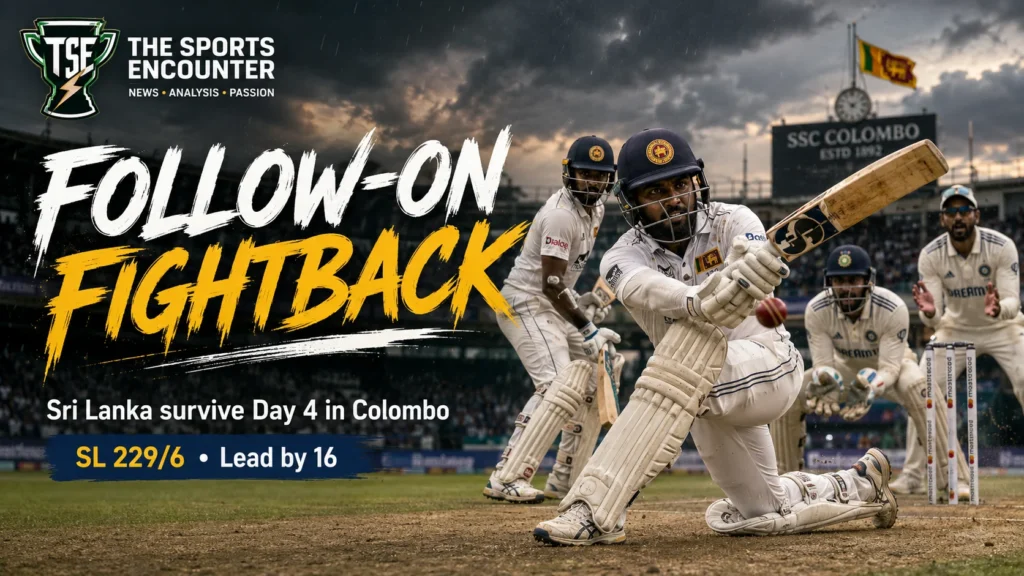
COLOMBO: Sri Lanka began the fourth day of the second Test trying to delay an innings defeat. By the time rain covered the Sinhalese Sports Club Ground, they had removed that possibility completely and forced India to return on Thursday needing four more wickets before they can even think about completing a 2-0 series sweep.
Asked to follow on after being bowled out for 290 in reply to India’s imposing 503 for nine declared, Sri Lanka reached 229 for six in their second innings before rain ended play after 72.4 overs. They now lead by 16 runs.
The scoreboard still favors India. Sri Lanka have only four wickets remaining, their lead is small, and the visitors could yet finish the match quickly on the final morning.
But Day 4 changed the nature of the contest.
Pasindu Sooriyabandara produced a superb 92 from 173 balls, Kamindu Mendis made 55, and their 115-run third-wicket partnership transformed a follow-on innings that had begun under enormous pressure. Sri Lanka were 63 for two when the pair came together. By the time India finally separated them, the possibility of an innings victory had started slipping away.
India eventually fought back through Prasidh Krishna, Manav Suthar and Saransh Jain, reducing Sri Lanka from 178 for two to 218 for six. Rain then intervened at 229 for six, leaving Sonal Dinusha unbeaten on seven and Keshara Nuwantha on three.
The final day now begins with a simple equation carrying several possible endings: Sri Lanka lead by 16 with four wickets left. India still control the Test, but they must complete the job.
Sri Lanka vs India 2nd Test: Day 4 at a Glance
| Match Detail | Position |
|---|---|
| Match | Sri Lanka vs India, 2nd Test |
| Venue | Sinhalese Sports Club Ground, Colombo |
| India first innings | 503/9 declared |
| Sri Lanka first innings | 290 |
| First-innings deficit | 213 runs |
| Follow-on | Enforced by India |
| Sri Lanka second innings | 229/6 in 72.4 overs |
| Current lead | Sri Lanka lead by 16 runs |
| Top scorer | Pasindu Sooriyabandara 92 |
| Kamindu Mendis | 55 |
| India’s second-innings wickets | Suthar 2, Siraj 1, Prasidh 1, Jadeja 1, Jain 1 |
| Overnight batters | Sonal Dinusha 7*, Keshara Nuwantha 3* |
| Day 5 situation | India need four wickets before beginning any chase |
TL;DR
- India bowled Sri Lanka out for 290 after declaring their first innings on 503 for nine.
- Sri Lanka therefore trailed by 213 runs and were asked to follow on.
- Lahiru Udara fell for three and Kamil Mishara made 32 before Sri Lanka slipped to 63 for two.
- Pasindu Sooriyabandara and Kamindu Mendis added 115 for the third wicket.
- Sooriyabandara scored 92 from 173 balls after making 80 in the first innings.
- Kamindu contributed 55 from 92 balls.
- Prasidh Krishna broke the partnership by removing Kamindu.
- Manav Suthar then dismissed Dhananjaya de Silva and Sooriyabandara as India regained control.
- Sri Lanka closed on 229 for six, leading by 16 runs.
- Rain ended play early, leaving India four wickets away from setting up a final-innings chase.
Dinusha Completes His Century Before India Enforce the Follow-On
Day 4 began with Sri Lanka still completing the first innings that had occupied most of the previous day.
They resumed on 265 for eight, with Sonal Dinusha unbeaten on 85 and Lahiru Kumara on eight. India had already done enough to ensure the follow-on remained available unless Sri Lanka could extend their resistance considerably.
Dinusha nevertheless gave the home crowd another reason to appreciate what has been an outstanding series for him.
He reached his hundred from 147 deliveries, hitting eight fours and three sixes, and eventually finished with 103 from 162 balls. Kumara contributed 12 before Saransh Jain removed him, while Dinusha became the final wicket at 290.
India had a 213-run advantage.
Shubman Gill enforced the follow-on.
The decision followed logically from the position India had constructed across the opening three days. Their 503 for nine declared had been built around Devdutt Padikkal’s 117, Dhruv Jurel’s unbeaten 115, Rishabh Pant’s 63 and contributions throughout the batting order.
The Sports Encounter’s earlier report from Colombo detailed how Jurel and Pant turned India’s already strong first innings into a total that placed Sri Lanka under sustained scoreboard pressure.
By the start of the second innings, Sri Lanka were effectively being asked to bat again with one objective before anything else mattered: make India bat again.
Sri Lanka Lose Udara Again but Mishara Counterattacks
The follow-on started badly.
Mohammed Siraj removed Lahiru Udara for three from 15 balls, leaving Sri Lanka five for one.
India had taken three wickets for just 13 runs across the end of Sri Lanka’s first innings and the beginning of the second. Another collapse appeared possible.
Kamil Mishara refused to allow the innings to become completely defensive.
The Test debutant made 32 from 39 balls, hitting three fours and a six. His scoring rate mattered because it stopped India from immediately settling into a cycle of attacking fields and maiden overs.
Ravindra Jadeja eventually trapped Mishara lbw at 63 for two. Sri Lanka reviewed the decision, but umpire’s call preserved the wicket.
Lunch arrived with the hosts on 83 for two.
The deficit remained enormous, but Sri Lanka had survived the most dangerous phase after being sent straight back out to bat.
Sooriyabandara Takes the Fight to India
The defining innings of the day belonged to Pasindu Sooriyabandara.
He had already made 80 in Sri Lanka’s first innings, one of the few substantial scores around Dinusha’s century. Asked to begin again almost immediately, he produced an even better innings under much greater pressure.
Sooriyabandara did not simply occupy the crease.
He challenged India’s spinners.
Against Manav Suthar in particular, he repeatedly used the sweep and reverse sweep to disturb length and field placement. When the opportunity appeared, he also came down the pitch rather than allowing India’s slow bowlers to dictate where he could score.
It was intelligent counterattacking Test batting rather than uncontrolled aggression.
He reached fifty from 78 balls with seven fours.
By then, Sri Lanka had passed 100 and the innings had begun to look substantially different from the desperate follow-on survival exercise India had expected.
Kamindu Mendis Gives Sri Lanka the Partnership They Needed
Kamindu Mendis provided the ideal partner.
The left-hander took time to settle before gradually becoming more assertive. His fifty came from 87 balls and contained two fours and three sixes.
More importantly, he gave Sooriyabandara stability at the other end.
The partnership reached 50 from 102 deliveries and then crossed 100 from 156 balls.
At drinks in the afternoon session, Sri Lanka were 163 for two. Sooriyabandara had 69 and Kamindu was on 54.
India had entered the day expecting to use a 213-run first-innings lead to finish the Test without batting again. Instead, they were suddenly spending another long session in the field against two batters prepared to attack spin rather than merely survive it.
It was the strongest passage Sri Lanka produced during Day 4.
The resistance also followed a pattern already visible during this series. In the first Test at Galle, Sri Lanka recovered from 90 for five through a major middle-order stand, a fightback covered in our Day 3 report from Galle.
Colombo demanded another rescue.
This time, Sooriyabandara and Kamindu supplied it.
Prasidh Turns to the Short Ball and Finally Breaks Through
There was little conventional assistance available for India’s fast bowlers.
The surface offered neither significant movement nor the kind of consistent seam response that would allow Prasidh Krishna and Siraj to attack through traditional methods.
India therefore used the short ball repeatedly as a change of pace and method.
Prasidh eventually made it work.
Kamindu moved to 55 before a short delivery produced the breakthrough, with Shubman Gill completing the catch.
Sri Lanka were 178 for three.
The wicket ended a 115-run partnership and changed the final part of the day.
India had spent much of the second session being pushed backward. Now there was a new batter at the crease and Sooriyabandara was approaching a century.
The visitors had an opening again.
Sooriyabandara Reaches 90 but Misses a Deserved Century
By tea, Sooriyabandara had reached 90.
Sri Lanka were 199 for three.
An innings defeat was almost gone, and a maiden Test century appeared within touching distance.
Neither milestone arrived quite the way Sooriyabandara would have wanted.
Dhananjaya de Silva was dismissed for 23 when Suthar struck at 209 for four.
Three runs later came the day’s most painful moment for Sri Lanka.
Sooriyabandara advanced to Suthar, was beaten, and Rishabh Pant completed the stumping.
He was out for 92 from 173 balls.
His innings included 10 fours and a six.
The missing eight runs will hurt, particularly after he had reached 80 in the first innings without converting that start either.
But the significance of the innings was much larger than the century he missed.
When Sooriyabandara began his second innings, Sri Lanka were 213 runs behind and facing the prospect of losing without India batting again.
When he departed, they had reached 212 for five.
The innings defeat had effectively disappeared.
Manav Suthar Takes Two Quick Wickets as India Hit Back
Suthar had been put under more pressure than any Indian spinner during Sooriyabandara’s attack.
His final figures reflected that contest. He conceded 81 runs from 18 overs, comfortably more expensive than India’s other frontline bowlers.
But he also took two of the wickets that stopped Sri Lanka from turning resistance into genuine control.
Dhananjaya fell for 23.
Sooriyabandara followed three runs later.
Then Saransh Jain trapped Niroshan Dickwella lbw for six, reducing Sri Lanka to 218 for six.
India had suddenly taken four wickets for 40 runs after the hosts reached 178 for two.
That late spell shifted the balance back toward the visitors.
By this stage, Sri Lanka had achieved their first target. India would have to bat again.
The next question was how large a chase they could create.
Rain Protects Sri Lanka’s Last Four Wickets
Sonal Dinusha and Keshara Nuwantha slowed the game dramatically after Dickwella’s dismissal.
Dinusha, who had scored 103 earlier in the day, moved to seven from 37 balls.
Nuwantha reached three from 29.
The final 10 overs of the day produced only 11 runs for the loss of one wicket.
There was nothing mysterious about the approach.
Sri Lanka no longer needed to chase the deficit aggressively. Every delivery survived increased the possibility of extending the game and every additional run increased the target India may eventually have to chase.
Then the sky changed.
Conditions had been growing darker before rain arrived at 4:37 p.m. local time. Ground staff quickly covered the pitch and surrounding areas, and heavier rain followed.
With the ground almost entirely covered and light deteriorating further, play was eventually called off.
Sri Lanka finished on 229 for six.
India Have Bowled More Than 160 Overs in Two Sri Lankan Innings
There is another element India must manage on Day 5.
Workload.
The visitors bowled 89.4 overs during Sri Lanka’s first innings and another 72.4 in the second. That is more than 162 overs in the field across consecutive innings.
India are also without Jasprit Bumrah and Kuldeep Yadav in Colombo, while the squad entered the tour with several availability and injury issues. The wider personnel pressure around the series was one of the central themes of The Sports Encounter’s pre-series analysis.
Siraj has remained extremely economical in the second innings, taking one for 11 from nine overs. Prasidh has one for 31 from 10. Jadeja has one for 48 from 18, while Jain has one for 55 from 17.4 overs.
Those workloads are manageable individually, but the cumulative effect of bowling across almost two complete Sri Lankan innings matters.
India need four wickets quickly enough to leave themselves comfortable time for the chase.
Why the Final Morning Could Still Become Complicated
India remain overwhelming favorites from the current position.
Four wickets separate them from Sri Lanka’s final total.
The lead is only 16.
Three of the four remaining batters are Prabath Jayasuriya, Lahiru Kumara and Asitha Fernando.
But Test matches become awkward when the expected ending does not arrive on schedule.
If Dinusha and Nuwantha can survive the first hour and push the lead toward 50 or 60, India will have to spend more time bowling before beginning a chase.
If rain removes another portion of the final day, the clock becomes relevant again.
If Sri Lanka lose two wickets immediately, India could be chasing a very small target before lunch.
That range of possibilities is why the first hour matters so much.
Sri Lanka Have Repeatedly Made India Work for the Final Wickets
The resistance of the lower order has already been visible twice during this Test.
In the first innings, Sri Lanka were 230 for eight before Dinusha and Kumara added 58 runs for the ninth wicket. Dinusha reached his century during that stand and stretched the innings to 290.
Now Dinusha is there again.
He has already faced 199 deliveries across the two innings and scored 110 runs in the match.
India therefore know that dismissing the recognized top order has not automatically ended Sri Lanka’s resistance.
That theme also appeared during the final stages of the opening Test in Galle, where India entered Day 5 needing six wickets before eventually completing a 165-run victory.
Colombo now presents a different version of the same challenge.
Sooriyabandara Has Changed His Place in This Sri Lankan Team
Whatever happens on Day 5, Pasindu Sooriyabandara leaves this Test with a stronger claim to a permanent role in Sri Lanka’s batting order.
He made 80 from 133 balls in the first innings.
He followed it with 92 from 173 in the second.
That gives him 172 runs in the match.
More importantly, both innings came with Sri Lanka under substantial pressure.
The methods were different enough to matter.
The first innings required recovery after early wickets.
The second demanded immediate mental reset after the follow-on, followed by tactical aggression against spin.
His willingness to sweep, reverse sweep and use his feet prevented Suthar and Jadeja from settling into uninterrupted attacking rhythms during the middle session.
For a Sri Lankan batting group still searching for greater stability, that adaptability could matter long after this match is finished.
India Still Hold the Advantage, but the Innings Victory Is Gone
India should still expect to win this Test.
They have controlled most of the match since compiling 503 for nine declared. Padikkal, Jurel and Pant built the scoreboard advantage. Prasidh, Suthar and the rest of the attack then bowled Sri Lanka out for 290.
Enforcing the follow-on was therefore entirely justified.
Sri Lanka’s response simply made India work much harder than the first-innings deficit suggested they would have to.
The hosts now lead by 16.
That means one result has already disappeared.
India cannot win by an innings anymore.
They need four wickets and then a successful chase.
Sri Lanka need time, runs and preferably more help from the weather.
This series forms part of the ICC World Test Championship 2025-27, which makes the result more important than the series score alone. India entered the Colombo Test already 1-0 ahead after their victory in Galle and are pursuing valuable WTC points as they attempt to move back toward the championship’s top two.
The unusual scheduling context is also part of a larger month of red-ball cricket. Colombo is one component of 19 consecutive calendar days with Test cricket scheduled during August, alongside Australia against Bangladesh and England against Pakistan.
TSE Verdict: Sri Lanka Won the Middle of Day 4, India Still Own the Match
Sri Lanka did something important on Wednesday.
They changed the manner in which this Test can end.
An innings defeat appeared entirely realistic when India enforced the follow-on with a 213-run lead. Sooriyabandara and Kamindu then produced the partnership the hosts needed, scoring with enough freedom to prevent India from simply surrounding the bat and waiting for mistakes.
For one full session, India looked frustrated rather than dominant.
The response after Kamindu’s dismissal was equally important.
Suthar recovered from being attacked to remove Dhananjaya and Sooriyabandara. Jain dismissed Dickwella. Four wickets fell between 178 and 218, preventing Sri Lanka from turning a rescue into a serious attempt to build a match-winning lead.
Rain ultimately froze the contest at 229 for six.
India remain in front.
Sri Lanka have finally made them look toward the clock as well as the wickets.
That is enough to give the second Test one meaningful final day.
Follow The Sports Encounter’s cricket coverage for the Day 5 report, international Test cricket, tournament news, player performances and analysis from across the game.
Frequently Asked Questions
What is the score after Day 4 of the Sri Lanka vs India second Test?
Sri Lanka are 229 for six in their second innings after following on. They lead India by 16 runs with four wickets remaining.
Did Sri Lanka avoid an innings defeat?
Yes. Sri Lanka moved past India’s 213-run first-innings advantage during their second innings, which means India must bat again to win the Test.
Why did India enforce the follow-on?
India scored 503 for nine declared before bowling Sri Lanka out for 290. The 213-run deficit exceeded the 200-run requirement for enforcing the follow-on in a five-day Test.
How many runs did Pasindu Sooriyabandara score?
Sooriyabandara scored 92 from 173 balls in Sri Lanka’s second innings, with 10 fours and one six. He had already made 80 in the first innings.
How many runs did Kamindu Mendis score?
Kamindu made 55 from 92 deliveries, hitting two fours and three sixes.
How many runs did Sooriyabandara and Kamindu add?
They shared a 115-run partnership for the third wicket, taking Sri Lanka from 63 for two to 178 for three.
Who took the wickets for India in Sri Lanka’s second innings?
Manav Suthar has two wickets, while Mohammed Siraj, Prasidh Krishna, Ravindra Jadeja and Saransh Jain have taken one each.
Who is unbeaten for Sri Lanka?
Sonal Dinusha is unbeaten on seven and Keshara Nuwantha is three not out.
How many runs did Sonal Dinusha score in Sri Lanka’s first innings?
Dinusha scored 103 from 162 balls, including eight fours and three sixes.
Can Sri Lanka still win the second Test?
Yes, mathematically. Sri Lanka would need to build a substantially larger lead with their remaining four wickets and then dismiss India while defending that target. India remain in the much stronger position.
What does India need to win?
India must take Sri Lanka’s remaining four wickets and then successfully chase whatever target the hosts set.
Why did play end early on Day 4?
Rain arrived late in the afternoon with Sri Lanka on 229 for six. Conditions became increasingly dark, the ground was covered, and no further play was possible.
When is Day 5 of the Sri Lanka vs India second Test?
The fifth and final day is scheduled for Thursday, August 27, 2026, at the Sinhalese Sports Club Ground in Colombo.