


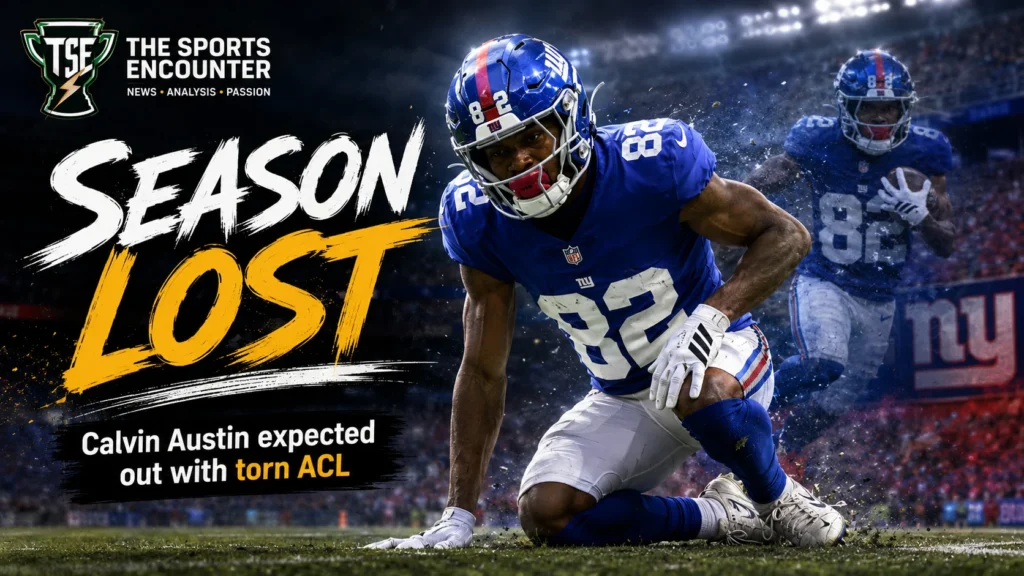
EAST RUTHERFORD: Calvin Austin III arrived in New York with a modest one-year contract, elite speed and a genuine opportunity to become an important part of Jaxson Dart’s second season as the Giants quarterback.
That opportunity appears to have ended before the regular season began.
Austin tore the ACL in his right knee during Tuesday’s practice and is expected to miss the entire 2026 NFL season, according to a person with knowledge of the injury who spoke to The Associated Press. NFL.com subsequently listed Austin as out for the season with the torn ACL.
The New York Giants had not publicly announced the full medical diagnosis at the time of publication, so the injury should remain attributed to those reports until the club provides its own formal update.
What is already clear is the impact.
Austin had been enjoying one of the strongest training camps among New York’s receivers, had developed a productive connection with Dart and appeared to be earning a meaningful role in an offense that already entered the summer managing Malik Nabers’ return from his own ACL reconstruction.
Losing Austin therefore affects considerably more than one place on the depth chart. It changes the competition for slot snaps, removes another vertical speed option, affects punt-return depth and creates additional pressure on a receiver group that the Giants spent much of the offseason rebuilding.
For continuing roster, injury and preseason coverage from across the league, readers can follow The Sports Encounter’s NFL coverage.
Calvin Austin ACL Injury: What We Know
| Detail | Latest Information |
|---|---|
| Player | Calvin Austin III |
| Team | New York Giants |
| Position | Wide receiver |
| Age | 27 |
| Injury | Reported torn ACL in right knee |
| How it happened | Non-contact injury during a 1-on-1 practice drill |
| Reported prognosis | Expected to miss the 2026 season |
| Giants status | Team had not formally announced the diagnosis at publication |
| Contract | One-year deal signed during 2026 free agency |
| Previous team | Pittsburgh Steelers |
| 2025 receiving | 31 catches, 372 yards, 3 touchdowns |
| Giants season opener | September 13 vs Dallas Cowboys |
TL;DR
- Calvin Austin III reportedly tore the ACL in his right knee during Giants practice on Tuesday.
- The 27-year-old wide receiver is expected to miss the entire 2026 NFL season.
- The Giants had not formally announced the diagnosis at the time of publication.
- Austin suffered the injury without contact during a 1-on-1 drill and was carted from the field.
- He had been one of the strongest performers in Giants training camp and developed chemistry with quarterback Jaxson Dart.
- Austin caught two passes for 24 yards during New York’s preseason victory over Miami.
- He joined the Giants this offseason after three active seasons with Pittsburgh.
- Austin recorded 84 regular-season receptions for 1,100 yards and eight touchdowns with the Steelers.
- His absence creates more opportunity for Darnell Mooney, Braxton Berrios, Odell Beckham Jr., Malachi Fields and other Giants receivers.
- New York has also signed rookie wide receiver Kobe Prentice as roster decisions approach.
- Malik Nabers continues working back from the ACL injury that ended his 2025 season.
- The Giants open the regular season against the Dallas Cowboys on September 13.
A Non-Contact Practice Rep Changed Austin’s Season
The injury occurred during a 1-on-1 drill at the Giants’ training facility on Tuesday.
Austin went down without contact while working against cornerback Deonte Banks. Practice stopped as teammates and staff gathered around him, and he was eventually taken from the field on a cart.
Offensive coordinator Matt Nagy acknowledged afterward that the situation looked serious and spoke warmly about both Austin’s character and the quality of the camp he had produced.
The following day brought the news the Giants had feared.
NFL.com’s August 26 injury roundup listed Austin with a torn ACL and said he would miss the 2026 season.
For Austin, the timing makes the injury especially cruel because his summer had been building toward a larger role.
Austin Was Winning His Place Rather Than Simply Filling a Roster Spot
When New York signed Austin in March, the move carried relatively little attention compared with the Giants’ larger offseason additions.
He arrived after three active seasons with Pittsburgh as a 5-foot-9, 162-pound receiver whose speed could stretch defenses vertically and create separation from several alignments.
The Giants’ official announcement of Austin’s signing highlighted 84 regular-season catches for 1,100 yards and eight touchdowns across 48 games with the Steelers.
He also brought established special-teams value. Austin returned 72 punts for 639 yards and a touchdown during his Pittsburgh career, including a 73-yard score against the Giants in 2024.
That combination made him useful in several different ways.
New York did not need Austin to become its No. 1 receiver. The roster already contained players with larger offensive profiles.
The Giants needed him to create speed, spacing, favorable matchups and reliable depth behind them.
Training camp suggested he was capable of doing considerably more than simply surviving the final roster cut.
Jaxson Dart Was Developing Trust With Austin
The most consequential part of Austin’s summer may have been his work with Dart.
AP reported that Austin had become one of the second-year quarterback’s most frequent targets during team periods.
That chemistry matters because NFL passing offenses depend heavily on timing established through repetition.
A receiver can understand the playbook and still require weeks of work with a quarterback to establish when a route will break, where a pass should arrive against different coverage leverage and how each player reacts when the original route changes after the snap.
Austin had spent the spring and summer accumulating those repetitions.
His preseason work offered further evidence. He caught two passes for 24 yards against Miami and also produced a 21-yard rushing gain as the Giants beat the Dolphins 26-3.
The wider NFL preseason has already demonstrated how quickly these August opportunities can reshape depth charts. The Sports Encounter’s Week 1 preseason analysis examined several players who used live game repetitions to strengthen their cases before roster decisions.
Austin appeared to be doing the same.
The ACL tear removes those accumulated gains from New York’s immediate plans.
Why Austin’s Speed Mattered to the Giants Offense
Speed becomes most valuable when it changes what a defense is willing to do.
Austin possesses enough of it to force defensive backs to respect vertical routes even when he is not the primary target.
That can create space underneath for tight ends, running backs and possession receivers.
It can discourage safeties from cheating aggressively toward another side of the field.
It can also create opportunities through motion, jet sweeps and manufactured touches because defenders cannot afford to lose leverage before Austin reaches full speed.
The Giants have other fast players.
Replacing Austin’s exact combination of speed, experience, slot capability and return value is harder.
This is the broader roster problem created by late-summer injuries. Teams rarely replace one injured player’s entire role with one healthy player.
They redistribute it.
That same pattern has appeared throughout August, something TSE examined in its recent NFL injury and signing roundup. A significant injury changes practice repetitions, roster probabilities and the acceptable level of risk elsewhere on the depth chart.
New York is now making those calculations at receiver.
The Malik Nabers Situation Makes the Timing More Important
The Giants were already approaching the regular season with one major receiver health story.
Nabers tore his ACL during New York’s Week 4 victory over the Los Angeles Chargers in September 2025, ending his second NFL season after only four games.
His rehabilitation has progressed throughout the summer.
Nabers returned to team periods in August while wearing a red non-contact jersey, and John Harbaugh said he looked good during that stage of the recovery.
The Giants have remained careful about attaching a firm date to his full return. Harbaugh has publicly expressed hope that Nabers can play in the September 13 opener against Dallas while emphasizing that the process will depend on how his knee continues responding.
That caution now becomes more relevant.
Austin’s injury should not change the medical timetable for Nabers. The Giants have every reason to continue managing their star receiver according to his own rehabilitation rather than accelerating the process because another player is unavailable.
It does, however, remove insurance around him.
If Nabers experiences any delay or workload limitation early in the season, New York now has one fewer experienced receiver available to absorb those snaps.
Darnell Mooney Could Gain More Responsibility
Mooney was already one of the important additions to the Giants offense.
His experience, speed and ability to work from different alignments give Nagy several options when replacing Austin’s snaps.
Mooney has played both outside and inside during his NFL career, which makes him a logical candidate for increased slot work depending on how New York structures its personnel.
The advantage is flexibility.
The disadvantage is that moving Mooney around can affect another role elsewhere in the offense.
Every redistribution creates a second decision.
If Mooney takes more inside snaps, somebody else must handle more work outside. If the Giants keep him primarily in his intended role, another receiver must win Austin’s slot opportunities.
This is why preseason injuries become questions of roster architecture rather than simple replacement.
Braxton Berrios Now Has an Obvious Opening
Berrios may have one of the clearest paths to additional work.
The veteran has extensive experience operating from the slot and brings his own return background.
Those traits overlap with two areas where Austin’s absence creates uncertainty.
Berrios also understands what an ACL rehabilitation requires after suffering the injury himself in 2024.
His place in the receiver competition therefore becomes more valuable than it appeared 48 hours earlier.
He does not need to reproduce Austin’s vertical speed to help New York.
Reliable route execution, short-area separation and special-teams usefulness could be enough to earn a meaningful role.
Odell Beckham Jr. Has Another Opportunity in a Crowded Room
Odell Beckham Jr.’s return to the Giants already carried obvious history.
The more important question during August has been how much he can still contribute to the current offense.
Austin’s injury creates more available snaps but does not automatically hand them to Beckham.
The veteran still has to demonstrate that he can separate consistently, stay healthy and provide enough weekly value to justify his place on the 53-man roster.
His experience does give New York an alternative few teams would possess this late in the preseason.
Beckham has played through almost every type of coverage and high-pressure environment an NFL receiver can encounter.
If his body allows him to contribute, the Giants now have an additional reason to keep exploring how he fits alongside Nabers, Mooney and Darius Slayton.
Malachi Fields May Be the Biggest Developmental Beneficiary
Rookie Malachi Fields enters a different stage of the competition.
He has shown enough during camp to suggest he can contribute earlier than some young receivers normally would.
Austin’s absence creates more practice opportunities and potentially more game snaps for the rookie.
That can accelerate development quickly.
Young receivers improve by seeing NFL coverage at full speed, learning how physical defensive backs become at the top of routes and discovering how small the throwing windows become once regular-season game plans are installed.
Fields now has a clearer route toward those experiences.
The situation resembles other receiver competitions around the league where injuries have increased opportunities for younger players. TSE recently examined how a training-camp injury to Saints rookie Jordyn Tyson affected New Orleans’ receiver planning.
New York now faces its own version of that calculation.
The Giants Have Already Added Kobe Prentice
New York did not wait long to reinforce the room.
The Giants announced Wednesday that they had signed rookie wide receiver Kobe Prentice along with veteran tight end Josiah Deguara.
The team did not state that Prentice was signed specifically because of Austin’s injury, so the two developments should not be presented as an officially confirmed cause-and-effect transaction.
The timing nevertheless gives New York another receiver for the final days of preseason and the closing roster evaluation.
According to the Giants’ official transaction announcement, Prentice is a 5-foot-10, 184-pound undrafted rookie who spent his final college season at Baylor after three years at Alabama.
He recorded 26 catches for 380 yards and six touchdowns in 11 games during his senior season.
Prentice had most recently been with New England after the Patriots claimed him from Carolina, and he became available when the Patriots released him Monday.
His arrival gives the coaching staff another body to evaluate.
It does not replace the chemistry Austin had already established with Dart.
The Punt-Return Competition Changes Too
Austin’s special-teams history should not disappear from the analysis.
He returned 72 punts during his three active Steelers seasons and averaged 8.9 yards per return.
His 73-yard touchdown in 2024 demonstrated the explosive possibility he could provide when space opened.
That role may not have been the primary reason New York signed him, but special-teams versatility helps determine the bottom of NFL rosters.
Berrios has extensive return experience and becomes an obvious option.
Other receivers and defensive backs could also receive more opportunities as the Giants decide how many players they can carry primarily for special teams.
The broader league has dealt with similar August depth questions throughout camp. Our NFL injury roundup on Josh Jacobs, Kenyon Sadiq and Elic Ayomanor highlighted how apparently isolated injuries often create secondary decisions elsewhere on a roster.
Austin Had Already Experienced a Lost Season
The rehabilitation challenge carries another layer for Austin because this will not be the first NFL season taken away by injury.
Pittsburgh selected him in the fourth round of the 2022 NFL Draft out of Memphis.
A foot injury prevented him from playing during his entire rookie season.
He eventually made his NFL debut in 2023 and gradually expanded his role over the following three years.
The 2024 season became his most productive as a receiver, when he recorded career highs of 36 receptions, 548 receiving yards and four touchdowns.
He followed with 31 catches for 372 yards and three touchdowns in 2025 before entering free agency.
New York represented a fresh opportunity.
Another long rehabilitation process now stands between Austin and the next stage of his career.
Why the Injury Hurts Austin Beyond 2026
The immediate consequence is the lost season.
The longer-term issue is contractual timing.
Austin joined the Giants on a one-year agreement, reportedly worth $1.5 million.
This season therefore represented an opportunity to establish his value inside a new offense before returning to free agency.
A productive year could have strengthened his case for a larger role or another contract in 2027.
The injury removes that platform.
His next negotiation may now depend heavily on rehabilitation progress, medical evaluations and whether teams believe his speed has fully returned.
ACL surgery and rehabilitation have become common across professional football, and many receivers return to high-level play. Speed-based players still face an especially important physical question because acceleration, cutting and sudden changes of direction sit at the center of their value.
Austin’s recovery will therefore matter far beyond simply receiving clearance to practice again.
The Giants Have Seen How Quickly ACL Injuries Reshape Plans
New York does not need a reminder of the disruption created by major knee injuries.
Nabers’ 2025 ACL tear changed Dart’s rookie season almost immediately.
The quarterback lost his most dangerous receiver during his first NFL start.
New York then spent months planning for Nabers’ rehabilitation while adding Mooney, Austin, Beckham and Berrios to strengthen the position.
Now one of those additions is gone before Week 1.
That sequence reflects the harsh side of NFL roster building.
Front offices can improve depth during free agency and the draft, yet every plan remains exposed to the physical nature of the sport.
The Sports Encounter has followed that reality throughout this preseason, including Atlanta losing Jalon Walker for the season with another ACL tear.
Those injuries affect different positions and teams, but the roster consequence is familiar.
A carefully designed rotation has to be rebuilt almost overnight.
New York’s Final Preseason Game Now Carries More Weight at Receiver
The Giants close their preseason against the New York Jets on Friday at MetLife Stadium.
Preseason finales often become evaluation games for players fighting over the final few roster places.
Austin’s absence raises the stakes considerably for the receivers behind the established names.
Berrios, Beckham, Fields and the other depth options now have more than roster survival at stake.
They are competing for snaps that may exist when the regular season begins.
Prentice has only just arrived and faces the difficult task of learning enough of the offense to make an impression quickly.
The coaching staff also has to determine which receivers provide enough special-teams value to dress on game day.
August football regularly produces this kind of compressed evaluation. Our wider training-camp coverage has tracked teams making similar depth adjustments as injuries force new players into larger roles.
The 53-Man Roster Decision Just Became More Complicated
The timing could hardly be more consequential.
New York’s initial 53-man roster must be finalized shortly after the preseason finale.
Before Austin’s injury, the receiver competition involved determining which players offered enough offensive and special-teams value behind the leading group.
The equation now includes a missing player who had been expected to contribute.
The Giants have to decide how many receivers they need, which skill sets overlap, whether younger players are ready and how much special-teams coverage they can preserve.
Those decisions become especially difficult when Nabers is still completing his return to full contact.
A healthy receiver room offers coaches the luxury of choosing complementary skill sets.
An injured one forces them to protect against scenarios they hope never occur.
What Austin’s Absence Means for Jaxson Dart
Dart remains the player through whom all of these decisions eventually connect.
The second-year quarterback needs a receiver group that gives him reliable answers against different defensive structures.
Nabers can become the focal point when healthy.
Slayton provides established vertical experience.
Mooney adds speed and positional flexibility.
Isaiah Likely strengthens the passing game from tight end.
Fields represents developmental upside, while Beckham and Berrios offer veteran alternatives.
Austin had been creating another useful layer within that group.
His loss does not leave Dart without weapons.
It reduces the margin for something else to go wrong.
That distinction becomes important during a 17-game NFL season, when receiver rooms are rarely completely healthy from September through January.
The Cowboys Opener Will Provide the First Real Answer
New York opens its regular season against Dallas at MetLife Stadium on September 13.
By then, the Giants expect to have a much clearer picture of Nabers’ availability and the hierarchy behind him.
The Cowboys will provide an immediate test because regular-season defenses disguise coverages and pressure quarterbacks in ways preseason games rarely reproduce.
Dart will need receivers who understand sight adjustments and can separate when his first read disappears.
Austin appeared to be developing toward precisely that type of trust.
The Giants now have a little more than two weeks to redistribute that responsibility.
The Final Word: Austin’s Injury Changes More Than One Line on the Depth Chart
The easiest interpretation of Calvin Austin’s injury is that New York lost a depth receiver.
His summer suggests the consequences go further.
Austin was developing into a player Dart trusted, offered legitimate vertical speed, could work from multiple receiving alignments and carried meaningful punt-return experience.
Those responsibilities now have to be divided among several teammates at exactly the point when the Giants are finalizing their regular-season roster.
Mooney can absorb some offensive work. Berrios has a clearer route into slot and return snaps. Fields receives an opportunity to develop faster. Beckham’s experience becomes more useful. Prentice arrives with a chance that did not exist earlier in the week.
The Giants have enough options to adjust.
The real question is whether those options can collectively replace the role Austin was creating for himself.
There is also a human cost behind the depth-chart discussion.
Austin had already lost his rookie season to injury, worked his way into a productive three-year run in Pittsburgh and came to New York attempting to establish the next stage of his career. A strong camp suggested he was doing exactly that.
Now another rehabilitation begins.
For the Giants, the season moves forward without one of the players who had done the most this summer to earn a place in it.
For more NFL injury developments, roster moves and preseason analysis, readers can also revisit The Sports Encounter’s broader training-camp coverage.
Frequently Asked Questions
What happened to Calvin Austin III?
Austin reportedly tore the ACL in his right knee after going down without contact during a 1-on-1 drill at New York Giants practice on August 25.
Will Calvin Austin play during the 2026 NFL season?
He is expected to miss the entire season, according to AP and subsequent NFL reporting. The Giants had not formally announced the full diagnosis at the time this article was prepared.
When did Calvin Austin join the Giants?
Austin signed with New York during free agency in March 2026 after spending his first four NFL years with the Pittsburgh Steelers organization.
What were Calvin Austin’s career numbers with Pittsburgh?
He recorded 84 receptions for 1,100 yards and eight touchdowns across 48 regular-season games. Including postseason play, AP lists his Pittsburgh totals at 89 catches, 1,140 yards and nine touchdowns in 51 games.
How did Calvin Austin perform during Giants preseason?
Austin caught two passes for 24 yards against Miami and had impressed throughout training camp while building chemistry with quarterback Jaxson Dart.
Who could replace Calvin Austin in the Giants offense?
Darnell Mooney, Braxton Berrios, Odell Beckham Jr., rookie Malachi Fields and other receivers could receive additional snaps. New York has also signed rookie Kobe Prentice.
Is Malik Nabers healthy?
Nabers is continuing his return from the ACL injury that ended his 2025 season. He has returned to team periods in a non-contact jersey, but the Giants have not guaranteed that he will play in Week 1.
When do the Giants begin the 2026 regular season?
New York opens its season at home against the Dallas Cowboys on September 13.
Who is the Giants quarterback in 2026?
Jaxson Dart enters his second NFL season as the central quarterback in the Giants offense after showing encouraging signs during his rookie campaign.
Did the Giants sign another receiver after Austin’s injury?
The Giants announced the signing of rookie wide receiver Kobe Prentice on August 26. The team did not officially state that the move was made specifically because of Austin’s injury.