Manchester United Sign Carlos Baleba From Brighton as Carrick’s Midfield Rebuild Accelerates
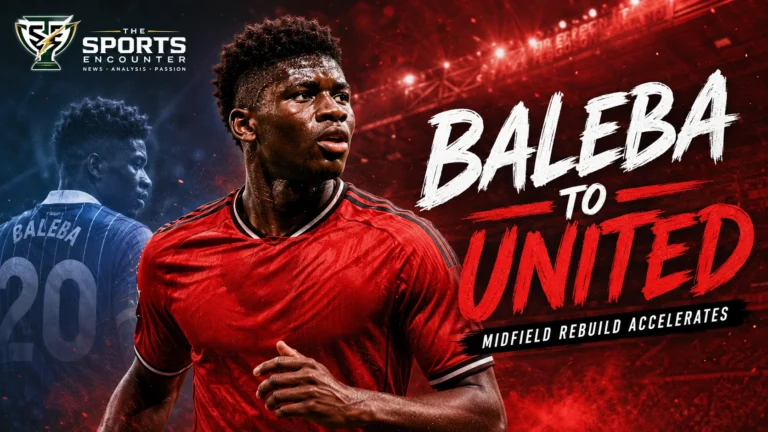
Manchester United have completed the signing of Carlos Baleba from Brighton, adding the 22-year-old Cameroon midfielder to Michael Carrick’s rebuilt midfield.
Manchester United have completed the signing of Carlos Baleba from Brighton & Hove Albion, adding one of the Premier League’s most dynamic young midfielders to Michael Carrick’s increasingly ambitious 2026-27 squad.
United confirmed the transfer on August 25, with Baleba signing a contract until June 2031 and the club holding an option to extend the deal for another year.
The 22-year-old Cameroon international arrives after establishing himself as one of Brighton’s most important midfielders and one of the league’s strongest young ball-winners. Manchester United have not officially disclosed the fee, so any transfer figure should still be treated as reported rather than confirmed.
The official Manchester United announcement confirmed the completion of the transfer, while the club’s Baleba player profile lists his contract through June 2031 with an additional one-year option.
For United, this signing matters because Baleba does not simply add another midfield body. He changes the physical and tactical ceiling of a department Carrick has already reshaped with Youri Tielemans and Andrey Santos.
Carlos Baleba to Manchester United: Key Facts
| Detail | Information |
|---|---|
| Player | Carlos Baleba |
| Age | 22 |
| Nationality | Cameroon |
| Position | Central midfielder |
| Previous club | Brighton & Hove Albion |
| New club | Manchester United |
| Contract | Until June 2031 |
| Extension option | One additional year |
| Date signed | August 25, 2026 |
| Official fee disclosed? | No |
Why Baleba Fits Michael Carrick’s Manchester United
United’s midfield rebuild has already been one of the defining features of Carrick’s first full summer in charge.
Youri Tielemans brought control, passing range and Premier League experience. Andrey Santos added athleticism, forward movement and another younger profile.
Baleba gives Carrick something different again.
He can recover possession, carry the ball through pressure and cover large spaces without forcing United to sacrifice technical security.
That balance is particularly valuable for a team attempting to become more aggressive without becoming structurally loose.
The Sports Encounter examined that broader project in our analysis of Michael Carrick’s Manchester United rebuild, where midfield control was identified as one of the biggest differences between the current side and several weaker United teams of recent years.
Baleba now deepens that evolution.
His Brighton Numbers Explain the Attraction
Manchester United’s official player profile highlights why Baleba had become one of the Premier League’s more valuable young midfielders.
During the 2024-25 season, his combined tackles and interceptions ranked sixth among Premier League midfielders, while he also ranked fourth for progressive ball carries per 90 minutes.
In 2025-26, he played 31 Premier League matches and ranked in the top eight percent of players for combined tackles and interceptions.
He also ranked in the top one percent for second balls won.
Those numbers are useful because they describe the type of midfielder United are buying.
Baleba is not primarily a tempo controller like Tielemans.
He is not a pure attacking midfielder either.
His value comes from affecting the spaces between both boxes.
United Have Built a Midfield With More Than One Solution
For years, Manchester United’s midfield often depended too heavily on one player solving too many problems.
Bruno Fernandes carried enormous creative responsibility.
Kobbie Mainoo was frequently asked to provide control and progression despite still developing.
Defensive coverage could become stretched when United lost possession.
The current recruitment strategy looks more deliberate.
Tielemans can dictate rhythm.
Santos can carry and press.
Baleba can win duels, drive forward and cover ground.
Mainoo can operate with greater freedom because the entire structure no longer depends on him performing every midfield task at once.
That is one reason United entered the season as genuine contenders in The Sports Encounter’s Premier League 2026-27 title contender rankings.
The squad still had questions, but midfield depth was already becoming a strength.
Baleba makes it stronger again.
This Is Carrick’s First Full-Summer Squad Taking Shape
The timing matters because Carrick inherited the team midway through last season rather than building it himself.
He still guided United from seventh to third and back into the Champions League.
The Sports Encounter’s Premier League 2026-27 season preview identified United as one of the most intriguing teams entering the new campaign because Carrick now has a full preseason and a squad shaped more closely around his football.
Baleba is an important part of that transition.
This is no longer a manager attempting to stabilize someone else’s team.
Carrick is beginning to assemble his own.
Baleba Could Help United Become Less Dependent on Transitions
One of the biggest tests facing United this season is whether they can consistently dominate opponents who defend deeply.
Last season, Carrick improved the side’s transition structure and defensive organization quickly.
The next step is controlling matches for longer periods.
Baleba’s ability to carry the ball through midfield can help with that problem.
When opponents block central passing lanes, ball carriers become especially valuable because they can move the defensive structure without relying on a risky vertical pass.
That ability should also help Fernandes receive the ball in more advanced positions.
The goal is not to turn Baleba into another creator.
It is to give United a midfielder capable of transporting possession far enough that the creative players do not have to retreat constantly to build attacks.
United’s Preseason Already Suggested a More Controlled Identity
The tactical direction was visible before the competitive season began.
United’s 5-0 preseason win over Rosenborg showed Carrick experimenting with greater patience in possession and more defined midfield spacing.
The subsequent 1-1 draw with Leeds United before a 5-4 penalty shootout win offered a different test, with United having to remain composed in a tighter contest.
Those matches were useful because they showed the broader direction of travel.
Baleba now gives Carrick another player suited to that style.
The Marcus Rashford Return Adds Another Layer to United’s Rebuild
The midfield is not the only part of the squad changing.
Marcus Rashford has returned after spells away from Old Trafford and is attempting to rebuild his own United career under Carrick.
The Sports Encounter explored that situation in our report on Rashford’s Manchester United return.
That context matters because United now have more attacking options than they carried through much of the previous campaign.
A stronger midfield should help those forwards receive possession earlier and in better areas.
The relationship between recruitment lines is important.
Baleba is not being signed in isolation.
He is part of a wider attempt to make the entire team function more efficiently.
What Baleba Could Mean for Kobbie Mainoo
One of the most interesting consequences may involve Mainoo.
The academy midfielder has already demonstrated that he can handle high-pressure Premier League matches, but United have often asked him to perform several different functions at once.
Baleba could reduce that burden.
With another athletic ball-winner available, Mainoo may receive more opportunities to operate as a possession midfielder rather than being forced constantly into recovery situations.
Carrick could also rotate more aggressively across domestic and European competition without dramatically changing the character of the midfield.
That will matter because United return to the Champions League this season.
The Sports Encounter’s analysis of Carrick’s rebuild identified Europe as one of the biggest tests facing a squad that had enjoyed a simpler competitive rhythm during the second half of last season.
Baleba Arrives With Premier League Experience, Not Adaptation Guesswork
Another advantage is familiarity.
Baleba is not arriving from a league where United need to guess how quickly he will adjust to English football.
He has already spent several seasons at Brighton and has faced the pace, physicality and tactical demands of the Premier League.
That reduces one of the biggest risks associated with expensive midfield recruitment.
There will still be a transition.
Playing for Manchester United brings different expectations, more possession, more scrutiny and less patience.
But the basic environment is already familiar.
That should make it easier for Carrick to integrate him once he is fully fit.
Brighton Lose Another Midfielder Developed Into Elite Value
From Brighton’s perspective, Baleba’s departure fits a familiar pattern.
The club have repeatedly identified young players, developed them inside a clear tactical environment and eventually sold them at significantly higher value.
Baleba arrived from Lille as a teenager and became a Premier League regular before attracting interest from one of England’s biggest clubs.
His development also contributed to Brighton qualifying for European football last season.
The Premier League’s official platform continues to list Brighton and Manchester United among the clubs beginning the new 2026-27 campaign with European ambitions.
For Brighton, replacing Baleba’s ball-winning and carrying ability may now become one of the most important remaining tasks of the transfer window.
The Reported Fee Should Be Handled Carefully
Manchester United have not publicly confirmed the financial details of the transfer.
That distinction matters.
Current reporting has placed the initial fee around £60 million, with additional payments potentially increasing the total value of the deal.
Until either club discloses the numbers, those figures should remain described as reported.
The sporting logic of the move is easier to assess than the final accounting.
At 22, Baleba offers several prime years and potential resale value.
United are paying for current Premier League performance and future development rather than a short-term veteran solution.
Baleba’s Fitness Is the Immediate Question
The transfer does not necessarily mean Baleba is ready to walk directly into Carrick’s starting XI.
He sustained an ankle ligament problem during preseason, making his recovery one of the immediate issues United must manage.
That should prevent the club from rushing him simply because the transfer has been completed.
United already possess enough midfield depth to allow a sensible return.
The bigger priority is ensuring Baleba becomes available for the sustained run of Premier League and Champions League fixtures rather than forcing an early debut and creating a longer absence.
Why This Signing Changes United’s Title Conversation
United finished third last season with 71 points.
That was enough to return to the Champions League but still left them 14 points behind champions Arsenal.
The Sports Encounter’s title contender analysis argued that United’s next step depends on eliminating the inconsistent weekends that separate a Champions League team from a champion.
Baleba helps because those dropped points often occur in midfield.
Teams lose control after turnovers.
Second balls go uncontested.
Transitions become too open.
Opponents turn one clearance into a counterattack.
Baleba’s statistical profile directly addresses those moments.
That does not make United title favorites.
It does make the squad more capable of surviving the type of match that championship contenders must win even when their attacking football is imperfect.
TSE Analysis: Baleba Makes United More Complete, Not More Glamorous
This is not the type of signing built primarily around shirt sales or global name recognition.
Baleba’s appeal is functional.
He gives Manchester United another way to win midfield duels, escape pressure and protect attacking players from doing too much defensive work.
That may prove more important than adding another headline forward.
United already have creators.
They already have finishers.
They already have players capable of producing spectacular moments.
The challenge under Carrick is turning those individual qualities into a side that controls enough of every match to compete across 38 league games and a Champions League campaign.
Baleba fits that problem.
What Happens Next?
The next focus will be Baleba’s recovery from his ankle injury and how quickly Carrick integrates him into training.
His eventual role could depend on the opponent.
Against aggressive pressing teams, his carrying ability may become especially valuable.
Against transition-heavy opponents, his defensive coverage could matter more.
Against deeper blocks, he may be used alongside Tielemans to combine physical security with distribution.
The important point is that Carrick now has options.
Manchester United began the summer rebuilding their midfield.
With Baleba added to Tielemans and Santos, that rebuild now looks much closer to complete.
Final Analysis
Carlos Baleba is one of the clearest indications yet that Manchester United’s summer is being built around structure rather than reputation.
At 22, he already has Premier League experience, elite ball-winning numbers and the ability to carry possession through midfield.
For Brighton, his departure removes one of the most valuable players from a team that reached European competition.
For United, the significance is broader.
Carrick now has a midfield capable of changing personality without changing the entire team.
That flexibility should help in the Premier League.
It may become even more important in Europe.
Baleba still has to recover, settle and prove he can handle the pressure attached to Old Trafford.
But the logic behind the signing is difficult to miss.
Manchester United are no longer trying to build a midfield around one answer.
They are building one with several.
Frequently Asked Questions
Has Carlos Baleba signed for Manchester United?
Yes. Manchester United officially confirmed Baleba’s signing from Brighton & Hove Albion on August 25, 2026.
How long is Carlos Baleba’s Manchester United contract?
Baleba has signed until June 2031, with Manchester United holding an option to extend the contract for another year.
How old is Carlos Baleba?
Baleba is 22 years old.
Which country does Carlos Baleba represent?
Baleba is a Cameroon international.
What position does Carlos Baleba play?
He primarily plays as a central midfielder and is particularly strong in ball recovery, second-ball situations and progressive carrying.
How much did Manchester United pay for Carlos Baleba?
Manchester United have not officially disclosed the transfer fee. Current reporting has placed the initial amount around £60 million with possible add-ons, so that figure remains reported rather than confirmed.
What were Carlos Baleba’s Premier League strengths at Brighton?
Manchester United’s official profile notes that Baleba ranked in the top eight percent of Premier League players for combined tackles and interceptions in 2025-26 and in the top one percent for second balls won.
Is Carlos Baleba fit to make his Manchester United debut?
Baleba has been recovering from an ankle ligament injury suffered during preseason, so his immediate availability will depend on his rehabilitation and United’s medical assessment.
Who else has Manchester United signed in midfield?
United have also added Youri Tielemans and Andrey Santos, giving Michael Carrick several different midfield profiles for the 2026-27 season.

Breaking News
Bunny Shaw Wins PFA Players’ Player of the Year After Historic Manchester City Season
Khadija “Bunny” Shaw has been named the 2025/26 PFA Women’s Players’ Player of the Year after another dominant Manchester City season featuring 21 WSL goals, 27 in all competitions and a record third consecutive Golden Boot.
Khadija “Bunny” Shaw has been named the 2025/26 PFA Women’s Players’ Player of the Year after a season in which the Manchester City striker combined record-breaking scoring with the kind of consistency that made her the outstanding individual force in the Women’s Super League.
The Jamaican forward scored 21 goals in 22 WSL appearances, claimed the Golden Boot for a record third consecutive season and finished the campaign with 27 goals across all competitions.
Her fellow professionals have now given her the clearest endorsement available to an elite footballer.
Shaw has won the PFA Players’ Player of the Year award for the second time in her career, having previously taken the honor in 2023/24. The latest award arrives after a season in which she also helped Manchester City win the WSL title and FA Cup.
Manchester City confirmed the award on August 25, describing Shaw as a central figure in the club’s successful 2025/26 campaign.
Bunny Shaw 2025/26 Season at a Glance
| Player | Khadija “Bunny” Shaw |
|---|---|
| Club | Manchester City |
| Nationality | Jamaica |
| PFA Award | 2025/26 Women’s Players’ Player of the Year |
| Previous PFA win | 2023/24 |
| WSL goals | 21 in 22 matches |
| All-competition goals | 27 |
| WSL Golden Boot | Third consecutive season |
| Manchester City contract | Runs until 2030 |
Why Bunny Shaw Won the PFA Players’ Player of the Year
The number that immediately stands out is 21.
Shaw scored 21 goals in only 22 league appearances, matching the best WSL scoring return of her career and finishing as the competition’s leading scorer.
Yet reducing her season to one total misses what made it so difficult for opponents to contain her.
Manchester City’s official data showed that Shaw also contributed four WSL assists and reached 100 goal involvements in the competition during the campaign.
She scored against 10 of City’s 11 league opponents, including Arsenal, Chelsea and Manchester United, while continuing to produce goals late in matches when defensive concentration was already being stretched.
The award therefore reflects more than finishing ability.
Shaw became the focal point of a title-winning attack, handled the physical attention that follows an elite center forward and continued producing even when opponents knew exactly where City’s greatest scoring threat would come from.
A Record Third Straight WSL Golden Boot
The PFA award arrived after Shaw had already made WSL history.
Her 21 league goals secured a third successive Golden Boot, making her the first player to win the award in three consecutive WSL seasons.
She had scored 21 league goals in 2023/24 before sharing the 2024/25 Golden Boot with Alessia Russo after both finished on 12.
Another 21-goal campaign followed in 2025/26.
Manchester City also confirmed that Shaw became the first player in WSL history to reach 20 league goals in three separate seasons.
That distinction matters because goalscoring peaks are common in football. Sustained scoring at the same level is much harder.
Shaw has now produced elite output across multiple seasons while opponents have had years to study her movement, strength, finishing patterns and preferred areas.
The Peer Vote Gives This Award Extra Weight
The PFA Players’ Player of the Year carries a particular kind of credibility because the winner is chosen by professional footballers.
These are the defenders trying to stop Shaw, the midfielders tracking her movement and the players competing against Manchester City throughout the season.
The 2026 shortlist also reflected the depth of individual quality in the WSL.
Shaw was nominated alongside Manchester City teammate Yui Hasegawa, Arsenal forward Alessia Russo, Aston Villa’s Kirsty Hanson, Chelsea’s Lauren James and Manchester United’s Jess Park.
The Professional Footballers’ Association confirmed the six-player shortlist before the winners were announced at the annual PFA Awards ceremony in Manchester.
Being selected from that group by fellow professionals strengthens the case that Shaw’s season was not simply statistically impressive. It was respected across the league.
Shaw’s 27 Goals Were Part of a Complete Attacking Season
Across all competitions, Shaw finished with 27 goals in 32 appearances.
Manchester City also credited her with eight assists across the campaign.
That output challenges the idea that Shaw operates only as a penalty-box finisher.
Her physical presence allows City to play directly when necessary. She can hold defenders off, create space for runners, attack crosses and turn imperfect deliveries into dangerous situations.
Her movement inside the penalty area remains the foundation of her game, but the broader production shows a forward increasingly capable of influencing attacks before the final touch.
That distinction becomes more important as elite women’s football continues becoming tactically deeper and physically faster.
Manchester City’s Success Changed the Meaning of Shaw’s Season
Individual awards tend to carry more weight when they accompany team success.
Shaw’s goals helped Manchester City win the WSL and FA Cup during a season that strengthened the club’s position at the top of English women’s football.
She was central to that success rather than an isolated scorer producing numbers for a team falling short of trophies.
The relationship between individual excellence and collective progress has become one of the major themes across women’s football.
A similar pattern appeared at the international level during the 2026 Women’s Africa Cup of Nations, where Cameroon completed a remarkable run to their first WAFCON title after entering the tournament through an expanded field.
Malawi produced another example of how individual attacking quality can reshape an entire team’s ceiling. Temwa Chawinga won the WAFCON Golden Boot as the Scorchers reached the final and qualified for their first Women’s World Cup.
The Sports Encounter documented Malawi’s breakthrough qualification after their quarterfinal victory over Ghana.
Shaw’s Manchester City season belongs in that broader conversation about the growing influence of elite forwards on the direction of women’s football.
She Has Now Passed 100 Goals for Manchester City
Another major milestone arrived during the season.
Shaw became the first player in Manchester City’s professional era to reach 100 goals for the club when she scored against Aston Villa in December 2025.
By the end of the league campaign, Manchester City listed her with 117 goals in 137 appearances for the club.
Those numbers provide useful context for the PFA award.
The 2025/26 season was not a sudden breakout from a forward discovering elite-level production for the first time. It was another dominant chapter in a scoring record that has been building since she joined City in 2021.
She had already become Manchester City Women’s record goalscorer in March 2024.
The gap between a prolific striker and a defining club player is usually measured over years rather than months. Shaw has now entered the second category.

Her New Manchester City Contract Matters
City have also secured Shaw’s future.
The forward signed a new four-year contract earlier this year, extending her stay at Manchester City until 2030.
That decision gives the club continuity around one of the most productive strikers in world football at a time when women’s football is becoming increasingly competitive in the transfer market.
Manchester City have made significant changes elsewhere across their football operation, including the transition surrounding the men’s team ahead of the new Premier League season.
The Sports Encounter’s 2026/27 Premier League preview examined how City are managing a very different transition on the men’s side following Pep Guardiola’s departure.
The women’s team have a clearer attacking reference point.
Shaw is signed through the end of the decade and remains firmly within the prime years of her career.
Bunny Shaw’s Success Carries Major Importance for Jamaica
The award also travels well beyond Manchester.
Shaw is already the most recognizable figure in Jamaican women’s football and one of the Caribbean’s most successful active players.
Her rise from Spanish Town to becoming the leading scorer for one of England’s biggest clubs has given Jamaica a global football figure whose influence extends beyond international tournament appearances.
That visibility matters as women’s football continues expanding into countries and regions that historically received less global coverage.
Africa has experienced a similar shift in recent months.
Algeria qualified for their first Women’s World Cup while Morocco secured another appearance, part of a changing international landscape ahead of Brazil 2027.
Malawi then pushed that story even further by reaching their first WAFCON final, a journey The Sports Encounter followed through their semifinal breakthrough.
Shaw operates in a different competition and on a different continent, but her career reflects the same broad trend. Elite women’s football is drawing defining players from a much wider global map.
The Numbers Explain Only Part of Her Dominance
There is a temptation with prolific forwards to treat every season as a mathematical exercise.
Goals per appearance. Conversion rates. Golden Boots. Records.
Those numbers matter, but Shaw’s value also lies in the tactical problems she creates.
Center backs cannot comfortably defend high against her because she can attack space. Dropping deeper creates another problem because she is strong enough to receive possession with a defender behind her.
Crosses become more dangerous because of her aerial presence. Loose balls inside the penalty area become emergencies because she reacts quickly enough to turn them into shots.
Opponents therefore need more than one solution.
That ability to alter how another team defends is one of the clearest signs of an elite forward.
Women’s Football Is Building More Global Superstars
Shaw’s award arrives during a period of rapid expansion for the women’s game.
Domestic leagues are growing commercially, international tournaments are attracting larger audiences and more players are becoming recognizable outside their home markets.
The next FIFA Women’s World Cup in Brazil will offer another significant stage for that development.
Africa’s qualification picture has already produced major changes, including first-time qualifiers Algeria and Malawi.
Malawi’s historic qualification showed how quickly a national team can alter its global standing when a generation of players begins producing at a higher level.
Elsewhere in women’s sport, questions about representation have become increasingly important too.
The Sports Encounter recently examined new broadcast guidelines designed to change how female athletes are filmed at the 2026 European Athletics Championships.
Those debates sit alongside the sporting achievements themselves. More visibility creates more scrutiny, more commercial opportunity and greater expectations around how female athletes are presented.
Shaw’s season gives that visibility a powerful sporting foundation.
What Comes Next for Bunny Shaw?
The difficult part now is repeating a season that already looks difficult to improve.
Twenty-one league goals produced another Golden Boot. Twenty-seven across all competitions helped Manchester City win major trophies. Her peers voted her the best player in the league.
She has also committed her future to City until 2030.
The next targets therefore become increasingly ambitious.
More league titles. European success. More scoring records. Further progress with Jamaica.
The strongest players eventually reach a point where they are competing as much with their own previous standards as with the players around them.
Shaw appears to have reached that stage.
TSE Verdict
Khadija Shaw’s second PFA Players’ Player of the Year award feels like a logical conclusion to a season in which almost every important indicator pointed in the same direction.
She scored 21 league goals in 22 matches, won a third consecutive WSL Golden Boot, reached 100 WSL goal involvements, passed 100 goals for Manchester City and finished the campaign with 27 goals across all competitions.
The trophies gave those numbers greater meaning.
The peer vote gave them authority.
Manchester City have now secured her through 2030, which means this story may still be closer to the middle of Shaw’s English career than the end.
For now, the 2025/26 season belongs firmly on the list of the strongest individual campaigns the WSL has produced.
And the players who had to face her clearly agree.
Frequently Asked Questions
Who won the 2025/26 PFA Women’s Players’ Player of the Year?
Manchester City striker Khadija “Bunny” Shaw won the 2025/26 PFA Women’s Players’ Player of the Year award.
How many times has Bunny Shaw won the PFA Players’ Player of the Year?
Shaw has now won the award twice. She previously received the honor for the 2023/24 season.
How many goals did Bunny Shaw score in the 2025/26 WSL season?
Shaw scored 21 goals in 22 Women’s Super League appearances.
Did Bunny Shaw win the WSL Golden Boot?
Yes. She won the 2025/26 WSL Golden Boot and became the first player to claim the award in three consecutive seasons.
How many goals did Bunny Shaw score in all competitions?
Shaw scored 27 goals in 32 appearances across all competitions during the 2025/26 campaign.
How many goals has Bunny Shaw scored for Manchester City?
Manchester City reported that Shaw had reached 117 goals in 137 appearances for the club by the end of the 2025/26 league campaign.
How long is Bunny Shaw’s Manchester City contract?
Shaw signed a new four-year contract that keeps her at Manchester City until 2030.
Who else was nominated for the PFA Women’s Players’ Player of the Year?
The shortlist included Yui Hasegawa, Alessia Russo, Kirsty Hanson, Lauren James and Jess Park alongside Shaw.
Where can I verify Bunny Shaw’s PFA award?
Manchester City officially confirmed Shaw’s award on its club website, while the PFA published the official 2026 awards shortlist ahead of the ceremony.
The Sports Encounter’s football coverage follows major domestic leagues, international tournaments, player milestones and the stories shaping the global game.
Breaking News
Vietnam Hold the Lead, but Thailand Still Have 90 Minutes to Change the ASEAN Final
Vietnam carry a 2-0 lead into the ASEAN Championship final second leg, but Thailand still have attacking weapons capable of turning Hanoi into a far more nervous night.
Thailand arrive in Hanoi with a problem that can be expressed very simply: they need goals, and they need them without giving Vietnam the spaces that made the first leg so damaging.
Vietnam’s 2-0 victory at Rajamangala Stadium has placed the defending champions within touching distance of another ASEAN Championship title. Nguyễn Hai Long and Nguyễn Quang Hải scored seven minutes apart during the second half in Bangkok, turning a competitive final into a difficult rescue mission for Thailand.
Yet the first leg also offered Anthony Hudson’s team enough evidence to believe the final remains alive. Thailand created dangerous first-half situations, forced Patrik Lê Giang into important saves and carried enough attacking threat to make Vietnam uncomfortable before Kim Sang-sik’s substitutions changed the match.
The second leg at Mỹ Đình National Stadium on August 26 will therefore revolve around one question: can Thailand score early enough to change the psychology of the final before Vietnam’s counterattacking threat changes it again?
Fans following the wider regional game can find more coverage in The Sports Encounter’s soccer news and analysis section and its continuing coverage of the ASEAN Championship knockout stages.
TL;DR
- Vietnam lead the ASEAN Championship 2026 final 2-0 after winning the first leg in Bangkok.
- Nguyễn Hai Long and Nguyễn Quang Hải scored in the 62nd and 69th minutes.
- Thailand must attack, but conceding first in Hanoi could effectively end their comeback hopes.
- Nguyễn Đình Bắc and Nguyễn Xuân Son remain Vietnam’s major attacking threats, with five tournament goals each entering the final.
- Teerasak Poeiphimai, Kakana Khamyok and Yotsakon Burapha give Thailand enough attacking quality to create problems.
- Vietnam have the stronger tactical position because they can defend compactly and attack the spaces Thailand must eventually leave behind.
Vietnam vs Thailand Final Second-Leg Information
| Detail | Information |
|---|---|
| Match | Vietnam vs Thailand |
| Competition | ASEAN Hyundai Cup 2026 Final, Second Leg |
| Date | August 26, 2026 |
| Venue | Mỹ Đình National Stadium, Hanoi |
| First Leg | Thailand 0-2 Vietnam |
| Aggregate | Vietnam lead 2-0 |
| First-Leg Scorers | Nguyễn Hai Long 62′, Nguyễn Quang Hải 69′ |
| Vietnam Coach | Kim Sang-sik |
| Thailand Coach | Anthony Hudson |
| Main Question | Can Thailand score early enough to make the comeback believable? |
| What Is at Stake | Vietnam’s fourth ASEAN title and first successful title defense, or Thailand’s record-extending eighth championship |
Thailand’s Comeback Starts With the First Goal
Thailand cannot afford to treat the second leg as a 90-minute attacking exercise from kickoff.
Hudson’s biggest challenge is timing.
If Thailand throw numbers forward too aggressively during the opening 15 minutes, they risk giving Nguyễn Đình Bắc, Nguyễn Xuân Son and Vietnam’s supporting runners exactly the transition spaces they want. If the visitors remain too cautious, the clock becomes Vietnam’s most useful defender.
Thailand therefore need sustained pressure rather than desperation.
Teerasak Poeiphimai is central to that plan. He entered the final as Thailand’s leading tournament scorer with four goals and produced two of them in the 3-1 semifinal first-leg victory over Singapore. Kakana Khamyok has added three goals, while Yotsakon Burapha troubled Vietnam during the opening half in Bangkok.
Thailand’s path probably requires one of those players to score before halftime.
A 1-0 lead in Hanoi would suddenly turn every tackle, set piece and Vietnamese clearance into a moment carrying much greater pressure.
Hudson has already made Thailand’s intention clear, saying before the return leg that his team’s only objective is victory and that his players will have to fight for it.
The War Elephants have already experienced the opposite side of this equation. They carried a 3-1 semifinal advantage home against Singapore, lost the second leg 2-1 and still advanced 4-3 on aggregate. The Sports Encounter’s analysis of Thailand’s tense semifinal escape showed how quickly a comfortable aggregate position can become uncomfortable.
Now Thailand must create that discomfort themselves.
Vietnam Have the Luxury Thailand Do Not
Vietnam can choose their moments.
That may be the biggest advantage of all.
Kim Sang-sik’s team have scored more goals than any other side in the tournament while also producing its strongest defensive record. Before the final, Vietnam had scored 17 times and conceded only once through six matches, recording five clean sheets.
Their semifinal against Malaysia offered an important rehearsal for this exact situation.
Vietnam won the first leg 2-0 in Kuala Lumpur, returned to Hanoi with no need to chase the match and still won the second leg 2-0 through two Nguyễn Xuân Son goals. They managed the aggregate advantage while continuing to create attacking opportunities rather than retreating permanently into their own penalty area.
The Sports Encounter examined that first-leg platform after Vietnam left Malaysia facing a two-goal semifinal deficit.
Thailand now face the same problem, against a team that has already shown it knows how to protect this exact margin.
Players to Watch for Vietnam
Nguyễn Đình Bắc
Five goals before the final made Đình Bắc one of the tournament’s joint leading scorers. His influence extends beyond finishing. His backheel created Hai Long’s opener in Bangkok, and his movement can punish Thailand whenever their defensive line becomes stretched.
He announced himself immediately during Vietnam’s 7-0 opening win over Timor-Leste, scoring a hat trick and establishing himself as one of the competition’s decisive attackers.
Nguyễn Xuân Son
Xuân Son also entered the final with five goals. His physical presence gives Vietnam another way to escape pressure because he can receive direct passes, contest aerial balls and occupy central defenders while teammates break forward.
Nguyễn Quang Hải
The captain may become even more influential if Thailand control possession. His technique, decision-making and ability to arrive around the penalty area produced Vietnam’s second goal in Bangkok. Another such moment could end the contest.
Patrik Lê Giang
Comeback attempts often depend on converting the first major chance. Vietnam’s goalkeeper prevented Thailand from doing that in Bangkok. Another strong opening half from Lê Giang could drain belief from the visitors very quickly.
Players to Watch for Thailand
Teerasak Poeiphimai
Thailand need a finisher and Teerasak has been their most productive one. His four goals and intelligent movement make him the obvious player Vietnam’s central defenders must track.
The Sports Encounter saw his knockout influence clearly when he scored twice against Singapore in the semifinal first leg.
Kakana Khamyok
Kakana can change matches through movement between midfield and attack. His ability to carry the ball forward may become especially valuable if Vietnam sit deeper than they did in Bangkok.
Yotsakon Burapha
Yotsakon’s first-leg involvement deserves attention despite the absence of a goal. He helped Thailand create some of their best moments before halftime and could become important if Hudson wants quicker combinations around Vietnam’s penalty area.
Sarach Yooyen
Thailand’s captain must manage the emotional side of the comeback. His passing tempo and decision-making will determine whether the visitors attack with structure or simply push bodies forward.
Who Really Has the Advantage?
Vietnam, clearly.
The two-goal lead matters, but the tactical conditions matter just as much.
Thailand have to alter the game. Vietnam can react to it.
Every additional Thai attacker creates another possible passing lane behind Thailand’s midfield. Every minute without a Thai goal makes the comeback harder. Every Vietnamese counterattack forces Hudson’s defenders to decide whether to protect themselves or keep supporting the attack.
A Thailand goal during the opening half would change the atmosphere dramatically. Two Thai goals would erase the aggregate deficit and could force extra time under the competition’s knockout format, while a three-goal victory would complete the comeback without requiring an additional period. The away-goals rule does not apply.
Vietnam’s best strategy therefore involves neither sitting completely inside their own box nor chasing another early goal.
They need control.
TSE Verdict: Thailand Can Make It Nervous, Vietnam Should Finish the Job
There is a credible route back for Thailand because they possess enough attacking talent to score at Mỹ Đình. Their first-leg performance was also better than a 2-0 defeat might suggest during stretches of the game.
The deeper problem is what happens after the first Thai goal.
They would still need another, and that requirement would continue pulling players forward against one of the tournament’s most efficient attacking teams.
Vietnam have already survived this tournament without losing, carried a two-goal semifinal advantage through another second leg in Hanoi and beaten Thailand on their own ground.
Thailand can make the final uncomfortable.
Vietnam remain much better positioned to decide how uncomfortable it becomes.
TSE Prediction: Vietnam 1-1 Thailand. Vietnam win 3-1 on aggregate and retain the ASEAN Championship.
Breaking News
Sadio Mané Inspires Stunning 10-Man Al Nassr Comeback From 2-0 Down Against Al Ettifaq
Sadio Mané inspired a remarkable Al Nassr comeback in Dammam, scoring twice as the defending Saudi Pro League champions recovered from 2-0 down with 10 men to beat Al Ettifaq 3-2.
Al Ettifaq 2-3 Al Nassr: Sadio Mané scored twice, including a dramatic 90th-minute winner, as 10-man Al Nassr recovered from a 2-0 halftime deficit to beat Al Ettifaq in one of the first extraordinary matches of the 2026-27 Saudi Pro League season.
Al Nassr goalkeeper Bento was sent off after only 12 minutes at EGO Stadium, leaving Ange Postecoglou’s defending champions facing almost an entire match with 10 players. Ondrej Duda and Álvaro Medrán punished them before halftime to put Al Ettifaq firmly in control.
What followed completely changed the story.
Cristiano Ronaldo was withdrawn at the start of the second half as Al Nassr reorganized, Mané pulled one back in the 74th minute, Abdulelah Al-Amri equalized three minutes later, and Mané completed an improbable comeback in the 90th minute.
The 3-2 victory keeps Al Nassr’s perfect start to their Saudi Pro League title defense intact after three matches and gives Postecoglou an early result that may tell him considerably more about his team than either of their comfortable opening victories.
Al Ettifaq vs Al Nassr: Match Facts
| Competition | 2026-27 Saudi Pro League |
|---|---|
| Round | Matchweek 3 |
| Result | Al Ettifaq 2-3 Al Nassr |
| Venue | EGO Stadium, Dammam |
| Al Ettifaq scorers | Ondrej Duda 31′, Álvaro Medrán 45+4′ |
| Al Nassr scorers | Sadio Mané 74′, 90′; Abdulelah Al-Amri 77′ |
| Red card | Bento, Al Nassr, 12′ |
| Halftime score | Al Ettifaq 2-0 Al Nassr |
| Cristiano Ronaldo | Started, substituted at the beginning of the second half |
| Winning goal | Sadio Mané, 90′ |
How Al Nassr Came Back From 2-0 Down With 10 Men
The first major moment arrived before either team had established control.
Moussa Dembélé broke toward goal in the 12th minute and Bento rushed outside his penalty area in an attempt to stop him. The Al Nassr goalkeeper brought the striker down and referee Mohammed Al-Hoaish produced a straight red card.
Postecoglou immediately had to sacrifice an attacking player, withdrawing Ângelo so substitute goalkeeper Abdulrahman Al-Otaibi could enter.
It changed everything.
Al Nassr had entered the match with Cristiano Ronaldo, João Félix, Kingsley Coman and Mané in an aggressive starting side. Within 12 minutes, their plan had effectively been torn up.
Al Ettifaq eventually took advantage in the 31st minute when Duda struck from outside the area. Medrán then doubled the lead in first-half stoppage time, sending the hosts into the break 2-0 ahead against an opponent already down to 10 men.
At that point, an Al Ettifaq victory appeared considerably more likely than an Al Nassr recovery.
Why Cristiano Ronaldo Was Taken Off at Halftime
Postecoglou made his biggest tactical decision before the second half began.
Ronaldo did not return.
Abdullah Al-Khaibari replaced the Al Nassr captain as the visitors added another midfielder and attempted to restore some balance to a side that had been playing short-handed since Bento’s dismissal.
The decision was striking because Ronaldo had only recently returned to Saudi Pro League action. He scored after coming off the bench in Al Nassr’s 4-0 victory over Al Riyadh, continuing a remarkable late-career chapter that has stretched well beyond his final FIFA World Cup campaign with Portugal.
Taking him off while trailing by two goals could easily have become the defining criticism of Postecoglou’s night.
Instead, the shape change helped create the conditions for one of Al Nassr’s best comebacks in recent memory.
Sadio Mané Changed the Match in Sixteen Minutes
Al Nassr remained 2-0 behind deep into the second half. They were still a man short, the clock was disappearing and Al Ettifaq had every reason to believe the points were secure.
Then Mané changed the entire contest.
The Senegal international struck in the 74th minute to cut the deficit to 2-1. Rather than treating the goal as consolation, Al Nassr immediately pushed for another.
Three minutes later, Al-Amri made it 2-2.
A match that had seemed almost beyond recovery at halftime was suddenly level, and the psychological pressure flipped. Al Ettifaq were no longer protecting a comfortable lead against 10 men. They were trying to prevent a collapse.
Mané delivered the final blow in the 90th minute, converting after Sami Al-Najei’s contribution to complete his brace and put Al Nassr 3-2 ahead.
From 2-0 down in the 73rd minute to 3-2 ahead in the 90th, Al Nassr had overturned the game in roughly a quarter of an hour while still playing with 10 men.
Al Ettifaq 2-3 Al Nassr: Goal Timeline
| Minute | Event | Score |
|---|---|---|
| 12′ | Bento sent off for Al Nassr | 0-0 |
| 31′ | Ondrej Duda scores for Al Ettifaq | 1-0 |
| 45+4′ | Álvaro Medrán scores for Al Ettifaq | 2-0 |
| 46′ | Abdullah Al-Khaibari replaces Cristiano Ronaldo | 2-0 |
| 74′ | Sadio Mané scores for Al Nassr | 2-1 |
| 77′ | Abdulelah Al-Amri equalizes | 2-2 |
| 90′ | Sadio Mané scores the winner | 2-3 |
Mané Became the Player Al Nassr Needed
The most interesting part of Mané’s performance was its timing.
Al Nassr did not require another attacker to dominate a comfortable match. They needed somebody to change a contest that had gone badly wrong.
Ronaldo was gone. Bento was gone. The team was two goals behind away from home and approaching the final 15 minutes.
Mané responded with two goals.
His first gave Al Nassr belief. His second converted belief into three points.
That matters for a team carrying greater expectations after winning the 2025-26 Saudi title. Ronaldo remains its most recognizable figure and one of football’s biggest global personalities, something reflected throughout The Sports Encounter’s assessment of his extraordinary World Cup career, but championship teams eventually need match-winners beyond their biggest star.
Mané provided exactly that in Dammam.
João Félix Quietly Played an Important Role
Mané will dominate the headlines, but João Félix also deserves attention.
The Portuguese attacker remained involved as Al Nassr tried to manufacture opportunities with fewer players and helped connect an attack operating without Ronaldo for the entire second half.
That ability to retain attacking threat after losing both a goalkeeper and the team’s captain illustrates the depth available to Postecoglou.
Saudi football continues to accumulate that type of quality. Al Hilal’s recent pursuit of Aston Villa striker Ollie Watkins showed how aggressively leading Saudi clubs continue to look for established international talent, while the league’s strongest teams are simultaneously preparing for demanding continental campaigns.
Al Nassr’s squad has enough individual quality to win matches in several ways. Tuesday night demonstrated something harder to purchase: the ability to survive disorder.
Postecoglou’s Halftime Gamble Worked
Postecoglou inherited a championship team, but defending a title presents a different problem from winning one.
Opponents know the standard. Expectations increase. Every dropped point becomes part of the title conversation earlier than it normally would.
His response after Bento’s dismissal therefore deserves scrutiny beyond the final score.
Removing Ronaldo at halftime could have looked unnecessarily conservative with Al Nassr two goals behind. The Australian instead appeared to prioritize restoring midfield structure before chasing the match.
Al Nassr became harder to exploit and eventually found enough stability to attack without turning every lost possession into another Al Ettifaq opportunity.
The comeback does not prove that every decision was perfect. Winning after falling 2-0 behind does not erase the defensive problems that produced such a difficult position in the first place.
It does show that Postecoglou was willing to make a major decision involving his captain when the match required a different tactical solution.
Why This Win Matters in the Saudi Pro League Title Race
Both teams arrived with six points from their opening two league matches.
Al Ettifaq had beaten Al Riyadh 4-2 before edging Al Fateh 1-0, giving Arthur Papas’ team a perfect opening to the campaign. The Saudi Pro League’s official platform had identified Al Ettifaq among the clubs making an unbeaten start to the new season.
Al Nassr had been equally convincing.
The defending champions opened by defeating Al Fateh 3-0 and followed that with a 4-0 win over Al Riyadh. Ronaldo scored after coming off the bench in the second match, his first league appearance of 2026-27.
The official 2026-27 Saudi Pro League schedule contains 306 matches across 34 rounds, so no August result decides a championship.
Some early results still reveal characteristics that become important much later.
Al Nassr have now shown they can win comfortably when controlling a game and win chaotically when almost everything goes against them.
That is useful evidence for a defending champion.
Saudi Football’s Competitive Depth Is Becoming Harder to Ignore
There is another reason this match matters.
Al Ettifaq did not spend 90 minutes hoping to survive against the champions. They went after Al Nassr, exploited the numerical advantage and came within minutes of taking all three points.
The result fits a wider Saudi football environment in which competitive ambition is spreading beyond a small collection of internationally recognizable clubs.
Al Ahli, for example, enter the new continental season as back-to-back Asian champions and face another demanding schedule after the AFC Champions League Elite draw paired them with Al Ain among their major league-stage opponents.
The movement of coaches is increasingly significant as well. Matthias Jaissle’s success with Al Ahli helped establish his reputation before his reported move toward Newcastle United, a development The Sports Encounter examined through the growing connection between Saudi football and the Premier League.
Meanwhile, Saudi clubs continue influencing the international transfer market even when deals do not ultimately happen. Mohamed Salah was repeatedly associated with Saudi interest before his eventual move to Trabzonspor.
The league’s competitive story therefore extends beyond famous arrivals. Matches such as Al Ettifaq against Al Nassr matter because they reveal how that investment and ambition translate when points are actually available.
Abdulelah Al-Amri Delivers Another Big Saudi Moment
Al-Amri’s equalizer deserves its own place in the story.
A center back scoring the 77th-minute goal in a 10-man comeback would already be significant. His recent history gives the moment additional context.
The defender also scored for Saudi Arabia during the 2026 World Cup, when the Green Falcons held Uruguay to a 1-1 draw in their tournament opener.
Against Al Ettifaq, his goal arrived only three minutes after Mané had finally broken through.
That speed changed the emotional balance of the match. Al Ettifaq barely had time to absorb conceding once before their two-goal advantage had disappeared completely.
What the Result Means for Cristiano Ronaldo
Ronaldo’s night will attract attention precisely because he was not on the field when the comeback happened.
That should not automatically be turned into a simplistic argument about whether Al Nassr are better without him.
The circumstances were unusual. Al Nassr had lost their goalkeeper, were playing with 10 men and needed a more secure midfield structure after halftime.
Postecoglou made a tactical substitution based on the state of one match.
Ronaldo remains central to the club’s season and continues playing at 41 after an international career in which he became the first male player to score at six World Cups. His life away from football has also entered a new chapter following his recent marriage to Georgina Rodríguez in Portugal.
The more significant football takeaway from Dammam concerns Al Nassr rather than Ronaldo individually.
They found another route to victory when their captain was no longer available to provide it.
Al Nassr Have Passed Their First Serious Stress Test
Winning 3-0 and 4-0 tells a coach plenty about attacking quality. Winning 3-2 after losing a goalkeeper in the 12th minute and trailing by two goals tells him something different.
Al Nassr were forced to change formation, goalkeeper, personnel and attacking priorities during the same match.
They still found three second-half goals.
There are warnings inside the victory. Bento’s decision put his team in unnecessary danger. Al Ettifaq were able to establish control after the dismissal, and a defending champion cannot expect to recover from two-goal deficits regularly.
But there is also something valuable about discovering this early that a team will continue competing when a match appears lost.
Postecoglou will have plenty to correct.
He also leaves Dammam with three points he had almost certainly stopped expecting at halftime.
Final Verdict
Sadio Mané will rightly own the headline.
His 90th-minute winner completed a brace and one of the most dramatic turnarounds of the young Saudi Pro League season.
The larger story belongs to Al Nassr collectively.
They lost Bento after 12 minutes. They conceded twice. Ronaldo was removed at halftime. They remained 2-0 behind until the 74th minute.
Then Mané scored, Al-Amri equalized and Mané struck again.
Al Ettifaq went from protecting a two-goal lead against 10 men to losing all three points in the space of 16 extraordinary minutes.
Championships are never won in August, particularly during a 34-round Saudi Pro League season.
They can still reveal something about the teams trying to win them.
Al Nassr have now started their title defense with three consecutive victories. The third told us considerably more about their resilience than the first two.
FAQs
What was the final score between Al Ettifaq and Al Nassr?
Al Nassr defeated Al Ettifaq 3-2 in their Saudi Pro League Matchweek 3 meeting on August 25, 2026.
Who scored for Al Nassr against Al Ettifaq?
Sadio Mané scored twice, in the 74th and 90th minutes, while Abdulelah Al-Amri scored Al Nassr’s equalizer in the 77th minute.
Who scored for Al Ettifaq?
Ondrej Duda opened the scoring in the 31st minute before Álvaro Medrán made it 2-0 during first-half stoppage time.
Who was sent off for Al Nassr?
Goalkeeper Bento received a straight red card in the 12th minute after bringing down Moussa Dembélé outside the penalty area.
Did Cristiano Ronaldo score against Al Ettifaq?
No. Ronaldo started the match but was replaced by Abdullah Al-Khaibari at the beginning of the second half with Al Nassr trailing 2-0 and playing with 10 men.
Who scored the winning goal for Al Nassr?
Sadio Mané scored the winning goal in the 90th minute, completing his brace and Al Nassr’s comeback from 2-0 down.
How many players did Al Nassr have during the comeback?
Al Nassr played with 10 men from the 12th minute onward following Bento’s red card. All three of their goals were scored while they were a player short.
How have Al Nassr started the 2026-27 Saudi Pro League season?
Al Nassr have won their opening three league matches, beating Al Fateh 3-0, Al Riyadh 4-0 and Al Ettifaq 3-2.
-
Cricket4 weeks agoIs The Hundred Losing Its Oomph Among English Cricket Fans?
-
Editor's Choice3 weeks agoPremier League 2026–27 Curtain Raiser: Fixtures, Teams, Title Contenders, Transfers and Season Predictions
-
Editor's Choice4 weeks agoUS Open 2026 Curtain-Raiser: Players, Schedule, Title Contenders, New York Storylines and Everything Fans Need to Know