LeBron James Partners With PGA Tour for Akron Golf Event as Firestone Gets New Life
LeBron James is bringing professional golf back to Akron through a new PGA Tour-backed Invitational at Firestone Country Club, combining player development, youth mentorship, and his growing post-basketball legacy.
LeBron James is taking his growing interest in golf back to the city where his story began. The NBA icon and the PGA Tour are launching the LeBron James Family Foundation Invitational at Firestone Country Club in Akron, Ohio, combining competitive golf, player development and opportunities for young people from James’ I PROMISE program.
The two-day event will take place on July 6-7, 2027 on Firestone’s South Course, bringing professional golf back to a venue that has hosted some of the sport’s biggest names and most important tournaments for more than seven decades.
Yet this is not being built as a celebrity golf exhibition with LeBron’s name attached to it.
The structure gives the announcement considerably more substance. Players emerging through the PGA Tour’s development pipeline will compete at Firestone, while students from James’ Akron-based education programs will gain access to mentorship, golf exposure and career opportunities around a sport many may never previously have considered accessible.
That combination makes the event an unusually natural extension of two parts of James’ life that have become more visible in recent years: his investment in Akron and his increasing fascination with golf.
LeBron James Family Foundation Invitational: Key Facts
| Detail | Information |
|---|---|
| Event | LeBron James Family Foundation Invitational |
| Dates | July 6-7, 2027 |
| Venue | Firestone Country Club, South Course |
| Location | Akron, Ohio |
| Partners | LeBron James Family Foundation and PGA Tour |
| Golf development component | PGA Tour Pathway to Progression / Pro-Bound Five |
| Youth component | I PROMISE students and Akron-area youth |
| Competition | Professionals and amateurs connected to the development pathway |
| Primary purpose | Golf development, mentorship, youth exposure and community impact |
This Is More Than LeBron Trying a New Sport
James has increasingly embraced golf during the later stage of his basketball career, but Tuesday’s announcement moves the relationship into a different category.
Playing golf recreationally is one thing.
Using his foundation, hometown and commercial reach to create a development event with the PGA Tour is another.
James recently launched golf-focused video content and has spoken publicly about how the game has introduced him to new relationships and opportunities. The attraction is understandable for an athlete approaching the final years of one of the longest careers in NBA history.
Golf gives him competition without the physical punishment of professional basketball. More importantly, it offers another sporting ecosystem in which his influence can extend beyond his own performance.
That matters because James is entering a dramatically different phase of his public career.
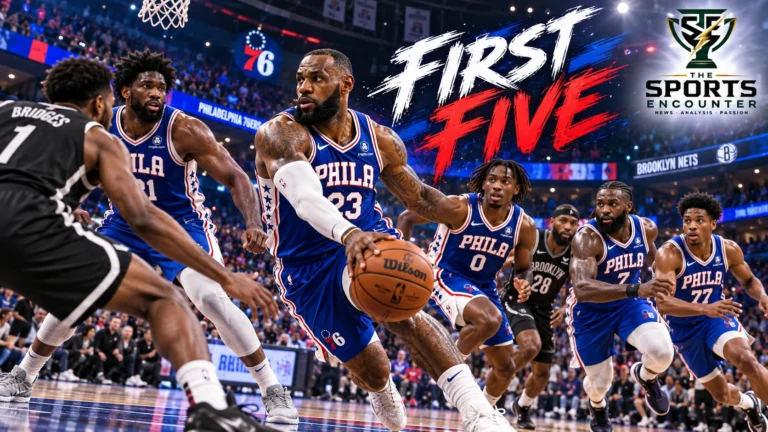
The Sports Encounter has already been following that transition closely. His decision to join the Philadelphia 76ers for a record-extending 24th NBA season created another championship pursuit, but it also reinforced how little playing time remains relative to the career already behind him.
The Firestone project offers a glimpse at what influence after basketball could look like.
Why Firestone Is the Perfect Venue
Firestone Country Club is not simply a recognizable golf course located conveniently near James’ hometown.
It is one of the most historically important tournament venues in American professional golf.
Professional events have been staged there since the 1950s. The South Course has hosted the World Series of Golf, the World Golf Championships-Bridgestone Invitational, PGA Tour Champions competition and three PGA Championships.
The PGA Tour’s history of Firestone Country Club details the venue’s extraordinary relationship with generations of elite players, from Jack Nicklaus and Gary Player to Tiger Woods.
That history makes the new event more interesting than starting from scratch at another course.
Akron is getting professional golf back at a venue whose identity has been built around it.
Tiger Woods Turned Firestone Into One of His Personal Kingdoms
No modern player is more closely associated with the South Course than Tiger Woods.
Woods won at Firestone eight times, including seven victories between 1999 and 2009 before adding another in 2013.
The PGA Tour records eight victories at Firestone as one of the highest totals any player has accumulated at a single course.
That history gives James’ involvement another fascinating sporting layer.
He is entering a golf environment where another transcendent American athlete once dominated in a way that resembles the territorial control James enjoyed on NBA courts for much of his career.
The comparison should not be pushed too far. James is not attempting to become a professional golfer.
What connects the two athletes is the scale of their influence.
Firestone became nationally recognizable to an entire generation partly because Woods kept winning there.
James now has enough cultural reach to introduce another audience to the same property.
What the PGA Tour’s Pathway to Progression Actually Does
The development component is central to understanding why the partnership matters.
The PGA Tour’s Pathway to Progression program is designed to expand opportunities for golfers from historically underrepresented communities through junior, collegiate and professional development.
Its professional pathway includes the Pro-Bound Five, providing selected players with access to the APGA Tour alongside development resources, competitive opportunities and assistance designed to reduce some of the barriers involved in pursuing professional golf.
The Firestone event will connect players coming through that system with young people from Akron.
That creates two distinct development tracks inside the same project.
Some participants are already trying to become professional golfers.
Others may be encountering the sport, its careers and its network for the first time.
That is much more meaningful than inviting students to watch professionals from behind a rope for two days.
I PROMISE Is the Part of the Story That Makes the Partnership Make Sense
James has spent years building education and community programs in Akron through the LeBron James Family Foundation.
The foundation’s official I PROMISE program says it serves more than 1,400 students and has grown from an initiative focused on at-risk children into a broader support system involving students and families.
The golf partnership fits that philosophy because exposure has always been part of the program’s logic.
A child cannot realistically imagine a career, network or opportunity that he or she has never encountered.
Golf remains particularly relevant to that problem.
The game has traditionally carried financial, geographic and cultural barriers that make access uneven. Equipment costs money. Courses require space. Coaching can be expensive. Professional networks often begin long before adulthood.
Bringing the pathway to Akron lowers at least the first barrier: awareness.
TSE Analysis: LeBron Is Building an Athlete Legacy That Does Not Need Basketball
The most interesting part of this announcement may be what it tells us about James himself.
For more than two decades, almost every major decision around him could be understood through basketball.
Which team gives him the best chance to win?
Who should play beside him?
How many championships can he reach?
How many records remain?
That framework is slowly becoming too small.
James’ move to Philadelphia still carries enormous sporting consequences. The Sports Encounter examined how his No. 23 arrival immediately changed expectations around the 76ers.
We also analyzed whether Philadelphia now possesses the NBA’s most intimidating starting five.
Those questions belong to the remaining basketball chapter.
Firestone belongs to what comes after it.
Akron Remains the Constant in Every Version of LeBron
James has played professionally in Cleveland, Miami, Los Angeles and now Philadelphia.
Akron has remained the geographic center of his personal identity throughout all of it.
That is why staging the Invitational there carries more meaning than placing it at a more commercially obvious golf destination.
The city is where James grew up.
It is where his foundation concentrated its education work.
It is where the I PROMISE School opened.
Now it becomes the location where his growing interest in another sport intersects with his existing community infrastructure.
For an athlete whose every career move has generated arguments about legacy, that continuity is striking.
Philadelphia Has LeBron the Player, Akron Still Has LeBron the Builder
James’ basketball attention is about to shift heavily toward Philadelphia.
His first 76ers season already carries an unusually demanding schedule.
The Sports Encounter’s report on LeBron’s Philadelphia debut and Christmas return to Los Angeles showed how quickly the NBA has turned his final chapter into national television theater.
The wider 2026-27 NBA schedule reinforces the same point.
James remains one of basketball’s most commercially powerful attractions even at 41.
His influence in Akron works differently.
There, the value is not measured by national broadcasts or ticket demand.
It is measured by whether programs remain after the celebrity leaves the building.
That distinction is important when evaluating athlete philanthropy.
LeBron’s Commercial Gravity Can Help Golf Reach a Different Audience
The PGA Tour also receives something valuable from this partnership.
James reaches people who may never intentionally search for a golf tournament.
That audience effect has already been visible around Philadelphia.
The Sports Encounter examined how LeBron’s arrival transformed the 76ers into one of the NBA’s biggest national television attractions before he had played a game for them.
Golf cannot assume that every member of that audience will become a regular fan.
It does not need to.
If a percentage become curious about Firestone, the APGA pathway or the players competing in Akron, the event has expanded its reach beyond a conventional developmental tournament.
James gives golf a doorway into a different sporting audience.
This Is Also a Diversity Story for Professional Golf
The connection to the APGA ecosystem deserves attention because representation remains a long-running issue within professional golf.
The APGA Tour was created to expand competitive opportunities for golfers from underrepresented backgrounds, with Black golfers an important part of that mission.
The PGA Tour’s development system now tries to connect those opportunities across multiple stages, beginning before a player reaches the professional level.
James’ involvement adds visibility, but visibility alone will not determine whether the initiative works.
The meaningful measurements will come later.
Do more players receive genuine competitive opportunities?
Do young people remain connected to the game?
Does mentorship become a pathway rather than a one-week experience?
Those outcomes will tell us much more than celebrity attendance.
Golf Could Become Part of LeBron’s Post-NBA Identity
James has not publicly mapped every part of his life after basketball, and speculation around his future remains constant.
Even questions about the 2028 Olympics continue to follow him. The Sports Encounter examined whether Team USA could still tempt LeBron into one final Olympic appearance despite his stated expectation that he will be watching rather than playing.
Golf offers a very different form of competitive involvement.
It does not require James to chase another professional athletic career.
He can participate as a player recreationally, a promoter, a mentor, a media personality, an investor or a philanthropic partner.
That flexibility makes the sport unusually compatible with retirement from the NBA.
His Golf Move Also Fits a Career Built Around Controlling the Next Chapter
James has rarely allowed the next phase of his career to arrive accidentally.
His moves between NBA franchises were deliberate, and even the uncertainty surrounding his final destination produced months of strategic speculation.
The Sports Encounter explored that process when we asked where LeBron would spend his 24th NBA season, before Philadelphia eventually became the answer.
Earlier, the possibility of joining Stephen Curry produced another fascinating late-career scenario, which we examined through Golden State’s reported interest in pairing LeBron with the Warriors’ veteran core.
The Firestone partnership is different because it does not depend on another franchise deciding what role he should occupy.
It is his foundation, his hometown and an initiative that can continue regardless of which basketball jersey he wears.
Why Bringing Professional Golf Back to Firestone Matters
There is also a local sporting story that should not get lost behind James’ name.
Firestone’s relationship with professional tournament golf has been unusually long.
The course was part of the professional calendar in different forms for roughly seven decades before its recent PGA Tour Champions event moved away.
Losing that presence meant more than losing a tournament.
Events bring volunteers, spectators, sponsorship, charitable activity and national attention into a local sporting ecosystem.
The new Invitational will operate on a different competitive scale from the WGC era, but it preserves the connection between Akron and professional golf.
That continuity matters.
The Best Version of This Event Will Eventually Outgrow LeBron’s Name
The inaugural edition will inevitably be discussed as LeBron James’ golf event.
That is useful in Year 1.
The stronger long-term outcome would be different.
If the Invitational succeeds, players should eventually become stories themselves.
A Pro-Bound Five golfer could use Firestone as part of a route toward a larger professional career.
An I PROMISE student might encounter golf through the program and later find a place in coaching, course management, sports business, broadcasting or another part of the industry.
Those stories would demonstrate that the event has become more than an extension of James’ celebrity.
They would prove the structure worked.
TSE Verdict: The Venue Makes This Partnership Smarter Than It First Appears
A basketball legend becoming interested in golf is not inherently important.
LeBron James could play famous courses, launch golf videos and participate in celebrity events for years without changing much about the sport.
Firestone gives this project another dimension.
The venue connects elite golf history to Akron.
The foundation connects Akron’s young people to resources.
The PGA Tour pathway connects emerging golfers to professional opportunities.
James connects all three groups through an audience few athletes in the world can match.
That is why the LeBron James Family Foundation Invitational has more potential than its celebrity headline suggests.
The NBA has spent more than two decades watching James build one of basketball’s greatest careers.
Akron may now be watching him build something designed to last after the final season ends.
Frequently Asked Questions
What is the LeBron James Family Foundation Invitational?
It is a new two-day golf event created through a partnership between the LeBron James Family Foundation and the PGA Tour. It will combine competition, player development, mentorship and youth engagement.
When is the LeBron James golf event at Firestone?
The inaugural LeBron James Family Foundation Invitational is scheduled for July 6-7, 2027.
Where will the LeBron James Family Foundation Invitational be played?
The event will take place on the South Course at Firestone Country Club in Akron, Ohio.
Will LeBron James play in the tournament?
The announced purpose of the event centers on player development, competition, mentorship and community programs. It should not be treated as a LeBron James professional golf appearance unless organizers later confirm that he will compete.
What is the PGA Tour Pro-Bound Five?
The Pro-Bound Five is part of the PGA Tour’s Pathway to Progression development system. Selected golfers receive opportunities including access to the APGA Tour and additional player-development support.
What is LeBron James’ I PROMISE program?
The LeBron James Family Foundation’s I PROMISE program supports students and families in Akron through education, mentorship and community resources. The foundation says the program serves more than 1,400 students.
Why is Firestone Country Club famous?
Firestone has hosted major professional golf for decades, including three PGA Championships, the World Series of Golf and the WGC-Bridgestone Invitational.
How many times did Tiger Woods win at Firestone?
Tiger Woods won eight times at Firestone Country Club, making the South Course one of the most successful venues of his career.
Which NBA team does LeBron James play for in 2026-27?
James joined the Philadelphia 76ers for the 2026-27 NBA season, his record-extending 24th season in the league.

A Celebration of 5000 ODIs
A Celebration of 5000 ODIs Match 11: 22 From One Ball Ends South Africa’s World Cup Dream
South Africa were closing on their first World Cup final when 12 minutes of Sydney rain turned a demanding chase into cricket’s most infamous impossible equation.
South Africa needed 22 runs from 13 balls. Brian McMillan and Dave Richardson were still there. A place in the World Cup final remained difficult, but entirely possible.
Then Sydney’s rain arrived.
Twelve minutes later, the equation that had taken almost seven hours of cricket to create had become impossible. The giant SCG scoreboard flashed the numbers that would follow South African cricket for decades: 22 runs required from one ball.
There is an important detail behind that famous image. Archived match records show the scoreboard was actually wrong. Under the calculation eventually applied, South Africa’s true requirement was 21 from the final delivery. It hardly mattered. No legal delivery could produce either number. The semifinal had effectively ended in a calculation rather than a cricketing contest.
That extraordinary finish is why England’s 19-run victory on March 22, 1992, is Match 11 in The Sports Encounter’s A Celebration of 5000 ODIs series. The match gave us Graeme Hick’s finest World Cup innings, Jonty Rhodes attacking under knockout pressure, a genuinely competitive chase and, finally, a rain rule so inadequate that cricket was forced to rethink how interrupted matches should be decided.
TL;DR
- England scored 252/6 from 45 overs, led by Graeme Hick’s 83 from 90 balls.
- South Africa reached 231/6 after 42.5 overs and required 22 from the final 13 balls when rain interrupted play.
- The Most Productive Overs method reduced the chase to an impossible final-ball equation.
- Jonty Rhodes made an attacking 43 from 38 balls, while Andrew Hudson top-scored with 46.
- Richard Illingworth and Gladstone Small took two wickets each for England.
- Graeme Hick was Player of the Match as England advanced to the final against Pakistan.
England vs South Africa 1992 World Cup Semifinal: Match Information
| Detail | Information |
|---|---|
| Match | England vs South Africa, 2nd Semifinal |
| Tournament | 1992 Cricket World Cup |
| Date | March 22, 1992 |
| Venue | Sydney Cricket Ground, Sydney |
| Toss | South Africa won the toss and fielded |
| England | 252/6 in 45 overs |
| South Africa | 232/6 in 43 overs |
| Result | England won by 19 runs under the revised target |
| Player of the Match | Graeme Hick, 83 from 90 balls |
| Top South Africa Batter | Andrew Hudson, 46 from 52 balls |
| Turning Point | Rain with South Africa needing 22 from 13 balls |
| Tournament Impact | England reached the World Cup final |
| Historical Impact | The finish exposed serious flaws in cricket’s rain-adjustment system |
Why Match 11 Belongs in A Celebration of 5000 ODIs
A famous controversy alone would not be enough.
This semifinal deserves its place because a very good cricket match was unfolding before the mathematics swallowed it.
South Africa were playing their first World Cup after returning to international cricket following more than two decades of isolation. They had already reached the semifinals at their first attempt. England, meanwhile, were trying to reach their third World Cup final.
The chase remained alive almost to its natural conclusion.
That combination of historical context, individual performance, knockout pressure and an unprecedented finish satisfies exactly what our 100-match ODI collection was built to preserve. The series has already revisited extraordinary World Cup moments such as Kapil Dev rescuing India from 17 for five against Zimbabwe and India defending 183 against West Indies in the 1983 final.
This one belongs for another reason: cricket eventually learned from it.
Graeme Hick Builds England’s Innings Under Pressure
England lost Graham Gooch for two and Ian Botham for 21, leaving the innings at 39 for two.
Graeme Hick supplied the stability they needed.
His 83 from 90 balls contained nine fours and came at a strike rate above 92, excellent tempo for an ODI semifinal in 1992. He added 71 with Alec Stewart, then helped push England toward a total capable of surviving South Africa’s deep batting order.
Hick’s dismissal at 187 for five could have stalled the innings.
Instead, England found another gear.
Dermot Reeve Turns 220 Into 252
Dermot Reeve’s contribution lasted only 14 balls.
It changed the value of England’s total.
Reeve struck an unbeaten 25 with four boundaries, while Chris Lewis added 18 not out from 16 deliveries. Their late acceleration carried England to 252 for six after the innings had been restricted to 45 overs because South Africa failed to complete their scheduled overs within the allotted time.
Those final runs became even more significant once the chase tightened.
Andrew Hudson Keeps South Africa Moving
South Africa lost captain Kepler Wessels for 17, but Andrew Hudson refused to allow England complete control.
Hudson made 46 from 52 deliveries with six fours and kept the required rate manageable despite regular wickets around him. Peter Kirsten fell for 11 before Hudson departed at 90 for three.
Adrian Kuiper then made 36, but England kept removing batters before partnerships could become decisive.
Richard Illingworth was particularly important, dismissing Hudson and Kuiper while conceding 46 from his 10 overs.
Jonty Rhodes Attacks the Semifinal
Jonty Rhodes produced South Africa’s most aggressive innings.
His 43 from 38 balls pushed the chase forward when the required rate was becoming uncomfortable. England knew one substantial partnership could take the match away from them, and Rhodes was beginning to build exactly that threat.
Gladstone Small eventually removed him with the score on 206.
Yet South Africa were not finished.
McMillan and Richardson took the total to 231 for six. Thirteen legitimate deliveries remained.
They needed 22.
Then the weather intervened.
The 12 Minutes That Changed Cricket’s Rain Rules
The 1992 World Cup used the Most Productive Overs method for rain-affected matches. When overs disappeared from the chasing team’s innings, the target was adjusted by removing the least productive overs from the first innings.
That logic became absurd when rain arrived near the end of this chase.
South Africa had only 13 balls left. Losing two overs therefore removed almost all their remaining opportunities, while England’s target reduction amounted to only one run.
The television and SCG scoreboard famously changed from 22 required from 13 balls, to 22 from seven, and finally 22 from one. Archived ESPN records note that the mathematically correct requirement was actually 21 from one.
McMillan pushed Chris Lewis’ final delivery for a single.
Nobody celebrated the cricket.
England had earned their position and had arguably been the better side over the match, but even they had reached the final through an ending nobody could reasonably defend as a competitive solution. The incident became one of the strongest arguments for developing a more sophisticated method for rain-adjusted targets, eventually leading ODI cricket toward the Duckworth-Lewis system.
Man of the Match: Graeme Hick
Hick’s 83 remains the central performance of the semifinal.
England’s innings repeatedly threatened to lose momentum, and none of their other top-six batters reached 35. Without Hick, there would probably have been no 252 to defend and perhaps no controversy for history to remember.
He therefore deserved the Player of the Match award.
His innings tends to disappear behind the famous scoreboard image, which is unfortunate. The rain rule explains why the match became infamous. Hick explains why England had something worth defending in the first place.
Complete Match Scorecard
England Innings: 252/6 in 45 Overs
| Batter | Dismissal | Runs | Balls | 4s | 6s |
|---|---|---|---|---|---|
| Graham Gooch | c Richardson b Donald | 2 | 8 | 0 | 0 |
| Ian Botham | b Pringle | 21 | 23 | 3 | 0 |
| Alec Stewart | c Richardson b McMillan | 33 | 54 | 4 | 0 |
| Graeme Hick | c Rhodes b Snell | 83 | 90 | 9 | 0 |
| Neil Fairbrother | b Pringle | 28 | 50 | 1 | 0 |
| Allan Lamb | c Richardson b Donald | 19 | 22 | 1 | 0 |
| Chris Lewis | not out | 18 | 16 | 2 | 0 |
| Dermot Reeve | not out | 25 | 14 | 4 | 0 |
| Extras | b 1, lb 7, w 9, nb 6 | 23 | |||
| Total | 6 wickets, 45 overs | 252 |
Did not bat: Phil DeFreitas, Gladstone Small, Richard Illingworth.
Fall of wickets: 20-1, 39-2, 110-3, 183-4, 187-5, 221-6.
South Africa Bowling
| Bowler | Overs | Maidens | Runs | Wickets |
|---|---|---|---|---|
| Allan Donald | 10 | 0 | 69 | 2 |
| Meyrick Pringle | 9 | 2 | 36 | 2 |
| Richard Snell | 8 | 0 | 52 | 1 |
| Brian McMillan | 9 | 0 | 47 | 1 |
| Adrian Kuiper | 5 | 0 | 26 | 0 |
| Hansie Cronje | 4 | 0 | 14 | 0 |
South Africa Innings: 232/6 in 43 Overs
| Batter | Dismissal | Runs | Balls | 4s | 6s |
|---|---|---|---|---|---|
| Kepler Wessels | c Lewis b Botham | 17 | 21 | 1 | 0 |
| Andrew Hudson | lbw b Illingworth | 46 | 52 | 6 | 0 |
| Peter Kirsten | b DeFreitas | 11 | 26 | 0 | 0 |
| Adrian Kuiper | b Illingworth | 36 | 44 | 5 | 0 |
| Hansie Cronje | c Hick b Small | 24 | 46 | 1 | 0 |
| Jonty Rhodes | c Lewis b Small | 43 | 38 | 3 | 0 |
| Brian McMillan | not out | 21 | 21 | 0 | 0 |
| Dave Richardson | not out | 13 | 10 | 1 | 0 |
| Extras | lb 17, w 4 | 21 | |||
| Total | 6 wickets, 43 overs | 232 |
Did not bat: Richard Snell, Meyrick Pringle, Allan Donald.
Fall of wickets: 26-1, 61-2, 90-3, 131-4, 176-5, 206-6.
England Bowling
| Bowler | Overs | Maidens | Runs | Wickets |
|---|---|---|---|---|
| Ian Botham | 10 | 0 | 52 | 1 |
| Chris Lewis | 5 | 0 | 38 | 0 |
| Phil DeFreitas | 8 | 1 | 28 | 1 |
| Richard Illingworth | 10 | 1 | 46 | 2 |
| Gladstone Small | 10 | 1 | 51 | 2 |
England Were Better, but South Africa Deserved a Cricketing Finish
It is tempting to retell this semifinal entirely as an injustice.
That loses some of its complexity.
England had made 252 despite being limited to 45 overs. Hick had played the game’s strongest innings. Their bowlers had taken six wickets and repeatedly prevented South Africa from putting together the partnership that could have settled the chase earlier.
South Africa also contributed to their own difficulty by taking too long to bowl England’s innings, which led to the reduction from 50 overs to 45.
Yet none of that makes the final equation sensible.
A World Cup semifinal with 22 required from 13 balls deserved to be decided by players attempting those 13 balls.
That is ultimately why Match 11 survives.
Readers can revisit other matches where a single moment changed a World Cup through our reports on Australia’s seven-run 1987 final victory over England and Gary Gilmour’s extraordinary 1975 semifinal against England, while ongoing match reports and analysis are available through The Sports Encounter Cricket Hub.
Final Takeaway: The Match Cricket Had to Learn From
England advanced to face Pakistan and South Africa went home from their first World Cup carrying an image that would become part of cricket folklore.
The semifinal’s real legacy, however, reaches further than heartbreak.
Hick played a superb innings. Rhodes attacked the chase. England’s bowlers kept the game under pressure. South Africa remained alive with 13 balls remaining.
Then the rules failed the match.
Thirty-four years later, people still remember 22 from one without needing the teams, venue or date explained to them. Few scoreboards in ODI history have said so little while revealing so much about why cricket sometimes has to change.https://chatgpt.com/backend-api/sentinel/frame.html?sv=20260810913b
Breaking News
Bunny Shaw Wins PFA Players’ Player of the Year After Historic Manchester City Season
Khadija “Bunny” Shaw has been named the 2025/26 PFA Women’s Players’ Player of the Year after another dominant Manchester City season featuring 21 WSL goals, 27 in all competitions and a record third consecutive Golden Boot.
Khadija “Bunny” Shaw has been named the 2025/26 PFA Women’s Players’ Player of the Year after a season in which the Manchester City striker combined record-breaking scoring with the kind of consistency that made her the outstanding individual force in the Women’s Super League.
The Jamaican forward scored 21 goals in 22 WSL appearances, claimed the Golden Boot for a record third consecutive season and finished the campaign with 27 goals across all competitions.
Her fellow professionals have now given her the clearest endorsement available to an elite footballer.
Shaw has won the PFA Players’ Player of the Year award for the second time in her career, having previously taken the honor in 2023/24. The latest award arrives after a season in which she also helped Manchester City win the WSL title and FA Cup.
Manchester City confirmed the award on August 25, describing Shaw as a central figure in the club’s successful 2025/26 campaign.
Bunny Shaw 2025/26 Season at a Glance
| Player | Khadija “Bunny” Shaw |
|---|---|
| Club | Manchester City |
| Nationality | Jamaica |
| PFA Award | 2025/26 Women’s Players’ Player of the Year |
| Previous PFA win | 2023/24 |
| WSL goals | 21 in 22 matches |
| All-competition goals | 27 |
| WSL Golden Boot | Third consecutive season |
| Manchester City contract | Runs until 2030 |
Why Bunny Shaw Won the PFA Players’ Player of the Year
The number that immediately stands out is 21.
Shaw scored 21 goals in only 22 league appearances, matching the best WSL scoring return of her career and finishing as the competition’s leading scorer.
Yet reducing her season to one total misses what made it so difficult for opponents to contain her.
Manchester City’s official data showed that Shaw also contributed four WSL assists and reached 100 goal involvements in the competition during the campaign.
She scored against 10 of City’s 11 league opponents, including Arsenal, Chelsea and Manchester United, while continuing to produce goals late in matches when defensive concentration was already being stretched.
The award therefore reflects more than finishing ability.
Shaw became the focal point of a title-winning attack, handled the physical attention that follows an elite center forward and continued producing even when opponents knew exactly where City’s greatest scoring threat would come from.
A Record Third Straight WSL Golden Boot
The PFA award arrived after Shaw had already made WSL history.
Her 21 league goals secured a third successive Golden Boot, making her the first player to win the award in three consecutive WSL seasons.
She had scored 21 league goals in 2023/24 before sharing the 2024/25 Golden Boot with Alessia Russo after both finished on 12.
Another 21-goal campaign followed in 2025/26.
Manchester City also confirmed that Shaw became the first player in WSL history to reach 20 league goals in three separate seasons.
That distinction matters because goalscoring peaks are common in football. Sustained scoring at the same level is much harder.
Shaw has now produced elite output across multiple seasons while opponents have had years to study her movement, strength, finishing patterns and preferred areas.
The Peer Vote Gives This Award Extra Weight
The PFA Players’ Player of the Year carries a particular kind of credibility because the winner is chosen by professional footballers.
These are the defenders trying to stop Shaw, the midfielders tracking her movement and the players competing against Manchester City throughout the season.
The 2026 shortlist also reflected the depth of individual quality in the WSL.
Shaw was nominated alongside Manchester City teammate Yui Hasegawa, Arsenal forward Alessia Russo, Aston Villa’s Kirsty Hanson, Chelsea’s Lauren James and Manchester United’s Jess Park.
The Professional Footballers’ Association confirmed the six-player shortlist before the winners were announced at the annual PFA Awards ceremony in Manchester.
Being selected from that group by fellow professionals strengthens the case that Shaw’s season was not simply statistically impressive. It was respected across the league.
Shaw’s 27 Goals Were Part of a Complete Attacking Season
Across all competitions, Shaw finished with 27 goals in 32 appearances.
Manchester City also credited her with eight assists across the campaign.
That output challenges the idea that Shaw operates only as a penalty-box finisher.
Her physical presence allows City to play directly when necessary. She can hold defenders off, create space for runners, attack crosses and turn imperfect deliveries into dangerous situations.
Her movement inside the penalty area remains the foundation of her game, but the broader production shows a forward increasingly capable of influencing attacks before the final touch.
That distinction becomes more important as elite women’s football continues becoming tactically deeper and physically faster.
Manchester City’s Success Changed the Meaning of Shaw’s Season
Individual awards tend to carry more weight when they accompany team success.
Shaw’s goals helped Manchester City win the WSL and FA Cup during a season that strengthened the club’s position at the top of English women’s football.
She was central to that success rather than an isolated scorer producing numbers for a team falling short of trophies.
The relationship between individual excellence and collective progress has become one of the major themes across women’s football.
A similar pattern appeared at the international level during the 2026 Women’s Africa Cup of Nations, where Cameroon completed a remarkable run to their first WAFCON title after entering the tournament through an expanded field.
Malawi produced another example of how individual attacking quality can reshape an entire team’s ceiling. Temwa Chawinga won the WAFCON Golden Boot as the Scorchers reached the final and qualified for their first Women’s World Cup.
The Sports Encounter documented Malawi’s breakthrough qualification after their quarterfinal victory over Ghana.
Shaw’s Manchester City season belongs in that broader conversation about the growing influence of elite forwards on the direction of women’s football.
She Has Now Passed 100 Goals for Manchester City
Another major milestone arrived during the season.
Shaw became the first player in Manchester City’s professional era to reach 100 goals for the club when she scored against Aston Villa in December 2025.
By the end of the league campaign, Manchester City listed her with 117 goals in 137 appearances for the club.
Those numbers provide useful context for the PFA award.
The 2025/26 season was not a sudden breakout from a forward discovering elite-level production for the first time. It was another dominant chapter in a scoring record that has been building since she joined City in 2021.
She had already become Manchester City Women’s record goalscorer in March 2024.
The gap between a prolific striker and a defining club player is usually measured over years rather than months. Shaw has now entered the second category.

Her New Manchester City Contract Matters
City have also secured Shaw’s future.
The forward signed a new four-year contract earlier this year, extending her stay at Manchester City until 2030.
That decision gives the club continuity around one of the most productive strikers in world football at a time when women’s football is becoming increasingly competitive in the transfer market.
Manchester City have made significant changes elsewhere across their football operation, including the transition surrounding the men’s team ahead of the new Premier League season.
The Sports Encounter’s 2026/27 Premier League preview examined how City are managing a very different transition on the men’s side following Pep Guardiola’s departure.
The women’s team have a clearer attacking reference point.
Shaw is signed through the end of the decade and remains firmly within the prime years of her career.
Bunny Shaw’s Success Carries Major Importance for Jamaica
The award also travels well beyond Manchester.
Shaw is already the most recognizable figure in Jamaican women’s football and one of the Caribbean’s most successful active players.
Her rise from Spanish Town to becoming the leading scorer for one of England’s biggest clubs has given Jamaica a global football figure whose influence extends beyond international tournament appearances.
That visibility matters as women’s football continues expanding into countries and regions that historically received less global coverage.
Africa has experienced a similar shift in recent months.
Algeria qualified for their first Women’s World Cup while Morocco secured another appearance, part of a changing international landscape ahead of Brazil 2027.
Malawi then pushed that story even further by reaching their first WAFCON final, a journey The Sports Encounter followed through their semifinal breakthrough.
Shaw operates in a different competition and on a different continent, but her career reflects the same broad trend. Elite women’s football is drawing defining players from a much wider global map.
The Numbers Explain Only Part of Her Dominance
There is a temptation with prolific forwards to treat every season as a mathematical exercise.
Goals per appearance. Conversion rates. Golden Boots. Records.
Those numbers matter, but Shaw’s value also lies in the tactical problems she creates.
Center backs cannot comfortably defend high against her because she can attack space. Dropping deeper creates another problem because she is strong enough to receive possession with a defender behind her.
Crosses become more dangerous because of her aerial presence. Loose balls inside the penalty area become emergencies because she reacts quickly enough to turn them into shots.
Opponents therefore need more than one solution.
That ability to alter how another team defends is one of the clearest signs of an elite forward.
Women’s Football Is Building More Global Superstars
Shaw’s award arrives during a period of rapid expansion for the women’s game.
Domestic leagues are growing commercially, international tournaments are attracting larger audiences and more players are becoming recognizable outside their home markets.
The next FIFA Women’s World Cup in Brazil will offer another significant stage for that development.
Africa’s qualification picture has already produced major changes, including first-time qualifiers Algeria and Malawi.
Malawi’s historic qualification showed how quickly a national team can alter its global standing when a generation of players begins producing at a higher level.
Elsewhere in women’s sport, questions about representation have become increasingly important too.
The Sports Encounter recently examined new broadcast guidelines designed to change how female athletes are filmed at the 2026 European Athletics Championships.
Those debates sit alongside the sporting achievements themselves. More visibility creates more scrutiny, more commercial opportunity and greater expectations around how female athletes are presented.
Shaw’s season gives that visibility a powerful sporting foundation.
What Comes Next for Bunny Shaw?
The difficult part now is repeating a season that already looks difficult to improve.
Twenty-one league goals produced another Golden Boot. Twenty-seven across all competitions helped Manchester City win major trophies. Her peers voted her the best player in the league.
She has also committed her future to City until 2030.
The next targets therefore become increasingly ambitious.
More league titles. European success. More scoring records. Further progress with Jamaica.
The strongest players eventually reach a point where they are competing as much with their own previous standards as with the players around them.
Shaw appears to have reached that stage.
TSE Verdict
Khadija Shaw’s second PFA Players’ Player of the Year award feels like a logical conclusion to a season in which almost every important indicator pointed in the same direction.
She scored 21 league goals in 22 matches, won a third consecutive WSL Golden Boot, reached 100 WSL goal involvements, passed 100 goals for Manchester City and finished the campaign with 27 goals across all competitions.
The trophies gave those numbers greater meaning.
The peer vote gave them authority.
Manchester City have now secured her through 2030, which means this story may still be closer to the middle of Shaw’s English career than the end.
For now, the 2025/26 season belongs firmly on the list of the strongest individual campaigns the WSL has produced.
And the players who had to face her clearly agree.
Frequently Asked Questions
Who won the 2025/26 PFA Women’s Players’ Player of the Year?
Manchester City striker Khadija “Bunny” Shaw won the 2025/26 PFA Women’s Players’ Player of the Year award.
How many times has Bunny Shaw won the PFA Players’ Player of the Year?
Shaw has now won the award twice. She previously received the honor for the 2023/24 season.
How many goals did Bunny Shaw score in the 2025/26 WSL season?
Shaw scored 21 goals in 22 Women’s Super League appearances.
Did Bunny Shaw win the WSL Golden Boot?
Yes. She won the 2025/26 WSL Golden Boot and became the first player to claim the award in three consecutive seasons.
How many goals did Bunny Shaw score in all competitions?
Shaw scored 27 goals in 32 appearances across all competitions during the 2025/26 campaign.
How many goals has Bunny Shaw scored for Manchester City?
Manchester City reported that Shaw had reached 117 goals in 137 appearances for the club by the end of the 2025/26 league campaign.
How long is Bunny Shaw’s Manchester City contract?
Shaw signed a new four-year contract that keeps her at Manchester City until 2030.
Who else was nominated for the PFA Women’s Players’ Player of the Year?
The shortlist included Yui Hasegawa, Alessia Russo, Kirsty Hanson, Lauren James and Jess Park alongside Shaw.
Where can I verify Bunny Shaw’s PFA award?
Manchester City officially confirmed Shaw’s award on its club website, while the PFA published the official 2026 awards shortlist ahead of the ceremony.
The Sports Encounter’s football coverage follows major domestic leagues, international tournaments, player milestones and the stories shaping the global game.
Breaking News
Vietnam Hold the Lead, but Thailand Still Have 90 Minutes to Change the ASEAN Final
Vietnam carry a 2-0 lead into the ASEAN Championship final second leg, but Thailand still have attacking weapons capable of turning Hanoi into a far more nervous night.
Thailand arrive in Hanoi with a problem that can be expressed very simply: they need goals, and they need them without giving Vietnam the spaces that made the first leg so damaging.
Vietnam’s 2-0 victory at Rajamangala Stadium has placed the defending champions within touching distance of another ASEAN Championship title. Nguyễn Hai Long and Nguyễn Quang Hải scored seven minutes apart during the second half in Bangkok, turning a competitive final into a difficult rescue mission for Thailand.
Yet the first leg also offered Anthony Hudson’s team enough evidence to believe the final remains alive. Thailand created dangerous first-half situations, forced Patrik Lê Giang into important saves and carried enough attacking threat to make Vietnam uncomfortable before Kim Sang-sik’s substitutions changed the match.
The second leg at Mỹ Đình National Stadium on August 26 will therefore revolve around one question: can Thailand score early enough to change the psychology of the final before Vietnam’s counterattacking threat changes it again?
Fans following the wider regional game can find more coverage in The Sports Encounter’s soccer news and analysis section and its continuing coverage of the ASEAN Championship knockout stages.
TL;DR
- Vietnam lead the ASEAN Championship 2026 final 2-0 after winning the first leg in Bangkok.
- Nguyễn Hai Long and Nguyễn Quang Hải scored in the 62nd and 69th minutes.
- Thailand must attack, but conceding first in Hanoi could effectively end their comeback hopes.
- Nguyễn Đình Bắc and Nguyễn Xuân Son remain Vietnam’s major attacking threats, with five tournament goals each entering the final.
- Teerasak Poeiphimai, Kakana Khamyok and Yotsakon Burapha give Thailand enough attacking quality to create problems.
- Vietnam have the stronger tactical position because they can defend compactly and attack the spaces Thailand must eventually leave behind.
Vietnam vs Thailand Final Second-Leg Information
| Detail | Information |
|---|---|
| Match | Vietnam vs Thailand |
| Competition | ASEAN Hyundai Cup 2026 Final, Second Leg |
| Date | August 26, 2026 |
| Venue | Mỹ Đình National Stadium, Hanoi |
| First Leg | Thailand 0-2 Vietnam |
| Aggregate | Vietnam lead 2-0 |
| First-Leg Scorers | Nguyễn Hai Long 62′, Nguyễn Quang Hải 69′ |
| Vietnam Coach | Kim Sang-sik |
| Thailand Coach | Anthony Hudson |
| Main Question | Can Thailand score early enough to make the comeback believable? |
| What Is at Stake | Vietnam’s fourth ASEAN title and first successful title defense, or Thailand’s record-extending eighth championship |
Thailand’s Comeback Starts With the First Goal
Thailand cannot afford to treat the second leg as a 90-minute attacking exercise from kickoff.
Hudson’s biggest challenge is timing.
If Thailand throw numbers forward too aggressively during the opening 15 minutes, they risk giving Nguyễn Đình Bắc, Nguyễn Xuân Son and Vietnam’s supporting runners exactly the transition spaces they want. If the visitors remain too cautious, the clock becomes Vietnam’s most useful defender.
Thailand therefore need sustained pressure rather than desperation.
Teerasak Poeiphimai is central to that plan. He entered the final as Thailand’s leading tournament scorer with four goals and produced two of them in the 3-1 semifinal first-leg victory over Singapore. Kakana Khamyok has added three goals, while Yotsakon Burapha troubled Vietnam during the opening half in Bangkok.
Thailand’s path probably requires one of those players to score before halftime.
A 1-0 lead in Hanoi would suddenly turn every tackle, set piece and Vietnamese clearance into a moment carrying much greater pressure.
Hudson has already made Thailand’s intention clear, saying before the return leg that his team’s only objective is victory and that his players will have to fight for it.
The War Elephants have already experienced the opposite side of this equation. They carried a 3-1 semifinal advantage home against Singapore, lost the second leg 2-1 and still advanced 4-3 on aggregate. The Sports Encounter’s analysis of Thailand’s tense semifinal escape showed how quickly a comfortable aggregate position can become uncomfortable.
Now Thailand must create that discomfort themselves.
Vietnam Have the Luxury Thailand Do Not
Vietnam can choose their moments.
That may be the biggest advantage of all.
Kim Sang-sik’s team have scored more goals than any other side in the tournament while also producing its strongest defensive record. Before the final, Vietnam had scored 17 times and conceded only once through six matches, recording five clean sheets.
Their semifinal against Malaysia offered an important rehearsal for this exact situation.
Vietnam won the first leg 2-0 in Kuala Lumpur, returned to Hanoi with no need to chase the match and still won the second leg 2-0 through two Nguyễn Xuân Son goals. They managed the aggregate advantage while continuing to create attacking opportunities rather than retreating permanently into their own penalty area.
The Sports Encounter examined that first-leg platform after Vietnam left Malaysia facing a two-goal semifinal deficit.
Thailand now face the same problem, against a team that has already shown it knows how to protect this exact margin.
Players to Watch for Vietnam
Nguyễn Đình Bắc
Five goals before the final made Đình Bắc one of the tournament’s joint leading scorers. His influence extends beyond finishing. His backheel created Hai Long’s opener in Bangkok, and his movement can punish Thailand whenever their defensive line becomes stretched.
He announced himself immediately during Vietnam’s 7-0 opening win over Timor-Leste, scoring a hat trick and establishing himself as one of the competition’s decisive attackers.
Nguyễn Xuân Son
Xuân Son also entered the final with five goals. His physical presence gives Vietnam another way to escape pressure because he can receive direct passes, contest aerial balls and occupy central defenders while teammates break forward.
Nguyễn Quang Hải
The captain may become even more influential if Thailand control possession. His technique, decision-making and ability to arrive around the penalty area produced Vietnam’s second goal in Bangkok. Another such moment could end the contest.
Patrik Lê Giang
Comeback attempts often depend on converting the first major chance. Vietnam’s goalkeeper prevented Thailand from doing that in Bangkok. Another strong opening half from Lê Giang could drain belief from the visitors very quickly.
Players to Watch for Thailand
Teerasak Poeiphimai
Thailand need a finisher and Teerasak has been their most productive one. His four goals and intelligent movement make him the obvious player Vietnam’s central defenders must track.
The Sports Encounter saw his knockout influence clearly when he scored twice against Singapore in the semifinal first leg.
Kakana Khamyok
Kakana can change matches through movement between midfield and attack. His ability to carry the ball forward may become especially valuable if Vietnam sit deeper than they did in Bangkok.
Yotsakon Burapha
Yotsakon’s first-leg involvement deserves attention despite the absence of a goal. He helped Thailand create some of their best moments before halftime and could become important if Hudson wants quicker combinations around Vietnam’s penalty area.
Sarach Yooyen
Thailand’s captain must manage the emotional side of the comeback. His passing tempo and decision-making will determine whether the visitors attack with structure or simply push bodies forward.
Who Really Has the Advantage?
Vietnam, clearly.
The two-goal lead matters, but the tactical conditions matter just as much.
Thailand have to alter the game. Vietnam can react to it.
Every additional Thai attacker creates another possible passing lane behind Thailand’s midfield. Every minute without a Thai goal makes the comeback harder. Every Vietnamese counterattack forces Hudson’s defenders to decide whether to protect themselves or keep supporting the attack.
A Thailand goal during the opening half would change the atmosphere dramatically. Two Thai goals would erase the aggregate deficit and could force extra time under the competition’s knockout format, while a three-goal victory would complete the comeback without requiring an additional period. The away-goals rule does not apply.
Vietnam’s best strategy therefore involves neither sitting completely inside their own box nor chasing another early goal.
They need control.
TSE Verdict: Thailand Can Make It Nervous, Vietnam Should Finish the Job
There is a credible route back for Thailand because they possess enough attacking talent to score at Mỹ Đình. Their first-leg performance was also better than a 2-0 defeat might suggest during stretches of the game.
The deeper problem is what happens after the first Thai goal.
They would still need another, and that requirement would continue pulling players forward against one of the tournament’s most efficient attacking teams.
Vietnam have already survived this tournament without losing, carried a two-goal semifinal advantage through another second leg in Hanoi and beaten Thailand on their own ground.
Thailand can make the final uncomfortable.
Vietnam remain much better positioned to decide how uncomfortable it becomes.
TSE Prediction: Vietnam 1-1 Thailand. Vietnam win 3-1 on aggregate and retain the ASEAN Championship.
-
Cricket4 weeks agoIs The Hundred Losing Its Oomph Among English Cricket Fans?
-
Editor's Choice3 weeks agoPremier League 2026–27 Curtain Raiser: Fixtures, Teams, Title Contenders, Transfers and Season Predictions
-
Editor's Choice4 weeks agoUS Open 2026 Curtain-Raiser: Players, Schedule, Title Contenders, New York Storylines and Everything Fans Need to Know