Connect with us

Published

on

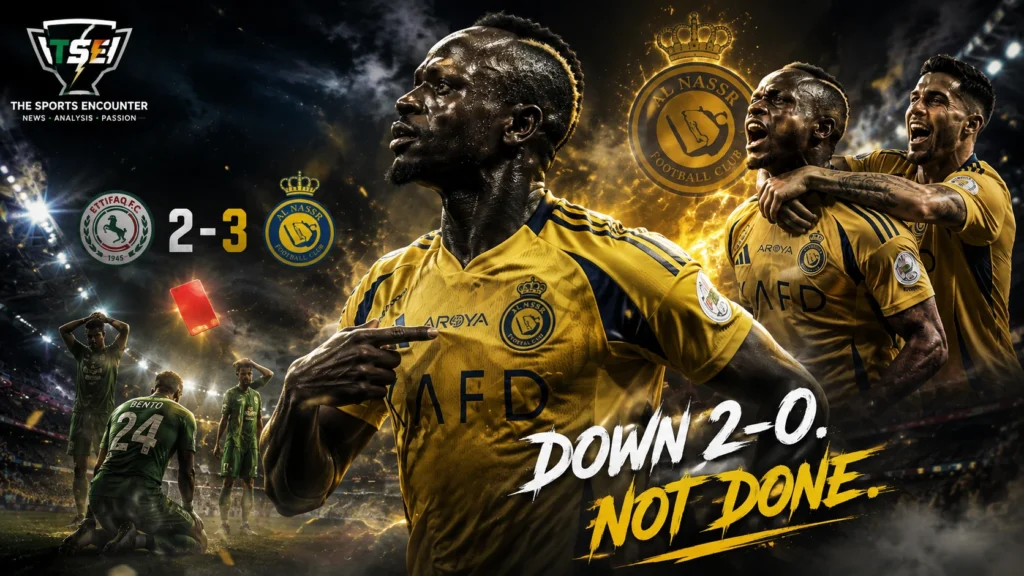
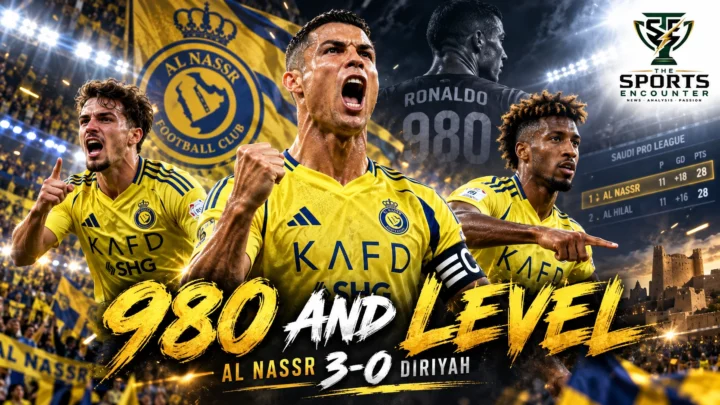
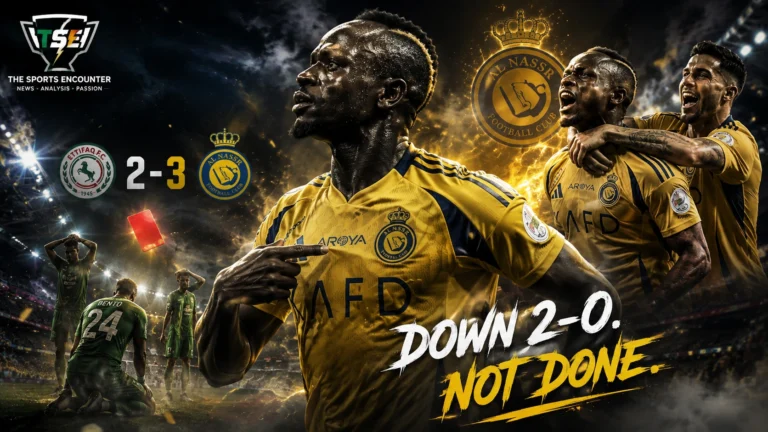
Al Ettifaq 2-3 Al Nassr: Sadio Mané scored twice, including a dramatic 90th-minute winner, as 10-man Al Nassr recovered from a 2-0 halftime deficit to beat Al Ettifaq in one of the first extraordinary matches of the 2026-27 Saudi Pro League season.

Al Nassr goalkeeper Bento was sent off after only 12 minutes at EGO Stadium, leaving Ange Postecoglou’s defending champions facing almost an entire match with 10 players. Ondrej Duda and Álvaro Medrán punished them before halftime to put Al Ettifaq firmly in control.

What followed completely changed the story.

Cristiano Ronaldo was withdrawn at the start of the second half as Al Nassr reorganized, Mané pulled one back in the 74th minute, Abdulelah Al-Amri equalized three minutes later, and Mané completed an improbable comeback in the 90th minute.

The 3-2 victory keeps Al Nassr’s perfect start to their Saudi Pro League title defense intact after three matches and gives Postecoglou an early result that may tell him considerably more about his team than either of their comfortable opening victories.

Al Ettifaq vs Al Nassr: Match Facts

Competition 2026-27 Saudi Pro League
Round Matchweek 3
Result Al Ettifaq 2-3 Al Nassr
Venue EGO Stadium, Dammam
Al Ettifaq scorers Ondrej Duda 31′, Álvaro Medrán 45+4′
Al Nassr scorers Sadio Mané 74′, 90′; Abdulelah Al-Amri 77′
Red card Bento, Al Nassr, 12′
Halftime score Al Ettifaq 2-0 Al Nassr
Cristiano Ronaldo Started, substituted at the beginning of the second half
Winning goal Sadio Mané, 90′

How Al Nassr Came Back From 2-0 Down With 10 Men

The first major moment arrived before either team had established control.

Moussa Dembélé broke toward goal in the 12th minute and Bento rushed outside his penalty area in an attempt to stop him. The Al Nassr goalkeeper brought the striker down and referee Mohammed Al-Hoaish produced a straight red card.

Postecoglou immediately had to sacrifice an attacking player, withdrawing Ângelo so substitute goalkeeper Abdulrahman Al-Otaibi could enter.

It changed everything.

Al Nassr had entered the match with Cristiano Ronaldo, João Félix, Kingsley Coman and Mané in an aggressive starting side. Within 12 minutes, their plan had effectively been torn up.

Al Ettifaq eventually took advantage in the 31st minute when Duda struck from outside the area. Medrán then doubled the lead in first-half stoppage time, sending the hosts into the break 2-0 ahead against an opponent already down to 10 men.

At that point, an Al Ettifaq victory appeared considerably more likely than an Al Nassr recovery.

Why Cristiano Ronaldo Was Taken Off at Halftime

Postecoglou made his biggest tactical decision before the second half began.

Ronaldo did not return.

Abdullah Al-Khaibari replaced the Al Nassr captain as the visitors added another midfielder and attempted to restore some balance to a side that had been playing short-handed since Bento’s dismissal.

The decision was striking because Ronaldo had only recently returned to Saudi Pro League action. He scored after coming off the bench in Al Nassr’s 4-0 victory over Al Riyadh, continuing a remarkable late-career chapter that has stretched well beyond his final FIFA World Cup campaign with Portugal.

Taking him off while trailing by two goals could easily have become the defining criticism of Postecoglou’s night.

Instead, the shape change helped create the conditions for one of Al Nassr’s best comebacks in recent memory.

Sadio Mané Changed the Match in Sixteen Minutes

Al Nassr remained 2-0 behind deep into the second half. They were still a man short, the clock was disappearing and Al Ettifaq had every reason to believe the points were secure.

Then Mané changed the entire contest.

The Senegal international struck in the 74th minute to cut the deficit to 2-1. Rather than treating the goal as consolation, Al Nassr immediately pushed for another.

Three minutes later, Al-Amri made it 2-2.

A match that had seemed almost beyond recovery at halftime was suddenly level, and the psychological pressure flipped. Al Ettifaq were no longer protecting a comfortable lead against 10 men. They were trying to prevent a collapse.

Mané delivered the final blow in the 90th minute, converting after Sami Al-Najei’s contribution to complete his brace and put Al Nassr 3-2 ahead.

From 2-0 down in the 73rd minute to 3-2 ahead in the 90th, Al Nassr had overturned the game in roughly a quarter of an hour while still playing with 10 men.

Al Ettifaq 2-3 Al Nassr: Goal Timeline

Minute Event Score
12′ Bento sent off for Al Nassr 0-0
31′ Ondrej Duda scores for Al Ettifaq 1-0
45+4′ Álvaro Medrán scores for Al Ettifaq 2-0
46′ Abdullah Al-Khaibari replaces Cristiano Ronaldo 2-0
74′ Sadio Mané scores for Al Nassr 2-1
77′ Abdulelah Al-Amri equalizes 2-2
90′ Sadio Mané scores the winner 2-3

Mané Became the Player Al Nassr Needed

The most interesting part of Mané’s performance was its timing.

Al Nassr did not require another attacker to dominate a comfortable match. They needed somebody to change a contest that had gone badly wrong.

Ronaldo was gone. Bento was gone. The team was two goals behind away from home and approaching the final 15 minutes.

Mané responded with two goals.

His first gave Al Nassr belief. His second converted belief into three points.

That matters for a team carrying greater expectations after winning the 2025-26 Saudi title. Ronaldo remains its most recognizable figure and one of football’s biggest global personalities, something reflected throughout The Sports Encounter’s assessment of his extraordinary World Cup career, but championship teams eventually need match-winners beyond their biggest star.

Mané provided exactly that in Dammam.

João Félix Quietly Played an Important Role

Mané will dominate the headlines, but João Félix also deserves attention.

The Portuguese attacker remained involved as Al Nassr tried to manufacture opportunities with fewer players and helped connect an attack operating without Ronaldo for the entire second half.

That ability to retain attacking threat after losing both a goalkeeper and the team’s captain illustrates the depth available to Postecoglou.

Saudi football continues to accumulate that type of quality. Al Hilal’s recent pursuit of Aston Villa striker Ollie Watkins showed how aggressively leading Saudi clubs continue to look for established international talent, while the league’s strongest teams are simultaneously preparing for demanding continental campaigns.

Al Nassr’s squad has enough individual quality to win matches in several ways. Tuesday night demonstrated something harder to purchase: the ability to survive disorder.

Postecoglou’s Halftime Gamble Worked

Postecoglou inherited a championship team, but defending a title presents a different problem from winning one.

Opponents know the standard. Expectations increase. Every dropped point becomes part of the title conversation earlier than it normally would.

His response after Bento’s dismissal therefore deserves scrutiny beyond the final score.

Removing Ronaldo at halftime could have looked unnecessarily conservative with Al Nassr two goals behind. The Australian instead appeared to prioritize restoring midfield structure before chasing the match.

Al Nassr became harder to exploit and eventually found enough stability to attack without turning every lost possession into another Al Ettifaq opportunity.

The comeback does not prove that every decision was perfect. Winning after falling 2-0 behind does not erase the defensive problems that produced such a difficult position in the first place.

It does show that Postecoglou was willing to make a major decision involving his captain when the match required a different tactical solution.

Why This Win Matters in the Saudi Pro League Title Race

Both teams arrived with six points from their opening two league matches.

Al Ettifaq had beaten Al Riyadh 4-2 before edging Al Fateh 1-0, giving Arthur Papas’ team a perfect opening to the campaign. The Saudi Pro League’s official platform had identified Al Ettifaq among the clubs making an unbeaten start to the new season.

Al Nassr had been equally convincing.

The defending champions opened by defeating Al Fateh 3-0 and followed that with a 4-0 win over Al Riyadh. Ronaldo scored after coming off the bench in the second match, his first league appearance of 2026-27.

The official 2026-27 Saudi Pro League schedule contains 306 matches across 34 rounds, so no August result decides a championship.

Some early results still reveal characteristics that become important much later.

Al Nassr have now shown they can win comfortably when controlling a game and win chaotically when almost everything goes against them.

That is useful evidence for a defending champion.

Saudi Football’s Competitive Depth Is Becoming Harder to Ignore

There is another reason this match matters.

Al Ettifaq did not spend 90 minutes hoping to survive against the champions. They went after Al Nassr, exploited the numerical advantage and came within minutes of taking all three points.

The result fits a wider Saudi football environment in which competitive ambition is spreading beyond a small collection of internationally recognizable clubs.

Al Ahli, for example, enter the new continental season as back-to-back Asian champions and face another demanding schedule after the AFC Champions League Elite draw paired them with Al Ain among their major league-stage opponents.

The movement of coaches is increasingly significant as well. Matthias Jaissle’s success with Al Ahli helped establish his reputation before his reported move toward Newcastle United, a development The Sports Encounter examined through the growing connection between Saudi football and the Premier League.

Meanwhile, Saudi clubs continue influencing the international transfer market even when deals do not ultimately happen. Mohamed Salah was repeatedly associated with Saudi interest before his eventual move to Trabzonspor.

The league’s competitive story therefore extends beyond famous arrivals. Matches such as Al Ettifaq against Al Nassr matter because they reveal how that investment and ambition translate when points are actually available.

Abdulelah Al-Amri Delivers Another Big Saudi Moment

Al-Amri’s equalizer deserves its own place in the story.

A center back scoring the 77th-minute goal in a 10-man comeback would already be significant. His recent history gives the moment additional context.

The defender also scored for Saudi Arabia during the 2026 World Cup, when the Green Falcons held Uruguay to a 1-1 draw in their tournament opener.

Against Al Ettifaq, his goal arrived only three minutes after Mané had finally broken through.

That speed changed the emotional balance of the match. Al Ettifaq barely had time to absorb conceding once before their two-goal advantage had disappeared completely.

What the Result Means for Cristiano Ronaldo

Ronaldo’s night will attract attention precisely because he was not on the field when the comeback happened.

That should not automatically be turned into a simplistic argument about whether Al Nassr are better without him.

The circumstances were unusual. Al Nassr had lost their goalkeeper, were playing with 10 men and needed a more secure midfield structure after halftime.

Postecoglou made a tactical substitution based on the state of one match.

Ronaldo remains central to the club’s season and continues playing at 41 after an international career in which he became the first male player to score at six World Cups. His life away from football has also entered a new chapter following his recent marriage to Georgina Rodríguez in Portugal.

The more significant football takeaway from Dammam concerns Al Nassr rather than Ronaldo individually.

They found another route to victory when their captain was no longer available to provide it.

Al Nassr Have Passed Their First Serious Stress Test

Winning 3-0 and 4-0 tells a coach plenty about attacking quality. Winning 3-2 after losing a goalkeeper in the 12th minute and trailing by two goals tells him something different.

Al Nassr were forced to change formation, goalkeeper, personnel and attacking priorities during the same match.

They still found three second-half goals.

There are warnings inside the victory. Bento’s decision put his team in unnecessary danger. Al Ettifaq were able to establish control after the dismissal, and a defending champion cannot expect to recover from two-goal deficits regularly.

But there is also something valuable about discovering this early that a team will continue competing when a match appears lost.

Postecoglou will have plenty to correct.

He also leaves Dammam with three points he had almost certainly stopped expecting at halftime.

Final Verdict

Sadio Mané will rightly own the headline.

His 90th-minute winner completed a brace and one of the most dramatic turnarounds of the young Saudi Pro League season.

The larger story belongs to Al Nassr collectively.

They lost Bento after 12 minutes. They conceded twice. Ronaldo was removed at halftime. They remained 2-0 behind until the 74th minute.

Then Mané scored, Al-Amri equalized and Mané struck again.

Al Ettifaq went from protecting a two-goal lead against 10 men to losing all three points in the space of 16 extraordinary minutes.

Championships are never won in August, particularly during a 34-round Saudi Pro League season.

They can still reveal something about the teams trying to win them.

Al Nassr have now started their title defense with three consecutive victories. The third told us considerably more about their resilience than the first two.

FAQs

What was the final score between Al Ettifaq and Al Nassr?

Al Nassr defeated Al Ettifaq 3-2 in their Saudi Pro League Matchweek 3 meeting on August 25, 2026.

Who scored for Al Nassr against Al Ettifaq?

Sadio Mané scored twice, in the 74th and 90th minutes, while Abdulelah Al-Amri scored Al Nassr’s equalizer in the 77th minute.

Who scored for Al Ettifaq?

Ondrej Duda opened the scoring in the 31st minute before Álvaro Medrán made it 2-0 during first-half stoppage time.

Who was sent off for Al Nassr?

Goalkeeper Bento received a straight red card in the 12th minute after bringing down Moussa Dembélé outside the penalty area.

Did Cristiano Ronaldo score against Al Ettifaq?

No. Ronaldo started the match but was replaced by Abdullah Al-Khaibari at the beginning of the second half with Al Nassr trailing 2-0 and playing with 10 men.

Who scored the winning goal for Al Nassr?

Sadio Mané scored the winning goal in the 90th minute, completing his brace and Al Nassr’s comeback from 2-0 down.

How many players did Al Nassr have during the comeback?

Al Nassr played with 10 men from the 12th minute onward following Bento’s red card. All three of their goals were scored while they were a player short.

How have Al Nassr started the 2026-27 Saudi Pro League season?

Al Nassr have won their opening three league matches, beating Al Fateh 3-0, Al Riyadh 4-0 and Al Ettifaq 3-2.


Ayman Abou Hasan is an Egypt-based sports journalist covering soccer, major international competitions, transfer news, player performances, and regional sports across North Africa and the wider Middle East. His work follows the athletes, clubs, and competitions that shape the region’s sporting conversation while also connecting local developments with the wider global game. At The Sports Encounter, Ayman contributes match reports, breaking news, transfer coverage, tournament analysis, and player-focused stories with an emphasis on accuracy, context, and clear reporting. His regional perspective helps bring added depth to stories involving Middle Eastern and North African athletes, clubs, and fan communities, while his broader soccer coverage tracks major leagues, international tournaments, and the evolving stories influencing the sport worldwide.

Breaking News

Serena Williams Wins on US Open Return With Carlos Alcaraz

Serena Williams returned to Arthur Ashe Stadium with a win as she and Carlos Alcaraz defeated Erin Routliffe and Lloyd Glasspool 5-3, 4-1 in their 2026 US Open mixed doubles opener.

Ruben Santos | The Sports Encounter

Published

on

Serena Williams and Carlos Alcaraz celebrate their 2026 US Open mixed doubles victory at Arthur Ashe Stadium.

Serena Williams returned to Arthur Ashe Stadium for her first US Open match since 2022 and immediately found a winning partner in Carlos Alcaraz, as the unlikely generational pairing defeated Erin Routliffe and Lloyd Glasspool 5-3, 4-1 in the first round of the 2026 US Open Mixed Doubles Championship.

The score suggests a comfortable 58-minute victory. The opening minutes told a different story.

Williams and Alcaraz lost the first two games, with Alcaraz showing understandable signs of rust in his first competitive appearance since April 14 following a four-month absence caused by a wrist injury. His timing was unsettled, his movement lacked its usual certainty and he opened the match with a double fault.

Williams, 44, was the player who initially stabilized the partnership.

She struck a backhand winner on the first ball she touched, began finding clean returns and helped pull the pair back into the opening set. By the time Alcaraz settled into the match, the atmosphere and momentum inside Arthur Ashe Stadium had changed with him.

For Williams, the victory extended a comeback that has already taken her from Wimbledon’s 2026 comeback conversation to another competitive appearance alongside Venus Williams in Cincinnati. For Alcaraz, it provided something he had been unable to obtain for four months: actual match pressure before defending his US Open singles title.

Williams/Alcaraz vs. Routliffe/Glasspool: Key Facts

  • Result: Serena Williams/Carlos Alcaraz def. Erin Routliffe/Lloyd Glasspool 5-3, 4-1
  • Competition: 2026 US Open Mixed Doubles Championship
  • Round: First round
  • Venue: Arthur Ashe Stadium, New York
  • Match duration: 58 minutes
  • Williams’ significance: First US Open match since 2022
  • Alcaraz’s significance: First competitive match since April 14 after a wrist injury
  • Next opponents: Belinda Bencic and Flavio Cobolli

Serena Williams returned to New York as the steadier player

The obvious assumption entering the match was that Alcaraz would provide most of the contemporary match sharpness while Williams supplied experience, instinct and the enormous crowd connection that accompanies virtually every appearance she makes in New York.

For the beginning of the match, the opposite happened.

Alcaraz looked like someone who had not played competitive tennis for four months. That should hardly have been surprising. The Sports Encounter had already examined the uncertainty surrounding his preparation when Alcaraz withdrew from the Cincinnati Open because of his wrist injury.

Practice can rebuild movement patterns and confidence. It cannot completely reproduce the unpredictability of a live match, particularly when serves, returns and quick reactions immediately place pressure on an injured wrist.

Alcaraz acknowledged afterward that nerves played a part in the opening. His first point ended with a double fault, while his movement and serving initially lacked their familiar rhythm.

Williams did not have the same problem.

She won 15 points during the opening set compared with nine for Alcaraz, according to the Associated Press, and produced one of the most striking moments of the match when she hit a 120 mph ace late in the set. Alcaraz eventually supplied the forehand winner that closed it.

By then, their roles were beginning to balance out.

The first two games had belonged to Routliffe and Glasspool. The rest of the match increasingly belonged to Williams and Alcaraz.

This was not exhibition opposition

One detail deserves more attention than it is likely to receive in the first wave of coverage.

Routliffe and Glasspool were not a celebrity pairing assembled simply to complete a star-heavy draw.

Both are former doubles world No. 1s. Routliffe is a two-time US Open women’s doubles champion, winning at Flushing Meadows in 2023 and again in 2025.

The pair also had to qualify for the mixed doubles main draw one day earlier.

According to the official US Open tournament report, Routliffe and Glasspool survived two demanding qualifying matches. They beat Luisa Stefani and Neal Skupski 4-1, 3-5, 10-7 before edging Kristina Mladenovic and Marcelo Arevalo 5-4(4), 2-4, 11-9.

That matters when assessing what Williams and Alcaraz actually achieved.

Mixed doubles under this condensed format can punish a poor service game almost immediately. Routliffe and Glasspool understood those margins and brought far more doubles-specific experience into the contest.

Williams and Alcaraz still solved the matchup after falling two games behind.

Why the unusual US Open format changed the match

The 2026 mixed doubles championship operates differently from conventional Grand Slam doubles.

From qualifying through the semifinals, matches are played as best-of-three-set contests with sets running only to four games, no-ad scoring and a tiebreak at 4-4. If the teams split the opening two sets, a 10-point match tiebreak decides the winner.

The final returns to six-game sets but retains no-ad scoring and the 10-point deciding tiebreak.

That compressed structure makes the opening of Tuesday’s match especially interesting.

Going 0-2 down in a normal six-game set creates room for recovery. Going 0-2 down when the set ends at four games puts immediate pressure on almost every remaining service game.

Williams and Alcaraz therefore had very little time to solve their early problems.

They did.

Once Williams helped establish the rhythm and Alcaraz began timing the ball properly, their opponents struggled to regain the initiative. The second set became considerably more straightforward, ending 4-1.

Carlos Alcaraz finally got the test his wrist needed

The mixed doubles result carries another layer because of what comes next.

Alcaraz is the defending US Open men’s singles champion, and his wrist has been one of the central questions surrounding the tournament. The Sports Encounter’s complete US Open 2026 preview identified his fitness and lack of recent competition as critical variables in the men’s title race.

Tuesday did not answer whether his wrist can withstand a best-of-five-set singles match. Mixed doubles creates completely different physical demands, and 58 minutes on court cannot reproduce the accumulated stress of a Grand Slam singles campaign.

It did provide useful evidence.

Alcaraz served competitively, returned live pace, changed direction and progressively increased his confidence without an obvious interruption to the match. More importantly, he experienced something training sessions could not provide: nerves.

His admission that he almost had to remember what competitive tennis felt like after four months away helps explain why this mixed doubles tournament matters to him beyond entertainment.

The result gives him another match rather than another practice session.

Serena Williams has now created another US Open chapter

For Williams, New York carries a very different significance.

Her previous US Open appearance came in 2022, when her third-round singles defeat to Ajla Tomljanovic appeared to close one of the most influential careers in tennis history.

Instead, 2026 has gradually rewritten that ending.

Williams returned to competitive tennis earlier this year, moved back into the Grand Slam conversation at Wimbledon and later reunited with Venus in Cincinnati. The Sports Encounter followed that progression through the Williams sisters’ Cincinnati doubles return, where they pushed Marta Kostyuk and Peyton Stearns into a deciding match tiebreak.

The Cincinnati result was a loss, but it demonstrated that Serena could still compete within the speed and reaction demands of high-level doubles.

New York provided the first victory of this US Open return.

The wider Williams story is also running through this year’s tournament. Venus, now 46, has received a singles wildcard, continuing the family’s connection with an event where both sisters became defining figures. The Sports Encounter has examined what Venus Williams’ US Open wildcard means at 46.

Serena’s return now gives that story another dimension.

Twenty-eight years separate Serena’s US Open mixed doubles title and this run

The historical symmetry is difficult to ignore.

Williams won the US Open mixed doubles championship in 1998 alongside Max Mirnyi.

Twenty-eight years later, she is pursuing the same title with a partner born in 2003.

Alcaraz grew up in a tennis world that Williams had already helped transform. By the time he emerged as a Grand Slam champion, Serena had spent decades changing expectations around athleticism, power, longevity and celebrity in the sport.

On Tuesday, those two eras occupied the same half of the court.

The connection could easily have become ceremonial. Instead, Williams was the player who helped rescue the first set while Alcaraz worked his way through the rust of his comeback.

That distinction gives the result more sporting value than the novelty of their names alone.

The US Open mixed doubles experiment is doing exactly what organizers wanted

The tournament’s redesigned mixed doubles championship was created partly to bring more leading singles players into the event and give mixed doubles its own high-profile window during Fan Week.

There has been criticism of that approach, particularly from doubles specialists concerned that established doubles teams have been squeezed by an event increasingly designed around star power.

Tuesday showed both sides of that argument.

Williams and Alcaraz filled Arthur Ashe Stadium with a level of attention rarely associated with the opening round of mixed doubles.

Elsewhere in the draw, however, elite doubles specialists demonstrated exactly why their expertise matters. Katerina Siniakova and Henry Patten knocked out top seeds Aryna Sabalenka and Novak Djokovic, reinforcing the tactical difference between assembling two famous singles players and building an effective doubles team.

That contrast makes the competition more interesting rather than less.

The championship also offers a $1 million prize to the winning team, giving the condensed tournament substantial competitive and commercial stakes.

For broader coverage of the final Grand Slam of the season, including singles contenders, injuries, scheduling and tournament storylines, follow The Sports Encounter’s Tennis Hub.

What comes next for Serena Williams and Carlos Alcaraz?

There is very little recovery time.

Williams and Alcaraz advance to face Belinda Bencic and Flavio Cobolli in the quarterfinals later Tuesday.

Under the compressed tournament schedule, the mixed doubles championship moves quickly. Tuesday contains the opening round and quarterfinals before the semifinals and final take place Wednesday at Arthur Ashe Stadium.

Another victory would therefore move Williams and Alcaraz within two matches of the title.

For Serena, that would deepen a comeback that once seemed impossible after her 2022 farewell. For Alcaraz, every competitive point carries another layer because his singles title defense is approaching after four months without tournament tennis.

Their first match together showed something neither reputation nor a wildcard could guarantee.

The partnership actually works.

Frequently Asked Questions

Who won Serena Williams and Carlos Alcaraz’s first US Open mixed doubles match?

Serena Williams and Carlos Alcaraz defeated Erin Routliffe and Lloyd Glasspool 5-3, 4-1 in the first round of the 2026 US Open Mixed Doubles Championship.

How long did the Williams-Alcaraz match last?

The match lasted 58 minutes at Arthur Ashe Stadium.

When did Serena Williams last play at the US Open before 2026?

Williams’ previous US Open match came in 2022. Her appearance alongside Alcaraz marked her first competitive match at Flushing Meadows in four years.

Why had Carlos Alcaraz been out of tennis?

Alcaraz had not competed since April 14 because of a wrist injury. His US Open mixed doubles debut was his first competitive match after approximately four months away.

Who will Serena Williams and Carlos Alcaraz play next?

They advance to face Belinda Bencic and Flavio Cobolli in the quarterfinals.

Has Serena Williams won the US Open mixed doubles title before?

Yes. Williams won the US Open mixed doubles championship in 1998 alongside Max Mirnyi.

How does the 2026 US Open mixed doubles format work?

From qualifying through the semifinals, sets are played to four games with no-ad scoring, a tiebreak at 4-4 and a 10-point match tiebreak instead of a third set. The final uses conventional six-game sets with no-ad scoring and a deciding 10-point tiebreak if required.

Sources: Match result, duration and tournament details were verified through the official US Open, Reuters and The Associated Press.

Continue Reading

A Celebration of 5000 ODIs

A Celebration of 5000 ODIs Match 11: 22 From One Ball Ends South Africa’s World Cup Dream

South Africa were closing on their first World Cup final when 12 minutes of Sydney rain turned a demanding chase into cricket’s most infamous impossible equation.

Hamad Hussain | The Sports Encounter

Published

on

A Celebration of 5000 ODIs Match 11: 22 From One Ball Ends South Africa’s World Cup Dream

South Africa needed 22 runs from 13 balls. Brian McMillan and Dave Richardson were still there. A place in the World Cup final remained difficult, but entirely possible.

Then Sydney’s rain arrived.

Twelve minutes later, the equation that had taken almost seven hours of cricket to create had become impossible. The giant SCG scoreboard flashed the numbers that would follow South African cricket for decades: 22 runs required from one ball.

There is an important detail behind that famous image. Archived match records show the scoreboard was actually wrong. Under the calculation eventually applied, South Africa’s true requirement was 21 from the final delivery. It hardly mattered. No legal delivery could produce either number. The semifinal had effectively ended in a calculation rather than a cricketing contest.

That extraordinary finish is why England’s 19-run victory on March 22, 1992, is Match 11 in The Sports Encounter’s A Celebration of 5000 ODIs series. The match gave us Graeme Hick’s finest World Cup innings, Jonty Rhodes attacking under knockout pressure, a genuinely competitive chase and, finally, a rain rule so inadequate that cricket was forced to rethink how interrupted matches should be decided.

TL;DR

  • England scored 252/6 from 45 overs, led by Graeme Hick’s 83 from 90 balls.
  • South Africa reached 231/6 after 42.5 overs and required 22 from the final 13 balls when rain interrupted play.
  • The Most Productive Overs method reduced the chase to an impossible final-ball equation.
  • Jonty Rhodes made an attacking 43 from 38 balls, while Andrew Hudson top-scored with 46.
  • Richard Illingworth and Gladstone Small took two wickets each for England.
  • Graeme Hick was Player of the Match as England advanced to the final against Pakistan.

England vs South Africa 1992 World Cup Semifinal: Match Information

DetailInformation
MatchEngland vs South Africa, 2nd Semifinal
Tournament1992 Cricket World Cup
DateMarch 22, 1992
VenueSydney Cricket Ground, Sydney
TossSouth Africa won the toss and fielded
England252/6 in 45 overs
South Africa232/6 in 43 overs
ResultEngland won by 19 runs under the revised target
Player of the MatchGraeme Hick, 83 from 90 balls
Top South Africa BatterAndrew Hudson, 46 from 52 balls
Turning PointRain with South Africa needing 22 from 13 balls
Tournament ImpactEngland reached the World Cup final
Historical ImpactThe finish exposed serious flaws in cricket’s rain-adjustment system

Why Match 11 Belongs in A Celebration of 5000 ODIs

A famous controversy alone would not be enough.

This semifinal deserves its place because a very good cricket match was unfolding before the mathematics swallowed it.

South Africa were playing their first World Cup after returning to international cricket following more than two decades of isolation. They had already reached the semifinals at their first attempt. England, meanwhile, were trying to reach their third World Cup final.

The chase remained alive almost to its natural conclusion.

That combination of historical context, individual performance, knockout pressure and an unprecedented finish satisfies exactly what our 100-match ODI collection was built to preserve. The series has already revisited extraordinary World Cup moments such as Kapil Dev rescuing India from 17 for five against Zimbabwe and India defending 183 against West Indies in the 1983 final.

This one belongs for another reason: cricket eventually learned from it.

Graeme Hick Builds England’s Innings Under Pressure

England lost Graham Gooch for two and Ian Botham for 21, leaving the innings at 39 for two.

Graeme Hick supplied the stability they needed.

His 83 from 90 balls contained nine fours and came at a strike rate above 92, excellent tempo for an ODI semifinal in 1992. He added 71 with Alec Stewart, then helped push England toward a total capable of surviving South Africa’s deep batting order.

Hick’s dismissal at 187 for five could have stalled the innings.

Instead, England found another gear.

Dermot Reeve Turns 220 Into 252

Dermot Reeve’s contribution lasted only 14 balls.

It changed the value of England’s total.

Reeve struck an unbeaten 25 with four boundaries, while Chris Lewis added 18 not out from 16 deliveries. Their late acceleration carried England to 252 for six after the innings had been restricted to 45 overs because South Africa failed to complete their scheduled overs within the allotted time.

Those final runs became even more significant once the chase tightened.

Andrew Hudson Keeps South Africa Moving

South Africa lost captain Kepler Wessels for 17, but Andrew Hudson refused to allow England complete control.

Hudson made 46 from 52 deliveries with six fours and kept the required rate manageable despite regular wickets around him. Peter Kirsten fell for 11 before Hudson departed at 90 for three.

Adrian Kuiper then made 36, but England kept removing batters before partnerships could become decisive.

Richard Illingworth was particularly important, dismissing Hudson and Kuiper while conceding 46 from his 10 overs.

Jonty Rhodes Attacks the Semifinal

Jonty Rhodes produced South Africa’s most aggressive innings.

His 43 from 38 balls pushed the chase forward when the required rate was becoming uncomfortable. England knew one substantial partnership could take the match away from them, and Rhodes was beginning to build exactly that threat.

Gladstone Small eventually removed him with the score on 206.

Yet South Africa were not finished.

McMillan and Richardson took the total to 231 for six. Thirteen legitimate deliveries remained.

They needed 22.

Then the weather intervened.

The 12 Minutes That Changed Cricket’s Rain Rules

The 1992 World Cup used the Most Productive Overs method for rain-affected matches. When overs disappeared from the chasing team’s innings, the target was adjusted by removing the least productive overs from the first innings.

That logic became absurd when rain arrived near the end of this chase.

South Africa had only 13 balls left. Losing two overs therefore removed almost all their remaining opportunities, while England’s target reduction amounted to only one run.

The television and SCG scoreboard famously changed from 22 required from 13 balls, to 22 from seven, and finally 22 from one. Archived ESPN records note that the mathematically correct requirement was actually 21 from one.

McMillan pushed Chris Lewis’ final delivery for a single.

Nobody celebrated the cricket.

England had earned their position and had arguably been the better side over the match, but even they had reached the final through an ending nobody could reasonably defend as a competitive solution. The incident became one of the strongest arguments for developing a more sophisticated method for rain-adjusted targets, eventually leading ODI cricket toward the Duckworth-Lewis system.

Man of the Match: Graeme Hick

Hick’s 83 remains the central performance of the semifinal.

England’s innings repeatedly threatened to lose momentum, and none of their other top-six batters reached 35. Without Hick, there would probably have been no 252 to defend and perhaps no controversy for history to remember.

He therefore deserved the Player of the Match award.

His innings tends to disappear behind the famous scoreboard image, which is unfortunate. The rain rule explains why the match became infamous. Hick explains why England had something worth defending in the first place.

Complete Match Scorecard

England Innings: 252/6 in 45 Overs

BatterDismissalRunsBalls4s6s
Graham Goochc Richardson b Donald2800
Ian Bothamb Pringle212330
Alec Stewartc Richardson b McMillan335440
Graeme Hickc Rhodes b Snell839090
Neil Fairbrotherb Pringle285010
Allan Lambc Richardson b Donald192210
Chris Lewisnot out181620
Dermot Reevenot out251440
Extrasb 1, lb 7, w 9, nb 623
Total6 wickets, 45 overs252

Did not bat: Phil DeFreitas, Gladstone Small, Richard Illingworth.

Fall of wickets: 20-1, 39-2, 110-3, 183-4, 187-5, 221-6.

South Africa Bowling

BowlerOversMaidensRunsWickets
Allan Donald100692
Meyrick Pringle92362
Richard Snell80521
Brian McMillan90471
Adrian Kuiper50260
Hansie Cronje40140

South Africa Innings: 232/6 in 43 Overs

BatterDismissalRunsBalls4s6s
Kepler Wesselsc Lewis b Botham172110
Andrew Hudsonlbw b Illingworth465260
Peter Kirstenb DeFreitas112600
Adrian Kuiperb Illingworth364450
Hansie Cronjec Hick b Small244610
Jonty Rhodesc Lewis b Small433830
Brian McMillannot out212100
Dave Richardsonnot out131010
Extraslb 17, w 421
Total6 wickets, 43 overs232

Did not bat: Richard Snell, Meyrick Pringle, Allan Donald.

Fall of wickets: 26-1, 61-2, 90-3, 131-4, 176-5, 206-6.

England Bowling

BowlerOversMaidensRunsWickets
Ian Botham100521
Chris Lewis50380
Phil DeFreitas81281
Richard Illingworth101462
Gladstone Small101512

England Were Better, but South Africa Deserved a Cricketing Finish

It is tempting to retell this semifinal entirely as an injustice.

That loses some of its complexity.

England had made 252 despite being limited to 45 overs. Hick had played the game’s strongest innings. Their bowlers had taken six wickets and repeatedly prevented South Africa from putting together the partnership that could have settled the chase earlier.

South Africa also contributed to their own difficulty by taking too long to bowl England’s innings, which led to the reduction from 50 overs to 45.

Yet none of that makes the final equation sensible.

A World Cup semifinal with 22 required from 13 balls deserved to be decided by players attempting those 13 balls.

That is ultimately why Match 11 survives.

Readers can revisit other matches where a single moment changed a World Cup through our reports on Australia’s seven-run 1987 final victory over England and Gary Gilmour’s extraordinary 1975 semifinal against England, while ongoing match reports and analysis are available through The Sports Encounter Cricket Hub.

Final Takeaway: The Match Cricket Had to Learn From

England advanced to face Pakistan and South Africa went home from their first World Cup carrying an image that would become part of cricket folklore.

The semifinal’s real legacy, however, reaches further than heartbreak.

Hick played a superb innings. Rhodes attacked the chase. England’s bowlers kept the game under pressure. South Africa remained alive with 13 balls remaining.

Then the rules failed the match.

Thirty-four years later, people still remember 22 from one without needing the teams, venue or date explained to them. Few scoreboards in ODI history have said so little while revealing so much about why cricket sometimes has to change.https://chatgpt.com/backend-api/sentinel/frame.html?sv=20260810913b

Continue Reading

Breaking News

Bunny Shaw Wins PFA Players’ Player of the Year After Historic Manchester City Season

Khadija “Bunny” Shaw has been named the 2025/26 PFA Women’s Players’ Player of the Year after another dominant Manchester City season featuring 21 WSL goals, 27 in all competitions and a record third consecutive Golden Boot.

Published

on

Khadija “Bunny” Shaw celebrates after winning the 2025/26 PFA Women’s Players’ Player of the Year award following a record-breaking Manchester City season.

Khadija “Bunny” Shaw has been named the 2025/26 PFA Women’s Players’ Player of the Year after a season in which the Manchester City striker combined record-breaking scoring with the kind of consistency that made her the outstanding individual force in the Women’s Super League.

The Jamaican forward scored 21 goals in 22 WSL appearances, claimed the Golden Boot for a record third consecutive season and finished the campaign with 27 goals across all competitions.

Her fellow professionals have now given her the clearest endorsement available to an elite footballer.

Shaw has won the PFA Players’ Player of the Year award for the second time in her career, having previously taken the honor in 2023/24. The latest award arrives after a season in which she also helped Manchester City win the WSL title and FA Cup.

Manchester City confirmed the award on August 25, describing Shaw as a central figure in the club’s successful 2025/26 campaign.

Bunny Shaw 2025/26 Season at a Glance

Player Khadija “Bunny” Shaw
Club Manchester City
Nationality Jamaica
PFA Award 2025/26 Women’s Players’ Player of the Year
Previous PFA win 2023/24
WSL goals 21 in 22 matches
All-competition goals 27
WSL Golden Boot Third consecutive season
Manchester City contract Runs until 2030

Why Bunny Shaw Won the PFA Players’ Player of the Year

The number that immediately stands out is 21.

Shaw scored 21 goals in only 22 league appearances, matching the best WSL scoring return of her career and finishing as the competition’s leading scorer.

Yet reducing her season to one total misses what made it so difficult for opponents to contain her.

Manchester City’s official data showed that Shaw also contributed four WSL assists and reached 100 goal involvements in the competition during the campaign.

She scored against 10 of City’s 11 league opponents, including Arsenal, Chelsea and Manchester United, while continuing to produce goals late in matches when defensive concentration was already being stretched.

The award therefore reflects more than finishing ability.

Shaw became the focal point of a title-winning attack, handled the physical attention that follows an elite center forward and continued producing even when opponents knew exactly where City’s greatest scoring threat would come from.

A Record Third Straight WSL Golden Boot

The PFA award arrived after Shaw had already made WSL history.

Her 21 league goals secured a third successive Golden Boot, making her the first player to win the award in three consecutive WSL seasons.

She had scored 21 league goals in 2023/24 before sharing the 2024/25 Golden Boot with Alessia Russo after both finished on 12.

Another 21-goal campaign followed in 2025/26.

Manchester City also confirmed that Shaw became the first player in WSL history to reach 20 league goals in three separate seasons.

That distinction matters because goalscoring peaks are common in football. Sustained scoring at the same level is much harder.

Shaw has now produced elite output across multiple seasons while opponents have had years to study her movement, strength, finishing patterns and preferred areas.

The Peer Vote Gives This Award Extra Weight

The PFA Players’ Player of the Year carries a particular kind of credibility because the winner is chosen by professional footballers.

These are the defenders trying to stop Shaw, the midfielders tracking her movement and the players competing against Manchester City throughout the season.

The 2026 shortlist also reflected the depth of individual quality in the WSL.

Shaw was nominated alongside Manchester City teammate Yui Hasegawa, Arsenal forward Alessia Russo, Aston Villa’s Kirsty Hanson, Chelsea’s Lauren James and Manchester United’s Jess Park.

The Professional Footballers’ Association confirmed the six-player shortlist before the winners were announced at the annual PFA Awards ceremony in Manchester.

Being selected from that group by fellow professionals strengthens the case that Shaw’s season was not simply statistically impressive. It was respected across the league.

Shaw’s 27 Goals Were Part of a Complete Attacking Season

Across all competitions, Shaw finished with 27 goals in 32 appearances.

Manchester City also credited her with eight assists across the campaign.

That output challenges the idea that Shaw operates only as a penalty-box finisher.

Her physical presence allows City to play directly when necessary. She can hold defenders off, create space for runners, attack crosses and turn imperfect deliveries into dangerous situations.

Her movement inside the penalty area remains the foundation of her game, but the broader production shows a forward increasingly capable of influencing attacks before the final touch.

That distinction becomes more important as elite women’s football continues becoming tactically deeper and physically faster.

Manchester City’s Success Changed the Meaning of Shaw’s Season

Individual awards tend to carry more weight when they accompany team success.

Shaw’s goals helped Manchester City win the WSL and FA Cup during a season that strengthened the club’s position at the top of English women’s football.

She was central to that success rather than an isolated scorer producing numbers for a team falling short of trophies.

The relationship between individual excellence and collective progress has become one of the major themes across women’s football.

A similar pattern appeared at the international level during the 2026 Women’s Africa Cup of Nations, where Cameroon completed a remarkable run to their first WAFCON title after entering the tournament through an expanded field.

Malawi produced another example of how individual attacking quality can reshape an entire team’s ceiling. Temwa Chawinga won the WAFCON Golden Boot as the Scorchers reached the final and qualified for their first Women’s World Cup.

The Sports Encounter documented Malawi’s breakthrough qualification after their quarterfinal victory over Ghana.

Shaw’s Manchester City season belongs in that broader conversation about the growing influence of elite forwards on the direction of women’s football.

She Has Now Passed 100 Goals for Manchester City

Another major milestone arrived during the season.

Shaw became the first player in Manchester City’s professional era to reach 100 goals for the club when she scored against Aston Villa in December 2025.

By the end of the league campaign, Manchester City listed her with 117 goals in 137 appearances for the club.

Those numbers provide useful context for the PFA award.

The 2025/26 season was not a sudden breakout from a forward discovering elite-level production for the first time. It was another dominant chapter in a scoring record that has been building since she joined City in 2021.

She had already become Manchester City Women’s record goalscorer in March 2024.

The gap between a prolific striker and a defining club player is usually measured over years rather than months. Shaw has now entered the second category.

Khadija “Bunny” Shaw celebrates after winning the 2025/26 PFA Women’s Players’ Player of the Year award following a record-breaking Manchester City season.

Her New Manchester City Contract Matters

City have also secured Shaw’s future.

The forward signed a new four-year contract earlier this year, extending her stay at Manchester City until 2030.

That decision gives the club continuity around one of the most productive strikers in world football at a time when women’s football is becoming increasingly competitive in the transfer market.

Manchester City have made significant changes elsewhere across their football operation, including the transition surrounding the men’s team ahead of the new Premier League season.

The Sports Encounter’s 2026/27 Premier League preview examined how City are managing a very different transition on the men’s side following Pep Guardiola’s departure.

The women’s team have a clearer attacking reference point.

Shaw is signed through the end of the decade and remains firmly within the prime years of her career.

Bunny Shaw’s Success Carries Major Importance for Jamaica

The award also travels well beyond Manchester.

Shaw is already the most recognizable figure in Jamaican women’s football and one of the Caribbean’s most successful active players.

Her rise from Spanish Town to becoming the leading scorer for one of England’s biggest clubs has given Jamaica a global football figure whose influence extends beyond international tournament appearances.

That visibility matters as women’s football continues expanding into countries and regions that historically received less global coverage.

Africa has experienced a similar shift in recent months.

Algeria qualified for their first Women’s World Cup while Morocco secured another appearance, part of a changing international landscape ahead of Brazil 2027.

Malawi then pushed that story even further by reaching their first WAFCON final, a journey The Sports Encounter followed through their semifinal breakthrough.

Shaw operates in a different competition and on a different continent, but her career reflects the same broad trend. Elite women’s football is drawing defining players from a much wider global map.

The Numbers Explain Only Part of Her Dominance

There is a temptation with prolific forwards to treat every season as a mathematical exercise.

Goals per appearance. Conversion rates. Golden Boots. Records.

Those numbers matter, but Shaw’s value also lies in the tactical problems she creates.

Center backs cannot comfortably defend high against her because she can attack space. Dropping deeper creates another problem because she is strong enough to receive possession with a defender behind her.

Crosses become more dangerous because of her aerial presence. Loose balls inside the penalty area become emergencies because she reacts quickly enough to turn them into shots.

Opponents therefore need more than one solution.

That ability to alter how another team defends is one of the clearest signs of an elite forward.

Women’s Football Is Building More Global Superstars

Shaw’s award arrives during a period of rapid expansion for the women’s game.

Domestic leagues are growing commercially, international tournaments are attracting larger audiences and more players are becoming recognizable outside their home markets.

The next FIFA Women’s World Cup in Brazil will offer another significant stage for that development.

Africa’s qualification picture has already produced major changes, including first-time qualifiers Algeria and Malawi.

Malawi’s historic qualification showed how quickly a national team can alter its global standing when a generation of players begins producing at a higher level.

Elsewhere in women’s sport, questions about representation have become increasingly important too.

The Sports Encounter recently examined new broadcast guidelines designed to change how female athletes are filmed at the 2026 European Athletics Championships.

Those debates sit alongside the sporting achievements themselves. More visibility creates more scrutiny, more commercial opportunity and greater expectations around how female athletes are presented.

Shaw’s season gives that visibility a powerful sporting foundation.

What Comes Next for Bunny Shaw?

The difficult part now is repeating a season that already looks difficult to improve.

Twenty-one league goals produced another Golden Boot. Twenty-seven across all competitions helped Manchester City win major trophies. Her peers voted her the best player in the league.

She has also committed her future to City until 2030.

The next targets therefore become increasingly ambitious.

More league titles. European success. More scoring records. Further progress with Jamaica.

The strongest players eventually reach a point where they are competing as much with their own previous standards as with the players around them.

Shaw appears to have reached that stage.

TSE Verdict

Khadija Shaw’s second PFA Players’ Player of the Year award feels like a logical conclusion to a season in which almost every important indicator pointed in the same direction.

She scored 21 league goals in 22 matches, won a third consecutive WSL Golden Boot, reached 100 WSL goal involvements, passed 100 goals for Manchester City and finished the campaign with 27 goals across all competitions.

The trophies gave those numbers greater meaning.

The peer vote gave them authority.

Manchester City have now secured her through 2030, which means this story may still be closer to the middle of Shaw’s English career than the end.

For now, the 2025/26 season belongs firmly on the list of the strongest individual campaigns the WSL has produced.

And the players who had to face her clearly agree.

Frequently Asked Questions

Who won the 2025/26 PFA Women’s Players’ Player of the Year?

Manchester City striker Khadija “Bunny” Shaw won the 2025/26 PFA Women’s Players’ Player of the Year award.

How many times has Bunny Shaw won the PFA Players’ Player of the Year?

Shaw has now won the award twice. She previously received the honor for the 2023/24 season.

How many goals did Bunny Shaw score in the 2025/26 WSL season?

Shaw scored 21 goals in 22 Women’s Super League appearances.

Did Bunny Shaw win the WSL Golden Boot?

Yes. She won the 2025/26 WSL Golden Boot and became the first player to claim the award in three consecutive seasons.

How many goals did Bunny Shaw score in all competitions?

Shaw scored 27 goals in 32 appearances across all competitions during the 2025/26 campaign.

How many goals has Bunny Shaw scored for Manchester City?

Manchester City reported that Shaw had reached 117 goals in 137 appearances for the club by the end of the 2025/26 league campaign.

How long is Bunny Shaw’s Manchester City contract?

Shaw signed a new four-year contract that keeps her at Manchester City until 2030.

Who else was nominated for the PFA Women’s Players’ Player of the Year?

The shortlist included Yui Hasegawa, Alessia Russo, Kirsty Hanson, Lauren James and Jess Park alongside Shaw.

Where can I verify Bunny Shaw’s PFA award?

Manchester City officially confirmed Shaw’s award on its club website, while the PFA published the official 2026 awards shortlist ahead of the ceremony.

The Sports Encounter’s football coverage follows major domestic leagues, international tournaments, player milestones and the stories shaping the global game.

Continue Reading

FIFA World Cup 2026 Hub

Leandro Paredes and Argentina players during the fallout from the 2026 FIFA World Cup final as FIFA announces suspensions and disciplinary sanctions. Leandro Paredes and Argentina players during the fallout from the 2026 FIFA World Cup final as FIFA announces suspensions and disciplinary sanctions.
Breaking News4 days ago

FIFA Hits Argentina with Heavy World Cup Sanctions as Paredes Gets 10-Game Ban

FIFA has handed Argentina major disciplinary sanctions after the 2026 World Cup final brawl, including a 10-game suspension for Leandro...

Gianni Infantino at the center of a cinematic FIFA power struggle as UEFA, AFC and CONCACAF weigh a possible no-confidence move against the FIFA president. Gianni Infantino at the center of a cinematic FIFA power struggle as UEFA, AFC and CONCACAF weigh a possible no-confidence move against the FIFA president.
Breaking News5 days ago

Can FIFA Oust Gianni Infantino? Regional Powerhouses Now Weigh Historic No-Confidence Vote

Gianni Infantino is facing the most serious political challenge of his FIFA presidency as UEFA, the AFC and CONCACAF discuss...

AFC President Sheikh Salman and Qatar football officials depicted in a dramatic split-screen graphic as the Gianni Infantino crisis deepens divisions inside Asian football. AFC President Sheikh Salman and Qatar football officials depicted in a dramatic split-screen graphic as the Gianni Infantino crisis deepens divisions inside Asian football.
Editor's Choice1 week ago

AFC-Qatar Rift Deepens as Infantino Crisis Divides Asian Football

AFC President Sheikh Salman bin Ebrahim Al-Khalifa has hit back at Qatar after its football federation challenged the confederation’s stance...

Kevin Lamour and Gianni Infantino feature in a FIFA governance graphic highlighting Lamour’s departure after criticism of the abandoned World Cup investment plan. Kevin Lamour and Gianni Infantino feature in a FIFA governance graphic highlighting Lamour’s departure after criticism of the abandoned World Cup investment plan.
Breaking News1 week ago

Why FIFA COO Kevin Lamour Was Shown the Exit Way

FIFA COO Kevin Lamour has left the organization weeks after accusing staff of being deceived over the abandoned FIFA Forward...

Gianni Infantino pictured against an Ireland football backdrop as the FAI withdraws support for his FIFA re-election campaign. Gianni Infantino pictured against an Ireland football backdrop as the FAI withdraws support for his FIFA re-election campaign.
Breaking News2 weeks ago

Ireland Turns on Infantino as FIFA Election Revolt Spreads Beyond Europe’s Heavyweights

Ireland has withdrawn its support for Gianni Infantino’s re-election as FIFA president, adding another national association to a widening governance...

Donald Trump backs Gianni Infantino as UEFA, AFC and CONCACAF intensify pressure on the FIFA president ahead of the 2027 election. Donald Trump backs Gianni Infantino as UEFA, AFC and CONCACAF intensify pressure on the FIFA president ahead of the 2027 election.
Breaking News2 weeks ago

Donald Trump Comes to Gianni Infantino’s Rescue as FIFA Crisis Turns Political

Donald Trump has thrown his support behind Gianni Infantino as UEFA, AFC and CONCACAF deepen their challenge to the FIFA...

Gianni Infantino appears under intense scrutiny as UEFA, AFC and CONCACAF challenge his FIFA leadership over the abandoned World Cup commercial rights stake-sale plan. Gianni Infantino appears under intense scrutiny as UEFA, AFC and CONCACAF challenge his FIFA leadership over the abandoned World Cup commercial rights stake-sale plan.
Editor's Choice2 weeks ago

UEFA, AFC and CONCACAF Turn on Infantino as FIFA Crisis Becomes a Fight for His Presidency

UEFA, the AFC and CONCACAF have jointly accused FIFA President Gianni Infantino of breaking trust over the abandoned World Cup...

Gianni Infantino stands under intense scrutiny in a cinematic FIFA leadership crisis scene, surrounded by press cameras, officials, global football imagery, and the headline “Infantino Under Pressure.” Gianni Infantino stands under intense scrutiny in a cinematic FIFA leadership crisis scene, surrounded by press cameras, officials, global football imagery, and the headline “Infantino Under Pressure.”
Editor's Choice2 weeks ago

FIFA Says Infantino Is Being Undermined as Leadership Crisis Turns Into a Battle Over Legitimacy

FIFA has escalated its defense of Gianni Infantino, warning of a concerted effort to undermine its president as the fallout...

Lionel Messi raises both index fingers toward the sky in Argentina’s No. 10 jersey during a match, illustrating the uncertainty around when the 39-year-old legend will retire from international football. Lionel Messi raises both index fingers toward the sky in Argentina’s No. 10 jersey during a match, illustrating the uncertainty around when the 39-year-old legend will retire from international football.
Editor's Choice3 weeks ago

When Will Lionel Messi Retire? Argentina President Says Only Messi Has the Answer

Lionel Messi’s retirement remains an open question after his eight-goal 2026 World Cup. Argentina president Claudio Tapia says only Messi...

Cinematic FIFA governance graphic showing a somber football executive at a FIFA Congress podium, a glowing FA letter stamped “Support Withdrawn,” the headline “FA Turns Against Infantino,” international flags, a connected globe, and The Sports Encounter logo. Cinematic FIFA governance graphic showing a somber football executive at a FIFA Congress podium, a glowing FA letter stamped “Support Withdrawn,” the headline “FA Turns Against Infantino,” international flags, a connected globe, and The Sports Encounter logo.
Breaking News3 weeks ago

English FA Turns Its Back on Gianni Infantino, Withdraws Support for Re-Election

The English FA has formally withdrawn its support for Gianni Infantino’s bid for another term as FIFA president, adding major...

A suited FIFA official bows at a crisis meeting beneath a fractured world football graphic, surrounded by delegates, torn $4.2 billion deal papers and the headline “World Cup Not for Sale.” A suited FIFA official bows at a crisis meeting beneath a fractured world football graphic, surrounded by delegates, torn $4.2 billion deal papers and the headline “World Cup Not for Sale.”
Editor's Choice3 weeks ago

FIFA President Apologizes to Member Nations After FIFA World Cup Selloff Plan Fails to Inspire

FIFA has apologized to its member associations after abandoning a controversial plan to sell a 20% stake in a new...

Gianni Infantino stands under pressure as FIFA officials hold crisis talks in Morocco following the rejected World Cup commercial stake sale proposal. Gianni Infantino stands under pressure as FIFA officials hold crisis talks in Morocco following the rejected World Cup commercial stake sale proposal.
Breaking News3 weeks ago

Infantino in Survival Mode After World Cup Stake Sale Idea Results in Global Revolt

Gianni Infantino’s abandoned World Cup commercial rights proposal has triggered an internal FIFA revolt, lost European support, and drawn a...

Gianni Infantino stands isolated at a FIFA podium as Arsène Wenger, Mattias Grafstrom, Prince Ali and divided football officials surround him, with fractured blue-and-red VFX imagery, The Sports Encounter logo, and the headline “Allies Break Ranks.” Gianni Infantino stands isolated at a FIFA podium as Arsène Wenger, Mattias Grafstrom, Prince Ali and divided football officials surround him, with fractured blue-and-red VFX imagery, The Sports Encounter logo, and the headline “Allies Break Ranks.”
Editor's Choice3 weeks ago

Crisis Plagues FIFA as Wenger, Grafstrom and Federations Break Ranks

Gianni Infantino’s grip on FIFA is under growing pressure after senior officials, European federations and former allies distanced themselves from...

Gianni Infantino stands between representatives of smaller football nations and the rejected UEFA and CONCACAF blocs, with a glowing world map, voting imagery, and the headline “Small Nations, Big Power” beneath The Sports Encounter logo. Gianni Infantino stands between representatives of smaller football nations and the rejected UEFA and CONCACAF blocs, with a glowing world map, voting imagery, and the headline “Small Nations, Big Power” beneath The Sports Encounter logo.
Editor's Choice3 weeks ago

Infantino Looks to Smaller Nations After UEFA, CONCACAF Snub

Gianni Infantino’s FIFA future may depend on smaller and emerging nations after UEFA and CONCACAF lost confidence in his leadership....

Gianni Infantino appears under a fractured World Cup trophy as UEFA, AFC, and other football stakeholders reject FIFA’s failed private investment stake plan. Gianni Infantino appears under a fractured World Cup trophy as UEFA, AFC, and other football stakeholders reject FIFA’s failed private investment stake plan.
Editor's Choice3 weeks ago

FIFA’s World Cup Stake Plan Failed in Three Days. The Damage to Gianni Infantino May Last Much Longer

FIFA’s attempt to sell a 20% stake in a new World Cup commercial entity collapsed within days after a global...

Cinematic tribute to Cristiano Ronaldo’s World Cup career, showing his rise, record-breaking goals and six-tournament journey on one side, and his emotional final farewell with Portugal on the other, under the headline “Goals. Records. Farewell.” with The Sports Encounter logo. Cinematic tribute to Cristiano Ronaldo’s World Cup career, showing his rise, record-breaking goals and six-tournament journey on one side, and his emotional final farewell with Portugal on the other, under the headline “Goals. Records. Farewell.” with The Sports Encounter logo.
Editor's Choice3 weeks ago

Cristiano Ronaldo’s World Cup Career: Goals, Records and Final Farewell

Cristiano Ronaldo became the first man to score in six FIFA World Cups, but football’s greatest tournament never gave him...

Cinematic VFX featured image showing fictionalized World Cup legend silhouettes walking toward a glowing stadium tunnel, with farewell confetti, The Sports Encounter logo, and the headline “The Last Dance: World Cup Legends Say Goodbye.” Cinematic VFX featured image showing fictionalized World Cup legend silhouettes walking toward a glowing stadium tunnel, with farewell confetti, The Sports Encounter logo, and the headline “The Last Dance: World Cup Legends Say Goodbye.”
Editor's Choice3 weeks ago

The Golden Generation Saying Goodbye After the FIFA World Cup 2026

The 2026 World Cup did more than crown a champion. It marked the emotional farewell of a generation that shaped...

Cinematic tribute to Neymar Jr.’s World Cup journey, showing his Brazilian flair and rainbow-flick skill on one side and his pain, injuries and emotional heartbreak on the other, with the headline “Skill. Pain. Legacy.” and The Sports Encounter logo. Cinematic tribute to Neymar Jr.’s World Cup journey, showing his Brazilian flair and rainbow-flick skill on one side and his pain, injuries and emotional heartbreak on the other, with the headline “Skill. Pain. Legacy.” and The Sports Encounter logo.
Editor's Choice4 weeks ago

Neymar’s World Cup Career: Skill, Pain, and the Rainbow Flick Legacy

Neymar carried Brazil’s World Cup hopes across four tournaments, producing unforgettable goals while enduring injuries, criticism and elimination heartbreak. His...

Cinematic FIFA World Cup 2030 graphic showing the golden trophy at the center of a global football revolt, with protesting delegates, distressed executives, collapsing financial charts, torn investment documents, and the headline “World Cup 2030: Not for Sale?” alongside The Sports Encounter logo. Cinematic FIFA World Cup 2030 graphic showing the golden trophy at the center of a global football revolt, with protesting delegates, distressed executives, collapsing financial charts, torn investment documents, and the headline “World Cup 2030: Not for Sale?” alongside The Sports Encounter logo.
Editor's Choice4 weeks ago

Is the FIFA World Cup 2030 Not for Sale Anymore?

FIFA’s proposal to sell a minority stake in a $20 billion World Cup commercial company appears to have collapsed after...

A cinematic World Cup 2030 graphic compares a 48-team format with a proposed 64-team expansion, surrounded by national teams, global flags, the trophy, and contrasting calls to grow or protect the tournament. A cinematic World Cup 2030 graphic compares a 48-team format with a proposed 64-team expansion, surrounded by national teams, global flags, the trophy, and contrasting calls to grow or protect the tournament.
Editor's Choice4 weeks ago

FIFA Explores 64-Nation World Cup for 2030: Is Another Expansion Worth It?

FIFA is examining whether the 2030 World Cup should expand from 48 to 64 teams. The proposal could increase global...

ASEAN Championship 2026

English Premier League 2026

NHL 2026

The Hundred 2026

Wimbledon 2026

French Open 2026

Lanka Premier League 2026

Global Super League 2026

The World of LeBron James

NFL 2026-27

Boxing Gloves On

US Open 2026

Breaking News