


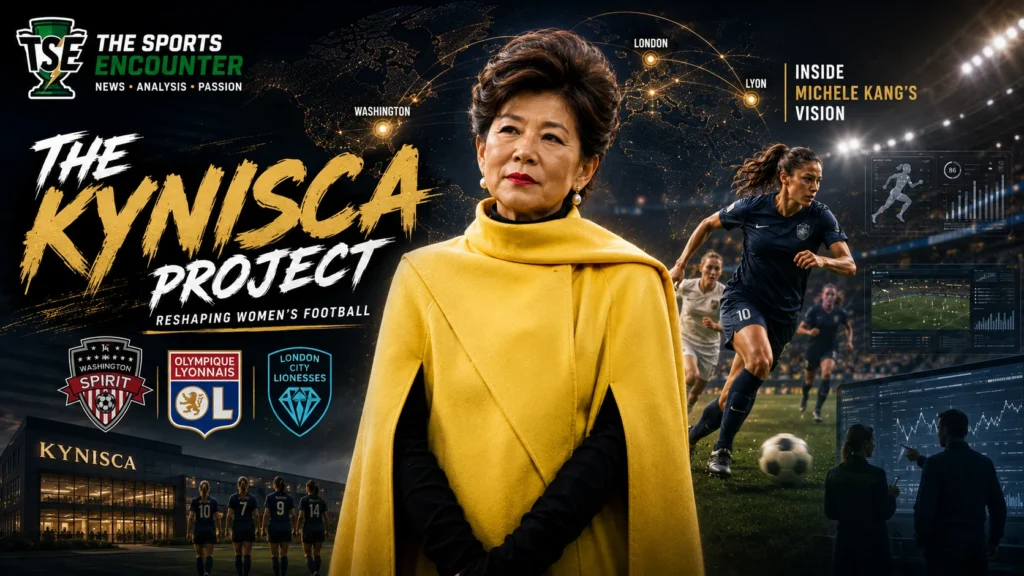
Owning major football clubs in three countries would already place Michele Kang in a small group of global sports investors. Building that portfolio specifically around women’s football makes her project far more unusual.
The South Korean-American businesswoman owns the Washington Spirit in the United States, OL Lyonnes in France and London City Lionesses in England. In June 2025, she was also appointed chairwoman and president of Olympique Lyonnais, extending her influence into the men’s side of one of France’s best-known football institutions.
Yet Kang’s most important idea may have little to do with the number of clubs she controls.
Through Kynisca Sports International, she is attempting to build an interconnected women’s football system in which clubs can share expertise in performance science, data, scouting, coaching, recruitment and player development. At the same time, she is investing heavily in research designed specifically around female athletes.
The ambition is significant. So are the questions surrounding it.
If Kynisca works, it could offer a blueprint for how women’s clubs accelerate professionalization without rebuilding the same infrastructure separately in every market. As the network grows, however, decisions involving coaches, players and resources will increasingly test whether clubs under common ownership can maintain genuine sporting independence.
That tension makes Kang’s project one of the more important experiments taking place in the modern football landscape.
What Is Michele Kang Building Through Kynisca?
Kang formally launched Kynisca Sports International in 2024 as a global organization dedicated to women’s football.
The structure connected Washington Spirit, OL Lyonnes and London City Lionesses under a broader organizational umbrella while allowing each club to retain its own identity.
According to Kynisca’s launch announcement, centrally developed capabilities include performance science and technology, data analytics, global scouting and sporting staff development.
The logic behind the system is relatively straightforward.
A football club traditionally builds its own recruitment network, medical department, performance systems, analytics processes and coaching infrastructure. Another club hundreds or thousands of miles away may be spending money solving many of the same problems.
Kynisca’s model creates the possibility of developing expertise once and applying that knowledge across several organizations.
If a better injury-prevention protocol is developed in Washington, knowledge from that work could eventually benefit players in London or Lyon. Scouting intelligence collected in Europe could potentially help the Spirit. Coaching methods, recruitment processes and performance data could circulate across the network rather than remaining locked inside individual clubs.
For a women’s game still developing professional structures across many countries, those efficiencies could be valuable.
Why the Name Kynisca Matters
The organization’s name comes from Cynisca, or Kyniska, the Spartan princess traditionally recognized as the first woman to win at the ancient Olympic Games.
Women could not compete directly in Olympic chariot racing, but owners of winning horses were officially recognized as victors. Cynisca entered horses and became associated with Olympic victories despite the restrictions placed on women at the time.
The symbolism fits Kang’s wider message. Women’s sport has historically developed inside structures that frequently gave female athletes fewer resources, less research and fewer professional opportunities.
Her investment strategy is aimed at changing some of those underlying systems rather than concentrating entirely on results and transfers.
The 6% Problem Behind Kang’s Sports Science Investment
The most distinctive part of the Kynisca project may be its focus on female-specific sports science.
When the Kynisca Innovation Hub was introduced in 2024, the organization said only around 6% of sports science research focused exclusively on females.
Kang committed $50 million in combined seed and matching funding toward an initiative designed to develop research, training methods and performance systems around female physiology.
Her message was memorable because it addressed a long-standing problem directly: elite women should be trained using evidence gathered from women.
Kang argued that the industry needed to stop training women as though they were simply smaller versions of male athletes.
The consequences of that research could extend well beyond a training session.
Injury Prevention, Recovery and Performance Could All Change
Elite football increasingly depends on marginal gains.
Clubs track workloads, acceleration, recovery, nutrition, sleep, muscular stress, tactical movement and dozens of other performance indicators. Yet systems built largely from research involving male athletes cannot automatically answer every question surrounding female performance.
A deeper female-specific evidence base could improve decisions around injury prevention, recovery, training loads, nutrition and long-term player health.
That becomes especially important as women’s football calendars become more demanding.
Domestic competitions, international tournaments, continental club competitions and expanded commercial schedules are increasing the physical load placed on leading players. Better research could help clubs understand when athletes should train harder, when they need additional recovery and how individual physiological factors influence performance.
The implications also reach youth development. If evidence-based methods become part of academies and development programs, female players could benefit much earlier in their careers.
This matters particularly as the women’s game expands into new markets. The recent rise of nations such as Malawi, who qualified for their first Women’s World Cup, and Algeria, who also secured a historic World Cup debut, shows how quickly competitive opportunities are broadening.
Kang Has Already Expanded the Research Project Beyond Kynisca
Kang’s sports science ambitions are no longer confined to her own clubs.
In April 2025, Kynisca announced that the Innovation Hub’s operations would be integrated into U.S. Soccer’s Soccer Forward Foundation. Kang committed another $25 million to support research, innovation and standards across women’s soccer.
U.S. Soccer described the collaboration as an effort to advance research, improve health outcomes and establish better performance and development standards.
That followed Kang’s other investments in women’s sport, including financial support for the United States women’s rugby sevens program.
Her professional background helps explain the emphasis on data and research. Kang built much of her business career in healthcare technology through Cognosante, an industry where evidence, systems, technology and measurable outcomes influence major decisions.
Kynisca appears to be applying a similar institutional mindset to women’s football.
The Multi-Club Model Creates Its Own Governance Test
The same structure that gives Kynisca its potential also creates its biggest challenge.
Shared knowledge is relatively easy to defend. Shared ownership becomes more complicated when coaches or players move between clubs inside the network.
The issue became visible in 2025 when Jonatan Giráldez left Washington Spirit to become head coach of OL Lyonnes.
Giráldez had arrived in Washington after a hugely successful spell with Barcelona, where he won two UEFA Women’s Champions League titles. Under his leadership, the Spirit reached the 2024 NWSL Championship game and later won the 2025 NWSL Challenge Cup.
Washington promoted assistant coach Adrián González as Giráldez prepared to move to Lyon.
From Kynisca’s perspective, the transition demonstrates one of the network’s advantages. Expertise developed or strengthened within one organization can remain within the broader group.
From the perspective of individual supporters, however, the question looks different.
If two clubs controlled by the same ownership group both want an elite coach, who decides which club needs him more?
And whose interests come first?
The Kadidiatou Diani Transfer Made the Question Harder to Ignore
The issue became even more visible during the summer of 2026.
London City Lionesses signed France international Kadidiatou Diani from OL Lyonnes on a three-year contract.
The clubs did not publicly disclose the transfer fee. French newspaper L’Équipe reported a fee of €800,000 and described it as the biggest player sale in OL Lyonnes’ history.
The significance goes beyond the amount.
Both clubs belong to Kang’s football network.
There is no evidence that the Diani deal was improperly structured or that the reported fee was manipulated. The transaction nevertheless illustrates a governance question that Kynisca will face repeatedly if more players and staff move between its clubs.
When the same ownership network stands behind the buyer and seller, supporters and competitors need confidence that decisions reflect the legitimate sporting and financial interests of each club.
Football is already wrestling with broader questions over ownership, commercial power and institutional accountability. Recent disputes covered by The Sports Encounter, including UEFA’s confrontation with FIFA over private investment and CONCACAF’s rejection of FIFA’s proposed World Cup stake structure, show how sensitive governance becomes when commercial interests intersect with sporting independence.
Can Shared Ownership Strengthen Clubs Without Weakening Independence?
This is the central challenge inside Kynisca.
Sharing sports science, scouting, technology and staff development can make every club more efficient. Moving influential players and coaches between those clubs introduces another layer of responsibility.
A strong multi-club system therefore needs transparent decision-making.
Each organization needs credible sporting leadership, clearly defined responsibilities and safeguards that allow supporters, players and competitors to understand how major decisions are made.
Those questions will become more important if Kynisca continues expanding.
Kang’s argument is that women’s football still lacks resources and infrastructure that men’s clubs have spent decades developing. Completely isolating every organization may therefore force women’s clubs to duplicate expensive research and systems unnecessarily.
There is merit in that argument.
The challenge is proving that collaboration can coexist with genuine sporting autonomy.
Kynisca Could Raise Standards Across Women’s Football
If Kang’s model succeeds, its influence could extend well beyond the three clubs she currently owns.
Competition has a habit of forcing investment.
If Kynisca clubs begin gaining measurable advantages through better performance science, stronger scouting, improved medical support and deeper analytics, rival owners will have an incentive to respond.
That could push other clubs to invest more heavily in training facilities, medical teams, analytics departments, academy structures and specialist coaching.
Women’s football would benefit if competition among owners gradually raises the minimum professional standard across the sport.
Transfer Spending Could Accelerate the Women’s Game
London City Lionesses have already shown how aggressive investment can change expectations around recruitment.
Higher transfer fees create economic value for selling clubs. Greater competition for established players can improve bargaining power for footballers. Better-funded squads can also attract more attention from broadcasters, sponsors and supporters.
There is another side to that development.
Clubs with smaller budgets may struggle to compete if a handful of wealthy ownership groups begin dominating the market for elite talent.
Women’s football therefore faces a familiar challenge: attracting more capital while preserving meaningful competitive balance.
The sport’s rapid growth makes that conversation increasingly important. Wider disputes over commercial control in football, including the recent collapse of FIFA’s proposed World Cup investment structure, have already demonstrated how quickly financial expansion can become a governance issue.
A Global Scouting Network Could Open New Pathways
Kynisca’s geographic spread gives it another potentially important advantage.
The United States, England and France have different football cultures, academy systems, player markets and competitive structures. Connecting those environments can create a wider scouting and development network.
Young players discovered in one market could eventually gain access to expertise or opportunities elsewhere in the organization.
This possibility becomes particularly significant outside football’s traditional elite nations.
The growth of women’s football across Africa offers a useful example. Nations reaching new levels of international competition are producing players who may previously have received limited global exposure. Recent qualification breakthroughs by Malawi and Algeria underline how quickly the player pool is widening.
A genuinely international scouting structure could identify talent earlier and create stronger routes into professional football.
The question is whether those pathways ultimately strengthen local football ecosystems as well as the clubs doing the recruiting.
Could Multi-Club Ownership Concentrate Too Much Power?
The larger the network becomes, the more significant another concern becomes.
If a small number of investors own leading women’s clubs across several countries, they can potentially gain considerable influence over the movement of players, coaches, intellectual property and sporting expertise.
Women’s football needs investment. It also needs competitive diversity.
Kynisca therefore has an opportunity to demonstrate whether multi-club ownership can help professionalize the women’s game while addressing the governance concerns that have followed similar structures elsewhere in football.
The question belongs to a much wider debate about who controls the sport. The Sports Encounter has tracked similar concerns at the international level, including the broader power struggle surrounding FIFA’s leadership and commercial direction.
Kang Wants the Network to Reach Beyond Three Clubs
Washington, London and Lyon may only be the beginning.
In a 2024 interview with The Guardian, Kang said she wanted to have a club in each continent.
She did not attach a firm timetable to that ambition, but the statement makes the scale of the project clear.
Kynisca has also spoken about investing in structures across Africa, the Americas, Asia and Europe.
A broader network could create opportunities for girls who currently live far from established professional pathways. Coaching expertise, scouting systems, research and performance support could reach markets where those resources remain limited.
Expansion would also increase the management challenge.
Football regulations differ across countries. So do league structures, financial conditions, transfer rules, cultural expectations and player-development systems.
A model that works in Washington cannot simply be copied into London, Lyon or another continent without adaptation.
What Would Success Actually Look Like?
The number of clubs Kang eventually owns will attract headlines, but it should not become the primary measure of whether Kynisca succeeds.
A more meaningful evaluation would look at outcomes.
- Are players healthier and missing fewer matches through preventable injuries?
- Are female-specific research and performance methods producing measurable benefits?
- Are academies developing more players?
- Are clubs becoming commercially stronger?
- Are salaries, facilities and professional standards improving?
- Are new international talent pathways opening?
- Can clubs inside the network retain credible sporting independence?
Those questions matter more than portfolio size.
Kang is effectively testing whether women’s football can build some of its future infrastructure differently from the men’s game rather than simply replicating systems that developed over the previous century.
The Bigger Question Facing Michele Kang and Kynisca
Women’s football is entering a period of rapid expansion.
New countries are reaching World Cups. Transfer fees are rising. Major clubs are investing more aggressively. Commercial interest is growing, while debates around governance and competitive balance are becoming more serious.
Kang has placed herself near the center of all those developments.
Her project combines club ownership, female-specific sports science, technology, scouting, player development and international expansion in a way few investors have attempted before.
The model now has to prove that scale can improve the game without compromising the independence of the clubs operating inside it.
If Kynisca can produce healthier athletes, stronger development pathways, better professional environments and commercially sustainable clubs while maintaining transparent sporting governance, Kang’s influence will extend far beyond Washington Spirit, OL Lyonnes and London City Lionesses.
That would represent a meaningful change in how women’s football is built.
If the network expands without equally strong safeguards around transfers, staff movement and club autonomy, the same structure designed to accelerate progress could create new concerns about concentrated power.
That is why Michele Kang’s project deserves attention.
The real story is bigger than how many clubs she owns. It is whether Kynisca can prove that an interconnected global football organization can improve the environment around female athletes while preserving the competition and independence that make the sport worth watching.