


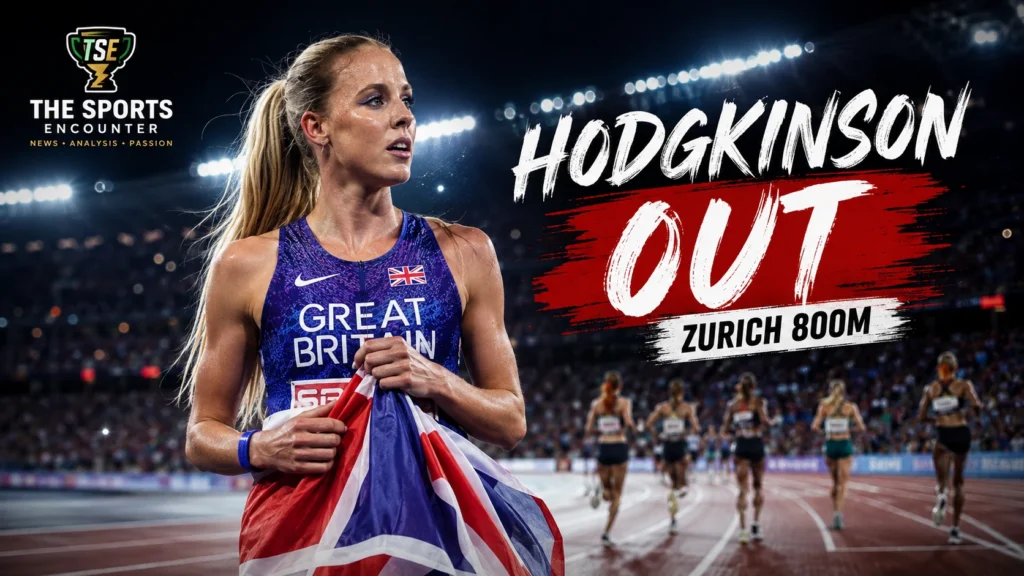
Keely Hodgkinson was supposed to arrive in Zurich looking for an answer.
Audrey Werro had beaten her to European 800m gold in Birmingham. The Swiss star had then returned home and won again in Lausanne in 1:55.33. Georgia Hunter Bell was waiting after an outstanding summer of her own, while Femke Broeders-Bol continued one of the most intriguing event transitions in athletics.
Instead, Hodgkinson has decided her body needs something more valuable than another high-profile race.
Recovery.
The Olympic 800m champion has withdrawn from Thursday’s Weltklasse Zurich Diamond League meeting, saying she is not physically ready to compete again following the European Athletics Championships.
“Unfortunately, the body isn’t quite ready to race again after the European championships, so we’ve made the decision to skip this race and get ready for the next one,” Hodgkinson said in announcing the decision.
The withdrawal removes the rematch Zurich had been built around.
It does not remove the larger story.
The women’s 800m has changed dramatically during 2026. Werro has gone from emerging challenger to European champion and one of the fastest women in history. Hunter Bell has added major championship success. Broeders-Bol has transformed herself from a world-class 400m hurdler into a genuine two-lap threat.
Hodgkinson remains the Olympic champion and one of the defining 800m runners of her generation.
What is less certain now is how aggressively she should chase a late-season rivalry when her body is asking for time.
Keely Hodgkinson Withdraws From Zurich: What We Know
| Detail | Information |
|---|---|
| Meeting | Weltklasse Zurich Diamond League |
| Date | August 27, 2026 |
| Event | Women’s 800m |
| Hodgkinson status | Withdrawn |
| Reason | Body not ready after European Championships |
| Major remaining contenders | Audrey Werro, Georgia Hunter Bell, Femke Broeders-Bol |
| Diamond League Final | Brussels, September 4-5 |
The official Weltklasse Zurich program confirms that the women’s 800m remains part of Thursday’s meeting at the Letzigrund Stadium.
Zurich Was Supposed to Be Hodgkinson vs Werro Again
When the Zurich organizers announced Hodgkinson for the meeting on August 17, the race immediately became one of the most compelling events of the late Diamond League season.
The reason was obvious.
Only days earlier, Werro had beaten Hodgkinson in one of the best women’s 800m finals Europe has produced in years.
The Swiss runner won the European title in Birmingham in 1:54.81.
Hodgkinson finished second in 1:55.01.
Broeders-Bol took bronze in 1:55.54.
The official World Athletics report from Birmingham confirmed Werro’s championship record and the quality of the race.
The Sports Encounter examined that final in depth in our analysis of Werro’s record-breaking European 800m victory over Hodgkinson.
Zurich was therefore supposed to answer the next obvious question.
Could Hodgkinson respond immediately?
That answer will have to wait.
Hodgkinson Is Choosing the Season Over One Race
That decision deserves more respect than disappointment.
Elite athletics constantly rewards athletes for racing.
Fans want rematches.
Organizers want stars.
Broadcasts want rivalries.
Sponsors want appearances.
The athlete has to live inside the body carrying all of it.
Hodgkinson has already dealt with hamstring and knee problems during recent seasons. She skipped the Commonwealth Games earlier this summer while prioritizing the European Championships and entered Birmingham knowing that the calendar had to be managed carefully.
She reached the European final and ran 1:55.01.
That is not the performance of an athlete suddenly out of form.
It is the performance of an Olympic champion who ran into an opponent producing an exceptional season.
The sensible response to physical warning signs is therefore not to chase revenge four days later because the storyline looks attractive.
It is to recover.
Audrey Werro Has Changed the Women’s 800m Hierarchy
Hodgkinson’s absence also changes how Zurich should be viewed.
Werro no longer needs Hodgkinson in the race to validate her status.
That was probably true before Birmingham.
It is certainly true now.
Werro arrived at the European Championships as one of the fastest women in the world and survived one of the strangest routes imaginable to the final.
She fell during her semifinal, finished last and initially appeared to be eliminated.
A successful Swiss appeal put her back into the final.
The Sports Encounter covered that extraordinary sequence in our report on Werro’s semifinal fall and reinstatement.
Less than 24 hours later, she became European champion.
That matters because adversity tests athletes differently from paced Diamond League racing.
Werro had to deal with uncertainty, recovery from the fall, championship pressure and Hodgkinson racing in front of a British crowd.
She still won.
Werro Backed Birmingham Up in Lausanne
The European title could have produced an emotional drop.
Instead, Werro went to Lausanne and won again.
She clocked 1:55.33, holding off Broeders-Bol, who finished only 0.08 seconds behind in 1:55.41.
That result matters as much as the time.
Championship peaks are difficult to reproduce immediately.
Werro did not need another 1:53 or 1:54 performance.
She needed to demonstrate that Birmingham had not consumed the rest of her season.
She did that.
Zurich now becomes another test of whether she can keep winning after becoming the athlete everyone else is trying to beat.
Hodgkinson Has Already Run Brilliantly Against Werro This Year
The rivalry should not be framed as though Hodgkinson has suddenly fallen away.
She has produced exceptional performances herself.
In Stockholm earlier this season, Hodgkinson ran a British record and personal best of 1:54.33.
She still lost.
Werro won in 1:53.98.
That result helped move the women’s 800m into territory rarely seen in the modern era.
The official Zurich organizers highlighted that race when announcing the proposed rematch and noted how rapidly the event’s standards have risen.
That is why Hodgkinson’s withdrawal should not be interpreted as evidence that she can no longer match Werro.
The available evidence says the opposite.
Hodgkinson remains fast enough to run performances that would have dominated most eras.
Werro has simply found another level during 2026.
Is There Really a Power Shift in the Women’s 800m?
Yes, but the phrase needs context.
A power shift does not mean Hodgkinson has disappeared.
It means she is no longer the only obvious reference point at the top of the event.
Werro has forced her way into that space.
Hunter Bell is increasingly relevant.
Broeders-Bol has created an entirely new competitive question.
World champion Lilian Odira remains part of the broader global picture even though she has also withdrawn from Zurich after recent illness and weakness.
The event is deeper than it was two years ago.
That should make Hodgkinson more cautious with her body, not less.
One forced late-season race is not worth compromising a career that should still have several championship cycles ahead of it.
Lilian Odira Has Also Withdrawn From Zurich
Hodgkinson is not the only major name missing from the original Zurich field.
World 800m champion Lilian Odira has also pulled out.
Reports indicate that the Kenyan has struggled with illness and weakness since the Commonwealth Games.
That removes another athlete who would have added world championship authority to an already extraordinary race.
The original field was promoted as a meeting of reigning champions.
Zurich will now look different.
It remains strong.
It is no longer the complete global showdown organizers initially hoped to stage.
Georgia Hunter Bell Now Has a Bigger Opportunity
Hunter Bell’s presence becomes much more significant without Hodgkinson and Odira.
She won Commonwealth Games 800m gold in Glasgow earlier this summer, controlling the final in 1:59.51.
The Sports Encounter covered that performance in our Glasgow 2026 Day 8 analysis, where Hunter Bell produced one of England’s strongest track performances of the Games.
She then shifted back to the 1,500m at the European Championships and won gold in Birmingham.
That range makes her particularly interesting.
Hunter Bell can race tactically.
She can survive physical 800m positioning.
She also possesses the endurance developed through the 1,500m.
What she has not yet done this season is consistently operate in the 1:54 to 1:55 territory Werro and Hodgkinson have made increasingly normal.
Zurich gives her another opportunity to find out how close she is.
Femke Broeders-Bol May Be the Most Fascinating Athlete in the Race
Even in an event filled with compelling stories, Broeders-Bol’s transition demands attention.
She built her reputation through the 400m hurdles.
Now she is running world-class 800m times.
Her bronze medal in Birmingham came in 1:55.54.
She followed that with 1:55.41 in Lausanne, finishing only eight hundredths behind Werro.
That is no longer experimentation.
That is elite 800m racing.
The intriguing part is how different her physical background is from most traditional two-lap specialists.
Years of 400m hurdle training gave her speed, strength and an ability to tolerate severe lactate accumulation.
The challenge is tactical efficiency.
Eight hundred meters requires positioning, pace judgment and the confidence to remain patient when another athlete makes an early move.
Broeders-Bol is learning those skills while already running times capable of winning major medals.
Zurich may therefore become less about Werro defending home territory and more about whether Broeders-Bol can close the remaining fraction of a second.
Birmingham Was the Race That Changed Everything
Hodgkinson’s withdrawal cannot be understood without returning to Birmingham.
The European final reshaped the event.
Werro took control.
Hodgkinson chased.
Broeders-Bol stayed close enough to threaten the top two.
The winning time of 1:54.81 broke a championship record that had stood since 1982.
Hodgkinson’s 1:55.01 would have won comfortably at most previous European Championships.
Instead, it earned silver.
The Sports Encounter’s full Birmingham record-night wrap placed Werro’s victory alongside major performances from Karsten Warholm, Gianmarco Tamberi and Nadia Battocletti.
That broader context matters.
Birmingham was not a weak championship where one athlete happened to produce a quick time.
It was an elite session filled with championship records and high-level performances.
Werro’s victory belonged at the center of it.
Hodgkinson Had Looked Strong Before the Final
Nothing in the preliminary rounds suggested a physical collapse was coming.
Hodgkinson controlled her European semifinal in 1:57.38.
She looked composed and qualified without the chaos Werro endured in the other semifinal.
Our Birmingham Day 4 report covered the contrasting routes both women took into the final.
That is another reason not to overstate the current withdrawal.
Hodgkinson was capable of running an elite championship final.
Her body is now telling her that another immediate high-intensity race is not the right decision.
That is different from being seriously injured or incapable of competing at the top level.
Should Hodgkinson Target the Brussels Diamond League Final?
That depends entirely on recovery.
Brussels hosts the Diamond League Final on September 4 and 5.
On paper, that gives Hodgkinson a little more than a week between Zurich and the final.
The calendar should not dictate the decision.
If she returns to full training, moves freely and can complete race-specific sessions without concern, Brussels becomes an attractive target.
If the body continues sending warning signs, she should skip that too.
The late-season temptation will be enormous because the women’s 800m rivalry has become commercially and competitively compelling.
But an Olympic champion does not need to prove her status through one September meeting.
Health has to win that argument.
Why This Matters Beyond Zurich
The women’s 800m is entering one of its strongest eras in decades.
Werro has approached one of the most controversial and long-standing world records in athletics.
Hodgkinson continues producing historically fast British performances.
Broeders-Bol is adding another world-class athlete to the event.
Hunter Bell is capable of moving between 800m and 1,500m at championship level.
Odira remains the reigning world champion.
This is precisely the kind of rivalry athletics needs.
It also increases the physical demands on every athlete involved because major races become harder to avoid.
Every meeting wants them.
Every organizer wants the rematch.
Every championship creates another rivalry narrative.
The athlete still has only one body.
British Athletics Should Want Hodgkinson Healthy, Not Constantly Available
There is also a national perspective.
British athletics currently has an unusually strong collection of female track athletes.
Hunter Bell is a major champion.
Amy Hunt completed a remarkable sprint double in Birmingham, a performance examined in The Sports Encounter’s analysis of her 100m and 200m titles.
Hodgkinson remains one of Britain’s biggest global athletics stars.
The long-term objective should be to have her healthy for Olympic and world championship cycles, not to squeeze another Diamond League appearance from an athlete who is telling her team she is not ready.
That becomes especially relevant as Britain continues trying to strengthen its position as a global athletics center. Our analysis of London’s bid for the 2029 World Athletics Championships examined how important the country’s current generation of stars could be to the sport’s domestic momentum.
Who Is the Zurich Favorite Now?
Audrey Werro.
There is very little reason to argue otherwise.
She has the fastest profile.
She is European champion.
She has just won Lausanne.
She is racing in Switzerland.
She has beaten Hodgkinson more than once this season.
And the two athletes most capable of carrying equal championship authority into Zurich, Hodgkinson and Odira, are no longer racing.
That does not make the result inevitable.
Broeders-Bol finished only 0.08 seconds behind her in Lausanne.
Hunter Bell brings tactical strength and championship confidence.
Eight hundred meters remains an event where positioning can destroy a favorite’s plan within seconds.
Werro should still start as the woman everyone else has to beat.
Zurich Women’s 800m: The Main Questions
| Question | Why It Matters |
|---|---|
| Can Werro win again? | Another victory would reinforce her position at the top of the 2026 hierarchy |
| Can Broeders-Bol close the Lausanne gap? | Only 0.08 seconds separated her from Werro |
| Can Hunter Bell run with the 1:55 group? | She has major titles but still has another level to find on pure time |
| How much does Hodgkinson’s absence change the race? | Zurich loses the athlete most likely to force Werro into another historically fast contest |
| Will the race become tactical? | Without Hodgkinson and Odira, athletes may be less willing to commit to an extreme early pace |
Hodgkinson’s Withdrawal May Actually Help the Rivalry
That sounds counterintuitive.
Fans wanted Zurich.
The organizers wanted Zurich.
Werro wanted the home rematch.
Hodgkinson herself had previously spoken about wanting to join such a strong field.
But rivalries become less interesting when one athlete races through physical problems and then disappears for months.
Hodgkinson and Werro are both young enough for this confrontation to continue across several seasons.
The better rivalry is the one that reaches another Olympic final, another World Championship and more Diamond League races with both athletes healthy.
Missing Zurich is disappointing.
Losing months to a preventable injury would be much worse.
The Wider European Championships Show Why Recovery Matters
Birmingham produced a demanding championship week for many of Europe’s leading athletes.
Some left with records.
Some left with medals.
Some left carrying the physical cost of multiple rounds.
Nadia Battocletti completed a historic 5,000m and 10,000m double-double, which The Sports Encounter covered after her remarkable distance achievement.
The point is not that Hodgkinson faced the same workload.
It is that championship athletics asks athletes to peak physically and emotionally within a narrow window.
Expecting another peak immediately afterward is not always realistic.
TSE Analysis: Hodgkinson Has More to Gain From Patience Than Zurich Revenge
The most tempting version of this story is the rivalry narrative.
Werro beats Hodgkinson in Birmingham.
Hodgkinson goes to Switzerland looking for revenge.
The home crowd chooses Werro.
Two of the fastest women of their generation settle it again over two laps.
That would have been excellent entertainment.
It is not worth racing if Hodgkinson does not believe her body is ready.
Her 2026 season has already established several important facts.
She remains capable of historically fast running.
She remains a championship-level athlete.
She can still produce 1:55 performances under enormous pressure.
The rise of Werro does not reduce Hodgkinson.
It gives her a stronger rival.
The smartest response is therefore not desperation.
It is durability.
What Would Count as a Successful End to Hodgkinson’s Season?
Not necessarily another win.
The priorities should be simpler.
- Resolve the physical issues left from Birmingham.
- Return to uninterrupted training.
- Race again only if full-speed sessions are pain-free.
- Avoid turning fatigue into another long-term injury.
- Finish 2026 with confidence rather than another rehabilitation program.
If that includes Brussels, excellent.
If it does not, Hodgkinson’s career will not be diminished by skipping another race.
The Sports Encounter Verdict
Keely Hodgkinson’s Zurich withdrawal removes the rematch athletics fans wanted.
It does not weaken the women’s 800m story.
It makes that story more complicated.
Audrey Werro now arrives at her home Diamond League meeting as European champion, Lausanne winner and the clear favorite.
Femke Broeders-Bol is rapidly becoming a genuine threat rather than an intriguing experiment.
Georgia Hunter Bell enters with major championship confidence and another opportunity to test herself against the event’s fastest athletes.
Lilian Odira’s withdrawal further changes the original field.
And Hodgkinson is left making a decision every elite athlete eventually has to make.
How much is one race worth?
In this case, probably not enough.
The Olympic champion has already shown that she can run with Werro.
She does not need Zurich to prove it.
What she needs is a body capable of doing it again when the stakes are even higher.
Werro may own Thursday night.
The larger rivalry remains unfinished.
Frequently Asked Questions
Why has Keely Hodgkinson withdrawn from the Zurich Diamond League?
Hodgkinson said her body is not ready to race again following the European Championships and that she and her team decided to skip Zurich and prepare for her next competition.
When is the Zurich Diamond League women’s 800m?
The race is scheduled for Thursday, August 27, 2026, at the Letzigrund Stadium.
Who beat Keely Hodgkinson at the 2026 European Championships?
Switzerland’s Audrey Werro won the European 800m title in a championship-record 1:54.81. Hodgkinson finished second in 1:55.01.
Who finished third in the European 800m final?
Femke Broeders-Bol of the Netherlands won bronze in 1:55.54.
Is Audrey Werro running in Zurich?
Yes. Werro remains in the Zurich field and enters as the leading favorite after winning the European title and the Lausanne Diamond League.
Is Lilian Odira racing in Zurich?
No. Odira has also withdrawn from the women’s 800m after reportedly dealing with illness and weakness since the Commonwealth Games.
Is Georgia Hunter Bell racing in Zurich?
Yes. Hunter Bell remains part of the field after a summer in which she won Commonwealth 800m gold and European 1,500m gold.
What did Audrey Werro run in Lausanne?
Werro won the Lausanne Diamond League 800m in 1:55.33, narrowly defeating Broeders-Bol, who ran 1:55.41.
Could Hodgkinson return for the Diamond League Final?
Potentially. The Diamond League Final is scheduled for Brussels on September 4-5, but Hodgkinson’s participation should depend on her recovery rather than the calendar.
Has Audrey Werro beaten Hodgkinson before Birmingham?
Yes. Werro also defeated Hodgkinson in Stockholm earlier in 2026, running 1:53.98 while Hodgkinson set a British record of 1:54.33.