Connect with us

Published

on

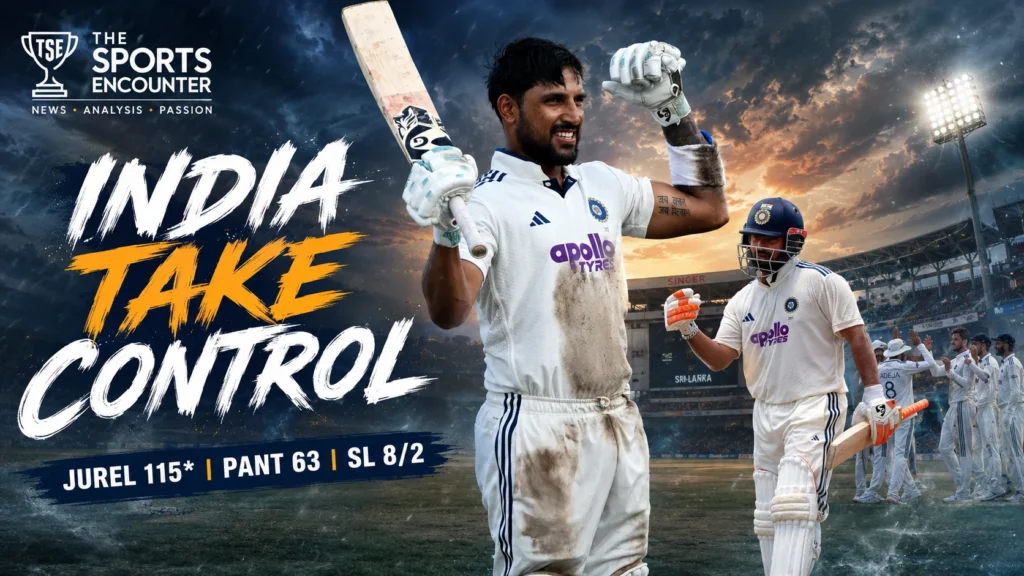
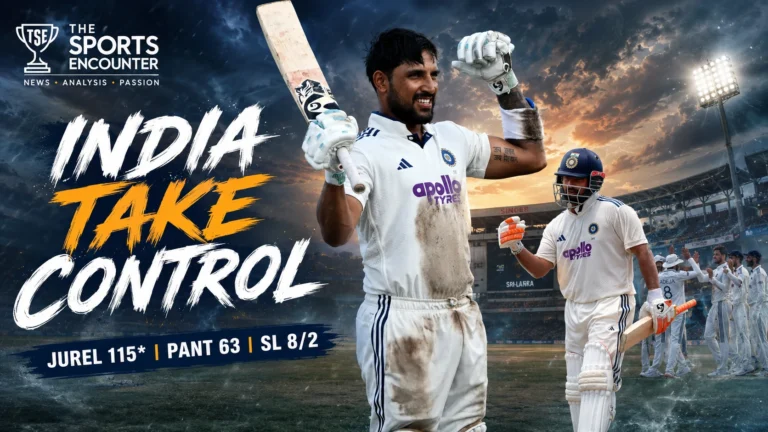
India ended the second day of the second Test in Colombo with complete control of the match after piling up 503 for nine declared and reducing Sri Lanka to 8 for two in fading light at the Sinhalese Sports Club Ground.

Dhruv Jurel’s assured 115 not out gave India the platform to bat Sri Lanka almost out of the game, while Rishabh Pant returned after retiring hurt on day one to make a typically inventive 63. Devdutt Padikkal’s 117 from the opening day remained the biggest score of the innings, but India’s strength came from how consistently they found partnerships across the batting order.

Shubman Gill had made 50, Ravindra Jadeja contributed 43, Yashasvi Jaiswal scored 45, and India kept extending the innings until they crossed 500 late in the day.

The declaration then became part of the strategy.

With light fading and only spin allowed as conditions deteriorated, Prasidh Krishna removed Lahiru Udara for one before Manav Suthar trapped nightwatchman Prabath Jayasuriya lbw with the final ball of the day.

Sri Lanka closed on 8 for two after three overs, still 495 runs behind.

India remain 18 wickets away from completing a 2-0 series win, but after two days the structure of the Test is unmistakable. Sri Lanka must first survive, then find a way to bat long enough to make India work for control they already possess.

India vs Sri Lanka 2nd Test: Day 2 at a Glance

Match Sri Lanka vs India, 2nd Test
Series India tour of Sri Lanka 2026
Competition ICC World Test Championship 2025-27
Venue Sinhalese Sports Club Ground, Colombo
Date August 24, 2026, Day 2
India 503/9 declared in 138 overs
Sri Lanka 8/2 in 3 overs
Match position Sri Lanka trail by 495 runs
India’s top scorers Devdutt Padikkal 117, Dhruv Jurel 115*, Rishabh Pant 63
Best Sri Lanka bowler Asitha Fernando 4/106
Late wickets Prasidh Krishna and Manav Suthar

TL;DR

  • India declared on 503 for nine after extending their first innings deep into day two.
  • Dhruv Jurel finished unbeaten on 115, his second Test hundred.
  • Rishabh Pant returned after retiring hurt on day one and scored 63.
  • Devdutt Padikkal’s 117 remained India’s highest individual score.
  • Asitha Fernando was Sri Lanka’s most successful bowler with 4 for 106.
  • India declared immediately after reaching 500.
  • Prasidh Krishna dismissed Lahiru Udara for one.
  • Manav Suthar removed nightwatchman Prabath Jayasuriya lbw with the final ball of the day.
  • Sri Lanka closed on 8 for two and trail by 495 runs.
  • India are firmly positioned to push for a 2-0 series victory.

India Resume With the Match Already Leaning Their Way

India had ended day one at 300 for five, with Dhruv Jurel on seven and Saransh Jain on four.

The overnight score already represented a strong foundation, but the second day was about whether India could convert that advantage into a total Sri Lanka would spend several sessions trying to escape.

They did exactly that.

There was an early complication because Rishabh Pant had retired hurt on the first day at 207 for three and did not resume immediately.

When he returned at 307 for six, India had lost three wickets for 100 runs since his departure.

The innings could have entered a more fragile phase.

Pant and Jurel made sure it did not.

The pair brought completely different energies to the partnership. Pant accelerated. Jurel settled. That combination gradually pushed Sri Lanka out of the session.

The wider significance of India’s batting depth had already been identified before the tour in The Sports Encounter’s India vs Sri Lanka Test series preview, where Pant, Jadeja and Jurel were identified as players capable of extending an innings beyond the specialist top order.

Colombo provided the clearest example yet.

Pant Returns and Immediately Changes the Tempo

Pant’s return altered Sri Lanka’s problem.

Before he came back, they could still think in conventional Test-match terms: remove the remaining specialist batter, work into the lower order and restrict India somewhere around 350 or 380.

Pant does not allow a bowling side to remain comfortable inside those calculations.

He reached his fifty from 81 balls, hitting five fours and a six on the way.

By lunch, India had moved to 419 for six.

Pant was on 63.

Jurel was on 59.

The seventh-wicket stand had passed 100.

India had added 119 runs during the first session without losing a wicket.

That was the session in which Sri Lanka’s prospects of keeping the first innings within manageable range largely disappeared.

Pant’s 63 Was More Valuable Than the Number Alone

Pant eventually fell for 63 from 89 deliveries.

His innings included six fours and two sixes and came at a strike rate of 70.78.

The raw figures were strong.

The timing mattered more.

India were no longer trying to recover when Pant returned. They were trying to convert control into dominance.

Pant’s aggression accelerated that process and gave Jurel time to construct an innings without being forced into unnecessary risks.

The partnership added 112 runs before Pant was dismissed at 419.

For Sri Lanka, it was the kind of seventh-wicket stand that causes more damage than many top-order partnerships because it arrives when a bowling side expects relief.

Pant’s ability to affect games before becoming India’s established Test wicketkeeper-batter was already evident when he won the ICC Emerging Men’s Cricketer of the Year award in 2018, a period included in The Sports Encounter’s complete 10-year history of ICC award winners.

Dhruv Jurel Shows Why India Can Use Him as a Specialist Batter

Jurel’s innings was different.

There was very little wasted movement and almost no sense that he was trying to prove anything through aggression.

He reached fifty from 97 balls.

His hundred came from 171.

By then, India had already crossed 475 and the question had shifted from whether Sri Lanka could restrict the total to when Gill would declare.

Jurel finished unbeaten on 115 from 177 deliveries, with nine fours and two sixes.

The innings lasted 291 minutes.

That is the part of his contribution that matters most.

India did not require a wicketkeeper’s cameo.

They needed a specialist batter’s innings.

Jurel supplied one.

His ability to spend nearly five hours at the crease gave India the luxury of batting through interruptions, weather delays and the loss of wickets around him.

Why Jurel’s Hundred Matters Beyond This Match

India’s Test batting has increasingly depended on flexibility around the middle order.

Pant’s availability changes one combination.

Jadeja’s role changes another.

Conditions determine whether India want an additional spinner, batter or seam option.

Jurel’s hundred strengthens the argument that he can be selected because of his batting rather than only as cover behind the stumps.

That flexibility may become increasingly valuable during the extraordinary run of 19 consecutive scheduled Test-cricket days in August, where squad depth and recovery periods are already becoming important across several international series.

Against Sri Lanka, however, the immediate value was simpler.

He ensured India reached 500.

Sri Lanka Keep Working but Cannot Stop the Total Growing

Asitha Fernando was comfortably Sri Lanka’s most successful bowler.

He finished with four wickets for 106 from 29 overs and removed Yashasvi Jaiswal, Shubman Gill, Ravindra Jadeja and Saransh Jain.

Prabath Jayasuriya bowled 42 overs for 132 runs and took two wickets.

Keshara Nuwantha also claimed two, dismissing Padikkal and Pant, but conceded 154 runs from 38 overs.

The numbers reflected Sri Lanka’s larger problem.

They could take wickets.

They could not take them quickly enough.

Every breakthrough was followed by another partnership or another period in which India absorbed pressure.

Padikkal’s 117 had anchored the first day.

Gill’s 50 helped stabilize the first innings.

Jadeja added 43.

Pant came back and made 63.

Jurel remained there until the declaration.

That spread of runs prevented Sri Lanka from identifying one wicket that could end the innings.

Rain Delays Jurel’s Hundred but Not India’s Plan

Weather interrupted the second half of the day with India on 475 for eight.

Jurel was stranded on 95 when rain stopped play.

The delay also reached the scheduled tea interval.

For Sri Lanka, the interruption offered temporary relief.

For India, it changed very little.

Jurel returned and completed his century.

Mohammed Siraj occupied 29 balls for three runs before Prabath Jayasuriya dismissed him lbw.

Prasidh Krishna then joined Jurel and helped India reach the psychological and tactical landmark they had clearly been targeting.

Five hundred arrived at the end of the 138th over.

The declaration followed immediately at 503 for nine.

India’s Declaration Was About More Than the Score

Five hundred was obviously a substantial total.

The timing made it more dangerous.

India had the opportunity to send Sri Lanka in late in the day, with conditions becoming darker and the batters beginning an innings after spending almost two days in the field.

That combination often creates a vulnerable period in Test cricket.

A fresh opener has to reset mentally after fielding for nearly 140 overs.

Footwork is less certain.

Visibility is deteriorating.

The bowling side has nothing to lose by attacking.

The batting side knows stumps are close enough to encourage survival rather than scoring.

India used that window almost perfectly.

Prasidh Krishna Strikes Before Sri Lanka Can Settle

Lahiru Udara faced only six balls.

He made one.

Prasidh Krishna removed him in the second over, with Yashasvi Jaiswal completing the catch.

Sri Lanka were 1 for one.

The wicket immediately changed the mood around what remained of the day.

Kamil Mishara, making his Test debut, was now batting under pressure before he had properly begun his innings.

His selection also represents a significant format transition. Earlier in August, Mishara had produced one of the standout innings of the Lanka Premier League when his unbeaten 108 powered Jaffna Kings past Galle Gallants in a 470-run playoff contest. That performance is covered in The Sports Encounter’s report on Mishara’s LPL 2026 Qualifier 1 century.

Sri Lanka responded by sending Prabath Jayasuriya in as nightwatchman.

The logic was obvious.

Protect the specialist batters.

Get through the final few minutes.

Begin again in daylight.

That plan almost worked.

Bad Light Brings Spin Into the Game

The conditions created an unusual final passage.

The umpires’ light meters dictated that play could continue only if India used spin.

Gill turned to Manav Suthar.

That did not make the situation easier for Jayasuriya.

Suthar’s left-arm spin included an arm ball that behaved far more like a swinging delivery than a conventional spinner’s ball.

The first deliveries gave Jayasuriya an indication of the threat.

The last one removed him.

Suthar’s Final-Ball Wicket Leaves Sri Lanka 8/2

Suthar went fuller with the final ball of the day.

Jayasuriya tried to defend but his front pad came into play before the bat.

Umpire Ahsan Raza gave him out.

Sri Lanka reviewed.

Ball-tracking showed the delivery clipping leg stump.

The original decision stood on umpire’s call.

Jayasuriya was out for two from seven balls.

Sri Lanka were 8 for two.

Stumps were called immediately afterward.

For a side already trailing by almost 500 runs, losing the nightwatchman with the final ball was especially damaging because the tactical purpose of sending him in had only partly been achieved.

He protected one specialist batter.

He could not protect Sri Lanka from beginning day three with another wicket already gone.

Sri Lanka Face 495-Run Deficit and a Completely Different Day Three

The scoreboard is severe.

Sri Lanka trail by 495.

They have eight first-innings wickets remaining.

The follow-on remains a distant problem because they first need to build anything resembling a normal innings.

The immediate objective is survival through the opening session.

Kamil Mishara will resume on five.

His recent white-ball form has been substantial. He also top-scored for Jaffna with 41 in the LPL 2026 final against eventual champions Galle Gallants, but Test cricket now asks a very different question of his technique and patience.

Pasindu Sooriyabandara, Kamindu Mendis and captain Dhananjaya de Silva remain to come.

Their task is not simply to score.

They need to consume time.

India’s strongest route to victory now involves creating a first-innings deficit large enough to retain complete control over whether they enforce the follow-on or bat again.

Sri Lanka therefore need partnerships capable of changing the time equation.

Why the First Session of Day Three Could Decide the Test

India already possess the scoreboard.

What Sri Lanka still control is how long this Test lasts.

If India take three or four wickets during the first session on day three, the match could accelerate rapidly toward an innings victory or a very short fourth-innings target.

If Sri Lanka bat through the session with only one wicket lost, the game becomes harder physically for India’s attack and weather could begin to matter more.

The first hour is therefore disproportionately important.

Mishara and the next specialist batter must survive Siraj and Prasidh if pace is available.

They must then manage Suthar, Jadeja and India’s other spin options without allowing dot-ball pressure to create desperate shots.

The broader series context also matters. This two-Test contest forms part of the ICC World Test Championship, which gives every result additional value beyond the bilateral series.

The pressure of collecting WTC points is not unique to this series. Recent red-ball contests have also shown how quickly one result can reshape a campaign, including Pakistan’s recovery against West Indies examined in The Sports Encounter’s West Indies-Pakistan Test series review.

India’s Batting Depth Has Become the Difference in the Series

Before the tour began, the most obvious structural advantage India held was depth.

The Sports Encounter’s series preview identified the lower middle order as an area capable of separating the teams in difficult conditions.

Colombo has produced a different kind of match.

The same advantage remains decisive.

India did not need a double century.

They did not need one batter to carry the innings.

They received 117 from Padikkal, 115 not out from Jurel, 63 from Pant, 50 from Gill, 45 from Jaiswal and 43 from Jadeja.

Six batters reached at least 43.

That is why Sri Lanka spent 138 overs bowling.

Padikkal’s Day-One Hundred Remains the Foundation

The second day belonged more visibly to Jurel and Pant, but Devdutt Padikkal’s 117 remains the innings that established India’s control.

He faced 193 balls and hit 12 fours.

That innings allowed India to recover after losing KL Rahul for 18 and Jaiswal for 45.

Gill then added 50 from 108 balls, ensuring Sri Lanka could not turn two early wickets into sustained pressure.

Gill had also been one of India’s leading contributors during their previous England white-ball tour, including a 77 at Lord’s in the match covered in The Sports Encounter’s England-India ODI series finale report. His role in Colombo required a much more patient version of the same top-order responsibility.

By the time Padikkal fell at 281 for four, India had already built the platform that their middle and lower order expanded on day two.

Pant and Jurel Give India Two Different Forms of Pressure

The contrast between Pant and Jurel may be the most useful tactical lesson from India’s innings.

Pant pressured Sri Lanka with tempo.

Jurel pressured them with time.

Pant forced field changes and punished defensive lengths.

Jurel made Sri Lanka keep bowling.

One accelerated the total.

The other extended the innings.

That combination is especially difficult to manage because a bowling side cannot solve both problems with one field or one pace of attack.

Asitha Fernando Deserves Credit in a Difficult Innings

Sri Lanka’s bowlers were made to work for almost two full days, but Asitha Fernando’s performance deserves recognition.

His 4 for 106 came from 29 overs.

He dismissed four players who had the ability to extend India’s innings significantly.

Jaiswal was bowled for 45.

Gill was caught behind for 50.

Jadeja was bowled for 43.

Saransh Jain was removed for six.

On another day, four wickets from a seamer at SSC might have been enough to keep an opposition below 350.

The Sinhalese Sports Club had also staged major franchise cricket earlier in the Sri Lankan season, including Galle’s opening LPL victory over Jaffna, covered in The Sports Encounter’s LPL 2026 opener report from the SSC Ground. Test cricket, however, has placed a very different workload on the surface and Sri Lanka’s attack.

India’s depth made Asitha’s four wickets insufficient.

What India Still Need to Do

The match is heavily tilted toward India.

It is not finished.

They still require 18 wickets.

Weather has already interrupted the Test.

Sri Lanka still possess experienced batters capable of occupying the crease for long periods.

India’s challenge is to avoid allowing the scoreboard advantage to reduce their intensity.

The same discipline that produced 503 must now appear in the field.

Siraj and Prasidh need to challenge the stumps and outside edge early.

Suthar and the other spinners must resist searching for magic deliveries simply because wickets arrived late on day two.

The pressure already exists.

India only need to maintain it.

What Sri Lanka Must Change on Day Three

Sri Lanka’s response cannot be built around the deficit.

Trying to score 495 quickly would only accelerate the defeat.

The first target should be far smaller.

Reach lunch.

Build one partnership.

Force India’s bowlers into second and third spells.

Make the pitch and weather part of the match again.

Kamindu Mendis and Dhananjaya de Silva are likely to carry particular responsibility because both have the technique to absorb spin and the range to score without taking unnecessary risks.

Kamindu entered the Test following a busy domestic franchise season in which he captained Colombo Kaps, including their playoff defeat against Galle examined in The Sports Encounter’s LPL Qualifier 2 analysis. The format has changed completely, but Sri Lanka now need the same willingness to absorb pressure and build a partnership.

If Sri Lanka lose Kamindu and Dhananjaya cheaply, the tail will be exposed far too early.

The 2019 South Africa Parallel Feels Familiar

The closing sequence recalled a pattern India used repeatedly during their 2019 home series against South Africa.

The basic method was simple.

Bat first.

Build a total near 500.

Declare late.

Attack in fading light.

Begin the following morning with the opposition already behind the match.

Colombo followed almost exactly that shape.

India crossed 500.

Gill declared.

Two Sri Lankan wickets disappeared before stumps.

Day three will begin with the hosts 495 behind and their top order immediately exposed.

Day 2 Scorecard Highlights

India batter Runs Balls 4s 6s
Devdutt Padikkal 117 193 12 0
Dhruv Jurel 115* 177 9 2
Rishabh Pant 63 89 6 2
Shubman Gill 50 108 6 0
Yashasvi Jaiswal 45 53 9 0
Ravindra Jadeja 43 83 4 0

Sri Lanka Bowling Figures

Bowler Overs Runs Wickets Economy
Asitha Fernando 29 106 4 3.65
Prabath Jayasuriya 42 132 2 3.14
Keshara Nuwantha 38 154 2 4.05
Lahiru Kumara 20 68 1 3.40

Key Turning Points on Day Two

  • Pant returns at 307/6: India regain an aggressive scoring option after his day-one injury interruption.
  • Pant and Jurel add 112: Sri Lanka’s chance of keeping India below 400 disappears.
  • India reach lunch at 419/6: An entire first session passes without a wicket.
  • Jurel completes his century: Another substantial batting contribution becomes the defining day-two landmark.
  • India cross 500: Gill declares immediately at 503/9.
  • Prasidh removes Udara: Sri Lanka lose an opener before settling into the innings.
  • Suthar gets Jayasuriya: The nightwatchman falls lbw from the final ball of the day.
  • Sri Lanka close at 8/2: The hosts end day two 495 runs behind.

What to Watch on Day Three

Play is scheduled to begin 15 minutes earlier, at 9:45 a.m. local time, to compensate for time lost to weather.

The first session should answer several major questions.

  • Can Kamil Mishara handle the pressure of a Test debut with India attacking from the first over?
  • Can Kamindu Mendis and Dhananjaya de Silva build the long partnership Sri Lanka desperately need?
  • Will India begin with pace before turning quickly to spin?
  • How much assistance will the SSC surface offer Suthar and India’s other slow bowlers?
  • Will weather become Sri Lanka’s most realistic route back into the contest?

Official series information can be followed through the Board of Control for Cricket in India and Sri Lanka Cricket. The Test also forms part of the ICC World Test Championship 2025-27.

The Sports Encounter Verdict

India spent two days creating the kind of Test-match position that removes almost every comfortable option from the opposition.

The innings was built in layers.

Padikkal supplied the hundred on day one.

Gill and Jaiswal contributed enough to prevent Sri Lanka from gaining momentum.

Pant returned and accelerated.

Jurel batted with the patience of a specialist and finished unbeaten.

India then used the last few minutes of daylight to turn a huge total into immediate scoreboard pressure.

Sri Lanka’s 8 for two tells only part of the story.

The more important number is 495.

That deficit shapes every decision they make on day three.

The hosts cannot chase the game yet.

They first need to keep it alive.

India, meanwhile, are in the position every touring side wants after two days of a Test match: the opposition are tired, behind on the scoreboard, two wickets down, and already thinking about survival before the next morning has begun.

A 2-0 series win is still a long way away in wicket terms.

In match-position terms, India could hardly have asked for more.

Frequently Asked Questions

What was India’s score in the second Test against Sri Lanka?

India declared their first innings at 503 for nine from 138 overs.

What was Sri Lanka’s score at stumps on day two?

Sri Lanka were 8 for two after three overs.

How far behind were Sri Lanka at the end of day two?

Sri Lanka trailed India by 495 runs.

Who scored a century for India?

Devdutt Padikkal scored 117 and Dhruv Jurel finished unbeaten on 115.

How many runs did Rishabh Pant score?

Pant scored 63 from 89 balls after returning to the innings following his retirement hurt on day one.

Who was India’s highest scorer?

Devdutt Padikkal’s 117 was the highest score, with Dhruv Jurel unbeaten on 115.

Who took the most wickets for Sri Lanka?

Asitha Fernando took four wickets for 106 runs.

Who took Sri Lanka’s two wickets before stumps?

Prasidh Krishna dismissed Lahiru Udara, while Manav Suthar trapped Prabath Jayasuriya lbw.

Why did India declare after reaching 500?

The declaration gave India an opportunity to bowl at Sri Lanka late in the day when the light was fading and the hosts had spent almost two days in the field.

When does day three begin?

Day three is scheduled to begin at 9:45 a.m. local time, 15 minutes earlier than the normal start to recover lost playing time.

Where is the second Test being played?

The match is being played at the Sinhalese Sports Club Ground in Colombo.

Is the Sri Lanka vs India series part of the World Test Championship?

Yes. Both Tests are part of the ICC World Test Championship 2025-27.

Serina Ramgopallan is a Sri Lanka-based sports writer and physical education graduate from the University of Colombo, covering cricket, athlete development, tournament competition, and major sporting events across South Asia and the wider international stage. Her academic background gives her a strong understanding of athletic performance, preparation, movement, and the physical demands placed on elite competitors. At The Sports Encounter, Serina contributes match reports, breaking news, tournament analysis, player-focused features, and in-depth cricket coverage, with particular attention to Sri Lanka, India, Bangladesh, and major franchise competitions. Her work combines regional insight with match context, performance analysis, and clear reporting, helping readers understand both the immediate result and the broader sporting implications behind it.

Breaking News

How $100 US Open Tickets Expose the Growing Cost of Watching Elite Tennis

New York City and the USTA are offering 1,000 discounted US Open tickets for $100 each, highlighting a wider debate over soaring resale prices and whether major tennis events remain affordable for ordinary fans.

Ruben Santos | The Sports Encounter

Published

on

US Open stadium and New York City fans featured in a cinematic graphic about rising ticket prices and the new $100 ticket initiative for local residents.

New York City is stepping into one of the biggest debates surrounding the 2026 US Open: how much should ordinary fans have to pay to watch elite tennis live?

Mayor Zohran Mamdani and the United States Tennis Association have announced that 1,000 discounted US Open tickets will be made available to New York City residents for $100 each, offering local fans access to main-draw sessions that have become increasingly expensive on the secondary market.

The tickets go on sale at 10 a.m. ET on Wednesday, August 26, on a first-come, first-served basis. Eligible New York City residents can purchase up to two tickets each.

The offer covers sessions from August 30 through September 8 and includes tickets for Arthur Ashe Stadium, Louis Armstrong Stadium and grounds admission, depending on availability.

On paper, 1,000 tickets represent only a small fraction of overall US Open attendance. In practice, the initiative has landed at exactly the right moment because ticket affordability has become part of the wider conversation around the tournament.

US Open $100 Ticket Offer: Key Details

Detail Information
Number of discounted tickets 1,000
Price $100 per ticket
Eligibility New York City residents
Purchase limit Maximum two tickets per resident
Sale begins August 26, 2026 at 10 a.m. ET
Eligible sessions August 30 through September 8
Ticket types Arthur Ashe Stadium, Louis Armstrong Stadium and grounds admission
Availability First-come, first-served

Why $100 US Open Tickets Suddenly Feel Like a Bargain

A $100 sports ticket would not normally be described as cheap.

At the 2026 US Open, however, the comparison changes quickly.

Secondary-market prices for the early rounds have risen significantly as demand builds around the final Grand Slam of the season. Grounds passes and stadium seats that originally entered the market at considerably lower face values have been appearing at multiples of those prices.

That pressure has been especially visible around opening-week sessions, when spectators can move between multiple courts and potentially watch several major players in a single day.

The Sports Encounter’s complete US Open 2026 preview already identified ticket demand as part of a tournament carrying unusual star power across both singles draws.

That demand is not difficult to understand.

Novak Djokovic is chasing another piece of Grand Slam history. Aryna Sabalenka is trying to extend her dominance in New York. Venus Williams is back at 46. Carlos Alcaraz remains part of the tournament picture despite an injury-disrupted preparation.

Add New York tourism, weekend demand and the traditional popularity of night sessions, and the resale market becomes extremely aggressive.

The Resale Market Is Where Fan Frustration Grows

The central affordability problem is not simply that the US Open sells premium tickets.

Major sporting events have always charged more for better seats, later rounds and high-profile sessions.

The frustration begins when ordinary admission products become expensive almost immediately after entering the resale market.

Recent secondary-market listings have shown grounds passes selling well above traditional face values, while Arthur Ashe Stadium tickets for opening-week sessions can quickly climb into several hundred dollars.

That leaves families and casual fans with a difficult choice.

Pay significantly more than expected, wait and hope prices fall, or skip the tournament entirely.

The New York City initiative does not solve that market. It creates a limited alternative inside it.

TSE Analysis: 1,000 Tickets Will Not Fix the Problem, but They Expose It

The most revealing thing about the $100 initiative is not the discount itself.

It is the fact that an affordability program feels necessary for one of tennis’ largest and wealthiest events.

The US Open regularly attracts enormous crowds, generates major broadcast revenue, sells premium hospitality packages and benefits from one of the strongest sporting markets in the world.

That success creates a tension familiar across modern professional sports.

Events want maximum commercial value from demand.

Fans still want to feel that attending in person remains realistically possible.

Those interests do not always move together.

When resale prices climb sharply enough, a tournament can remain financially successful while becoming less accessible to the supporters who give it much of its atmosphere.

New York Is Making Fan Access Part of Sports Policy

The US Open announcement is not an isolated city initiative.

Mamdani’s administration has increasingly framed access to major sporting events as a public-interest issue for New Yorkers.

The official New York City announcement explicitly linked the tennis offer to previous attempts to make major events more accessible to local residents.

The underlying argument is straightforward.

New York provides the infrastructure, workforce, public services and audience base that help make major sporting events commercially valuable.

Residents should therefore have some realistic path into the venues hosting them.

That argument becomes more persuasive when the event itself is deeply tied to the city’s identity.

The US Open is not a travelling tournament arriving in New York for one season.

Flushing Meadows has been its permanent home for decades.

The USTA Already Has a Stronger Accessibility Argument Than Many Major Events

It would be unfair to portray the US Open as a tournament interested only in premium customers.

The USTA has invested heavily in Fan Week, which runs from August 23 through August 29.

Grounds admission during Fan Week is free with a Fan Access Pass, giving spectators access to qualifying, practices, family activities and selected mixed-doubles action.

The official US Open Fan Week program includes qualifying involving 128 men and 128 women, player activities and several free events across the National Tennis Center.

That is genuine access.

It also matters because qualifying can produce some of the best value at any Grand Slam.

Fans can stand close to the courts, watch emerging players and established names trying to recover their ranking positions, and experience the venue without paying main-draw prices.

Free Fan Week Shows the USTA Understands the Access Problem

Fan Week has become one of the strongest parts of the US Open experience precisely because it lowers the financial barrier.

The atmosphere is different from a semifinal night inside Arthur Ashe Stadium, but that is part of its appeal.

Players practice on smaller courts.

Qualifiers compete in matches that can determine the direction of entire careers.

Fans can move more freely around the grounds.

The tournament also used Fan Week to elevate mixed doubles this year.

The Sports Encounter examined that strategy when Novak Djokovic and Aryna Sabalenka were announced as a headline mixed-doubles partnership.

Their involvement helped transform what could have been a secondary event into something capable of drawing major crowds before the singles tournament even began.

Demand Is Being Driven by More Than the Main Draw

The 2026 tournament has expanded the number of reasons for spectators to visit Flushing Meadows before August 30.

Mixed doubles, qualifying, exhibitions and player appearances have turned the first week into a larger entertainment product.

The official US Open ticket platform shows how the event now extends across Fan Week, mixed doubles, premium exhibitions and the traditional main draw.

That expansion has advantages.

More events mean more opportunities to attend.

They also mean more demand around the venue.

The result is a US Open that increasingly operates like a major sports festival rather than a two-week tennis tournament.

Venus Williams Adds Another Layer to the Ticket Rush

Few players illustrate the power of nostalgia better than Venus Williams.

The 46-year-old former champion has received another main-draw wildcard, guaranteeing one more appearance at Flushing Meadows.

The Sports Encounter’s analysis of Venus Williams’ US Open return at 46 examined why her presence matters far beyond her current ranking.

Fans who watched Venus become a champion more than two decades ago now have another opportunity to see her compete in New York.

That kind of generational connection drives demand in a way ordinary ranking numbers cannot capture.

A wildcard becomes a ticket-selling story.

Djokovic Is Creating a Different Kind of Demand

Djokovic enters the tournament with history hanging over every match.

His pursuit of a 25th Grand Slam singles title keeps him among the biggest attractions in tennis even at 39.

The uncertainty surrounding his preparation may actually increase interest.

The Sports Encounter recently examined how Djokovic’s Cincinnati defeat raised fresh questions about his US Open readiness.

Fans buying tickets do not know how many more New York campaigns they will get from him.

Scarcity applies to athletes as well as seats.

That can push demand higher whenever an all-time great enters the final stage of a career.

Carlos Alcaraz Adds Uncertainty to the Market

Alcaraz presents almost the opposite story.

He is still young enough to have many US Open appearances ahead of him, but his current participation carries uncertainty because of the wrist injury that disrupted his season.

His withdrawal from Cincinnati intensified those questions.

The Sports Encounter’s report on Alcaraz’s Cincinnati withdrawal and US Open title-defense concerns explained how limited his competitive preparation has become.

If Alcaraz is healthy enough to play, he remains one of the tournament’s biggest attractions.

If he withdraws or struggles physically, a major part of the ticket-value equation changes for sessions in which fans hoped to see him.

That is one of the risks of buying expensive tennis tickets before the order of play is known.

Tennis Tickets Are Different From Most Team-Sport Tickets

That uncertainty deserves more attention in affordability discussions.

A fan buying an NBA or NFL ticket usually knows which teams will appear.

A tennis fan may purchase a session weeks in advance without knowing which players will be assigned to that court.

Seeds can lose early.

Players can withdraw.

Weather can move schedules.

Matches can be reassigned.

A $300 ticket therefore does not guarantee a particular superstar.

It guarantees access to a session.

That makes price inflation especially frustrating when buyers are effectively paying premium prices for an uncertain lineup.

Cincinnati Already Showed How Quickly the Star Picture Can Change

The final warm-up event before New York reinforced that uncertainty.

The Sports Encounter’s Cincinnati Open roundup followed a tournament in which some leading names advanced while others struggled with injuries, form and changing preparation plans.

Our separate look at the biggest Cincinnati disappointments and early exits showed how quickly expected headline matchups can disappear.

The US Open faces the same basic reality on a larger scale.

Fans can pay for star power.

The draw does not promise that star power will survive long enough for them to see it.

The $100 Tickets Are Also a Smart Public-Relations Move

The USTA benefits from the initiative too.

The number of tickets is modest enough that the financial impact should be limited relative to the size of the tournament.

The reputational benefit is much larger.

The organization can point to a concrete program that gives local residents access during a period of rising concern about ticket costs.

That matters when secondary-market prices are generating headlines beyond tennis.

The partnership also allows the USTA to distinguish between the prices it controls and the prices created after tickets enter resale channels.

Those two markets are often blurred together by frustrated supporters.

Resale Economics Are the Harder Problem

Major events face a recurring dilemma when demand exceeds supply.

Keeping face values artificially low can create a huge arbitrage opportunity for resellers.

Raising primary prices can reduce that opportunity but directly makes tickets less affordable.

Restricting resale can discourage speculation but may also make legitimate transfers more difficult.

Dynamic pricing creates another controversy because fans can see prices change while they are trying to buy.

There is no simple fix.

The US Open’s problem is amplified by the size and wealth of the New York market, tourism demand and the global popularity of the players involved.

TSE Analysis: Sports Access Is Becoming a Class Question

The wider concern reaches beyond tennis.

Elite sport increasingly makes more money from premium experiences.

Hospitality lounges, luxury seating, exclusive access packages and high-demand resale markets can generate enormous revenue.

Commercially, the logic works.

Culturally, there is a risk.

A stadium can become filled with people able to pay the highest prices while supporters who built their relationship with the sport through ordinary attendance are pushed toward television.

That changes atmosphere over time.

It also changes who feels that the event belongs to them.

Mamdani’s statement that New Yorkers should be able to watch the world’s best players when those athletes are competing in their city taps directly into that concern.

A Full Day at the US Open Has Value That Television Cannot Replace

Live tennis offers an experience that is difficult to reproduce through a broadcast.

Television focuses on the biggest match.

A grounds ticket lets a spectator build an entirely different day.

A fan can watch a top-10 player practice, sit courtside for an early-round match on an outside court, discover a qualifier, move to doubles and then follow another match from a neighboring stadium.

That freedom is part of what makes early Grand Slam rounds so appealing.

It is also why expensive grounds passes are particularly sensitive.

They were traditionally the democratic entry point into a major.

The Tournament Still Has Affordable Ways In

Fans unable to secure one of the $100 city tickets are not completely shut out.

Fan Week remains the obvious alternative.

Qualifying and many activities are free with the required Fan Access Pass, subject to capacity.

Mixed doubles has also included free-to-attend matches in Grandstand and Louis Armstrong Stadium during the opening stages.

Those options deserve recognition because they make the US Open more accessible than a price discussion based only on Arthur Ashe resale listings would suggest.

Readers can follow the tournament’s matches, qualifying stories and player developments through The Sports Encounter’s Tennis Hub.

The Real Test Comes After the 1,000 Tickets Sell

There is little reason to expect the discounted allocation to last long.

One thousand tickets in a city of millions, attached to one of the world’s biggest tennis tournaments, creates obvious scarcity.

The speed of the sellout may itself become useful information.

If the tickets disappear almost immediately, it will demonstrate how much demand exists around a genuinely lower entry price.

That could strengthen the argument for expanding similar allocations in future years.

The more interesting question is whether this remains a symbolic program or becomes part of a broader access strategy.

What Should Fans Watch Next?

New York City residents interested in the offer should be ready when sales open at 10 a.m. ET on August 26 because availability is first-come, first-served and purchases are limited to two tickets.

The main draw begins August 30.

Before then, qualifying, Fan Week and the mixed-doubles championship continue shaping the tournament.

The sporting story will soon move back toward players and results.

The ticket debate should not disappear with it.

TSE Verdict: Affordable Access Cannot Become a Luxury Product

The US Open has every right to capitalize on enormous demand.

It is one of the world’s premier sporting events and operates inside one of its most expensive cities.

Fans also have every right to question where the commercial ceiling sits.

When a $100 ticket begins to look like a remarkable bargain, the market is telling us something.

The city and USTA deserve credit for creating 1,000 lower-cost opportunities.

The initiative will help real people attend matches they may otherwise have missed.

Its small scale also reveals the size of the affordability problem surrounding major live sport.

The US Open does not need every ticket to be cheap.

It does need enough ordinary fans inside the gates for Flushing Meadows to continue feeling like a sporting event rather than an exclusive entertainment product.

Frequently Asked Questions

How much are the discounted US Open tickets for New York residents?

The tickets cost $100 each.

How many discounted US Open tickets are available?

New York City and the USTA have made 1,000 discounted tickets available.

When do the $100 US Open tickets go on sale?

Sales begin at 10 a.m. ET on Wednesday, August 26, 2026.

Who can buy the discounted tickets?

The offer is available to New York City residents.

How many tickets can one person buy?

Eligible residents can purchase up to two tickets.

Which US Open sessions are included?

The discounted allocation covers main-draw sessions from August 30 through September 8 and can include Arthur Ashe Stadium seats, Louis Armstrong Stadium seats and grounds passes, depending on availability.

Is US Open Fan Week free?

Yes. Grounds admission during Fan Week is free with a Fan Access Pass, although some premium events require separate tickets and all access remains subject to capacity.

When does the 2026 US Open main draw begin?

The men’s and women’s singles main draws begin on Sunday, August 30.

Why are US Open resale tickets so expensive?

High demand, limited seating, New York tourism, premium matchups and secondary-market resale activity can all push prices well above original face values.

Continue Reading

Breaking News

Djokovic and Sabalenka Stunned as US Open Mixed Doubles Rewards the Specialists

Novak Djokovic and Aryna Sabalenka crashed out of the 2026 US Open mixed doubles after Katerina Siniakova and Henry Patten used their doubles experience to win 1-4, 4-2, 10-2.

Miley Rumer | The Sports Encounter

Published

on

Novak Djokovic and Aryna Sabalenka featured in a US Open mixed-doubles graphic after their first-round loss to Katerina Siniakova and Henry Patten.

Novak Djokovic and Aryna Sabalenka arrived at the 2026 US Open Mixed Doubles Championship as the top seeds and one of the most marketable partnerships in the field. They left after 49 minutes, beaten 1-4, 4-2, 10-2 by Katerina Siniakova and Henry Patten in a result that immediately gave the tournament a much sharper competitive identity.

The upset at Arthur Ashe Stadium on Tuesday did more than remove two of the biggest singles stars in tennis from the draw. It reinforced a point the redesigned event was always going to test: celebrity appeal can fill the stadium, but short-format mixed doubles still rewards players who understand spacing, positioning, reflex exchanges and partnership patterns at a specialist level.

Siniakova and Patten entered the main draw through qualifying less than 24 hours earlier. By the end of their first main-draw match, they had eliminated the No. 1 seeds and advanced to the quarterfinals.

The Sports Encounter had already identified Djokovic and Sabalenka as the pairing capable of giving the tournament its biggest spotlight when we examined why their partnership could become the US Open’s headline mixed-doubles attraction.

The first round produced the opposite story.

The stars drew the attention. The doubles players won the match.

Djokovic and Sabalenka vs Siniakova and Patten: Match Facts

Detail Information
Event 2026 US Open Mixed Doubles Championship
Round First round
Venue Arthur Ashe Stadium
Top seeds Aryna Sabalenka and Novak Djokovic
Opponents Katerina Siniakova and Henry Patten
Result Siniakova/Patten won 1-4, 4-2, 10-2
Match duration 49 minutes
Deciding format 10-point match tiebreak
Next round Quarterfinals

The First Set Looked Like the Star Pairing Might Work

Sabalenka and Djokovic opened the match with enough control to justify their No. 1 seeding.

They won the first set 4-1 and initially looked comfortable with the compressed format.

That mattered because neither player was entering the event as a complete doubles novice.

Sabalenka has previously reached world No. 1 in doubles and won major women’s doubles titles, while Djokovic owns an ATP doubles title and has enough net skill, return quality and tactical awareness to adapt quickly to almost any tennis environment.

The pairing had also generated interest well before the tournament began. The Sports Encounter’s US Open 2026 preview placed both players among the defining personalities of New York, even before the mixed-doubles draw added another layer to their stories.

For a set, the partnership looked capable of turning that attention into a run.

Then the match changed.

Siniakova and Patten Started Playing the Geometry Better

The most important difference was not raw shot quality.

It was court understanding.

Doubles compresses space differently from singles. The middle of the court becomes more valuable. Returns need to be controlled rather than merely powerful. The first volley often determines the entire point. Players have to read the partner as much as the opponent.

Siniakova and Patten are built for those decisions.

Siniakova is one of the most accomplished doubles players of her generation. She completed a Career Golden Slam in women’s doubles, has won multiple major titles and added a Wimbledon mixed-doubles championship in 2025.

Patten is also a multiple Grand Slam men’s doubles champion and shares the top of the doubles rankings with Harri Heliovaara.

The US Open’s official profile of Siniakova and Patten outlined the depth of their doubles credentials before qualifying even began.

Once the match moved away from the opening-set rhythm, those instincts started to matter more.

The Second Set Changed the Match Without Looking Dramatic

Siniakova and Patten took the second set 4-2.

That scoreline is easy to underestimate.

In a conventional best-of-three match, losing a six-game set can still leave room for gradual recovery.

The US Open’s mixed-doubles format removes most of that breathing space.

From qualifying through the semifinals, sets are played to four games, no-ad scoring is used, and a 10-point match tiebreak replaces the third set.

The official US Open mixed-doubles format therefore increases the value of every mini-run.

Once Siniakova and Patten forced the deciding tiebreak, there was no long third set available for Djokovic and Sabalenka to reset.

Ten points became the season.

The 10-2 Tiebreak Was the Real Statement

The deciding score was emphatic.

Siniakova and Patten won the match tiebreak 10-2.

That margin matters because match tiebreaks often become chaotic. One good return, one net cord or one double fault can swing the entire sequence.

This one became increasingly one-sided.

The doubles specialists handled the quick exchanges better and prevented the top seeds from turning the finish into a sequence of individual shot-making battles.

That is precisely where mixed doubles can expose even great singles players.

Djokovic is one of the best returners tennis has produced.

Sabalenka can overpower almost any opponent from the baseline.

Neither strength automatically solves a doubles pattern when the other side is closing space faster, reading the net better and making cleaner first decisions.

TSE Analysis: This Result Helps the New Format More Than a Predictable Star Win Would Have

The US Open has deliberately built mixed doubles around recognizable names.

That strategy is easy to understand.

Star partnerships attract spectators who might otherwise ignore the discipline.

Serena Williams and Carlos Alcaraz, Iga Swiatek and Casper Ruud, Jessica Pegula and Taylor Fritz, Djokovic and Sabalenka all give the event immediate commercial visibility.

The problem with an entirely celebrity-driven event would emerge if specialist doubles players became decorative participants.

Tuesday’s result pushed strongly against that possibility.

Siniakova and Patten had to earn their place through qualifying.

They then beat the top seeds.

That gives the format competitive credibility.

The tournament can market stars without guaranteeing them progress.

Siniakova and Patten Earned Their Main-Draw Place the Hard Way

The route into Tuesday’s match makes the upset more impressive.

Siniakova and Patten were not direct main-draw entrants.

They had to qualify.

On Monday, they defeated Tatjana Maria and Valentin Vacherot 4-1, 4-2 before beating Peyton Stearns and Christian Harrison by the same 4-1, 4-2 scoreline.

Those victories earned them a main-draw place against the top seeds.

The US Open confirmed their qualifying run before they moved straight into Arthur Ashe Stadium the following day.

That means the pair entered the Djokovic-Sabalenka match with two competitive doubles matches already behind them.

That preparation may have mattered.

Match Rhythm Was an Advantage the Top Seeds Did Not Have

Siniakova and Patten had already spent Monday solving the exact tactical problems this format creates.

Short sets.

No-ad points.

Quick changes of momentum.

Compressed pressure.

Djokovic and Sabalenka were encountering those specific competitive rhythms together for the first time.

That does not fully explain the result, but it helps explain why the qualifiers looked increasingly comfortable after losing the opening set.

The difference between knowing the rules and having already played under them can be significant.

Djokovic’s Exit Adds Another Uncomfortable US Open Preparation Question

For Djokovic, the defeat carries a second layer because his singles preparation has already been uneven.

The 39-year-old entered New York after a brief Cincinnati campaign in which he lost to Thiago Tirante after struggling physically in the Ohio heat.

The Sports Encounter examined those concerns in detail after Djokovic’s Cincinnati defeat raised questions about his match sharpness and conditioning.

Mixed doubles is not a reliable predictor of singles form.

The movement patterns are different. The sets are shorter. The tactical demands change.

Still, Djokovic would probably have welcomed additional competitive court time before the singles tournament begins.

Instead, his mixed-doubles involvement ended after one match.

Djokovic’s Bigger Objective Remains Grand Slam No. 25

That is the context that matters most.

Djokovic is still chasing a record-extending 25th Grand Slam singles title.

The Sports Encounter had already framed his return to Ohio as a major preparation checkpoint in our analysis of why Cincinnati mattered to Djokovic’s US Open record chase.

He did not receive the volume of singles matches he wanted there.

Now he will not receive an extended mixed-doubles run either.

The benefit is reduced physical load.

The cost is another missed competitive repetition.

At 39, balancing those two considerations has become central to almost every Djokovic tournament.

Sabalenka’s Singles Outlook Is Far More Important Than This Loss

Sabalenka’s exit should be interpreted differently.

Her mixed-doubles defeat does little to weaken her singles credentials.

She remains one of the strongest hard-court players in the women’s game and enters the US Open period with the power, serve and New York experience required to challenge for another title.

The wider North American swing has already shown how volatile the women’s field can become. The Sports Encounter’s National Bank Open quarterfinal analysis followed a tournament in which Sabalenka and several other major contenders disappeared earlier than expected.

Mixed doubles adds another result to that summer without necessarily changing the singles hierarchy.

The Serena Williams and Carlos Alcaraz Factor Is Now Even Bigger

The early exit of the No. 1 seeds increases attention on another superstar partnership.

Serena Williams and Carlos Alcaraz were awarded a wildcard into the main draw and entered one of the tournament’s most anticipated pairings.

They face qualifiers Erin Routliffe and Lloyd Glasspool, another partnership carrying elite doubles experience.

That matchup now carries an obvious warning.

Fame will not solve the format.

Williams possesses extraordinary doubles credentials, including 14 Grand Slam women’s doubles titles with Venus Williams, so her situation is different from that of a singles specialist learning doubles on the fly.

Alcaraz, however, is entering another tactical environment at a delicate point in his singles preparation.

The Sports Encounter has already tracked his difficult build-up after Alcaraz withdrew from Cincinnati because of his wrist problem.

The mixed-doubles event now gives him competitive court time before the singles draw begins.

The Williams Sisters Already Showed Why Doubles Chemistry Matters

Serena’s return to doubles competition has also provided a useful recent reference point.

She reunited with Venus Williams in Cincinnati, where the sisters lost 2-6, 6-1, 10-8 to Marta Kostyuk and Peyton Stearns.

The Sports Encounter covered that return in our Cincinnati Open wrap featuring the Williams sisters’ doubles comeback.

The sisters won the first set but could not finish the match tiebreak.

That result and Tuesday’s Sabalenka-Djokovic defeat illustrate the same structural reality.

Short-format doubles gives very little time to recover once momentum changes.

The US Open’s Reimagined Mixed Doubles Experiment Needed This Kind of Upset

The tournament was redesigned to make mixed doubles more visible.

The field is smaller.

The schedule is concentrated.

Arthur Ashe Stadium is involved.

The prize money is significant.

The winning team will receive $1 million, while first-round teams earn $40,000.

That is a serious competitive incentive.

It also changes how players approach a discipline that has often existed in the shadow of singles at Grand Slam tournaments.

The event’s second year is therefore testing whether mixed doubles can become appointment viewing rather than a side attraction.

An upset of the No. 1 seeds helps.

The Tournament Still Needs the Specialists to Matter

There is a delicate balance involved.

If every headline focuses exclusively on singles stars, specialist doubles players become invisible.

If the event lacks recognizable stars, casual interest can disappear.

The best version combines both.

Tuesday offered that combination.

Djokovic and Sabalenka brought the audience.

Siniakova and Patten supplied the result.

That gives readers a reason to learn who the doubles specialists are.

Siniakova’s Résumé Deserves More Attention

Siniakova’s career is especially relevant to that conversation.

She has built one of the strongest modern doubles records in women’s tennis.

Her achievements include major championships across all four Grand Slam tournaments, Olympic gold and the No. 1 doubles ranking.

She also owns mixed-doubles success, including the 2025 Wimbledon title and Olympic mixed-doubles gold.

Her movement at net, anticipation and ability to redirect pace make her exactly the type of player who can punish teams relying too heavily on baseline quality.

The Sports Encounter’s wider tennis coverage hub follows the sport beyond singles headlines, including doubles, Grand Slam storylines, tactical analysis and player development.

Patten Gives the Partnership Another Specialist Layer

Patten brings a similar level of doubles familiarity from the men’s side.

He has won multiple Grand Slam men’s doubles titles and operates naturally around fast net exchanges.

That matters in mixed doubles because the male player is often asked to cover significant middle space while still respecting the return patterns of the female opponent.

His partnership with Siniakova gives both players defined responsibilities.

They do not have to invent a doubles identity while playing.

That difference became increasingly visible in the deciding tiebreak.

Venus Williams’ US Open Return Adds Another Doubles-Era Connection

The mixed-doubles event is also unfolding during a US Open already filled with generational crossover.

Venus Williams has received a singles wildcard at 46, extending her relationship with Flushing Meadows more than 25 years after she first reached the final there.

The Sports Encounter examined what Venus’ 2026 US Open wildcard means for her extraordinary New York career.

Serena is returning in mixed doubles.

Djokovic is chasing another singles major at 39.

Meanwhile, Alcaraz, Sabalenka and the younger generation remain at the center of the modern game.

The mixed-doubles championship has become one of the places where those eras overlap most visibly.

What This Upset Says About Short-Format Tennis

The result also demonstrates why compressed formats produce different risk calculations.

In ordinary Grand Slam singles, elite players have time to solve problems.

Five-set men’s matches can last hours.

Women’s singles offers full six-game sets and conventional third sets.

Here, a poor five-minute stretch can remove an entire set.

No-ad scoring increases the value of single points.

A 10-point match tiebreak can turn the deciding phase into little more than a handful of return games and net exchanges.

That structure increases volatility.

It also increases the value of doubles instincts because there is less time to learn them during the match.

TSE Verdict: The Upset Gave the Event Competitive Credibility

The easiest outcome for the tournament commercially would have been a deep run from Djokovic and Sabalenka.

The more useful outcome competitively may have been exactly what happened.

A qualifying team built around elite doubles experience defeated the No. 1 seeds on Arthur Ashe Stadium.

The result told the field that the event cannot be won through reputation.

It told spectators that the doubles specialists deserve attention.

It also gave the US Open something every new format needs: uncertainty.

Djokovic and Sabalenka may have been the biggest names in the draw.

They were not the best team on Tuesday.

Siniakova and Patten were.

What Happens Next?

Siniakova and Patten advance to the quarterfinals, where they are scheduled to face Elina Svitolina and Gael Monfils.

The remaining first-round matches and quarterfinals continue Tuesday, with the semifinals and final scheduled for Wednesday night at Arthur Ashe Stadium.

The championship team will split $1 million.

For Djokovic and Sabalenka, attention now shifts back to the singles tournament and the much larger individual objectives awaiting them at Flushing Meadows.

For the mixed-doubles event, the first major upset has already delivered something valuable.

The format has a story of its own.

Frequently Asked Questions

Who beat Novak Djokovic and Aryna Sabalenka in US Open mixed doubles?

Katerina Siniakova and Henry Patten defeated Djokovic and Sabalenka 1-4, 4-2, 10-2 in the first round.

How long did the Djokovic-Sabalenka mixed-doubles match last?

The match lasted 49 minutes at Arthur Ashe Stadium.

Were Djokovic and Sabalenka the top seeds?

Yes. Aryna Sabalenka and Novak Djokovic were the No. 1 seeds in the 2026 US Open Mixed Doubles Championship.

Who are Katerina Siniakova and Henry Patten?

Siniakova and Patten are elite doubles players with multiple Grand Slam titles and top-level doubles rankings. They reached the main draw through qualifying before defeating the top seeds.

What is the US Open mixed-doubles scoring format?

From qualifying through the semifinals, matches use sets to four games, no-ad scoring and a 10-point match tiebreak instead of a third set. The final uses conventional six-game sets with no-ad scoring and a match tiebreak in place of a third set.

How much prize money do the US Open mixed-doubles champions receive?

The winning team receives $1 million in prize money.

Are Serena Williams and Carlos Alcaraz playing mixed doubles?

Yes. Serena Williams and Carlos Alcaraz received a wildcard into the 2026 US Open mixed-doubles main draw.

Who do Siniakova and Patten play next?

They are scheduled to face Elina Svitolina and Gael Monfils in the quarterfinals.

Continue Reading

Breaking News

LeBron James Partners With PGA Tour for Akron Golf Event as Firestone Gets New Life

LeBron James is bringing professional golf back to Akron through a new PGA Tour-backed Invitational at Firestone Country Club, combining player development, youth mentorship, and his growing post-basketball legacy.

Ruben Santos | The Sports Encounter

Published

on

LeBron James swings a golf club on a dramatic course overlooking Akron in a cinematic graphic for his new Firestone Invitational.

LeBron James is taking his growing interest in golf back to the city where his story began. The NBA icon and the PGA Tour are launching the LeBron James Family Foundation Invitational at Firestone Country Club in Akron, Ohio, combining competitive golf, player development and opportunities for young people from James’ I PROMISE program.

The two-day event will take place on July 6-7, 2027 on Firestone’s South Course, bringing professional golf back to a venue that has hosted some of the sport’s biggest names and most important tournaments for more than seven decades.

Yet this is not being built as a celebrity golf exhibition with LeBron’s name attached to it.

The structure gives the announcement considerably more substance. Players emerging through the PGA Tour’s development pipeline will compete at Firestone, while students from James’ Akron-based education programs will gain access to mentorship, golf exposure and career opportunities around a sport many may never previously have considered accessible.

That combination makes the event an unusually natural extension of two parts of James’ life that have become more visible in recent years: his investment in Akron and his increasing fascination with golf.

LeBron James Family Foundation Invitational: Key Facts

Detail Information
Event LeBron James Family Foundation Invitational
Dates July 6-7, 2027
Venue Firestone Country Club, South Course
Location Akron, Ohio
Partners LeBron James Family Foundation and PGA Tour
Golf development component PGA Tour Pathway to Progression / Pro-Bound Five
Youth component I PROMISE students and Akron-area youth
Competition Professionals and amateurs connected to the development pathway
Primary purpose Golf development, mentorship, youth exposure and community impact

This Is More Than LeBron Trying a New Sport

James has increasingly embraced golf during the later stage of his basketball career, but Tuesday’s announcement moves the relationship into a different category.

Playing golf recreationally is one thing.

Using his foundation, hometown and commercial reach to create a development event with the PGA Tour is another.

James recently launched golf-focused video content and has spoken publicly about how the game has introduced him to new relationships and opportunities. The attraction is understandable for an athlete approaching the final years of one of the longest careers in NBA history.

Golf gives him competition without the physical punishment of professional basketball. More importantly, it offers another sporting ecosystem in which his influence can extend beyond his own performance.

That matters because James is entering a dramatically different phase of his public career.

The Sports Encounter has already been following that transition closely. His decision to join the Philadelphia 76ers for a record-extending 24th NBA season created another championship pursuit, but it also reinforced how little playing time remains relative to the career already behind him.

The Firestone project offers a glimpse at what influence after basketball could look like.

Why Firestone Is the Perfect Venue

Firestone Country Club is not simply a recognizable golf course located conveniently near James’ hometown.

It is one of the most historically important tournament venues in American professional golf.

Professional events have been staged there since the 1950s. The South Course has hosted the World Series of Golf, the World Golf Championships-Bridgestone Invitational, PGA Tour Champions competition and three PGA Championships.

The PGA Tour’s history of Firestone Country Club details the venue’s extraordinary relationship with generations of elite players, from Jack Nicklaus and Gary Player to Tiger Woods.

That history makes the new event more interesting than starting from scratch at another course.

Akron is getting professional golf back at a venue whose identity has been built around it.

Tiger Woods Turned Firestone Into One of His Personal Kingdoms

No modern player is more closely associated with the South Course than Tiger Woods.

Woods won at Firestone eight times, including seven victories between 1999 and 2009 before adding another in 2013.

The PGA Tour records eight victories at Firestone as one of the highest totals any player has accumulated at a single course.

That history gives James’ involvement another fascinating sporting layer.

He is entering a golf environment where another transcendent American athlete once dominated in a way that resembles the territorial control James enjoyed on NBA courts for much of his career.

The comparison should not be pushed too far. James is not attempting to become a professional golfer.

What connects the two athletes is the scale of their influence.

Firestone became nationally recognizable to an entire generation partly because Woods kept winning there.

James now has enough cultural reach to introduce another audience to the same property.

What the PGA Tour’s Pathway to Progression Actually Does

The development component is central to understanding why the partnership matters.

The PGA Tour’s Pathway to Progression program is designed to expand opportunities for golfers from historically underrepresented communities through junior, collegiate and professional development.

Its professional pathway includes the Pro-Bound Five, providing selected players with access to the APGA Tour alongside development resources, competitive opportunities and assistance designed to reduce some of the barriers involved in pursuing professional golf.

The Firestone event will connect players coming through that system with young people from Akron.

That creates two distinct development tracks inside the same project.

Some participants are already trying to become professional golfers.

Others may be encountering the sport, its careers and its network for the first time.

That is much more meaningful than inviting students to watch professionals from behind a rope for two days.

I PROMISE Is the Part of the Story That Makes the Partnership Make Sense

James has spent years building education and community programs in Akron through the LeBron James Family Foundation.

The foundation’s official I PROMISE program says it serves more than 1,400 students and has grown from an initiative focused on at-risk children into a broader support system involving students and families.

The golf partnership fits that philosophy because exposure has always been part of the program’s logic.

A child cannot realistically imagine a career, network or opportunity that he or she has never encountered.

Golf remains particularly relevant to that problem.

The game has traditionally carried financial, geographic and cultural barriers that make access uneven. Equipment costs money. Courses require space. Coaching can be expensive. Professional networks often begin long before adulthood.

Bringing the pathway to Akron lowers at least the first barrier: awareness.

TSE Analysis: LeBron Is Building an Athlete Legacy That Does Not Need Basketball

The most interesting part of this announcement may be what it tells us about James himself.

For more than two decades, almost every major decision around him could be understood through basketball.

Which team gives him the best chance to win?

Who should play beside him?

How many championships can he reach?

How many records remain?

That framework is slowly becoming too small.

James’ move to Philadelphia still carries enormous sporting consequences. The Sports Encounter examined how his No. 23 arrival immediately changed expectations around the 76ers.

We also analyzed whether Philadelphia now possesses the NBA’s most intimidating starting five.

Those questions belong to the remaining basketball chapter.

Firestone belongs to what comes after it.

Akron Remains the Constant in Every Version of LeBron

James has played professionally in Cleveland, Miami, Los Angeles and now Philadelphia.

Akron has remained the geographic center of his personal identity throughout all of it.

That is why staging the Invitational there carries more meaning than placing it at a more commercially obvious golf destination.

The city is where James grew up.

It is where his foundation concentrated its education work.

It is where the I PROMISE School opened.

Now it becomes the location where his growing interest in another sport intersects with his existing community infrastructure.

For an athlete whose every career move has generated arguments about legacy, that continuity is striking.

Philadelphia Has LeBron the Player, Akron Still Has LeBron the Builder

James’ basketball attention is about to shift heavily toward Philadelphia.

His first 76ers season already carries an unusually demanding schedule.

The Sports Encounter’s report on LeBron’s Philadelphia debut and Christmas return to Los Angeles showed how quickly the NBA has turned his final chapter into national television theater.

The wider 2026-27 NBA schedule reinforces the same point.

James remains one of basketball’s most commercially powerful attractions even at 41.

His influence in Akron works differently.

There, the value is not measured by national broadcasts or ticket demand.

It is measured by whether programs remain after the celebrity leaves the building.

That distinction is important when evaluating athlete philanthropy.

LeBron’s Commercial Gravity Can Help Golf Reach a Different Audience

The PGA Tour also receives something valuable from this partnership.

James reaches people who may never intentionally search for a golf tournament.

That audience effect has already been visible around Philadelphia.

The Sports Encounter examined how LeBron’s arrival transformed the 76ers into one of the NBA’s biggest national television attractions before he had played a game for them.

Golf cannot assume that every member of that audience will become a regular fan.

It does not need to.

If a percentage become curious about Firestone, the APGA pathway or the players competing in Akron, the event has expanded its reach beyond a conventional developmental tournament.

James gives golf a doorway into a different sporting audience.

This Is Also a Diversity Story for Professional Golf

The connection to the APGA ecosystem deserves attention because representation remains a long-running issue within professional golf.

The APGA Tour was created to expand competitive opportunities for golfers from underrepresented backgrounds, with Black golfers an important part of that mission.

The PGA Tour’s development system now tries to connect those opportunities across multiple stages, beginning before a player reaches the professional level.

James’ involvement adds visibility, but visibility alone will not determine whether the initiative works.

The meaningful measurements will come later.

Do more players receive genuine competitive opportunities?

Do young people remain connected to the game?

Does mentorship become a pathway rather than a one-week experience?

Those outcomes will tell us much more than celebrity attendance.

Golf Could Become Part of LeBron’s Post-NBA Identity

James has not publicly mapped every part of his life after basketball, and speculation around his future remains constant.

Even questions about the 2028 Olympics continue to follow him. The Sports Encounter examined whether Team USA could still tempt LeBron into one final Olympic appearance despite his stated expectation that he will be watching rather than playing.

Golf offers a very different form of competitive involvement.

It does not require James to chase another professional athletic career.

He can participate as a player recreationally, a promoter, a mentor, a media personality, an investor or a philanthropic partner.

That flexibility makes the sport unusually compatible with retirement from the NBA.

His Golf Move Also Fits a Career Built Around Controlling the Next Chapter

James has rarely allowed the next phase of his career to arrive accidentally.

His moves between NBA franchises were deliberate, and even the uncertainty surrounding his final destination produced months of strategic speculation.

The Sports Encounter explored that process when we asked where LeBron would spend his 24th NBA season, before Philadelphia eventually became the answer.

Earlier, the possibility of joining Stephen Curry produced another fascinating late-career scenario, which we examined through Golden State’s reported interest in pairing LeBron with the Warriors’ veteran core.

The Firestone partnership is different because it does not depend on another franchise deciding what role he should occupy.

It is his foundation, his hometown and an initiative that can continue regardless of which basketball jersey he wears.

Why Bringing Professional Golf Back to Firestone Matters

There is also a local sporting story that should not get lost behind James’ name.

Firestone’s relationship with professional tournament golf has been unusually long.

The course was part of the professional calendar in different forms for roughly seven decades before its recent PGA Tour Champions event moved away.

Losing that presence meant more than losing a tournament.

Events bring volunteers, spectators, sponsorship, charitable activity and national attention into a local sporting ecosystem.

The new Invitational will operate on a different competitive scale from the WGC era, but it preserves the connection between Akron and professional golf.

That continuity matters.

The Best Version of This Event Will Eventually Outgrow LeBron’s Name

The inaugural edition will inevitably be discussed as LeBron James’ golf event.

That is useful in Year 1.

The stronger long-term outcome would be different.

If the Invitational succeeds, players should eventually become stories themselves.

A Pro-Bound Five golfer could use Firestone as part of a route toward a larger professional career.

An I PROMISE student might encounter golf through the program and later find a place in coaching, course management, sports business, broadcasting or another part of the industry.

Those stories would demonstrate that the event has become more than an extension of James’ celebrity.

They would prove the structure worked.

TSE Verdict: The Venue Makes This Partnership Smarter Than It First Appears

A basketball legend becoming interested in golf is not inherently important.

LeBron James could play famous courses, launch golf videos and participate in celebrity events for years without changing much about the sport.

Firestone gives this project another dimension.

The venue connects elite golf history to Akron.

The foundation connects Akron’s young people to resources.

The PGA Tour pathway connects emerging golfers to professional opportunities.

James connects all three groups through an audience few athletes in the world can match.

That is why the LeBron James Family Foundation Invitational has more potential than its celebrity headline suggests.

The NBA has spent more than two decades watching James build one of basketball’s greatest careers.

Akron may now be watching him build something designed to last after the final season ends.

Frequently Asked Questions

What is the LeBron James Family Foundation Invitational?

It is a new two-day golf event created through a partnership between the LeBron James Family Foundation and the PGA Tour. It will combine competition, player development, mentorship and youth engagement.

When is the LeBron James golf event at Firestone?

The inaugural LeBron James Family Foundation Invitational is scheduled for July 6-7, 2027.

Where will the LeBron James Family Foundation Invitational be played?

The event will take place on the South Course at Firestone Country Club in Akron, Ohio.

Will LeBron James play in the tournament?

The announced purpose of the event centers on player development, competition, mentorship and community programs. It should not be treated as a LeBron James professional golf appearance unless organizers later confirm that he will compete.

What is the PGA Tour Pro-Bound Five?

The Pro-Bound Five is part of the PGA Tour’s Pathway to Progression development system. Selected golfers receive opportunities including access to the APGA Tour and additional player-development support.

What is LeBron James’ I PROMISE program?

The LeBron James Family Foundation’s I PROMISE program supports students and families in Akron through education, mentorship and community resources. The foundation says the program serves more than 1,400 students.

Why is Firestone Country Club famous?

Firestone has hosted major professional golf for decades, including three PGA Championships, the World Series of Golf and the WGC-Bridgestone Invitational.

How many times did Tiger Woods win at Firestone?

Tiger Woods won eight times at Firestone Country Club, making the South Course one of the most successful venues of his career.

Which NBA team does LeBron James play for in 2026-27?

James joined the Philadelphia 76ers for the 2026-27 NBA season, his record-extending 24th season in the league.

Continue Reading

FIFA World Cup 2026 Hub

Leandro Paredes and Argentina players during the fallout from the 2026 FIFA World Cup final as FIFA announces suspensions and disciplinary sanctions. Leandro Paredes and Argentina players during the fallout from the 2026 FIFA World Cup final as FIFA announces suspensions and disciplinary sanctions.
Breaking News4 days ago

FIFA Hits Argentina with Heavy World Cup Sanctions as Paredes Gets 10-Game Ban

FIFA has handed Argentina major disciplinary sanctions after the 2026 World Cup final brawl, including a 10-game suspension for Leandro...

Gianni Infantino at the center of a cinematic FIFA power struggle as UEFA, AFC and CONCACAF weigh a possible no-confidence move against the FIFA president. Gianni Infantino at the center of a cinematic FIFA power struggle as UEFA, AFC and CONCACAF weigh a possible no-confidence move against the FIFA president.
Breaking News5 days ago

Can FIFA Oust Gianni Infantino? Regional Powerhouses Now Weigh Historic No-Confidence Vote

Gianni Infantino is facing the most serious political challenge of his FIFA presidency as UEFA, the AFC and CONCACAF discuss...

AFC President Sheikh Salman and Qatar football officials depicted in a dramatic split-screen graphic as the Gianni Infantino crisis deepens divisions inside Asian football. AFC President Sheikh Salman and Qatar football officials depicted in a dramatic split-screen graphic as the Gianni Infantino crisis deepens divisions inside Asian football.
Editor's Choice1 week ago

AFC-Qatar Rift Deepens as Infantino Crisis Divides Asian Football

AFC President Sheikh Salman bin Ebrahim Al-Khalifa has hit back at Qatar after its football federation challenged the confederation’s stance...

Kevin Lamour and Gianni Infantino feature in a FIFA governance graphic highlighting Lamour’s departure after criticism of the abandoned World Cup investment plan. Kevin Lamour and Gianni Infantino feature in a FIFA governance graphic highlighting Lamour’s departure after criticism of the abandoned World Cup investment plan.
Breaking News1 week ago

Why FIFA COO Kevin Lamour Was Shown the Exit Way

FIFA COO Kevin Lamour has left the organization weeks after accusing staff of being deceived over the abandoned FIFA Forward...

Gianni Infantino pictured against an Ireland football backdrop as the FAI withdraws support for his FIFA re-election campaign. Gianni Infantino pictured against an Ireland football backdrop as the FAI withdraws support for his FIFA re-election campaign.
Breaking News2 weeks ago

Ireland Turns on Infantino as FIFA Election Revolt Spreads Beyond Europe’s Heavyweights

Ireland has withdrawn its support for Gianni Infantino’s re-election as FIFA president, adding another national association to a widening governance...

Donald Trump backs Gianni Infantino as UEFA, AFC and CONCACAF intensify pressure on the FIFA president ahead of the 2027 election. Donald Trump backs Gianni Infantino as UEFA, AFC and CONCACAF intensify pressure on the FIFA president ahead of the 2027 election.
Breaking News2 weeks ago

Donald Trump Comes to Gianni Infantino’s Rescue as FIFA Crisis Turns Political

Donald Trump has thrown his support behind Gianni Infantino as UEFA, AFC and CONCACAF deepen their challenge to the FIFA...

Gianni Infantino appears under intense scrutiny as UEFA, AFC and CONCACAF challenge his FIFA leadership over the abandoned World Cup commercial rights stake-sale plan. Gianni Infantino appears under intense scrutiny as UEFA, AFC and CONCACAF challenge his FIFA leadership over the abandoned World Cup commercial rights stake-sale plan.
Editor's Choice2 weeks ago

UEFA, AFC and CONCACAF Turn on Infantino as FIFA Crisis Becomes a Fight for His Presidency

UEFA, the AFC and CONCACAF have jointly accused FIFA President Gianni Infantino of breaking trust over the abandoned World Cup...

Gianni Infantino stands under intense scrutiny in a cinematic FIFA leadership crisis scene, surrounded by press cameras, officials, global football imagery, and the headline “Infantino Under Pressure.” Gianni Infantino stands under intense scrutiny in a cinematic FIFA leadership crisis scene, surrounded by press cameras, officials, global football imagery, and the headline “Infantino Under Pressure.”
Editor's Choice2 weeks ago

FIFA Says Infantino Is Being Undermined as Leadership Crisis Turns Into a Battle Over Legitimacy

FIFA has escalated its defense of Gianni Infantino, warning of a concerted effort to undermine its president as the fallout...

Lionel Messi raises both index fingers toward the sky in Argentina’s No. 10 jersey during a match, illustrating the uncertainty around when the 39-year-old legend will retire from international football. Lionel Messi raises both index fingers toward the sky in Argentina’s No. 10 jersey during a match, illustrating the uncertainty around when the 39-year-old legend will retire from international football.
Editor's Choice2 weeks ago

When Will Lionel Messi Retire? Argentina President Says Only Messi Has the Answer

Lionel Messi’s retirement remains an open question after his eight-goal 2026 World Cup. Argentina president Claudio Tapia says only Messi...

Cinematic FIFA governance graphic showing a somber football executive at a FIFA Congress podium, a glowing FA letter stamped “Support Withdrawn,” the headline “FA Turns Against Infantino,” international flags, a connected globe, and The Sports Encounter logo. Cinematic FIFA governance graphic showing a somber football executive at a FIFA Congress podium, a glowing FA letter stamped “Support Withdrawn,” the headline “FA Turns Against Infantino,” international flags, a connected globe, and The Sports Encounter logo.
Breaking News3 weeks ago

English FA Turns Its Back on Gianni Infantino, Withdraws Support for Re-Election

The English FA has formally withdrawn its support for Gianni Infantino’s bid for another term as FIFA president, adding major...

A suited FIFA official bows at a crisis meeting beneath a fractured world football graphic, surrounded by delegates, torn $4.2 billion deal papers and the headline “World Cup Not for Sale.” A suited FIFA official bows at a crisis meeting beneath a fractured world football graphic, surrounded by delegates, torn $4.2 billion deal papers and the headline “World Cup Not for Sale.”
Editor's Choice3 weeks ago

FIFA President Apologizes to Member Nations After FIFA World Cup Selloff Plan Fails to Inspire

FIFA has apologized to its member associations after abandoning a controversial plan to sell a 20% stake in a new...

Gianni Infantino stands under pressure as FIFA officials hold crisis talks in Morocco following the rejected World Cup commercial stake sale proposal. Gianni Infantino stands under pressure as FIFA officials hold crisis talks in Morocco following the rejected World Cup commercial stake sale proposal.
Breaking News3 weeks ago

Infantino in Survival Mode After World Cup Stake Sale Idea Results in Global Revolt

Gianni Infantino’s abandoned World Cup commercial rights proposal has triggered an internal FIFA revolt, lost European support, and drawn a...

Gianni Infantino stands isolated at a FIFA podium as Arsène Wenger, Mattias Grafstrom, Prince Ali and divided football officials surround him, with fractured blue-and-red VFX imagery, The Sports Encounter logo, and the headline “Allies Break Ranks.” Gianni Infantino stands isolated at a FIFA podium as Arsène Wenger, Mattias Grafstrom, Prince Ali and divided football officials surround him, with fractured blue-and-red VFX imagery, The Sports Encounter logo, and the headline “Allies Break Ranks.”
Editor's Choice3 weeks ago

Crisis Plagues FIFA as Wenger, Grafstrom and Federations Break Ranks

Gianni Infantino’s grip on FIFA is under growing pressure after senior officials, European federations and former allies distanced themselves from...

Gianni Infantino stands between representatives of smaller football nations and the rejected UEFA and CONCACAF blocs, with a glowing world map, voting imagery, and the headline “Small Nations, Big Power” beneath The Sports Encounter logo. Gianni Infantino stands between representatives of smaller football nations and the rejected UEFA and CONCACAF blocs, with a glowing world map, voting imagery, and the headline “Small Nations, Big Power” beneath The Sports Encounter logo.
Editor's Choice3 weeks ago

Infantino Looks to Smaller Nations After UEFA, CONCACAF Snub

Gianni Infantino’s FIFA future may depend on smaller and emerging nations after UEFA and CONCACAF lost confidence in his leadership....

Gianni Infantino appears under a fractured World Cup trophy as UEFA, AFC, and other football stakeholders reject FIFA’s failed private investment stake plan. Gianni Infantino appears under a fractured World Cup trophy as UEFA, AFC, and other football stakeholders reject FIFA’s failed private investment stake plan.
Editor's Choice3 weeks ago

FIFA’s World Cup Stake Plan Failed in Three Days. The Damage to Gianni Infantino May Last Much Longer

FIFA’s attempt to sell a 20% stake in a new World Cup commercial entity collapsed within days after a global...

Cinematic tribute to Cristiano Ronaldo’s World Cup career, showing his rise, record-breaking goals and six-tournament journey on one side, and his emotional final farewell with Portugal on the other, under the headline “Goals. Records. Farewell.” with The Sports Encounter logo. Cinematic tribute to Cristiano Ronaldo’s World Cup career, showing his rise, record-breaking goals and six-tournament journey on one side, and his emotional final farewell with Portugal on the other, under the headline “Goals. Records. Farewell.” with The Sports Encounter logo.
Editor's Choice3 weeks ago

Cristiano Ronaldo’s World Cup Career: Goals, Records and Final Farewell

Cristiano Ronaldo became the first man to score in six FIFA World Cups, but football’s greatest tournament never gave him...

Cinematic VFX featured image showing fictionalized World Cup legend silhouettes walking toward a glowing stadium tunnel, with farewell confetti, The Sports Encounter logo, and the headline “The Last Dance: World Cup Legends Say Goodbye.” Cinematic VFX featured image showing fictionalized World Cup legend silhouettes walking toward a glowing stadium tunnel, with farewell confetti, The Sports Encounter logo, and the headline “The Last Dance: World Cup Legends Say Goodbye.”
Editor's Choice3 weeks ago

The Golden Generation Saying Goodbye After the FIFA World Cup 2026

The 2026 World Cup did more than crown a champion. It marked the emotional farewell of a generation that shaped...

Cinematic tribute to Neymar Jr.’s World Cup journey, showing his Brazilian flair and rainbow-flick skill on one side and his pain, injuries and emotional heartbreak on the other, with the headline “Skill. Pain. Legacy.” and The Sports Encounter logo. Cinematic tribute to Neymar Jr.’s World Cup journey, showing his Brazilian flair and rainbow-flick skill on one side and his pain, injuries and emotional heartbreak on the other, with the headline “Skill. Pain. Legacy.” and The Sports Encounter logo.
Editor's Choice4 weeks ago

Neymar’s World Cup Career: Skill, Pain, and the Rainbow Flick Legacy

Neymar carried Brazil’s World Cup hopes across four tournaments, producing unforgettable goals while enduring injuries, criticism and elimination heartbreak. His...

Cinematic FIFA World Cup 2030 graphic showing the golden trophy at the center of a global football revolt, with protesting delegates, distressed executives, collapsing financial charts, torn investment documents, and the headline “World Cup 2030: Not for Sale?” alongside The Sports Encounter logo. Cinematic FIFA World Cup 2030 graphic showing the golden trophy at the center of a global football revolt, with protesting delegates, distressed executives, collapsing financial charts, torn investment documents, and the headline “World Cup 2030: Not for Sale?” alongside The Sports Encounter logo.
Editor's Choice4 weeks ago

Is the FIFA World Cup 2030 Not for Sale Anymore?

FIFA’s proposal to sell a minority stake in a $20 billion World Cup commercial company appears to have collapsed after...

A cinematic World Cup 2030 graphic compares a 48-team format with a proposed 64-team expansion, surrounded by national teams, global flags, the trophy, and contrasting calls to grow or protect the tournament. A cinematic World Cup 2030 graphic compares a 48-team format with a proposed 64-team expansion, surrounded by national teams, global flags, the trophy, and contrasting calls to grow or protect the tournament.
Editor's Choice4 weeks ago

FIFA Explores 64-Nation World Cup for 2030: Is Another Expansion Worth It?

FIFA is examining whether the 2030 World Cup should expand from 48 to 64 teams. The proposal could increase global...

ASEAN Championship 2026

English Premier League 2026

NHL 2026

The Hundred 2026

Wimbledon 2026

French Open 2026

Lanka Premier League 2026

Global Super League 2026

The World of LeBron James

NFL 2026-27

Boxing Gloves On

US Open 2026

Breaking News