


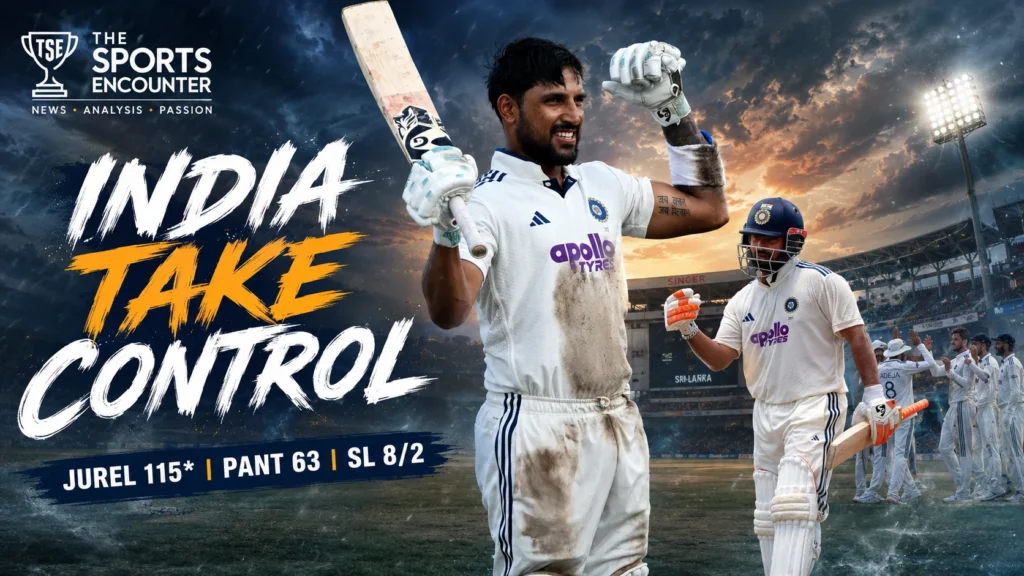
India ended the second day of the second Test in Colombo with complete control of the match after piling up 503 for nine declared and reducing Sri Lanka to 8 for two in fading light at the Sinhalese Sports Club Ground.
Dhruv Jurel’s assured 115 not out gave India the platform to bat Sri Lanka almost out of the game, while Rishabh Pant returned after retiring hurt on day one to make a typically inventive 63. Devdutt Padikkal’s 117 from the opening day remained the biggest score of the innings, but India’s strength came from how consistently they found partnerships across the batting order.
Shubman Gill had made 50, Ravindra Jadeja contributed 43, Yashasvi Jaiswal scored 45, and India kept extending the innings until they crossed 500 late in the day.
The declaration then became part of the strategy.
With light fading and only spin allowed as conditions deteriorated, Prasidh Krishna removed Lahiru Udara for one before Manav Suthar trapped nightwatchman Prabath Jayasuriya lbw with the final ball of the day.
Sri Lanka closed on 8 for two after three overs, still 495 runs behind.
India remain 18 wickets away from completing a 2-0 series win, but after two days the structure of the Test is unmistakable. Sri Lanka must first survive, then find a way to bat long enough to make India work for control they already possess.
India vs Sri Lanka 2nd Test: Day 2 at a Glance
| Match | Sri Lanka vs India, 2nd Test |
| Series | India tour of Sri Lanka 2026 |
| Competition | ICC World Test Championship 2025-27 |
| Venue | Sinhalese Sports Club Ground, Colombo |
| Date | August 24, 2026, Day 2 |
| India | 503/9 declared in 138 overs |
| Sri Lanka | 8/2 in 3 overs |
| Match position | Sri Lanka trail by 495 runs |
| India’s top scorers | Devdutt Padikkal 117, Dhruv Jurel 115*, Rishabh Pant 63 |
| Best Sri Lanka bowler | Asitha Fernando 4/106 |
| Late wickets | Prasidh Krishna and Manav Suthar |
TL;DR
- India declared on 503 for nine after extending their first innings deep into day two.
- Dhruv Jurel finished unbeaten on 115, his second Test hundred.
- Rishabh Pant returned after retiring hurt on day one and scored 63.
- Devdutt Padikkal’s 117 remained India’s highest individual score.
- Asitha Fernando was Sri Lanka’s most successful bowler with 4 for 106.
- India declared immediately after reaching 500.
- Prasidh Krishna dismissed Lahiru Udara for one.
- Manav Suthar removed nightwatchman Prabath Jayasuriya lbw with the final ball of the day.
- Sri Lanka closed on 8 for two and trail by 495 runs.
- India are firmly positioned to push for a 2-0 series victory.
India Resume With the Match Already Leaning Their Way
India had ended day one at 300 for five, with Dhruv Jurel on seven and Saransh Jain on four.
The overnight score already represented a strong foundation, but the second day was about whether India could convert that advantage into a total Sri Lanka would spend several sessions trying to escape.
They did exactly that.
There was an early complication because Rishabh Pant had retired hurt on the first day at 207 for three and did not resume immediately.
When he returned at 307 for six, India had lost three wickets for 100 runs since his departure.
The innings could have entered a more fragile phase.
Pant and Jurel made sure it did not.
The pair brought completely different energies to the partnership. Pant accelerated. Jurel settled. That combination gradually pushed Sri Lanka out of the session.
The wider significance of India’s batting depth had already been identified before the tour in The Sports Encounter’s India vs Sri Lanka Test series preview, where Pant, Jadeja and Jurel were identified as players capable of extending an innings beyond the specialist top order.
Colombo provided the clearest example yet.
Pant Returns and Immediately Changes the Tempo
Pant’s return altered Sri Lanka’s problem.
Before he came back, they could still think in conventional Test-match terms: remove the remaining specialist batter, work into the lower order and restrict India somewhere around 350 or 380.
Pant does not allow a bowling side to remain comfortable inside those calculations.
He reached his fifty from 81 balls, hitting five fours and a six on the way.
By lunch, India had moved to 419 for six.
Pant was on 63.
Jurel was on 59.
The seventh-wicket stand had passed 100.
India had added 119 runs during the first session without losing a wicket.
That was the session in which Sri Lanka’s prospects of keeping the first innings within manageable range largely disappeared.
Pant’s 63 Was More Valuable Than the Number Alone
Pant eventually fell for 63 from 89 deliveries.
His innings included six fours and two sixes and came at a strike rate of 70.78.
The raw figures were strong.
The timing mattered more.
India were no longer trying to recover when Pant returned. They were trying to convert control into dominance.
Pant’s aggression accelerated that process and gave Jurel time to construct an innings without being forced into unnecessary risks.
The partnership added 112 runs before Pant was dismissed at 419.
For Sri Lanka, it was the kind of seventh-wicket stand that causes more damage than many top-order partnerships because it arrives when a bowling side expects relief.
Pant’s ability to affect games before becoming India’s established Test wicketkeeper-batter was already evident when he won the ICC Emerging Men’s Cricketer of the Year award in 2018, a period included in The Sports Encounter’s complete 10-year history of ICC award winners.
Dhruv Jurel Shows Why India Can Use Him as a Specialist Batter
Jurel’s innings was different.
There was very little wasted movement and almost no sense that he was trying to prove anything through aggression.
He reached fifty from 97 balls.
His hundred came from 171.
By then, India had already crossed 475 and the question had shifted from whether Sri Lanka could restrict the total to when Gill would declare.
Jurel finished unbeaten on 115 from 177 deliveries, with nine fours and two sixes.
The innings lasted 291 minutes.
That is the part of his contribution that matters most.
India did not require a wicketkeeper’s cameo.
They needed a specialist batter’s innings.
Jurel supplied one.
His ability to spend nearly five hours at the crease gave India the luxury of batting through interruptions, weather delays and the loss of wickets around him.
Why Jurel’s Hundred Matters Beyond This Match
India’s Test batting has increasingly depended on flexibility around the middle order.
Pant’s availability changes one combination.
Jadeja’s role changes another.
Conditions determine whether India want an additional spinner, batter or seam option.
Jurel’s hundred strengthens the argument that he can be selected because of his batting rather than only as cover behind the stumps.
That flexibility may become increasingly valuable during the extraordinary run of 19 consecutive scheduled Test-cricket days in August, where squad depth and recovery periods are already becoming important across several international series.
Against Sri Lanka, however, the immediate value was simpler.
He ensured India reached 500.
Sri Lanka Keep Working but Cannot Stop the Total Growing
Asitha Fernando was comfortably Sri Lanka’s most successful bowler.
He finished with four wickets for 106 from 29 overs and removed Yashasvi Jaiswal, Shubman Gill, Ravindra Jadeja and Saransh Jain.
Prabath Jayasuriya bowled 42 overs for 132 runs and took two wickets.
Keshara Nuwantha also claimed two, dismissing Padikkal and Pant, but conceded 154 runs from 38 overs.
The numbers reflected Sri Lanka’s larger problem.
They could take wickets.
They could not take them quickly enough.
Every breakthrough was followed by another partnership or another period in which India absorbed pressure.
Padikkal’s 117 had anchored the first day.
Gill’s 50 helped stabilize the first innings.
Jadeja added 43.
Pant came back and made 63.
Jurel remained there until the declaration.
That spread of runs prevented Sri Lanka from identifying one wicket that could end the innings.
Rain Delays Jurel’s Hundred but Not India’s Plan
Weather interrupted the second half of the day with India on 475 for eight.
Jurel was stranded on 95 when rain stopped play.
The delay also reached the scheduled tea interval.
For Sri Lanka, the interruption offered temporary relief.
For India, it changed very little.
Jurel returned and completed his century.
Mohammed Siraj occupied 29 balls for three runs before Prabath Jayasuriya dismissed him lbw.
Prasidh Krishna then joined Jurel and helped India reach the psychological and tactical landmark they had clearly been targeting.
Five hundred arrived at the end of the 138th over.
The declaration followed immediately at 503 for nine.
India’s Declaration Was About More Than the Score
Five hundred was obviously a substantial total.
The timing made it more dangerous.
India had the opportunity to send Sri Lanka in late in the day, with conditions becoming darker and the batters beginning an innings after spending almost two days in the field.
That combination often creates a vulnerable period in Test cricket.
A fresh opener has to reset mentally after fielding for nearly 140 overs.
Footwork is less certain.
Visibility is deteriorating.
The bowling side has nothing to lose by attacking.
The batting side knows stumps are close enough to encourage survival rather than scoring.
India used that window almost perfectly.
Prasidh Krishna Strikes Before Sri Lanka Can Settle
Lahiru Udara faced only six balls.
He made one.
Prasidh Krishna removed him in the second over, with Yashasvi Jaiswal completing the catch.
Sri Lanka were 1 for one.
The wicket immediately changed the mood around what remained of the day.
Kamil Mishara, making his Test debut, was now batting under pressure before he had properly begun his innings.
His selection also represents a significant format transition. Earlier in August, Mishara had produced one of the standout innings of the Lanka Premier League when his unbeaten 108 powered Jaffna Kings past Galle Gallants in a 470-run playoff contest. That performance is covered in The Sports Encounter’s report on Mishara’s LPL 2026 Qualifier 1 century.
Sri Lanka responded by sending Prabath Jayasuriya in as nightwatchman.
The logic was obvious.
Protect the specialist batters.
Get through the final few minutes.
Begin again in daylight.
That plan almost worked.
Bad Light Brings Spin Into the Game
The conditions created an unusual final passage.
The umpires’ light meters dictated that play could continue only if India used spin.
Gill turned to Manav Suthar.
That did not make the situation easier for Jayasuriya.
Suthar’s left-arm spin included an arm ball that behaved far more like a swinging delivery than a conventional spinner’s ball.
The first deliveries gave Jayasuriya an indication of the threat.
The last one removed him.
Suthar’s Final-Ball Wicket Leaves Sri Lanka 8/2
Suthar went fuller with the final ball of the day.
Jayasuriya tried to defend but his front pad came into play before the bat.
Umpire Ahsan Raza gave him out.
Sri Lanka reviewed.
Ball-tracking showed the delivery clipping leg stump.
The original decision stood on umpire’s call.
Jayasuriya was out for two from seven balls.
Sri Lanka were 8 for two.
Stumps were called immediately afterward.
For a side already trailing by almost 500 runs, losing the nightwatchman with the final ball was especially damaging because the tactical purpose of sending him in had only partly been achieved.
He protected one specialist batter.
He could not protect Sri Lanka from beginning day three with another wicket already gone.
Sri Lanka Face 495-Run Deficit and a Completely Different Day Three
The scoreboard is severe.
Sri Lanka trail by 495.
They have eight first-innings wickets remaining.
The follow-on remains a distant problem because they first need to build anything resembling a normal innings.
The immediate objective is survival through the opening session.
Kamil Mishara will resume on five.
His recent white-ball form has been substantial. He also top-scored for Jaffna with 41 in the LPL 2026 final against eventual champions Galle Gallants, but Test cricket now asks a very different question of his technique and patience.
Pasindu Sooriyabandara, Kamindu Mendis and captain Dhananjaya de Silva remain to come.
Their task is not simply to score.
They need to consume time.
India’s strongest route to victory now involves creating a first-innings deficit large enough to retain complete control over whether they enforce the follow-on or bat again.
Sri Lanka therefore need partnerships capable of changing the time equation.
Why the First Session of Day Three Could Decide the Test
India already possess the scoreboard.
What Sri Lanka still control is how long this Test lasts.
If India take three or four wickets during the first session on day three, the match could accelerate rapidly toward an innings victory or a very short fourth-innings target.
If Sri Lanka bat through the session with only one wicket lost, the game becomes harder physically for India’s attack and weather could begin to matter more.
The first hour is therefore disproportionately important.
Mishara and the next specialist batter must survive Siraj and Prasidh if pace is available.
They must then manage Suthar, Jadeja and India’s other spin options without allowing dot-ball pressure to create desperate shots.
The broader series context also matters. This two-Test contest forms part of the ICC World Test Championship, which gives every result additional value beyond the bilateral series.
The pressure of collecting WTC points is not unique to this series. Recent red-ball contests have also shown how quickly one result can reshape a campaign, including Pakistan’s recovery against West Indies examined in The Sports Encounter’s West Indies-Pakistan Test series review.
India’s Batting Depth Has Become the Difference in the Series
Before the tour began, the most obvious structural advantage India held was depth.
The Sports Encounter’s series preview identified the lower middle order as an area capable of separating the teams in difficult conditions.
Colombo has produced a different kind of match.
The same advantage remains decisive.
India did not need a double century.
They did not need one batter to carry the innings.
They received 117 from Padikkal, 115 not out from Jurel, 63 from Pant, 50 from Gill, 45 from Jaiswal and 43 from Jadeja.
Six batters reached at least 43.
That is why Sri Lanka spent 138 overs bowling.
Padikkal’s Day-One Hundred Remains the Foundation
The second day belonged more visibly to Jurel and Pant, but Devdutt Padikkal’s 117 remains the innings that established India’s control.
He faced 193 balls and hit 12 fours.
That innings allowed India to recover after losing KL Rahul for 18 and Jaiswal for 45.
Gill then added 50 from 108 balls, ensuring Sri Lanka could not turn two early wickets into sustained pressure.
Gill had also been one of India’s leading contributors during their previous England white-ball tour, including a 77 at Lord’s in the match covered in The Sports Encounter’s England-India ODI series finale report. His role in Colombo required a much more patient version of the same top-order responsibility.
By the time Padikkal fell at 281 for four, India had already built the platform that their middle and lower order expanded on day two.
Pant and Jurel Give India Two Different Forms of Pressure
The contrast between Pant and Jurel may be the most useful tactical lesson from India’s innings.
Pant pressured Sri Lanka with tempo.
Jurel pressured them with time.
Pant forced field changes and punished defensive lengths.
Jurel made Sri Lanka keep bowling.
One accelerated the total.
The other extended the innings.
That combination is especially difficult to manage because a bowling side cannot solve both problems with one field or one pace of attack.
Asitha Fernando Deserves Credit in a Difficult Innings
Sri Lanka’s bowlers were made to work for almost two full days, but Asitha Fernando’s performance deserves recognition.
His 4 for 106 came from 29 overs.
He dismissed four players who had the ability to extend India’s innings significantly.
Jaiswal was bowled for 45.
Gill was caught behind for 50.
Jadeja was bowled for 43.
Saransh Jain was removed for six.
On another day, four wickets from a seamer at SSC might have been enough to keep an opposition below 350.
The Sinhalese Sports Club had also staged major franchise cricket earlier in the Sri Lankan season, including Galle’s opening LPL victory over Jaffna, covered in The Sports Encounter’s LPL 2026 opener report from the SSC Ground. Test cricket, however, has placed a very different workload on the surface and Sri Lanka’s attack.
India’s depth made Asitha’s four wickets insufficient.
What India Still Need to Do
The match is heavily tilted toward India.
It is not finished.
They still require 18 wickets.
Weather has already interrupted the Test.
Sri Lanka still possess experienced batters capable of occupying the crease for long periods.
India’s challenge is to avoid allowing the scoreboard advantage to reduce their intensity.
The same discipline that produced 503 must now appear in the field.
Siraj and Prasidh need to challenge the stumps and outside edge early.
Suthar and the other spinners must resist searching for magic deliveries simply because wickets arrived late on day two.
The pressure already exists.
India only need to maintain it.
What Sri Lanka Must Change on Day Three
Sri Lanka’s response cannot be built around the deficit.
Trying to score 495 quickly would only accelerate the defeat.
The first target should be far smaller.
Reach lunch.
Build one partnership.
Force India’s bowlers into second and third spells.
Make the pitch and weather part of the match again.
Kamindu Mendis and Dhananjaya de Silva are likely to carry particular responsibility because both have the technique to absorb spin and the range to score without taking unnecessary risks.
Kamindu entered the Test following a busy domestic franchise season in which he captained Colombo Kaps, including their playoff defeat against Galle examined in The Sports Encounter’s LPL Qualifier 2 analysis. The format has changed completely, but Sri Lanka now need the same willingness to absorb pressure and build a partnership.
If Sri Lanka lose Kamindu and Dhananjaya cheaply, the tail will be exposed far too early.
The 2019 South Africa Parallel Feels Familiar
The closing sequence recalled a pattern India used repeatedly during their 2019 home series against South Africa.
The basic method was simple.
Bat first.
Build a total near 500.
Declare late.
Attack in fading light.
Begin the following morning with the opposition already behind the match.
Colombo followed almost exactly that shape.
India crossed 500.
Gill declared.
Two Sri Lankan wickets disappeared before stumps.
Day three will begin with the hosts 495 behind and their top order immediately exposed.
Day 2 Scorecard Highlights
| India batter | Runs | Balls | 4s | 6s |
|---|---|---|---|---|
| Devdutt Padikkal | 117 | 193 | 12 | 0 |
| Dhruv Jurel | 115* | 177 | 9 | 2 |
| Rishabh Pant | 63 | 89 | 6 | 2 |
| Shubman Gill | 50 | 108 | 6 | 0 |
| Yashasvi Jaiswal | 45 | 53 | 9 | 0 |
| Ravindra Jadeja | 43 | 83 | 4 | 0 |
Sri Lanka Bowling Figures
| Bowler | Overs | Runs | Wickets | Economy |
|---|---|---|---|---|
| Asitha Fernando | 29 | 106 | 4 | 3.65 |
| Prabath Jayasuriya | 42 | 132 | 2 | 3.14 |
| Keshara Nuwantha | 38 | 154 | 2 | 4.05 |
| Lahiru Kumara | 20 | 68 | 1 | 3.40 |
Key Turning Points on Day Two
- Pant returns at 307/6: India regain an aggressive scoring option after his day-one injury interruption.
- Pant and Jurel add 112: Sri Lanka’s chance of keeping India below 400 disappears.
- India reach lunch at 419/6: An entire first session passes without a wicket.
- Jurel completes his century: Another substantial batting contribution becomes the defining day-two landmark.
- India cross 500: Gill declares immediately at 503/9.
- Prasidh removes Udara: Sri Lanka lose an opener before settling into the innings.
- Suthar gets Jayasuriya: The nightwatchman falls lbw from the final ball of the day.
- Sri Lanka close at 8/2: The hosts end day two 495 runs behind.
What to Watch on Day Three
Play is scheduled to begin 15 minutes earlier, at 9:45 a.m. local time, to compensate for time lost to weather.
The first session should answer several major questions.
- Can Kamil Mishara handle the pressure of a Test debut with India attacking from the first over?
- Can Kamindu Mendis and Dhananjaya de Silva build the long partnership Sri Lanka desperately need?
- Will India begin with pace before turning quickly to spin?
- How much assistance will the SSC surface offer Suthar and India’s other slow bowlers?
- Will weather become Sri Lanka’s most realistic route back into the contest?
Official series information can be followed through the Board of Control for Cricket in India and Sri Lanka Cricket. The Test also forms part of the ICC World Test Championship 2025-27.
The Sports Encounter Verdict
India spent two days creating the kind of Test-match position that removes almost every comfortable option from the opposition.
The innings was built in layers.
Padikkal supplied the hundred on day one.
Gill and Jaiswal contributed enough to prevent Sri Lanka from gaining momentum.
Pant returned and accelerated.
Jurel batted with the patience of a specialist and finished unbeaten.
India then used the last few minutes of daylight to turn a huge total into immediate scoreboard pressure.
Sri Lanka’s 8 for two tells only part of the story.
The more important number is 495.
That deficit shapes every decision they make on day three.
The hosts cannot chase the game yet.
They first need to keep it alive.
India, meanwhile, are in the position every touring side wants after two days of a Test match: the opposition are tired, behind on the scoreboard, two wickets down, and already thinking about survival before the next morning has begun.
A 2-0 series win is still a long way away in wicket terms.
In match-position terms, India could hardly have asked for more.
Frequently Asked Questions
What was India’s score in the second Test against Sri Lanka?
India declared their first innings at 503 for nine from 138 overs.
What was Sri Lanka’s score at stumps on day two?
Sri Lanka were 8 for two after three overs.
How far behind were Sri Lanka at the end of day two?
Sri Lanka trailed India by 495 runs.
Who scored a century for India?
Devdutt Padikkal scored 117 and Dhruv Jurel finished unbeaten on 115.
How many runs did Rishabh Pant score?
Pant scored 63 from 89 balls after returning to the innings following his retirement hurt on day one.
Who was India’s highest scorer?
Devdutt Padikkal’s 117 was the highest score, with Dhruv Jurel unbeaten on 115.
Who took the most wickets for Sri Lanka?
Asitha Fernando took four wickets for 106 runs.
Who took Sri Lanka’s two wickets before stumps?
Prasidh Krishna dismissed Lahiru Udara, while Manav Suthar trapped Prabath Jayasuriya lbw.
Why did India declare after reaching 500?
The declaration gave India an opportunity to bowl at Sri Lanka late in the day when the light was fading and the hosts had spent almost two days in the field.
When does day three begin?
Day three is scheduled to begin at 9:45 a.m. local time, 15 minutes earlier than the normal start to recover lost playing time.
Where is the second Test being played?
The match is being played at the Sinhalese Sports Club Ground in Colombo.
Is the Sri Lanka vs India series part of the World Test Championship?
Yes. Both Tests are part of the ICC World Test Championship 2025-27.