


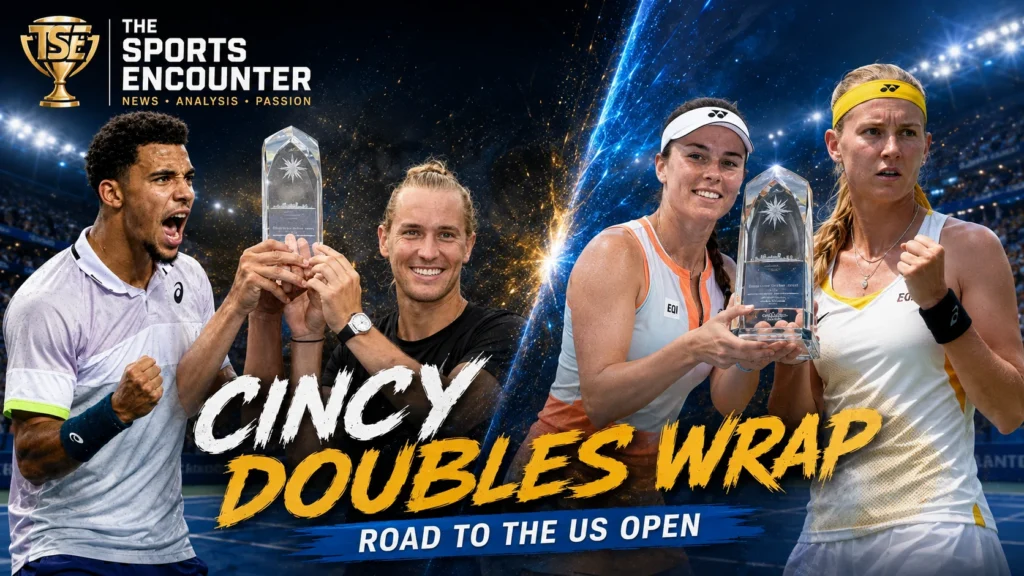
Cincinnati’s singles champions took most of the headlines, but the doubles courts produced two of the most consequential stories of the entire North American hard-court swing.
Orlando Luz and Rafael Matos completed one of the rarest Masters doubles achievements of the Open Era by winning Cincinnati immediately after capturing Montreal.
Linda Noskova and Marie Bouzkova needed only their third tournament together to win a WTA 1000 title, overwhelming Magali Kempen and Alexandra Panova in a final that lasted only one hour.
The men’s championship was built on survival, match-tiebreak pressure and a Brazilian partnership playing the best tennis of its life.
The women’s title followed a different path. Noskova and Bouzkova became increasingly dominant as the tournament progressed and lost only three games in the championship match.
Together, the two title runs created an important final doubles checkpoint before the US Open.
There is also an important distinction for readers following all three doubles disciplines: Cincinnati did not stage mixed doubles in 2026.
The tournament featured separate ATP and WTA doubles competitions. Mixed doubles now becomes a distinctly New York story, with the US Open staging its redesigned championship during Fan Week before the singles main draw begins.
That makes Cincinnati an unusually useful bridge. Traditional doubles specialists leave Ohio with rankings, momentum and tactical evidence, while several of the sport’s biggest singles stars prepare to enter a much shorter and more volatile mixed-doubles format in New York.
Cincinnati Open 2026 Doubles Champions
| Event | Champions | Finalists | Final Score |
|---|---|---|---|
| Men’s Doubles | Orlando Luz / Rafael Matos | Constantin Frantzen / Robin Haase | 6-4, 3-6, 10-7 |
| Women’s Doubles | Marie Bouzkova / Linda Noskova | Magali Kempen / Alexandra Panova | 6-1, 6-2 |
| Mixed Doubles | No mixed doubles competition was staged in Cincinnati in 2026 | ||
The official Cincinnati Open report confirms Luz and Matos became only the fifth men’s team in the Open Era to win Canada and Cincinnati in the same season.
Men’s Doubles: Luz and Matos Complete a North American Double Almost Nobody Achieves
Before August, Orlando Luz had never progressed beyond the second round of an ATP Masters 1000 tournament.
Within a matter of weeks, he had won two of them.
Luz and Rafael Matos defeated Constantin Frantzen and Robin Haase 6-4, 3-6, 10-7 in the Cincinnati final to complete a Canada-Cincinnati sweep achieved by only five teams during the Open Era.
| Team | Year of Canada-Cincinnati Sweep |
|---|---|
| Bruce Manson / Brian Teacher | 1980 |
| Bob Bryan / Mike Bryan | 2010 |
| Ivan Dodig / Marcelo Melo | 2016 |
| Pierre-Hugues Herbert / Nicolas Mahut | 2017 |
| Orlando Luz / Rafael Matos | 2026 |
The Sports Encounter had already documented the first half of the achievement when Luz and Matos became the first all-Brazilian team to win an ATP Masters 1000 title in Montreal.
Montreal could have been treated as the breakthrough.
Cincinnati transformed it into something larger.
One Masters title can emerge from one extraordinary week. Back-to-back Masters championships require a partnership to survive accumulated fatigue, tactical adjustments, different opponents and the psychological change that occurs when every team in the next draw knows exactly how well you are playing.
Men’s Doubles Quarterfinals
| Match | Result |
|---|---|
| Marcel Granollers / Horacio Zeballos vs Luciano Darderi / Tomas Martin Etcheverry | Granollers / Zeballos 6-3, 7-6(8) |
| Constantin Frantzen / Robin Haase vs Theo Arribage / Albano Olivetti | Frantzen / Haase 7-6(1), 7-6(3) |
| Hugo Nys / Edouard Roger-Vasselin vs Sadio Doumbia / Fabien Reboul | Nys / Roger-Vasselin 4-6, 7-6(5), 11-9 |
| Orlando Luz / Rafael Matos vs Simone Bolelli / Andrea Vavassori | Luz / Matos 7-6(7), 6-3 |
The last eight revealed two very different routes toward the final weekend.
Frantzen and Haase advanced without dropping a set against Arribage and Olivetti, although both sets required tiebreaks.
Granollers and Zeballos, one of the most experienced partnerships in the draw, also survived a tight second-set breaker.
Nys and Roger-Vasselin survived the most dramatic quarterfinal. After losing the opening set to Doumbia and Reboul, they won the second-set tiebreak and escaped the match tiebreak 11-9.
Luz and Matos produced the cleaner statement by defeating fourth seeds Bolelli and Vavassori in straight sets.
The result deserves context. Bolelli and Vavassori had already won Masters titles in Miami and Rome during 2026 and entered Cincinnati among the most accomplished partnerships of the season.
Luz and Matos removed them without requiring another match tiebreak.
The Brazilian Pair Had Already Removed Zverev and Melo
Their path had been demanding even before the quarterfinals.
Luz and Matos defeated Marcelo Melo and Alexander Zverev 7-6(4), 6-3 in the round of 16.
Melo remains one of Brazil’s most accomplished doubles players, while Zverev’s serve makes almost any partnership dangerous in a short-format match.
The Brazilians handled that combination and then defeated Bolelli and Vavassori.
The official ATP Cincinnati doubles results provide the complete tournament path and match scores.
Men’s Semifinal: Luz and Matos Take Control of the Match Tiebreak
Hugo Nys and Edouard Roger-Vasselin forced Luz and Matos into another momentum reversal in the semifinal.
The Brazilians won the first set 6-4.
Nys and Roger-Vasselin responded 6-2.
The entire match was suddenly reduced to a 10-point decider.
Luz and Matos won it 10-2.
That margin is particularly striking because match tiebreaks are normally volatile. A few loose returns or one strong serving sequence can completely change the outcome.
The Brazilians never allowed that randomness to develop.
Frantzen and Haase Remove Granollers and Zeballos
The other semifinal also required a deciding match tiebreak.
Frantzen and Haase took the opening set 6-3 before Granollers and Zeballos answered with the same score in the second.
The German-Dutch partnership then won the decider 10-5.
That victory carried significant weight because Granollers and Zeballos possess years of elite Grand Slam and Masters experience.
Frantzen and Haase compensated through execution and earned their place in the final.
The Men’s Final: Ten Points for History
Luz and Matos began the championship match in control and won the first set 6-4.
Frantzen and Haase responded 6-3.
That produced the most appropriate possible conclusion to a Cincinnati doubles tournament dominated by match-tiebreak pressure.
Ten points would decide a Masters 1000 title.
Luz and Matos won the decider 10-7.
The match lasted one hour and 17 minutes.
Luz fell to his knees after match point.
The emotion made sense.
Only weeks earlier, he had never progressed beyond the second round of a Masters tournament. Now he and Matos had won two consecutively.
The official Cincinnati Open says the partnership has now collected five tour-level titles together, with four arriving in 2026.
Why Luz and Matos Are So Difficult to Break
Their strength is not based around one overwhelming serve or one player dominating every exchange at the net.
The partnership works because responsibilities remain balanced.
They communicate constantly.
They reset after losing sets.
They generate energy for each other rather than waiting for the other player to solve the problem.
That emotional stability has become especially valuable in the shortened deciding format used on the ATP Tour.
A doubles team can possess two excellent players and still collapse if one player’s difficult service game changes the other’s body language.
Luz and Matos currently appear unusually resistant to that problem.
What the Canada-Cincinnati Sweep Means for the US Open
New York creates a different challenge.
At Masters level, the deciding match tiebreak can compress an entire contest into a handful of points.
Grand Slam doubles demands longer stretches of sustained concentration, gives opponents more time to identify tactical patterns and places greater physical demands on partnerships across multiple rounds.
Still, no traditional men’s doubles pair leaves the North American Masters swing with stronger momentum.
Montreal proved Luz and Matos could win a Masters title.
Cincinnati proved they could immediately do it again.
That makes them impossible to ignore when the US Open doubles draw begins.
Women’s Doubles: Noskova and Bouzkova Find Chemistry Almost Immediately
Linda Noskova had already transformed her 2026 season before arriving in Cincinnati.
She had won Wimbledon singles.
Now she owns a WTA 1000 doubles title too.
Noskova partnered fellow Czech Marie Bouzkova and defeated Magali Kempen and Alexandra Panova 6-1, 6-2 in the Cincinnati final.
The match lasted exactly one hour.
That level of domination would be impressive for a partnership with years of shared experience.
Noskova and Bouzkova were competing together for only the third time.
The official Cincinnati Open women’s doubles report confirms the Czech pair’s 6-1, 6-2 victory and their remarkably quick development as a team.
Why the Partnership Works
The most interesting part of the partnership is how naturally their strengths divide the court.
Noskova provides greater raw power.
Bouzkova offers coverage, anticipation and defensive stability.
That balance allows Noskova to attack aggressively without requiring Bouzkova to play the same style.
They complement one another rather than duplicate one another.
Noskova’s extraordinary season has also made her one of the central names in the women’s US Open discussion. The Sports Encounter’s Cincinnati women’s singles wrap and US Open race analysis examined how Coco Gauff’s title, Noskova’s rise and several other developments changed the landscape entering New York.
TSE also followed the women’s doubles major season when Guo Hanyu and Kristina Mladenovic won the Wimbledon women’s doubles championship.
Women’s Doubles Quarterfinals
| Match | Result |
|---|---|
| Magali Kempen / Alexandra Panova vs Hao-Ching Chan / Maya Joint | Kempen / Panova 1-6, 6-4, 10-2 |
| Iva Jovic / Caty McNally vs Xinyu Jiang / Zhang Shuai | Jovic / McNally 7-6(8), 3-6, 10-6 |
| Hsieh Su-Wei / Jelena Ostapenko vs Guo Hanyu / Kristina Mladenovic | Hsieh / Ostapenko 6-3, 6-4 |
| Marie Bouzkova / Linda Noskova vs Erin Routliffe / Aldila Sutjiadi | Bouzkova / Noskova 7-5, 7-5 |
Noskova and Bouzkova Remove a Defending Cincinnati Champion
Erin Routliffe entered Cincinnati chasing a third consecutive title at the tournament.
She had won in 2024 with Asia Muhammad and again in 2025 with Gabriela Dabrowski.
In 2026 she partnered Aldila Sutjiadi.
Bouzkova and Noskova defeated them 7-5, 7-5.
That was the point at which their run stopped looking like an interesting new partnership experiment and started looking like a genuine championship campaign.
Jovic and McNally Remove the No. 1 Team
The women’s doubles draw had already opened considerably before the quarterfinals.
Iva Jovic and Caty McNally eliminated top-ranked Katerina Siniakova and Taylor Townsend 5-7, 6-4, 10-8 in the round of 16.
The upset carried additional significance because Siniakova entered Cincinnati immediately after winning Toronto alongside Zhang Shuai.
The Sports Encounter covered that Canadian title in our National Bank Open doubles finals report.
Siniakova and Townsend were among the obvious Cincinnati favorites.
They were gone before the last eight.
Kempen and Panova Produce the Most Unexpected Final Run
Magali Kempen and Alexandra Panova were not the partnership most expected to reach championship Saturday.
Their quarterfinal initially looked likely to end quickly when Chan and Joint won the first set 6-1.
Kempen and Panova completely reversed the match.
They won the second set 6-4 and then dominated the match tiebreak 10-2.
The comeback became part of a wider story for a partnership that had spent months trying to make doubles financially and competitively sustainable.
A WTA 1000 final therefore represented far more than one strong tournament.
Hsieh and Ostapenko Remove the Wimbledon Champions
Another quarterfinal carried major pedigree.
Guo Hanyu and Kristina Mladenovic had won Wimbledon only weeks earlier.
Hsieh Su-Wei and Jelena Ostapenko beat them 6-3, 6-4.
Hsieh remains one of doubles tennis’s most difficult players to read because she rarely attempts to overpower opponents conventionally.
She changes pace, redirects the ball early and manipulates positioning.
Ostapenko provides the opposite energy through explosive returning and first-strike aggression.
The combination appeared dangerous enough to win Cincinnati.
Kempen and Panova stopped them in the semifinal.
Women’s Semifinals
| Match | Result |
|---|---|
| Magali Kempen / Alexandra Panova vs Hsieh Su-Wei / Jelena Ostapenko | Kempen / Panova 6-3, 7-5 |
| Marie Bouzkova / Linda Noskova vs Iva Jovic / Caty McNally | Bouzkova / Noskova 6-3, 6-2 |
By the semifinals, much of the original power structure had disappeared.
Siniakova and Townsend were gone.
Routliffe was gone.
Wimbledon champions Guo and Mladenovic were gone.
Hsieh and Ostapenko then disappeared too.
Kempen and Panova defeated them 6-3, 7-5.
Noskova and Bouzkova took an even more direct route, defeating Jovic and McNally 6-3, 6-2.
The Women’s Final: One Hour of Czech Control
The championship match was essentially decided by how Noskova and Bouzkova handled the first pressure point.
They broke for 3-1 in the opening set.
From there, the match accelerated.
The first set finished 6-1.
Another early break arrived in the second.
Kempen and Panova never generated enough return pressure to disrupt the Czech rhythm.
Noskova’s power opened the court.
Bouzkova’s anticipation closed it.
The final finished 6-1, 6-2 in exactly one hour.
Thirteen games were played.
The champions won eleven of them.
Czech Tennis Keeps Producing Depth
Noskova’s Cincinnati success also belongs inside a larger Czech tennis story.
Her Wimbledon singles championship had already given the country another major champion.
Karolina Muchova had reached the same final.
Now Noskova and Bouzkova have added a Cincinnati doubles title.
This looks increasingly less like a short cycle built around one exceptional player and more like a system producing women capable of succeeding in both singles and doubles.
That versatility becomes particularly relevant at a Grand Slam, where schedules, fatigue and tactical adaptability can determine whether players continue in multiple disciplines.
What About Cincinnati Mixed Doubles?
There was none.
That distinction matters because the US Open has made mixed doubles unusually prominent in 2026.
Cincinnati staged men’s and women’s doubles, but no mixed championship.
Rather than treating that absence as a gap, it helps explain the calendar.
Mixed doubles moves directly into New York, where the US Open has transformed the discipline into a separate Fan Week showcase.
US Open Mixed Doubles Runs From August 24 to 26
The 2026 US Open Mixed Doubles Championship begins with qualifying on August 24.
Eight qualifying teams compete for two remaining main-draw places.
The main competition then contains 16 teams.
First-round and quarterfinal matches are scheduled for August 25, with the semifinals and championship match taking place at Arthur Ashe Stadium on August 26.
The official US Open Mixed Doubles Championship page provides the current schedule, draw information and event details.
US Open 2026 Mixed Doubles Format
| Stage | Format |
|---|---|
| Qualifying through semifinals | Best of three sets, sets to four games, no-ad scoring, 10-point match tiebreak instead of a full third set |
| Final | Best of three sets to six games, no-ad scoring, 10-point match tiebreak instead of a full third set |
The Sports Encounter’s complete US Open 2026 preview examines Fan Week, the singles fields, mixed doubles and the major storylines surrounding the final Grand Slam of the season.
The Official Mixed Doubles Draw Brings Together Stars and Specialists
The US Open’s final mixed-doubles field is deliberately constructed to place world-class singles names and elite doubles specialists inside the same shortened competition.
Top seeds Aryna Sabalenka and Novak Djokovic were drawn against Leylah Fernandez and Frances Tiafoe in the opening round.
Serena Williams and Carlos Alcaraz received a wild card, while Taylor Townsend and Alexander Zverev, Sara Errani and Andrea Vavassori, Emma Navarro and Tommy Paul, Alex Eala and Felix Auger-Aliassime, Elina Svitolina and Gael Monfils, and several other high-profile combinations are also part of the championship.
The official US Open draw announcement also underlines how dramatically this version differs from traditional Grand Slam mixed doubles.
Doubles specialists such as Townsend, Errani and Vavassori bring positioning, communication and return instincts developed specifically for the discipline.
Players such as Sabalenka, Djokovic, Alcaraz and Zverev bring overwhelming singles firepower.
The shortened scoring system reduces the time available for either style to recover from a poor game.
Wimbledon Provides the Traditional Mixed-Doubles Counterpoint
Only weeks ago, traditional Grand Slam mixed doubles produced one of the season’s most compelling partnership stories.
Jelena Ostapenko and Marcelo Arevalo came from a set down to win Wimbledon, a championship covered in our Wimbledon 2026 mixed doubles final report.
That match unfolded over conventional sets and allowed tactical adjustments to develop gradually.
The US Open’s compact mixed format is designed around the opposite idea.
There is very little recovery time.
A poor return game can decide a four-game set.
A match tiebreak can decide everything.
That makes doubles instincts potentially even more valuable.
Luz and Matos Carry the Strongest Traditional Men’s Doubles Momentum
The Brazilians have now won Montreal and Cincinnati consecutively.
The championships required different paths.
In Montreal, Luz and Matos defeated Marcelo Arevalo and Mate Pavic after losing the opening set.
In Cincinnati, Frantzen and Haase again forced them into a deciding match tiebreak.
That means their biggest titles repeatedly required emotional recovery.
For the US Open, that matters because Grand Slam doubles will expose partnerships to longer stretches in which one player can lose timing.
Luz and Matos have shown they can survive those periods without destabilizing as a team.
Noskova and Bouzkova Carry a Different Kind of Momentum
The Czech pair arrive with less shared history but greater tactical surprise.
Opponents have relatively little material from which to establish long-term patterns against them.
Noskova also enters New York with enormous singles confidence after her Wimbledon championship.
The physical question is workload.
Players competing deep in singles and doubles face a completely different recovery problem during a Grand Slam.
The women’s singles race is already loaded with contenders. The Sports Encounter’s Coco Gauff Cincinnati title analysis examines how Gauff, Jessica Pegula, Iga Swiatek, Aryna Sabalenka and other contenders now approach New York.
Cincinnati Also Changed the Singles Momentum Entering New York
The doubles championships did not happen in isolation.
Arthur Fils won the men’s singles title and enters the US Open with the biggest trophy of his career. Our Arthur Fils Cincinnati championship analysis examines how his title changed the men’s US Open conversation.
Brandon Nakashima also continued one of the strongest North American hard-court stretches of any American player, reaching the Cincinnati semifinals after previously making the Montreal final.
The Sports Encounter covered his quarterfinal breakthrough when Nakashima defeated Taylor Fritz to reach the Cincinnati semifinals.
That wider singles context matters because some of the same names involved in the mixed event are entering New York with very different levels of physical and competitive momentum.
The Established Doubles Hierarchy Leaves Cincinnati With Warnings
The teams that failed to reach the finals matter too.
Harri Heliovaara and Henry Patten were eliminated in the round of 16.
Marcelo Arevalo and Mate Pavic also disappeared before the quarterfinals.
Rajeev Ram and Joe Salisbury were eliminated by Frantzen and Haase.
On the women’s side, Siniakova and Townsend fell before the quarterfinals.
Defending Cincinnati champion Routliffe was beaten in the last eight.
Wimbledon champions Guo and Mladenovic also stopped at the quarterfinal stage.
There is no dominant doubles partnership entering New York with complete protection from the draw.
That could make the US Open doubles events unusually open.
The Match-Tiebreak Question Changes at a Grand Slam
This may be the most important tactical difference between Cincinnati and the traditional US Open doubles competitions.
ATP and WTA tour doubles frequently uses a 10-point match tiebreak instead of a full deciding set.
That rewards fast resets and makes brief bursts of momentum extremely valuable.
Grand Slam men’s and women’s doubles demands longer set management.
A partnership that dominates match tiebreaks does not automatically possess the same advantage over longer deciding stretches.
Luz and Matos therefore have something else to prove.
Cincinnati showed they can handle condensed pressure.
New York will test whether they can sustain their quality for longer.
Why Doubles Specialists Still Matter
Cincinnati’s finals offered an important reminder.
The men’s championship was not decided by two celebrity singles pairings.
The women’s final was not won by the highest-ranked singles players in the draw.
The trophies went to partnerships that understood positioning, communication, return placement and transition play.
Doubles remains its own discipline.
Singles ability helps.
It does not replace doubles instinct.
That distinction will become especially interesting when the US Open mixed event puts stars and specialists on the same court under a format designed to make every mistake more expensive.
TSE Analysis: Cincinnati Changed the Doubles Conversation Before New York
Luz and Matos leave Cincinnati with the clearest traditional doubles momentum of the North American summer.
Their two Masters titles demonstrate more than form. They show emotional resilience across multiple deciding match tiebreaks and against established partnerships.
Noskova and Bouzkova present almost the opposite problem for opponents.
They are new enough that scouting remains limited, yet their complementary games already look organized enough to win at WTA 1000 level.
The established hierarchy also leaves Ohio with fewer guarantees.
Major champions, No. 1 teams and defending Cincinnati winners all disappeared before the finals.
That creates a wide-open traditional doubles picture.
Mixed doubles then adds another layer entirely.
New York is deliberately turning the discipline into a high-profile Fan Week event built around short sets, rapid pressure and superstar combinations.
The result is that doubles enters the US Open through two very different doors.
Luz, Matos, Noskova and Bouzkova arrive carrying evidence from the traditional game.
Sabalenka, Djokovic, Alcaraz, Williams, Townsend, Zverev and the mixed field arrive for something designed almost as a separate product.
Both stories begin in New York this week.
Frequently Asked Questions
Who won the Cincinnati Open 2026 men’s doubles title?
Orlando Luz and Rafael Matos defeated Constantin Frantzen and Robin Haase 6-4, 3-6, 10-7.
Who won the Cincinnati Open 2026 women’s doubles title?
Linda Noskova and Marie Bouzkova defeated Magali Kempen and Alexandra Panova 6-1, 6-2.
Did Cincinnati stage mixed doubles in 2026?
No. Cincinnati staged separate ATP and WTA doubles events but did not hold a mixed-doubles championship.
What record did Luz and Matos achieve?
They became only the fifth men’s partnership in the Open Era to win Canada and Cincinnati in the same season.
How many ATP titles have Luz and Matos won together?
They have won five tour-level titles together, with four coming during 2026.
How long had Noskova and Bouzkova been playing together?
Cincinnati was only their third tournament as a partnership.
When is the US Open 2026 Mixed Doubles Championship?
Qualifying began on August 24. The first round and quarterfinals are scheduled for August 25, with the semifinals and final on August 26.
How many teams are in the US Open mixed-doubles main draw?
The main championship contains 16 teams, including two teams advancing from qualifying.
What is the US Open mixed-doubles scoring format?
Qualifying through the semifinals uses sets to four games with no-ad scoring and a 10-point match tiebreak instead of a full third set. The final uses sets to six games, also with no-ad scoring and a 10-point deciding match tiebreak.
Who are the top seeds in US Open mixed doubles?
Aryna Sabalenka and Novak Djokovic are the top seeds in the 2026 US Open Mixed Doubles Championship.