


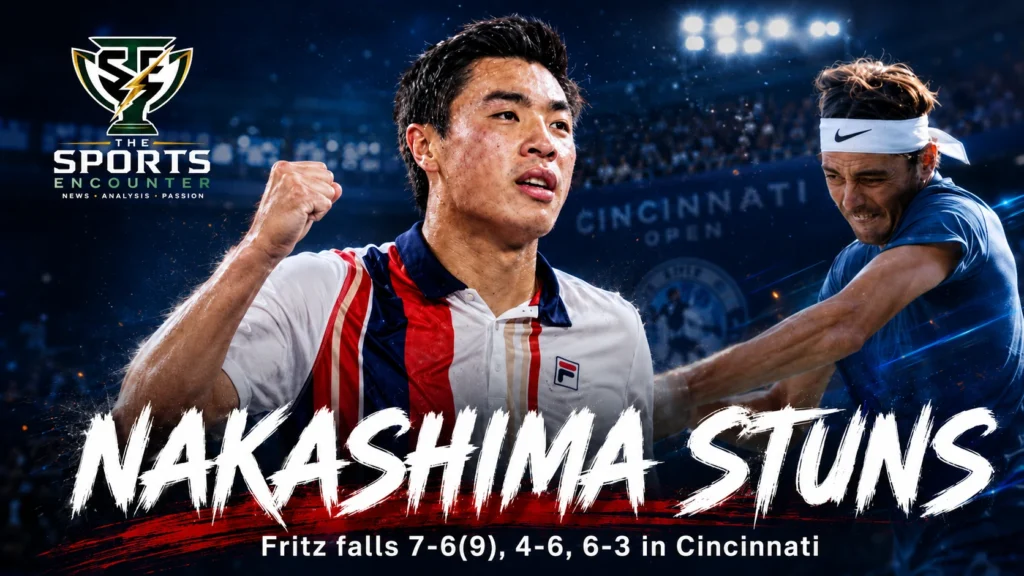
CINCINNATI, Ohio, August 22, 2026: Brandon Nakashima has turned the North American hard-court summer into the defining stretch of his career.
Two weeks after reaching his first ATP Masters 1000 final in Montreal, the 25-year-old American produced another major result on home soil, defeating sixth seed Taylor Fritz 7-6(11-9), 4-6, 6-3 in a tense Cincinnati Open quarterfinal.
The victory sends Nakashima into the semifinals at the Lindner Family Tennis Center and removes one of the highest-ranked players remaining in a men’s draw that has already lost Alexander Zverev, Novak Djokovic, Daniil Medvedev, Felix Auger-Aliassime and several other established contenders.
For Fritz, the defeat is particularly painful because he had successfully dragged the match into a deciding set after losing an extraordinary opening tiebreak. For Nakashima, it represents another sign that his recent surge has moved beyond a temporary hot streak.
He has now beaten Daniil Medvedev and Fritz during the same Cincinnati campaign after arriving in Ohio with confidence from his breakthrough run in Montreal.
The Sports Encounter has followed that rise throughout the summer, including Nakashima’s run to his first Masters 1000 final in Montreal, where his aggressive baseline tennis and improved willingness to finish points at the net began changing the ceiling of his game.
Taylor Fritz vs Brandon Nakashima: Cincinnati Quarterfinal Result
| Player | Set 1 | Set 2 | Set 3 |
|---|---|---|---|
| Taylor Fritz [6] | 6 (9) | 6 | 3 |
| Brandon Nakashima [27] | 7 (11) | 4 | 6 |
Winner: Brandon Nakashima
Final score: 7-6(11-9), 4-6, 6-3
Round: Men’s singles quarterfinal
Tournament: Cincinnati Open 2026
Surface: Outdoor hard court
Venue: Lindner Family Tennis Center
The official ATP Cincinnati tournament page lists the event as one of the season’s premier Masters 1000 tournaments, with the 2026 edition running through August 23.
A 20-Point Tiebreak Sets the Tone
The opening set immediately established what kind of match this would become.
Neither American was prepared to surrender control on serve, and the first set eventually moved into a tiebreak where the pressure continued to build long after the normal seven-point finish line had passed.
Fritz reached nine points.
Nakashima reached 11.
That 11-9 tiebreak gave Nakashima the opening set and placed Fritz in the uncomfortable position of having to chase a match against an opponent whose confidence has been growing almost every week.
Fast hard courts suit both players. Fritz possesses one of the most effective first-serve and forehand combinations in American tennis, while Nakashima has increasingly learned how to take the ball earlier and prevent opponents from settling into defensive patterns.
That made the first set less about extended control from the baseline and more about who could handle the small moments around serve, return depth and first-strike execution.
Nakashima handled the decisive points better.
Fritz Refuses to Let the Match Escape
Fritz entered Cincinnati with reasons to trust himself in difficult matches.
Earlier this month, he defeated Nakashima in three sets in the Washington semifinals before going on to win the Mubadala DC Open title.
The Sports Encounter documented that run in our report on Fritz’s Washington championship, where he repeatedly recovered from momentum shifts before defeating Rafael Jodar in the final.
That resilience appeared again in Cincinnati.
After losing such a punishing opening tiebreak, Fritz could easily have allowed frustration to carry into the second set.
Instead, he reset.
The sixth seed protected his service games more efficiently, maintained pressure on Nakashima’s second serve and eventually created enough separation to take the set 6-4.
The match had become exactly what the quarterfinal deserved: a one-set shootout between two Americans arriving in Cincinnati through very different paths.
Nakashima Has Learned How to Survive Deciding Sets
The third set provided another test of the quality that has increasingly defined Nakashima’s summer.
He does not disappear when matches become uncomfortable.
That was visible against Medvedev earlier in Cincinnati.
Nakashima lost the opening set in a tiebreak and then faced three consecutive match points in the second. He saved all three, won another tiebreak and overwhelmed the former US Open champion 6-1 in the deciding set.
Reuters described the result as one of the biggest wins of Nakashima’s season, while the victory extended a run that had already taken him to the Washington semifinals and his first Masters final in Montreal.
The Sports Encounter had already tracked Nakashima’s growing confidence during the Canadian swing, including his progression through a chaotic Montreal draw in our National Bank Open tournament coverage.
Against Fritz, the deciding set again demanded composure.
Nakashima found it.
He secured the separation he needed and protected it through the closing stages, completing the set 6-3 and earning another Masters 1000 semifinal.
Washington Belonged to Fritz. Cincinnati Belongs to Nakashima
The result also gives this emerging American rivalry a useful new chapter.
Only three weeks ago, Fritz beat Nakashima 6-3, 3-6, 6-3 in Washington.
The circumstances were similar.
Three sets.
Hard court.
A place in a major final at stake.
Fritz won that meeting and then lifted the trophy.
Cincinnati produced the reversal.
Nakashima won the first set, Fritz responded in the second, but this time the younger-ranked American controlled the deciding set.
That does not suddenly make Nakashima the stronger player overall. Fritz remains the more established Top 10-level performer, owns considerably more tour-level success and has already reached a US Open final.
What Cincinnati demonstrates is that the gap between them has narrowed.
Nakashima’s Summer Has Changed His Place in American Tennis
At the beginning of the summer, American men’s tennis conversations still tended to begin with Fritz, Ben Shelton, Tommy Paul and Frances Tiafoe.
Nakashima has forced his way into that group.
He reached the Queen’s Club semifinals after beating Alex de Minaur.
He made another semifinal in Washington.
He then produced the biggest tournament run of his career in Montreal, defeating Rafael Jodar in the semifinals to reach his first Masters 1000 final.
The Sports Encounter’s Montreal semifinal report highlighted how Nakashima had started taking the ball more aggressively from the baseline while also moving forward more confidently.
The official Cincinnati Open also noted before this tournament that Nakashima had begun working with former world No. 6 Wayne Ferreira in June.
That partnership appears to be accelerating several parts of his game.
Ferreira has encouraged Nakashima to move forward more often rather than relying almost exclusively on clean baseline patterns.
“Even if I lose some points here and there, just making the effort of coming forward and trying to finish points at the net I think is good for my game,” Nakashima told the official Cincinnati Open website earlier this week.
Medvedev, Borges and Fritz: This Was No Soft Route
Nakashima has earned this semifinal through a demanding part of the draw.
His third-round victory over Daniil Medvedev required him to save three match points.
He then defeated Nuno Borges 6-3, 6-7(5), 6-3 in the fourth round.
Fritz presented a different problem.
Medvedev tries to extend rallies and disrupt rhythm.
Fritz attacks much earlier and can make entire service games disappear quickly when his first delivery is working.
Nakashima has now solved both types of opponent during the same tournament.
That versatility is one reason his Cincinnati run feels more significant than a sequence built around favorable matchups.
Fritz’s Defeat Changes the American Hierarchy in Cincinnati
Cincinnati reached the quarterfinal stage with four American men still alive: Fritz, Nakashima, Tommy Paul and Frances Tiafoe.
The tournament’s official website noted that four American men had not reached the Cincinnati final eight together since 1995.
Paul was eliminated by Flavio Cobolli in another three-set quarterfinal, losing 2-6, 6-3, 6-4.
Fritz has now followed him out.
Tiafoe still has his quarterfinal against Lorenzo Musetti to play, while Nakashima has guaranteed that at least one American will appear in the semifinals.
That becomes particularly important during a summer when US men are again searching for someone capable of converting strong Masters performances into a genuine Grand Slam challenge.
The US Open Context Makes This Victory Bigger
The timing could hardly be better for Nakashima.
The US Open begins immediately after Cincinnati, and the men’s draw has changed dramatically in recent days.
World No. 1 Jannik Sinner has withdrawn because of a persistent right knee injury.
Carlos Alcaraz is returning from a long injury absence.
Novak Djokovic has endured fitness and heat problems.
Several other leading players have struggled for consistency during the North American swing.
The Sports Encounter’s complete US Open 2026 preview identified Fritz as America’s most established men’s contender entering the summer.
Nakashima is now creating a reason to expand that conversation.
He does not need to be called a US Open favorite for this run to matter.
Players who arrive in New York with confidence, clean serving mechanics and recent experience surviving long three-set battles can become exceptionally dangerous during the opening week.
Fritz Still Heads to New York With a Strong Summer Behind Him
The loss should not erase what Fritz has accomplished.
He won Washington.
He reached another Masters 1000 quarterfinal in Cincinnati.
His serve remains one of the most damaging weapons in the men’s field, and his experience gives him advantages Nakashima is still developing.
The question now becomes physical and emotional recovery.
Fritz dealt with chronic knee tendinitis earlier this season, an issue that kept him away from much of the clay swing and returned during Wimbledon.
The official Cincinnati Open highlighted those fitness concerns before the tournament.
With the US Open approaching, there is little value in treating this defeat as a crisis.
Fritz’s bigger objective begins in New York.
Nakashima’s Ranking Rise Is No Longer the Main Story
Nakashima entered Cincinnati at a career-high ranking around No. 22.
Those numbers will continue improving if he keeps reaching the closing rounds of Masters tournaments.
But the more important development is qualitative.
His game is starting to look more complete.
The serve has always been clean.
The backhand has always been reliable.
His court positioning has generally been disciplined.
The missing piece was often aggression at the right moments.
Nakashima could play high-quality tennis without consistently forcing opponents out of their comfort zone.
This summer has looked different.
He is taking larger cuts at second serves, stepping inside the baseline more willingly and finishing more points in the forecourt.
That makes his natural consistency far more dangerous.
The Montreal Final Was a Breakthrough. Cincinnati Is Confirmation.
One deep Masters run can happen through form, draw circumstances and momentum.
Doing it again immediately is harder.
Nakashima arrived in Cincinnati only days removed from the biggest tournament of his career.
There was every possibility of an emotional drop.
Instead, he has beaten Medvedev, survived Borges and now eliminated Fritz.
The Sports Encounter noted during Montreal’s quarterfinal stage that Nakashima was part of a younger group beginning to exploit opportunities created by an unstable ATP hierarchy.
Cincinnati suggests he may be doing more than exploiting openings.
He is starting to create them himself.
Who Will Brandon Nakashima Play Next?
Nakashima will face the winner of the remaining quarterfinal between Lorenzo Musetti and Frances Tiafoe.
Both would present very different challenges.
Musetti brings greater variety, changes pace more naturally and can disrupt Nakashima’s preferred baseline rhythm with angles, slice and movement into the forecourt.
Tiafoe would create another all-American matchup and a completely different kind of atmosphere.
The 2024 Cincinnati finalist has been one of the tournament’s most consistent performers this week and remains dangerous when his serve and forehand begin feeding off crowd energy.
The other semifinal is already set between Flavio Cobolli and Arthur Fils.
Cobolli recovered from a set down to defeat Tommy Paul 2-6, 6-3, 6-4, while Fils dominated Thiago Agustin Tirante 6-3, 6-2.
Cincinnati’s Men’s Draw Has Completely Escaped Its Original Script
Look at the tournament before the first ball was struck.
Alexander Zverev was the top seed.
Felix Auger-Aliassime was seeded second.
Daniil Medvedev, Alex de Minaur, Ben Shelton, Novak Djokovic and Taylor Fritz all appeared capable of reaching the weekend.
Now Cobolli, Fils and Nakashima are already in the semifinals, while Musetti or Tiafoe will complete the final four.
The wider upheaval reflects what has been happening throughout the North American swing.
The Sports Encounter explored the same instability during the National Bank Open quarterfinal stage, where established contenders disappeared and younger players received opportunities to redefine the tournament.
Cincinnati has followed the same theme.
TSE Analysis: Nakashima Won Because He No Longer Needs the Match to Stay Comfortable
That may be the biggest difference between the current Brandon Nakashima and earlier versions of him.
His tennis used to look best when the match stayed orderly.
Clean service games.
Predictable baseline patterns.
Controlled exchanges.
The last two weeks have been anything but orderly.
He saved three match points against Medvedev.
He survived a three-set battle with Borges.
Against Fritz, he endured a 20-point opening tiebreak, lost the second set and still recovered strongly enough to take the deciding set 6-3.
Those experiences matter because Masters 1000 and Grand Slam success eventually requires players to win matches when their preferred pattern disappears.
Nakashima is doing that now.
The First-Set Tiebreak May Have Been the Match
The scoreboard says the match lasted three sets.
The psychological center of it may have been the opening breaker.
Winning an 11-9 tiebreak against a server as dangerous as Fritz requires repeated emotional resets.
A set point can disappear with one serve.
A return opportunity may not come back.
Every mini-break feels temporary.
Nakashima survived that sequence and took the set.
Fritz deserves considerable credit for responding by winning the second, but the tiebreak ensured Nakashima never had to chase the match from behind.
When the third set began, both players effectively entered a fresh contest.
Nakashima handled it better.
What This Means for Brandon Nakashima
- He has reached another ATP Masters 1000 semifinal immediately after making the Montreal final.
- He has defeated Daniil Medvedev and Taylor Fritz during the same Cincinnati run.
- He has strengthened his position among the leading American hard-court players.
- He enters the final days before the US Open with arguably the strongest sustained form of his career.
- He is now two victories away from his first Masters 1000 title.
What This Means for Taylor Fritz
- His Cincinnati title hopes end in the quarterfinals.
- His North American summer still includes the Washington Open championship.
- Recovery becomes the priority before the US Open.
- His position as one of America’s leading Grand Slam hopes remains intact, although Nakashima’s rise adds another credible name to the conversation.
Final Verdict
Three weeks ago in Washington, Taylor Fritz had the final answer.
In Cincinnati, Brandon Nakashima found his own.
The 27th seed survived an extraordinary 11-9 opening tiebreak, watched Fritz force the match into a third set, then played the cleaner tennis when the quarterfinal finally reached its decisive phase.
7-6(11-9), 4-6, 6-3.
Another top player is gone from Cincinnati.
Nakashima is still standing.
After Washington, Montreal and now Cincinnati, his summer can no longer be described as a promising run of form.
It has become a genuine breakthrough.
One semifinal remains between him and another Masters 1000 final.
One week remains before the US Open.
Brandon Nakashima could hardly be arriving in New York with more momentum.
Frequently Asked Questions
Who won Taylor Fritz vs Brandon Nakashima at the Cincinnati Open?
Brandon Nakashima defeated Taylor Fritz 7-6(11-9), 4-6, 6-3 in the men’s singles quarterfinals.
What happened in the first-set tiebreak?
Nakashima won an extended tiebreak 11-9 to take the opening set 7-6.
Did Taylor Fritz win a set?
Yes. Fritz responded after losing the opening set and took the second 6-4 before Nakashima won the deciding set 6-3.
Who will Brandon Nakashima play in the Cincinnati semifinal?
Nakashima will face the winner of Lorenzo Musetti vs Frances Tiafoe.
Who is playing in the other Cincinnati men’s semifinal?
Flavio Cobolli will face Arthur Fils in the other semifinal.
Did Fritz and Nakashima play earlier in 2026?
Yes. Fritz defeated Nakashima in three sets in the Washington semifinals earlier in August before going on to win the title.
How far did Nakashima go in Montreal?
Nakashima reached his first ATP Masters 1000 final at the 2026 National Bank Open in Montreal.
Who has Nakashima beaten in Cincinnati?
His run has included a major victory over Daniil Medvedev, a three-set win over Nuno Borges and the quarterfinal victory over Taylor Fritz.
When is the Cincinnati Open men’s final?
The 2026 Cincinnati Open concludes on August 23.