


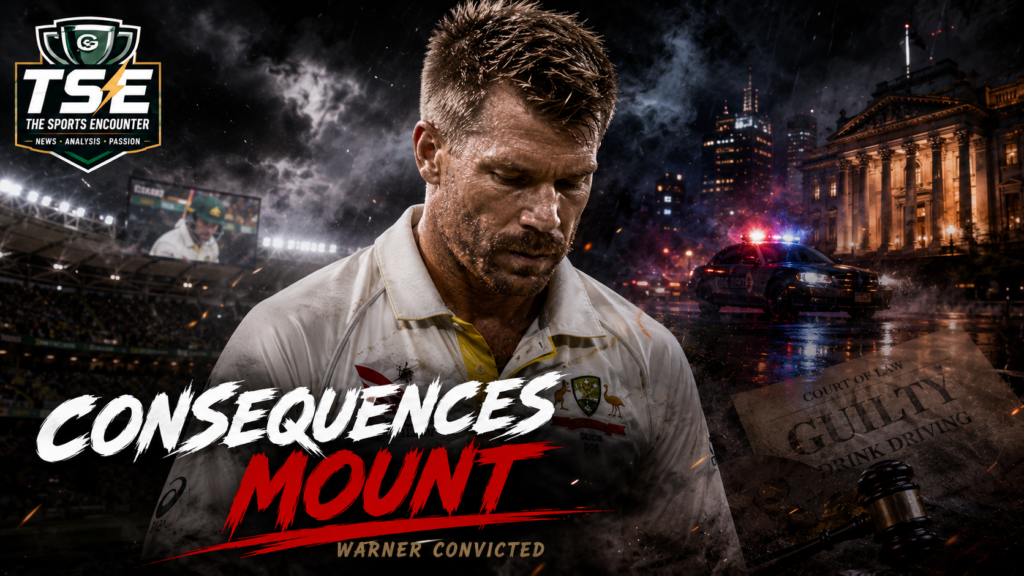
David Warner’s drink-driving case has moved beyond admission and into consequence.
When the former Australia opener pleaded guilty in July, the immediate question was what punishment would follow and whether Sydney Thunder could continue presenting him as captain while participating in public campaigns against drink-driving.
Those questions are now considerably harder to avoid.
Warner was formally convicted at Waverley Local Court in Sydney on Tuesday and fined A$1,500 for mid-range drink-driving. He must also use an alcohol interlock device before driving, while the judge specifically identified the presence of children in his vehicle as an aggravating factor.
The legal proceedings may now be approaching their conclusion, but the professional consequences could only be beginning.
Warner remains captain of Sydney Thunder, works as a commentator for Fox Sports Australia, and continues to carry significant commercial value despite retiring from international cricket.
His own lawyer told the court that commercial opportunities were already being affected by the case.
That means the discussion surrounding Warner has changed.
The central issue is no longer whether he accepts responsibility. He has already pleaded guilty.
The question now is what responsibility looks like after conviction.
David Warner drink-driving conviction: Key facts
| Detail | Information |
|---|---|
| Incident | Easter weekend, April 2026 |
| Location | Sydney’s eastern suburbs, New South Wales |
| Blood-alcohol reading | 0.104 |
| Charge | Mid-range drink-driving |
| Plea | Guilty |
| Conviction | August 18, 2026 |
| Fine | A$1,500 |
| Additional requirement | Alcohol interlock device |
| Interlock period | 12 months |
| Current BBL team | Sydney Thunder |
| Current role | Captain |
| Broadcast role | Fox Sports Australia commentator |
What changed with Tuesday’s court ruling?
The Sports Encounter has already covered the most important earlier stage of this case.
On July 22, we examined why David Warner’s guilty plea placed his Sydney Thunder captaincy under serious pressure.
At that point, Warner had admitted the offence, but sentencing had not taken place.
The August 18 hearing provides the legal outcome that was missing from the earlier story.
Warner has now been convicted.
The court imposed a A$1,500 fine and ordered that he use an alcohol interlock system before he can legally drive.
The device requires a driver to provide an alcohol-free breath sample before the vehicle can start.
According to the court ruling, Warner will need to hold an interlock licence for 12 months.
That makes the consequences tangible.
The guilty plea established responsibility.
The conviction establishes the formal legal judgment that will now follow Warner into his professional life.
The blood-alcohol reading was more than twice the general legal limit
The offence arose from an incident during the Easter weekend while Warner was driving his family home after a social function in Sydney’s eastern suburbs.
His recorded blood-alcohol concentration was 0.104.
The general legal limit for fully licensed drivers in New South Wales is 0.05, placing Warner’s reading at more than twice that level.
The court heard that Warner stopped his vehicle after noticing a roadside breath-testing operation and attempted to exchange seats with a female passenger before police approached.
Once officers identified him as the driver, he cooperated with the testing process.
Warner had previously admitted consuming three glasses of white wine before deciding to drive.
His legal representatives acknowledged before sentencing that driving had been a reckless and avoidable decision.
Children in the car made the offence more serious
One of the most significant aspects of Tuesday’s judgment was the court’s treatment of the passengers.
Children were inside Warner’s vehicle when the offence occurred.
Judge Clare Farnan identified that fact as an aggravating element when considering the seriousness of the conduct.
This pushes the incident beyond a simple numerical discussion about whether Warner’s reading crossed a particular threshold.
The potential consequences involved passengers who had no control over whether the driver was fit to be behind the wheel.
That distinction matters when assessing both the court’s response and the broader reputational consequences.
The judge accepted Warner was unlikely to reoffend
The court did not portray Warner as someone expected to repeatedly commit the same offence.
Judge Farnan accepted that he was unlikely to reoffend.
That assessment, however, did not persuade the court to avoid recording a conviction.
The judge emphasized the continuing role drink-driving plays in serious crashes across New South Wales and the importance of deterrence.
That reasoning is particularly relevant in Warner’s case because his legal team had asked the court to consider sparing him a conviction.
His lawyers argued that the enormous media attention surrounding the case had already imposed additional consequences.
The court ultimately decided those reputational costs did not replace the need for a conventional legal penalty.
Warner’s lawyers say commercial opportunities are already being affected
The most important new development outside the legal penalty may have come from Warner’s own defence team.
Before sentencing, lawyer Awais Ahmad told the court that Warner’s commercial opportunities were being affected.
That admission is significant.
Professional athletes often experience consequences from off-field incidents that never appear in sentencing documents.
Sponsors review relationships.
Broadcasters reassess public-facing roles.
Franchises consider leadership positions.
Commercial partners evaluate whether association with a player still fits their own brand standards.
Warner has spent nearly two decades building one of the most recognizable personal brands in Australian cricket.
The court case now enters that commercial environment as a formal conviction rather than an unresolved allegation or admitted charge awaiting sentencing.
Fox Sports now has a public-facing decision of its own
Warner has transitioned successfully into broadcasting since ending his international career.
He works as a commentator for Fox Sports Australia and was recently part of the network’s coverage of Australia’s Test against Bangladesh in Darwin.
The broadcaster has not been accused of wrongdoing and there has been no confirmed announcement that Warner will lose his role.
That distinction should remain clear.
Yet the conviction inevitably becomes relevant because broadcasting places former athletes in highly visible ambassadorial positions.
A commentator is no longer judged solely on cricket expertise.
They also represent the network carrying the sport into millions of homes.
Warner’s lawyer acknowledging lost commercial opportunities suggests this wider reputational process is already happening somewhere around him, even if individual partners have not publicly identified themselves.
Sydney Thunder now face the question we raised in July
The most immediate cricket consequence remains the Sydney Thunder captaincy.
Our July analysis argued that Thunder could continue using Warner as a player while reconsidering whether he should remain the franchise’s official leader.
That distinction has become even more relevant now that the court process has produced a conviction.
Warner remains one of the most accomplished T20 batters in the world.
He has scored more than 14,000 runs in the format and remains among the leading run-scorers in T20 history, as documented in The Sports Encounter’s ranking of the format’s highest career run-scorers.
His cricketing value does not automatically answer the leadership question.
Captaincy carries institutional responsibility.
The captain represents the team at launches, media events, sponsor engagements, community appearances and league promotions.
That is where Warner’s conviction collides most directly with Cricket NSW’s public commitments.
The road-safety partnership creates an uncomfortable contradiction
Cricket NSW has maintained a long-running partnership with Transport for NSW focused on road safety.
Sydney Thunder and Sydney Sixers have been directly connected to that work, including matches and campaigns designed to discourage drink-driving.
Cricket NSW again emphasized its commitment to safe driving after Warner’s conviction.
The organization said it takes the incident seriously and continues educating players about road safety.
That position is entirely reasonable.
It also increases the pressure surrounding Warner’s captaincy.
A public campaign becomes credible when an organization applies its message consistently, including when doing so creates discomfort around an important player.
Warner can continue acknowledging his mistake and complying with the court order.
Cricket NSW still has to decide whether that is sufficient for him to remain the public leader of Sydney Thunder.
Andrew Flintoff’s arrival makes the leadership decision even more important
Sydney Thunder are entering an important new phase under Andrew Flintoff.
Flintoff has stepped away from his England Lions position to concentrate on his work with the Thunder, a decision The Sports Encounter recently examined in detail.
That means the captaincy question will become one of the earliest major culture decisions of his tenure.
A new coach normally wants clarity around leadership.
Flintoff must build relationships with players, establish behavioral expectations, define tactical responsibilities and create a public identity for the squad.
Allowing uncertainty around the captaincy to extend deep into BBL preparation would provide an unnecessary distraction.
The situation also gives Thunder an opportunity to separate Warner’s cricketing importance from his formal leadership responsibilities without removing him from the team altogether.
Warner’s restored leadership status makes this case unusually sensitive
There is another reason Warner’s captaincy cannot be treated like an ordinary leadership appointment.
He had already spent years trying to restore his eligibility to captain an Australian cricket team following the 2018 ball-tampering scandal in South Africa.
The leadership ban imposed after Cape Town was eventually lifted in 2024 after an independent panel considered evidence surrounding Warner’s rehabilitation, remorse and conduct.
Sydney Thunder then handed him the captaincy.
That history gave the appointment symbolic weight.
Warner was being trusted to lead again after a long period in which Australian cricket had formally prevented him from doing so.
The drink-driving conviction does not recreate the Cape Town circumstances.
They are entirely different events.
What it does change is the conversation around the second chance Warner had already been given.
A second chance carries responsibility after the celebration ends
Rehabilitation is meaningful only when it survives later tests.
Warner’s return to leadership demonstrated that Australian cricket was willing to reconsider a severe sanction after years of changed behavior.
That was a defensible position.
The current case does not mean every argument supporting his rehabilitation was false.
People can improve and still make serious mistakes later.
What matters now is how the institution responds to the new mistake.
Thunder do not need to pretend Warner has contributed nothing positive since 2018.
They also do not need to pretend that captaincy must continue untouched simply because his original leadership ban was lifted.
Why losing the captaincy would be different from losing his playing career
One important distinction needs to remain clear throughout this debate.
Removing Warner as Sydney Thunder captain would not mean banning him from cricket.
Warner could remain one of the team’s leading batters.
He could continue mentoring younger players.
He could remain part of the leadership group without occupying the formal captaincy.
He could rebuild trust through his behavior over time.
Professional sport regularly separates selection from leadership.
A player’s ability to score runs answers one question.
Whether that player should publicly represent the team’s behavioral standards answers another.
For Thunder, the second question has become much more difficult after August 18.
What happens to Warner’s Sydney Thunder captaincy now?
Cricket NSW had not announced a captaincy decision immediately after Tuesday’s court ruling.
That means Warner remains captain unless the organization decides otherwise.
There are several realistic options.
Option 1: Keep Warner as captain
Thunder could conclude that the A$1,500 fine, conviction, interlock requirement, public scrutiny and Warner’s acceptance of responsibility constitute sufficient consequences.
This would provide continuity but leave the franchise repeatedly defending the tension between its leadership choice and its road-safety messaging.
Option 2: Remove the captaincy but retain Warner as a player
This remains the most proportionate response in our assessment.
It would recognize Warner’s continuing cricket value while attaching a leadership consequence directly to conduct incompatible with the team’s public responsibilities.
Option 3: Impose additional internal sanctions
Cricket NSW could introduce education, community-service, road-safety or behavioral requirements alongside any captaincy decision.
Such measures could allow Warner to use the incident constructively without pretending the original conduct was insignificant.
Warner still matters enormously to the Big Bash
None of this changes his sporting stature.
Warner remains one of Australia’s greatest white-ball batters and one of the most recognizable players still active in franchise cricket.
He played 112 Tests, 161 ODIs and 110 T20 internationals for Australia.
He won major global tournaments, dominated attacks across formats and became one of the most aggressive opening batters of his generation.
His continuing commercial power also reflects the broader importance star players have to competitions such as the Big Bash.
The Sports Encounter recently examined this phenomenon through Babar Azam’s enormous audience impact during BBL|15, where the commercial effect of a superstar extended far beyond his individual runs.
Warner has similar value to Thunder.
That makes the leadership decision harder.
It also makes it more meaningful.
The financial penalty is only a small part of the consequence
A$1,500 is unlikely to represent meaningful financial hardship for an athlete with Warner’s career earnings.
The conviction carries importance because the consequences extend beyond the amount printed on the court order.
There is the interlock requirement.
There is the criminal conviction itself.
There is reputational damage.
There are potential commercial losses.
There is uncertainty around his captaincy.
There is the uncomfortable relationship between his conduct and Cricket NSW’s road-safety campaigning.
There is also a permanent addition to the way his post-playing career will be discussed.
Those consequences can matter far more than the fine.
Why Warner’s public profile did not remove the conviction
Warner’s legal team argued that the scale of media attention and hostile social-media commentary had already imposed substantial punishment.
The court acknowledged the scrutiny but did not treat celebrity exposure as a replacement for sentencing.
That principle matters.
A recognizable athlete inevitably receives more publicity than an ordinary defendant.
That increased attention can be unpleasant and, at times, excessive.
It does not change the underlying road-safety standard.
The court’s responsibility was to determine an appropriate legal response to the offence rather than compensate for Warner’s fame.
The case arrives during a difficult period for Australian cricket
The Warner story is unfolding while Australian cricket is already navigating significant sporting questions.
Bangladesh recently defeated Australia by nine wickets in Darwin, prompting a wider examination of Australia’s batting problems, aging core and vulnerabilities against Asian opposition.
The two-Test series is part of an extraordinary August schedule in which 19 consecutive calendar days have Test cricket scheduled somewhere in the world.
Warner is retired from international cricket, so those sporting concerns do not directly involve him.
They do illustrate how his public role has changed.
He now analyzes Australian cricket rather than opening the batting for it.
That makes reputation increasingly important to the second career he is building.
What Warner does next matters
The court has already determined the legal punishment.
The next stage belongs largely to Warner himself and the organizations that employ him.
Compliance with the interlock requirement is the minimum.
A stronger response would involve sustained behavior that demonstrates he understands why the offence mattered.
Road-safety advocacy may be one route if handled sincerely rather than as reputation management.
He can also accept whatever leadership decision Sydney Thunder ultimately makes without turning the consequence into another public dispute.
That response would probably do more for his long-term reputation than any legal argument about how much media attention he has already endured.
TSE analysis: The court case has ended one debate and intensified another
Before the conviction, there were three separate questions.
Did Warner commit the offence?
What legal punishment would he receive?
What would cricket do about it?
The first two have now been answered.
Warner pleaded guilty.
The court convicted him, fined him A$1,500 and imposed an alcohol interlock requirement.
The third question remains open.
That is why Tuesday’s hearing does not close this story.
It moves the story from the courtroom into the institutions around Warner.
Cricket NSW can continue emphasizing road safety.
Sydney Thunder can continue valuing Warner’s batting.
Fox Sports can continue recognizing his cricket knowledge.
Each organization now has to decide how the conviction interacts with the standards attached to a public-facing role.
The captaincy remains the clearest test
Our position from July does not need to change after sentencing.
If anything, the conviction strengthens it.
Sydney Thunder should retain David Warner as a player if they believe he remains good enough to contribute.
They should appoint somebody else as captain for BBL 2026-27.
That response would be meaningful without being excessive.
It would recognize that Warner has accepted responsibility and remains capable of contributing to the team.
It would also recognize that formal leadership comes with responsibilities that extend beyond runs and tactical decisions.
The arrival of Andrew Flintoff gives Thunder an opportunity to begin a new coaching era with clear standards and a clear leadership structure.
Warner can remain an important part of that structure without standing at the top of it.
From admission to consequence
When Warner pleaded guilty, the story was about accountability still to come.
Now it has arrived.
The A$1,500 fine is the easiest consequence to measure.
The 12-month interlock requirement is another.
The effect on sponsorships, broadcasting work and the Sydney Thunder captaincy will take longer to understand.
That may ultimately be where the most significant consequences emerge.
Warner has spent his career recovering from difficult moments as aggressively as he once attacked opening bowlers.
This recovery will be different.
There is no innings that can settle it in one night.
What happens next will depend on judgment, behavior and whether the institutions around him believe accountability should reach beyond the courtroom.
Follow The Sports Encounter’s cricket coverage for continuing updates on David Warner, Sydney Thunder, the Big Bash League, Australian cricket and major stories from around the sport.