


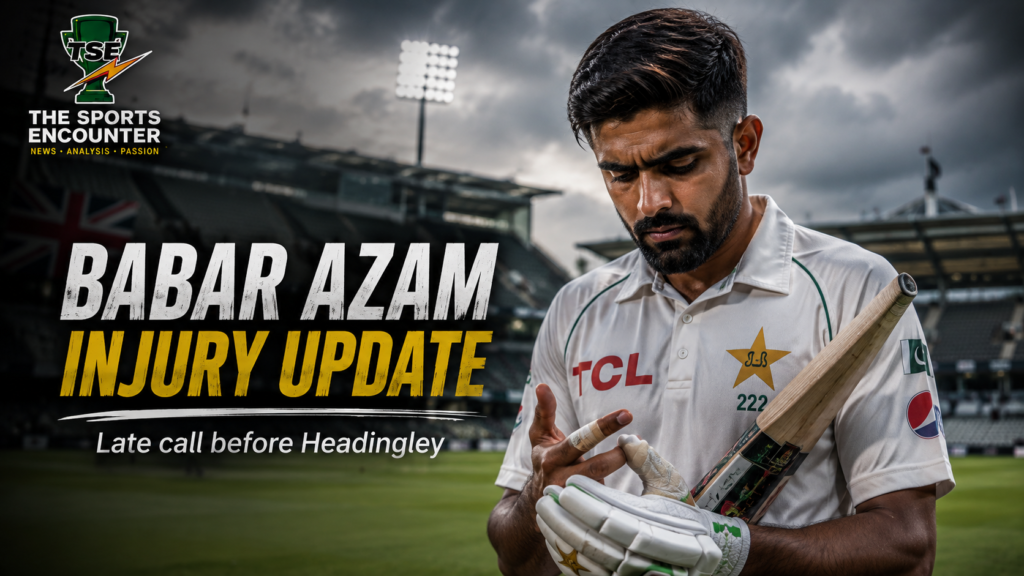
Pakistan have spent weeks preparing to face England’s moving ball, Joe Root’s restored captaincy and the pressure of trying to end a 30-year wait for a Test series victory in England.
Less than 48 hours before the first ball at Headingley, however, their biggest question is much closer to home.
Will Babar Azam play?
As of late Monday, August 17, the answer remains unresolved.
Babar has not been officially ruled out of the first Test. He remains in serious doubt because of an impact injury to his right hand that first troubled him during Pakistan’s second Test against West Indies and was aggravated when he was struck again while batting in the warm-up match against a Professional County Club Select XI at Beckenham.
He retired hurt from that practice innings and took no further part in the match.
Pakistan initially described the withdrawal as precautionary. The concern increased because the blow affected the same hand already being managed following the Caribbean series.
Babar trained at Headingley on Monday. He faced throwdowns and batted briefly in the nets. There were no obvious outward signs of major discomfort, but his stay was short enough to prevent anyone outside the medical and coaching group from drawing a confident conclusion.
Mohammad Abbas then provided the clearest official indication of Pakistan’s thinking.
“Whether he plays or not will be a decision taken on match day. He did a few throwdowns and some batting practice today. But we’ll have to follow medical advice for it.”
That leaves Pakistan facing two versions of the same Test.
One has Babar at No. 4, leading a side that has finally interrupted its miserable away run and walking into the series with a rare opening against an unsettled England.
The other removes Pakistan’s captain and most recognizable batter simultaneously, forces another middle-order reshuffle, and potentially hands Test-match leadership to someone who has never captained Pakistan in the format.
For a team that has spent several years struggling with stability, the timing could hardly be worse.
For England, it could hardly be more interesting.
The Sports Encounter’s full England vs Pakistan Test series preview framed Headingley around two captains attempting very different resets. Joe Root is returning to England’s leadership after the end of the Ben Stokes-Brendon McCullum era. Babar is back in charge because Pakistan’s attempt to rebuild under Shan Masood collapsed.
Now there is a genuine possibility that only one of them will walk out for the toss.
Babar Azam Injury Update Before the First England Test
| Current status | Doubtful, not officially ruled out |
| Injury | Impact injury to the right hand/finger |
| Initial problem | Sustained during the second Test against West Indies |
| Latest setback | Struck again during Pakistan’s Beckenham warm-up match |
| Warm-up participation | Retired hurt and did not return |
| Headingley training | Batted briefly and faced throwdowns on August 17 |
| Medical clearance | Still awaited |
| Final decision | Could be made on match day |
| First Test | England vs Pakistan, August 19 at Headingley |
| Likely batting consequence if absent | Saud Shakeel and Awais Zafar could both feature |
| Leadership consequence | Pakistan would require a stand-in Test captain |
The Most Important Clarification: Babar Has Not Been Ruled Out
The uncertainty surrounding Babar has created exactly the environment in which speculation spreads faster than medical information.
Some reports have already presented his absence as settled.
Pakistan’s own public position is more cautious.
Abbas did not say Babar would miss the Test. He did not say the captain had been cleared either.
He said Pakistan would follow medical advice.
That means the correct description on Monday night is straightforward: Babar is doubtful and Pakistan may wait until match day before deciding.
There is an important difference between an injury concern and a confirmed withdrawal.
That distinction becomes even more important when the player concerned is the captain.
Pakistan do not simply need to know whether Babar can hold a bat. They need to determine whether he can survive potentially five days of Test cricket without exposing the injury to greater damage.
Why a Short Net Session Cannot Answer the Question
The sight of Babar batting at Headingley naturally encouraged optimism.
It should not be mistaken for medical clearance.
Net batting and Test batting place different demands on an injured hand.
During a controlled session, workload can be reduced. Bowlers can be selected. The length of the practice can be limited. A batter can stop immediately if discomfort increases.
None of those protections exist once the Test begins.
England’s seamers will attack the body.
A short ball can force Babar into evasive movement or a defensive stroke that jars the injured hand. A thick edge can create vibration through the handle. Even ordinary defensive contact can become uncomfortable when repeated over a long innings.
Fielding creates another problem.
Babar may have to catch hard-hit balls, throw repeatedly and remain on the field for several sessions. If the injury affects grip strength, the consequences extend beyond batting technique.
Pakistan’s medical decision therefore has to answer a harder question than “Can he bat today?”
It has to answer whether he is ready to complete a Test match.
The Injury Began Before Pakistan Reached England
The Beckenham blow did not arrive on a completely healthy hand.
Babar had already been managing soreness after taking an impact during the second Test against West Indies.
That match ended positively for Pakistan.
They won by eight wickets at Queen’s Park Oval, ended an eight-match away losing streak and drew the two-Test series 1-1.
Babar finished the chase by hitting consecutive sixes, ending his first series back as Test captain with a result Pakistan badly needed.
The Sports Encounter’s complete West Indies-Pakistan series review noted at the time that Babar was dealing with bruising to the finger but had not initially been considered likely to miss Headingley.
The situation changed in Beckenham.
He was struck again while batting on five and immediately required attention.
Pakistan removed him from the remainder of the match as a precaution.
Repeated impact to an already injured area explains why a problem that initially looked manageable has become a genuine selection issue.
There Is an Uncomfortable Historical Echo for Babar in England
This is not the first time an England tour has placed Babar’s hand and arm at the center of Pakistan’s Test plans.
In 2018, he was batting beautifully in the first Test at Lord’s when a Ben Stokes delivery struck him on the left forearm.
Babar had made 68.
Scans confirmed a fracture.
He was ruled out of the remainder of that Test and the next match.
The next match happened to be at Headingley.
Eight years later, Babar is again preparing for an England Test at Headingley with an impact injury threatening his availability.
The injuries are not the same. The 2018 problem was a confirmed fracture to his left forearm. The current issue involves his right hand and has not been publicly described as a fracture.
The history is still difficult to ignore.
It also explains why Pakistan should resist any temptation to take unnecessary risks merely because the first Test carries enormous importance.
Babar’s Absence Would Cost Pakistan More Than Runs
If this were only a question about replacing one middle-order batter, the calculation would be difficult but manageable.
Babar’s role is larger.
Pakistan restored him to the Test captaincy only last month after Shan Masood’s leadership tenure ended with 12 defeats in 16 matches.
The Sports Encounter’s analysis of Babar’s return as Test captain argued that the decision represented more than another PCB reshuffle. Pakistan were asking Babar to restore authority to a red-ball team that had forgotten how to control matches.
The Caribbean tour provided an imperfect beginning.
Pakistan lost the first Test at Tarouba by 90 runs despite Babar carrying his bat for 58 in the failed chase. They then responded in Port of Spain, made bold selection changes, brought spin into the contest and won the second Test convincingly.
Babar shared Player of the Series honors and left Trinidad with something Pakistan had been missing for years: an away Test victory.
England was supposed to be the next stage of that reset.
Missing Headingley would interrupt it immediately.
Pakistan Need Babar the Batter Almost as Much as Babar the Captain
Pakistan’s leadership dilemma naturally attracts attention, but the batting problem may be even more serious.
The lineup is already dealing with injuries and uncertainty.
Abdullah Fazal has been ruled out of the England Tests with a back problem.
Shan Masood has only recently recovered from the fractured finger that kept him out of the second West Indies Test and the Beckenham warm-up.
Saud Shakeel is returning after fitness concerns and a decline in Test form.
Awais Zafar remains at the beginning of his international career.
That is not the ideal moment to remove Pakistan’s most experienced specialist middle-order batter.
Babar has 64 Tests and more than 4,600 runs. His recent career has included a prolonged wait for another Test hundred, but dismissing his value because of the century drought would miss the wider context.
He remains Pakistan’s most experienced batter against high-level international attacks and one of the few members of this squad who has repeatedly faced English conditions.
Headingley, particularly under cloud cover, asks technical questions that can expose uncertainty quickly.
Pakistan need batters who understand that surviving the first 30 deliveries can be more important than winning them.
England’s Attack Makes a Compromised Hand Especially Dangerous
The England attack awaiting Pakistan does not require Babar to be merely fit enough.
He needs to be capable of trusting his hands.
Jofra Archer offers pace and steep bounce.
Gus Atkinson attacks the stumps and can climb awkwardly from a length.
Josh Tongue provides another high-release option.
Ollie Robinson and Sam Cook offer seam control.
Brydon Carse brings physical aggression.
England therefore have several ways to investigate an injured right hand.
If Babar begins protecting it subconsciously, technique changes.
The bottom hand can become reluctant to engage. Drives become less authoritative. Defensive contact can become late. Short-pitched bowling becomes more effective because the batter begins thinking about impact instead of movement.
There is also a strategic question for England.
If Babar is named in Pakistan’s XI, Joe Root will know exactly where the doubt lies.
England will test it.
That is Test cricket.
Pakistan Cannot Pick Babar Because of His Name
This is where Pakistan’s selectors and medical panel need clarity.
Babar’s importance cannot become the argument for playing him.
It should make the threshold for selection higher.
A half-fit specialist batter can occasionally survive limited-overs cricket because the innings has a defined maximum duration.
A Test can demand six hours of batting on one day and 90 overs of fielding the next.
If Babar cannot grip the bat normally, field comfortably and protect himself against the short ball, Pakistan gain very little by selecting him simply because the occasion feels too important to miss.
The first Test matters.
The series matters more.
Lord’s begins only eight days after Headingley is scheduled to finish.
Turning bruising or impact damage into a longer-term injury for the sake of one match could remove Babar from multiple Tests.
If Babar Misses Out, Saud Shakeel Becomes Even More Important
Saud Shakeel was already likely to return to Pakistan’s XI.
A Babar withdrawal would increase the probability that Shakeel and Awais Zafar both feature in the middle order.
Shakeel gave Pakistan an encouraging reminder of his quality at Beckenham.
He scored an unbeaten century as Pakistan successfully chased 262 on the final day of the warm-up match.
The innings arrived at an important time.
Shakeel had missed the West Indies Tests over fitness concerns and his previous ten Test innings had produced only 189 runs.
He also knows England will present conditions very different from the slow surfaces on which he has built much of his Test reputation.
Shakeel has county experience with Yorkshire, but his numbers outside Asia have been significantly weaker than his home record.
That makes Headingley a major individual examination even if Babar plays.
Without Babar, it becomes central to Pakistan’s hopes.
Awais Zafar Could Suddenly Move From Prospect to Essential Batter
Babar’s absence would also accelerate Awais Zafar’s role.
Zafar made his Test debut during the West Indies series after being called into the squad amid Pakistan’s injury problems.
He was originally part of a wider attempt to refresh a batting group that had repeatedly failed under pressure.
Headingley would be a different assignment entirely.
A young batter facing England’s seamers in Yorkshire is not being eased into Test cricket.
He is being examined immediately.
That does not mean Pakistan should fear selecting him.
It means expectations need to be realistic.
If Babar misses out, Pakistan would potentially ask Zafar, Shakeel and other returning or inexperienced batters to compensate collectively for the absence of the captain.
That is a much larger challenge than replacing one name on a team sheet.
What Happens to the Captaincy If Babar Cannot Play?
This may be the most awkward part of the entire decision.
Pakistan have not announced a stand-in Test captain for Headingley.
Salman Ali Agha led Pakistan in the Beckenham warm-up when Babar could no longer take part.
He is also Pakistan’s established T20I captain and has leadership experience at international level.
That makes him the most obvious procedural candidate if Babar is unavailable.
But Salman has never captained Pakistan in a Test.
Headingley against England is not a gentle introduction.
Shan Masood creates another layer.
He has extensive first-class experience in England and captained Pakistan until only last month. If medically cleared, he would give the XI a former Test captain who understands field settings, bowling changes and the tempo required in English conditions.
Pakistan are unlikely to want to recreate the leadership debate they have just tried to end by handing Masood the job back immediately, even temporarily.
His presence could nevertheless be invaluable to whoever leads.
Salman Agha Leading Would Change Pakistan’s Leadership Dynamic
Salman has increasingly become one of Pakistan cricket’s most important connecting figures.
He contributes with bat and ball.
He has white-ball leadership responsibility.
He is experienced enough to communicate with senior players without appearing overwhelmed by them.
What he does not have is Test captaincy experience.
That distinction matters because red-ball leadership demands a different rhythm.
A captain may spend two hours setting up one dismissal.
Fast-bowler spells have to be managed across days rather than overs.
The second new ball, weather, changing light and deterioration of the pitch become strategic variables.
Declaring, enforcing a follow-on and balancing attacking fields against run prevention create decisions that simply do not exist in T20 cricket.
If Salman leads, Pakistan would need strong tactical input from Masood, Mohammad Rizwan, Abbas and the coaching staff.
Pakistan’s Selection Could Change Significantly Depending on One Medical Call
| If Babar Plays | If Babar Misses Out |
|---|---|
| Babar retains captaincy | Pakistan require a stand-in captain |
| Middle order retains its most experienced specialist batter | Saud Shakeel carries greater responsibility |
| Awais Zafar may miss out depending on combination | Shakeel and Zafar could both play |
| Pakistan maintain intended leadership structure | Salman Agha becomes a leading captaincy option |
| England can target Babar’s injured hand | Pakistan avoid the risk of aggravating the injury |
| Potential risk to availability later in series | Babar gains additional recovery time before Lord’s |
Shan Masood’s Fitness Is the Better News for Pakistan
If Babar’s status remains uncertain, Shan Masood’s progress offers Pakistan some relief.
Masood fractured the index finger on his left hand during the first Test against West Indies.
He continued batting despite the injury and had already scored a century in that match, but scans subsequently ruled him out of the second Test.
He also missed the Beckenham warm-up.
At Headingley, however, Masood completed a much longer batting session than Babar.
Abbas described him as looking “very good.”
Medical clearance is still required, but the tone around Masood is considerably more optimistic.
Pakistan desperately need that experience.
The combination of Babar and Masood both missing would leave the top and middle order dangerously exposed.
There Is a Bigger Irony in Babar’s Possible Absence
Pakistan have arrived in England at precisely the moment when England appear unusually vulnerable.
That opportunity was central to The Sports Encounter’s series preview.
England have lost seven of their last ten Tests.
They were recently beaten 2-1 at home by New Zealand.
Ben Stokes has retired from Test cricket.
Brendon McCullum’s tenure has ended.
Root has returned to captaincy.
Marcus Trescothick is serving as interim coach before Stephen Fleming takes control later in the year.
Jacob Bethell is injured.
Jordan Cox is being asked to bat at No. 3 despite limited first-class experience in that position.
This is not the settled England machine Pakistan have often encountered.
Pakistan have their own problems, but they have also been presented with one of their better opportunities to compete seriously in England.
Losing Babar before the opening Test would reduce that advantage.
Pakistan Have Waited 30 Years for This Opportunity
Pakistan’s last Test series victory in England came in 1996.
That team had Wasim Akram, Waqar Younis, Mushtaq Ahmed, Saeed Anwar and several cricketers who understood how to translate English conditions into Pakistani strengths.
There have been excellent Pakistan performances in England since then.
There have been drawn series.
There have been famous wins.
The complete series victory has remained out of reach.
Babar’s return to the captaincy created an obvious historical target.
The question was whether he could become the captain who ended the wait.
The injury has changed the immediate version of that question.
Pakistan now need to determine whether he will even begin the attempt.
Babar’s Relationship With England Has Always Carried Strange Timing
England has repeatedly intersected with major moments in Babar’s Test career.
He was developing into a top-order force when the 2018 forearm injury ended his tour.
He later produced some of his most technically assured batting in English conditions.
Then came the 2024 series in Pakistan.
Babar entered that contest in a prolonged slump, scored only 35 runs across the first Test and was left out for the remaining two matches after Pakistan lost the opener by an innings and 47 runs.
Pakistan went on to change their approach, turn heavily toward spin and win the series 2-1.
The episode became one of the lowest points of Babar’s red-ball career.
Now he returns to England as captain again.
The context could hardly be more different.
The Sports Encounter’s preview of Babar’s red-ball reset in the Caribbean described the West Indies tour as a chance to rebuild his authority before the harder examination in England.
That harder examination has arrived.
His first opponent may be his own hand.
The West Indies Series Suggested Babar Was Finding a Way Back
The first Test at Tarouba was another difficult Pakistan defeat, but Babar’s unbeaten 58 in the fourth innings offered evidence of his ability to absorb pressure.
He watched wickets disappear around him as Pakistan collapsed to 120 while chasing 211.
The Sports Encounter’s match analysis of that 90-run defeat described Babar as effectively stranded while West Indies’ fast bowlers dismantled the other end.
Port of Spain was better.
Pakistan adapted their selection to the conditions, Abdullah Shafique produced a major comeback innings, the spinners dominated, and Babar finished the chase.
After years of overseas disappointment, Pakistan finally won away from home again.
The captain was supposed to carry that momentum into Headingley.
Pakistan Cannot Afford Another Self-Created Crisis
Pakistan’s recent Test record has been damaged by enough problems without creating another.
They have lost 13 of their last 18 Tests.
Until Port of Spain, they had gone eight consecutive away Tests without a victory.
They finished at the bottom of the previous World Test Championship cycle and remain near the bottom end of the current one.
Their captaincy changed from Babar to Masood and then back to Babar.
Senior players have moved in and out of the side.
Fast-bowling selections have changed.
Home conditions have repeatedly been redesigned in search of an advantage.
The Sports Encounter’s deeper analysis of Pakistan’s captaincy reversal argued that the board’s central challenge is to stop breaking its own rhythm.
The Babar decision requires exactly that discipline.
Pakistan should neither gamble on him because of panic nor remove him because of noise outside the dressing room.
The medical evidence has to decide.
Why Mohammad Abbas Could Become Even More Important
Whether Babar plays or not, Pakistan’s clearest route into the Test may begin with the ball.
Mohammad Abbas has spent years mastering English conditions.
He has taken more than 300 wickets in county cricket and understands how little movement is sometimes required when the line and length are exact.
Headingley’s cooler, cloudier weather during Pakistan’s first training session would have been welcome.
England’s batting order also contains opportunities.
Emilio Gay is inexperienced at Test level.
Cox is moving into the No. 3 role.
England’s lineup still contains Root and Harry Brook, but the structure around them is being rebuilt.
Pakistan do not need Babar to score 150 to compete if Abbas, Mohammad Ali and the rest of the attack can create early wickets.
They do need leadership capable of recognizing those moments when they arrive.
Headingley Makes the Captaincy Question More Important
Headingley has a reputation for matches that change quickly.
Cloud can appear.
The ball can suddenly move.
A partnership can make batting look comfortable for an hour before two wickets transform the session.
That creates a premium on tactical awareness.
A captain has to know when to attack.
When to hold a bowler back.
When to use Abbas with the new ball and when to preserve overs for changing conditions.
When to bring a catcher into an unconventional position because a batter’s trigger movement has changed.
Babar has made mistakes as a Test captain before, but he has lived through these situations.
A replacement would be learning while the match is happening.
Playing Babar Would Also Require Pakistan to Protect Him Intelligently
If he is cleared, selection should not end the conversation.
Pakistan would still need to manage the injury.
That may influence where Babar fields.
It may affect the amount of catching practice he undertakes between innings.
It may shape how frequently he receives treatment.
Pakistan also need to be prepared for the possibility that he starts the Test and the hand worsens.
That scenario would leave them effectively carrying a compromised batter for the remainder of the match.
Medical clearance therefore needs to mean more than accepting manageable pain.
It needs to mean the risk of meaningful deterioration is considered acceptable.
Resting Babar Would Not Mean Pakistan Are Surrendering Headingley
This is another important point.
If Pakistan leave Babar out, the decision should not automatically be interpreted as defensive.
There are moments when refusing to gamble with a player is the more aggressive long-term decision.
The series contains three Tests.
Lord’s follows on August 27.
Edgbaston hosts the final Test from September 9.
A week of additional recovery could be the difference between Babar playing two healthy Tests and struggling through three compromised ones.
Pakistan have to judge the first Test within the series rather than treating Headingley as the entire tour.
The ECB’s official series schedule confirms that tight turnaround, with only a few days separating the end of Headingley from the start at Lord’s.
What Would Pakistan Lose Tactically Without Babar?
His captaincy has often been debated through results, but on this particular tour his familiarity with several English players matters.
Babar has spent years facing Root, Brook, Archer and other members of the England setup across formats.
He understands their tendencies.
He also returned to the Test captaincy alongside head coach Sarfaraz Ahmed with the expectation that the pair would develop a more stable leadership structure.
Removing one half of that structure for the opening Test changes communication.
The stand-in captain would still have Sarfaraz’s support.
But decisions on the field belong to the player wearing the captain’s responsibility.
A first-time Test captain being asked to manage England at Headingley is a significant additional variable.
What Would Pakistan Gain by Leaving Him Out?
Certainty.
That is the strongest argument.
If the medical panel believes the hand is not ready, removing Babar from the equation allows Pakistan to build a fully fit XI.
Awais Zafar gets a defined role rather than waiting until the morning of the match.
Shakeel knows his responsibility increases.
The captaincy is transferred clearly.
Babar begins uninterrupted recovery for Lord’s.
Most importantly, Pakistan stop wondering whether one ball on the fingers could alter the entire series.
Sometimes certainty around an imperfect XI is more valuable than uncertainty around a stronger one.
What Would Pakistan Gain by Playing Him?
The answer is equally obvious.
They retain their captain.
They retain their most experienced specialist batter.
They avoid forcing another player into a role earlier than intended.
They preserve the leadership structure designed for this tour.
And they give themselves a better chance of exploiting an England team that is entering the series with problems of its own.
That is why the decision is difficult.
There is no tactical argument against a fully fit Babar.
The entire issue is contained in those two words: fully fit.
England Will Be Happy to Let Pakistan Debate It
Root’s team have enough uncertainty inside their own dressing room.
They will not mind Pakistan carrying some as well.
The official England squad for the first two Tests confirms a side undergoing significant change. Cox will bat at three for the injured Bethell, Lawrence returns, Root is captain again and several bowlers are fighting for places.
If Babar misses the match, England lose one of the major problems they had been preparing to solve.
If Babar plays injured, they gain a potential area to attack.
From England’s perspective, either outcome offers something.
The Decision May Tell Us Something About Babar 2.0 as Captain
There is another subtle leadership test here.
What does Babar himself want?
Captains often want to play through pain.
The instinct is understandable, especially after returning to a role that carries enormous scrutiny.
Missing the first Test of the England tour only weeks after being reappointed would be deeply frustrating.
But leadership sometimes requires resisting the desire to prove toughness.
If Babar knows he cannot perform properly, stepping aside would not weaken his captaincy.
It could strengthen it.
The same is true in reverse.
If the medical panel clears him fully and he trusts the hand, Pakistan should not bench their captain because external debate has made the injury sound worse than it is.
The Search Question Has a Simple Answer for Now
Fans searching for “Will Babar Azam play the first Test against England?” deserve something more useful than rumors.
Here is where the situation stands.
- Babar Azam has not been officially ruled out.
- He has an impact injury to his right hand/finger.
- The problem began during the West Indies series and was aggravated in the Beckenham warm-up.
- He retired hurt from that match and did not return.
- He batted briefly at Headingley on Monday.
- Pakistan are awaiting medical guidance.
- Mohammad Abbas said the final decision may be made on match day.
- If Babar misses out, Saud Shakeel and Awais Zafar are both likely to come strongly into the middle-order equation.
- Pakistan have not publicly confirmed who would captain the Test in Babar’s absence.
Anything more definite than that currently moves from reporting into prediction.
TSE Verdict: Pakistan Should Make a Medical Decision, Not an Emotional One
Babar Azam should play at Headingley if he is medically ready to play Test cricket.
That sounds obvious.
Pakistan cricket has spent enough time turning obvious decisions into complicated ones.
The temptation to force the issue will be enormous.
This is England.
This is Babar’s first major tour since returning as captain.
Pakistan have not won a series here since 1996.
England are vulnerable.
Root’s team are rebuilding.
Pakistan have finally won an away Test after three years of waiting.
Everything about the occasion encourages urgency.
That is precisely why the decision needs to remain clinical.
If Babar’s grip is normal, his fielding is unaffected, pain is manageable and the medical panel believes another blow is unlikely to significantly worsen the injury, he belongs in Pakistan’s XI.
His batting and captaincy make the side stronger.
If those conditions are not met, Pakistan should leave him out.
There are two more Tests.
A healthy Babar at Lord’s and Edgbaston is more valuable than an injured Babar surviving Headingley because Pakistan were afraid to begin without him.
This team has already spent years living through captaincy changes, selection reversals, batting collapses and injuries.
It does not need another avoidable crisis.
The encouraging part is that Pakistan do have alternatives.
Shakeel scored a warm-up hundred.
Masood appears to be recovering well.
Awais Zafar offers another middle-order option.
Salman has leadership experience.
Abbas may be walking into some of the most suitable conditions of his career.
The Sports Encounter’s Cricket Hub will follow the final selection, Headingley Test and the wider series as Pakistan attempt to convert opportunity into something their recent Test history has rarely provided: sustained control.
Babar’s name will dominate the discussion until the XI is handed over.
For now, there is no honest way around the uncertainty.
Babar or no Babar?
Pakistan themselves may not know until Wednesday morning.
And that makes the first decision of this Test almost as compelling as the cricket that follows it.
Frequently Asked Questions About Babar Azam’s Injury
Will Babar Azam play the first Test against England in 2026?
Babar Azam remains doubtful for the first Test at Headingley. Pakistan have not ruled him out, and Mohammad Abbas said the final decision could be made on match day after advice from the medical panel.
What injury does Babar Azam have?
Babar is managing an impact injury to his right hand/finger. He first picked up the problem during the second Test against West Indies and was struck on the same hand again in Pakistan’s warm-up match at Beckenham.
Was Babar Azam ruled out after the warm-up match?
No official announcement has ruled Babar out of the Headingley Test. Pakistan withdrew him from the remainder of the warm-up match as a precaution and are continuing to assess his fitness.
Did Babar Azam bat in the Headingley nets?
Yes. Babar took part in Pakistan’s August 17 training session, facing throwdowns and batting briefly. He did not show obvious signs of major discomfort, although his session was shorter than Shan Masood’s.
When will Pakistan decide whether Babar plays?
The decision may be left until match day on August 19, depending on medical advice and Babar’s response to training.
Who could replace Babar Azam in Pakistan’s batting lineup?
Saud Shakeel is expected to return to the XI and Awais Zafar would become a strong candidate to join him in the middle order if Babar is unavailable.
Who will captain Pakistan if Babar Azam misses the Test?
Pakistan have not officially named a replacement captain. Salman Ali Agha led the side during the Beckenham warm-up match and is an obvious candidate, while former Test captain Shan Masood could provide significant leadership support if fit.
Is Shan Masood fit for the first England Test?
Masood’s situation appears more encouraging than Babar’s. He completed an extended batting session at Headingley after recovering from the fractured finger that ruled him out of the second West Indies Test. He still requires medical clearance.
When does England vs Pakistan first Test start?
The first Test begins at Headingley in Leeds on Wednesday, August 19, 2026. Lord’s hosts the second Test from August 27, and the third begins at Edgbaston on September 9.
Why is Babar Azam’s availability so important?
Babar is both Pakistan’s Test captain and their most experienced specialist middle-order batter. His absence would therefore affect the batting order, leadership structure and selection combination at the same time.
Has Babar Azam previously suffered an injury during an England Test?
Yes. In 2018, Babar was struck by a Ben Stokes delivery while making 68 at Lord’s and suffered a fractured left forearm. The injury ruled him out of the remainder of that series, including the following Test at Headingley.
What is Pakistan’s current Test form?
Pakistan recently drew their two-Test series against West Indies 1-1. Their eight-wicket victory in Port of Spain ended an eight-match away losing streak and was their first overseas Test win since 2023.
The Sports Encounter will update this story if Pakistan confirm a change in Babar Azam’s medical status before the Headingley Test.