


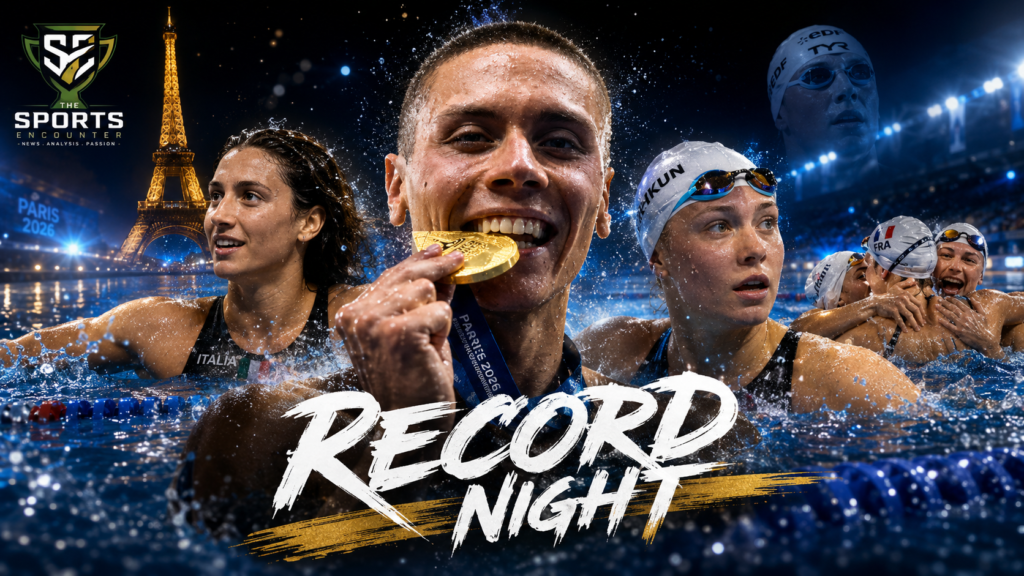
Paris 2026 delivered the kind of finals session that makes a championship feel bigger than the medal table. Belgium found a butterfly breakthrough, David Popovici reminded Europe who controls the 200m freestyle, Evgeniia Chikunova and Simona Quadarella broke championship records, and the Neutral Athletes closed the night with a relay record that gave the session a sharp final statement.
The latest finals session at the 2026 European Aquatics Championships in Paris produced six gold-medal moments across sprint, middle-distance, distance and relay swimming. Roos Vanotterdijk won the women’s 100m butterfly in 56.08, Popovici took the men’s 200m freestyle in 1:44.15, Chikunova set a championship record of 2:19.32 in the women’s 200m breaststroke, Miroslav Knedla won the men’s 50m backstroke in 24.11, Quadarella broke the championship record in the women’s 1500m freestyle with 15:46.22, and Neutral Athletes B won the mixed 4x100m freestyle relay in a championship-record 3:19.95.
This was not a session built around one headline. It was a night of layered stories: established champions defending authority, new names grabbing attention, and several events showing how deep European swimming has become two years after Paris hosted the Olympic Games.
European Aquatics Championships Paris 2026: Today’s Gold Medal Winners
| Event | Gold Medal Winner | Time | Key Note |
|---|---|---|---|
| Women’s 100m Butterfly | Roos Vanotterdijk, Belgium | 56.08 | Belgian butterfly breakthrough |
| Men’s 200m Freestyle | David Popovici, Romania | 1:44.15 | Dominant European 200m freestyle statement |
| Women’s 200m Breaststroke | Evgeniia Chikunova, Neutral Athletes B | 2:19.32 | Championship record |
| Men’s 50m Backstroke | Miroslav Knedla, Czechia | 24.11 | Explosive sprint backstroke win |
| Women’s 1500m Freestyle | Simona Quadarella, Italy | 15:46.22 | Championship record |
| Mixed 4x100m Freestyle Relay | Neutral Athletes B | 3:19.95 | Championship record |
Roos Vanotterdijk Gives Belgium a Major Butterfly Moment
Roos Vanotterdijk opened the session’s gold-medal run by winning the women’s 100m butterfly in 56.08, giving Belgium one of its clearest swimming headlines of Paris 2026.
The 100m butterfly is one of the most unforgiving events in the pool because it gives swimmers very little room to recover from even a small technical error. The start, underwater phase, first 50 meters, turn and final stroke cycle all have to connect. A swimmer can look in control at 75 meters and still lose the race over the final five strokes.
Vanotterdijk handled that pressure with the timing of a swimmer ready for a championship final. Her 56.08 gave Belgium a major gold medal in an event that rewards both raw speed and efficient power.
The result also matters because Belgian swimming needs visible championship moments to grow beyond occasional individual excellence. A European title in a marquee 100m event gives the program something strong to build around.
David Popovici Still Owns the European 200m Conversation
David Popovici’s 1:44.15 in the men’s 200m freestyle was not just another gold medal swim. It was a reminder that the Romanian remains one of Europe’s most important freestyle names.
Popovici’s relationship with the 200m freestyle has always carried a different weight. The event sits at the intersection of speed, control and pain. It is too long to be pure sprinting and too short to allow a slow build. Swimmers have to attack while still saving enough for the final 50 meters, where races can unravel brutally.
In Paris, Popovici delivered a controlled championship performance that kept him clear of the field and gave Romania another major aquatics headline.
For fans who watched him become one of Europe’s most recognizable young swimming stars, this gold mattered because it showed continuity. Popovici is no longer just a teenage phenomenon or a future-facing name. He is a repeated championship force.
That kind of sustained excellence belongs beside the broader athlete-legacy conversations The Sports Encounter has explored, including our analysis of what separates the greatest athletes from the rest.
Evgeniia Chikunova Breaks the 200m Breaststroke Championship Record
Evgeniia Chikunova produced one of the session’s strongest technical performances by winning the women’s 200m breaststroke in 2:19.32, a new championship record.
The 200m breaststroke is a race of rhythm, patience and late power. Swimmers cannot win it by fighting the water from the start. They have to manage glide, tempo, timing and body position while fatigue gradually changes the feel of every stroke.
Chikunova’s championship record showed both efficiency and authority. The time placed her performance at the center of the session because it did more than win gold. It reset the event standard at the European Championships.
That matters in breaststroke, where technical control often separates champions from swimmers who simply look powerful. Chikunova did not only survive the final. She defined it.
Official global athlete records and swimming profiles are maintained by World Aquatics, while Paris 2026 event information is available through European Aquatics.
Miroslav Knedla Wins the 50m Backstroke Sprint
Miroslav Knedla gave Czechia a sharp sprint victory in the men’s 50m backstroke, touching in 24.11.
The 50m backstroke is one of swimming’s purest pressure events. There is no time for recovery, no room for tactical patience, and no margin for a poor start or sloppy finish. The underwater phase, breakout and final reach can decide everything.
Knedla’s win gave Czech swimming a standout moment in Paris and showed how important sprint events can be for nations trying to make a statement at major championships.
Unlike longer races, the 50m backstroke does not allow a swimmer to slowly build a story. The story happens in less than 25 seconds. Knedla made his count.
Simona Quadarella Turns the 1500m Into Another Italian Distance Statement
Simona Quadarella delivered one of the session’s most commanding swims by winning the women’s 1500m freestyle in 15:46.22, setting a new championship record.
The 1500m is a different kind of championship test. It does not produce instant drama in the same way as a 50m sprint or a relay. Instead, it builds pressure through repetition. Lap after lap, the leading swimmer has to hold technique, protect pacing and slowly break the resistance of the field.
Quadarella has made that kind of controlled distance swimming part of her identity. In Paris, the championship record turned another gold into a statement of endurance authority.
Italy has enjoyed several major moments across European sport this summer, and Quadarella’s swim fits that wider national pattern. TSE has already covered Italian excellence in other disciplines, including Nadia Battocletti’s historic European distance double-double and Gianmarco Tamberi’s fourth European high jump gold. Quadarella gave Italian swimming its own version of that same championship authority.
Neutral Athletes B Close the Night With a Relay Championship Record
The mixed 4x100m freestyle relay gave the session a fast and dramatic closing statement.
Neutral Athletes B won gold in 3:19.95, setting a new championship record and underlining the depth available across sprint freestyle.
Mixed relays have become increasingly important because they test more than individual speed. They test order, tactical split management, reaction under pressure and how teams balance male and female swimmers across the race. A poor changeover can undo a brilliant split. A strong anchor can turn silver into gold.
Neutral Athletes B’s 3:19.95 showed that the team did not merely assemble fast swimmers. It put together a record-setting relay performance.
For a session already defined by individual championship records, the relay record gave the night a fitting finish.
Paris 2026 Is Building a Championship of Contrasts
The most interesting part of the session was its variety.
Vanotterdijk gave Belgium a breakout butterfly title. Popovici gave Romania a familiar star performance. Chikunova gave breaststroke a record. Knedla gave Czechia a sprint victory. Quadarella gave Italy a distance record. Neutral Athletes B gave the relay program a championship record.
That mix is exactly what makes a multi-event swimming championship compelling.
Fans do not watch one type of excellence. They watch six different versions of it.
Sprint swimming creates impact. Breaststroke rewards patience and technical mastery. Distance freestyle demands mental toughness. Relays bring national and team emotion into the pool. A good finals session needs all of that.
Paris delivered it.
The Records Gave the Session Its Edge
Three championship records in one finals session gave the night a sharper historical feel.
Chikunova’s 2:19.32 in the 200m breaststroke, Quadarella’s 15:46.22 in the 1500m freestyle and Neutral Athletes B’s 3:19.95 in the mixed 4x100m freestyle relay all changed the championship standard.
That matters because records give a session a memory hook. Gold medals decide the night. Records help the night survive beyond the news cycle.
Not every title win becomes part of the event’s future reference point. These three did.
That record theme also connects to other major-event performances TSE has followed, including Glasgow 2026 Day 4 and Glasgow 2026 Day 5, where swimming, athletics and multi-sport momentum helped define the wider competition.
Why Popovici’s Gold Still Feels Like the Central Swim
Even in a session with three championship records, Popovici’s 200m freestyle victory may travel furthest with casual fans.
That is because he remains one of European swimming’s most recognizable names. His combination of smooth technique, closing control and big-race history gives every 200m freestyle swim extra attention.
In Paris, he did not need a championship record to own the event’s conversation.
He simply needed to win the race that people expected him to win.
That can be harder than chasing from the outside. Favorites carry their own weight. Popovici handled it, and Romania left with another gold attached to its biggest swimming star.
Belgium, Czechia and Romania Get Important National Moments
European aquatics strength is often discussed through the largest swimming powers, but this session gave several countries distinct moments.
Belgium had Vanotterdijk’s 100m butterfly gold. Czechia had Knedla’s 50m backstroke title. Romania had Popovici’s 200m freestyle victory. Italy had Quadarella’s 1500m record. Neutral Athletes B controlled two record-winning events through Chikunova and the mixed relay.
That range gives the medal session a broader European feel.
It was not dominated by one federation, one training system or one type of event. The session moved across national identities and swimming styles, which is exactly why the European Aquatics Championships remain valuable even in a crowded global calendar.
Paris Carries Extra Meaning for European Swimming
Paris is not a neutral backdrop for aquatics right now.
The city hosted Olympic swimming in 2024, and the European Championships returning to France two years later gives the event a natural emotional layer. Swimmers are competing in a city still tied to Olympic memory, pressure and identity.
For some athletes, that adds inspiration. For others, it adds weight. Either way, it changes the atmosphere.
The European Aquatics Championships Paris 2026 run from July 31 to August 16, with swimming finals staged during the closing week. Official schedule and results are available through European Aquatics.
What This Session Means for the Rest of the Championships
A finals session like this changes the energy of a championship.
It gives teams momentum. It sharpens rivalries. It changes how fans view the remaining events. It also creates internal pressure, because once records begin to fall, every final feels capable of becoming something bigger.
For Italy, Quadarella’s record reinforces distance strength. For Romania, Popovici’s gold keeps star power high. For Belgium and Czechia, individual gold medals bring national visibility. For Neutral Athletes B, the breaststroke and relay records show depth and precision.
The closing days now carry a stronger storyline.
Paris 2026 is no longer just moving through scheduled finals. It is producing nights that can define the championship.
TSE Analysis: Paris Needed a Session Like This
Every championship needs a night when the event starts to feel alive beyond individual results.
This was that kind of night for Paris 2026.
It had a recognizable star in Popovici. It had breakthrough energy from Vanotterdijk and Knedla. It had technical dominance from Chikunova. It had distance authority from Quadarella. It had a record-setting relay finish from Neutral Athletes B.
More importantly, it had range.
That is what gives a wrap-up article its real value. The story is not simply that six swimmers or teams won gold. The story is that six very different races created one complete championship session.
Popovici protected status. Vanotterdijk raised Belgium’s profile. Chikunova and Quadarella rewrote records. Knedla made Czechia visible in a sprint. Neutral Athletes B ended the night with the kind of relay performance that reminds fans how explosive mixed events can be.
Paris 2026 now has a finals session with shape, emotion and statistical weight.
That is what makes it worth remembering.
Readers can follow The Sports Encounter’s wider major-event coverage through Glasgow 2026 Day 4, Glasgow 2026 Day 5, our analysis of sporting greatness, our feature on major-event organizer challenges, Wimbledon 2026’s new power shift, Nadia Battocletti’s European distance double-double, and Gianmarco Tamberi’s latest European high jump gold.
Frequently Asked Questions
Who won the women’s 100m butterfly at the European Aquatics Championships in Paris?
Roos Vanotterdijk of Belgium won the women’s 100m butterfly in 56.08.
Who won the men’s 200m freestyle?
David Popovici of Romania won the men’s 200m freestyle in 1:44.15.
Who broke the women’s 200m breaststroke championship record?
Evgeniia Chikunova, competing for Neutral Athletes B, won the women’s 200m breaststroke in a championship-record 2:19.32.
Who won the men’s 50m backstroke?
Miroslav Knedla of Czechia won the men’s 50m backstroke in 24.11.
Who won the women’s 1500m freestyle?
Simona Quadarella of Italy won the women’s 1500m freestyle in a championship-record 15:46.22.
Who won the mixed 4x100m freestyle relay?
Neutral Athletes B won the mixed 4x100m freestyle relay in a championship-record 3:19.95.
Where are the 2026 European Aquatics Championships being held?
The 2026 European Aquatics Championships are being held in Paris, France.
Where can official Paris 2026 aquatics results be found?
Official event information and results are available through European Aquatics, while global athlete records and event data are available through World Aquatics.
The Sports Encounter’s aquatics coverage follows major swimming championships, records, medal races, athlete breakthroughs, relay drama and the biggest stories shaping the pool, open water and global aquatic sports.