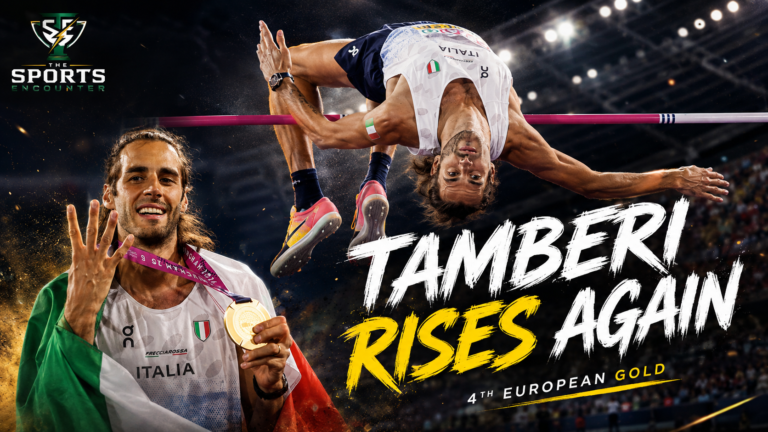
Gianmarco Tamberi Rises Again With Fourth European High Jump Gold
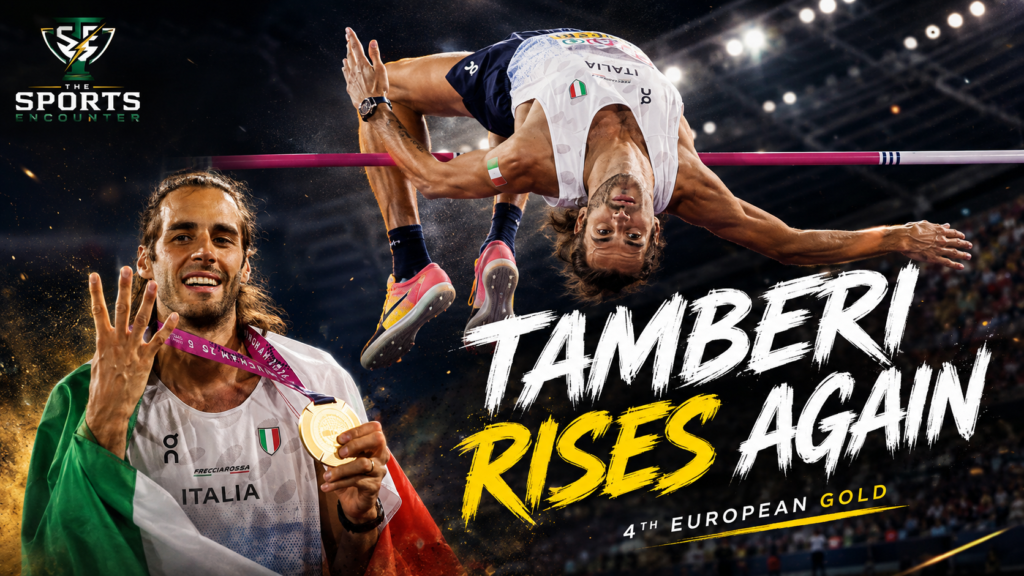
Gianmarco Tamberi turned doubt into another golden night, clearing a season-best 2.32m to win his fourth European high jump title at Birmingham 2026 as Italy celebrated a 1-3 podium finish.
Gianmarco Tamberi arrived in Birmingham with questions around his form and left with another gold medal around his neck. That is what separates a performer from a champion.
The Italian high jump great won the men’s high jump title at the 2026 European Athletics Championships with a season-best clearance of 2.32 meters, adding another dramatic chapter to a career already decorated with Olympic gold, world gold and multiple European titles.
Ukraine’s Oleh Doroshchuk took silver at 2.30m, while Italy’s Matteo Sioli cleared 2.27m for bronze, giving Italy a 1-3 finish on the podium and another major moment in what has become a powerful modern era for Italian athletics.
For Tamberi, this was not simply another medal.
It was proof that even at 34, even after an uneven build-up, even when the numbers suggested caution, he could still turn a major final into his stage.
Gianmarco Tamberi’s Birmingham 2026 Gold at a Glance
| Detail | Information |
|---|---|
| Event | Men’s high jump final |
| Champion | Gianmarco Tamberi, Italy |
| Winning mark | 2.32m |
| Performance note | Season best |
| Silver | Oleh Doroshchuk, Ukraine, 2.30m |
| Bronze | Matteo Sioli, Italy, 2.27m |
| European titles | Fourth European outdoor high jump title |
| Current streak | Third straight European outdoor title |
| Career context | Olympic champion, world champion and European champion |
Tamberi Turned Doubt Into Theatre Again
Tamberi’s greatness has never been built only on height.
It has always involved theatre, nerve and timing.
That is why this Birmingham victory carried such a familiar emotional rhythm. His season had not looked smooth. His best mark before the championship stood at 2.23m, a number that looked modest beside his reputation and far below the level normally required to win a major European final.
That kind of build-up creates pressure of a different kind.
For younger jumpers, a quiet season can be explained as development. For an athlete with Tamberi’s résumé, it becomes a warning sign. Every missed clearance gets interpreted as decline. Every lower mark becomes evidence that the magic may finally be fading.
Then the final starts.
Then the crowd rises.
Then Tamberi becomes Tamberi again.
2.32m Was More Than a Winning Clearance
A clearance of 2.32m won the gold medal, but the real meaning of the jump was psychological.
Tamberi had to move from a 2.23m season-best range into a performance that demanded championship authority. That is not a minor adjustment. In high jump, nine centimeters can represent a massive competitive gap, especially when an athlete is managing age, rhythm, pressure and confidence.
He found the jump when it mattered.
That is what elite championship jumpers do. They do not always arrive with the cleanest season. They do not always dominate the circuit. But when the final becomes a test of timing and emotional control, they still know how to produce the jump that changes everything.
Tamberi’s official World Athletics profile reflects the scale of his career, but Birmingham 2026 added something numbers alone cannot capture: another comeback performance under bright lights.
Oleh Doroshchuk Pushed the Final to Championship Level
Doroshchuk’s silver at 2.30m deserves strong recognition.
The Ukrainian had already shown world-class form, and his presence in the final meant Tamberi could not win through aura alone. A 2.30m clearance in a European final forces the champion to respond. It keeps pressure on every attempt. It makes one failure feel heavier.
Doroshchuk did exactly what a challenger must do.
He stayed close enough to make the contest real.
For Ukraine, the medal also carried emotional weight beyond the field. Every major international podium for Ukrainian athletes continues to resonate against a difficult national backdrop, and Doroshchuk’s performance gave his country another high-level athletics moment.
Matteo Sioli Made It an Italian Podium Story
Sioli’s bronze transformed the event from a Tamberi headline into a broader Italian high jump story.
At 2.27m, the younger Italian gave the team a second medal and helped create a 1-3 podium finish. That matters because Tamberi has been Italy’s high jump symbol for years, but sustained national success requires more than one icon.
Sioli’s medal suggested depth.
It also created an appealing generational image: Tamberi still winning gold, Sioli joining him on the podium, and Italy showing that its high jump identity is not tied only to one man’s brilliance.
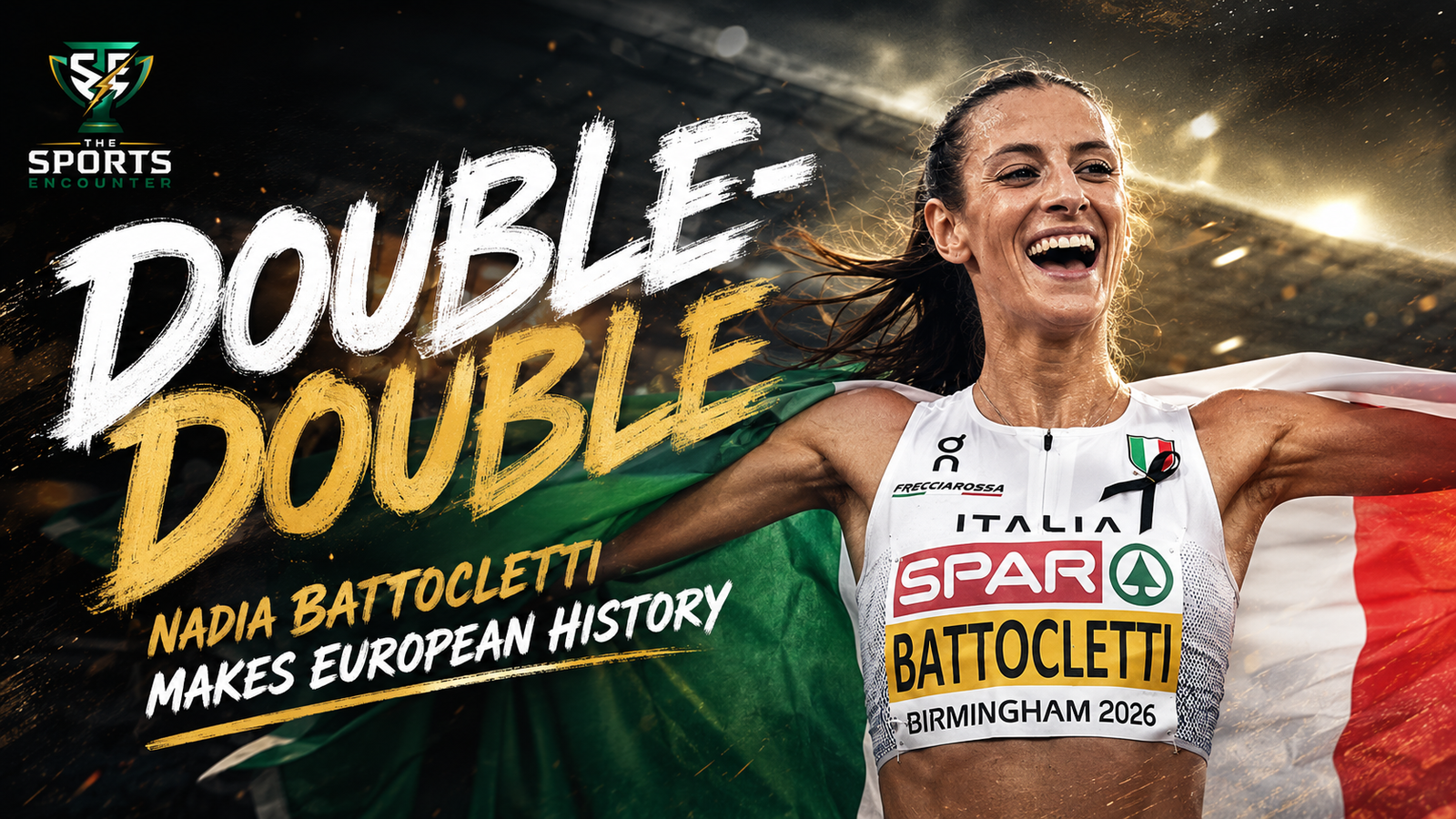
The Sports Encounter has followed similar Italian dominance stories during these championships, including Nadia Battocletti’s historic 5,000m-10,000m double-double. Together, those results show Italy’s Birmingham success is not isolated to one discipline.
Fourth European Title, Third Straight, Same Old Tamberi
Tamberi’s fourth European outdoor high jump title places him in rare company.
Even more striking is the current streak: three straight European titles. Sustaining that level in a technical field event is not easy. High jump punishes small timing errors, approach inconsistency and mental hesitation. A jumper can look brilliant in warm-up and lose the final through one mistimed take-off.
Tamberi has survived enough of those pressures to build one of the strongest championship résumés in the event.
This was not his first great night.
That is exactly why it mattered.
The victory showed that his best competitive instincts still appear when the stakes are highest.
Why Tamberi Connects With Fans So Easily
There are athletes who win quietly, and there are athletes who invite the stadium into the performance.
Ops, he did it again!
— Simona 💫🎶📖💜 (@lasimo_2101) August 14, 2026
Che demonio sei, gimbo ⭐️#Birmingham2026 #Tamberi pic.twitter.com/W1iEOGGiWO
Tamberi belongs firmly to the second group.
He reacts. He gestures. He feeds off noise. He turns clearances into moments. That energy can divide purists who prefer colder technical control, but it has made him one of track and field’s most recognizable personalities.
At a major championship, that matters.
Athletics needs performers who make casual viewers feel the tension of an attempt before they understand the technical details. Tamberi does that naturally. He gives fans a reason to care about the run-up, the pause, the bar and the landing.
That showmanship is not separate from his competitiveness.
It is part of it.
The 34-Year-Old Question Was Answered in the Best Way
Age follows every great athlete differently.
In high jump, 34 is a serious number. The event demands speed on the approach, explosive take-off, elastic strength, body control and confidence in repeated high-impact jumps. None of that becomes easier with time.
That is why Tamberi’s victory in Birmingham deserves more than routine applause.
He did not simply show up and rely on reputation. He improved sharply on his season best and cleared the highest bar in the final.
That is the answer champions prefer to give.
No long explanation.
No defensive speech.
Just a gold-medal jump.
Italy’s Golden Athletics Era Gets Another Signature Moment
Italian athletics has been enjoying one of the strongest periods in its modern history, and Tamberi remains one of the faces of that era.
His Olympic gold in Tokyo, world title, European titles and public charisma helped make him central to Italy’s athletics identity. Birmingham added another chapter at a time when other Italian athletes are also producing major championship success.
That matters because national momentum is rarely built by one athlete alone.
Battocletti’s distance dominance, Sioli’s high jump bronze and Tamberi’s latest gold together suggest a wider ecosystem of belief, competition and medal expectation.
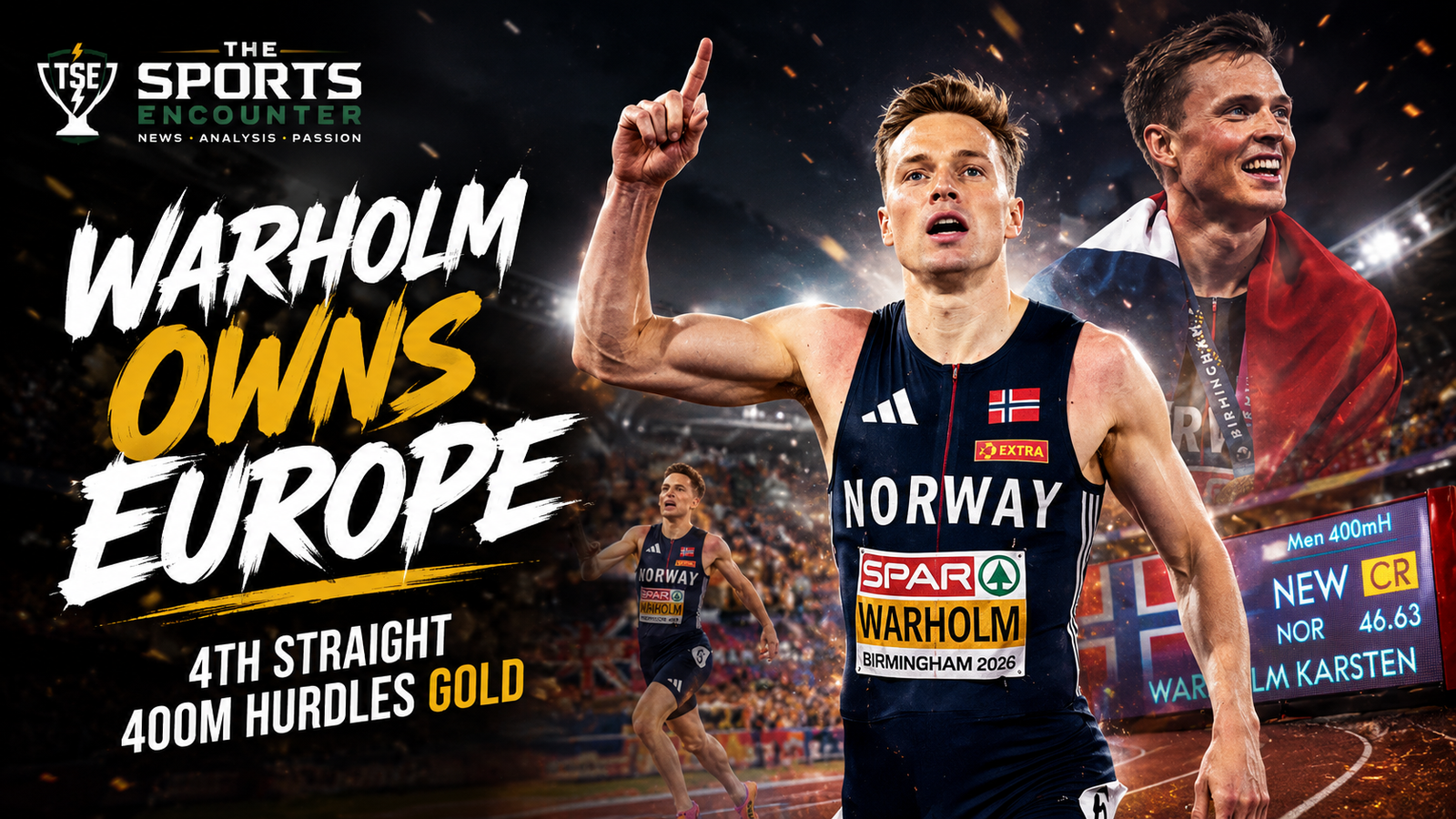
The Sports Encounter has tracked that same wider major-event pattern across athletics and multi-sport coverage, including Karsten Warholm’s fourth straight European 400m hurdles title and Amy Hunt’s rare European sprint double.
Doroshchuk and Sioli Show the Event’s Future Is Not Quiet
Tamberi won the night, but the podium around him mattered.
Doroshchuk’s 2.30m confirmed that Ukraine has a serious high jump medal force. Sioli’s 2.27m confirmed that Italy has another jumper capable of entering major podium conversations. That combination keeps the men’s high jump landscape interesting beyond Tamberi’s personal story.
The champion remains the headline, but the event is not standing still.
That is important for the next cycle.
Tamberi’s competitive fire still burns, but the athletes around him are pushing. That pressure is exactly what makes victories like Birmingham meaningful. A great champion needs real challengers to keep the story alive.
The Bar Became a Stage, Not Just an Obstacle
High jump is one of the few events in athletics where tension is so visible.
The bar sits there. The stadium watches. The athlete walks back, resets, breathes, begins the approach and takes one attempt at changing the medal order.
Tamberi understands that theatre better than almost anyone.
He does not hide from the moment. He stretches it. He makes the stadium wait with him. He turns the attempt into drama before the jump even happens.
That is why fans respond to him.
They are not only watching an athlete jump. They are watching a performer wrestle with risk in real time.
Why This Gold Belongs Beside His Bigger Career Wins
Olympic gold and world gold will always sit at the top of Tamberi’s career résumé.
But not every important victory has to be the biggest victory.
Birmingham mattered because of timing. It came after a modest season-best, at an age where decline questions are natural, against active challengers and inside a championship setting where his reputation alone could not win the event.
That gives the gold its own character.
It was a resilience title.
It was a reminder title.
It was a night when Tamberi showed he could still bend a final toward himself.
What This Means for the Global Picture
A European title does not settle the global high jump field.
The event remains volatile. Major finals can turn on countback, one missed attempt, weather, rhythm, or one athlete suddenly finding a season-best clearance at the perfect time. Tamberi knows that better than most.
But Birmingham showed he cannot be written off.
That is the key takeaway.
Any global championship conversation involving the men’s high jump still has to include him. He may not dominate every meeting. He may not arrive with the highest season’s best every time. But if he reaches a final and the crowd begins to rise, history says he becomes dangerous.
Official championship information is available through European Athletics, while athlete records and global rankings are available through World Athletics. Italian athletics updates are also available through the official federation, FIDAL.
TSE Analysis: Tamberi’s Greatest Skill May Be Timing
In high jump, timing usually means the approach, take-off and clearance.
With Tamberi, it also means something bigger.
He knows when the night needs him.
He knows when the crowd can become useful. He knows when emotion can sharpen rather than distract. He knows how to make a major final feel like his natural environment.
That is a rare competitive gift.
Birmingham 2026 was not his smoothest route to gold. That made it more compelling. He arrived with doubts, gave the field a chance to believe, then produced the 2.32m clearance that reminded everyone why he remains one of the great high jumpers of his era.
Doroshchuk pushed him. Sioli joined him on the podium. Italy celebrated another major athletics success.
But the final still belonged to Tamberi.
The showman is still a champion.
And when the bar rises, so does he.
Readers can also follow The Sports Encounter’s wider athletics coverage through Nadia Battocletti’s historic double-double, Karsten Warholm’s record hurdles gold, Amy Hunt’s European sprint double, Glasgow 2026 Day 4, Glasgow 2026 Day 5, and our analysis of sporting greatness.
Frequently Asked Questions
What did Gianmarco Tamberi win at the 2026 European Athletics Championships?
Gianmarco Tamberi won the men’s high jump gold medal at the 2026 European Athletics Championships in Birmingham.
What height did Gianmarco Tamberi clear to win gold?
Tamberi won with a season-best clearance of 2.32 meters.
Who won silver and bronze in the men’s high jump?
Ukraine’s Oleh Doroshchuk won silver with 2.30m, while Italy’s Matteo Sioli took bronze with 2.27m.
How many European high jump titles has Tamberi won?
Tamberi has now won four European outdoor high jump titles.
Is this Tamberi’s third straight European title?
Yes. Birmingham 2026 marked his third consecutive European outdoor high jump title.
Why was Tamberi’s Birmingham win important?
It showed that Tamberi could still produce a major championship-winning performance at 34 after entering the event with a modest season-best mark.
Has Tamberi won Olympic and world gold?
Yes. Tamberi is an Olympic champion and world champion, in addition to being a multiple-time European champion.
Why is Matteo Sioli’s bronze important for Italy?
Sioli’s bronze gave Italy two medals in the men’s high jump and showed depth behind Tamberi in one of the country’s strongest athletics events.
The Sports Encounter’s athletics coverage follows major championships, records, athlete breakthroughs, sprinting, hurdles, distance running, field events and the biggest stories shaping global track and field.
Birmingham 2026
Birmingham 2026 Belonged to Amy Hunt, but Italy Won the Championship
Amy Hunt became the first athlete to win four gold medals at a single European Championships, while Italy finished Birmingham 2026 on top of the medal table after a week packed with records, comebacks, and unforgettable performances.
Birmingham waited 92 years to host the European Athletics Championships.
Seven days were enough to make the wait worthwhile.
Amy Hunt arrived at Alexander Stadium as one of Britain’s most exciting young sprinters and left with four gold medals, something no athlete had achieved at a single European Championships before her.
Dina Asher-Smith became the most decorated athlete in the history of the competition.
Matthew Hudson-Smith won another European 400m title on the track where much of his career began, then finished the week as the most decorated male athlete in championship history.
Italy turned individual brilliance into collective dominance, collecting 22 medals and 10 golds to beat the host nation to the top of the final medal table.
Armand Duplantis cleared 6.15 meters for a fourth consecutive European pole vault crown.
Karsten Warholm broke the championship record while winning his fourth straight 400m hurdles title.
Nadia Battocletti completed another historic 5,000m-10,000m double.
Audrey Werro recovered from a frightening semifinal fall to defeat Olympic champion Keely Hodgkinson in one of the races of the week.
Andy Díaz Hernández landed the fourth-longest triple jump in history.
Andreas Almgren rewrote one of the championship’s oldest distance records.
Julian Weber finally moved beyond 90 meters.
Georgia Hunter Bell completed her extraordinary comeback from five years away from athletics by winning the women’s 1500m title in front of a home crowd.
There were stories everywhere.
The opening night of Birmingham 2026 had already suggested this championship might become something special. By Sunday evening, the event had produced records, generational shifts, established champions, late-career breakthroughs and a medal-table fight that remained alive until the final race.
Birmingham 2026 European Athletics Championships: Key Facts
| Competition | 27th European Athletics Championships |
| Dates | August 10-16, 2026 |
| Venue | Alexander Stadium, Birmingham, Great Britain |
| Historical significance | First European Athletics Championships staged in Britain |
| Medal-table winner | Italy |
| Italy | 22 medals, 10 gold |
| Great Britain & Northern Ireland | 19 medals, 9 gold |
| Germany | 21 medals, 6 gold |
| Netherlands | 14 medals, 5 gold |
| Norway | 6 medals, 4 gold |
| Most successful individual athlete | Amy Hunt, four gold medals |
| Major championship record | Mondo Duplantis, 6.15m pole vault |
| European relay record | Great Britain, mixed 4x100m, 39.97 |
Complete official results, placings and records can be found through the European Athletics Birmingham 2026 results center.
Amy Hunt Became the Athlete Birmingham Will Be Remembered For
Major championships often produce one athlete whose story seems to follow the entire week.
In Birmingham, that athlete was Amy Hunt.
Her championship began with the women’s 100m.
Hunt ran 11.00 seconds to beat Poland’s Ewa Swoboda by 0.02, claiming her first major senior individual outdoor title. The Sports Encounter’s analysis of Hunt’s 100m victory argued that the result represented a shift in Britain’s sprint hierarchy.
Three days later, the argument became considerably stronger.
Hunt won the 200m in 22.19, beating Ireland’s Rhasidat Adeleke and training partner Dina Asher-Smith.
The victory made Hunt only the third woman to complete the 100m-200m double at a European Championships.
The Sports Encounter examined the significance in Amy Hunt’s rare European sprint-double story.
She still had two races left.
Britain’s women’s 4x100m team of Hunt, Asher-Smith, Success Eduan and Imani-Lara Lansiquot won gold in 42.05 seconds on Saturday.
That gave Hunt three titles.
Sunday provided the unprecedented fourth.
Jeremiah Azu, Zharnel Hughes, Asher-Smith and Hunt combined in the newly contested mixed 4x100m relay and stopped the clock at a European-record 39.97.
No athlete in 92 years of European Championships competition had previously won four gold medals at a single edition.
Hunt had done it at 24.
Four races, four gold medals
| Event | Result | Performance |
|---|---|---|
| Women’s 100m | Gold | 11.00 |
| Women’s 200m | Gold | 22.19 |
| Women’s 4x100m | Gold | 42.05 |
| Mixed 4x100m | Gold | 39.97, European record |
It was the kind of week that changes an athlete’s career category.
Hunt entered Birmingham as a contender.
She left as one of the central figures in European sprinting heading toward the Los Angeles 2028 Olympic cycle.
Dina Asher-Smith Made History Without Winning an Individual Title
Hunt’s rise created a compelling generational subplot because the woman racing alongside her was already one of Britain’s greatest sprinters.
Asher-Smith did not defend her individual 100m crown.
She took bronze behind Hunt and Adeleke in the 200m.
Yet Birmingham still became one of the most historically significant championships of her career.
Saturday’s women’s 4x100m gold moved Asher-Smith level with Polish legend Irena Szewinska on 10 European Championship medals.
The mixed relay on Sunday moved her ahead.
Asher-Smith finished Birmingham with **11 European Championship medals, including eight golds**, making her the most decorated athlete in the 92-year history of the competition.
There was something fitting about the record arriving while she shared a relay with Hunt.
British sprinting did not need one generation to disappear before the next could emerge.
For one championship, the two overlapped.
Italy Won the Championship by Being Good Everywhere
Britain produced the athlete of the championships.
Italy produced the strongest team.
The final medal table says Italy finished with 22 medals, including 10 golds. Britain collected 19 medals with nine golds.
The margin in gold medals was one.
The decisive title arrived in the final event.
Italy won the men’s 4x400m relay by just 0.03 seconds over Britain, giving the Italians their 10th gold and ensuring they would leave Birmingham at the top of Europe.
The relay finish represented the entire championship in miniature.
Britain had the crowd, the momentum and several historic performers.
Italy had depth.
Leonardo Fabbri defended his shot put title on opening night.
Nadia Battocletti won both distance titles.
Gianmarco Tamberi remained Europe’s high jump king.
Andy Díaz produced one of the most spectacular field-event performances ever seen at a European Championships.
Larissa Iapichino won the women’s long jump on the final evening.
The men’s 4x400m team supplied the closing blow.
Italy’s ability to score across sprints, distance events, jumps, throws and relays made the difference.
Nadia Battocletti Completed Another Distance Double
Battocletti has quietly become one of the most dependable championship performers in European athletics.
Birmingham strengthened that reputation.
She won the women’s 5,000m on Day 2, one of the defining performances in The Sports Encounter’s Day 2 Birmingham report.
Then she returned for the 10,000m.
Battocletti waited until the closing stages before producing a devastating final burst to win in 31:41.17.
The result completed the 5,000m-10,000m double for a second consecutive European Championships.
No woman had previously achieved that double-double.
It was another example of why Italy eventually won the medal table. When one gold-medal opportunity appeared, their leading athletes often converted it.
Andy Díaz Produced the Jump of the Championships
If Birmingham 2026 produced one field-event mark that forced people to stop and reconsider the historical record book, it came from Andy Díaz Hernández.
The Cuban-born Italian triple jumper landed at 18.15 meters.
That was a 28-centimeter personal best.
More importantly, it became the fourth-longest legal triple jump in history.
Only Jonathan Edwards’ 18.29 world record, Christian Taylor’s 18.21 and Jordan Díaz’s 18.18 have gone farther.
This was not simply European gold.
It placed Díaz inside one of athletics’ most exclusive historical conversations.
His victory also arrived after Italian long jump world champion Mattia Furlani had suffered a hamstring injury during qualifying earlier in the week, removing one of Italy’s expected medal opportunities.
Italy lost one field-event superstar.
Another delivered an 18-meter masterpiece.
Duplantis Turned a Difficult Summer Into a Fourth European Crown
Armand Duplantis has won so often that the difficulty is remembering how unusual his performances still are.
Birmingham offered a reminder.
The world record holder entered the championships after a rare Diamond League defeat in Stockholm and a withdrawal from the London Diamond League.
He had described the build-up as difficult and stressful.
Then the final started.
Duplantis cleared six meters.
He moved beyond Greek rival Emmanouil Karalis.
He cleared 6.10.
Then came 6.15 meters.
The bar stayed up.
Duplantis had broken his own European Championships record and secured a fourth consecutive continental outdoor title.
Karalis produced another world-class performance with 6.00m for silver, but even that was not enough to place the title in serious doubt once Duplantis found his rhythm.
Karsten Warholm Still Owns the European 400m Hurdles
Duplantis was not the only athlete leaving Birmingham with a fourth consecutive European title.
Karsten Warholm did the same in the men’s 400m hurdles.
The Norwegian ran 46.63 seconds, breaking the championship record and finishing more than a second ahead of silver medalist Emil Agyekum.
The Sports Encounter’s full Warholm analysis showed something especially impressive about his run of European finals.
He keeps getting faster.
The championships have changed venues.
Rivals have changed.
Warholm has moved into his 30s.
The outcome has remained familiar.
Birmingham confirmed that European dominance in this event still runs through him.
Audrey Werro Fell, Got Reinstated, Then Beat Keely Hodgkinson
No championship comeback happened faster than Audrey Werro’s.
The Swiss 800m star fell heavily during her semifinal after contact during the race.
She crossed the line last.
Officials later reinstated her after reviewing the incident.
One day later, Werro stood beside Olympic champion Keely Hodgkinson in the European final.
Then she beat her.
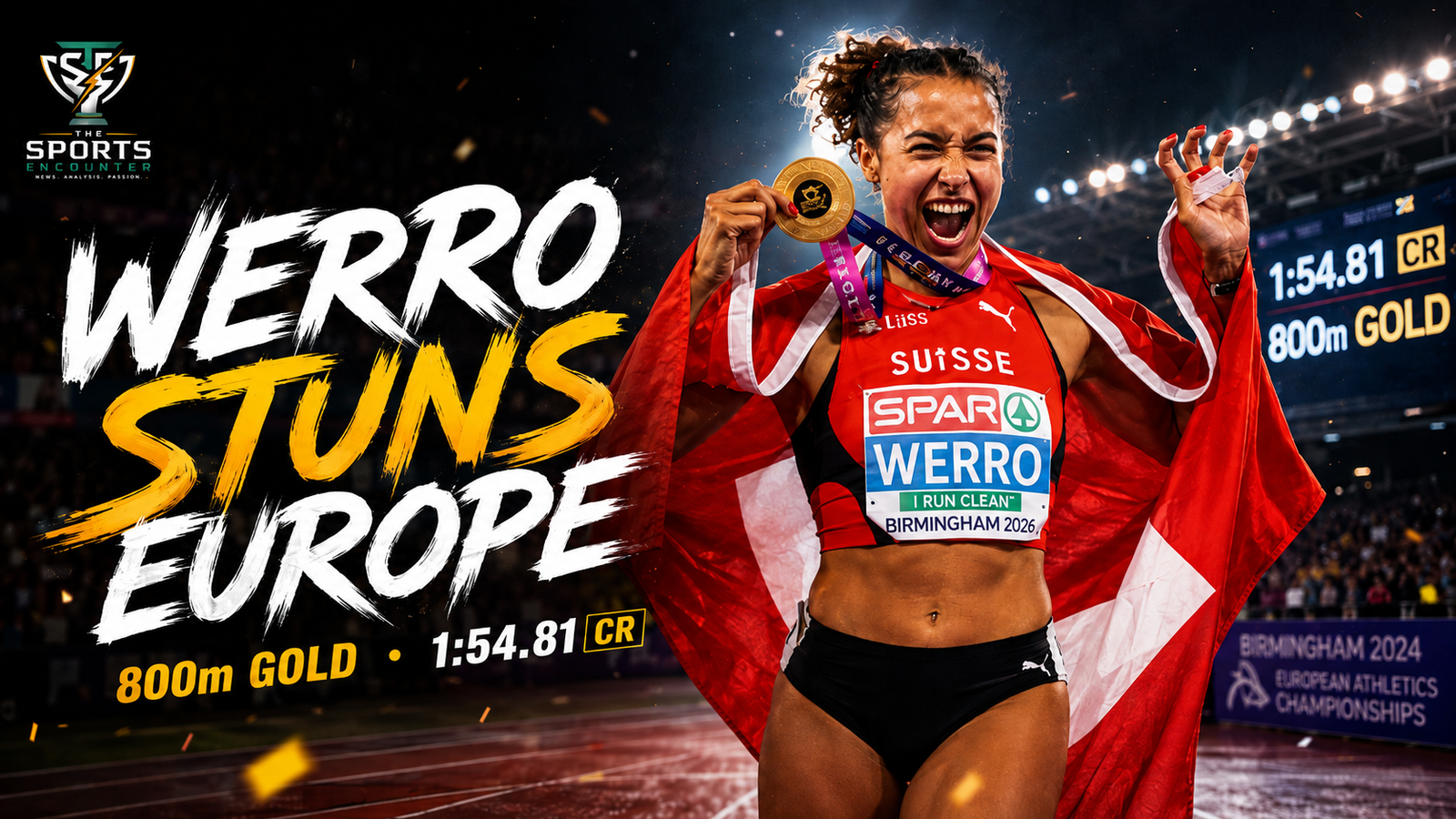
Werro ran 1:54.81, breaking a championship record that had survived since 1982.
Hodgkinson produced 1:55.01 in front of the home crowd and still finished second.
Femke Broeders-Bol, continuing one of the more fascinating event transitions in modern athletics, took bronze in 1:55.54.
The Sports Encounter’s analysis of Werro’s remarkable 800m victory identified the race as one of Birmingham’s defining contests.
It deserves that status.
Werro entered the final roughly 24 hours after believing her championship might be over.
She left with gold and one of the fastest performances ever produced over two laps.
Matthew Hudson-Smith Won at Home and Rewrote European History
Few athletes carried a more personal relationship with Alexander Stadium than Matthew Hudson-Smith.
He grew up nearby.
He trained there.
A stand was named after him during the championship.
On Day 3, he won the men’s 400m in 44.17 seconds.
It was his third European title in the event, making him the first man to achieve that feat.
Hudson-Smith had already been one of Britain’s most decorated European athletes.
His silver medal in the men’s 4x400m on the final night raised his career European Championship total to nine medals.
That moved him beyond Christophe Lemaitre as the most decorated male competitor in championship history.
Birmingham therefore produced historic medal records for both Asher-Smith and Hudson-Smith.
One had defined British women’s sprinting for a decade.
The other had spent years turning one lap of a track into a career of extraordinary durability.
Georgia Hunter Bell Completed One of Athletics’ Best Comeback Stories
Georgia Hunter Bell’s European title would have been significant under normal circumstances.
Her background makes it remarkable.
She quit competitive athletics for five years.
Then she came back.
By 2026, Hunter Bell had already collected world indoor and Commonwealth titles.
Birmingham added European outdoor gold.
She took control of the 1500m final and closed the last lap aggressively, running 4:07.78 to finish more than a second ahead of Poland’s Klaudia Kazimierska.
The victory represented Britain’s ninth and final gold medal of the championships.
Hunter Bell’s story also fitted Birmingham’s wider theme.
These championships were full of athletes at very different points in their careers.
Hunt represented arrival.
Asher-Smith represented longevity.
Hunter Bell represented return.
Romell Glave Gave Britain the Men’s 100m Too
Hunt’s opening-night victory ensured Britain owned the women’s 100m.
Twenty-four hours later, Romell Glave completed a home sprint double of a different kind.
Glave won the men’s 100m, with Jeremiah Azu taking silver.
The race became one of the key stories from Birmingham Day 2.
By the weekend, Britain had added both the men’s and women’s 4x100m titles.
The host nation therefore controlled almost every short-sprint opportunity available during the championship.
Owen Ansah prevented a total sweep by winning the men’s 200m for Germany.
Owen Ansah Gave Germany a Major Sprint Title
Germany’s strength in Birmingham went much deeper than one event, but Ansah provided its clearest pure sprint headline.
He won the men’s 200m in a wind-assisted 19.95 seconds, beating Britain’s Zharnel Hughes.
The +2.5 m/s wind meant the performance could not stand for record purposes.
The gold medal did.
Ansah had already won bronze in the men’s 100m, making him one of the championship’s most productive male sprinters.
The Sports Encounter’s report on Ansah’s 200m title examined why the result mattered for German sprinting.
His performance became one part of a much larger German championship.
Germany Won 21 Medals Because Its Strength Was Everywhere
Germany actually won more medals than Britain.
Twenty-one medals placed the Germans second in total podium finishes behind Italy, although six golds left them third on the official table.
Leo Neugebauer won an exhausting decathlon battle with 8,611 points, beating teammate Niklas Kaul by only 38.
Gesa Felicitas Krause returned to the top of the women’s 3,000m steeplechase, winning her third European title in 9:12.69.
Julian Weber produced one of the throwing performances of the week.
His 90.40m javelin throw carried him beyond the 90-meter barrier and delivered gold.
Frederik Ruppert won the men’s 3,000m steeplechase on the final evening.
Ansah supplied the 200m title.
The accumulation explains why Germany remained prominent on the medal table from beginning to end.
Kristjan Čeh and Mykolas Alekna Pushed the Discus Into Another Era
The men’s discus has become one of athletics’ deepest technical rivalries.
Birmingham added another chapter.
Slovenia’s Kristjan Čeh opened the final with 70.83m, immediately breaking the championship record.
The record did not last.
Čeh later threw 72.51m.
That became the winning mark and another championship record.
World record holder Mykolas Alekna took silver with 69.89m, while Germany’s Henrik Janssen earned bronze.
The Sports Encounter’s Day 4 wrap-up captured the extraordinary sequence as Čeh repeatedly pushed the championship standard farther.
Mark English Finally Reached the Top of the Podium
Some medals carry the weight of one race.
Mark English’s carried 12 years.
The Irish 800m runner had won European bronze in 2014 and again in 2022.
He had spent much of his career close to major outdoor gold without owning one.
Birmingham changed that.
English ran a patient final and produced the decisive move late, winning in 1:45.26.
It made him the first Irishman to win a European outdoor 800m title.
Combined with Rhasidat Adeleke’s 200m silver, Kate O’Connor’s heptathlon gold and Andrew Coscoran’s 1500m bronze, Birmingham became an important championship for Irish athletics.
Kate O’Connor Turned Commonwealth Momentum Into European Gold
O’Connor arrived only weeks after winning Commonwealth gold.
She left Birmingham with another major title.
The Irish multi-event athlete accumulated 6,751 points in the heptathlon, a national record, and held off Dutch rival Emma Oosterwegel by 38 points.
Her win reinforced another Birmingham theme: athletes carrying momentum from Glasgow into the European Championships rather than treating the two events as separate seasons.
O’Connor handled seven events across two days and still had enough control in the concluding 800m to protect the championship.
Jakob Ingebrigtsen’s Return Began With Gold
Before Hunt’s four-title week developed, Birmingham’s first night had already supplied a major comeback story.
Jakob Ingebrigtsen returned from an injury-affected period and won the men’s 5,000m in 13:15.29.
The Norwegian waited until the closing stages before using the finishing speed that has defined so many championship victories.
It was another European title for an athlete whose relationship with these championships has become almost routine.
Yet this one felt different because of the uncertainty surrounding his return.
The TSE Day 1 wrap identified Ingebrigtsen’s victory alongside Hunt as the championship’s opening statement.
Andreas Almgren Refused to Wait for a Sprint Finish
Sweden’s Andreas Almgren approached the men’s 10,000m differently.
He did not want to discover who had the fastest kick.
He wanted to remove everyone else’s kick from the equation.
Almgren attacked the race from the front and won in 27:23.44, smashing the championship record.
He finished almost 20 seconds clear.
Most of the field had been lapped.
Distance championships often become tactical waiting games.
Almgren turned his into a statement of sustained speed.
Yaroslava Mahuchikh Kept Her European Crown
World record holder Yaroslava Mahuchikh did not need an extraordinary height to preserve her dominance.
She needed to clear the right height at the right time.
The Ukrainian won the women’s high jump with 1.97m, securing a third consecutive European title.
Poland’s Maria Żodzik and Montenegro’s Marija Vuković both cleared 1.95m behind her.
Mahuchikh’s result added another established champion to a Birmingham week where emerging athletes frequently shared the stage with athletes who have controlled their events for years.
Final Day Turned Into a Championship of Records
Sunday began away from Alexander Stadium.
Finland’s Alisa Vainio won the women’s marathon in 2:22:26.
Germany’s Amanal Petros took the men’s title in 2:09:11.
Britain’s Abbie Donnelly collected a historic women’s marathon bronze and helped the hosts add another medal before the stadium program began.
Then came the final evening.
Croatia’s Sara Kolak won the women’s javelin.
Larissa Iapichino produced exactly 7.00m to win the women’s long jump, beating Britain’s Jazmin Sawyers by a single centimeter after Sawyers set a personal best of 6.99m.
Great Britain broke the European record in the mixed 4x100m.
Frederik Ruppert won steeplechase gold for Germany.
Hunter Bell won the 1500m.
The Netherlands took the women’s 4x400m title.
Duplantis cleared 6.15m.
Italy won the men’s 4x400m by 0.03 seconds and secured the medal table.
There was almost no quiet ending available.
Final Birmingham 2026 Medal Table: Top Five
| Rank | Nation | Gold | Total Medals |
|---|---|---|---|
| 1 | Italy | 10 | 22 |
| 2 | Great Britain & Northern Ireland | 9 | 19 |
| 3 | Germany | 6 | 21 |
| 4 | Netherlands | 5 | 14 |
| 5 | Norway | 4 | 6 |
Britain Did Not Win the Medal Table, but Birmingham Still Changed British Athletics
Finishing second may sound disappointing after nine gold medals on home soil.
The deeper picture is considerably more encouraging.
Hunt emerged as a championship superstar.
Hudson-Smith retained his position at the top of European 400m running.
Hunter Bell added another major title.
Glave won the men’s 100m.
Both traditional 4x100m teams took gold.
The mixed sprint relay set a European record.
Asher-Smith and Hudson-Smith established championship medal records.
Hodgkinson ran 1:55.01 and lost, which says more about Werro’s brilliance than any major weakness in the British champion.
Sawyers jumped a personal best of 6.99m.
The final days were sold out, and Alexander Stadium produced the kind of atmosphere British athletics has often struggled to recreate outside an Olympics or Commonwealth Games.
The championship provided both results and personalities.
The Netherlands’ Five Golds Showed Their Range
The Netherlands finished fourth with 14 medals and five golds.
Jessica Schilder began the championship by retaining the women’s shot put title.
Nadine Visser finally claimed the European 100m hurdles crown after years around major finals.
Femke Broeders-Bol continued her remarkable transition toward the 800m and won bronze in one of the strongest two-lap races ever seen at the championships.
The women’s 4x400m squad finished the event with another Dutch gold on Sunday.
The national program remains one of Europe’s most versatile, capable of producing medals from hurdles through throws, middle-distance running and relays.
Norway Won Only Six Medals, but Four Were Gold
Norway’s six-medal total was modest compared with Italy, Germany, Britain or the Netherlands.
The efficiency was extraordinary.
Four of those six medals were gold.
Ingebrigtsen won the 5,000m.
Warholm took the 400m hurdles.
Henriette Jæger won the women’s 400m in 49.04.
The mixed 4x400m team had already delivered gold on opening night.
Norway continues to possess a concentration of world-class athletes that allows a relatively small delegation to exert enormous influence on major championship medal tables.
Birmingham Was Full of Athletes Refusing to Age Quietly
The championships were marketed around stars, but one of their most compelling patterns involved longevity.
Asher-Smith is 30 and became the most decorated European Championship athlete ever.
Hudson-Smith is 31 and became the most decorated male athlete.
Hunter Bell is 32 and won the 1500m after once spending five years away from competitive running.
Mark English won his first European outdoor gold in his 30s after waiting more than a decade.
Gesa Krause returned to the top of Europe years after her earlier continental titles.
Warholm, Tamberi and Duplantis added more gold to careers already full of them.
Birmingham was simultaneously a championship of new names and long memories.
The Championship Also Produced a Clear LA28 Generation
Hunt is 24.
Werro is 22.
Ansah is still developing into his best sprinting years.
O’Connor has transformed into a genuine major-championship multi-event contender.
Broeders-Bol’s move to 800m continues to generate enormous intrigue.
Several of these athletes are likely to arrive at the Los Angeles Olympics with more experience and considerably larger expectations than they carried into Birmingham.
The European Championships therefore served as more than a continental endpoint.
They became an early map of where European athletics may be heading over the next two years.
What Birmingham 2026 Will Be Remembered For
Championships eventually become shorthand.
Rome 2024 had its images.
Munich 2022 had its own.
Birmingham already has several that should survive.
- Amy Hunt becoming the first four-gold athlete in European Championships history.
- Dina Asher-Smith reaching 11 career European medals.
- Matthew Hudson-Smith winning another 400m title on his home track.
- Italy taking the medal table with the last gold of the championships.
- Andy Díaz reaching 18.15m in the triple jump.
- Audrey Werro returning from a semifinal fall to beat Keely Hodgkinson.
- Karsten Warholm running 46.63 for a fourth straight hurdles title.
- Armand Duplantis clearing 6.15m.
- Nadia Battocletti completing another distance double.
- Georgia Hunter Bell completing her extraordinary comeback with European gold.
- Andreas Almgren refusing to wait for a sprint and destroying the 10,000m championship record.
- Julian Weber finally joining the 90-meter javelin club.
Those moments explain why the championship felt bigger than a medal table.
TSE Verdict: Birmingham Gave European Athletics Exactly What It Needed
The European Championships have always occupied an interesting place in athletics.
They sit below the Olympics and World Championships in global status, yet they offer something those competitions cannot.
Depth.
European rivalries.
Events in which established global champions collide with athletes for whom a continental medal may become the defining achievement of a career.
Birmingham used that formula almost perfectly.
The stars showed up.
Duplantis won.
Warholm won.
Mahuchikh won.
Battocletti won twice.
Ingebrigtsen returned with gold.
Tamberi found another title.
Yet the championship never became predictable.
Werro beat Hodgkinson.
Hunt overtook Asher-Smith in the individual sprints while simultaneously helping her senior teammate make history in the relays.
English finally won.
Hunter Bell completed a comeback that once seemed impossible.
Ansah broke through.
Díaz produced 18.15m.
Italy and Britain carried the medal-table fight into the final event.
That balance is difficult to manufacture.
Established greatness needs enough resistance to remain interesting. Emerging athletes need opportunities large enough to change careers. Home crowds need athletes they can genuinely believe might win.
Birmingham had all three.
Italy deserved the final medal-table victory because its success stretched across the program.
Britain may nevertheless have gained something equally valuable from hosting the championships.
The home team found new stars.
Its established athletes created historical milestones.
The crowd became part of the competition rather than decoration around it.
And Amy Hunt left Alexander Stadium with four gold medals and a place in the record book that nobody else occupies.
Ninety-two years passed before Britain hosted these championships.
After what happened in Birmingham, another wait that long would make very little sense.
Frequently Asked Questions About Birmingham 2026
Who topped the Birmingham 2026 European Athletics Championships medal table?
Italy finished first with 22 medals, including 10 golds. Great Britain and Northern Ireland were second with 19 medals and nine golds.
How many gold medals did Amy Hunt win?
Amy Hunt won four gold medals: the women’s 100m, women’s 200m, women’s 4x100m relay and mixed 4x100m relay.
What history did Amy Hunt make?
Hunt became the first athlete in European Athletics Championships history to win four gold medals at a single edition.
How many European Championship medals does Dina Asher-Smith have?
Asher-Smith now has 11 European Championship medals, including eight golds, making her the most decorated athlete in the history of the competition.
Who became the most decorated male athlete in European Championship history?
Matthew Hudson-Smith reached nine career medals after winning the 400m and taking 4x400m relay silver, moving him to the top of the men’s all-time list.
Who won the women’s 800m?
Switzerland’s Audrey Werro beat Keely Hodgkinson in a championship-record 1:54.81.
How high did Mondo Duplantis clear?
Duplantis won the men’s pole vault with 6.15m, breaking his own European Championships record and claiming a fourth consecutive title.
How far did Andy Díaz jump?
Andy Díaz Hernández won the men’s triple jump with 18.15m, the fourth-longest legal jump in athletics history.
Who won the men’s 400m hurdles?
Karsten Warholm won in a championship-record 46.63 seconds, securing his fourth consecutive European title.
Who won the women’s 1500m?
Great Britain’s Georgia Hunter Bell won in 4:07.78, completing another major step in her remarkable comeback to elite athletics.
Who won the men’s 10,000m?
Sweden’s Andreas Almgren dominated the race in a championship-record 27:23.44.
Where were the 2026 European Athletics Championships held?
The championships were staged at Alexander Stadium in Birmingham, England, from August 10 to 16, marking the first time Britain hosted the outdoor European Athletics Championships.
The Sports Encounter’s athletics coverage follows major championships, records, emerging stars, historic performances and the athletes shaping the road toward Los Angeles 2028.
Birmingham 2026
Birmingham 2026: Werro, Warholm, Tamberi, Battocletti and Ansah Light Up Record Night
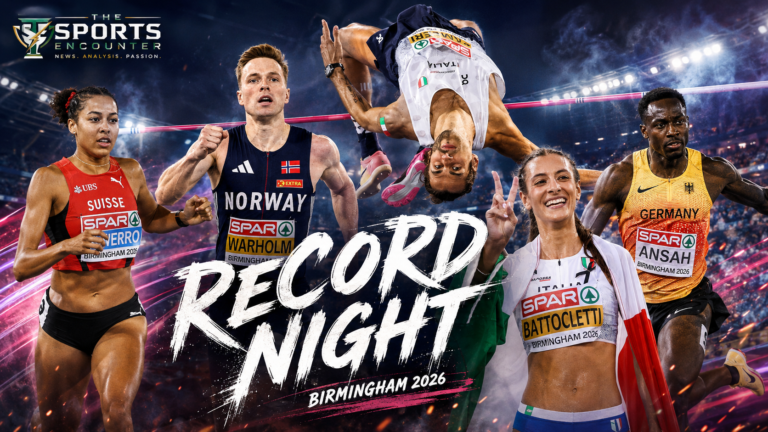
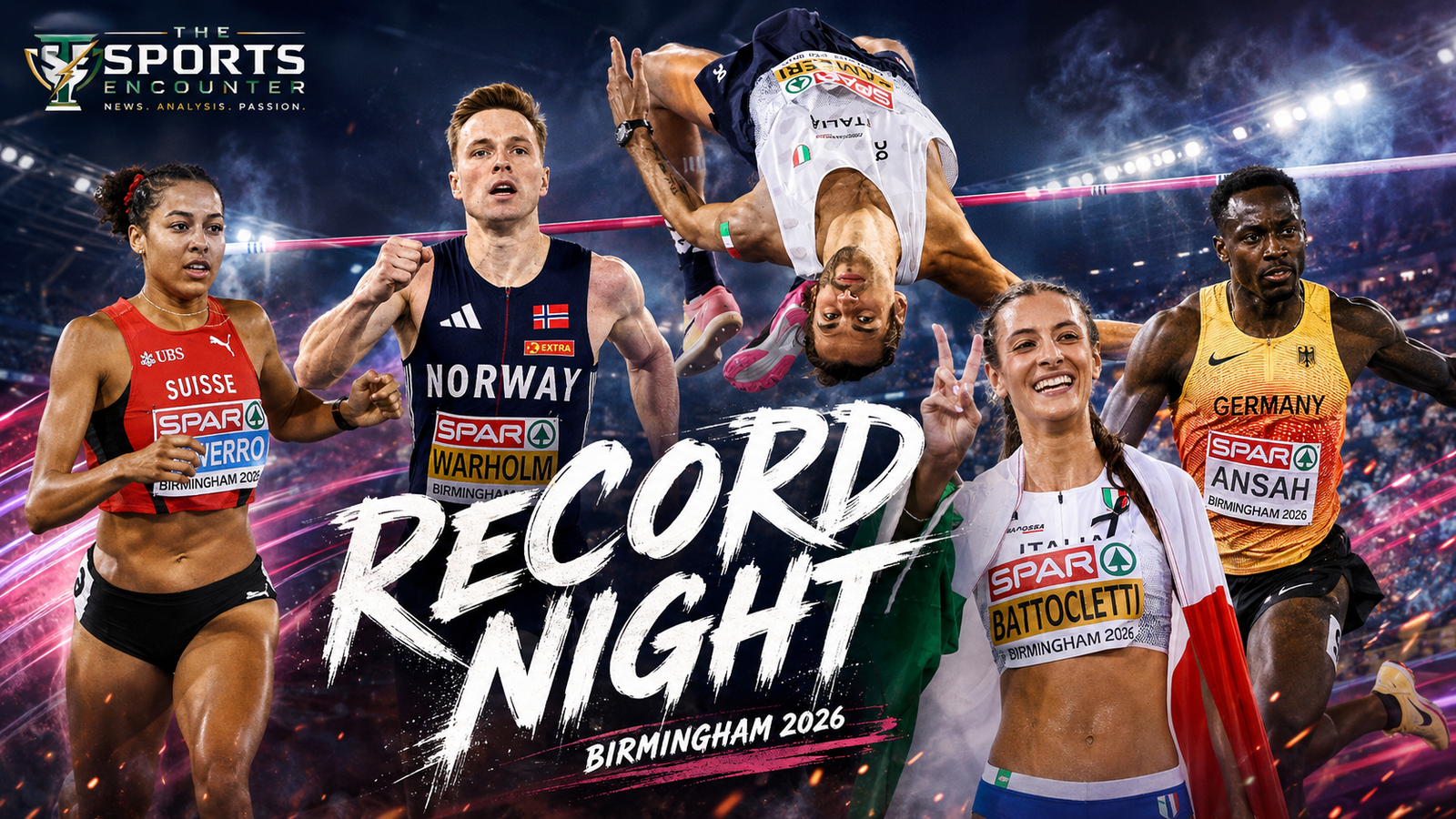
Birmingham 2026 delivered one of its biggest European Athletics Championships sessions as Audrey Werro stunned Keely Hodgkinson, Karsten Warholm set another hurdles record, Gianmarco Tamberi rose again, Nadia Battocletti completed history and Owen Ansah gave Germany a sprint breakthrough.
Birmingham 2026 produced the kind of European Athletics Championships session that turns a medal table into a memory. Audrey Werro broke a 44-year championship record to beat Keely Hodgkinson, Karsten Warholm owned the 400m hurdles again, Gianmarco Tamberi turned doubt into high jump gold, Nadia Battocletti completed a historic distance double-double, and Owen Ansah gave Germany a major sprint breakthrough.
This was not a quiet championship day. It was a night of statements.
Werro won the women’s 800m in 1:54.81, holding off Hodgkinson in front of a British crowd that expected a home celebration. Warholm ran 46.63 for his fourth straight European 400m hurdles title. Tamberi cleared a season-best 2.32m to win his fourth European high jump crown. Battocletti took the women’s 10,000m in 31:41.17 after already winning the 5,000m. Ansah captured the men’s 200m in 19.95, with a +2.5 wind reading, to give Germany its clearest sprint headline of the championships.
Some athletes defended territory. Others announced themselves. Together, they gave Birmingham its sharpest finals session yet.
Birmingham 2026 Today’s Biggest Winners at a Glance
| Event | Winner | Winning Mark | Main Story |
|---|---|---|---|
| Women’s 800m | Audrey Werro, Switzerland | 1:54.81 | Championship record, beating Keely Hodgkinson |
| Men’s 400m hurdles | Karsten Warholm, Norway | 46.63 | Fourth straight European title and championship record |
| Men’s high jump | Gianmarco Tamberi, Italy | 2.32m | Fourth European title, third straight, season-best clearance |
| Women’s 10,000m | Nadia Battocletti, Italy | 31:41.17 | Completed 5,000m and 10,000m double-double |
| Men’s 200m | Owen Ansah, Germany | 19.95, +2.5 wind | Germany’s breakthrough sprint gold |
Audrey Werro Turns the 800m Into Her Breakthrough Night
The women’s 800m had the tension of a race built for a major championship. Hodgkinson had the Olympic gold, the home crowd and the pressure. Werro had the fastest momentum of the season and the growing belief that she was ready to change the event’s hierarchy.
She did exactly that.
Werro won in a championship-record 1:54.81, beating Hodgkinson, who took silver in 1:55.01. Femke Broeders-Bol of the Netherlands claimed bronze in 1:55.54, reported as an equal national record.
The significance of Werro’s win went beyond the time. A fast mark in a paced race can prove talent. A championship record against an Olympic champion proves something deeper. It shows that the speed survives pressure, positioning, noise and the emotional weight of a final.
Hodgkinson did not run badly. That is what makes the race so important. She ran a brilliant 1:55.01 and still finished second. Werro did not win because the favorite folded. She won because she found the higher level on the night.
The result now gives the women’s 800m a sharper rivalry. Hodgkinson remains a champion-level force. Werro is no longer waiting outside the conversation. She is standing in the center of it.
Read the full TSE race analysis on Audrey Werro’s record 800m gold over Keely Hodgkinson.
Karsten Warholm Still Runs Like Europe Belongs to Him
Warholm’s dominance has lasted so long that the danger is treating it as routine.
Birmingham showed why that would be a mistake.
The Norwegian world record holder won the men’s 400m hurdles in 46.63, setting a championship record and claiming his fourth straight European title in the event. Germany’s Emil Agyekum took silver in 47.87, while Turkey’s Ismail Nezir earned bronze in 48.26.
Warholm’s race was brutal in its simplicity. He attacked early, forced the field into a chase and never gave the final back. By the home straight, the gold-medal race and the medal race behind him were no longer the same thing.
That is what separates great hurdlers from event-defining hurdlers.
Warholm has now broken 47 seconds 18 times in his career. His 46.63 in Birmingham was not close to his world record, but that is part of the point. One of his seventh-fastest performances ever was still far too much for Europe.
His full dominance is covered in Karsten Warholm’s fourth straight European 400m hurdles gold.
Gianmarco Tamberi Makes the High Jump His Stage Again
Gianmarco Tamberi arrived in Birmingham with a modest season-best of 2.23m and the natural questions that follow a 34-year-old champion in a technical event.
Then the final began, and Tamberi became Tamberi again.
The Italian cleared a season-best 2.32m to win the men’s high jump gold, holding off Ukraine’s Oleh Doroshchuk, who took silver at 2.30m. Matteo Sioli added bronze for Italy with 2.27m, giving the Italians a 1-3 finish on the podium.
This was Tamberi’s fourth European outdoor title and third straight. It was also another reminder that his greatest skill may be timing. Not only technical timing at take-off, but emotional timing inside a major final.
Tamberi understands how to pull a stadium into his attempts. He stretches the drama, feeds off noise and then finds the clearance when the bar begins to feel heavier than the measurement.
The win was not his biggest career achievement. Olympic gold and world gold still sit higher. But Birmingham mattered because it came at a moment when doubt had a reasonable argument. Tamberi answered with 2.32m and another gold medal.
Read the full feature on Gianmarco Tamberi’s fourth European high jump gold.
Nadia Battocletti Turns the Distance Double Into Her Own Property
Nadia Battocletti’s 10,000m gold was the kind of achievement that grows larger once the details settle.
The Italian won in a season-best 31:41.17 after already taking the 5,000m title earlier in the championships. That completed the 5,000m and 10,000m double for the second consecutive European Championships, making her the first woman to achieve that double at back-to-back editions.
Maureen Koster of the Netherlands took silver. Belgium’s Jana van Lent won bronze. Britain’s Megan Keith finished eighth after leading much of the race.
The important part is the repeat.
Winning a distance double once requires range, recovery and championship nerve. Doing it twice, across consecutive editions, means rivals had time to study the pattern and still could not break it.
Battocletti now owns a rare place in European distance running. Rome 2024 gave her a home-stage breakthrough. Birmingham 2026 confirmed that her dominance travels.
Her historic achievement is explored in detail in Nadia Battocletti’s 5,000m and 10,000m double-double.
Owen Ansah Gives Germany Its Sprint Moment
Owen Ansah’s men’s 200m gold gave the evening a breakthrough sprint story.
The German won in 19.95 with a +2.5 wind reading, beating Britain’s Zharnel Hughes, who took silver in 20.16. Italy’s Eseosa Desalu and Switzerland’s Timothé Mumenthaler shared bronze after both were recorded at 20.26.
The wind reading matters. A mark above +2.0 is not legal for record purposes, so Ansah’s 19.95 will not carry the same statistical status as a legal sub-20 performance.
But the title does not need that protection.
Every finalist ran with the same wind. Ansah still beat Hughes by 0.21 seconds and separated himself clearly from a field full of experience and speed. The wind helped the clock. It did not explain the margin.
Ansah had already won 100m bronze earlier in the championships. The 200m gold now gives Germany a sprinter with multi-event championship proof and a profile that can travel beyond one night.
The full story is available in Owen Ansah’s European 200m gold for Germany.
Italy’s Championship Strength Keeps Expanding
Italy came out of the day looking like one of the strongest stories of Birmingham 2026.
Tamberi won high jump gold. Sioli added high jump bronze. Battocletti completed the distance double. Desalu shared 200m bronze. That is a spread across field events, endurance and sprinting.
That spread matters.
National championships stories often become powerful when success stops depending on one athlete or one discipline. Italy now has Tamberi’s showmanship, Battocletti’s distance authority, Sioli’s podium emergence and Desalu’s sprint experience all contributing to the same wider picture.
This is not a one-star campaign.
It is a team identity being reinforced across the stadium.
Britain’s Night Was Strong, Painful and Complicated
Britain did not leave the session empty, but it did leave with several what-ifs.
Hodgkinson ran 1:55.01 and lost to a championship record. Hughes took silver in the 200m behind Ansah. Megan Keith led much of the 10,000m before finishing eighth. The crowd had moments to lift itself, but the biggest gold-medal celebrations belonged elsewhere.
That is the cruel side of a home championship.
Every British move feels amplified. Every near miss feels heavier. Hodgkinson’s silver will sting because she is good enough to win any major 800m final. Hughes’ silver will feel like a missed chance because he had the pedigree. Keith’s race will be remembered for courage more than the final placing.
Still, Britain’s championships have already delivered historic highs, led by Amy Hunt’s rare European 100m and 200m sprint double. This was a night that reminded the home team how fine the difference can be between carrying a crowd and being beaten in front of one.
Birmingham 2026 Is Becoming a Championship of Statements
The session worked because every major result carried a clear meaning.
Werro’s win changed the women’s 800m conversation. Warholm’s record reminded Europe that his event still belongs to him. Tamberi’s gold turned doubt into theatre. Battocletti’s double-double created history. Ansah’s 200m victory gave Germany a new sprint face.
That is why this did not feel like five unrelated finals.
It felt like a championship night with identity.
Some sessions are remembered because records fall. Others are remembered because favorites lose. The best ones do both while also creating new questions for the next season.
Birmingham did that.
The Official Championship Context
The Birmingham 2026 European Athletics Championships are part of the official continental championship structure overseen by European Athletics. Global athlete records, official profiles, rankings and performance lists are maintained by World Athletics.
Host-nation athletics updates are available through British Athletics, while full championship coverage and event information can be followed through European Athletics.
TSE Analysis: This Was the Night Birmingham Found Its Edge
Every championship needs a session where the event stops feeling like a schedule and starts feeling like a story.
This was that session for Birmingham 2026.
It had speed, theatre, endurance, records, home heartbreak and breakthrough energy. Werro gave the night its shock. Warholm gave it authority. Tamberi gave it personality. Battocletti gave it history. Ansah gave it a new sprint headline.
That combination is rare.
The best championship nights do more than hand out medals. They change how athletes are discussed after the stadium lights go down.
Werro is no longer simply the runner with fast 2026 times. She is the European 800m champion who beat Hodgkinson in record time. Warholm is no longer only defending a legacy. He is still actively expanding it. Tamberi is still not ready to become a ceremonial champion. Battocletti has made the European distance double her own. Ansah has moved Germany into the men’s sprint spotlight.
That is a lot for one evening.
And that is exactly why Birmingham 2026 now feels bigger than it did before the session began.
Readers can follow The Sports Encounter’s full athletics coverage through Audrey Werro’s record 800m gold, Karsten Warholm’s hurdles dominance, Gianmarco Tamberi’s high jump gold, Nadia Battocletti’s distance double-double, Owen Ansah’s 200m gold, Amy Hunt’s sprint double, and our wider analysis of sporting greatness.
Frequently Asked Questions
Who were the biggest winners at Birmingham 2026 today?
Audrey Werro, Karsten Warholm, Gianmarco Tamberi, Nadia Battocletti and Owen Ansah produced the day’s biggest victories at the European Athletics Championships.
Who won the women’s 800m gold?
Audrey Werro of Switzerland won the women’s 800m in a championship-record 1:54.81, beating Great Britain’s Keely Hodgkinson.
What did Karsten Warholm win?
Karsten Warholm won his fourth straight European men’s 400m hurdles title in a championship-record 46.63.
Who won the men’s high jump?
Gianmarco Tamberi of Italy won the men’s high jump with a season-best clearance of 2.32m.
What history did Nadia Battocletti make?
Battocletti became the first woman to complete the 5,000m and 10,000m double at consecutive European Championships.
Who won the men’s 200m?
Owen Ansah of Germany won the men’s 200m in a wind-aided 19.95 seconds, beating Zharnel Hughes.
Where can official Birmingham 2026 results be found?
Official championship information is available through European Athletics, while athlete records and global rankings are available through World Athletics.
The Sports Encounter’s athletics coverage follows major championships, records, athlete breakthroughs, sprinting, hurdles, middle-distance running, distance running, field events and the biggest stories shaping global track and field.

Birmingham 2026
Owen Ansah Claims European 200m Gold as Germany Finds a New Sprint Star
Owen Ansah gave Germany a major European sprint moment in Birmingham, winning the men’s 200m title in a wind-aided 19.95 as Zharnel Hughes took silver and Eseosa Desalu and Timothé Mumenthaler shared bronze.
Owen Ansah did not just win the European men’s 200m title in Birmingham. He turned a wind-aided final into a German sprinting statement that Europe could not ignore.
The German sprinter powered to gold in 19.95 seconds at the 2026 European Athletics Championships, beating Britain’s Zharnel Hughes, who took silver in 20.16, while Italy’s Eseosa Desalu and Switzerland’s Timothé Mumenthaler shared bronze after both were recorded at 20.26.
The +2.5 wind means Ansah’s time will not stand as a legal record, but that should not flatten the meaning of the race. The title was real. The margin was real. The way he finished was real.
For a championship already packed with historic performances, Ansah’s 200m gold added something different: a breakthrough sprint victory for Germany in one of track’s most unforgiving events.
Owen Ansah’s European 200m Gold at a Glance
| Detail | Information |
|---|---|
| Event | Men’s 200m final |
| Champion | Owen Ansah, Germany |
| Winning time | 19.95 seconds |
| Wind reading | +2.5 |
| Silver | Zharnel Hughes, Great Britain, 20.16 |
| Bronze | Eseosa Desalu, Italy, 20.26 |
| Bronze | Timothé Mumenthaler, Switzerland, 20.26 |
| Key context | Ansah won after taking 100m bronze earlier in the championships |
Ansah Turned the Final Into His Moment
The men’s 200m final had the ingredients of a tight European showdown.
Hughes brought proven championship pedigree. Desalu had Olympic relay gold and major-stage experience. Mumenthaler entered as a dangerous Swiss contender with the authority of a defending European champion from the previous cycle. Ansah had already shown sharpness in Birmingham by winning 100m bronze.
But the final did not become a slow tactical race.
Ansah made sure of that.
He attacked the bend, held his form into the straight and finished with the kind of authority that left the rest of the field racing for silver and bronze. The 19.95 will carry the wind note, but visually, the win looked emphatic.
That matters in the 200m.
The event is not only about speed. It is about how speed survives the curve, how the body handles transition, and how the sprinter keeps mechanics together when the final 50 meters begin to ask harder questions.
Ansah answered them better than anyone else.
The Wind Reading Should Be Understood Properly
The +2.5 wind reading is important because sprint marks above +2.0 are not legal for record purposes.
That means Ansah’s 19.95 will not carry the same statistical status as a wind-legal sub-20 performance.
But there is a difference between record eligibility and championship value.
The wind helped the clock. It did not choose the winner. Every athlete in the final ran under the same wind conditions, and Ansah still beat Hughes by 0.21 seconds. That gap gives the performance its real meaning.
This was not a photo-finish gold hidden inside a technical footnote.
It was a clear victory.
Zharnel Hughes Had to Settle for Silver
Hughes arrived with the strongest name recognition in the final and the experience to handle championship pressure.
He had already won European 200m gold in 2022 and remains one of Britain’s most important male sprinters. In Birmingham, he ran 20.16 and still could not get close enough to Ansah.
That makes the result interesting rather than merely disappointing.
Hughes was not beaten because he disappeared from the race. He was beaten because Ansah found a sharper level on the night.
For British sprinting, the silver still adds to a championship that has delivered major headlines, including Amy Hunt’s rare 100m-200m sprint double. But in the men’s 200m, the biggest statement belonged to Germany.
A Rare Shared Bronze Added Drama Behind the Winner
Desalu and Mumenthaler both crossed in 20.26, creating a rare shared bronze.
That detail gave the final an unusual shape.
At the front, Ansah’s margin made gold clear. Behind him, the bronze fight came down to a near-perfect tie, with Desalu and Mumenthaler inseparable on the official timing.
For Desalu, the bronze added another major medal to a career built on relay success, speed and experience. For Mumenthaler, it kept him on the podium in an event where defending status can become its own pressure.
The shared bronze also underlined the depth of European 200m sprinting. Ansah had separation, but the fight behind him was brutally tight.
Germany Gets a Sprinting Headline It Can Build Around
Germany has a rich athletics history, but European men’s sprint dominance has not always been the country’s most consistent modern calling card.
Ansah’s 200m gold changes the tone.
A European sprint title gives Germany a visible face in one of the sport’s most marketable events. It also builds on Ansah’s 100m bronze earlier in the championships, creating a week that feels less like a one-race surprise and more like a genuine arrival.
The official German athletics federation, Deutscher Leichtathletik-Verband, now has a sprinter whose Birmingham performance can help carry attention beyond one final.
That matters because sprinting travels. It catches casual audiences quickly. It creates simple storylines and immediate visual impact. A German sprinter winning the European 200m title gives the sport in Germany a sharper public hook.
Owen Ansah 🇩🇪 wins the European men's 200m title in 19.95s (+2.5)!🥇
— Track & Field Gazette (@TrackGazette) August 14, 2026
🥈 Zharnel Hughes 🇬🇧 20.16
🥉 Eseosa Desalu 🇮🇹 20.26 (.251)
🥉 Timothe Mumenthaler 🔥 20.26 (.251) pic.twitter.com/M8OYruzsVl
The 100m Bronze Made the 200m Gold Feel Less Random
Ansah’s gold becomes more convincing when placed beside his earlier 100m bronze.
One medal can sometimes come from a perfect draw, a single great start or a final where rivals misfire. Two sprint medals at the same championship suggest a stronger foundation.
The 100m showed raw speed.
The 200m showed curve management, endurance and race execution.
That range matters because the 200m asks a sprinter to carry speed longer and handle rhythm differently. Ansah proved he could compete in both short sprints across the same championship schedule.
In that sense, his Birmingham week belongs beside other multi-event and repeat-performance stories from these European Championships, including Nadia Battocletti’s historic distance double-double and Karsten Warholm’s fourth straight European hurdles gold.
Why the 200m Is Such a Hard Event to Own
The 200m looks simple to casual viewers because it is over so quickly.
It is not simple.
The event demands acceleration, bend technique, maximum velocity, speed endurance and emotional control. A sprinter must start aggressively without losing shape, run the bend with precision, then enter the straight with enough left to resist the athlete charging from another lane.
The final 60 meters reveal everything.
Some sprinters have the start but not the finish. Some have top speed but lose rhythm on the curve. Some run well when drawn outside but struggle when they cannot see the field clearly.
Ansah’s Birmingham run showed enough balance across those phases to win comfortably.
Hughes Remains Dangerous, But the European Picture Has Shifted
Hughes’ silver should not be treated as decline on its own.
One final does not erase his career. He remains a major European sprint figure, and his experience still matters across future championships and relays.
But the European 200m picture has clearly shifted.
Ansah has moved from contender to champion. Mumenthaler remains a podium-level threat. Desalu still has the experience to find medals. The next major final will not start with one obvious favorite in everyone’s mind.
That is good for the event.
European sprinting feels more competitive when the hierarchy is unstable.
Desalu and Mumenthaler Keep Italy and Switzerland in the Sprint Conversation
Italy’s bronze through Desalu continued a wider championship theme for the Italian team.
Italy has been visible across several disciplines in Birmingham, from Gianmarco Tamberi’s fourth European high jump gold to Battocletti’s distance dominance. Desalu’s medal ensured the sprint program also remained part of that story.
For Switzerland, Mumenthaler’s shared bronze added to a championship already marked by Audrey Werro’s record-breaking 800m gold. Swiss athletics now has visibility in both middle-distance drama and men’s sprinting.
That kind of spread matters for national teams.
It shows medals are not coming from one isolated discipline alone.
Ansah’s Win Adds to Birmingham’s Record of Breakthrough Nights
Birmingham 2026 has not been a championship of routine outcomes only.
Werro beat an Olympic champion in a championship-record 800m. Hunt swept the 100m and 200m. Battocletti completed another distance double. Warholm defended with a championship record. Tamberi rose again when the build-up suggested doubt.
Ansah now adds a men’s sprint breakthrough to that list.
The Sports Encounter has tracked those stories because they all share a common thread: athletes are not merely collecting medals, they are shifting how their events are discussed.
Ansah’s 200m victory does exactly that for Germany.
What Comes Next for Owen Ansah?
The next challenge is turning a European title into a wider global threat.
That is the natural progression for any continental sprint champion. Europe is difficult. The world stage is harsher. The 200m globally includes deeper fields, more sub-20 talent and sprinters who can punish the smallest technical weakness.
Ansah’s Birmingham performance gives him credibility, not a guarantee.
He now has to prove he can reproduce elite 200m racing in legal wind, against global fields, through rounds, under different pressure. That is where reputations become durable.
But the foundation is stronger now than it was before Birmingham.
He is no longer only a promising German sprinter.
He is a European champion.
The Official Championship Context
The Birmingham 2026 European Athletics Championships are part of the official continental championship structure overseen by European Athletics. Athlete records, performance lists and official global profiles are maintained by World Athletics.
Germany’s national athletics updates can be followed through Deutscher Leichtathletik-Verband, while official European championship information is available through European Athletics.
TSE Analysis: Ansah’s Gold Was More Than a Wind-Aided Time
The easy way to discuss this race is to argue about the +2.5 wind.
That would miss the point.
Yes, the time is wind-aided. No, it will not carry legal record status. But championship finals are ultimately about beating the athletes beside you, and Ansah did that clearly.
He beat Hughes by 0.21 seconds. He finished well ahead of a shared bronze dead heat. He converted 100m bronze momentum into 200m gold. He gave Germany one of the biggest sprinting headlines of the championships.
That is the story.
The wind explains the clock.
It does not explain the margin.
Ansah earned the title because he ran the best race when the medals were on the line.
In a Birmingham championship full of historic champions and breakthrough stars, his 200m gold belongs near the center of the sprint conversation.
Readers can also follow The Sports Encounter’s wider athletics coverage through Amy Hunt’s European sprint double, Audrey Werro’s record 800m gold, Nadia Battocletti’s distance double-double, Karsten Warholm’s record hurdles gold, Gianmarco Tamberi’s high jump gold, Glasgow 2026 Day 4, and Glasgow 2026 Day 5.
Frequently Asked Questions
Who won the men’s 200m at the 2026 European Athletics Championships?
Owen Ansah of Germany won the men’s 200m title at the 2026 European Athletics Championships in Birmingham.
What was Owen Ansah’s winning time?
Ansah won in 19.95 seconds with a +2.5 wind reading.
Does Owen Ansah’s 19.95 count as a legal record?
No. The +2.5 wind reading is above the legal limit of +2.0, so the time is not eligible for record purposes.
Who won silver in the men’s 200m?
Great Britain’s Zharnel Hughes won silver in 20.16 seconds.
Who won bronze in the men’s 200m?
Italy’s Eseosa Desalu and Switzerland’s Timothé Mumenthaler shared bronze after both were recorded at 20.26.
Did Owen Ansah win another medal in Birmingham?
Yes. Ansah also won bronze in the men’s 100m earlier in the championships.
Why is Ansah’s 200m gold important for Germany?
It gives Germany a major European sprint title and confirms Ansah as one of the leading names in European men’s sprinting.
Where can official athletics records and results be followed?
Official European championship information is available through European Athletics, while athlete records and global rankings are available through World Athletics.
The Sports Encounter’s athletics coverage follows major championships, records, athlete breakthroughs, sprinting, hurdles, middle-distance running, distance running, field events and the biggest stories shaping global track and field.
-
Cricket3 weeks agoIs The Hundred Losing Its Oomph Among English Cricket Fans?
-
Editor's Choice2 weeks agoPremier League 2026–27 Curtain Raiser: Fixtures, Teams, Title Contenders, Transfers and Season Predictions
-
Editor's Choice3 weeks agoUS Open 2026 Curtain-Raiser: Players, Schedule, Title Contenders, New York Storylines and Everything Fans Need to Know