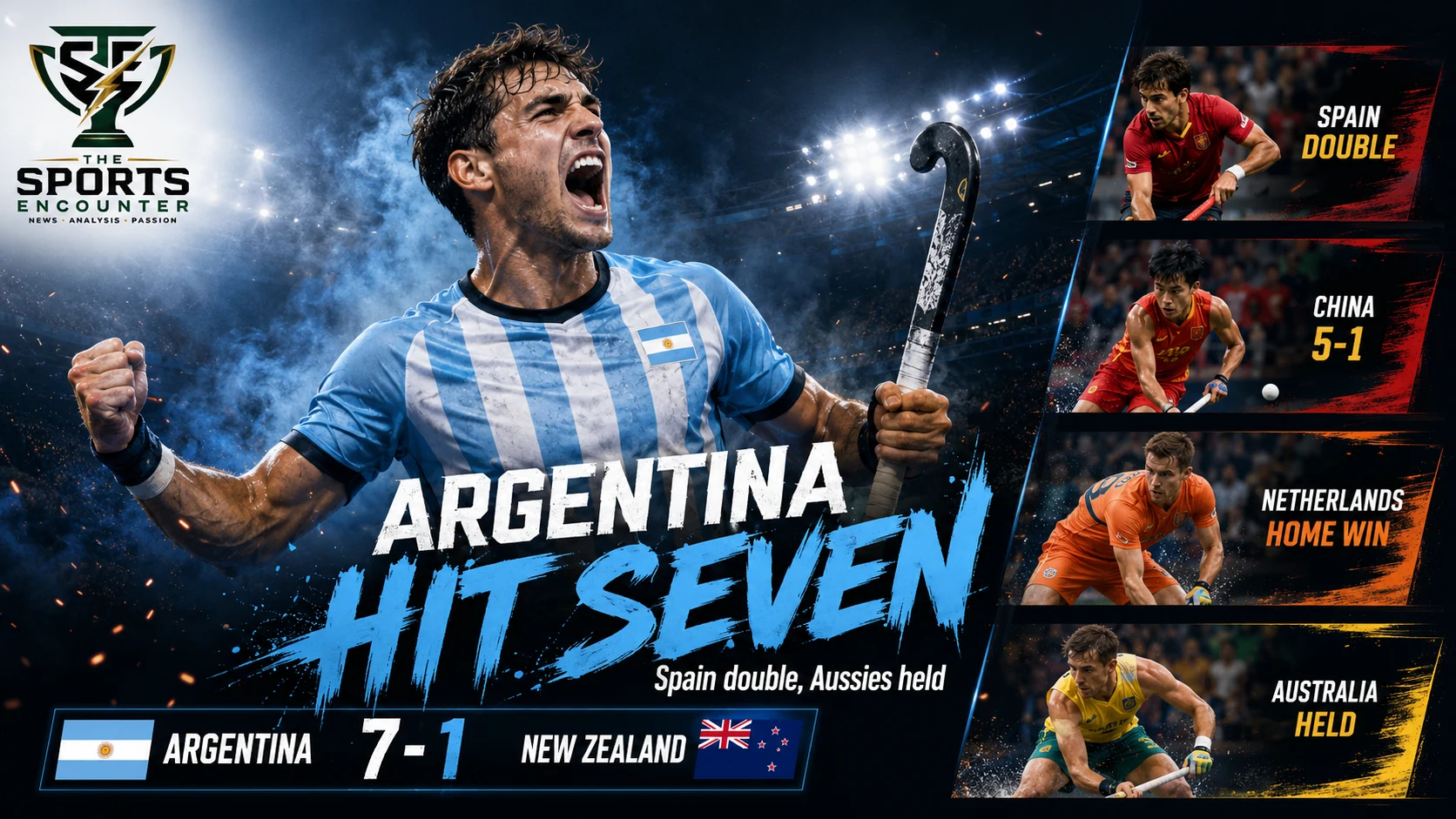
India vs Wales, England vs Pakistan Lead FIH Hockey World Cup 2026 Opening Day Drama
The FIH Hockey World Cup 2026 starts today across Belgium and the Netherlands, with host-nation pressure, historic rivals, Asian heavyweights, European contenders and eight opening-day matches setting the tone for the tournament.
The FIH Hockey World Cup 2026 begins today with the kind of opening day that immediately gives the tournament its identity: host-nation pressure, historic rivalries, Asian heavyweights, European contenders, and two venues carrying very different emotional stakes.
The joint Belgium-Netherlands edition opens on August 15 with eight matches across the men’s and women’s competitions. Wagener Stadium in Amstelveen hosts Australia vs Japan in the women’s Pool A opener, India vs Wales in men’s Pool D, Netherlands vs Chile in women’s Pool A, and England vs Pakistan in men’s Pool D. Belfius Hockey Arena in Wavre hosts Germany vs Scotland in women’s Pool B, Germany vs Malaysia in men’s Pool B, Argentina vs United States in women’s Pool B, and Belgium vs France in men’s Pool B.
That schedule gives the opening day a broad World Cup feel. It is not built around one headline alone. It has the Dutch women beginning a home campaign, Belgium’s men starting in front of their own supporters, India and Pakistan entering a dangerous Pool D, Germany testing both its women’s and men’s programs, and Australia, Argentina, England, Malaysia, Wales, Japan, Scotland, Chile, France and the United States all trying to create early momentum.
For a tournament that carries more than 50 years of men’s World Cup history and more than five decades of women’s World Cup tradition, the first day matters because it does more than award points.
It reveals which teams are ready for the weight of the shirt.
FIH Hockey World Cup 2026 Opening Day Matches
| Venue | Competition | Pool | Opening Day Match | What to Watch |
|---|---|---|---|---|
| Wagener Stadium, Amstelveen | Women | Pool A | Australia vs Japan | Australia’s tournament authority against Japan’s discipline and counterattack threat |
| Wagener Stadium, Amstelveen | Men | Pool D | India vs Wales | India’s historical weight and attacking depth against Wales’ underdog structure |
| Wagener Stadium, Amstelveen | Women | Pool A | Netherlands vs Chile | The defending women’s world champions begin at home against a Chile side chasing a statement |
| Wagener Stadium, Amstelveen | Men | Pool D | England vs Pakistan | A historic hockey nation meets a modern European contender in one of Day 1’s sharpest fixtures |
| Belfius Hockey Arena, Wavre | Women | Pool B | Germany vs Scotland | Germany’s experience and structure against Scotland’s chance to disrupt the pool early |
| Belfius Hockey Arena, Wavre | Men | Pool B | Germany vs Malaysia | A former world champion faces a Malaysian side that can punish loose defensive phases |
| Belfius Hockey Arena, Wavre | Women | Pool B | Argentina vs United States | Argentina’s World Cup pedigree meets American energy and transition speed |
| Belfius Hockey Arena, Wavre | Men | Pool B | Belgium vs France | The Belgian men open at home against a French side looking to spoil the occasion |
A World Cup Built Across Two Hockey Nations
The 2026 edition is unusual because both the men’s and women’s World Cups are being staged together across Belgium and the Netherlands. The two main venues, Wagener Stadium in Amstelveen and Belfius Hockey Arena in Wavre, give the tournament a strong European hockey foundation from day one.
The Netherlands brings deep hockey culture, huge women’s World Cup history and a home crowd that expects dominance rather than participation. Belgium brings the momentum of a men’s program that has grown from contender to global power over the past decade, plus the emotional pull of hosting major World Cup hockey in Wavre.
FIH’s official draw placed the women’s Pool A and men’s Pool D matches in the Netherlands, while women’s Pool B and men’s Pool B open in Belgium. That split immediately gives both host nations meaningful Day 1 storylines, with the Netherlands women and Belgium men stepping into the spotlight at home.
Why the Tournament History Matters
The men’s Hockey World Cup began in 1971, with Pakistan winning the inaugural edition in Barcelona. Pakistan remain the most successful men’s World Cup nation with four titles, while the Netherlands, Germany and Australia have each built major winning traditions. FIH’s own historical material notes the first men’s World Cup in 1971, while its 2026 tournament preview also highlights Pakistan’s four-title legacy. :contentReference[oaicite:1]{index=1}
The women’s World Cup began in 1974 in Mandelieu, France, where the Netherlands won the first title. The Dutch women have since become the tournament’s defining force, and FIH’s women’s World Cup archive lists the Netherlands as the dominant champion across multiple editions, including 2022. :contentReference[oaicite:2]{index=2}
That history gives the 2026 opener a deeper frame.
This is not simply another international tournament. The World Cup is where hockey nations measure themselves against memory. Pakistan arrive with the weight of past greatness. India carry the legacy of a 1975 men’s title and decades of expectation. The Dutch women carry a dynasty. Belgium’s men carry the pressure of modern success. Germany and Australia carry permanent heavyweight status. Argentina, England and Malaysia bring their own tournament identities.
Australia vs Japan Women: Pool A Opens With Contrast
Australia against Japan gives the women’s tournament a clean opening contrast.
Australia have long been associated with physical power, speed through the lines and major-tournament confidence. Japan usually ask different questions: shape, discipline, compact defending, patience and quick attacks when opponents overcommit.
For Australia, the danger is assuming control too early. Opening games can be awkward because timing is not always sharp and penalty-corner routines can need one or two matches to fully settle. Japan’s best route is to keep the first half tight, deny Australia the emotional comfort of an early goal and turn the match into a test of patience.
A win for Australia would keep Pool A moving in the expected direction before the Netherlands enter the same group later in the day. A result for Japan would immediately stretch the pool and put pressure on more established sides.
India vs Wales Men: India Start With Expectation, Wales With Opportunity
India’s men begin against Wales in Pool D, and that sentence alone carries pressure.
India’s World Cup history is complicated. The country won the men’s title in 1975, remains one of hockey’s most emotionally invested nations, and enters every major tournament with supporters expecting more than a respectable campaign. Against Wales, India will be expected to control possession, create penalty corners and set the tone before bigger Pool D meetings arrive.
Wales, however, enter with the freedom of a team that can make the group uncomfortable by refusing to play the role assigned to it. If Wales defend the circle well, slow India’s rhythm and stay alive into the final quarter, the match can become tense quickly.
India cannot afford a slow start in a pool that also includes England and Pakistan. In a group loaded with history and emotion, three points against Wales are not just useful. They are necessary.
The Sports Encounter has often covered how opening games shape tournament psychology, including in Japan’s dramatic football World Cup draw against the Netherlands, where one result immediately changed the mood of a group. The same principle applies here: Day 1 can bend a pool before the tournament has found its rhythm.
Netherlands vs Chile Women: The Home Champions Face Their First Test
The Netherlands women opening against Chile may look straightforward on paper, but home World Cups rarely feel simple from inside the dressing room.
The Dutch women do not only carry expectation. They carry history. They are the defending world champions, the most successful team in women’s World Cup history and the side every opponent wants to measure itself against.
For Chile, that creates both difficulty and opportunity.
The difficulty is obvious. Beating the Netherlands in the Netherlands requires defensive bravery, clinical outlet passing, set-piece resistance and nearly perfect emotional control. But the opportunity is also real. Opening matches in front of huge home crowds can create nervous energy. If Chile can keep the score level early, the pressure moves from underdog to favorite.
The Netherlands will want the opposite: early control, early goals, clean circulation and a performance that tells the rest of Pool A that the champions are not easing into the tournament.
England vs Pakistan Men: Day 1’s Most Emotional Pool D Fixture
England vs Pakistan is one of the most interesting opening-day matches because it carries both modern competitive meaning and deep hockey history.
Pakistan are not just another team in World Cup history. They are the most successful men’s World Cup nation, with four titles. Their golden periods shaped the tournament’s identity and gave Pakistan a place in hockey history that remains powerful even when recent results have been uneven.
England enter with a different kind of pressure. They are expected to be organized, physically strong and tactically clear. Against Pakistan, they must manage not only the hockey but the emotion of facing a nation whose history in the event still carries serious symbolic weight.
This match could shape Pool D immediately. If England win, they put pressure on India and Pakistan before the later heavyweight meetings. If Pakistan win or even take something from the game, the group becomes far more volatile.
For TSE readers, this fixture sits naturally beside our coverage of major India, Pakistan and England sporting narratives, including England’s collapse against India in cricket and our feature on Imran Khan’s all-round dominance in the 1980s, where history, rivalry and national expectation also shaped the sporting conversation.
Germany vs Scotland Women: Germany Need Control, Scotland Need Disruption
Germany’s women open against Scotland in Pool B at Belfius Hockey Arena, a match that will test whether Germany can impose structure early without allowing the opening-day nerves to flatten their attack.
Germany traditionally bring tournament discipline. They usually understand space, transition control and defensive shape. Against Scotland, the challenge is to turn that structure into scoreboard pressure before the game becomes uncomfortable.
Scotland’s best chance is disruption. They need to make Germany defend longer sequences, win free hits in useful areas, and avoid giving away cheap penalty corners. If Scotland can keep the match narrow, the final quarter becomes less about reputation and more about nerve.
Opening matches often reward clarity. Germany must show it quickly.
Germany vs Malaysia Men: A Former Champion Faces a Dangerous Test
Germany’s men open against Malaysia in Pool B, and this is not a match they can treat as routine.
Germany have one of the strongest men’s World Cup traditions, with multiple titles and a reputation for tournament intelligence. Their teams often know how to survive difficult phases, use set pieces efficiently and manage knockout-style tension long before the knockout rounds arrive.
Malaysia bring speed, energy and the ability to make games uncomfortable when opponents lose control of transitions. Their route to an upset depends on staying disciplined defensively and punishing Germany when the match opens up.
For Germany, the key is patience without passivity. They do not need to win the match in the first quarter. They do need to avoid letting Malaysia believe the game is there for the taking.
Argentina vs United States Women: Pedigree Meets Rising Ambition
Argentina’s women begin against the United States in Pool B, bringing one of the day’s clearest contrasts between established World Cup pedigree and a side trying to push upward.
Argentina have long been one of women’s hockey’s most respected major-tournament sides, with technical quality, emotional intensity and a history of deep World Cup runs. They know how to live inside uncomfortable games.
The United States will need energy, pace and defensive concentration. Against Argentina, mistakes around the circle can become costly quickly. The U.S. cannot afford long spells of chasing shadows or giving Argentina repeated penalty-corner chances.
If Argentina win cleanly, they immediately announce themselves as one of Pool B’s serious forces. If the United States make the game messy and close, the pool becomes more interesting right away.
Belgium vs France Men: Host Pressure Meets Local Edge
Belgium’s men close the opening day in Wavre against France, and this match will carry more than three points.
Belgium’s rise in men’s hockey has been one of the sport’s great modern development stories. From challenger to Olympic champion, world champion and regular major-tournament contender, Belgium have become a standard for what long-term planning can produce.
Now they open a home World Cup against France.
The danger for Belgium is emotional overload. Opening at home can lift a team, but it can also rush decision-making. France will want to stay compact, frustrate the hosts and turn the crowd’s expectation into tension.
Belgium need the opposite. They need clean tempo, strong circle entries and early authority. If they score first, the night can become a celebration. If France hold them for long enough, the match can become a proper test of Belgium’s patience.
The official Belgium programme confirms the Belfius Hockey Arena schedule for August 15, including Germany vs Scotland, Germany vs Malaysia, Argentina vs United States and Belgium vs France. The Netherlands programme confirms the Amstelveen matches, including Australia vs Japan, India vs Wales, Netherlands vs Chile and England vs Pakistan. :contentReference[oaicite:3]{index=3}
The Pools Give Opening Day Extra Weight
The FIH draw placed the women’s Pool A teams as Netherlands, Australia, Chile and Japan, while women’s Pool B includes Argentina, Germany, United States and Scotland. On the men’s side, Pool B contains Belgium, Germany, France and Malaysia, while Pool D contains England, India, Pakistan and Wales. :contentReference[oaicite:4]{index=4}
That structure makes Day 1 more important than usual.
In women’s Pool A, Australia and the Netherlands will both expect to start fast, but Japan and Chile have the chance to complicate the pool immediately. In women’s Pool B, Argentina and Germany will both want to avoid being dragged into pressure games against teams with less to lose.
In men’s Pool B, Belgium and Germany are the obvious heavyweight names, but France and Malaysia can make the group far more dangerous if either steals points today. In men’s Pool D, India, England and Pakistan already create one of the tournament’s most emotionally loaded groups. Wales can change everything if they make India uncomfortable in the opener.
What the Opening Day Should Tell Us
Opening days do not decide World Cups, but they expose teams quickly.
They show whether favorites are ready to carry expectation. They show whether underdogs have come only to defend or to compete. They show whether penalty-corner units are sharp, whether defensive structures can survive pressure, and whether captains can keep teams calm when the first match begins to slip.
For the Netherlands women and Belgium men, the key question is how they manage home pressure. For India and Pakistan, the question is how history translates into present performance. For Germany, across both men’s and women’s competitions, the question is whether structure becomes control. For Australia and Argentina’s women, the question is whether pedigree turns into an immediate statement.
That is what makes this opening day rich.
It is not just about who wins.
It is about who looks ready for the next two weeks.
Why This World Cup Can Matter Beyond Hockey’s Core Audience
Hockey has a strong global following, but the World Cup gives the sport a chance to reach fans who may not follow every Pro League cycle or continental championship.
The 2026 tournament has several built-in advantages. It is jointly hosted by two serious hockey nations. It includes both men’s and women’s events. It opens with recognizable names and heavyweight hockey cultures. It also creates daily storylines across two countries, which can help the tournament feel bigger than one venue or one national narrative.
The Sports Encounter has tracked similar patterns in other sports, including the way compact, high-speed formats can bring new fans into hockey through Finland’s win at the inaugural 3ICE World Cup, and how major-event structure can shape fan attention in our analysis of FIFA World Cup 2026 organizer challenges.
The FIH World Cup has the same chance now. If the opening day produces tight matches, late goals or an early upset, the tournament can pull in viewers quickly.
Official Tournament Context
The FIH Hockey World Cup Belgium and Netherlands 2026 is organized under the International Hockey Federation. Official match schedules, pools, fixtures, points tables and tournament information are available through the FIH Hockey World Cup 2026 event page.
Venue-specific information for matches in Belgium is available through the Belgium 2026 programme, while Netherlands venue information is available through the Netherlands 2026 event website. The global governing body’s official site remains FIH Hockey.
TSE Analysis: The Opening Day Is About Pressure, Not Just Fixtures
The best opening days carry one simple test: who can be themselves immediately?
That is what today will tell us.
The Netherlands women have to be champions at home, not just champions on paper. Belgium’s men have to absorb the noise of Wavre and turn it into sharp hockey. India have to treat Wales with respect without playing nervously. England have to control Pakistan’s emotional and historical gravity. Germany have to show why both their programs remain serious World Cup threats. Australia and Argentina have to start like teams that expect to go deep.
The World Cup is long enough for teams to recover from one bad performance, but opening-day signals matter. They affect confidence, pool pressure, rotation plans and the emotional temperature around every squad.
That is why August 15 matters.
The FIH Hockey World Cup 2026 does not ease into the tournament. It starts with history, hosts, heavyweights and underdogs all on the same day.
That is exactly how a World Cup should begin.
Readers can also follow The Sports Encounter’s wider major-event coverage through our analysis of sporting greatness, major-event organizer challenges, Finland’s 3ICE World Cup title, Japan’s World Cup draw with the Netherlands, India beating England in cricket, Imran Khan’s 1980s cricket legacy, and Spain’s two World Cup heroes.
Frequently Asked Questions
When does the FIH Hockey World Cup 2026 begin?
The FIH Hockey World Cup 2026 begins on August 15, 2026, with opening-day matches in both Belgium and the Netherlands.
Where is the FIH Hockey World Cup 2026 being played?
The tournament is being co-hosted by Belgium and the Netherlands, with matches at Belfius Hockey Arena in Wavre and Wagener Stadium in Amstelveen.
Which teams play on opening day in the Netherlands?
The Netherlands opening-day schedule includes Australia vs Japan women, India vs Wales men, Netherlands vs Chile women, and England vs Pakistan men.
Which teams play on opening day in Belgium?
The Belgium opening-day schedule includes Germany vs Scotland women, Germany vs Malaysia men, Argentina vs United States women, and Belgium vs France men.
Which opening-day match has the most history?
England vs Pakistan in men’s Pool D carries major historical weight because Pakistan are the most successful men’s World Cup nation and England are a strong modern European contender.
Which host teams play on opening day?
The Netherlands women play Chile at Wagener Stadium, while Belgium’s men face France at Belfius Hockey Arena.
When did the men’s Hockey World Cup begin?
The men’s Hockey World Cup began in 1971, with Pakistan winning the inaugural edition in Barcelona.
When did the women’s Hockey World Cup begin?
The women’s Hockey World Cup began in 1974 in Mandelieu, France, where the Netherlands won the first title.
The Sports Encounter’s hockey coverage follows World Cup fixtures, team histories, match previews, tactical stories, player performances, major tournament narratives and the biggest moments shaping field hockey and ice hockey worldwide.

Breaking News
Premier League 2026: Villa Sign Suzuki and Ruggeri as Arsenal Land Konsa, and Man Utd Close on Baleba
Aston Villa have completed deals for Zion Suzuki and Matteo Ruggeri, Arsenal are moving for Ezri Konsa, and Manchester United are closing in on Carlos Baleba. The latest Premier League transfer activity reveals how several top clubs are reshaping key positions before the window closes.
The Premier League transfer market has suddenly accelerated.
Aston Villa have completed two permanent signings, Arsenal have reached an agreement to take one of Villa’s most important defenders, and Manchester United are pushing toward another major midfield addition from Brighton.
Within the same burst of activity, Zion Suzuki and Matteo Ruggeri have arrived at Villa Park, Ezri Konsa is heading toward Arsenal after the clubs agreed a deal reported at £51 million, and United remain in negotiations over Carlos Baleba.
Viewed separately, they are three significant transfer stories.
Put together, they reveal something more interesting about the Premier League market in August 2026. Leading clubs are no longer simply adding depth before the season settles into its rhythm. They are solving immediate structural problems, and Aston Villa sit at the center of much of the movement.
Here is where each deal stands, why the players are being targeted, and what the moves could change for Aston Villa, Arsenal, Manchester United and Brighton.
Premier League Transfer Tracker: Where the Deals Stand
| Player | From | To | Position | Status |
|---|---|---|---|---|
| Zion Suzuki | Parma | Aston Villa | Goalkeeper | Confirmed |
| Matteo Ruggeri | Atletico Madrid | Aston Villa | Left-back / wing-back | Confirmed |
| Ezri Konsa | Aston Villa | Arsenal | Center-back / right-back | Club agreement reported |
| Carlos Baleba | Brighton | Manchester United | Central midfielder | Advanced negotiations |
The wider context can be followed through the official Premier League website, while the clubs involved continue to communicate completed business through their respective official channels.
Aston Villa Confirm Zion Suzuki and Matteo Ruggeri
Villa have moved decisively at two positions.
Japan international goalkeeper Zion Suzuki arrives from Parma after establishing himself in Serie A, while Italian defender Matteo Ruggeri joins from Atletico Madrid.
Both are permanent signings.
Reuters reported that Suzuki made 59 appearances during two seasons with Parma before the move. The 23-year-old has also accumulated substantial international experience with Japan and arrives at an intriguing moment in Villa’s goalkeeping plans.
Ruggeri, 24, provides Unai Emery with another option on the left side of defense after a season with Atletico that included domestic and Champions League football.
Together, the moves suggest Villa are trying to refresh important areas of the squad with players young enough to develop further but experienced enough to contribute immediately.
Zion Suzuki Could Be Much More Than Goalkeeping Depth
Suzuki is the more strategically interesting of Villa’s two arrivals.
A goalkeeper signing can sometimes be read as straightforward competition.
This one arrives against continuing uncertainty surrounding Emiliano Martinez.
That gives Suzuki’s transfer a longer horizon.
He has already played regularly in Serie A, represented Japan at major international tournaments and attracted attention from several prominent European clubs.
His age is equally important.
At 23, Villa are buying a goalkeeper who could potentially occupy the position for years rather than simply covering it for a season.
Why Suzuki Fits Unai Emery’s Villa
Emery’s goalkeeper has to do more than stop shots.
Villa regularly ask their goalkeeper to participate in possession, remain composed against pressure and help manipulate the opposition press.
Suzuki’s development in Italy should help with the tactical transition, although the Premier League will present a different physical challenge.
Crosses arrive under heavier pressure. Set pieces are intensely contested. Opponents will test his decision-making quickly.
There is also a broader historical dimension.
If Suzuki establishes himself as Villa’s first-choice goalkeeper, he would break relatively unexplored ground for Japanese goalkeepers in the Premier League.
Japanese outfield players have become increasingly familiar across England’s top flight. Goalkeeper remains a very different frontier.
Matteo Ruggeri Gives Villa a Different Weapon on the Left
Ruggeri’s attraction lies in his tactical flexibility.
He can operate as a conventional left-back but has considerable experience playing higher as a wing-back.
That matters for Emery.
Villa’s shape can change considerably depending on possession, opponent and game state. A full-back who understands when to advance and when to become part of the defensive structure gives the manager another way to manipulate that shape.
Ruggeri also arrives with experience from two very different tactical environments.
His development at Atalanta exposed him to an aggressive, highly structured system before his move to Atletico Madrid placed him inside Diego Simeone’s demanding defensive environment.
Those experiences should make the tactical education at Villa less intimidating.
Then Villa’s Window Took Another Turn: Arsenal Move for Ezri Konsa
Villa’s incoming business cannot be understood without looking at the other side of their transfer window.
Ezri Konsa is now set for Arsenal after the clubs reached an agreement reported at £51 million.
Earlier reports described negotiations as advancing. The situation subsequently moved forward, with Arsenal and Villa agreeing terms for the England defender.
For Villa, that means the same transfer cycle that brought Suzuki and Ruggeri into Emery’s squad is also threatening to remove one of his most dependable defensive players.
Konsa has become an established Premier League center-back and offers something particularly valuable to Arsenal: he can also play at right-back.
Why Arsenal Want Ezri Konsa Now
Arsenal’s interest is easy to understand once their defensive situation is considered.
William Saliba and Jurrien Timber have both been dealing with injuries, increasing the need for another defender capable of handling major Premier League and European matches immediately.
Konsa removes much of the adaptation risk associated with signing from abroad.
He already understands the league.
He has played European football.
He is an England international.
He can cover two defensive positions.
For a team pursuing major trophies, those qualities are enormously useful.
Konsa Is More Than Injury Cover
Calling him cover would undersell the transfer.
Arsenal’s schedule requires multiple high-level defenders even when everyone is healthy. Premier League title challenges, European football and domestic cup competitions create too many demanding matches for a defense to depend on a fixed starting four.
Konsa gives Arsenal another defender capable of starting important games without forcing a major tactical compromise.
His ability to move between central defense and right-back also gives the coaching staff more ways to manage injuries, suspensions and workload.
That is why £51 million can make sense despite Arsenal already possessing high-level defenders.
The Bigger Question Is What Konsa’s Exit Does to Aston Villa
This is where Villa’s transfer window becomes fascinating.
Signing Suzuki and Ruggeri strengthens two positions.
Losing Konsa weakens another.
Recruitment cannot therefore be judged by counting arrivals.
The relevant question is whether the final squad is stronger than the one that entered the window.
Konsa has provided reliability, Premier League experience and tactical flexibility. Replacing those qualities may prove harder than replacing his name on a team sheet.
Villa could still respond in the market, and the financial return from a major sale gives them options.
Yet every replacement carries adaptation risk.
Konsa already knew Emery’s system.
A newcomer would have to learn it.
Manchester United Close In on Carlos Baleba
While Villa and Arsenal negotiate directly with each other, Manchester United are attempting to complete another major Premier League-to-Premier League transfer.
United and Brighton are in advanced negotiations over Carlos Baleba.
Reports indicate United have offered around £60 million plus £5 million in add-ons. That proposal has been considered below Brighton’s valuation, but talks have continued with the parties working toward an agreement.
Other reporting has placed United’s bid at approximately £65 million and suggested Brighton are now prepared to negotiate below valuations associated with Baleba during previous transfer discussions.
The important distinction is that, unlike Suzuki and Ruggeri, Baleba has not yet been officially announced as a Manchester United player.
Until the clubs complete the agreement, he remains a Brighton player.
Why Carlos Baleba Has Become Such an Important Manchester United Target
United’s interest is about midfield architecture.
Baleba is 22 and already understands Premier League football. He brings physical power, ball-winning ability and the capacity to carry possession through pressure.
Those qualities become particularly valuable for a team trying to control transitions.
United have spent too many periods in recent seasons with matches becoming stretched through midfield. When possession breaks down, large spaces can appear between the attacking and defensive units.
A midfielder capable of recovering ground, competing physically and moving the ball forward can reduce that vulnerability.
Baleba Would Continue United’s Midfield Reconstruction
Manchester United have already reshaped the midfield this summer.
Youri Tielemans arrived from Aston Villa, while Andrey Santos joined from Chelsea. Kobbie Mainoo remains another major component of the department.
Adding Baleba would create a significantly different midfield group from the one United carried through previous campaigns.
More importantly, it would lower the age profile while giving the coaching staff several different combinations.
Tielemans offers passing and experience.
Santos brings mobility and technical quality.
Mainoo provides composure and progression.
Baleba would add another layer of athleticism and defensive coverage.
Brighton Again Find Themselves Holding a Valuable Premier League Asset
United may want the deal quickly.
Brighton have little reason to make it easy.
The club’s recruitment model has repeatedly placed Brighton in a powerful negotiating position. They identify young players, develop them in the Premier League and sell only when the financial conditions make sense.
Baleba fits that model.
Brighton signed him from Lille in 2023, and his development in England subsequently attracted interest from clubs with considerably greater spending power.
That explains why a £60 million-plus package does not automatically finish the negotiation.
Brighton know the value of Premier League-proven midfielders with Baleba’s age and physical profile.
Aston Villa Sit at the Center of This Transfer Chain
The most interesting connection across these stories is Aston Villa.
Villa have signed Suzuki.
They have signed Ruggeri.
They are selling Konsa to Arsenal.
United have already taken Tielemans from Villa during the same summer.
This is beginning to look less like routine squad maintenance and more like a significant recalibration under Emery.
Villa are changing personnel across the goalkeeper, defense and midfield departments while preparing for another demanding season.
That creates opportunity and risk simultaneously.
Fresh legs and younger players can increase the squad’s ceiling.
Too much turnover can damage established relationships.
What Each Club Is Actually Buying
| Club | Player | Immediate Need | Longer-Term Value |
|---|---|---|---|
| Aston Villa | Zion Suzuki | Goalkeeping competition | Potential long-term No. 1 |
| Aston Villa | Matteo Ruggeri | Left-side defensive depth | Tactical flexibility at full-back/wing-back |
| Arsenal | Ezri Konsa | Defensive reinforcement amid injuries | Premier League-proven multi-position depth |
| Manchester United | Carlos Baleba | Midfield athleticism and ball-winning | Potential cornerstone midfielder at 22 |
TSE Analysis: These Deals Tell Us Where the Premier League Arms Race Has Moved
The most revealing feature of these transfers is the profile of the players involved.
None is being recruited primarily for celebrity value.
Suzuki is 23.
Ruggeri is 24.
Baleba is 22.
Konsa is older at 28, but Arsenal are buying something the younger players cannot offer to the same degree: established Premier League reliability at two defensive positions.
That reflects the increasingly sophisticated way leading Premier League clubs approach recruitment.
The question is rarely simply, “Who is the best player available?”
Clubs increasingly ask which player solves the exact problem inside their squad while retaining resale value, tactical flexibility or both.
Villa’s two additions fit that model.
Baleba fits it for United.
Konsa represents Arsenal choosing certainty over developmental speculation.
Arsenal May Be Making the Safest Signing of the Four
Suzuki could become an outstanding Premier League goalkeeper.
Baleba possesses an extremely attractive midfield profile.
Ruggeri has the tools to fit Emery’s system.
Konsa, however, carries the least mystery.
Arsenal already know he can defend against Premier League forwards.
They know he can operate in high-pressure matches.
They know he can play centrally and on the right.
That certainty has value for a team expected to challenge immediately for major trophies.
A £51 million fee can be debated. The football logic is much harder to question.
Baleba Could Have the Highest Ceiling
If United complete their deal, Baleba may become the player from this group with the greatest potential to transform his new team’s structure.
Midfielders influence almost every phase of a match.
They help teams escape pressure, protect defenders, recover second balls, support attacks and control transitions.
United’s problem has often been that improving one of those areas has exposed another.
A younger, more athletic midfield gives them a chance to change that equation.
Baleba would not solve every problem by himself, and expectations surrounding a transfer of this size would need to remain realistic.
Still, his age gives United something particularly valuable: time.
If the move works, they could be buying several prime seasons rather than a short-term patch.
Suzuki May Become Villa’s Most Important Signing
Goalkeepers are difficult to evaluate through transfer-window excitement.
Their influence usually becomes clearer over months rather than announcement day.
Suzuki therefore may receive less attention than Konsa or Baleba.
His importance to Villa could eventually exceed both Ruggeri’s arrival and several of their other summer moves.
If Martinez eventually leaves and Suzuki becomes Villa’s long-term No. 1, this transfer will represent a genuine generational change in goal.
That makes his development one of Villa’s most interesting stories heading into the new campaign.
What Happens Next?
Villa have already completed their part of the incoming double deal.
The next major step concerns Konsa. With Arsenal and Aston Villa reported to have reached agreement, the remaining formalities include the player’s medical and completion of the transfer process before an official announcement.
Manchester United’s Baleba pursuit remains less advanced.
Negotiations with Brighton are continuing, and the valuation gap still matters. United have made substantial progress, but a transfer should not be described as complete until the clubs finalize terms and the usual medical and contractual formalities are concluded.
For Villa, attention may quickly return to recruitment if Konsa’s departure is finalized.
Emery has gained a goalkeeper and left-sided defender. Losing an established center-back would create another problem requiring an answer.
Premier League Transfer Window Is Entering Its Decisive Phase
The final weeks of a transfer window often produce movement that months of speculation cannot.
Clubs know what their squads still lack.
Players understand where they stand.
Selling clubs know how much time remains to recruit replacements.
That pressure is now visible across these deals.
Villa have acted decisively with Suzuki and Ruggeri while accepting a major offer for Konsa.
Arsenal are moving to protect a title-challenging squad against defensive injuries.
Manchester United are attempting to add one of Brighton’s most valuable young midfielders.
Brighton, as so often happens, are negotiating from a position of strength.
Four clubs. Four different squad problems. Four transfers that reveal far more than the headline fees.
And with the Premier League season moving into focus, the most consequential part of the summer market may only now be beginning.
Breaking News
India Knock Pakistan Out as 49-Goal FIH Hockey World Cup Day Delivers Drama
India’s 5-3 win over Pakistan became the headline result of an extraordinary August 19 at the FIH Hockey World Cup 2026. Across eight men’s and women’s matches, 49 goals were scored as the Netherlands crushed Japan, England overwhelmed Wales, and Australia and France survived with dramatic late equalizers.
August 19 began with Australia trying to save its Women’s Hockey World Cup campaign and ended with Belgium surviving a Malaysian challenge that came much closer to an upset than the final score suggested.
In between, the FIH Hockey World Cup produced one of its busiest and most revealing days yet.
Eight matches across the men’s and women’s tournaments delivered 49 goals. The Netherlands women scored nine of them. England’s men added eight. India and Pakistan revived one of international hockey’s fiercest rivalries with eight more between them. Chile came within 31 seconds of beating Australia, while France waited until the final 39 seconds to deny defending men’s champions Germany victory.
By the end of Wednesday, the picture had also become much clearer. Pool A and Pool B were settled in the women’s competition, while Pools B and D reached their conclusions on the men’s side. Under the 2026 format, the top two teams from each opening pool advance to the Second Stage and remain in championship contention, while the bottom two move into the Classification Stage.
The official FIH Hockey World Cup 2026 tournament center provides the full schedule, standings and match information as the competition moves forward.
For readers following hockey across its different international forms, The Sports Encounter’s hockey coverage hub tracks the sport’s major competitions, players and wider storylines.
FIH Hockey World Cup 2026: August 19 Results
| Competition | Pool | Match | Result | Player of the Match |
|---|---|---|---|---|
| Women | A | Chile vs Australia | 4-4 | Mariah Williams, Australia |
| Women | B | Argentina vs Scotland | Argentina 2-0 | Victoria Miranda, Argentina |
| Women | B | United States vs Germany | Germany 3-1 | Jette Fleschütz, Germany |
| Women | A | Netherlands vs Japan | Netherlands 9-0 | Luna Fokke, Netherlands |
| Men | D | England vs Wales | England 8-2 | Tom Sorsby, England |
| Men | D | Pakistan vs India | India 5-3 | Abhishek, India |
| Men | B | France vs Germany | 1-1 | Michel Struthoff, Germany |
| Men | B | Belgium vs Malaysia | Belgium 5-3 | Tom Boon, Belgium |
Those results were confirmed in the official FIH August 19 tournament review.
Women’s World Cup: Netherlands Turn Pool A Into a Warning
The Netherlands did considerably more than win Pool A.
They made another statement about the gap their best hockey can create.
Japan ran into the full force of the defending champions in Amstelveen and lost 9-0. The Dutch were already five goals clear by halftime before adding four more after the break.
Yibbi Jansen produced the day’s most destructive individual scoring performance.
She scored four.
Marijn Veen and Felice Albers contributed two goals each, while Frederique Matla completed the scoring.
Japan goalkeeper Akio Tanaka still made several excellent saves, which tells its own story about the volume and quality of Dutch pressure.
Yibbi Jansen Gives the Netherlands Another Route to Goal
Scoring four goals in a World Cup match would dominate almost any individual performance discussion.
What makes Jansen’s contribution more concerning for the Netherlands’ rivals is the attack around her.
The Dutch did not rely on a single scorer to manufacture nine goals. Veen and Albers both struck twice. Matla also scored. Japan had to defend threats coming from several areas while Jansen repeatedly punished them.
The result completed a perfect opening phase for the Netherlands and sent them into the Second Stage as Pool A winners.
Australia advanced alongside them in second place.
That second outcome only became secure after a match that nearly went badly wrong for the Hockeyroos.
Chile 4-4 Australia: Thirty-One Seconds Save the Hockeyroos
Australia’s tournament was moving toward a very different conversation when the clock entered its final minute.
Chile led 4-3.
Then Mariah Williams found the loose ball that kept Australia alive.
Her equalizer came with only 31 seconds remaining and completed one of the most dramatic matches of the tournament so far.
Courtney Schonell had initially put Australia ahead just 11 seconds before halftime. Laura Müller equalized early in the third quarter before Abigail Wilson converted a penalty stroke to restore the Hockeyroos’ advantage.
Australia then lost control of both its discipline and the match.
At one stage, the Hockeyroos were reduced to nine players. Chile removed its goalkeeper to create an even larger numerical advantage and Manuela Urroz converted that pressure into a 47th-minute equalizer.
Claire Colwill made it 3-2 to Australia from a penalty corner five minutes later.
Chile responded again.
Florencia Barrios scored her first senior international goal to make it 3-3 before Fernanda Villagran converted a penalty stroke in the 55th minute.
For the first time all afternoon, Chile led.
They were half a minute from a famous victory when Williams reacted fastest inside the circle and made it 4-4.
Why the Draw Mattered More Than the Score Suggests
Australia’s equalizer eventually proved sufficient to send the Hockeyroos through in second place after the Netherlands completed their rout of Japan.
Yet qualification should not disguise the warning.
Australia repeatedly lost leads, suffered costly disciplinary problems and allowed Chile to dictate the final-quarter pressure.
The Hockeyroos survived. The next stage may not be so forgiving.
Argentina 2-0 Scotland: Las Leonas Win Pool B Without Needing Their Best Hockey
Argentina’s 2-0 victory over Scotland carried a different tone.
There was little chaos and no nine-goal explosion.
Las Leonas simply found the moments they needed.
Scotland began positively, but María Granatto punished Argentina’s first significant opening by converting from a penalty corner in the 11th minute.
Argentina increasingly controlled the match during the second quarter without adding another goal.
Lara Casas finally created separation in the 41st minute, scrambling the ball home from close range.
The victory eventually secured first place in Pool B for Argentina.
That is important because World Cups are rarely won by playing at maximum intensity in every pool match. Championship teams learn how to win games that never fully open up.
Argentina did exactly that.
Germany 3-1 USA: Fleschütz Wins the Pool B Qualification Fight
Germany and the United States entered their meeting with considerably more at stake.
Second place in Pool B was effectively on the table.
Germany took it.
Jette Fleschütz opened the scoring from a penalty stroke in the 20th minute. Lisa Nolte doubled Germany’s advantage early in the second half.
The Americans refused to disappear.
Ashley Sessa produced an outstanding individual goal to reduce the deficit and briefly reopen the contest.
Germany’s response was immediate enough to prevent the match from changing direction.
Fleschütz converted another penalty stroke four minutes later to complete her brace and restore the two-goal advantage.
Germany won 3-1 and finished second behind Argentina.
Women’s Pool A and Pool B Winners
| Pool | Winner | Second | What Happened August 19 |
|---|---|---|---|
| A | Netherlands | Australia | Netherlands beat Japan 9-0; Australia drew Chile 4-4 |
| B | Argentina | Germany | Argentina beat Scotland 2-0; Germany beat USA 3-1 |
Men’s World Cup: England Produce the Day’s First Avalanche
Before the Netherlands women scored nine, England’s men had already set the attacking standard.
Wales were beaten 8-2 in a Pool D match that England controlled almost from the opening whistle.
Sam Ward scored after two minutes.
Will Calnan then struck twice in seven minutes, pushing the lead to 3-0 before Wales had found any meaningful control.
Tom Sorsby added the fourth in the 22nd minute.
Zach Wallace made it 5-0 during the third quarter.
England were still not finished.
Three more goals arrived between the 48th and 54th minutes as Wales’ defense finally gave way under sustained pressure.
Goalkeeper Toby Reynolds-Cotterill prevented the score from becoming even more severe with a series of saves.
Gareth Furlong scored twice for Wales in the final three minutes, but those goals could only soften the margin.
England had already made its point.
An 8-2 victory gave them first place in Pool D and reinforced their status as one of the early men’s teams capable of creating goals in clusters.
India 5-3 Pakistan: The Rivalry Delivers, but India’s Start Decides It
The match carrying the greatest emotional weight on Wednesday was never difficult to identify.
India against Pakistan remains one of hockey’s defining rivalries, carrying decades of Olympic history, World Cup memories and regional sporting tension.
The 2026 meeting produced eight goals.
India won 5-3.
The decisive damage came early.
Harmanpreet Singh opened the scoring from a penalty corner. Abhishek doubled the advantage before Harmanpreet struck again to make it 3-0.
Pakistan suddenly faced a problem larger than simply chasing the game. They had to do so against an opponent with enough control to punish the spaces created by that chase.
Pakistan found one response.
Abhishek quickly answered with his second goal, restoring India’s three-goal cushion at 4-1.
Sufyan Khan then hammered home a drag flick for Pakistan to make it 4-2.
Any realistic comeback needed Pakistan to score next.
Instead, Hardik Singh converted a penalty stroke early in the second half and India were 5-2 ahead.
Hannan Shahid scored his second goal during the final quarter, but Pakistan could not complete the recovery.
India held on for a 5-3 victory and second place in Pool D behind England.
Abhishek Earns Player of the Match
Harmanpreet’s penalty-corner work gave India early authority, but Abhishek’s contribution changed the match’s shape.
His first goal stretched the lead. His second arrived after Pakistan had finally found a response.
That second strike mattered particularly because rivalry matches can change emotionally after one goal.
Pakistan had a route back at 3-1.
Abhishek closed it almost immediately.
FIH named him Player of the Match.
France 1-1 Germany: Thirty-Nine Seconds Change the Pool B Finish
Germany were 39 seconds from ending their opening stage with another victory.
France refused to accept it.
Justus Weigand had put the defending champions ahead in the 42nd minute after Thies Prinz’s effort found him positioned in front of goal.
Germany carried that 1-0 lead deep into the final quarter.
France then made the gamble teams increasingly use when a tournament result is slipping away.
The goalkeeper came off.
An extra outfield player went on.
Germany were also reduced to 10 players, creating the opening France needed.
Louis Haertelmeyer finally found it.
With 39 seconds left, his upright reverse-stick finish beat the German defense and rescued a 1-1 draw.
Germany still finished first in Pool B, but France had denied the defending champions a clean ending to the phase.
Belgium 5-3 Malaysia: Tom Boon Scores Four, but Malaysia Refuse to Fold
The final match of August 19 looked comfortable on paper.
World No. 1 Belgium beat Malaysia 5-3.
The match itself was considerably less comfortable.
Tom Boon scored four goals for Belgium, producing the men’s individual performance of the day. Thibeau Stockbroekx supplied Belgium’s other goal.
Malaysia kept creating enough pressure to stop the contest from becoming routine.
Aiman Rozemi scored while making his 200th appearance for Malaysia, giving his milestone night a World Cup goal against one of the tournament favorites.
More importantly, Malaysia had an opportunity to make the finish even more uncomfortable.
A penalty stroke in the closing minutes went unconverted.
Belgium survived and secured a 5-3 victory, confirming second place in Pool B behind Germany.
Tom Boon’s Four Goals Carry More Weight Than the Final Margin
Belgium needed Boon’s finishing because Malaysia kept asking questions.
That makes his four-goal performance more valuable than a similar total accumulated during a one-sided rout.
Belgium’s wider championship credentials will be tested later, but elite tournaments often turn on whether a leading scorer can convert difficult matches into victories.
Boon did that on Wednesday.
Readers interested in how individual scorers shape hockey’s biggest games can also explore The Sports Encounter’s coverage of Finland’s inaugural 3ICE World Cup title, another international hockey tournament where finishing quality became decisive.
Men’s Pool B and Pool D Winners
| Pool | Winner | Second | August 19 Decisive Results |
|---|---|---|---|
| B | Germany | Belgium | Germany drew France 1-1; Belgium beat Malaysia 5-3 |
| D | England | India | England beat Wales 8-2; India beat Pakistan 5-3 |
The Numbers That Defined August 19
| Category | Figure |
|---|---|
| Matches played | 8 |
| Women’s matches | 4 |
| Men’s matches | 4 |
| Total goals | 49 |
| Women’s goals | 24 |
| Men’s goals | 25 |
| Biggest victory | Netherlands 9-0 Japan |
| Highest-scoring men’s match | England 8-2 Wales, 10 goals |
| Highest-scoring women’s matches | Chile 4-4 Australia and Netherlands 9-0 Japan, 8 and 9 goals respectively |
| Leading individual scorers | Yibbi Jansen and Tom Boon, 4 goals each |
| Latest equalizer | Mariah Williams, Australia, 31 seconds remaining |
| Other late equalizer | Louis Haertelmeyer, France, 39 seconds remaining |
Jansen and Boon Owned the Scoreboard, but the Day Was About Pressure
Yibbi Jansen and Tom Boon will understandably dominate the individual headlines.
Both scored four times.
Their performances came in very different circumstances.
Jansen was the central scorer inside a Dutch attack that overwhelmed Japan from multiple directions. Boon supplied four of Belgium’s five goals in a match where Malaysia kept forcing the hosts to find another response.
Elsewhere, the day’s most important contributions were often smaller.
Mariah Williams needed one goal to change Australia’s tournament.
Louis Haertelmeyer needed one touch with 39 seconds remaining to change France’s evening.
Abhishek’s two goals helped India control the emotional momentum of the Pakistan rivalry.
Jette Fleschütz converted two penalty strokes in a match carrying direct qualification consequences.
That variety explains why Wednesday felt significant.
World Cups reveal teams through different types of pressure.
What August 19 Told Us About the Women’s World Cup
The Netherlands remain the clearest statement team from the pools decided on Wednesday.
Nine goals against Japan reinforced the depth of their attack and their ability to turn territorial superiority into scoreboard damage.
Argentina showed something different.
Las Leonas did not need a spectacular performance to beat Scotland. They remained patient, found two goals and won Pool B.
Germany handled a direct qualification contest against the United States with greater efficiency in the circles.
Australia advanced, but the Chile draw exposed problems that stronger Second Stage opponents will study carefully.
The Hockeyroos’ discipline and inability to protect repeated leads could become significant if left unresolved.
What August 19 Told Us About the Men’s World Cup
England may have made the loudest statement.
Eight goals against Wales showed how quickly their attack can turn control into separation.
Germany’s draw with France was less convincing, although the defending champions still won Pool B.
Belgium’s 5-3 victory also came with a warning. Malaysia stayed close enough to make the world No. 1 side work until late in the match.
India’s position is particularly interesting.
The 5-3 victory over Pakistan showed attacking quality and penalty-corner danger, but the three goals conceded also leave defensive questions before the level rises again.
The result itself, however, carries enormous value.
India entered one of world hockey’s most emotionally demanding fixtures and controlled enough of it to advance in second place.
TSE Matchday Awards
| Award | Selection | Reason |
|---|---|---|
| Women’s performance of the day | Netherlands | Nine unanswered goals against Japan |
| Men’s performance of the day | England | Eight goals and complete control against Wales |
| Women’s individual performance | Yibbi Jansen | Four goals against Japan |
| Men’s individual performance | Tom Boon | Four of Belgium’s five goals against Malaysia |
| Most dramatic moment | Mariah Williams | Equalized for Australia with 31 seconds remaining |
| Late escape | France | Haertelmeyer equalized against Germany with 39 seconds left |
| Rivalry performance | Abhishek | Two goals and Player of the Match in India’s 5-3 win over Pakistan |
| Milestone moment | Aiman Rozemi | Scored against Belgium on his 200th Malaysia appearance |
Why the New World Cup Format Makes These Results More Important
The 2026 tournament does not move directly from conventional four-team pools into quarterfinals.
The top two teams from each opening pool move into a Second Stage, where the championship race continues. The bottom two enter the Classification Stage.
That changes the value of early positioning.
Winning a pool does not deliver an immediate knockout ticket, but it tells us which teams have entered the next phase with momentum and which have already exposed weaknesses.
The official FIH fixtures and results page will track the Second Stage and Classification Stage as the tournament develops.
August 19 Was the Day This World Cup Began to Separate Teams
The opening days of a World Cup tell us who has arrived.
Days like August 19 begin telling us who may stay around.
The Netherlands women look every bit like a team prepared to defend their title. Argentina have moved through their opening pool without requiring constant fireworks. Germany’s women survived a direct qualification test, while Australia escaped a result that could have transformed their tournament.
Among the men, England’s eight-goal performance will demand attention. Germany remain alive to another title defense. Belgium have Tom Boon scoring at frightening volume. India survived the pressure of Pakistan and moved forward.
There were also reminders that reputations offer little protection once the ball starts moving.
Chile pushed Australia to the final 31 seconds. France denied Germany with 39 seconds remaining. Malaysia stayed within striking distance of Belgium. Scotland made Argentina work.
For broader hockey analysis, readers can follow The Sports Encounter’s hockey news archive, revisit our Jonathan Toews career retrospective, or explore our analysis of hockey’s highest-paid players.
The sport’s club and international forms are very different, but the same competitive truth keeps appearing. The biggest games reward teams that manage pressure without losing their structure.
On August 19, some teams mastered that pressure.
Others survived it.
And a few discovered exactly how quickly a World Cup can begin slipping away.
Frequently Asked Questions
What were the FIH Hockey World Cup results on August 19, 2026?
In the women’s tournament, Chile drew 4-4 with Australia, Argentina beat Scotland 2-0, Germany beat the United States 3-1 and the Netherlands defeated Japan 9-0. In the men’s tournament, England beat Wales 8-2, India defeated Pakistan 5-3, France drew 1-1 with Germany and Belgium beat Malaysia 5-3.
Who scored four goals at the Hockey World Cup on August 19?
Yibbi Jansen scored four for the Netherlands women against Japan, while Tom Boon scored four for Belgium’s men against Malaysia.
What was the India vs Pakistan Hockey World Cup score?
India defeated Pakistan 5-3 in their men’s Pool D match. Abhishek scored twice and was named Player of the Match.
Who won England vs Wales?
England defeated Wales 8-2 to finish first in men’s Pool D.
What was the Netherlands vs Japan women’s score?
The Netherlands defeated Japan 9-0. Yibbi Jansen scored four goals, while Marijn Veen and Felice Albers scored twice each.
Did Australia qualify after drawing with Chile?
Yes. Australia’s 4-4 draw, combined with the Netherlands’ victory over Japan, left the Hockeyroos second in women’s Pool A and through to the Second Stage.
Who qualified from women’s Pool B?
Argentina finished first and Germany second, sending both teams into the Second Stage.
Who qualified from men’s Pool D?
England won Pool D and India finished second.
Who qualified from men’s Pool B?
Defending champions Germany finished first, with Belgium taking second place.
Where is the 2026 FIH Hockey World Cup being played?
The men’s and women’s competitions are being staged across Belgium and the Netherlands, with matches at the Belfius Hockey Arena and Wagener Hockey Stadium.
Final Verdict: Eight Matches Changed the Shape of Two World Cups
The raw number from August 19 is 49 goals.
The more useful number is eight.
Eight matches gave the tournament a much clearer hierarchy.
The Netherlands women and England men produced the largest victories. Jansen and Boon supplied the individual scoring explosions. Australia and France found equalizers in the final minute. Germany’s women won a direct qualification battle. India handled the pressure of Pakistan.
Yet none of those results finishes the argument about who will become world champion.
They make the next stage more interesting.
The teams moving forward now carry evidence with them. Some have shown overwhelming attacking power. Others have shown resilience. A few have revealed vulnerabilities their next opponents will already be studying.
That is what August 19 ultimately gave the FIH Hockey World Cup.
Less uncertainty about who survived the opening pools, and far more intrigue about what happens when the survivors begin facing each other.
Follow The Sports Encounter for continuing FIH Hockey World Cup 2026 results, match reports, analysis and major stories from the men’s and women’s tournaments.
Breaking News
Harry Kane Wins Second European Golden Shoe as 36-Goal Season Strengthens Ballon d’Or Case
Harry Kane has claimed the European Golden Shoe for the second time after scoring 36 Bundesliga goals. His 61-goal season, domestic double, Champions League form and World Cup impact now strengthen a serious 2026 Ballon d’Or case.
Harry Kane has spent most of his career answering questions with goals.
Could he score outside Tottenham? Could he dominate another league? Could he handle the expectations that come with leading Bayern Munich’s attack? Could he turn individual numbers into major trophies?
By August 2026, most of those questions have disappeared.
Kane received the European Golden Shoe for the second time in his career on Wednesday after scoring 36 Bundesliga goals during Bayern Munich’s extraordinary 2025-26 campaign. The England captain later described himself as “very proud” of the achievement and credited his teammates, coaches and family for helping him win the award.
“Very proud to win the European Golden Shoe for the second time in my career! An award that wouldn’t be possible without the support of my incredible teammates, coaches and family.”
The trophy confirms what the numbers had already made clear. Kane was Europe’s most productive domestic-league goalscorer last season.
Yet the more interesting conversation begins after the trophy presentation.
Kane scored 61 goals for Bayern across competitive matches, helped the German club win the Bundesliga and DFB-Pokal double, struck 14 times in the Champions League, scored a hat-trick in the German Cup final, then added six goals for England during a World Cup campaign that ended with a third-place finish.
At 33, he has assembled the kind of season that usually forces itself into the center of the Ballon d’Or discussion.
The question is how much football’s biggest individual vote will value it.
TL;DR
- Harry Kane has received the 2025-26 European Golden Shoe after scoring 36 Bundesliga goals in 31 appearances.
- He finished with 72 Golden Shoe points, ahead of Erling Haaland on 54 and Kylian Mbappé on 50.
- Kane also won the European Golden Shoe in 2023-24, when he scored the same number of Bundesliga goals: 36.
- He scored 61 competitive goals for Bayern Munich during 2025-26.
- His season included 14 Champions League goals and a hat-trick in Bayern’s 3-0 DFB-Pokal final victory over VfB Stuttgart.
- Bayern completed the Bundesliga and DFB-Pokal double.
- Kane followed his club season with six goals as England finished third at the FIFA World Cup 2026.
- His second Golden Shoe strengthens an already serious Ballon d’Or case, although team achievements and performances in the biggest international matches will also influence the debate.
Harry Kane’s 2025-26 Season at a Glance
| Category | Harry Kane |
|---|---|
| Club | Bayern Munich |
| Bundesliga goals | 36 |
| Bundesliga appearances | 31 |
| European Golden Shoe points | 72 |
| Champions League goals | 14 |
| Competitive Bayern goals in 2025-26 | 61 |
| DFB-Pokal final | Hat-trick vs VfB Stuttgart |
| Major club trophies | Bundesliga, DFB-Pokal |
| World Cup 2026 goals | 6 |
| England World Cup finish | Third |
| European Golden Shoes | 2 |
Kane Wins the European Golden Shoe by a Huge Margin
The European Golden Shoe race never developed into the tight battle many expected.
According to the Bundesliga’s official Golden Shoe report, Kane accumulated 72 points from his 36 league goals.
Manchester City’s Erling Haaland finished on 54 points, while Real Madrid’s Kylian Mbappé collected 50.
| Player | Club | Golden Shoe Points |
|---|---|---|
| Harry Kane | Bayern Munich | 72 |
| Erling Haaland | Manchester City | 54 |
| Kylian Mbappé | Real Madrid | 50 |
An 18-point advantage over Haaland gives the final standings an unusual degree of separation considering the quality of the players involved.
Kane averaged roughly 1.16 Bundesliga goals per appearance. More importantly, his goals formed part of a Bayern attack capable of sustaining pressure across an entire season.
Haaland remains one of the defining scorers of his generation, something The Sports Encounter examined in our detailed look at Erling Haaland’s career, records and evolution. Kane still managed to create considerable distance between himself and the Norwegian in Europe’s domestic scoring race.
Very proud to win the European Golden Shoe for the second time in my career! An award that wouldn’t be possible without the support of my incredible teammates, coaches and family. 🙌 pic.twitter.com/FgMYVI8rIF
— Harry Kane (@HKane) August 19, 2026
The comparison became even more fascinating during the World Cup, when Kane and Haaland found themselves on opposite sides of England’s quarterfinal against Norway.
Europe’s two dominant central strikers had spent the club season chasing goals. By July, they were chasing national history.
36 Goals Again, Three Seasons Apart
There is a strange symmetry to Kane’s two European Golden Shoes.
He scored 36 Bundesliga goals during his first Bayern season in 2023-24.
Two years later, he reached exactly 36 again.
The surrounding circumstances changed dramatically.
His first Golden Shoe in Germany arrived during a season in which Bayern failed to win the Bundesliga. The second came with major silverware attached.
That distinction matters when evaluating Kane’s wider legacy.
Goals have rarely been difficult to find on his résumé. Team trophies were the missing part of the conversation for much of his career.
That gap has narrowed considerably.
61 Bayern Goals Change the Scale of the Discussion
The Bundesliga total gives Kane the Golden Shoe. His wider Bayern numbers explain why his season deserves a deeper examination.
Bayern Munich’s official season review credits Kane with 61 goals across competitive club matches in 2025-26.
That included 36 Bundesliga goals and 14 in 13 Champions League appearances.
Bayern also reported that Kane had reached 146 goals in 147 competitive appearances for the club by August, alongside 33 assists.
Those numbers reveal why describing Kane purely as a penalty-box striker has become increasingly inadequate.
He still finishes attacks at an elite rate. Yet Vincent Kompany has also used his passing range, movement into deeper areas and ability to connect Bayern’s runners around him.
Kane can operate close to the center-backs for one sequence, retreat toward midfield during the next and then arrive inside the penalty area before the defense resets.
That movement gives players around him room to attack.
It also creates an awkward problem for defenders. Following Kane into midfield leaves space behind. Giving him freedom to receive allows one of football’s best passers among center forwards to turn and find runners.
The DFB-Pokal Final May Be the Best Snapshot of Kane’s Season
Statistics across 50 or 60 matches can sometimes blur into one giant number.
The DFB-Pokal final provides something more tangible.
Bayern faced VfB Stuttgart at Berlin’s Olympiastadion with the opportunity to complete the domestic double.
Kane scored three times.
Bayern won 3-0.
His hat-trick pushed his club tally to 61 goals and turned a major final into a personal showcase.
That performance carries particular weight in any Ballon d’Or conversation because individual awards are rarely decided through spreadsheets alone. Voters remember decisive nights, finals, knockout games and performances that become shorthand for an entire season.
Berlin gave Kane one of those nights.
The World Cup Added Another Layer to Kane’s Season
Kane’s season did not end when Bayern’s club campaign finished.
England traveled to North America expecting to challenge for the World Cup, with Kane again carrying the responsibility that comes with captaining a country whose tournament history follows every generation.
He scored six times.
The Sports Encounter’s final breakdown of the leading scorers at the FIFA World Cup 2026 placed Kane sixth in a remarkable scoring race eventually won by Kylian Mbappé.
His goals helped England move through the group stage and early knockout rounds before Argentina stopped Thomas Tuchel’s team in the semifinals.
The buildup to that game had placed enormous attention on Kane, Messi and Bellingham, as explored in our preview of Argentina vs England with a World Cup final at stake.
England fell short.
Our tactical review of why England lost the semifinal to Argentina showed how the team’s attacking burden had become concentrated around Kane and Jude Bellingham during critical stages of the tournament.
Kane then remained on the bench as England beat France 6-4 in the bronze-medal game, with Bukayo Saka producing the defining performance. That remarkable finish is covered in our full report on England’s victory over France in the World Cup third-place playoff.
England returned home with its best men’s World Cup finish since 1966.
Kane returned to Munich with another six tournament goals added to an already extraordinary year.
Best striker in the world. Facts.
— FC Bayern (@FCBayernEN) August 19, 2026
Congrats on your Golden Shoe achievement, @HKane 😮💨🏅 pic.twitter.com/cHolHquYP6
Why the Ballon d’Or Conversation Is Complicated
Sixty-one Bayern goals. A domestic double. Fourteen Champions League goals. Six World Cup goals. A second European Golden Shoe.
Placed together, the résumé looks overwhelming.
The Ballon d’Or has never functioned as a simple goals leaderboard, however.
UEFA’s published explanation of how Ballon d’Or voting is assessed identifies three broad considerations: individual performances and decisive impact, team achievements, and class and fair play.
That framework creates both strengths and complications for Kane.
Individual performance: elite
Very few players can challenge his statistical case.
Thirty-six league goals gave him Europe’s scoring crown. Sixty-one Bayern goals expanded the argument beyond domestic football. His Champions League production showed he could maintain that level against elite continental opposition.
The Sports Encounter ranked Kane among the standout performers during the World Cup knockout stages, giving his individual season another major-tournament dimension.
Team achievement: strong, with one obvious limitation
The Bundesliga and DFB-Pokal double gives Kane the major team success that critics once used against him.
Bayern still missed the Champions League title.
England reached the World Cup semifinals and eventually finished third. Spain won the tournament.
Those details matter because Ballon d’Or races often become especially sensitive to the biggest trophies available in a given year.
Decisive moments: a much stronger case than his old reputation suggests
The DFB-Pokal final hat-trick is difficult to ignore.
So are his league goals, Champions League production and World Cup scoring contribution.
Kane’s performance profile now contains far more trophy-connected moments than it did during the Tottenham years.
Harry Kane’s Ballon d’Or Case: TSE Scorecard
| Category | Assessment | Why It Matters |
|---|---|---|
| Domestic scoring | 10/10 | 36 goals and European Golden Shoe winner |
| Overall club scoring | 10/10 | 61 competitive Bayern goals |
| Champions League production | 9/10 | 14 goals in 13 appearances |
| Domestic trophies | 10/10 | Bundesliga and DFB-Pokal double |
| Major final impact | 10/10 | Hat-trick in the DFB-Pokal final |
| World Cup performance | 8/10 | Six goals as England finished third |
| Champions League team result | 7/10 | Bayern fell short of the title |
| World Cup team result | 8/10 | England reached the semifinals and won bronze |
| Longevity and consistency | 10/10 | Second Golden Shoe and sustained elite production into his 30s |
| Overall Ballon d’Or case | 92/100 | One of the strongest complete-season résumés in world football |
Haaland and Mbappé Keep the Striker Debate Alive
Kane’s numbers become even more impressive when placed beside the forwards defining his era.
Haaland has changed expectations around goalscoring volume. Mbappé used the World Cup to strengthen his own claim to football’s highest individual honors.
Kane sits between them stylistically.
He lacks Haaland’s extraordinary acceleration and physical directness. Mbappé offers a different kind of one-on-one threat from wider areas.
Kane compensates through a combination of finishing, passing, spatial awareness, aerial strength, penalties, long-range shooting and the ability to function as both scorer and attacking reference point.
That versatility explains why comparisons based purely on goals can miss part of his influence.
It also explains why Kane remained in the wider World Cup conversation even when supporters selected other forwards ahead of him in The Sports Encounter’s fan-voted World Cup 2026 Dream Team.
Munich Has Changed Harry Kane’s Career Story
The move from Tottenham to Bayern always carried risk.
Kane left the Premier League while chasing Alan Shearer’s scoring record. He entered a club where winning the Bundesliga was treated almost as a minimum requirement rather than a career-defining achievement.
The first season complicated the narrative when Bayern went trophyless despite Kane scoring 36 league goals.
Three years later, his decision looks very different.
He has won major trophies, broken Bayern records, collected two European Golden Shoes and established himself as the central striker of one of Europe’s biggest clubs.
He has also resisted the idea that an aging elite forward inevitably has to begin looking toward a lower-pressure league.
That subject recently resurfaced when Saudi clubs were linked with major Premier League and European forwards. The Sports Encounter examined Kane’s name in that wider market while reporting on Al-Hilal’s pursuit of Ollie Watkins and the changing striker market.
Kane’s latest comments point toward ambition rather than retreat.
He described 2025-26 as the best season of his career during Wednesday’s Golden Shoe ceremony and spoke enthusiastically about continuing to improve.
Only Messi and Ronaldo Have Won More Golden Shoes
The historical company is becoming difficult to dismiss.
According to Bayern, Kane is now the third player to win the European Golden Shoe twice while representing the club, following Gerd Müller and Robert Lewandowski.
Across the wider history of the award, only Lionel Messi and Cristiano Ronaldo have collected it more often than Kane’s current total.
That does not place Kane alongside them in an overall career debate. Their bodies of work extend far beyond one award.
It does place his peak goalscoring seasons inside a remarkably exclusive historical group.
Football has spent nearly two decades using Messi and Ronaldo as the statistical reference point for attacking greatness. Kane’s second Golden Shoe provides another reason to consider how the next generation of elite scorers should be measured once those two names leave the center of the conversation.
The Most Interesting Part of Kane’s Season May Be His Age
Kane turned 33 in July.
For an earlier generation of strikers, that age often marked the beginning of a visible decline.
Modern conditioning, recovery, tactical intelligence and sports science have changed the curve.
Kane’s game helps, too.
His effectiveness has never depended entirely on explosive pace. Reading defenders, manipulating space, passing accurately and finishing efficiently can age more gracefully than repeated high-speed isolation attacks.
That makes his 2025-26 season significant beyond the trophies.
A striker in his early 30s has just produced the most prolific club campaign of his career.
So, Does Harry Kane Deserve the 2026 Ballon d’Or?
He deserves to be treated as a serious contender.
That conclusion can be reached without pretending the race is settled.
The Ballon d’Or asks voters to combine individual excellence with team achievement, decisive performances and the emotional weight attached to football’s biggest competitions.
Kane checks almost every box.
He won the Bundesliga. Bayern lifted the DFB-Pokal. He scored a hat-trick in the cup final. His 61 club goals established an extraordinary statistical foundation. Fourteen Champions League goals demonstrated elite European production. Another six World Cup goals helped England reach the final four.
His weaker points are relative rather than disastrous.
Bayern did not win the Champions League. England did not reach the World Cup final. Other contenders can therefore build arguments around trophies or tournament moments Kane does not possess.
That is where the vote becomes fascinating.
If the award prioritizes the most consistently devastating individual season, Kane has a compelling argument.
If the electorate gives overwhelming weight to the Champions League or World Cup winner, another candidate may gain the advantage.
Final Verdict: The Golden Shoe Confirms Something Bigger
The trophy Kane lifted in Munich rewards 36 Bundesliga goals.
His season deserves a wider interpretation.
At 33, Harry Kane has produced 61 goals for Bayern Munich, won a domestic double, scored a cup-final hat-trick, finished as Europe’s leading league scorer and followed it with six goals at the World Cup.
He has also won the European Golden Shoe twice in three seasons in Germany.
For years, Kane’s career was discussed through whatever happened to be missing. The absence of a major team trophy usually dominated the conversation, regardless of how many goals he scored.
That old framing has run out of road.
Kane now has trophies. He has records. He has repeat scoring titles. He has major-final goals. He has elite European production and another strong World Cup behind him.
The next judgment belongs to Ballon d’Or voters.
Whatever they decide, the second European Golden Shoe has already settled one important argument.
Harry Kane’s move to Bayern Munich did far more than preserve his goalscoring career. It pushed him into one of the most productive periods any European striker has produced in the modern game.
Frequently Asked Questions
How many European Golden Shoes has Harry Kane won?
Harry Kane has won the European Golden Shoe twice. He first won it after scoring 36 Bundesliga goals for Bayern Munich in 2023-24 and won it again after scoring 36 league goals in 2025-26.
How many Bundesliga goals did Harry Kane score in 2025-26?
Kane scored 36 goals in 31 Bundesliga appearances during the 2025-26 season.
How many goals did Harry Kane score for Bayern Munich in 2025-26?
Bayern Munich credits Kane with 61 goals across competitive club matches during the 2025-26 campaign.
How many Champions League goals did Harry Kane score?
Kane scored 14 goals in 13 Champions League appearances during Bayern Munich’s 2025-26 campaign.
How many goals did Harry Kane score at the 2026 World Cup?
Kane scored six goals for England at the FIFA World Cup 2026. England reached the semifinals before eventually finishing third.
Did Harry Kane win trophies with Bayern in 2025-26?
Yes. Bayern won the Bundesliga and DFB-Pokal, completing a domestic double. Kane scored a hat-trick in the 3-0 German Cup final victory over VfB Stuttgart.
Is Harry Kane a contender for the 2026 Ballon d’Or?
His 61-goal club season, European Golden Shoe, Bundesliga and DFB-Pokal titles, Champions League scoring record and six World Cup goals give him one of the strongest individual cases. The final vote will also reflect the achievements and decisive performances of other leading candidates.
-
Cricket3 weeks agoIs The Hundred Losing Its Oomph Among English Cricket Fans?
-
Editor's Choice2 weeks agoPremier League 2026–27 Curtain Raiser: Fixtures, Teams, Title Contenders, Transfers and Season Predictions
-
Editor's Choice3 weeks agoUS Open 2026 Curtain-Raiser: Players, Schedule, Title Contenders, New York Storylines and Everything Fans Need to Know