


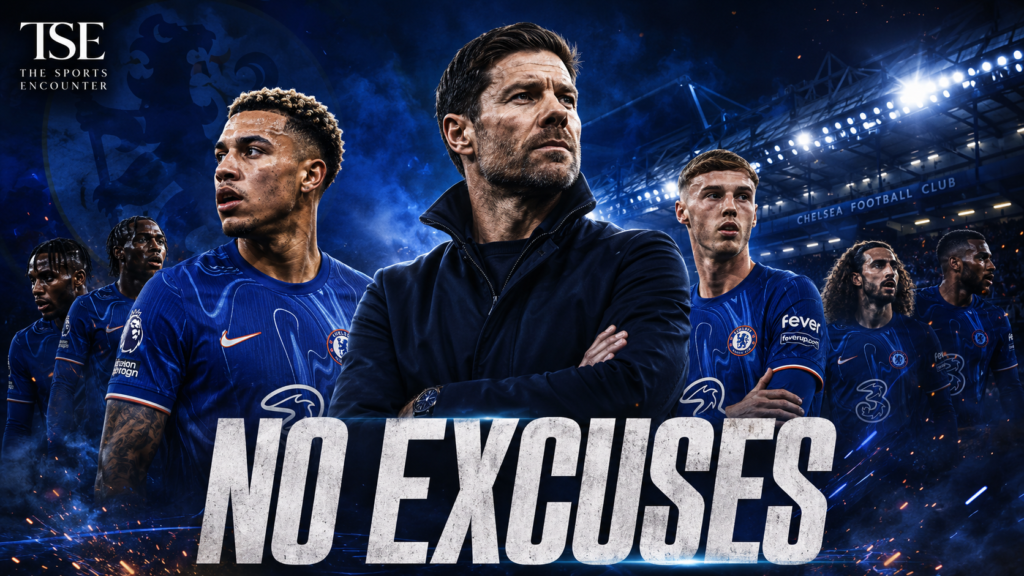
Chelsea have spent four years trying to turn an extraordinary collection of talent into a coherent football team. Xabi Alonso enters the 2026-27 season with perhaps the clearest opportunity yet to make it work.
He has Morgan Rogers, the most expensive British footballer in history.
He has Cole Palmer.
He has Moisés Caicedo, Enzo Fernández, Geovany Quenda, Marco Palestra and another summer’s worth of new arrivals.
He also has something Chelsea’s major Premier League rivals do not: no European competition.
That combination changes the expectations.
Chelsea finished 10th last season after another turbulent campaign in which Enzo Maresca and Liam Rosenior both lost their jobs. The club has since hired Alonso, spent heavily again and added experience to one of the youngest and deepest squads in England.
The reset cannot remain theoretical forever.
As The Sports Encounter’s complete Premier League 2026-27 curtain raiser noted, Chelsea may be the most unpredictable major club in the division. Their ceiling is high enough to challenge the top four. Their recent history is unstable enough to make almost any outcome believable.
Alonso’s job is to reduce that uncertainty.
Chelsea’s 2026-27 Rebuild at a Glance
| Manager | Xabi Alonso |
| 2025-26 Premier League finish | 10th |
| Reported Morgan Rogers fee | £117 million |
| Rogers contract | Until 2033 |
| European competition | None |
| Major summer additions | Morgan Rogers, Jordan Henderson, Danny Welbeck, Maxence Lacroix, Marco Palestra, Pep Chavarria, Valentin Barco |
| Premier League opener | Fulham away, August 24 |
| TSE preseason assessment | Outside title contender, realistic top-four challenger |
£117 Million Changes the Meaning of Morgan Rogers’ Arrival
Morgan Rogers is not another developmental signing Chelsea can quietly wait three seasons to assess.
The reported £117 million fee carries immediate expectation.
It made Rogers the most expensive British player and placed him among the largest transfers in Premier League history, a financial shift examined in The Sports Encounter’s ranking of the league’s most expensive signings.
Rogers earned that attention through rapid progression at Aston Villa.
He scored 31 goals in 125 appearances for the club, produced 10 Premier League goals last season and played a major role in Villa’s Europa League triumph.
His World Cup reinforced the impression that his development had reached another level.
Rogers appeared in seven of England’s eight matches and supplied the cross for Anthony Gordon’s goal against Argentina in the semifinal. TSE’s analysis of England’s World Cup semifinal defeat highlighted how Rogers helped create the breakthrough before Argentina’s late comeback.
Chelsea therefore have not paid for potential alone.
They have paid for a 23-year-old who has already performed in the Premier League, Europe and at a World Cup.
Alonso Already Knows Where Rogers Fits
The encouraging part is that Chelsea appear to have bought Rogers with a tactical idea rather than simply because he became available.
Alonso has spoken about pairing him with Palmer.
The two already know each other well from Manchester City’s academy and England duty.
Their profiles are different enough to make the partnership interesting.
Palmer prefers receiving between the lines, slowing defenders down and manipulating space through passing and body movement.
Rogers is more direct.
He carries the ball through pressure, attacks open grass and can overpower defenders when moving at speed.
Alonso has described the need for a balance between players who provide stability and those who can play with freedom.
That may be the clearest indication of what he wants Chelsea to become.
Palmer and Rogers Could Finally Give Chelsea a Defined Attack
Chelsea’s attacking problem has often been less about a shortage of talent and more about a shortage of hierarchy.
Too many players have arrived without an obvious answer to a basic question: who is the attack actually built around?
Palmer already solved part of that problem.
Rogers can solve another.
Instead of surrounding Palmer with several interchangeable prospects, Chelsea can build repeatable combinations around two players who understand one another.
Rogers can drive from wider or deeper positions.
Palmer can occupy the No. 10 spaces Alonso has identified for him.
Danny Welbeck offers experienced movement through the middle, while Geovany Quenda provides width and one-on-one ability.
Quenda’s long-term role has already been explored in TSE’s analysis of Chelsea’s 2034 plan for the Portuguese winger.
The Squad Is Still Enormous
That attacking depth creates the next problem.
Chelsea still possess one of the Premier League’s largest squads despite selling Marc Cucurella, Trevoh Chalobah and Andrey Santos.
There is talent everywhere.
There are also only so many minutes available.
Alonso will need to decide which players form the core and which ones are genuinely rotational.
That distinction matters more this season because Chelsea have no European competition to distribute appearances across.
A player who might normally receive Champions League or Europa League starts will instead be competing for domestic league and cup minutes.
Managing dissatisfaction could become almost as important as designing the starting XI.
No European Football Removes One of Alonso’s Biggest Excuses
The absence of European football may ultimately become Chelsea’s greatest advantage.
Arsenal, Manchester City, Manchester United, Liverpool and Aston Villa will all have continental schedules.
Chelsea will have full training weeks more often.
They can recover longer.
Alonso can spend more time coaching tactical details rather than moving from recovery session to travel day to another match.
The difference could become particularly important from October onward, when European fixtures, domestic cups and league matches begin piling up for Chelsea’s rivals.
TSE’s Premier League title-contenders ranking placed Chelsea outside the leading group partly because they finished 33 points behind champions Arsenal last season.
The schedule gives them one obvious route toward reducing that gap.
Jordan Henderson and Danny Welbeck Signal a Change in Recruitment
Chelsea’s summer has also included something their recent transfer strategy often lacked: older players.
Jordan Henderson is 36.
Danny Welbeck is 35.
Neither signing fits the stereotype of Chelsea’s youth-heavy recruitment model.
That is precisely why both matter.
Henderson has captained a Premier League title-winning team and understands the demands of high-pressure seasons.
Welbeck has played elite English football for more than 15 years and offers experience across several attacking roles.
Their value will not be measured only through starts.
Young squads need voices capable of recognizing when a poor half should remain a poor half rather than becoming a three-week crisis.
Chelsea have lacked that kind of emotional stability during several difficult periods.
Marco Palestra and Pep Chavarria Give Alonso Tactical Options
The defensive recruitment also looks increasingly shaped around Alonso’s preferences.
Marco Palestra offers athleticism and wing-back versatility after arriving from Atalanta, a move TSE examined when Chelsea moved aggressively to secure the Italian wide defender.
Pep Chavarria adds another experienced option on the left following Cucurella’s departure.
Maxence Lacroix gives Chelsea pace and recovery ability in central defense.
Those profiles matter because Alonso has frequently used structures that ask defenders to operate aggressively away from their own penalty area.
The players behind Rogers and Palmer therefore have to support attacking freedom without leaving Chelsea exposed every time possession is lost.
Valentin Barco Adds Another Flexible Piece
Valentin Barco’s arrival from Strasbourg further expands Alonso’s options.
The Argentina international can operate through midfield or from wider positions and arrives after featuring in his country’s run to the World Cup final.
His flexibility fits the broader recruitment theme.
Chelsea are building a squad filled with players capable of covering more than one role.
The danger is that versatility becomes an excuse to avoid defining anyone’s best position.
Alonso must prevent that.
Caicedo Is the Warning Against Judging £100M Players Too Quickly
Moisés Caicedo offers Rogers a useful internal example.
His first season after a £115 million move from Brighton was difficult.
The fee followed him into every mistake.
As Chelsea’s structure improved, Caicedo’s importance became clearer.
He developed into the defensive platform around which the midfield could function and eventually won major individual recognition within the club.
That progression formed an important part of TSE’s wider analysis of record Premier League transfers.
Rogers will receive pressure immediately.
Chelsea must avoid making his price the only lens through which his first months are viewed.
Alonso Is Also Under More Pressure Than His Job Title Suggests
The £117 million fee belongs to Rogers.
The larger pressure belongs to Alonso.
Chelsea’s ownership has already worked through several coaches since 2022.
Alonso arrives with a stronger reputation than most of them.
He led Bayer Leverkusen to a domestic league and cup double and arrives with a tactical identity established before joining Stamford Bridge.
His later spell at Real Madrid ended badly after only seven months, but Chelsea have still given him something previous coaches did not always appear to possess: greater authority.
Even the title matters.
Alonso has been appointed manager rather than merely head coach.
That suggests the owners may finally be willing to allow the football department to operate with clearer leadership.
Chelsea Cannot Keep Treating Every Season as Year One
This may be the most important issue surrounding the club.
Chelsea have repeatedly reset the timeline.
New coach.
New signings.
New structure.
New explanation for why patience is required.
At some point, a long-term project has to produce short-term evidence.
The Conference League and Club World Cup victories in 2025 proved the squad could win tournaments.
The 10th-place finish last season showed how little consistency those successes guaranteed.
Alonso must connect the two versions of Chelsea.
He needs the ceiling of the cup-winning side with the weekly reliability required in the Premier League.
The Opening Schedule Will Tell Us Something Quickly
Chelsea begin the league season away to Fulham on August 24.
Two weeks later comes Arsenal.
The opening weeks therefore offer both a local test and an immediate encounter with the defending champions.
The full sequence is included in The Sports Encounter’s 2026-27 Premier League preview.
Those fixtures will not define Alonso’s entire season.
They may reveal how much work remains.
What Would Success Actually Look Like?
A title challenge would represent an extraordinary leap from 10th.
It should not be the minimum requirement.
Champions League qualification is a much more sensible benchmark.
Chelsea have too much talent and too much schedule advantage to spend another season outside the top four conversation.
The Sports Encounter currently views Chelsea as an outside championship contender but a realistic Champions League challenger.
That assessment reflects both sides of the club.
The talent is obvious.
The reliability is not.
Now Chelsea Have to Turn Investment Into Identity
Rogers can improve Chelsea.
Palmer can remain the creative centerpiece.
Caicedo can protect the midfield.
Henderson can provide experience.
Palestra, Chavarria and Lacroix can reshape the defense.
Alonso can provide the tactical structure.
The ingredients are there.
The real challenge is making them belong to the same team.
Chelsea have spent years collecting potential.
The £117 million Rogers deal raises the expectation again, but it also gives Alonso one of the Premier League’s most dynamic young attackers.
No European football gives him training time.
The squad gives him options.
The ownership has given him significant backing.
By May, the conversation cannot still be about what Chelsea might become.
For official squad news and club updates, supporters can follow Chelsea FC. Fixtures, standings and official competition information are available through the Premier League.
Readers can also follow The Sports Encounter’s complete soccer coverage throughout the 2026-27 season.
Frequently Asked Questions
How much did Chelsea pay for Morgan Rogers?
Chelsea did not publicly disclose the transfer fee, but British media widely reported the deal at £117 million, making Rogers the most expensive British footballer.
How long is Morgan Rogers’ Chelsea contract?
Rogers signed a contract running until 2033.
Who is Chelsea’s manager for the 2026-27 season?
Xabi Alonso is Chelsea’s manager after taking over ahead of the new campaign.
Where did Chelsea finish last season?
Chelsea finished 10th in the 2025-26 Premier League.
Is Chelsea playing in Europe in 2026-27?
No. Chelsea have no European competition this season, giving Alonso more full training weeks and recovery time than many of his Premier League rivals.
Can Morgan Rogers and Cole Palmer play together?
Alonso believes they can. The pair came through Manchester City’s academy, are close friends and England teammates, but offer different attacking qualities that could complement each other.
Who else has Chelsea signed?
Chelsea’s summer additions include Jordan Henderson, Danny Welbeck, Maxence Lacroix, Marco Palestra, Pep Chavarria and Valentin Barco, alongside Rogers.
When is Chelsea’s first Premier League game?
Chelsea begin the 2026-27 league season away to Fulham on August 24.
Can Chelsea challenge for the Premier League title?
The squad has enough quality to improve dramatically, but a top-four finish is a more realistic initial target after Chelsea finished 33 points behind champions Arsenal last season.
What is Xabi Alonso’s biggest challenge at Chelsea?
His biggest challenge is turning one of the Premier League’s largest and most expensive squads into a stable team with clear roles, consistent performances and a recognizable tactical identity.
The Sports Encounter’s soccer coverage follows Premier League news, transfers, tactical developments, player stories and the major issues shaping football throughout the season.