


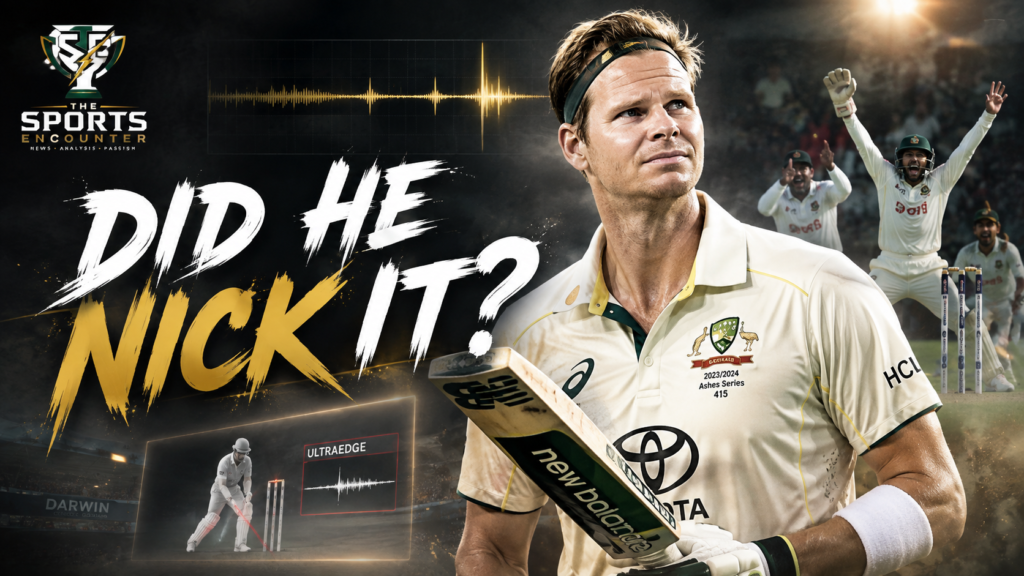
Steve Smith did not need technology to tell him what he thought had happened.
Bangladesh believed he had edged Ebadot Hossain behind. Smith appeared to think the same thing. He started moving away from the crease during the review, almost as if the decision had already been made.
Then Real-Time Snickometer showed a flat line.
The on-field not-out decision survived.
Smith stayed.
Hours later, after making 71 in Australia’s otherwise troubled first innings, he was asked the question that turned a strange review into one of the most fascinating technology debates of the current Test season.
“Did you nick that?”
Smith’s answer was just as direct.
“I think so, yeah.”
That admission changed the story.
The issue was no longer simply whether Bangladesh had been denied a wicket. It became a deeper question about the role of the Decision Review System, the limits of edge-detection technology and what cricket should do when a batter’s own physical sensation appears to conflict with the official evidence.
On a day when Bangladesh bowled Australia out for 198 and ended at 96 for one, the DRS moment became the most debated passage of play because Smith’s later honesty effectively challenged the system that had kept him at the crease.
The controversy is not that Smith cheated.
He followed the decision given to him.
The controversy is whether cricket has become so dependent on technology that a batter can believe he hit the ball, the fielding team can believe he hit it, his body language can suggest he hit it, and the official process can still conclude that there is not enough evidence to dismiss him.
Steve Smith DRS Controversy at a Glance
| Detail | What Happened |
|---|---|
| Match | Australia vs Bangladesh, First Test |
| Venue | Marrara Stadium, Darwin |
| Smith’s score at the time | 7 |
| Bowler | Ebadot Hossain |
| Original decision | Not out |
| Bangladesh action | Reviewed for caught behind |
| Technology | Real-Time Snickometer showed no clear spike |
| DRS outcome | Not-out decision remained |
| Smith’s later admission | He said he thought he had nicked the ball |
| Smith’s final score | 71 |
| Australia’s total | 198 |
| Bangladesh at stumps | 96-1 |
What Happened to Steve Smith on 7?
Australia were already finding batting difficult on the opening morning in Darwin.
Smith had survived an earlier chance when he was dropped at third slip on 2. Five runs later, Ebadot produced a delivery that Bangladesh believed had found the outside edge.
The wicketkeeper completed the catch.
The appeal followed.
The on-field umpire said not out.
"Did you nick that?"
— cricket.com.au (@cricketcomau) August 13, 2026
"I think so, yeah."
Watch Steve Smith's full press conference after day one of #AUSvBAN: https://t.co/UPFVhNe5II pic.twitter.com/hzoOHz4xVR
Bangladesh reviewed almost immediately.
Cricket Australia’s own Day 1 match report described Smith as looking to have edged the ball and noted that Real-Time Snickometer failed to register the apparent contact.
The review footage also made Smith’s reaction part of the debate. He moved away from the crease while the decision was being checked, behavior that many viewers interpreted as the natural reaction of a batter who believed he had hit the ball.
Once the sound technology displayed no meaningful spike, however, the third umpire had no clear technological evidence to overturn the original decision.
Smith returned to his guard.
Bangladesh were left stunned.
Smith’s Press Conference Turned a Marginal Call Into a Major Story
The controversy might have faded as another disputed DRS moment if Smith had simply said he was unsure.
Instead, he gave the debate fresh life.
Asked directly whether he had nicked the delivery, Smith said he thought he had.
He also explained that he had felt something and indicated that if the on-field umpire had originally given him out, he would have accepted the decision rather than reviewing it.
His conclusion was equally revealing: technology had saved him.
That is an extraordinary position for a batter to occupy.
The player who benefited from DRS was effectively saying his own physical impression differed from the evidence displayed by the review system.
That is why this controversy is different from the usual complaints about technology.
Normally, the bowler, captain or dismissed batter disputes what DRS has shown.
Here, the beneficiary questioned it.
DRS Did Not Prove Smith Missed the Ball
This is the most important technical distinction in the entire incident.
DRS did not establish with certainty that Smith had not edged the ball.
It established that the available review technology did not provide sufficient evidence to overturn the on-field not-out decision.
Those are not the same thing.
The ICC defines DRS as a technology-based process designed to assist match officials. It is not presented as an infallible replacement for human judgment.
For player reviews, third umpires can use broadcast replays, stump-microphone audio and approved edge-detection technology.
When the available evidence remains inconclusive, the original decision stands.
Smith’s review was therefore procedurally simple even if the cricketing reality may have been messy.
The on-field call was not out.
Snickometer did not show the clear evidence required to reverse it.
The third umpire retained the decision.
Why Can Snickometer or UltraEdge Miss a Faint Edge?
Edge-detection technology is often treated by viewers as though it directly detects contact between bat and ball.
It does not.
Systems such as Real-Time Snickometer and UltraEdge work by identifying sound or vibration patterns and synchronizing those signals with video.
That means the system is interpreting evidence created by contact rather than physically observing the contact itself.
Very faint edges can therefore create difficult situations.
Possible complications include:
- Extremely light contact producing only a weak acoustic signal.
- Competing sounds from bat, pad, clothing, gloves, equipment or the ground.
- Microphone sensitivity and positioning.
- Audio and video synchronization.
- The contact producing too little measurable vibration to create a clear visual spike.
None of that proves the system malfunctioned in Darwin.
At the time of publication, there had been no official ICC finding that the technology failed technically.
That point matters.
The strongest responsible conclusion is that the technology did not register evidence strong enough to overturn the decision.
Anything beyond that remains interpretation unless match officials, the ICC or the technology provider release further information.
Why the Third Umpire Could Not Dismiss Smith Based on Body Language
Many supporters watching the replay drew their own conclusion from Smith beginning to walk away.
A third umpire cannot do that.
Smith’s reaction is not part of the official dismissal test.
Under the MCC Law governing caught dismissals, the legal question is whether the ball touched the bat and was then fairly caught before reaching the ground.
DRS must determine that through the approved review process.
A player’s facial expression, hesitation or movement toward the pavilion cannot replace the evidence.
That protects players as much as it frustrates fielding teams.
Batters sometimes react to sounds that come from pad or equipment. They can also be genuinely uncertain whether a faint sensation came from the ball or something else.
Smith himself left room for that possibility afterward.
He thought he had hit it.
Thinking something happened is still different from independently proving it.
Was Steve Smith Required to Walk?
No.
This part of the controversy is easier to settle than the technology debate.
A batter is not legally required to dismiss himself because he believes he has edged the ball.
Cricket’s Laws place dismissal decisions with the umpires following an appeal.
The wider Spirit of Cricket promotes fairness and respect, but it does not impose a separate law requiring a batter to walk whenever he believes he is out.
Smith had been given not out.
Bangladesh used the review system available to them.
The review did not overturn the call.
Smith was entitled to continue batting.
That is different from saying every fan must agree with the convention.
Cricket’s Walking Debate Has Never Really Disappeared
For generations, cricket has argued over whether batters should leave voluntarily when they know they have edged a catch.
Some players became famous for walking.
Others rejected the principle entirely.
The traditional argument against walking is straightforward: players should not selectively umpire themselves.
A bowler does not normally withdraw an LBW appeal because he thinks the delivery was missing leg stump.
A fielder does not always volunteer that a catch may have touched the grass.
The umpire exists to decide.
DRS strengthened that philosophy.
Modern players are repeatedly told that technology can correct clear umpiring errors.
Smith’s case exposes the tension inside that arrangement.
What happens when the batter trusts his own senses more than the electronic evidence?
Technology Has Changed the Meaning of Walking
Before DRS, the walking debate was mostly about individual ethics.
Today, it is also about process.
A modern batter can reasonably say that the fielding side has access to reviews, the umpire has made a decision and technology has examined the dismissal.
That creates a powerful incentive to let the system decide.
Smith did exactly that.
Yet his admission afterward creates an uncomfortable contradiction.
If the player believes he edged the ball, but technology fails to detect it, which evidence should cricket trust?
The answer under the current rules is clear.
The official process wins.
Whether supporters are emotionally satisfied by that answer is another matter.
Australia Needed Every Part of Smith’s 71
This controversy would carry less weight if Smith’s reprieve had not materially influenced Australia’s innings.
It did.
Bangladesh dismissed Australia for only 198, their lowest Test total against the Tigers.
Smith made 71.
No other Australian batter reached 30.
“Just hit the damn thing, Smudge. Stop being a princess.” 😂
— myKhel.com (@mykhelcom) August 13, 2026
A fan in Darwin lost all patience with Steve Smith over the sight-screen delays today!
Smith went on to top-score with 71, but Hasan Mahmud got the last laugh, knocking him over as Australia were rolled for 198. 🎯…
Had the disputed caught-behind decision gone Bangladesh’s way with Smith on 7, Australia would have lost the one batter who eventually provided sustained resistance.
That does not allow us to simply subtract 64 runs from the final score.
Cricket does not work that way. Different wickets change partnerships, bowling plans, field settings and the decisions made by every player who follows.
What we can say is that Smith’s survival became highly consequential.
He went on to make more than a third of Australia’s total.
Bangladesh’s Dominant Day Deserved More Than a Technology Footnote
The controversy should not erase the quality of Bangladesh’s performance.
The visitors arrived in Australia for their first Test series there in 23 years, a challenge examined in The Sports Encounter’s detailed Australia-Bangladesh series preview.
They then produced one of their finest opening days against the world’s top-ranked Test side.
Hasan Mahmud led the attack with career-best figures of 6 for 55.
His performance was particularly important because Bangladesh’s pace group had already been weakened by injuries.
The Sports Encounter recently examined the broader development of Bangladesh’s fast-bowling resources in our analysis of Asia’s changing fast-bowling landscape.
Darwin provided another clear sign that Bangladesh can now threaten strong batting teams with pace rather than relying entirely on traditional spin-friendly conditions.
Hasan Mahmud Turned the First Innings Into a Personal Breakthrough
Hasan’s 6 for 55 was not merely the best bowling performance of the day.
It was one of the finest Test returns ever produced by a Bangladesh fast bowler.
He dismissed key batters throughout the innings and returned to remove the tail after Smith had threatened to drag Australia toward a more respectable total.
Smith eventually became one of Hasan’s six wickets, top-edging an aggressive shot as Australia tried to squeeze out late runs.
There was a certain irony in the dismissal.
The batter who survived a possible faint edge earlier was eventually removed by a much more obvious contact.
Bangladesh Then Made Australia’s 198 Look Even Smaller
The tourists did not waste the advantage created by their bowlers.
Bangladesh reached 96 for one by stumps.
Tanzid Hasan finished unbeaten on 32, while Mominul Haque closed on 35 not out.
Their 60-run second-wicket partnership quietened an Australian attack featuring Pat Cummins, Mitchell Starc, Josh Hazlewood and Nathan Lyon.
The unusual Darwin series forms part of a remarkable stretch of red-ball cricket that The Sports Encounter highlighted in our guide to 19 consecutive days of Test cricket in August.
Bangladesh have already ensured that their portion of that run will command attention.
Mitchell Starc Still Made History on a Difficult Australian Day
Australia had one major bowling milestone to celebrate.
Mitchell Starc removed Shadman Islam and moved past Rangana Herath to become the leading left-arm wicket-taker in Test cricket.
It was an important achievement inside an otherwise frustrating evening for the hosts.
Starc, Cummins, Hazlewood and Lyon entered the series together for the first time in more than a year, one of the major themes identified in our pre-series analysis.
Bangladesh’s top order nevertheless handled the conditions with far greater stability than Australia’s batters had managed earlier.
Smith’s Reputation Makes the Admission More Interesting
Smith is hardly an anonymous batter caught inside an obscure technical dispute.
He is one of the defining Test players of his era.
The Sports Encounter has repeatedly placed him inside the modern batting elite, including our analysis of Joe Root’s pursuit of Sachin Tendulkar and our report on the latest Test batting rankings.
Smith was also named ICC Test Cricketer of the Decade for the 2011-2020 period, a distinction revisited in The Sports Encounter’s complete ICC Awards retrospective.
His words therefore carry unusual weight.
When a batter of Smith’s experience says he believed he made contact, the cricket world naturally pays attention.
That still does not make his perception a substitute for technical proof.
DRS Has Always Been About Correcting Clear Errors, Not Achieving Perfection
This incident exposes one of the most common misunderstandings about DRS.
The system is often discussed as though its purpose is to make every decision objectively perfect.
That is not realistic.
The ICC describes DRS as an assistance system for match officials.
Its structure preserves uncertainty in several areas.
LBW reviews retain elements such as Umpire’s Call.
Caught-behind reviews depend on the quality of visual and sound evidence.
Marginal situations can remain with the original umpire when technology cannot establish enough certainty to reverse the call.
That is not necessarily a design flaw.
It is a recognition that sport does not always produce perfect evidence.
Why Umpire’s Call and Smith’s Edge Come From the Same Philosophy
The specific technology is different, but the philosophical principle is similar.
DRS does not automatically erase the authority of the on-field umpire.
When evidence crosses the threshold required for reversal, the decision changes.
When it does not, the original call can survive.
This approach protects the review system from becoming a second round of subjective officiating.
The third umpire is not supposed to replace one uncertain judgment with another uncertain judgment.
That means DRS sometimes produces results that feel unsatisfying even when the protocol has been followed correctly.
Smith’s survival may be one of the clearest examples.
Could Cricket Use More Than One Edge-Detection Method?
The Smith incident will inevitably prompt calls for better technology.
Those demands should be treated seriously, but carefully.
Cricket has experimented with multiple tools over the years, including sound-based detection and heat-based imaging.
Every technology brings trade-offs involving speed, accuracy, cost, broadcast integration and availability across different countries.
The ICC already requires accredited technology for DRS at the international level.
The more useful question is whether extremely faint contact could be assessed through improved redundancy rather than relying on one dominant signal.
For example, a future system could theoretically combine:
- High-frame-rate close-up video.
- Enhanced stump-microphone analysis.
- Multiple independent acoustic channels.
- Improved vibration detection.
- Automated synchronization between sound and visual frames.
That does not mean cricket needs to rush into another technology because of one controversial delivery.
It means incidents like this provide useful stress tests for systems that are often treated as settled.
The Real Question Is Trust
The most important consequence may not involve one wicket or one Test.
Sports technology depends on trust.
Players must believe the system is worth using.
Umpires must believe the evidence is reliable enough to guide decisions.
Supporters must understand why a verdict has been reached.
Smith’s admission creates an unusual challenge because the official evidence and the player’s own impression appear to point in different directions.
If similar incidents became common, trust would become harder to maintain.
One isolated case does not prove a systemic problem.
It does remind cricket that technological authority must continually be earned.
TSE Analysis: Smith Did Nothing Wrong, but Cricket Still Has a Problem to Examine
The easiest versions of this story are also the least useful.
Calling Smith a cheat ignores the rules.
Declaring DRS broken ignores the absence of an official technical finding.
Saying the system worked perfectly ignores the unusual evidence supplied by the batter himself.
The more accurate conclusion sits between those extremes.
Smith was given not out.
Bangladesh reviewed.
The technology did not produce enough evidence to overturn the decision.
Smith continued batting exactly as the rules allowed.
Afterward, he honestly acknowledged that he believed he had felt an edge.
That honesty is what makes the incident valuable.
It exposes the boundary between evidence and certainty.
DRS can tell officials what its sensors registered.
It cannot always tell cricket what physically happened with absolute certainty.
What Happens if Smith’s 71 Decides the Test?
The debate will become much louder if Australia eventually win narrowly.
Smith added 64 runs after the disputed moment.
Again, those runs cannot be treated as a simple arithmetic gift because the innings would have developed differently had he been dismissed.
Yet Bangladesh supporters would understandably revisit the review if the match margin becomes small.
That is the nature of controversial decisions.
Their significance grows or shrinks according to what happens later.
Day 1 has already ensured that the incident will remain part of the Test’s story.
Australia vs Bangladesh Day 1: Key Numbers
| Statistic | Figure |
|---|---|
| Australia first innings | 198 all out |
| Steve Smith | 71 |
| Hasan Mahmud | 6-55 |
| Bangladesh at stumps | 96-1 |
| Bangladesh deficit | 102 runs |
| Tanzid Hasan | 32 not out |
| Mominul Haque | 35 not out |
| Mitchell Starc | Became Test cricket’s leading left-arm wicket-taker |
Frequently Asked Questions
Did Steve Smith admit he edged the ball against Bangladesh?
Yes. After Day 1 in Darwin, Smith said he thought he had nicked the delivery from Ebadot Hossain that Bangladesh reviewed when he was on 7.
Why was Steve Smith not given out?
The original on-field decision was not out. Real-Time Snickometer did not show clear evidence of an edge, so the third umpire did not have sufficient evidence to overturn the original decision.
Did DRS prove Steve Smith did not hit the ball?
No. The review established that there was not enough technological evidence to reverse the not-out call. That is different from proving with absolute certainty that no contact occurred.
Did Snickometer malfunction?
There was no official ICC finding at the time of publication confirming a technical malfunction. Cricket Australia’s report said the technology failed to register the apparent nick, while Smith later said he believed he had felt contact.
Was Steve Smith required to walk?
No. Cricket’s Laws do not require a batter to dismiss himself. The umpire makes the decision after an appeal, and Smith was entitled to remain after the not-out verdict survived Bangladesh’s review.
What did Steve Smith score?
Smith made 71, the highest score in Australia’s first innings of 198.
Who took six wickets for Bangladesh?
Fast bowler Hasan Mahmud took career-best figures of 6 for 55.
What was Bangladesh’s score at stumps?
Bangladesh ended Day 1 on 96 for one, trailing Australia by 102 runs.
What is Real-Time Snickometer?
It is sound-based technology used to help determine whether the ball has made contact with the bat or another surface during a review.
Why does the original umpire’s decision matter in DRS?
DRS requires sufficient evidence to overturn an on-field decision. If the evidence remains inconclusive, the original call can remain in place.
Could the Smith decision affect the result of the Test?
Potentially. Smith made 64 additional runs after the disputed review, although it would be inaccurate to assume Australia’s total would simply have been 64 runs lower had he been dismissed because the entire innings would have developed differently.
Smith Felt Something. The Machine Heard Nothing.
That may be the simplest way to understand why this incident has captured so much attention.
A world-class batter believed he had made contact.
Bangladesh believed they had taken the wicket.
The review system found insufficient evidence.
The rules therefore kept Smith at the crease.
Nothing about that sequence proves cheating.
Nothing yet proves a technological malfunction.
It does expose one uncomfortable truth about modern cricket.
Technology can reduce mistakes.
It cannot eliminate uncertainty.
The more cricket relies on DRS, the more important it becomes to understand that distinction.
For Bangladesh, the immediate concern is simpler. They dominated the opening day, dismissed Australia for less than 200 and placed themselves in a strong position in a Test few expected them to control so early.
For Smith, 71 may ultimately be remembered either as a crucial rescue innings or as the score at the center of a much larger argument.
For cricket, the delivery on 7 has already become something else.
It is a reminder that even in the age of Snickometer, slow motion and third umpires, there are still moments when the game has to live with doubt.
Follow The Sports Encounter’s cricket coverage for continuing reports and analysis from the Australia-Bangladesh Test series and the wider international calendar.