


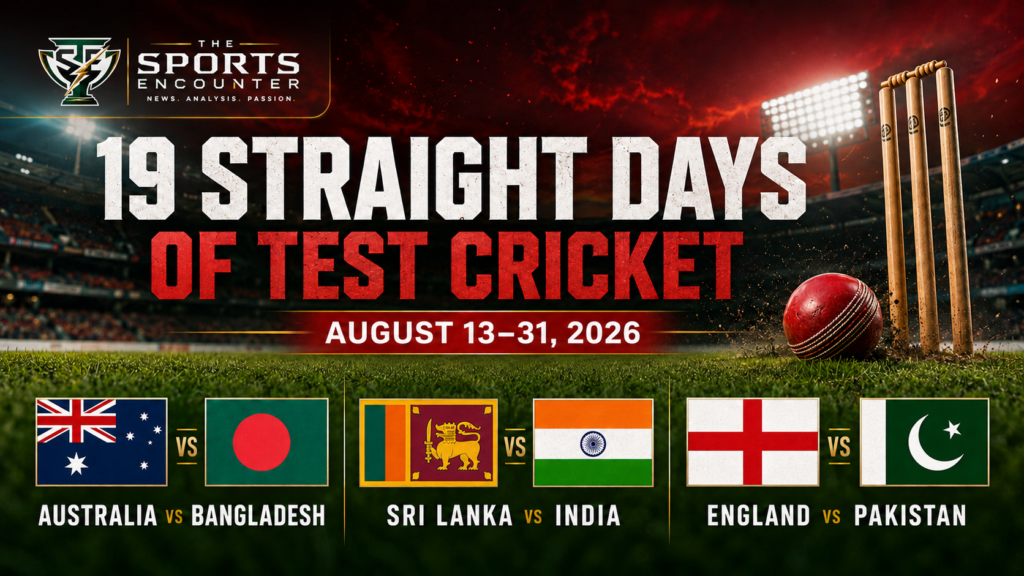
Test cricket will occupy every date on the calendar from August 13 through August 31, giving red-ball fans an unusual stretch in which one match begins before another has finished.
The sequence starts in Darwin, where Australia host Bangladesh. Sri Lanka and India join the action two days later in Galle. England and Pakistan then begin their series at Headingley on August 19, the scheduled final day of the Galle Test.
Three series, six Tests and 30 scheduled match-days combine to cover 19 consecutive calendar dates.
There is one important qualification. Test matches can finish before their fifth day, so the schedule cannot guarantee actual play on all 19 dates. What it guarantees is that at least one Test is scheduled on every day from August 13 to 31.
For supporters who have watched franchise tournaments consume larger sections of cricket’s calendar, even that scheduled continuity feels worth celebrating.
Readers can follow every major red-ball development through The Sports Encounter’s Cricket Hub and its wider cricket news and analysis coverage.
TL;DR
- Six Test matches are scheduled between August 13 and August 31, 2026.
- At least one Test is scheduled on each of those 19 consecutive calendar days.
- Australia host Bangladesh in Darwin and Mackay.
- Sri Lanka face India in Galle and Colombo.
- England welcome Pakistan at Headingley and Lord’s.
- The six matches create 30 scheduled Test days across a 19-day window.
Complete Schedule for 19 Straight Days of Test Cricket
| Dates | Match | Test | Venue | Scheduled Days |
|---|---|---|---|---|
| August 13–17 | Australia vs Bangladesh | First Test | Marrara Stadium, Darwin | 5 |
| August 15–19 | Sri Lanka vs India | First Test | Galle International Stadium, Galle | 5 |
| August 19–23 | England vs Pakistan | First Test | Headingley, Leeds | 5 |
| August 22–26 | Australia vs Bangladesh | Second Test | Great Barrier Reef Arena, Mackay | 5 |
| August 23–27 | Sri Lanka vs India | Second Test | Sinhalese Sports Club, Colombo | 5 |
| August 27–31 | England vs Pakistan | Second Test | Lord’s, London | 5 |
The fixtures are confirmed through official schedules published by Cricket Australia, the BCCI, the ECB and the ICC World Test Championship.
How the 19-Day Test Cricket Sequence Works
| Calendar Dates | Test Cricket Scheduled |
|---|---|
| August 13–14 | Australia vs Bangladesh, First Test |
| August 15–17 | Australia vs Bangladesh and Sri Lanka vs India |
| August 18 | Sri Lanka vs India, First Test |
| August 19 | Sri Lanka vs India and England vs Pakistan |
| August 20–21 | England vs Pakistan, First Test |
| August 22 | England vs Pakistan and Australia vs Bangladesh |
| August 23 | England vs Pakistan, Australia vs Bangladesh and Sri Lanka vs India |
| August 24–26 | Australia vs Bangladesh and Sri Lanka vs India |
| August 27 | Sri Lanka vs India and England vs Pakistan |
| August 28–31 | England vs Pakistan, Second Test |
August 23 represents the busiest point. Three Tests are scheduled on the same date across England, Australia and Sri Lanka.
Time zones should extend the daily viewing window considerably. Fans could wake up to play in Australia, move through the Sri Lankan session and finish with evening coverage from England, depending on where they live.
Australia and Bangladesh Open the Red-Ball Run
Australia and Bangladesh begin the sequence at Marrara Stadium in Darwin on August 13.
The match returns Test cricket to Australia’s tropical north and gives Bangladesh one of the hardest assignments in the current World Test Championship cycle. Pat Cummins leads a powerful squad that includes Mitchell Starc, Josh Hazlewood, Nathan Lyon, Steve Smith and Travis Head.
Bangladesh will have to manage conditions that differ from the country’s familiar slow, spin-friendly surfaces. Darwin’s heat, possible movement with the newer ball and Australia’s bowling depth make the first innings particularly important.
The second Test begins in Mackay on August 22, overlapping with the final two scheduled days of England’s Headingley Test.
The demands placed on fast bowlers across modern schedules remain a major talking point. The Sports Encounter examined that debate in its analysis of whether workload management has changed the art of Test fast bowling.
Sri Lanka and India Bring Spin Into the Celebration
Sri Lanka host India at Galle from August 15, adding a completely different red-ball examination to the Australian series.
Galle can transform quickly as a Test develops. Batters must score before the surface becomes increasingly difficult, while spinners need patience when early turn fails to produce immediate wickets.
India enter the series without recently retired Ajinkya Rahane, whose overseas record and crisis management shaped some of the country’s finest Test victories. His career and leadership legacy were explored in The Sports Encounter’s tribute to India’s quiet crisis manager.
The second Test moves to the Sinhalese Sports Club in Colombo on August 23. Its opening day creates the only three-Test overlap in the schedule, joining Australia vs Bangladesh in Mackay and England vs Pakistan at Headingley.
England and Pakistan Carry the Sequence Through August 31
England and Pakistan begin their three-Test series at Headingley on August 19.
Pakistan arrive after their Caribbean assignment, where Babar Azam began his second spell as Test captain. The tour’s red-ball reset, selection issues and World Test Championship pressure were examined in The Sports Encounter’s West Indies vs Pakistan series preview.
English conditions will place Pakistan’s batting judgment under immediate scrutiny. Leaving the ball, surviving lateral movement and building partnerships after the first breakthrough will matter as much as attacking intent.
England enter another period of red-ball change. The prospect of Stephen Fleming reshaping their approach before the Pakistan series has already raised questions about tactical control, leadership and the future of Bazball. Readers can explore that transition in our analysis of England’s Test coaching direction under Fleming and the deeper feature on how Bazball changed and exposed England.
The second Test starts at Lord’s on August 27, the scheduled final day of Sri Lanka vs India in Colombo. It then carries the uninterrupted red-ball sequence through August 31.
Pakistan’s fast bowlers will encounter a country closely connected to their cricketing mythology. Fazal Mahmood, Wasim Akram and Waqar Younis all produced defining performances in England. That tradition remains central to The Sports Encounter’s ranking of Pakistan’s most lethal fast bowlers.
Why This 19-Day Run Matters to Test Cricket Fans
The appeal comes from contrast.
Darwin and Mackay should reward pace, bounce and endurance. Galle and Colombo may become contests of footwork, spin and surface deterioration. Headingley and Lord’s should test technique against seam and swing.
Fans will see the same format ask completely different questions across three continents.
Test cricket also allows stories to develop slowly. A batter can survive a difficult opening session and build a century the following morning. A spinner can struggle for two days before changing the match on the fourth. Captains must manage workloads, weather, declarations and deteriorating conditions over several sessions.
Recent matches have shown how quickly that slow pressure can become decisive. New Zealand’s 253-run victory over England at The Oval turned on sustained bowling control rather than one isolated burst.
Late August now gives fans six opportunities to watch those stories unfold, often at the same time.
A Red-Ball Festival With One Necessary Caveat
The phrase “19 straight days of Test cricket” describes the official schedule accurately. Actual play on every day will depend on results, weather and whether each match reaches its scheduled conclusion.
An innings victory in Darwin or a three-day finish in Galle could interrupt the run. Rain may remove an entire day even when a match remains active.
Still, the calendar has produced something rare: every date from August 13 to 31 contains scheduled international Test cricket.
That gives red-ball supporters a late-summer festival spanning six teams, three continents and vastly different playing conditions. For 19 days, the longest format will always have another session, another contest or another morning waiting.
Frequently Asked Questions
Are there really 19 consecutive days of Test cricket in August 2026?
At least one Test is scheduled on every calendar date from August 13 through August 31. Actual play on all 19 days depends on matches lasting long enough and avoiding full-day weather interruptions.
How many Test matches are included?
Six Tests across three series form the 19-day sequence.
Which teams are playing?
Australia, Bangladesh, Sri Lanka, India, England and Pakistan are involved.
Which date has three Tests scheduled?
Australia vs Bangladesh, Sri Lanka vs India and England vs Pakistan are all scheduled on August 23.
When does the sequence end?
The run concludes with the scheduled fifth day of England vs Pakistan at Lord’s on August 31,