


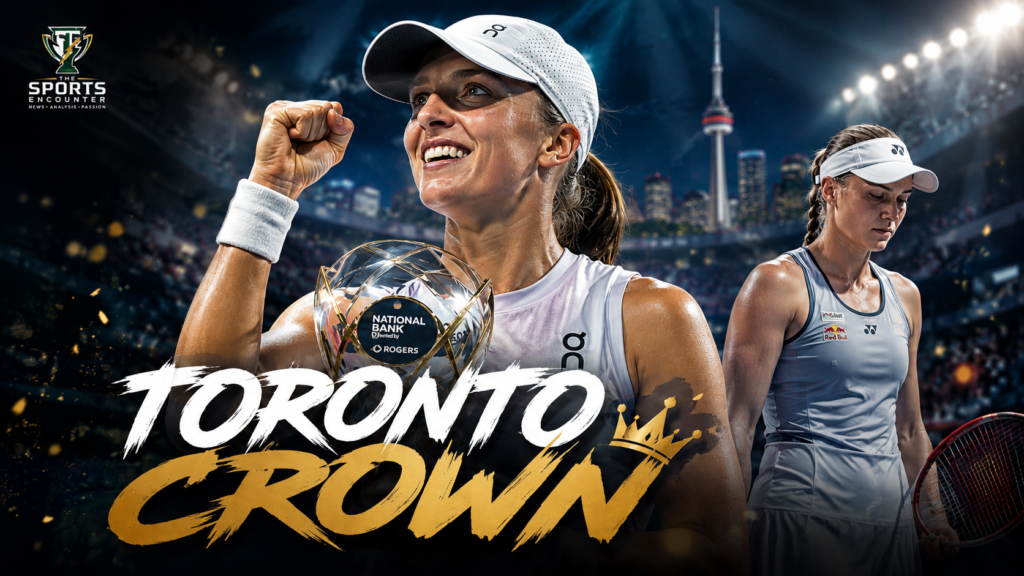
Iga Swiatek arrived in Toronto searching for something that had been missing from her 2026 season: a title.
She left with considerably more than that.
The Polish star swept aside Elena Rybakina 6-2, 6-3 in the National Bank Open women’s singles final at Sobeys Stadium, producing her most authoritative performance of the tournament at precisely the moment the North American hard-court season begins turning toward the US Open.
Rybakina had survived four three-set matches to reach the championship match. She had come back against Naomi Osaka, recovered again against Coco Gauff, and entered Thursday’s final as one of the most battle-tested players in Toronto.
Swiatek gave her no opportunity to stage another escape.
The six-time Grand Slam champion broke immediately, repeatedly absorbed Rybakina’s first-strike power, and controlled the final in straight sets to claim her first title of 2026.
For a player whose season had contained more frustration than silverware, the timing could hardly have been better.
National Bank Open 2026 Women’s Final at a Glance
| Category | Result |
|---|---|
| Champion | Iga Swiatek |
| Runner-up | Elena Rybakina |
| Final score | 6-2, 6-3 |
| Venue | Sobeys Stadium, Toronto |
| Tournament level | WTA 1000 |
| Swiatek’s 2026 titles | First |
| Career singles titles | 26 |
| Career head-to-head | Swiatek leads Rybakina 7-6 |
| Champion’s ranking points | 1,000 |
| Champion’s prize money | $1,085,200 |
Swiatek Breaks Immediately and Never Lets Rybakina Settle
The tone of the final was established almost immediately.
Rybakina opened the match serving, but two double faults contributed to a damaging first game that ended with Swiatek taking the early break.
That mattered because Rybakina’s serve is normally the foundation from which the rest of her game operates.
When the first delivery lands consistently, she can shorten points, dictate the next ball and prevent opponents from settling into return patterns. When the serve becomes vulnerable, the rest of the court suddenly feels much larger.
Swiatek understood the opportunity immediately.
She consolidated for 2-0 and began forcing Rybakina to hit extra shots rather than allowing her to dictate the match with two- or three-ball combinations.
The Kazakhstani settled enough to hold comfortably in her next service game, but she never completely removed the early pressure.
At 4-2, Rybakina finally created her best opening.
A Swiatek double fault gave her two break points at 15-40.
This was the moment that could have changed the direction of the set.
Instead, Rybakina sent backhands long on both opportunities.
Swiatek escaped.
The opportunity disappeared.
Minutes later, Rybakina surrendered her own 30-love advantage, and Swiatek attacked with a forehand down the line to earn the second break.
She served out the opening set to love.
Six games to two.
The Match Changed Because Swiatek Took Away Rybakina’s First Strike
The scoreboard suggests a straightforward final, but the tactical story explains why it became one.
Rybakina is most dangerous when the serve creates an immediate attacking ball.
Her ideal sequence is simple: land the first serve, receive a short or neutral return, then take control with the next forehand or backhand.
Swiatek repeatedly disrupted that sequence.
Her return position allowed her to absorb pace while still sending enough depth back into the court. Once rallies became neutral, her movement and ability to redirect the ball began tilting exchanges in her favor.
Rybakina therefore had to play more points rather than simply finish them.
That was particularly demanding after the route she had taken through Toronto.
Before the final, the WTA noted that Rybakina had already played four three-set matches during the tournament.
She needed three sets against Daria Kasatkina, Liudmila Samsonova, Naomi Osaka and Coco Gauff.
Those matches demonstrated her resilience.
They also accumulated miles in her legs.
Rybakina’s Toronto Survival Act Finally Runs Out
Few players had fought harder to reach a WTA final this season.
Rybakina began her Toronto campaign by defeating Kasatkina 6-3, 5-7, 6-4.
She then beat Ann Li in straight sets before another demanding battle against Samsonova.
The quarterfinal against Osaka became one of the tournament’s defining matches.
Rybakina trailed by a set and a break before recovering to win 4-6, 7-6(5), 6-4.
The Sports Encounter covered that dramatic stage of the tournament in our National Bank Open quarterfinal and semifinal roundup.
Another comeback followed against Gauff.
After losing the first set, Rybakina won the next two 6-2, 6-2 to reach her first National Bank Open final.
Our full analysis of that semifinal examined how Rybakina turned the match around against Coco Gauff.
The pattern was becoming remarkable.
Fall behind.
Absorb pressure.
Find the serve.
Take control.
Against Swiatek, the comeback never arrived.
Swiatek Refuses to Open the Door in the Second Set
Rybakina needed the second set to become untidy.
She needed longer games, more pressure on Swiatek’s serve and enough scoreboard tension to make her opponent reconsider the aggressive patterns that had worked so well.
For a short period, the possibility remained.
The set reached 2-2 without either player establishing separation.
Then Swiatek began squeezing the available space again.
She moved ahead 4-2 and protected the advantage rather than giving Rybakina the kind of opening she had used repeatedly throughout the tournament.
Rybakina managed another hold, but Swiatek remained composed as the finish line approached.
At 6-3, Toronto had its champion.
The emotional difference between the two players was understandable.
Rybakina had spent much of the tournament fighting for survival.
Swiatek had spent much of the final preventing survival from becoming necessary.
Toronto Became Swiatek’s Most Important Week of 2026
The title carries unusual significance because of what came before it.
Swiatek entered Toronto without a tournament victory this season.
Her results had remained strong enough to keep her among the elite, but the standards attached to her career are different from those faced by most players.
She had also experienced disappointing exits at major events and made a coaching change during the season.
Toronto therefore became an opportunity to rebuild something deeper than ranking points.
Her opening match provided the first clue.
Swiatek beat Sara Bejlek 6-0, 6-3 after winning the first nine games, a performance The Sports Encounter highlighted in our National Bank Open Day 4 report.
Viktorija Golubic followed.
Then came Marta Kostyuk.
That match provided a very different examination.
Swiatek lost the opening set 3-6 and struggled badly on serve before rebuilding the match to win the next two sets 6-1, 6-2.
It was an important sign that she could repair problems during matches rather than requiring perfect conditions from the start.
Diana Shnaider Was Given Almost Nothing
The quarterfinal produced perhaps Swiatek’s cleanest performance before the championship match.
She defeated Diana Shnaider 6-2, 6-1 in only 68 minutes.
Shnaider did not earn a break point.
Swiatek’s combination of court coverage, return depth and controlled baseline aggression made the match increasingly one-sided.
That victory took her into her first WTA 1000 semifinal of the season.
From there, the resistance became much stronger.
Svitolina Forced Swiatek to Solve a Different Problem
Elina Svitolina entered the semifinal having already beaten Swiatek twice during 2026.
The Ukrainian again made the matchup uncomfortable.
Swiatek won the first set 6-3 before Svitolina responded emphatically, taking the second 6-1.
Svitolina then broke for a 3-2 advantage in the deciding set.
Swiatek’s response became one of the most important sequences of her entire Toronto run.
She won the final four games.
The 6-3, 1-6, 6-3 victory sent her into her first final of the year and provided a very different test from the dominance she had shown against Shnaider.
The Sports Encounter’s full semifinal report examined how Swiatek survived Svitolina’s fightback to reach the Toronto final.
Twenty-four hours later, she was lifting the trophy.
Swiatek Moves Ahead in a Rivalry That Had Been Perfectly Balanced
Thursday’s final was the 13th meeting between Swiatek and Rybakina.
The previous 12 had been split 6-6.
That symmetry reflected how difficult the matchup has historically been for both players.
Rybakina’s flatter power and strong first serve have frequently challenged Swiatek’s preferred patterns.
Swiatek’s movement, return game and ability to take time away have caused equally serious problems for Rybakina.
Rybakina had also won their previous two meetings, including their 2026 Australian Open quarterfinal.
Toronto changes the immediate narrative.
Swiatek now leads the career series 7-6.
More importantly, she solved the matchup in a major hard-court final without requiring a deciding set.
A 26th Career Title and Another Piece of WTA 1000 History
The championship gives Swiatek the 26th singles title of her career.
It also extends one of the more remarkable records of her generation.
According to the WTA, Swiatek entered the final with an opportunity to become the only player to win at least one WTA 1000 title in six consecutive seasons, beginning in 2021.
Toronto completes that sequence.
She has now won a WTA 1000 title in:
- 2021
- 2022
- 2023
- 2024
- 2025
- 2026
The victory also continued her extraordinary record in WTA 1000 championship matches.
Swiatek entered Toronto having won six consecutive finals at this level.
The seventh moves her beyond Serena Williams’ previous mark of six consecutive WTA 1000 final victories since the category was introduced in 2009.
Toronto Also Delivers 1,000 Ranking Points and More Than $1 Million
The sporting significance is the larger story, but the rewards are substantial.
The champion receives 1,000 ranking points and $1,085,200 in prize money.
Rybakina receives 650 ranking points and $564,920 as runner-up.
The National Bank Open offered more than $7.4 million in total prize money for the Toronto women’s event.
Those points may become particularly important during the final months of the season as the race toward the WTA Finals intensifies.
Rybakina Still Leaves Toronto With Major Momentum
The final should not erase what Rybakina accomplished during the previous two weeks.
She arrived as the No. 2 seed and justified that position by reaching the championship match through one of the most demanding routes imaginable.
Her victories over Osaka and Gauff were particularly significant.
Both opponents forced her to adjust tactically.
Against Osaka, she had to survive a match that appeared to be slipping away.
Against Gauff, she had to recover after losing a close opening set.
Rybakina’s ability to keep competing when her best tennis was unavailable may ultimately prove more useful heading into New York than another series of comfortable wins.
The final was a setback.
Her Toronto tournament was not.
Swiatek’s Title Changes the US Open Conversation
This is where the result becomes particularly important.
The US Open is close enough now that every major hard-court performance carries additional meaning.
Swiatek already knows how to win in New York.
She captured the 2022 US Open and remains one of the most accomplished players of her generation.
The question entering Toronto was whether her 2026 form could again reach the level required to beat several elite opponents across the same tournament.
Toronto has supplied a convincing answer.
She defeated Kostyuk after adversity.
She overwhelmed Shnaider.
She survived Svitolina.
Then she controlled Rybakina.
Four different problems produced four different solutions.
That versatility matters far more than one isolated dominant scoreline.
The broader Grand Slam landscape remains crowded. Aryna Sabalenka, Coco Gauff, Rybakina, Jessica Pegula, Naomi Osaka and several rising players remain capable of building deep runs.
Our comprehensive US Open 2026 preview examines the leading contenders and storylines heading toward Flushing Meadows.
Swiatek now deserves to move considerably higher in that conversation.
Toronto Started With Sabalenka as the Top Seed and Ended With Swiatek Holding the Trophy
The women’s draw changed repeatedly during the tournament.
World No. 1 Aryna Sabalenka arrived as the top seed.
Jessica Pegula was another major contender.
Both were eliminated before the closing stages.
Our National Bank Open weekend analysis examined how those exits opened opportunities throughout the Toronto draw.
Swiatek took advantage better than anyone.
Her path was not easy simply because other favorites disappeared.
She still had to beat elite opponents.
What Toronto showed was that once an opportunity appeared, she was ready to take it.
How Swiatek Won the 2026 National Bank Open
| Round | Opponent | Score |
|---|---|---|
| First Round | Bye | Bye |
| Second Round | Sara Bejlek | 6-0, 6-3 |
| Third Round | Viktorija Golubic | 6-2, 6-1 |
| Fourth Round | Marta Kostyuk | 3-6, 6-1, 6-2 |
| Quarterfinal | Diana Shnaider | 6-2, 6-1 |
| Semifinal | Elina Svitolina | 6-3, 1-6, 6-3 |
| Final | Elena Rybakina | 6-2, 6-3 |
How Rybakina Reached the Toronto Final
| Round | Opponent | Score |
|---|---|---|
| First Round | Bye | Bye |
| Second Round | Daria Kasatkina | 6-3, 5-7, 6-4 |
| Third Round | Ann Li | 6-2, 7-5 |
| Fourth Round | Liudmila Samsonova | 6-4, 4-6, 6-4 |
| Quarterfinal | Naomi Osaka | 4-6, 7-6(5), 6-4 |
| Semifinal | Coco Gauff | 5-7, 6-2, 6-2 |
| Final | Iga Swiatek | 2-6, 3-6 |
TSE Analysis: The Scoreline Matters Less Than the Timing
Swiatek has won bigger tournaments.
She has lifted Grand Slam trophies, spent extended periods at world No. 1 and dominated stretches of the tour in a way very few players manage.
Toronto still feels significant.
The reason is timing.
Her 2026 season needed a result capable of changing the conversation around her tennis.
A semifinal would have represented progress.
A final would have restored confidence.
Winning the tournament by defeating Rybakina 6-2, 6-3 creates something stronger.
It establishes evidence.
Swiatek can still absorb elite power on hard courts.
She can still recover when matches become unstable.
She can still dominate when an opponent gives her an opening.
Most importantly, she can still finish a major tournament with her best tennis of the week.
That is precisely the profile required to win seven matches at a Grand Slam.
What Comes Next for Swiatek and Rybakina?
The North American swing now moves quickly toward its final stages.
Cincinnati provides another major test before New York, although player scheduling and recovery decisions will matter after two demanding weeks in Canada.
Rybakina has accumulated a heavy workload.
Swiatek has played deep into the tournament as well, although her route required considerably less court time.
The larger objective for both remains the same.
Arrive at Flushing Meadows healthy, confident and capable of sustaining high-level tennis across two weeks.
Toronto suggests both should be treated seriously.
Only one leaves Canada with the trophy.
Swiatek leaves with something else as well: proof that her strongest tennis has returned at exactly the point of the season when it can matter most.
Frequently Asked Questions
Who won the 2026 National Bank Open women’s singles title?
Iga Swiatek won the 2026 National Bank Open women’s singles championship in Toronto.
What was the Swiatek vs Rybakina final score?
Swiatek defeated Elena Rybakina 6-2, 6-3 in the final at Sobeys Stadium.
Is this Iga Swiatek’s first title of 2026?
Yes. Toronto is Swiatek’s first singles title of the 2026 season.
How many career titles does Iga Swiatek have?
The Toronto championship is the 26th WTA singles title of Swiatek’s career.
What is the Swiatek vs Rybakina head-to-head record?
Swiatek now leads their career series 7-6 after winning their 13th meeting in Toronto.
How many ranking points does Swiatek receive for winning Toronto?
As the champion of a WTA 1000 tournament, Swiatek receives 1,000 ranking points.
How much prize money does the National Bank Open women’s champion receive?
The 2026 women’s singles champion receives $1,085,200.
Who did Swiatek beat in the semifinal?
Swiatek defeated Elina Svitolina 6-3, 1-6, 6-3 after winning the final four games of the deciding set.
Who did Rybakina beat before reaching the final?
Rybakina defeated Daria Kasatkina, Ann Li, Liudmila Samsonova, Naomi Osaka and Coco Gauff before losing to Swiatek in the championship match.
Has Iga Swiatek won the US Open before?
Yes. Swiatek won the US Open women’s singles title in 2022.
Does the Toronto result make Swiatek a US Open favorite?
Toronto significantly strengthens her case. She has proven Grand Slam pedigree and has now produced a complete WTA 1000 title run on North American hard courts shortly before the US Open.
Toronto Has Its Champion
Rybakina spent much of the National Bank Open proving how difficult she is to finish off.
Swiatek solved that problem before it could develop.
She broke early, defended the moments that could have brought Rybakina back into the match, and maintained enough pressure to prevent another comeback from taking shape.
Six-two, six-three.
A first trophy of 2026.
A 26th career title.
Another WTA 1000 championship.
And with New York approaching, a reminder to the rest of the women’s field that Iga Swiatek is arriving at the most important hard-court tournament of the summer with a trophy in her hands.
Follow The Sports Encounter’s tennis coverage for continuing reports, analysis and tournament coverage from Cincinnati and the road to the 2026 US Open.