


Erling Haaland has spent much of 2026 appearing on scoreboards, television screens, social feeds and World Cup highlights.
His image has now turned up somewhere far stranger.
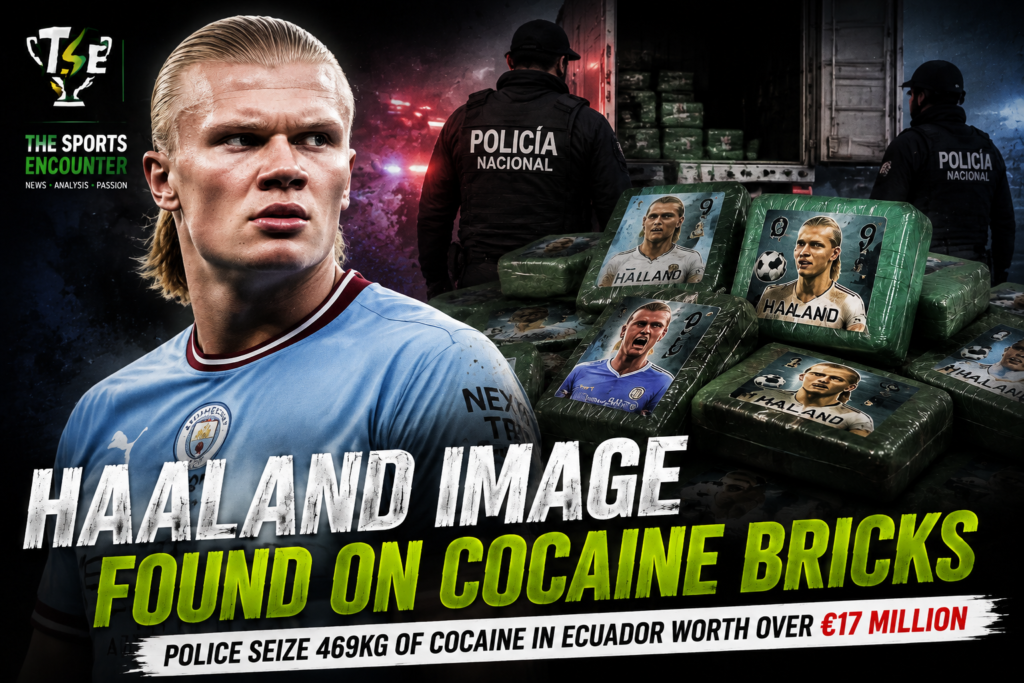
Police in Ecuador seized 469 kilograms of cocaine hidden inside a truck near the Colombian border, with hundreds of green packages carrying stickers featuring the Norwegian and Manchester City striker.
Authorities said the haul was discovered inside a false compartment of the vehicle after anti-narcotics officers acted on an anonymous tip along the Pan-American Highway. A woman carrying Colombian identification was arrested during the operation.
There is no indication that Haaland had any connection to the shipment. His image appears to have been used without his involvement as a marker on the packages, a practice authorities and law-enforcement reporting say is sometimes used by trafficking networks to distinguish shipments, producers or intended recipients.
Erling Haaland Cocaine Seizure in Ecuador: Key Facts
| Detail | Information |
|---|---|
| Location | Near Tulcán, Carchi Province, Ecuador, close to the Colombian border |
| Drug seized | Cocaine |
| Total weight | 469 kilograms, approximately 1,034 pounds |
| Number of packages | 370 |
| Where drugs were found | False compartment inside a truck |
| Distinctive feature | Green packages carrying stickers featuring Erling Haaland |
| Estimated US value | More than $11 million |
| Estimated European value | More than $19.6 million, approximately €17 million |
| Arrest | A woman identified by authorities as María R., carrying Colombian documents |
Police Find 370 Packages Hidden Inside a Truck
The seizure took place near the northern Ecuadorian border with Colombia, one of the most important corridors in the international cocaine trade.
According to Associated Press reporting based on Ecuadorian police information, anti-narcotics officers were conducting an operation after receiving an anonymous tip when they identified a suspicious truck traveling along the Pan-American Highway.
A search revealed 370 packages concealed in a false bottom.
Police footage showed officers removing the green rectangular packages from the vehicle. Many carried stickers displaying Haaland’s face alongside soccer-related imagery.
The unusual packaging immediately pushed what would otherwise have been another major drug seizure into the international sports conversation.
Haaland has been one of football’s most visible players this year. His prominence grew substantially during Norway’s historic World Cup campaign, when he scored seven goals and became a central figure in The Sports Encounter’s coverage of Haaland’s career, records and first World Cup.
Why Would Traffickers Put Haaland’s Face on Cocaine?
The obvious question is also the strangest part of the story.
Why Haaland?
Police did not publicly establish a specific reason for his image appearing on this particular shipment.
However, drug-trafficking organizations have long used logos, symbols, names and celebrity images as identifying marks on narcotics packages. Such markings can help distinguish one shipment from another, identify the organization associated with the product or signal its intended recipient.
That context matters because the sticker should not be interpreted as evidence of any relationship between Haaland and the people involved.
There is none established in the reporting.
The footballer’s image appears to have functioned as unauthorized branding.
That choice may also reflect Haaland’s extraordinary global visibility. During the FIFA World Cup 2026, his popularity expanded far beyond goals. The Sports Encounter tracked how he became one of the tournament’s most recognizable internet figures in our analysis of the World Cup’s most viral players.
Haaland’s 2026 Fame Makes the Choice Less Random Than It Looks
Haaland entered the summer as one of the best-known strikers in world football. The World Cup pushed his profile into another category.
Norway reached the quarterfinals for the first time, and Haaland scored seven times during the tournament. His late double against Brazil helped deliver one of the biggest knockout shocks of the competition.
The Sports Encounter’s Brazil vs Norway preview framed that Round of 16 meeting around the clash between Haaland and Vinícius Júnior. Norway eventually won 2-1, with Haaland providing both goals.
His World Cup became about more than finishing.
Memes, old music videos, unusual social posts, running clips and fan edits kept circulating around him. We later explored that strange expansion of his public identity in the Haaland Multiverse, where his football and internet personalities had effectively become separate stories.
None of that explains who physically chose his image for the Ecuador shipment.
It does explain why traffickers looking for a globally recognizable face would have had no trouble recognizing Haaland’s commercial and cultural visibility.
The Shipment Could Be Worth More Than $19 Million in Europe
The scale of the seizure extends well beyond the bizarre stickers.
Ecuadorian authorities estimated that the 469 kilograms of cocaine would be worth about $842,000 domestically.
The same shipment could command more than $11 million if sold in the United States and more than $19.6 million, or approximately €17 million, in Europe, according to the estimates reported by the Associated Press.
Those differences illustrate how dramatically cocaine values increase as shipments move farther from production areas and deeper into major consumer markets.
The woman arrested in connection with the operation was identified only as María R. Authorities said she was carrying Colombian identity documents when detained in the Guagua Negro area near Tulcán, roughly 246 kilometers north of Quito.
Ecuador Sits at the Center of a Major Cocaine Transit Network
Ecuador does not produce cocaine on anything close to the scale of neighboring Colombia or Peru, but its geography has made the country an important logistics point in the international trade.
Large quantities of cocaine produced elsewhere in the region move through Ecuador before continuing toward Central America, the United States and European ports.
According to the AP report, local criminal groups working with Colombian and Mexican cartels control significant trafficking routes. Police say around 80% of narcotics moving through Ecuador originate in Colombia, with most of the remainder coming from Peru.
Ecuadorian police reported seizing about 80 tons of drugs during the first half of 2026. Authorities confiscated nearly 215 tons during 2025 and almost 295 tons in 2024.
The Haaland-marked shipment is therefore unusual because of its packaging, but the trafficking route itself fits a much larger pattern.
This Is Not the First Time a Soccer Star Has Appeared on Drug Packages
Haaland is also not the first elite footballer whose image has reportedly appeared on narcotics packaging.
Authorities have previously encountered packages carrying the image of Lionel Messi, according to reporting surrounding the Ecuador seizure.
The practice shows how globally recognized athletes can become symbols entirely outside their control.
Football stars occupy a strange place in modern visual culture. Their faces appear on legitimate products, advertising campaigns, video games, trading cards, merchandise and social platforms. The same recognizability can also make those images attractive for unauthorized or criminal use.
Haaland’s fame is particularly well suited to that kind of instant recognition.
The Norwegian has become part of a new generation carrying global football beyond the Messi and Cristiano Ronaldo era. The Sports Encounter’s look at football’s changing World Cup generation placed Haaland alongside Kylian Mbappé, Jude Bellingham, Lamine Yamal and other stars shaping the sport’s next phase.
A Very Different Haaland Story After His World Cup Summer
For most of the summer, Haaland’s name was attached to goals.
He helped Norway eliminate Brazil and then faced England in the quarterfinals. Jude Bellingham scored twice as England won 2-1 after extra time, ending Norway’s run in a match covered in our England vs Norway quarterfinal report.
The tournament strengthened Haaland’s international reputation after years in which much of his fame had been attached to Manchester City and club football.
It also introduced more fans to his personality.
His friendship with Bellingham became another major storyline, especially after the former Borussia Dortmund teammates ended up facing one another in a World Cup knockout match. The Sports Encounter explored that relationship in Haaland and Bellingham’s friendship story.
That combination of athletic success, global exposure and internet popularity made Haaland one of the most recognizable faces of the tournament.
Weeks later, that face appeared on hundreds of packages inside a truck in Ecuador.
The Important Distinction: Haaland Is Part of the Image, Not the Crime
The nature of the story makes careful wording essential.
Police seized cocaine packages carrying Haaland’s image.
That does not mean police seized “Haaland cocaine” in any meaningful ownership or endorsement sense, and there is no reported evidence connecting the Manchester City striker with the shipment, the arrested woman or the trafficking network.
The stickers appear to be unauthorized imagery used by people involved in the drug trade.
That distinction should remain central whenever the story is discussed or shared.
Haaland remains a professional footballer whose image was placed on an illegal product without any publicly established involvement on his part.
From Football Meme to Criminal Packaging
The story is likely to travel because the visual contrast is difficult to ignore.
One of football’s most recognizable stars appears on hundreds of green cocaine bricks removed from a hidden compartment by police officers thousands of miles from Manchester or Norway.
Social media users quickly responded with jokes about sponsorships, transfer fees and Haaland’s scoring record.
The humor is understandable, but the underlying story remains serious. Nearly half a metric ton of cocaine was intercepted on a route connected to one of the world’s largest narcotics trafficking systems.
The celebrity sticker made the seizure unusual.
The drugs made it consequential.
For more stories involving the personalities, culture and wider world surrounding football, readers can follow The Sports Encounter’s soccer coverage.
Frequently Asked Questions
How much cocaine did Ecuadorian police seize?
Police seized 469 kilograms of cocaine, equivalent to approximately 1,034 pounds.
Why was Erling Haaland’s image on the cocaine packages?
Police did not establish a specific reason for Haaland’s image appearing on the shipment. Criminal networks sometimes use celebrity images, symbols or logos to identify shipments, producers or intended recipients.
Was Erling Haaland involved in the cocaine shipment?
There is no reported evidence connecting Haaland to the cocaine, the trafficking network or the people arrested. His image appears to have been used without his involvement.
How many packages were found?
Authorities discovered 370 packages hidden inside a false compartment in a truck.
Where was the cocaine seized?
The seizure occurred in Ecuador’s Carchi Province near Tulcán and the border with Colombia.
How much was the cocaine worth?
Authorities estimated the shipment at nearly $842,000 in Ecuador, more than $11 million in the United States and more than $19.6 million, or approximately €17 million, in Europe.
Was anyone arrested?
Yes. Authorities said a woman identified as María R., who carried Colombian identification documents, was arrested during the operation.
Have other footballers appeared on drug packages?
Yes. Lionel Messi’s image has reportedly appeared on previously seized narcotics packages, reflecting a broader practice of using recognizable celebrities as unauthorized shipment markings.