


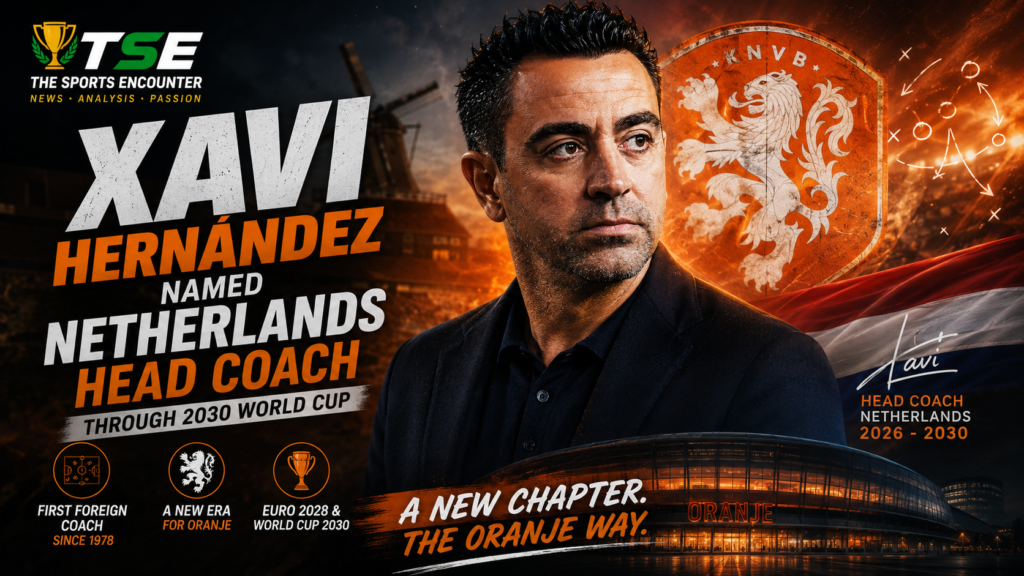
The Netherlands have appointed Xavi Hernández as head coach of the men’s national team on a contract running through the 2030 FIFA World Cup, handing one of international football’s most recognizable identities to a coach shaped by the same positional-play ideas that helped define Dutch football.
The 46-year-old Spaniard replaces Ronald Koeman following the Netherlands’ Round of 32 elimination by Morocco at the 2026 World Cup and returns to coaching for the first time since leaving Barcelona in 2024.
The appointment is historic before Xavi has even taken charge of a match.
He becomes the first foreign coach to lead the Netherlands men’s national team since Austrian Ernst Happel in 1978, ending a 48-year sequence of Dutch managers.
More importantly, the KNVB has not treated this as a short-term repair job.
Xavi’s deal runs through Euro 2028 and the 2030 World Cup, giving him a full cycle to rebuild the Oranje after a World Cup campaign that began with promise and ended in another painful knockout exit.
For The Sports Encounter, the most interesting question is not whether Xavi understands possession football.
It is whether he can turn a philosophy with deep Dutch roots into a modern national-team structure capable of surviving knockout football.
Xavi to Netherlands: Key Facts
| Detail | Information |
|---|---|
| New Netherlands coach | Xavi Hernández |
| Age | 46 |
| Contract | Through the 2030 FIFA World Cup |
| Replaces | Ronald Koeman |
| Previous coaching job | Barcelona |
| Previous clubs managed | Al-Sadd, Barcelona |
| First foreign Netherlands coach since | Ernst Happel, 1978 |
| First match | Germany, UEFA Nations League, September 24 |
| Long-term targets | Euro 2028 and FIFA World Cup 2030 |
The appointment was confirmed by the Dutch football federation and reported by Reuters. Official Netherlands team information is available through OnsOranje.
Why the Netherlands Have Turned to Xavi
The timing of the appointment tells us almost as much as the name.
The Netherlands did not fail completely at the 2026 World Cup.
They topped Group F with seven points after drawing with Japan and beating Sweden and Tunisia. The Sports Encounter covered the final group-stage victory in its report on the Netherlands beating Tunisia 3-1 to finish first in Group F.
The problem came later.
Morocco dragged the Dutch into exactly the kind of knockout match that has repeatedly exposed their emotional and tactical vulnerabilities.
Cody Gakpo put the Netherlands ahead in the Round of 32. Issa Diop equalized in stoppage time. After extra time, Morocco won 3-2 on penalties.
The Sports Encounter’s full Netherlands vs Morocco match report showed how the Oranje gradually surrendered control after taking the lead.
That collapse appears to have mattered.
Koeman’s team could manage possession. They could create good spells. They could dominate weaker opponents.
What they did not consistently do was turn control into knockout certainty.
Xavi’s appointment suggests the KNVB wants a deeper structural answer.
Xavi Is a Foreign Coach With Dutch Football in His DNA
On paper, appointing a Spaniard after 48 years without a foreign coach looks like a major break from tradition.
In footballing terms, the move is less radical than it first appears.
Xavi’s understanding of the game was shaped by Barcelona’s positional-play tradition, which itself was heavily influenced by Dutch football.
Johan Cruyff transformed Barcelona as a coach after carrying ideas rooted in Ajax and the Netherlands into Catalonia.
Rinus Michels, another foundational Dutch figure, also shaped Barcelona and the modern understanding of collective space, movement and pressing.
Louis van Gaal later continued that connection.
Xavi has openly referenced Cruyff, Michels and Van Gaal as major influences on how he understands football.
That makes this appointment historically unusual but philosophically familiar.
The Netherlands are not hiring a coach from outside their footballing tradition.
They are hiring someone who learned a version of that tradition elsewhere and then spent his playing career perfecting it.
The Cruyff Connection Is More Than a Marketing Line
It would be easy to reduce the appointment to a romantic slogan about Cruyff.
The tactical connection is more substantial.
Xavi’s teams generally want to control matches through possession, occupy defined zones, create overloads around the ball and use positional superiority to open passing lanes.
That approach is rooted in the same broad football lineage that made the Netherlands one of the most influential national teams in history.
Modern international football, however, is less forgiving than club football.
Xavi will not have months of daily training sessions to teach rotations.
He will have international windows.
That means his challenge is not simply to recreate Barcelona in orange shirts.
He has to simplify the principles enough that national-team players can execute them quickly.
Xavi’s Barcelona Record Was Better Than the Ending Suggests
Xavi has not coached since leaving Barcelona in 2024.
His final months there were messy enough that they can overshadow what came before.
He took over Barcelona in November 2021 during a difficult financial and sporting period.
By the 2022-23 season, Barcelona had won LaLiga and the Spanish Super Cup.
That league title was built largely on defensive consistency and control rather than spectacular attacking football.
This matters because Xavi is sometimes portrayed as an ideological coach who only cares about possession.
His championship-winning Barcelona showed a more pragmatic side.
They could defend leads.
They could win narrow matches.
They could survive imperfect performances.
That quality may be more useful to the Netherlands than the aesthetic debate surrounding his Barcelona tenure.
What Xavi Learned at Al-Sadd
Xavi’s first senior coaching role came at Al-Sadd in Qatar.
He won multiple domestic trophies there before returning to Barcelona.
That period gave him an opportunity to build a team around clear positional structures without the weekly pressure attached to one of Europe’s largest clubs.
It also helped establish the coaching identity he later brought to Barcelona.
International football will now test whether those principles can function with less preparation time and greater tactical variety.
The Netherlands Are Breaking a 48-Year Coaching Pattern
Xavi becomes the first foreign coach to lead the Dutch men’s national team since Ernst Happel in 1978.
That statistic alone shows how significant the appointment is institutionally.
The Netherlands have traditionally trusted their own coaching school.
Names such as Rinus Michels, Guus Hiddink, Dick Advocaat, Louis van Gaal, Frank de Boer and Koeman have reinforced the idea that the national team should be led by someone who grew up inside Dutch football culture.
Hiring Xavi means the KNVB has decided philosophical compatibility matters more than nationality.
That is a meaningful shift.
If it works, the decision could also change how the Dutch federation thinks about future appointments.
Koeman Leaves With a Mixed Second Spell
Ronald Koeman’s second tenure began in 2023 after Louis van Gaal stepped down.
He took the Netherlands to the Euro 2024 semifinals and guided them through qualification for the 2026 World Cup.
The World Cup itself was harder to judge.
The Dutch were inconsistent early, including a 2-2 draw with Japan that raised concerns about game management.
They then responded strongly, including a 5-1 victory over Sweden and the controlled 3-1 win against Tunisia.
Those results suggested the team had found momentum.
Morocco exposed the unresolved weakness.
The Netherlands led but could not close the match.
They retreated.
Morocco grew.
The equalizer arrived in stoppage time.
Another penalty shootout followed.
Another Dutch World Cup campaign ended.
That kind of defeat often changes how federations judge otherwise respectable tournament performances.
Xavi’s First Job Is to Restore Control Without Removing Risk
The Netherlands do not need more possession for possession’s sake.
They need possession that protects them.
That distinction will define Xavi’s early work.
A good positional team keeps the ball in areas that make counterattacks difficult.
When possession is lost, players should already be positioned to press or delay the opponent.
That is where Xavi can help.
The Dutch have technical midfielders and attacking players capable of playing through pressure.
The bigger question is whether their spacing can become consistent enough to prevent matches from becoming stretched.
Frenkie de Jong Could Become the Center of Xavi’s Netherlands
Few players have a clearer tactical relationship with Xavi than Frenkie de Jong.
Xavi coached him at Barcelona and knows exactly what the midfielder can and cannot do.
De Jong is at his best when he can receive under pressure, carry the ball through the first line and connect deeper midfield zones with attacking players.
He is less effective when asked to remain static or defend large spaces alone.
A well-structured Xavi system could therefore place De Jong at the heart of the rebuild.
The challenge is balance.
If De Jong moves forward, someone has to protect the space behind him.
If both fullbacks advance simultaneously, the midfield structure must compensate.
Those details will decide whether the Netherlands look elegant or vulnerable.
Xavi Simons Could Be One of the Biggest Winners
Xavi Simons also appears well suited to the new coach’s ideas.
The Dutch attacker developed in Barcelona’s youth system before building his senior career elsewhere.
He is comfortable receiving between lines, drifting into half-spaces and combining quickly around the penalty area.
Those are useful traits in a positional attack.
The interesting question is where Xavi Hernández chooses to use him.
Simons can play wide, as an attacking midfielder or in a freer interior role.
A rigid assignment could limit him.
A structured team that still gives him freedom in the final third could make him one of the central figures of the new cycle.
Cody Gakpo Gives Xavi a Different Type of Forward
Gakpo does not fit the stereotype of a small positional-play forward.
That is exactly why he may matter.
He can start from the left, move inside, attack the box and finish transitions.
He also gives the Netherlands a more direct option when slow possession stops working.
Xavi’s best version of the Oranje should not eliminate those vertical qualities.
It should organize them.
The Netherlands were most dangerous at the World Cup when Gakpo received the ball facing goal rather than with his back to it.
A structure that creates those moments more often would immediately improve their attacking threat.
Brian Brobbey Gives Xavi a No. 9 Question
Brian Brobbey emerged during the World Cup as a credible central-forward option.
He scored against Tunisia and had entered the tournament after rebuilding his club career.
Xavi will have to decide what kind of No. 9 he wants.
Does he prioritize a striker who pins center backs?
Does he want a false nine who drops into midfield?
Does he use a hybrid structure where Gakpo or Simons rotate centrally?
International football rarely gives coaches enough time to test endless variations.
Xavi’s first few squad selections should tell us a lot.
Virgil van Dijk’s Role Will Be Just as Important
The tactical discussion will naturally focus on midfield and possession.
Van Dijk remains central to whether the system works.
Xavi’s teams generally want to defend higher up the pitch.
That exposes center backs to more space behind them.
Van Dijk’s positioning, passing range and ability to defend one-on-one situations could therefore become critical.
There is also a generational question.
The 2030 World Cup is four years away.
The Netherlands have to decide how long established leaders remain central to the project and when younger defenders begin taking over.
Xavi has been given enough time to manage that transition gradually.
What Xavi Must Not Repeat From Barcelona
The appointment is not risk-free.
Xavi’s Barcelona teams occasionally became predictable against opponents willing to defend compactly.
Possession could become sterile.
The tempo sometimes dropped.
Wide players were asked to hold positions without receiving enough support.
When Barcelona lost midfield control, their defensive transitions could become uncomfortable.
Those are exactly the kinds of problems that can destroy national teams in tournament football.
Xavi therefore needs to carry the strongest elements of his philosophy into the Netherlands job without turning ideology into rigidity.
International Football Will Test Xavi Differently
Club managers can solve tactical problems through repetition.
National-team coaches cannot.
That changes everything.
Xavi may have only a handful of training sessions before an important Nations League match.
Players arrive from different clubs with different pressing triggers, build-up structures and defensive habits.
The best international coaches simplify without becoming simplistic.
Xavi’s biggest tactical challenge is therefore translation.
He knows what he wants football to look like.
Now he has to make elite players understand it quickly.
Germany Will Provide an Immediate Test
Xavi’s first match is scheduled against Germany in the Nations League on September 24.
There is no gentle introduction.
Germany provide exactly the kind of opponent capable of punishing structural mistakes.
The match should therefore offer an early indication of what Xavi prioritizes.
Will the Netherlands press high?
Will De Jong operate as the main build-up reference?
How aggressive will the fullbacks be?
Will Xavi immediately install a positional attack or begin with a more conservative version?
The answer does not need to be complete in September.
The direction should be visible.
Euro 2028 Is the First Real Checkpoint
The contract runs through 2030, but Xavi will not be given four years without judgment.
Euro 2028 is the obvious first major checkpoint.
By then, the Netherlands should have a recognizable style, a settled core and a clear understanding of which players belong to the next World Cup cycle.
Anything less than a serious run at the tournament would raise questions.
The Dutch are not rebuilding from a low base.
They already possess Champions League-level players across several positions.
Xavi has inherited talent.
His job is to make the collective better than the names.
The 2030 World Cup Is the Bigger Bet
The length of Xavi’s contract makes the 2030 World Cup the real long-term target.
The tournament will be centered in Spain, Portugal and Morocco, with centenary matches also planned in South America.
The Sports Encounter has examined the unusual structure of that tournament in its analysis of the evolving 2030 World Cup model.
For Xavi, the symbolism is obvious.
A Spanish coach could lead the Netherlands into a World Cup staged partly in Spain.
More importantly, four years give him enough time to reshape the squad rather than simply manage the current generation.
The Cruyff Irony Runs Even Deeper
There is another historical layer to the appointment.
Xavi’s playing career was shaped by a Barcelona identity that might not have existed in the same form without Cruyff.
Cruyff’s footballing ideas travelled from the Netherlands to Barcelona.
Now one of Barcelona’s greatest midfielders is carrying a modern version of those ideas back to the Dutch national team.
That is not proof the appointment will succeed.
It does explain why it makes sense.
There Is Also a 2010 World Cup Twist
Xavi played against the Netherlands in the 2010 World Cup final.
Spain won 1-0 after extra time through Andrés Iniesta.
Xavi was central to the Spanish midfield that controlled possession against a Dutch team that had reached its third World Cup final.
Sixteen years later, he is now responsible for trying to take the Netherlands back toward that stage.
Football has a habit of creating these strange circles.
Why This Appointment Feels Bigger Than a Normal Coaching Change
Most national-team appointments are judged on résumé and results.
This one carries an identity question.
The Netherlands have spent decades debating what Dutch football should look like.
Every generation inherits the language of Total Football, positional interchange and attacking responsibility.
Modern elite football has complicated that heritage.
Pressing systems are more organized.
Transitions are faster.
Physical demands are higher.
Xavi’s challenge is to prove the old principles can still survive if the details are updated.
What Success Would Look Like Under Xavi
Success cannot be measured only by possession percentages.
The Netherlands need several things.
They need clearer control of knockout matches.
They need better rest defense when attacking.
They need to create more high-quality chances against deep blocks.
They need younger players to emerge without destabilizing the team.
Most importantly, they need to stop allowing major tournament matches to drift emotionally once they take the lead.
The Morocco defeat provided the clearest warning.
Xavi’s job is to make the next version of the Netherlands less fragile when the game changes.
TSE Verdict: A Historic Gamble That Actually Fits
The easiest reaction to Xavi Hernández becoming Netherlands coach is to call it surprising.
It is surprising.
It is also logical.
The KNVB has broken a 48-year pattern by appointing a foreign coach, yet the footballing philosophy behind the decision is deeply connected to Dutch history.
Xavi grew up inside a Barcelona system shaped by Cruyff and later influenced by coaches who carried Dutch ideas into Catalonia.
He understands possession.
He understands positional play.
He understands the pressure that comes with representing a football identity larger than one team.
What he still has to prove is whether those ideas can survive the brutal efficiency of international knockout football.
The Netherlands do not need another team that looks good until the match becomes uncomfortable.
They need one that controls discomfort.
That is the real assignment.
Euro 2028 will tell us how far Xavi has moved them.
The 2030 World Cup will tell us whether the gamble worked.
For now, one of football’s most recognizable tactical traditions has been handed to one of the players who understood it best.
That makes the next Oranje cycle impossible to ignore.
Follow The Sports Encounter’s soccer coverage for international football, coaching changes, tactical analysis and major tournament stories, and revisit our FIFA World Cup 2026 hub for the tournament that brought Koeman’s second Netherlands spell to an end.
Frequently Asked Questions
Who is the new Netherlands head coach?
Xavi Hernández has been appointed head coach of the Netherlands men’s national team.
How long is Xavi’s Netherlands contract?
Xavi has signed a contract running through the 2030 FIFA World Cup.
Who did Xavi replace as Netherlands coach?
He replaced Ronald Koeman, whose second spell ended after the Netherlands were eliminated by Morocco in the Round of 32 at the 2026 World Cup.
Is Xavi the first foreign Netherlands coach?
No. He is the first foreign coach of the Netherlands men’s national team since Austrian Ernst Happel in 1978.
When was Xavi’s last coaching job?
Xavi last managed Barcelona, leaving the club in 2024.
What trophies did Xavi win as Barcelona coach?
He won LaLiga and the Spanish Super Cup during the 2022-23 season.
Why does Xavi fit Dutch football?
His coaching philosophy is heavily influenced by positional play and the Cruyff tradition, which has deep roots in both Dutch football and Barcelona.
When is Xavi’s first Netherlands match?
His first match is scheduled against Germany in the UEFA Nations League on September 24.
What are Xavi’s major targets with the Netherlands?
Euro 2028 will be the first major tournament of his tenure, while his contract runs through the 2030 FIFA World Cup.
How did the Netherlands perform at the 2026 World Cup?
The Netherlands topped Group F with seven points but were eliminated by Morocco on penalties in the Round of 32 after a 1-1 draw.