


Afghanistan are going to the 2027 ODI World Cup, but their ticket to Southern Africa was stamped on an afternoon when qualification briefly looked far less certain than the final result suggests.
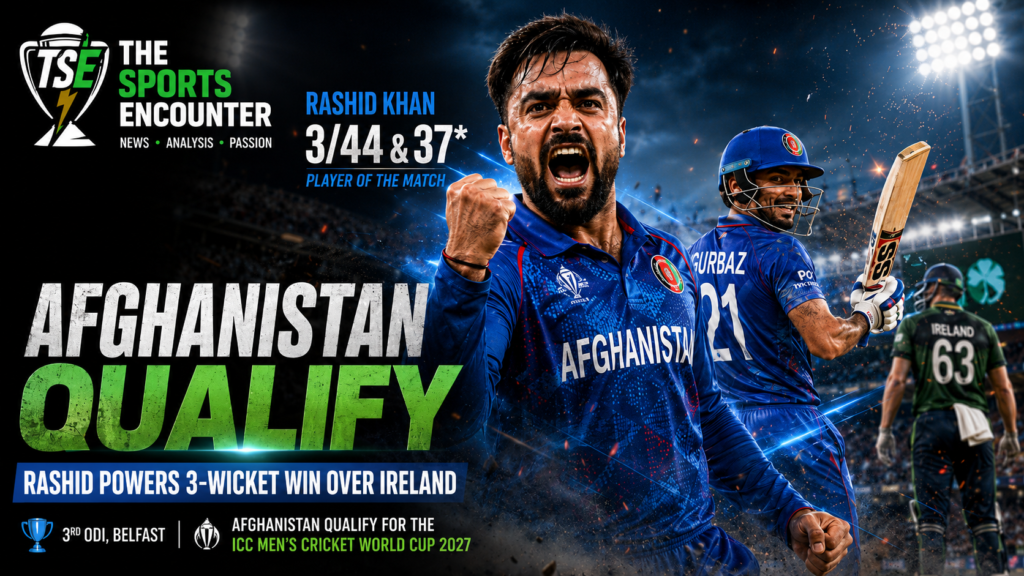
Rashid Khan delivered one of those performances that explains why Afghanistan have grown from adventurous outsiders into a serious international cricket force. He took 3 for 44 with the ball, then walked into a chase that was beginning to unravel and finished unbeaten on 37 from 43 balls as Afghanistan defeated Ireland by three wickets at Stormont in Belfast on Monday.
The victory took Afghanistan to an unassailable 2-0 lead in the five-match ODI series and, more importantly, secured direct qualification for the 2027 ODI World Cup.
Ireland were bowled out for 206 in 46.3 overs. Afghanistan reached 207 for 7 from 44.5 overs, completing the chase with 31 balls remaining.
The scoreboard makes that pursuit look relatively comfortable.
For a significant period, it was anything but.
Afghanistan slipped from 132 for 3 to 176 for 7 as Gavin Hoey produced an outstanding spell of legspin and Mark Adair kept asking questions from the other end. Another wicket would have exposed a tail already under enormous pressure.
Rashid refused to give Ireland one.
He absorbed the pressure, trusted Yamin Ahmadzai to survive beside him, waited for Ireland’s main threats to finish their spells and then completed one of Afghanistan’s most consequential ODI victories with a wristy two through the leg side off Harry Tector.
For broader international cricket coverage, match analysis and player features, visit The Sports Encounter Cricket Hub.
Afghanistan vs Ireland 3rd ODI: Match Summary
| Match | Ireland vs Afghanistan, 3rd ODI |
|---|---|
| Date | August 10, 2026 |
| Venue | Civil Service Cricket Club, Stormont, Belfast |
| Ireland | 206 all out in 46.3 overs |
| Afghanistan | 207/7 in 44.5 overs |
| Result | Afghanistan won by 3 wickets |
| Player of the Match | Rashid Khan, 3/44 and 37* |
| Series | Afghanistan lead 2-0 |
| Major consequence | Afghanistan qualified directly for the 2027 ODI World Cup |
Rashid Khan Did More Than Win a Cricket Match
Rashid’s numbers tell only part of the story.
Three wickets for 44 from ten overs is a strong ODI spell. An unbeaten 37 in a chase of 207 is useful rather than spectacular when viewed in isolation.
Combine them with the circumstances and their importance changes completely.
Afghanistan needed someone to break Ireland’s middle order when the hosts were trying to construct a defendable total. Rashid did that.
They then needed someone to survive after their own middle order lost its discipline. Rashid did that too.
His contribution therefore came at two different pressure points, requiring two completely different versions of the same cricketer.
With the ball he remained aggressive. With the bat he became patient.
That adaptability separated his performance from a standard all-round contribution.
Afghanistan have long relied on Rashid’s ability to change matches with legspin. His franchise career has repeatedly demonstrated how effectively he controls middle overs, something also visible in The Sports Encounter’s analysis of Rashid Khan and MI London in The Hundred.
Belfast demanded something different.
Afghanistan needed him to finish with the bat.
He did.
Ghazanfar and Rashid Turn Ireland’s Middle Order Into a Trap
Ireland were never able to build the type of substantial top-order partnership normally required to control an ODI innings.
Andy Balbirnie departed for seven before captain Paul Stirling made 23. Cade Carmichael battled to 32 from 52 deliveries, while Harry Tector contributed 14.
The critical phase arrived once Afghanistan’s spinners began working together.
AM Ghazanfar removed Lorcan Tucker for one, Curtis Campher for four and Ben Calitz for 20. His nine overs cost only 29 runs and produced three wickets.
Rashid accounted for Carmichael, Tector and Mark Adair.
By the time Calitz became Ireland’s eighth wicket, the hosts had collapsed to 128 for 8.
Ghazanfar and Rashid finished with combined figures of six wickets for 73 runs.
That passage should have ended Ireland’s competitive hopes.
Instead, Ireland produced the partnership that made the second half of the match possible.
Hoey and Moondra Turn 128 for 8 Into 206
Gavin Hoey and Jai Moondra added 76 for the ninth wicket, a record ninth-wicket ODI partnership for Ireland.
It transformed the innings.
Hoey played the more patient hand, making 36 from 67 deliveries. Moondra, playing only his second ODI innings, supplied the aggression with 31 from 33 balls and five boundaries.
Afghanistan had Ireland almost completely buried at 128 for 8. Instead of forcing the innings to a quick conclusion, they allowed the ninth wicket to add nearly 80 runs.
Those runs later became enormously significant.
Moondra eventually edged Yamin Ahmadzai behind for 31 at 204 for 9. Azmatullah Omarzai bowled Hoey for 36 two runs later as Ireland’s innings ended on 206.
The recovery did not suddenly make 206 a strong ODI score. What it did was create enough scoreboard pressure for Ireland’s bowlers to attack Afghanistan’s mistakes.
Gurbaz Gives Afghanistan the Chase They Wanted
Rahmanullah Gurbaz initially made the target appear straightforward.
He attacked Ireland’s seamers whenever they overpitched and gave Afghanistan early momentum. The wicketkeeper-batter reached his eighth ODI half-century from 45 deliveries and continued towards 71 from 77 balls.
His innings included two fours and five sixes.
Gurbaz’s role mattered because Afghanistan were chasing a total that did not require unnecessary risk. A strong opening partnership could effectively remove Ireland from the contest.
Ibrahim Zadran made 12 as Afghanistan reached 53 before losing their first wicket. Sediqullah Atal then struck 27 from 25 balls.
At 84 for 2, Afghanistan remained comfortably positioned.
Even when captain Rahmat Shah was bowled by an excellent Mark Adair delivery for four, Gurbaz still offered the innings an anchor.
Afghanistan reached 100 in the 19th over and appeared on course for a routine victory.
Then Gavin Hoey changed the match.
Gavin Hoey Almost Stole Afghanistan’s World Cup Party
Hoey’s contribution deserves more attention than simply describing it as a losing performance.
He had already rescued Ireland with the bat.
Then he nearly won the match with the ball.
The legspinner finished with 4 for 34 from ten overs, conceding only 3.40 runs per over.
He dismissed Sediqullah Atal, Hashmatullah Shahidi, Gurbaz and Darwish Rasooli.
More importantly, he changed Afghanistan’s thinking.
Hoey used flight, dip, pace changes and stump-to-stump accuracy rather than searching constantly for extravagant turn. Afghanistan’s batters began trying to manufacture scoring opportunities against him instead of simply accepting that a target of 207 allowed them to play conservatively.
Shahidi dragged a loose delivery towards deep square. Rasooli swiped across the line. Gurbaz, after doing the hard work, became Hoey’s fourth victim for 71.
Afghanistan went from controlling the chase to creating their own crisis.
Afghanistan’s Chase Started Unravelling
The fall of wickets shows how quickly Ireland reopened the contest:
- 53/1: Ibrahim Zadran, 12
- 84/2: Sediqullah Atal, 27
- 97/3: Rahmat Shah, 4
- 132/4: Hashmatullah Shahidi, 22
- 149/5: Rahmanullah Gurbaz, 71
- 154/6: Darwish Rasooli, 13
- 176/7: Azmatullah Omarzai, 13
At 154 for 6, Ireland had transformed a seemingly modest 206 into a serious contest.
When Adair removed Omarzai at 176 for 7, Afghanistan still needed 31.
That was the moment the qualification story became a Rashid Khan story.
Why Rashid’s 37 Was More Impressive Than the Strike Rate Suggests
Rashid faced 43 balls for his unbeaten 37.
For a cricketer famous for explosive lower-order hitting, a strike rate of 86.04 hardly jumps off the page.
That restraint was exactly what Afghanistan required.
Ireland wanted Rashid to attack.
A mistimed lofted shot would have brought Ghazanfar and Fazalhaq Farooqi closer to the crease. Hoey had already completed his spell, but Adair remained dangerous and the match still contained enough scoreboard pressure to punish recklessness.
Rashid resisted.
He waited until Afghanistan were within 15 runs of victory before opening his range more aggressively.
His innings contained four boundaries but no sixes.
That absence is revealing.
The man capable of clearing almost any boundary in modern white-ball cricket understood that Afghanistan did not need spectacle.
They needed qualification.
Yamin Ahmadzai’s Four Runs Deserve Their Own Mention
Scorecards often hide important performances.
Yamin Ahmadzai finished unbeaten on four.
He faced 26 balls.
Those 26 deliveries mattered enormously.
Playing his first ODI since 2022, Ahmadzai gave Rashid the one thing Afghanistan desperately needed after losing their seventh wicket: a partner who would stay there.
He did not attempt to become the hero. He did not chase boundaries or allow Ireland to create another opening through impatience.
He survived.
The pair added the unbeaten 31 runs Afghanistan needed, with Ahmadzai’s occupation of the crease allowing Rashid to control the finish.
Earlier, Ahmadzai had taken 2 for 35 from nine overs, making his comeback particularly valuable.
The Winning Runs Belonged to the Right Man
With Afghanistan needing two, Harry Tector bowled to Rashid in the 45th over.
Rashid went down on one knee, used his wrists and worked the ball towards deep square leg.
They completed two.
Afghanistan had reached 207 for 7.
Qualification was secured.
There was symmetry to the ending.
The player who had spent years becoming the global face of Afghan cricket was standing in the middle when Afghanistan confirmed another appearance on cricket’s biggest ODI stage.
Afghanistan Are Heading to a Fourth Straight ODI World Cup
The result means Afghanistan will compete at a fourth consecutive men’s ODI World Cup.
That progression tells a much larger story about their place in international cricket.
Afghanistan’s early World Cup appearances carried the excitement of a developing cricket nation reaching global tournaments.
That description now undersells them.
Qualification is becoming expectation.
They increasingly enter major tournaments with players who have substantial international and franchise experience, a bowling attack capable of controlling different surfaces and a batting group that has become far more sophisticated than in their first years at the elite level.
Rashid remains the global superstar, but Afghanistan are no longer dependent on one player alone.
Ghazanfar’s 3 for 29 in Belfast is another example of the spin depth surrounding him. Gurbaz provides destructive power at the top. Omarzai has developed into a high-value all-rounder. Fazalhaq Farooqi provides left-arm pace, while Ibrahim Zadran and Rahmat Shah offer batting structure.
Afghanistan’s cricket has matured alongside a wider change in the modern game, where players develop across international and franchise environments. The Sports Encounter has explored that evolution through its analysis of how workload management and franchise cricket are reshaping modern bowling careers.
What Afghanistan Still Need to Fix Before 2027
Qualification should not disguise the weaknesses Belfast exposed.
1. Afghanistan Still Give Away Wickets in Manageable Chases
A target of 207 should rarely become 176 for 7 for a side with Afghanistan’s experience.
Several dismissals came from poor decision-making rather than unplayable bowling.
That becomes dangerous at a World Cup, where stronger opponents punish short periods of indiscipline far more severely.
2. Finishing Lower Orders Remains Important
Ireland were 128 for 8.
Afghanistan allowed them to reach 206.
The 76-run partnership between Hoey and Moondra nearly changed the result.
Closing innings efficiently is one of the differences between good tournament sides and title contenders.
3. The Middle Order Needs Greater Control
Gurbaz’s 71 gave Afghanistan almost everything they needed.
The middle order repeatedly surrendered momentum.
Against Australia, India, South Africa, England, Pakistan or New Zealand in a World Cup knockout situation, the same sequence could end the tournament.
Afghanistan therefore leave Belfast with both qualification and a useful warning.
Ireland Should Be Frustrated, but Not Discouraged
Ireland lost the match, yet there were several reasons for encouragement.
Hoey produced one of the outstanding individual performances of the game with 36 runs and four wickets.
Moondra showed remarkable composure for a player in only his second ODI innings. Adair conceded just 36 from his ten overs while taking two wickets.
Ireland captain Paul Stirling acknowledged how close his side had come, saying they had repeatedly managed to put themselves into positions where they were involved in the contest.
His assessment of the batting was equally important: another 20 or 30 runs could have changed everything.
That feels accurate.
Ireland did not need 280.
Something around 230 may have been enough given the pressure Hoey and Adair later generated.
Their problem was the collapse to 128 for 8. The remarkable ninth-wicket recovery prevented humiliation, but it could not completely repair the damage.
Rahmat Shah: Rashid Assessed the Conditions
Afghanistan captain Rahmat Shah described the match as difficult because of its low-scoring nature and praised Rashid’s ability to understand the conditions.
That reading of the game became the defining difference.
Several Afghanistan batters tried to force the match forward.
Rashid eventually recognized that time, overs and required rate were all on Afghanistan’s side.
His winning approach came from removing urgency from a chase that his teammates had unnecessarily made urgent.
Five Turning Points in Afghanistan’s World Cup-Qualifying Victory
| Turning Point | Why It Mattered |
|---|---|
| Ghazanfar and Rashid reduce Ireland to 128/8 | Afghanistan’s spin attack appeared to have broken the match open. |
| Hoey and Moondra add 76 | Ireland turned a near-collapse into a defendable 206. |
| Gurbaz scores 71 | His innings established control and kept the asking rate comfortably manageable. |
| Hoey takes four wickets | Afghanistan collapsed through the middle overs and Ireland suddenly had a path to victory. |
| Rashid and Ahmadzai add an unbeaten 31 | The eighth-wicket pair removed the final Irish threat and sealed World Cup qualification. |
Why This Victory Matters Beyond Belfast
Afghanistan did not qualify by producing their cleanest performance.
That may make the result more useful.
World Cups are rarely won through perfect cricket for an entire tournament. Teams eventually encounter difficult pitches, collapses, pressure chases and opponents who refuse to disappear.
Belfast offered Afghanistan a small version of that test.
Their spinners dominated.
They failed to close Ireland’s innings.
Gurbaz controlled the chase.
The middle order lost control.
Hoey threatened to steal the match.
Then Rashid solved the problem.
Afghanistan will arrive at the 2027 World Cup knowing their place is secured. The more important question between now and then will concern how far this generation can go once it gets there.
For more cricket history and analysis, readers can explore The Sports Encounter’s feature on Kapil Dev’s impact on Indian cricket, our analysis of Asia’s enduring fascination with Pakistan’s fast-bowling tradition, and our examination of Pakistan’s latest red-ball leadership reset.
Readers can also follow official international cricket developments through the International Cricket Council.
Final Verdict: Afghanistan Qualified Because Rashid Understood the Moment
Rahmanullah Gurbaz made the highest score of Afghanistan’s chase.
AM Ghazanfar produced the most economical major bowling spell.
Gavin Hoey may have delivered the most complete losing performance of the match.
Rashid Khan still owned the day.
He recognized both moments that required intervention.
When Ireland needed breaking, he attacked.
When Afghanistan needed calming, he stayed.
The second skill may ultimately have mattered more.
Afghanistan have produced more spectacular victories. Rashid has delivered more explosive individual performances.
Few have carried a clearer reward.
Two runs off Harry Tector ended the match in Belfast.
They also opened the road to the 2027 World Cup.
FAQs
Did Afghanistan qualify for the 2027 ODI World Cup?
Yes. Afghanistan’s three-wicket victory over Ireland in the third ODI at Belfast secured direct qualification for the 2027 men’s ODI World Cup.
Who won the Ireland vs Afghanistan third ODI?
Afghanistan beat Ireland by three wickets after chasing 207 in 44.5 overs at Stormont in Belfast on August 10, 2026.
Who was Player of the Match?
Rashid Khan was named Player of the Match after taking 3 for 44 and scoring an unbeaten 37 from 43 balls.
How many runs did Rahmanullah Gurbaz score?
Rahmanullah Gurbaz scored 71 from 77 balls, including two fours and five sixes.
How many wickets did Gavin Hoey take?
Ireland legspinner Gavin Hoey took 4 for 34 from ten overs. He also scored 36 and helped Ireland recover through a 76-run ninth-wicket partnership with Jai Moondra.
What did Ireland score?
Ireland were bowled out for 206 in 46.3 overs after recovering from 128 for 8.
What were Rashid Khan’s figures?
Rashid took three wickets for 44 runs from ten overs before scoring 37 not out from 43 deliveries in Afghanistan’s chase.
How many ODI World Cups in a row have Afghanistan qualified for?
The 2027 tournament will be Afghanistan’s fourth consecutive men’s ODI World Cup appearance.
Where will the 2027 Cricket World Cup be held?
The 2027 men’s ODI World Cup will be staged in Southern Africa.
What was the biggest turning point of the match?
Ireland’s comeback through Gavin Hoey created the late pressure, but Rashid Khan’s unbeaten eighth-wicket partnership with Yamin Ahmadzai ultimately decided the contest. Rashid remained calm after Afghanistan slipped to 176 for 7 and guided the chase home.