


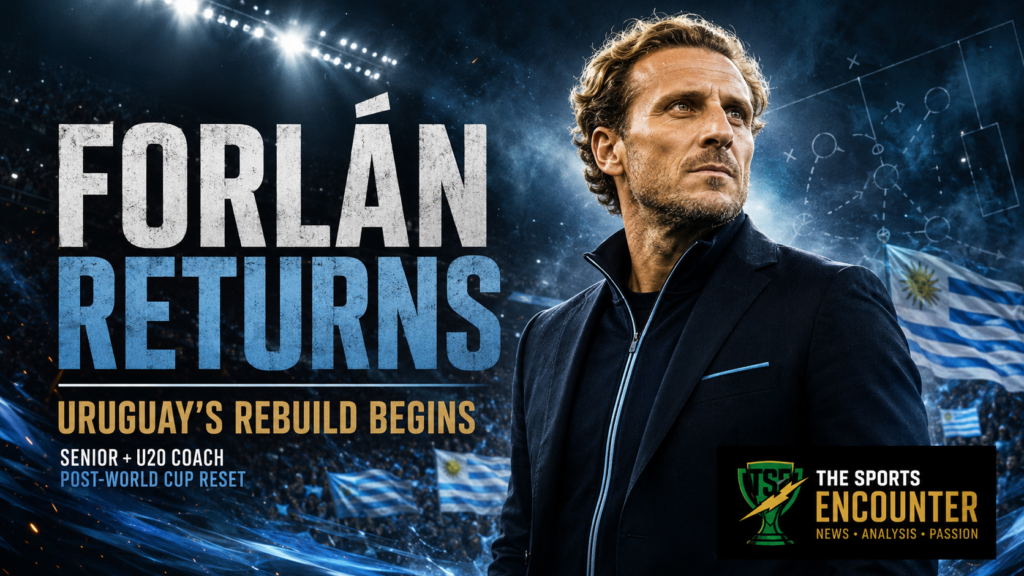
Uruguay have turned to one of the most important players in their modern history, appointing Diego Forlán to lead both the senior national team and the Under-20 side following a deeply disappointing FIFA World Cup 2026 campaign.
The Uruguayan Football Association confirmed that the 47-year-old will take charge immediately, beginning his work with the Under-20 team before leading the senior side through friendly matches scheduled between September and November.
Forlán succeeds Marcelo Bielsa, whose contract expired after Uruguay failed to win a match and exited the World Cup during the group stage.
The appointment places a national icon at the center of Uruguay’s rebuilding project as the country tries to restore trust, reconnect the senior side with its football identity, and prepare a younger generation for the years ahead.
Diego Forlán Appointment at a Glance
| Detail | Information |
|---|---|
| New coach | Diego Forlán |
| Age | 47 |
| Teams | Uruguay senior team and Under-20 team |
| Previous senior coach | Marcelo Bielsa |
| Immediate assignment | Begin work with Uruguay Under-20s |
| First senior fixtures | Friendlies between September and November 2026 |
| International record as player | 112 appearances and 36 goals |
| Major international honor | 2011 Copa América winner |
| Individual World Cup honor | Golden Ball at the 2010 World Cup |
Supporters can read the announcement through the official Uruguayan Football Association website.
Why Uruguay Chose Diego Forlán
Forlán brings limited senior coaching experience, but his appointment carries enormous cultural and emotional weight.
Few figures understand the expectations surrounding Uruguay’s national team more deeply.
He represented the country 112 times, scored 36 international goals, helped Uruguay win the 2011 Copa América, and produced one of the finest individual World Cup campaigns of the modern era in South Africa in 2010.
Forlán scored five goals during that tournament as Uruguay reached the semifinals. His performances earned him the Golden Ball as the competition’s best player.
That history gives him immediate credibility with supporters and players, but the AUF is asking him to provide more than inspiration.
He must build a technical structure capable of improving the senior team while developing the younger players expected to sustain Uruguay over the next international cycle.
The federation described his return as the homecoming of a role model, an icon, and an emblem of an unforgettable generation.
That language shows how Uruguay views the appointment. Forlán is being asked to carry experience, identity, leadership, and technical responsibility into a team that lost direction during the World Cup.
Uruguay’s World Cup Campaign Left the Team Needing a Reset
Uruguay arrived at the FIFA World Cup 2026 with a squad containing considerable talent and a coach whose tactical influence had shaped elite football for decades.
The tournament quickly became a struggle.
Bielsa’s side drew 1-1 with Saudi Arabia in its opening match, a performance that exposed problems with chance creation, finishing, and attacking rhythm.
The Sports Encounter’s report on Saudi Arabia’s determined draw against Uruguay highlighted how the South Americans required a late equalizer to avoid defeat.
The result placed immediate pressure on the second group game against Cape Verde.
Uruguay again failed to produce the attacking clarity expected from a team featuring Federico Valverde, Darwin Núñez, Ronald Araújo, and other players competing at leading European clubs.
A second draw left the team needing a result against Spain in its final Group H fixture.
Spain won 1-0, ending Uruguay’s tournament without a victory and sending Bielsa’s team home after three matches.
The full story of that elimination is available in The Sports Encounter’s report on Spain ending Uruguay’s World Cup campaign.
Bielsa Could Not Turn Talent Into a Functioning Tournament Team
Bielsa acknowledged after the tournament that he had failed to shape Uruguay’s talented squad into a team capable of avoiding elimination.
The problem extended beyond results.
Reports during and after the World Cup pointed to tensions between Bielsa and members of the squad. Questions emerged around training intensity, communication, tactical flexibility, and the relationship between the coach and senior players.
Uruguay often looked caught between Bielsa’s demanding principles and the emotional, physical, and tactical realities of tournament football.
The players worked hard, but the team rarely appeared comfortable.
Possession did not consistently become clear chances. Pressing did not always create control. Attacking movement lacked the timing needed to break compact opponents.
The defeat against Spain brought the wider failure into focus.
Uruguay entered the final group match knowing that the campaign required a response. Instead, the team again struggled to create enough danger and left the tournament with two draws, one defeat, and no lasting attacking identity.
That group-stage collapse now becomes the starting point for Forlán’s work.
Forlán Will Coach the Senior and Under-20 Teams
The most important structural element of the appointment is Forlán’s dual responsibility.
He will oversee both Uruguay’s senior national team and the Under-20 side.
The AUF says the youth project will focus on developing emerging talent, supporting players through their progression, and strengthening the pathway into the senior team.
Forlán will work with assistant coaches Santiago Espasandín and Diego Pérez. Marco Mansulino will serve as physical trainer, Ignacio Bordad will coach the goalkeepers, and Gabriel Skrilec will work as video analyst.
The model gives Uruguay a direct technical link between its leading youth side and the senior national team.
That alignment could become one of the appointment’s greatest strengths.
Young players will learn the senior team’s tactical expectations earlier. Coaches will have a clearer view of development. Selection decisions can reflect a long-term national plan rather than isolated tournament needs.
For a country with a population much smaller than most global football powers, that pathway matters.
Uruguay cannot rely on unlimited player depth. It must identify talent early, prepare players efficiently, and build continuity across age groups.
What Forlán Represents to Uruguay
Forlán’s international career helped define one of Uruguay’s strongest modern generations.
The 2010 World Cup restored Uruguay’s place among the game’s elite nations after years of uneven results and missed opportunities.
Forlán became the face of that campaign.
His long-range shooting, movement, technique, composure, and leadership carried Uruguay through tense knockout matches and into the semifinals.
One year later, he played an important role as Uruguay won the Copa América in Argentina.
That team also featured Luis Suárez, Edinson Cavani, Diego Godín, Fernando Muslera, and other players who created a period of stability and belief around the national side.
Forlán now returns at a moment when Uruguay needs to define its next generation.
The squad still includes established players, but several positions require renewal, clearer succession planning, and more consistent integration of younger talent.
Forlán’s Coaching Experience Remains the Main Question
The emotional logic of the appointment is clear. The technical risk is equally clear.
Forlán retired from playing in 2019 and later coached Peñarol and Atenas in Uruguay.
His experience in management remains modest compared with the demands of leading a national team carrying major international expectations.
He has coached only a limited number of senior club matches and has not yet managed in one of Europe’s leading leagues or in an extended international qualification campaign.
Managing Uruguay will require several skills that playing experience alone cannot guarantee:
- Building a clear tactical structure
- Managing established international players
- Selecting squads across multiple leagues
- Handling limited training time
- Developing younger players without weakening results
- Managing media and federation pressure
- Responding to setbacks without losing the dressing room
Forlán’s national status may buy patience during the opening months.
Results will eventually determine whether the appointment becomes a long-term project or a temporary bridge after Bielsa.
What Must Change Under Forlán?
1. Uruguay Need a Clearer Attacking Identity
Uruguay scored only twice during the World Cup group stage and never found a consistent method of breaking down organized defenses.
The new coach must decide whether the team will continue using aggressive pressing and direct vertical play or move toward a more measured possession structure.
Darwin Núñez needs clearer support around him. Wide players need defined responsibilities. Midfielders must understand when to control the tempo and when to attack space.
2. The Dressing Room Needs Stability
Reports of tension during Bielsa’s final tournament damaged the sense of unity around the squad.
Forlán’s first task may involve listening rather than immediately imposing a complex tactical model.
He must understand what players experienced during the World Cup, rebuild trust, and establish communication standards that prevent frustration from becoming another public crisis.
3. Younger Players Need a Visible Path
Controlling the Under-20 team gives Forlán a direct opportunity to identify the players who could shape Uruguay’s future.
The dual role should help the federation avoid abrupt generational transitions.
Promising players can be introduced gradually, tested in friendlies, and developed within the same football philosophy.
4. Senior Players Need Defined Roles
Uruguay still has elite experience through players such as Valverde, Araújo, Núñez, Rodrigo Bentancur, and others.
Forlán must build around their strengths without allowing reputation to decide every selection.
The best national teams combine continuity with accountability.
How Forlán Could Set Up Uruguay
Forlán’s playing career does not automatically reveal how he will coach, but his experience as an intelligent and versatile forward may influence his attacking approach.
He understood movement between defenders, shooting from distance, combination play, and the value of creating space for teammates.
Uruguay could benefit from a more flexible front line built around those principles.
A 4-2-3-1 structure would allow Valverde to influence midfield while giving Núñez support from three attacking players.
A 4-3-3 could preserve width and allow Uruguay to press from the front.
A 3-4-2-1 may help maximize the country’s center-back depth while freeing wing-backs to attack.
The final system will matter less than the clarity behind it.
Uruguay’s World Cup problem involved more than formation. Players frequently appeared uncertain about spacing, attacking responsibility, and the best route through opposition pressure.
The Friendly Matches Will Provide the First Evidence
Forlán is expected to lead Uruguay through international friendlies between September and November.
Those matches will give him an opportunity to experiment without the immediate pressure of tournament elimination.
The coaching staff can test new combinations, introduce Under-20 prospects, evaluate senior players, and begin defining the principles that will guide the next cycle.
Supporters should not expect every problem to disappear immediately.
The more important questions will involve structure and direction.
- Does Uruguay create chances more consistently?
- Do players understand their roles?
- Is the team calmer in possession?
- Are younger players receiving meaningful opportunities?
- Does the squad appear more united?
The answers will indicate whether Forlán is building a genuine project or providing an emotional response to a painful tournament.
Uruguay’s World Cup Failure Must Become Useful
The 2026 campaign produced disappointment, but failure can still reveal what a team needs to change.
Uruguay discovered that talent and intensity alone cannot guarantee progress.
The expanded World Cup format gave the team three group matches and multiple routes into the knockout phase. Uruguay still failed to advance.
The Sports Encounter’s complete FIFA World Cup 2026 schedule showed the scale of the tournament and the opportunities available within the new 48-team structure.
For continuing tournament context, readers can also explore our FIFA World Cup 2026 hub.
Forlán must now turn that failure into a more disciplined national-team structure.
What Success Would Look Like
The first signs of progress may appear before trophies or qualification campaigns.
Success during the opening months would include a calmer dressing room, a more coherent attack, a functioning youth pathway, and clearer roles for key players.
Longer term, Uruguay will expect to challenge for the Copa América, remain among South America’s strongest teams, and prepare for the 2030 World Cup cycle.
The appointment therefore carries both immediate and historical importance.
Uruguay will co-host part of the 2030 World Cup as the tournament marks the centenary of the inaugural competition held in Montevideo in 1930.
The national team cannot approach that moment without a strong football structure and a generation capable of carrying the country’s identity.
Final Verdict
Diego Forlán returns to the Uruguay national team at a moment when symbolism and substance must work together.
His playing career gives him credibility, emotional authority, and a deep understanding of what the shirt means.
His limited coaching experience creates legitimate uncertainty.
The AUF has responded by giving him responsibility across both the senior and Under-20 teams, creating a project built around continuity rather than a short-term senior appointment alone.
Forlán inherits a talented squad, a damaged World Cup campaign, reports of dressing-room tension, and a public searching for a clearer direction.
His challenge is to turn national affection into technical progress.
Uruguay already knows what Diego Forlán gave the country as a player. The next chapter will show whether he can shape its future from the touchline.
Follow The Sports Encounter’s soccer coverage for the latest international football news, coaching changes, tactical analysis, and major stories from across the game.