


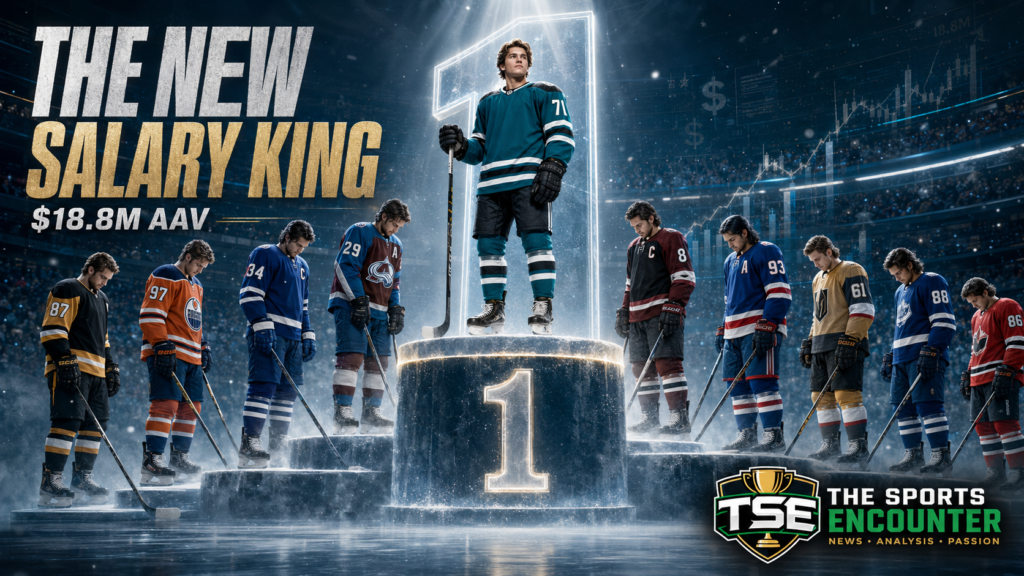
Macklin Celebrini has become the highest-paid NHL player in history by average annual value after signing a five-year, $94 million extension with the San Jose Sharks. His record $18.8 million annual cap hit moves him ahead of Leo Carlsson, Kirill Kaprizov, Connor Bedard, Leon Draisaitl, and every established superstar who previously occupied hockey’s financial summit.
The contract provides a striking measure of Celebrini’s rise. San Jose selected him first overall in the 2024 NHL Draft. Two years later, before his 21st birthday, the Sharks valued him more highly per season than Connor McDavid, Auston Matthews, Nathan MacKinnon, and every other player signed during the NHL’s salary-cap era.
Celebrini earned that confidence with one of the greatest teenage seasons the league has seen. He produced 45 goals and 70 assists for 115 points in 82 games during 2025-26, setting a Sharks single-season scoring record. His 115 points ranked fourth in the NHL, while his 45 goals tied for fourth.
He became only the second player after Wayne Gretzky to record at least 40 goals and 70 assists in a season before turning 20. Celebrini also joined Gretzky and Sidney Crosby as the only teenagers to finish among the NHL’s top five scorers.
His five-year extension begins in 2027-28 and runs through 2031-32. Until then, he will complete the final season of his entry-level contract.
The record will immediately generate a familiar question among hockey fans: Who are the highest-paid NHL players in history?
The answer depends on the metric. This ranking uses average annual value, or AAV, because that is the amount assigned to a player’s contract against his team’s salary cap each season. Total contract value, yearly cash salary, signing bonuses, career earnings, and endorsements measure different forms of wealth.
For broader historical context, see The Sports Encounter’s evidence-based ranking of the 10 best NHL players ever and follow the latest news, analysis, trades, contracts, and postseason coverage through our NHL section.
Fast Answer: Who Is The Highest-Paid NHL Player Ever?
Macklin Celebrini is the highest-paid NHL player in history by average annual value. His five-year, $94 million extension with the San Jose Sharks carries an $18.8 million annual cap hit.
The deal surpassed the five-year, $90 million contract Leo Carlsson received after the Anaheim Ducks matched his offer sheet from the Philadelphia Flyers. Carlsson’s $18 million AAV had stood as the NHL record for only 20 days.
Kirill Kaprizov remains the owner of the richest NHL contract by total value. His eight-year, $136 million extension with the Minnesota Wild is worth $17 million per season.
Top 10 Highest-Paid NHL Players By AAV
| Rank | Player | Team | Contract | AAV | Contract Begins |
|---|---|---|---|---|---|
| 1 | Macklin Celebrini | San Jose Sharks | 5 years, $94 million | $18.8 million | 2027-28 |
| 2 | Leo Carlsson | Anaheim Ducks | 5 years, $90 million | $18 million | 2026-27 |
| 3 | Kirill Kaprizov | Minnesota Wild | 8 years, $136 million | $17 million | 2026-27 |
| 4 | Connor Bedard | Chicago Blackhawks | 5 years, $75 million | $15 million | 2026-27 |
| 5 | Leon Draisaitl | Edmonton Oilers | 8 years, $112 million | $14 million | 2025-26 |
| 6 | Jack Eichel | Vegas Golden Knights | 8 years, $108 million | $13.5 million | 2026-27 |
| 7 | Auston Matthews | Toronto Maple Leafs | 4 years, $53 million | $13.25 million | 2024-25 |
| 8 | Nathan MacKinnon | Colorado Avalanche | 8 years, $100.8 million | $12.6 million | 2023-24 |
| 9 | Connor McDavid | Edmonton Oilers | 8 years, $100 million | $12.5 million | 2018-19 |
| 10 | Bowen Byram | Chicago Blackhawks | 6 years, $75 million | $12.5 million | 2027-28 |
Methodology: Players are ranked by the highest AAV attached to a signed NHL contract as of July 29, 2026. Future extensions are included once officially signed. Figures represent nominal US dollars and are not adjusted for inflation. Where two players share the same AAV, the earlier record-setting contract receives the higher position.
What Does AAV Mean In An NHL Contract?
Average annual value is the total value of an NHL contract divided by its length. Celebrini’s $94 million contract covers five seasons, producing an AAV of $18.8 million.
The AAV normally becomes the player’s annual salary-cap charge, even when the actual cash payments change from season to season. A player might receive a large signing bonus and a smaller base salary in one year, followed by a different payment structure in another. His cap hit generally remains constant.
This distinction explains why the “highest-paid NHL player” can have several technically correct answers:
- Highest AAV: Macklin Celebrini at $18.8 million
- Largest total contract: Kirill Kaprizov at $136 million
- Highest salary in a particular season: Depends on base salary and bonuses due that year
- Highest career earnings: Measures money earned across multiple completed contracts
- Highest percentage of the cap: Compares a contract with the salary ceiling when it began
AAV offers the cleanest measurement of how much roster-building space a team has committed to one player. It does not reveal every detail of the financial arrangement, but it allows meaningful comparisons across active contracts.
Ranking The 10 Highest-Paid NHL Players In History
1. Macklin Celebrini, San Jose Sharks: $18.8 Million AAV
Celebrini’s extension represents a powerful combination of production, youth, positional value, and timing.
The Sharks are paying for the player he has already become and the seasons they believe are still ahead. Celebrini will be 21 when the extension starts and only 26 when it ends. San Jose therefore avoids carrying a record cap hit into the decline years that make many long-term superstar contracts dangerous.
His sophomore season gave the organization a compelling reason to move quickly. Celebrini scored 45 goals, recorded 70 assists, and reached 115 points in 82 games. No Sharks player had ever produced more points in one season.
He finished fourth in the NHL scoring race and fourth in Hart Trophy voting. Across his first 152 regular-season appearances, Celebrini accumulated 178 points. That output placed him on a historic development curve rather than a merely promising one.
The international evidence strengthened his case. Celebrini helped Canada win silver at the Milano Cortina 2026 Winter Olympics, led the tournament with five goals, and became the youngest Canadian NHL player to compete in the event.
The official NHL report on Celebrini’s contract confirmed the $94 million value, $18.8 million AAV, and his new position at the top of the league’s salary hierarchy.
Why San Jose Accepted The Record Price
Elite centers are the hardest foundational players to acquire. They drive play through the middle, influence both special teams, control possession, and give rebuilding organizations a player around whom every other decision can be organized.
Celebrini also gives San Jose a level of certainty that draft picks and free agents cannot offer. The Sharks know his game, character, preparation, and relationship with the market. Allowing negotiations to drift toward restricted free agency would have invited the risk of another aggressive offer sheet.
The five-year term provides Celebrini with another chance to negotiate while still in his prime. San Jose gains cost certainty through 2031-32, but it has not secured his entire peak. That is the price of avoiding an eight-year commitment at an even larger total cost.
2. Leo Carlsson, Anaheim Ducks: $18 Million AAV
For 20 days, Leo Carlsson owned the largest annual cap hit in NHL history.
The Philadelphia Flyers signed the Anaheim center to a five-year, $90 million offer sheet in July 2026. The Ducks faced a stark decision: match the $18 million AAV or accept four first-round draft picks as compensation.
Anaheim matched.
Carlsson was the second overall selection in the 2023 draft and had produced 141 points across his first 201 NHL games when the offer sheet arrived. During 2025-26, he established career highs with 29 goals, 38 assists, and 67 points in 70 games.
Those numbers did not resemble the traditional statistical profile of the highest-paid player in hockey. The price was shaped by leverage. Philadelphia had enough cap room and draft capital to force Anaheim into a decision, while the Ducks could not easily explain losing a 21-year-old franchise center during a rebuild.
Our earlier analysis of Anaheim’s decision to match the richest NHL offer sheet explains how Carlsson’s contract shifted bargaining power toward young restricted free agents.
Celebrini’s subsequent extension makes the Carlsson deal look less isolated. It may have been the first clear signal that the NHL’s new economic cycle would reward age, upside, and negotiating leverage as aggressively as established production.
3. Kirill Kaprizov, Minnesota Wild: $17 Million AAV
Kaprizov’s eight-year, $136 million extension remains the largest contract in NHL history by total value.
Minnesota signed him in September 2025, after he reportedly rejected an earlier offer worth $128 million. The final agreement added $8 million and established records for both total value and AAV at the time.
Kaprizov entered the NHL later than most North American superstars, debuting in 2020-21 after developing in Russia. He immediately won the Calder Trophy and became the most dangerous offensive player in Wild history.
He had 386 points in 319 regular-season games through 2024-25, including 56 points in 41 games during an injury-shortened campaign. His combination of goal scoring, puck protection, lateral movement, and creativity made replacing him almost impossible.
The contract also reflected Minnesota’s market reality. True franchise forwards rarely reach unrestricted free agency, and the Wild could not assume another player of Kaprizov’s caliber would choose Minnesota if he left.
Unlike Celebrini and Carlsson, Kaprizov received the maximum eight-year term available for a player re-signing with his existing club. The benefit is long-term control. The risk is that the contract runs deep into his 30s.
4. Connor Bedard, Chicago Blackhawks: $15 Million AAV
Connor Bedard signed a five-year, $75 million extension with Chicago in July 2026, securing a $15 million annual cap hit through 2030-31.
The first overall pick in the 2023 NHL Draft led the Blackhawks in scoring during each of his first three seasons. He produced personal bests of 30 goals, 45 assists, and 75 points in 69 games during 2025-26 despite playing for a club that remained near the bottom of the standings.
Bedard’s contract was negotiated while he recovered from shoulder surgery, adding a physical-risk component to Chicago’s decision. His importance to the franchise nevertheless extended beyond one injury or one season.
He remains the centerpiece of the Blackhawks’ rebuild, their most marketable player, and their best chance to create another championship era after the retirements and departures of the Patrick Kane and Jonathan Toews generation.
Chicago chose the same five-year structure later used by San Jose with Celebrini. It controls several prime seasons but gives Bedard an opportunity to return to the market before age 27.
The Blackhawks’ wider transition can be understood through our feature on Patrick Kane’s return to Chicago and our career tribute to Jonathan Toews.
5. Leon Draisaitl, Edmonton Oilers: $14 Million AAV
Leon Draisaitl’s eight-year, $112 million extension became the NHL’s highest-AAV contract when Edmonton announced it in September 2024. The deal began in 2025-26 and runs through 2032-33.
Draisaitl had already assembled a record worthy of an enormous commitment. He won the Hart Trophy, Art Ross Trophy, and Ted Lindsay Award in 2019-20, repeatedly crossed the 100-point mark, and became one of the most productive playoff performers of his generation.
His partnership with McDavid gives Edmonton the strongest one-two center combination in hockey. Draisaitl can play alongside McDavid, run his own line, score from difficult angles, control the power play, and punish opponents who build their entire defensive plan around Edmonton’s captain.
The contract carried more conventional risk than the deals given to Celebrini, Carlsson, and Bedard. Draisaitl was an established veteran signing through his 30s, meaning Edmonton accepted potential decline years to preserve a championship window that already existed.
For a team built to win now, losing Draisaitl would have damaged the roster more severely than paying a premium to keep him.
6. Jack Eichel, Vegas Golden Knights: $13.5 Million AAV
Jack Eichel’s eight-year, $108 million extension with Vegas begins in 2026-27.
His career offers one of the clearest examples of how playoff achievement can reshape contractual value. Eichel arrived in Vegas through a major trade with Buffalo in 2021. Less than two years later, he led the 2023 postseason with 26 points in 22 games as the Golden Knights won their first Stanley Cup.
He later posted a career-high 94 points in 2024-25 and became a Lady Byng Trophy finalist. Through that season, Eichel had 608 points in 616 regular-season games.
Vegas values stars who can survive the hardest playoff matchups. Eichel has already demonstrated that he can drive offense, defend against elite centers, and carry a top line through four postseason rounds.
The $13.5 million cap hit looked substantial when signed. Carlsson and Celebrini have since pushed it well down the ranking, illustrating how quickly a contract can move from record territory toward market value during a rising-cap period.
Eichel’s importance was visible throughout Vegas’ run to the 2026 Stanley Cup Final, which ended with the Carolina Hurricanes defeating the Golden Knights in Game 6.
7. Auston Matthews, Toronto Maple Leafs: $13.25 Million AAV
Auston Matthews signed a four-year, $53 million extension in August 2023, moving ahead of Nathan MacKinnon as the NHL’s highest-paid player by AAV at the time.
The shorter term was as important as the salary. Toronto secured Matthews through 2027-28 but could not obtain the eight years of control normally preferred for a franchise player.
Matthews possessed extraordinary leverage. He was a first overall pick, a Hart Trophy winner, and the greatest pure goal scorer in Maple Leafs history. His 69-goal season in 2023-24 produced the NHL’s highest single-season total since Mario Lemieux scored 69 in 1995-96.
Toronto’s decision reflected the difficulty of separating a player’s contractual value from his importance to the organization. Matthews drives ticket demand, national television interest, merchandise sales, sponsorship appeal, and the competitive credibility of hockey’s most scrutinized market.
The central question has always involved postseason conversion. Toronto has repeatedly entered the playoffs with elite offensive talent but struggled to turn regular-season quality into a sustained Stanley Cup run.
Matthews’ deal therefore sits at the intersection of individual excellence and team pressure. His annual value is supported by historic goal scoring. Its ultimate legacy will be influenced by what Toronto achieves while he occupies such a large share of the cap.
8. Nathan MacKinnon, Colorado Avalanche: $12.6 Million AAV
Nathan MacKinnon signed an eight-year, $100.8 million extension in September 2022. When it began in 2023-24, the $12.6 million AAV moved him slightly above McDavid.
The timing was perfect for MacKinnon. Colorado had just won the 2022 Stanley Cup, while its franchise center had spent years outperforming a previous contract carrying a $6.3 million cap hit.
MacKinnon’s next deal corrected that imbalance.
He followed with a 140-point season in 2023-24, setting an Avalanche record and winning the Hart Trophy. His speed through the neutral zone, shot generation, puck carrying, and playoff aggression made the contract appear reasonable almost immediately.
The Avalanche also secured the full eight-year term. That allowed the organization to plan around a fixed cap charge rather than reopen negotiations during MacKinnon’s remaining prime.
His deal demonstrates why contract value cannot be judged from rank alone. MacKinnon has fallen from first to eighth without becoming a less valuable player. The market and salary ceiling simply moved around him.
9. Connor McDavid, Edmonton Oilers: $12.5 Million AAV
Connor McDavid signed his eight-year, $100 million extension in July 2017. It began in 2018-19 and immediately became the NHL’s largest annual cap hit.
Years later, it may be remembered as one of the strongest superstar contracts of the salary-cap era.
McDavid continued to separate himself from the league after signing it. Through 2025-26, he had accumulated 409 goals, 811 assists, and 1,220 points in 794 regular-season games. His six Art Ross Trophies, three Hart Trophies, five Ted Lindsay Awards, and 2024 Conn Smythe Trophy place him among the greatest offensive players hockey has produced.
His $12.5 million AAV now sits below contracts awarded to younger players who have not approached his career accomplishments. That is partly a consequence of cap growth and partly evidence of the value Edmonton secured by signing him for eight seasons.
McDavid’s contract accounted for approximately 15.7% of the salary ceiling when it began. Celebrini’s extension will consume a larger dollar amount but a potentially similar share of a much higher cap.
This is why cross-era comparisons require more than nominal salary. McDavid’s deal was enormous for its economic environment, even if later cap growth has pushed him down the dollar ranking.
10. Bowen Byram, Chicago Blackhawks: $12.5 Million AAV
Bowen Byram’s six-year, $75 million extension gives this list its only defenseman.
The contract begins in 2027-28 and will run through 2032-33. Chicago acquired Byram from Buffalo before making him the highest-paid defenseman by AAV under the signed extension market at the time.
Byram recorded a career-high 42 points during 2025-26. His skating, transition play, age, and ability to handle important minutes made him particularly valuable to a Blackhawks team trying to build a competitive roster around Bedard.
The $12.5 million cap hit represents a significant projection. Byram has shown top-pair ability, but the contract pays him to become a durable, season-shaping defenseman rather than merely remain a productive puck mover.
Chicago will eventually carry $27.5 million in combined AAV for Bedard and Byram. That is a major investment in two players expected to define the franchise’s next competitive window.
The structure shows how rebuilding teams use cap space. Rather than waiting until every piece is established, Chicago is attempting to secure cornerstone talent before the salary ceiling climbs further.
How Celebrini Passed Carlsson, Kaprizov, And McDavid
Celebrini’s new record reflects more than one exceptional season. Three league-wide forces created the conditions for an $18.8 million AAV.
A Rapidly Rising NHL Salary Cap
The NHL salary ceiling increased from $88 million in 2024-25 to $95.5 million in 2025-26 and then to a record $104 million for 2026-27. The individual maximum salary for 2026-27 is $20.8 million.
Further growth was projected for 2027-28, the season in which Celebrini’s extension begins. Rising national media revenue, stronger attendance, increased sponsorship activity, and improving league-wide income have created more room for teams to pay elite players.
The commercial momentum is supported by audience growth. The 2026 Stanley Cup Final delivered the NHL’s strongest championship-round television audience in seven years.
Young Stars Are Choosing Five-Year Deals
Celebrini, Carlsson, and Bedard all signed five-year contracts. That pattern gives teams meaningful control while allowing the players to negotiate again in their mid-20s.
Players and agents understand that the cap could be substantially higher by 2030 or 2031. An eight-year agreement may provide security, but it can also trap a superstar below market value during the final seasons.
Teams accepting five-year contracts avoid paying for a player’s late 30s. The cost is another expensive negotiation arriving much sooner.
Offer-Sheet Pressure Changed The Market
Philadelphia’s $90 million offer sheet to Carlsson demonstrated that cap-rich clubs were prepared to attack another team’s restricted free agent.
San Jose could negotiate with Celebrini one year before his entry-level contract expired. Waiting would have exposed the Sharks to the same pressure Anaheim faced.
The $18.8 million AAV removed uncertainty, protected the franchise’s most valuable asset, and prevented another team from dictating the structure of the negotiation.
Are Today’s NHL Players Really The Highest-Paid Ever?
In nominal dollars, yes. Adjusting for inflation or salary-cap percentage produces a more complicated historical picture.
Joe Sakic received approximately $16.45 million during the 1997-98 season after Colorado matched a front-loaded offer sheet from the New York Rangers. Sergei Fedorov collected roughly $14.5 million in 1998-99 under another heavily structured offer sheet. Mario Lemieux earned approximately $11.35 million in 1996-97.
Those payments occurred before the modern salary cap was introduced in 2005. Teams operated under different rules, contract structures, and financial conditions.
Wayne Gretzky, Lemieux, Sakic, Fedorov, Jaromir Jagr, Paul Kariya, and other stars could lead a season’s cash-salary rankings without carrying a modern AAV-based cap charge.
The cap era introduced a harder strategic question: How much of a fixed payroll should one player occupy?
A $12.5 million McDavid cap hit in 2018-19 represented approximately 15.7% of the $79.5 million ceiling. Celebrini’s $18.8 million extension may represent a comparable or moderately larger proportion when it starts, depending on the confirmed 2027-28 cap.
Celebrini owns the nominal AAV record. Historical purchasing power and cap-share comparisons can produce different conclusions about which contract was most financially dominant for its era.
Largest NHL Contracts By Total Value
AAV determines this ranking, but total contract value tells another important story.
| Player | Contract Value | Length | AAV |
|---|---|---|---|
| Kirill Kaprizov | $136 million | 8 years | $17 million |
| Alex Ovechkin | $124 million | 13 years | Approximately $9.54 million |
| Shea Weber | $110 million | 14 years | Approximately $7.86 million |
| Jack Eichel | $108 million | 8 years | $13.5 million |
| Nathan MacKinnon | $100.8 million | 8 years | $12.6 million |
| Connor McDavid | $100 million | 8 years | $12.5 million |
| Macklin Celebrini | $94 million | 5 years | $18.8 million |
| Leo Carlsson | $90 million | 5 years | $18 million |
Ovechkin and Weber signed before the league imposed its current limits on contract length. Those agreements used extended terms to distribute the cap charge over many seasons.
Modern rules generally limit a player re-signing with his current team to eight years and a player joining another team to seven. New collective bargaining rules will further shape future contract length and structure.
Which Highest-Paid NHL Contract Carries The Most Risk?
Carlsson’s $18 million AAV may carry the greatest performance-projection risk. His career high of 67 points was excellent for a 21-year-old center, but it remained far below the production normally associated with the league’s largest salary.
Anaheim paid partly because an external offer sheet removed its negotiating control.
Byram’s deal carries a similar projection element. Chicago is betting that his best seasons lie ahead and that he will grow into the responsibilities attached to a $12.5 million defenseman.
Kaprizov, Draisaitl, Eichel, and MacKinnon carry more age-related risk because their agreements extend into their 30s. These players have provided stronger performance evidence, but longer contracts can become difficult if health or production declines.
Celebrini’s contract balances those concerns unusually well. His AAV is the highest, but the five-year term covers only young prime seasons. The main danger is that one historic season may not become his permanent standard.
Which Contract Could Become The Best Value?
McDavid’s current deal has already delivered remarkable value. He remained the league’s defining player while newer contracts pushed his $12.5 million cap hit outside the top eight.
MacKinnon’s agreement could follow a similar path if the cap continues rising and he sustains elite production. Draisaitl’s $14 million AAV may also age well if his playoff dominance continues.
Celebrini has a path toward becoming an excellent value despite setting the salary record. If the cap reaches the levels anticipated later in the decade and he develops into a consistent Hart Trophy winner, $18.8 million may no longer look extraordinary by 2030.
That possibility explains why San Jose acted now. Record contracts rarely remain records for long during a period of sustained revenue growth.
What Celebrini’s Deal Means For The Next NHL Superstars
Every new record becomes evidence in the next negotiation.
Young centers approaching restricted free agency can point toward Carlsson and Celebrini. Established scorers can compare their production with Kaprizov’s $17 million AAV. Defensemen can use Byram’s $12.5 million extension as a new benchmark.
The most consequential future negotiation belongs to McDavid. His $100 million contract expires after the 2025-26 season under its original timetable, and any subsequent agreement has the potential to reset the market again depending on his contractual status and the final league calendar.
A player with McDavid’s production, awards, playoff record, and commercial importance could reasonably argue that the market’s top figure should return to him. The salary ceiling would determine how far Edmonton or another team could go.
Celebrini’s record therefore may be temporary. Its greater importance lies in establishing that an NHL team is now willing to devote nearly $19 million in annual cap space to one player.
Final Verdict: The NHL Has Entered Its $20 Million Era
Macklin Celebrini is the highest-paid NHL player in history by AAV because his career reached the right point at the right time.
He delivered 115 points as a teenager, became the face of the Sharks, excelled internationally, and approached restricted free agency while the league’s salary cap was rising at unprecedented speed. Carlsson’s offer sheet provided the immediate market comparison. San Jose then went $800,000 higher per season.
The contract is a considerable bet, but it is not a reckless one. Celebrini’s extension covers ages 21 through 26, the period in which elite forwards often produce their most dynamic hockey. The Sharks are paying for premium seasons without accepting the aging risk attached to a decade-long agreement.
His rise also captures the NHL’s changing economics. McDavid, MacKinnon, Matthews, and Draisaitl have not lost their standing because younger players passed them in salary. Their contracts were negotiated under lower ceilings and different market conditions.
Celebrini sits first today. Carlsson and Kaprizov follow. Bedard has joined the $15 million tier, while the next wave of extensions could carry hockey beyond $20 million per year.
The NHL’s financial ceiling is moving upward. Its best young players have noticed, and teams determined to keep them are beginning to pay accordingly.
For more reporting on the sport’s business growth and competitive landscape, read our analysis of the $1.75 billion Pittsburgh Penguins ownership deal.
Frequently Asked Questions About The Highest-Paid NHL Players
Who Is The Highest-Paid NHL Player In History?
Macklin Celebrini is the highest-paid NHL player in history by average annual value. His five-year, $94 million extension with the San Jose Sharks carries an $18.8 million annual cap hit beginning in 2027-28.
Who Has The Biggest Contract In NHL History?
Kirill Kaprizov has the largest NHL contract by total value. His eight-year extension with the Minnesota Wild is worth $136 million and carries a $17 million AAV.
How Much Does Macklin Celebrini Make Per Year?
Celebrini’s new contract has an average annual value of $18.8 million. The cap hit does not necessarily mean he will receive exactly $18.8 million in cash every season because base salary and signing bonuses can vary.
When Does Macklin Celebrini’s New Contract Begin?
Celebrini’s five-year extension begins with the 2027-28 NHL season. He remains on his entry-level contract for 2026-27 and is signed through 2031-32.
Is Macklin Celebrini Paid More Than Connor McDavid?
Yes, by AAV. Celebrini’s extension carries an $18.8 million cap hit, while McDavid’s current listed contract carries a $12.5 million cap hit. McDavid’s agreement was negotiated in 2017 when the NHL salary cap was much lower.
Who Are The Top Five Highest-Paid NHL Players?
By signed-contract AAV as of July 29, 2026, the top five are Macklin Celebrini at $18.8 million, Leo Carlsson at $18 million, Kirill Kaprizov at $17 million, Connor Bedard at $15 million, and Leon Draisaitl at $14 million.
What Does AAV Mean In The NHL?
AAV means average annual value. It is calculated by dividing the total value of a contract by its number of seasons. AAV generally determines how much the contract counts against a team’s salary cap each year.
Who Is The Highest-Paid NHL Defenseman?
Bowen Byram’s signed six-year, $75 million extension carries a $12.5 million AAV beginning in 2027-28, placing him first among defensemen under the future extension market reflected in this ranking.
Who Is The Highest-Paid NHL Goalie?
Igor Shesterkin’s eight-year, $92 million contract with the New York Rangers carries an $11.5 million AAV, the highest annual cap hit for a goaltender under the active contract market preceding the 2026-27 season.
Why Are NHL Salaries Increasing So Quickly?
NHL salaries are rising because the league’s salary cap has increased alongside revenue from broadcasting, streaming, sponsorships, attendance, and other commercial sources. The cap reached $104 million for 2026-27, giving teams more room to retain elite players.
Can An NHL Player Earn More Than $20 Million Per Year?
Yes. The maximum individual salary is tied to a percentage of the league’s salary cap. With the 2026-27 ceiling at $104 million, the maximum is $20.8 million. No player in this ranking has reached that limit, but future contracts could cross $20 million in AAV.
Do NHL Players Receive Their Entire Contracts If They Are Injured?
NHL contracts are generally guaranteed, although exact payments and cap treatment depend on the contract, insurance, long-term injured reserve rules, buyouts, termination provisions, and the collective bargaining agreement.
Are NHL Contract Figures Reported In US Or Canadian Dollars?
NHL contract values and salary-cap figures are reported in US dollars, including contracts signed by players with Canadian teams.
Who Was The Highest-Paid NHL Player Before Macklin Celebrini?
Leo Carlsson briefly held the record with an $18 million AAV after the Anaheim Ducks matched his five-year, $90 million offer sheet from Philadelphia. Celebrini surpassed him 20 days later.
Does The Highest-Paid NHL Player Always Have The Highest Salary In Cash?
No. AAV measures the annual cap charge. Actual yearly earnings can differ because contracts may contain uneven base salaries and signing bonuses. A player with a lower AAV can receive more cash during a particular season.