


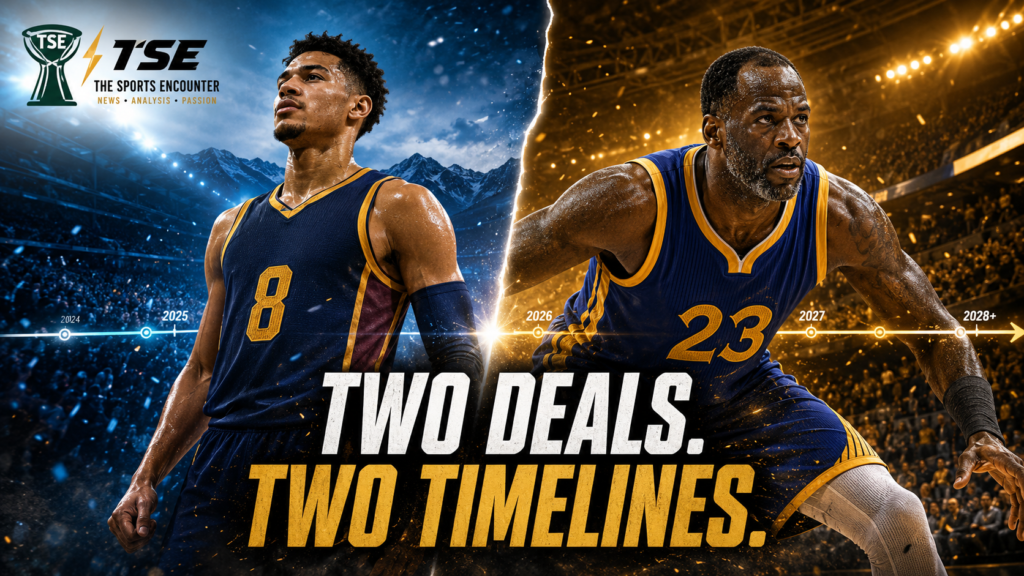
Two Western Conference contenders made very different investments Tuesday, but both decisions reflected the same priority: keeping players who already understand what their teams need.
The Denver Nuggets reportedly offered restricted free agent Peyton Watson a five-year, $70 million contract following his breakout 2025-26 season. Meanwhile, the Golden State Warriors retained one of the defining players in franchise history, agreeing to a one-year, $27.7 million deal with veteran forward Draymond Green.
Watson represents Denver’s future. Green remains inseparable from Golden State’s championship past, with another season to prove he can still influence its present.
The combined $97.7 million in proposed and agreed contracts reveals two contrasting timelines. Denver wants to secure a 23-year-old two-way forward before his value rises further. Golden State has chosen continuity with its 36-year-old defensive anchor while preserving the freedom to reassess the roster after the 2026-27 season.
Both moves arrive during an eventful offseason in which contenders are balancing expensive veterans, emerging talent, luxury-tax pressure and limited trade flexibility. Similar financial calculations recently influenced the Oklahoma City Thunder’s decision to trade Aaron Wiggins to the Atlanta Hawks.
Peyton Watson and Draymond Green Contract Summary
| Category | Peyton Watson | Draymond Green |
|---|---|---|
| Team | Denver Nuggets | Golden State Warriors |
| Contract status | Offer reported | Agreement reported |
| Contract value | Five years, $70 million | One year, $27.7 million |
| Age | 23 | 36 |
| 2025-26 points per game | 14.6 | 8.4 |
| Primary value | Two-way development and shooting | Defense, passing and leadership |
| Team strategy | Invest in the future | Preserve the championship core |
Peyton Watson’s Breakout Season Forces Denver’s Hand
Watson entered the NBA as a developmental prospect whose athleticism, defensive reach and shot-blocking instincts stood well ahead of his offensive production.
The Oklahoma City Thunder selected him with the 30th pick in the 2022 NBA Draft before sending him to Denver in a draft-night trade. Watson played only 15 regular-season games during his rookie campaign, but he still finished that season as an NBA champion.
Three years later, Denver faces a much different decision.
Watson averaged career highs of 14.6 points, 4.9 rebounds and 2.1 assists in 54 games during the 2025-26 season. He started 40 times and shot 41.1% from three-point range, representing an important development for a player initially valued primarily for his defense.
His improved shooting changed how opponents could guard Denver. Leaving Watson unattended on the perimeter became increasingly dangerous, while his size and athleticism allowed him to attack closeouts and finish around the basket.
Denver’s five-year offer carries an average annual value of $14 million. That number could become team-friendly if Watson sustains his perimeter shooting and continues developing as a multipositional defender.
The Nuggets are following a league-wide pattern of securing young contributors before another productive season increases their market value. Boston recently made a similar long-term calculation by giving Jordan Walsh an extension through 2030.
Why the Bucks, Hawks and Clippers Want Watson
Watson’s growth has reportedly attracted interest from the Milwaukee Bucks, Atlanta Hawks and Los Angeles Clippers, all of whom have explored possible sign-and-trade arrangements.
The interest makes basketball sense.
Milwaukee needs athletic defenders capable of operating around veteran stars. Atlanta has been searching for players who can strengthen its defensive structure without compromising spacing. The Clippers understand the value of switchable forwards when playoff matchups demand frequent defensive adjustments.
Watson potentially answers all three needs.
At 6-foot-8, he can defend several positions, run the floor and contribute without dominating possession. His improved shooting makes him easier to place alongside high-usage creators and established scorers.
That combination has become expensive across the NBA. Teams regularly pay substantial salaries for wings who defend, hit open shots and remain useful without having plays called specifically for them.
Watson has averaged 8.7 points and 3.5 rebounds across 225 career appearances, including 64 starts. Those career figures no longer describe his current level after the offensive leap he produced last season.
The Contract Creates Financial Pressure for Denver
Retaining Watson would help the Nuggets protect their supporting cast, but the decision cannot be separated from the NBA’s restrictive financial environment.
Denver has already committed heavily to its championship-level core. Another long-term deal places additional pressure on the luxury-tax bill and the second apron, where high-spending teams face major limitations on trades, free-agent acquisitions and roster construction.
A $14 million annual salary remains manageable for a productive starter or high-level sixth man. It becomes harder to carry if Watson’s shooting regresses or Denver must sacrifice depth elsewhere to control payroll costs.
The Nuggets are effectively betting that Watson’s 2025-26 performance established a sustainable baseline. His age, defense and offensive progress make that a reasonable position, although the reported sign-and-trade interest gives Denver another route if the financial equation becomes too difficult.
The wider offseason has shown how rapidly teams are recalculating the cost of young rotation players. The Chicago Bulls and Boston Celtics recently made their own value decisions involving Leonard Miller and Ron Harper Jr., while the 2026 draft introduced another wave of prospects competing for roster roles.
Draymond Green Returns After Golden State Misses LeBron James
Golden State’s agreement with Green emerged from a completely different sequence of events.
Green declined a $27.6 million salary earlier in the offseason, giving the Warriors additional flexibility while they pursued LeBron James. That possibility had been central to speculation over which team LeBron would choose for the 2026-27 season.
James eventually signed with the Philadelphia 76ers for his record-extending 24th NBA campaign. The move ended Golden State’s hopes of pairing him with Stephen Curry and transformed Philadelphia into an immediate Eastern Conference contender.
The signing also changed the financial picture for the Warriors. With James unavailable, Golden State restored Green at $27.7 million, only $100,000 more than the salary he had declined.
The new deal reportedly does not include a no-trade clause. That detail gives Golden State the ability to move Green if its season deteriorates or a larger opportunity appears.
Green receives a slight salary increase and another year with the only NBA franchise he has represented. The Warriors retain their most important defensive communicator without creating another long-term financial commitment.
It is a practical reunion shaped by the market rather than a lifetime agreement based on sentiment.
Green’s Value Still Extends Beyond the Box Score
Green averaged 8.4 points, 5.5 rebounds and 5.5 assists across 68 starts last season. His scoring remains modest, but traditional offensive numbers have never fully captured his influence.
He organizes Golden State’s defense, directs teammates through rotations and remains one of the NBA’s quickest tactical readers. On offense, his screening, passing and established understanding with Curry allow the Warriors to create opportunities without relying entirely on isolation basketball.
Green will enter his 15th season with career averages of 8.7 points, 6.8 rebounds and 5.6 assists across 949 regular-season games. Golden State originally selected him with the 35th pick in the 2012 draft.
Few second-round selections have influenced a franchise so deeply.
Green has won four championships, appeared in four All-Star Games and earned nine All-Defensive Team selections. He was named Defensive Player of the Year for the 2016-17 season and became the tactical center of a defensive system that complemented Golden State’s revolutionary shooting.
His return also keeps alive one of the NBA’s defining modern partnerships. Curry supplies the offensive gravity and shooting range. Green reads the floor, coordinates the defense and turns those movements into structure.
The remaining question concerns the wider roster. Golden State explored a remarkable late-career partnership between Curry and James, but Philadelphia ultimately persuaded LeBron to join the 76ers for his 24th season.
LeBron’s Decision Changed Both Conferences
James choosing Philadelphia did more than close Golden State’s pursuit. It altered the championship race and forced several contenders to reconsider their offseason plans.
The 76ers now believe a lineup featuring James, Joel Embiid, Jaylen Brown and Tyrese Maxey can challenge for the title. Questions remain about health, ball distribution and defensive balance, but Philadelphia may possess the NBA’s strongest projected starting five.
Golden State must continue building around Curry, Green and its remaining veterans without the transformative addition it had pursued. Retaining Green preserves familiarity, although familiarity alone cannot solve concerns about age, durability and scoring depth.
The Warriors still have a player who understands their system better than any available replacement. Whether that remains enough in an increasingly athletic Western Conference will help define their season.
Two Contracts, Two Versions of Continuity
Denver and Golden State are retaining different forms of organizational knowledge.
Watson understands how to play beside established stars without requiring a high volume of touches. He offers Denver younger legs, defensive versatility and a valuable shooting profile as the franchise manages an expensive roster.
Green understands every detail of Golden State’s system because he helped create it. His communication with Curry and the institutional memory he carries cannot be replicated through an ordinary free-agent signing.
The contract lengths reveal the difference.
Denver is prepared to invest five years in Watson’s development and prime. Golden State has committed only one season to Green, allowing both sides to reconsider their positions in 2027.
Watson’s offer expresses confidence in what he could become. Green’s agreement recognizes what he still provides while acknowledging that the Warriors are approaching a crossroads.
Neither transaction guarantees contention. Denver must manage the financial consequences of retaining its supporting players, while Golden State still needs sufficient athleticism, durability and scoring around its veteran core.
Final Verdict
Watson could become one of Denver’s most important long-term two-way players. If his three-point improvement holds, the reported $70 million offer may eventually look like a smart piece of cost control rather than an expensive gamble.
Green remains the emotional and tactical pulse of a Warriors era moving gradually toward its final chapters. His one-year agreement gives Golden State another chance to compete without pretending the franchise can postpone every difficult decision indefinitely.
Denver is paying to protect its next phase. Golden State is bringing back a champion for another consequential run.
Both teams chose continuity, but they are looking in opposite directions. The Nuggets see Watson as part of the team they want to become. The Warriors still believe Green belongs in the team they are trying to preserve.
For additional analysis, roster developments and offseason coverage, visit The Sports Encounter’s NBA news and analysis hub.
Official transactions, player statistics, schedules and league updates are available through the NBA’s official website.