


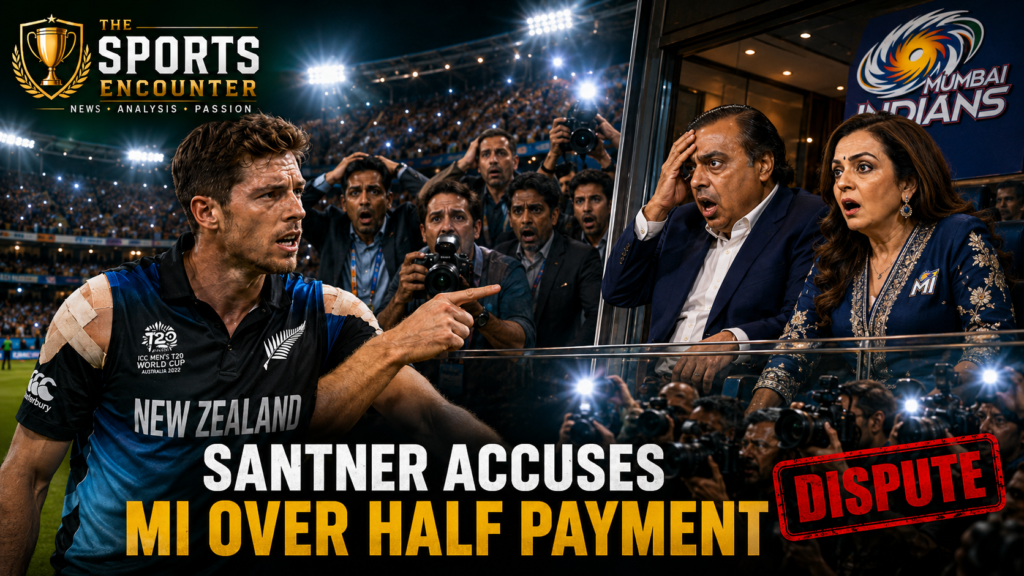
Mitchell Santner’s complaint against Mumbai Indians carries weight because of who made it, who stands accused, and what reportedly happened before his IPL season ended.
The New Zealand white-ball captain says he received only half of his agreed Indian Premier League payment after injuries forced him to leave the Mumbai Indians squad during the 2026 season.
Santner had reportedly joined Mumbai for INR 2 crore and continued playing despite problems affecting both shoulders. His campaign eventually ended when he injured his left shoulder while fielding against Chennai Super Kings. New Zealand Cricket later confirmed that the injury required specialist assessment, rest, and rehabilitation.
The allegation is serious.
Mumbai Indians are among the IPL’s richest, most successful, and most commercially powerful franchises. They operate within a league that has reshaped cricket’s global economy and created life-changing opportunities for players.
A dispute involving a struggling start-up competition might be dismissed as another example of poor financial planning. A payment allegation involving Mumbai Indians raises a different question.
If an established IPL franchise can become involved in a disagreement over an injured international captain’s salary, how secure are players in leagues with weaker governance, smaller revenues, and less public scrutiny?
Santner’s Claim Against Mumbai Indians at a Glance
| Key detail | Reported information |
|---|---|
| Player | Mitchell Santner |
| Franchise | Mumbai Indians |
| Competition | IPL 2026 |
| Reported contract value | INR 2 crore |
| Alleged payment received | Approximately 50% of the agreed fee |
| Reason given for reduced involvement | Shoulder injuries |
| Confirmed injury | Left shoulder injury suffered while fielding |
| Consequence | Ruled out of the remainder of the IPL season |
| Replacement | Keshav Maharaj |
| Mumbai Indians’ public explanation | No detailed public response identified at the time of writing |
Santner’s allegation has been reported by several South Asian media organizations. He reportedly expressed disappointment that his payment was reduced after an injury ended his participation.
However, an important distinction must remain clear.
The public reporting available does not establish whether Mumbai Indians breached Santner’s written contract. It also does not disclose the exact payment clauses, insurance arrangements, deductions, or injury provisions contained in his agreement.
Until the franchise, the IPL, Santner, or his representatives release those details, the public can judge the fairness of the situation but cannot deliver a final legal verdict.
Santner Played Through Pain Before His IPL Exit
Santner’s frustration appears to come from more than the missing portion of his reported fee.
The all-rounder indicated that he had already been playing with injuries affecting both shoulders. He then suffered further damage to his left shoulder while completing a catch during Mumbai Indians’ defeat against Chennai Super Kings.
New Zealand Cricket subsequently announced that Santner would be unavailable for at least a month. The injury ruled him out of the remainder of the IPL and affected his international availability, including New Zealand’s Test commitments.
That sequence matters.
A player who arrives injured, hides an existing condition, or withdraws without a valid medical reason presents one type of contractual issue.
A player who continues representing his franchise, competes while managing physical pain, and suffers a documented injury while performing his duties presents another.
Santner’s case appears closer to the second category based on the information currently available.
He did not simply leave the squad because he had changed his mind. He played, fielded, bowled, and exposed his body to further damage before medical advice ended his season.
That makes the alleged reduction feel especially severe from a player-welfare perspective.
The wider concern resembles the workload questions examined in The Sports Encounter’s analysis of whether modern fast bowlers are losing the art of Test cricket. Modern cricketers move between international tours and franchise competitions with limited recovery time, yet the financial and medical protections surrounding those workloads can vary dramatically.
Was Mumbai Indians Entitled to Reduce the Payment?
This remains the most important unanswered question.
IPL player contracts can contain provisions governing availability, injury, replacement, medical reporting, insurance, and deductions. Replacement-player regulations also calculate fees according to the number of matches remaining after a player joins a squad.
Those rules do not automatically explain Santner’s situation.
Several details require clarification:
- Did Santner’s contract guarantee the full INR 2 crore once he joined the squad?
- Did the agreement permit a proportional reduction after he was replaced?
- Was the injury classified as an IPL duty-related injury?
- Did Mumbai Indians or the league hold an insurance policy covering the unpaid portion?
- Was the alleged 50% payment temporary, final, or part of an unresolved settlement?
- Did Santner formally challenge the calculation through the IPL or BCCI?
- Did the franchise believe part of his condition existed before the season began?
Without the contract, the public cannot answer these questions conclusively.
Mumbai Indians also deserve the opportunity to explain their position. At the time of writing, no detailed public response from the franchise had emerged in the sources reviewed for this article.
That silence leaves Santner’s version as the dominant public account, but it should not be treated as the complete contractual record.
Why the Allegation Damages the IPL’s Image
The IPL does not present itself as an improvised tournament held together by promises.
It is cricket’s most influential domestic league, supported by major broadcasters, global sponsors, billionaire owners, packed stadiums, and enormous media rights agreements.
Its franchises expect complete commitment from players.
The league has also introduced strict measures against players who withdraw after being selected without an accepted injury or national-board reason. Players can face bans covering multiple seasons when a late withdrawal disrupts a franchise’s planning.
That level of contractual discipline should work in both directions.
When a player withdraws without justification, the league protects the franchise.
When a player becomes injured while representing the franchise, the system should offer equally clear protection to the player.
The Santner dispute creates the impression that franchises may hold stronger remedies than the athletes whose bodies sustain the competition.
That perception can damage trust even when the franchise believes it followed the contract correctly.
Player Payment Problems Are Widespread Across Franchise Cricket
Santner’s allegation may look unusual because it involves Mumbai Indians, but payment disputes have become a recurring problem across the expanding franchise-cricket market.
The World Cricketers’ Association reported in 2025 that 29% of more than 320 surveyed professional players had experienced late payment or non-payment in cricket sanctioned by the ICC or its member boards.
An earlier global review found that approximately one in four players had experienced payment problems. FICA described parts of the domestic-league environment as a “Wild West” and called for enforceable minimum contract standards and stronger payment mechanisms.
The issue has affected established leagues, emerging competitions, individual franchises, and tournaments that disappeared before building a stable future.
Major Payment Disputes Across Cricket Leagues
| League or franchise | Reported problem | Outcome |
| Global T20 Canada | Players protested over unpaid wages | Match delayed for around two hours |
| Bangladesh Premier League | Repeated salary and ownership disputes across seasons | Board intervention and payment pressure |
| Lanka Premier League, Jaffna Kings | Financial and contractual obligations reportedly not fulfilled | Ownership agreement terminated and league operators took control |
| Euro T20 Slam | Franchise fees reportedly remained unpaid | Inaugural tournament cancelled shortly before launch |
| Indian Heaven Premier League | Players, hotels, and service providers reportedly unpaid | Tournament collapsed and organizers allegedly disappeared |
| Indian Cricket League | Financial pressure and governing-body conflict | League folded after operating from 2007 to 2009 |
| Masters Champions League | Player-payment complaints reported | Competition disappeared after one edition |
Global T20 Canada Players Refused to Take the Field
One of franchise cricket’s most visible salary protests occurred during the 2019 Global T20 Canada season.
Players from the Toronto Nationals and Montreal Tigers initially refused to travel to the ground because of unpaid wages. Their match was delayed by approximately two hours while the dispute was addressed. Reports indicated that some payment problems dated back to the previous season.
The protest exposed the limited leverage available to players.
Individually, they could be pressured to continue playing.
Collectively, they could stop the television product, delay the fixture, and force organizers to respond.
Global T20 Canada later faced further contractual and organizational uncertainty. Cricket Canada terminated its agreement with the tournament’s former operator in December 2024, citing alleged contractual breaches and delayed payments. A new licensing arrangement was announced in 2025.
The Euro T20 Slam Was Cancelled Before It Began
The Euro T20 Slam was planned as a major franchise competition involving teams from Ireland, Scotland, and the Netherlands.
It attracted international players and promised to expand professional opportunities in European cricket.
The inaugural tournament was cancelled approximately two weeks before it was due to begin in 2019.
Reports linked the crisis to unpaid franchise fees and severe cash-flow problems. Players had committed time, negotiated contracts, and adjusted their schedules, only to lose the opportunity before a ball was bowled.
The competition was later postponed again and never developed into the sustainable European league originally promoted.
This case demonstrated that payment insecurity can hurt players even before a tournament begins.
Lost contracts also carry real costs. Players may reject other leagues, decline county opportunities, alter family plans, or arrange travel based on an agreement that later disappears.
The Indian Heaven Premier League Collapsed in Chaos
The 2025 Indian Heaven Premier League in Srinagar produced one of the most extraordinary breakdowns in recent cricket history.
The privately organized tournament featured recognizable players, including Chris Gayle, Martin Guptill, Jesse Ryder, and Thisara Perera.
The event reportedly collapsed during the competition after organizers disappeared. Players were left stranded, while hotels, transport providers, caterers, staff, and other service providers were reportedly owed money.
Around 40 players were said to have been left unpaid or without clear information about their travel and financial arrangements.
The tournament did not merely struggle commercially. Its operating structure appeared to disintegrate.
That episode showed why a famous player list cannot serve as proof of financial credibility. Star names may attract attention, but they do not guarantee that a league has secured its working capital, insurance, accommodation payments, prize money, and player salaries.
Jaffna Kings Lost Their Ownership Rights During LPL 2026
A more recent example emerged during the 2026 Lanka Premier League.
The Jaffna Kings’ ownership agreement was terminated after the franchise reportedly failed to meet financial and contractual obligations. Sri Lanka Cricket and the league’s rights holder assumed operational control so the team could continue playing.
Emergency funding reportedly cleared most outstanding player and staff salaries, with the remaining amounts scheduled for settlement.
The Sports Encounter covered how the crisis affected the team during Galle Gallants’ victory over Jaffna Kings.
Players had reportedly covered sponsor logos on their shirts with black tape during an earlier match because sponsorship funds had not been distributed.
The league’s intervention prevented the team from collapsing midseason, but the incident still demonstrated how quickly a franchise’s financial problems can reach the dressing room.
The Sports Encounter’s report on Jaffna Kings’ narrow win over Colombo Kaps also provides sporting context from the period immediately surrounding the ownership dispute.
Bangladesh Premier League Has Faced Repeated Salary Concerns
The Bangladesh Premier League has generated important opportunities for local and overseas cricketers, but it has also experienced recurring disputes involving delayed wages, franchise ownership, contractual enforcement, and player payments.
The competition has survived, unlike several failed leagues, because the Bangladesh Cricket Board can intervene, replace franchises, and restructure tournament operations.
However, survival does not remove the underlying lesson.
A league’s governing body must verify the financial strength of its owners before awarding franchise rights. Waiting until players publicly complain places the burden on the people with the least institutional power.
The same concern applies across the franchise ecosystem. Team owners should not receive access to player labor, broadcast exposure, sponsor inventory, and league branding without placing guaranteed funds into protected accounts.
The Difference Between Partial Payment and Non-Payment
Santner’s allegation does not appear identical to the collapse of the Indian Heaven Premier League or the unpaid-wage protest in Canada.
He says he received half of his fee.
That distinction matters legally, but it may not matter much ethically if the remaining amount was contractually guaranteed.
Partial payment can arise from several situations:
- A legitimate contractual deduction
- A dispute over player availability
- A disagreement about when an injury occurred
- An insurance delay
- A pro rata payment formula
- A franchise cash-flow problem
- A negotiated settlement
- A straightforward breach of contract
Public discussion often treats every short payment as theft. That conclusion would be premature without examining the agreement.
However, franchises also damage themselves when they allow payment disputes to remain unexplained.
A transparent statement could clarify whether the reduced payment followed a standard clause, remains under review, or resulted from an administrative disagreement.
Silence allows the harshest interpretation to grow.
Injured Players Need Stronger Contractual Protection
Cricket depends on players accepting physical risk.
Santner’s shoulder injury occurred while fielding for Mumbai Indians. Fast bowlers suffer stress fractures. Batters break fingers. Wicketkeepers damage knees and shoulders. All-rounders carry workloads that place several parts of the body under continuous strain.
The economics of franchise cricket can encourage players to compete through discomfort because a contract may represent a substantial part of their annual income.
That creates a dangerous incentive if playing through pain can later weaken their financial protection.
The issue connects with the wider debate around franchise workloads, including The Sports Encounter’s examination of Shaheen Afridi’s injury history and career pressures before the LPL.
Players should not have to choose between reporting an injury honestly and protecting their salary.
Strong contracts should define:
- What qualifies as a competition-related injury
- Who appoints the independent medical specialist
- Whether salary continues after an injury replacement is signed
- Which party pays rehabilitation costs
- How insurance claims are managed
- When payments must be completed
- Which independent body hears disputes
- What penalties apply when a franchise pays late
Cricket Needs Escrow Accounts and Enforceable Guarantees
Most payment crises become public only after the money has already disappeared.
By that point, a franchise may have failed, an owner may have left the country, or a league may have lost its sponsors.
Prevention offers better protection than litigation.
1. Player salaries should be placed in escrow
Before a season begins, franchises should deposit guaranteed player payments into an independently controlled account.
The funds would then be released according to the agreed schedule.
2. Governing bodies should demand performance bonds
Every owner should provide a bank guarantee large enough to cover salaries, accommodation, insurance, travel, and core operating expenses.
A franchise that cannot secure the guarantee should not enter the league.
3. Injury clauses should use common minimum standards
An injury suffered while training, traveling, or playing for a franchise should trigger a clearly defined protection system across sanctioned leagues.
4. Replacement players should not reduce the injured player’s rights automatically
Signing a replacement solves a squad problem. It should not automatically remove a contractual obligation to the original player.
5. Independent arbitration should be available
Players should not have to sue an overseas owner through an unfamiliar legal system to recover their wages.
6. Sanctions should target owners, not only franchise names
Owners responsible for unpaid salaries should face restrictions from purchasing teams in other sanctioned competitions.
Cricket franchises increasingly operate across several countries. Accountability should travel with the ownership group.
Why Santner’s Case Could Become an Important Test
Santner is not a young domestic player without representation.
He is an experienced international cricketer and New Zealand captain. He has played in the IPL for years and understands how elite franchise contracts operate.
That does not prove his interpretation is correct. It does make his willingness to speak publicly significant.
Senior players often resolve financial disagreements privately. Public criticism can damage future contracts and relationships with powerful franchise groups.
Santner’s comments therefore suggest that he felt genuinely aggrieved by the outcome.
The dispute also arrives during a period when franchise cricket is asking players for greater availability, faster travel, shorter recovery periods, and loyalty across multi-team ownership networks.
The IPL’s influence continues to shape international selection, workload management, and player development. The Sports Encounter examined another consequence of that influence in its investigation into whether the IPL Impact Player rule is contributing to India’s all-rounder crisis.
Commercial power brings responsibility.
A league cannot demand professional behavior from players while treating contract transparency as a private inconvenience.
Final Verdict
Mitchell Santner’s allegation against Mumbai Indians should concern cricket, but it should also be examined carefully.
The confirmed facts show that Santner suffered a significant shoulder injury while representing Mumbai Indians and left the tournament for medical treatment.
Santner says he received only half of his agreed IPL fee.
What remains unknown is whether the franchise relied on a contractual deduction, whether insurance covered part of the payment, whether the dispute is still active, and whether Mumbai Indians believe they fulfilled the agreement.
Those details will determine whether this was a legal breach, a contract interpretation dispute, or a payment structure that exposed a weakness in player protection.
The broader issue requires less uncertainty.
Late salaries, partial payments, broken franchises, cancelled leagues, and vanished organizers have appeared too frequently across professional cricket.
Players provide the labor, risk their bodies, and make the product worth watching. Their payment should never depend on whether an owner finds enough money after the tournament has already begun.
Mumbai Indians may eventually provide an explanation that changes the interpretation of Santner’s case.
Until then, his allegation leaves one of franchise cricket’s most uncomfortable questions hanging in the air:
When a player gets injured while serving a team, who does the contract protect first?
Frequently Asked Questions
What did Mitchell Santner say about Mumbai Indians?
Santner reportedly said Mumbai Indians paid him only half of his agreed IPL 2026 fee after shoulder injuries ended his season.
How much was Mitchell Santner’s reported IPL salary?
Santner’s reported contract value with Mumbai Indians was INR 2 crore.
Was Mitchell Santner injured while playing for Mumbai Indians?
Yes. New Zealand Cricket confirmed that Santner suffered a left shoulder injury while fielding for Mumbai Indians against Chennai Super Kings.
Did Mumbai Indians respond to Santner’s payment allegation?
No detailed public response from Mumbai Indians was identified in the sources reviewed at the time of writing.
Have players faced payment problems in other cricket leagues?
Yes. Documented disputes have affected Global T20 Canada, the Bangladesh Premier League, the Lanka Premier League, the Euro T20 Slam, the Masters Champions League, and other franchise competitions.
How common are player-payment problems in franchise cricket?
A 2025 World Cricketers’ Association survey found that 29% of more than 320 professional players had experienced late payment or non-payment in sanctioned cricket.
How can cricket leagues prevent unpaid salaries?
Leagues can require escrow accounts, bank guarantees, independent audits, standardized injury clauses, enforceable payment schedules, and international arbitration.