


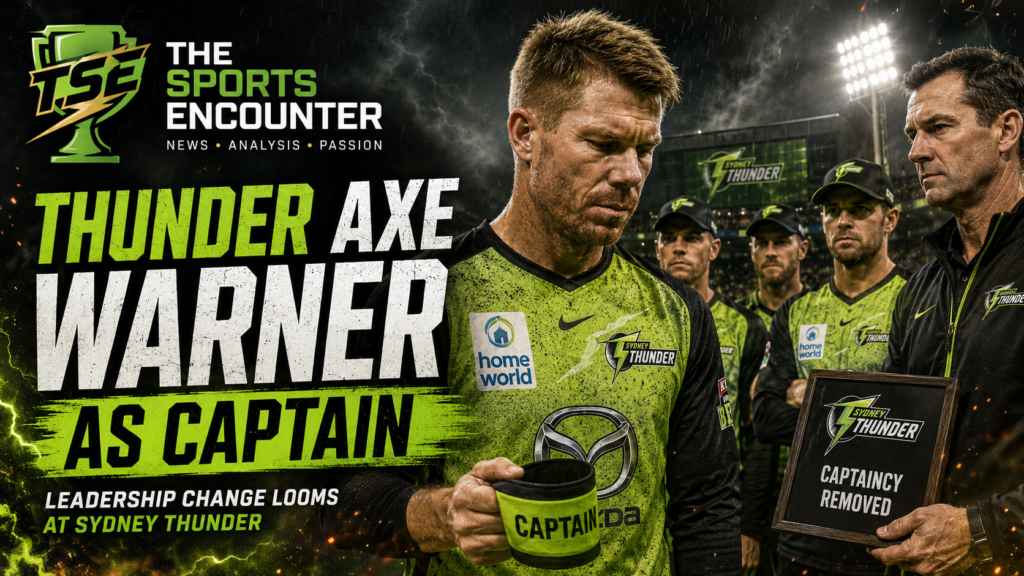
David Warner spent years fighting for the right to captain an Australian cricket team again. His guilty plea to a mid-range drink-driving charge has now placed that hard-won second chance in serious danger ahead of the 2026-27 Big Bash League season.
Warner admitted the offence through his lawyer at Waverley Local Court after recording a blood-alcohol reading of 0.104 during the Easter break. The figure was more than twice Australia’s general legal limit of 0.05.
He is due to be sentenced on August 18, but the legal punishment will not settle the leadership question confronting Sydney Thunder and Cricket NSW.
Thunder must decide whether Warner can continue as the official leader of a team connected to public messaging against drink-driving.
The club does not need to terminate his contract or remove him from its playing plans. Warner remains an elite T20 batter, a major commercial figure and an experienced mentor.
Captaincy carries a different standard. Keeping him as skipper would leave Thunder defending an uncomfortable contradiction throughout BBL|16.
David Warner Drink-Driving Case: Key Facts
| Incident date | April 5, 2026 |
|---|---|
| Location | Maroubra, Sydney |
| Blood-alcohol reading | 0.104 |
| Charge | Mid-range prescribed concentration of alcohol driving |
| Plea | Guilty |
| Sentencing date | August 18, 2026 |
| Current club | Sydney Thunder |
| Current role | Captain and opening batter |
What Happened During Warner’s Easter Break?
Warner was home in Sydney during a break from captaining Karachi Kings in the Pakistan Super League when the incident occurred on April 5.
Police were operating a roadside breath-testing site on Malabar Road in Maroubra. Warner’s vehicle stopped and parked before reaching the testing point, prompting officers to approach the car.
A roadside test returned a positive result. Warner was taken to Maroubra Police Station, where the secondary test produced a reading of 0.104.
His lawyer, Bobby Hill, said Warner had consumed three glasses of wine at a friend’s apartment before deciding to drive. Hill acknowledged that his client should have taken an Uber and called the decision reckless and foolish.
The lawyer also said Warner’s final drink had been consumed shortly before police stopped him.
Warner was not required to attend court when the guilty plea was formally entered. His legal team indicated that discussions over the agreed facts were continuing ahead of sentencing.
Whatever sentence follows, the central fact is no longer disputed. Warner has accepted responsibility for driving after drinking.
Why This Cannot Be Treated as a Private Matter
Off-field conduct is sometimes classified as a personal matter when it does not affect a player’s availability or involve the club directly.
That distinction is difficult to maintain here.
Cricket NSW, Sydney Thunder and Sydney Sixers have supported road-safety messaging intended to discourage drink-driving. Cricket NSW chief executive Lee Germon described the allegations as concerning and said the organization strongly supported safe driving.
The club now faces a direct test of that position.
Thunder can retain Warner as a player while acknowledging that his conduct was incompatible with the responsibilities attached to captaincy.
Leaving the leadership structure untouched would send a different message. It could suggest that the standards promoted publicly carry fewer consequences when the person involved is the team’s biggest star.
Warner’s Runs Still Matter to Sydney Thunder
Removing Warner as captain should not be confused with questioning his cricketing value.
He remains a destructive opener capable of controlling an innings or overwhelming an attack during the powerplay. His experience, tactical knowledge and understanding of Australian conditions continue to make him one of Thunder’s most important players.
The club’s official David Warner player profile reflects his status as one of the most accomplished batters associated with the franchise.
Thunder can continue building their batting plans around him. They can also use his experience to help young players without requiring him to remain the formal leader.
Cricket regularly separates individual importance from captaincy. A team’s leading run-scorer does not automatically have to be its skipper.
The Sports Encounter examined a similar distinction between batting status and leadership responsibility when assessing Babar Azam’s return as Pakistan Test captain.
The circumstances are different, but the principle remains useful. Captaincy is an institutional responsibility, not a reward for scoring the most runs.
Captaincy Requires More Than Match-Day Performance
A Big Bash captain handles tactical decisions, represents the team publicly, works closely with management and helps establish standards inside the dressing room.
The captain may also appear in community programs, commercial campaigns and events aimed at younger supporters.
Those duties give the role a significance that extends beyond the boundary.
Warner’s authority would be tested whenever Thunder addressed behavior, responsibility or off-field standards. Players could reasonably ask how accountability operates when the captain has admitted making a serious and avoidable decision.
That does not mean Warner has lost the respect of every teammate. It means Thunder must consider whether retaining him weakens the credibility of the position itself.
The 2024 Leadership Review Makes the Case More Serious
Warner’s Thunder captaincy carried unusual meaning because he had previously been banned for life from holding leadership positions in Australian cricket.
The ban followed his role in the 2018 ball-tampering scandal in South Africa. Alongside a 12-month playing suspension, Warner was prevented from captaining an Australian team indefinitely.
An independent panel lifted that leadership sanction in October 2024 after accepting evidence of remorse, rehabilitation and improved conduct.
Sydney Thunder appointed him captain soon afterward.
His restoration to leadership therefore represented more than a tactical appointment. It was a public statement that Warner had rebuilt enough trust to lead again.
The drink-driving offence does not erase every positive action he has taken since 2018. It does, however, require Thunder to reassess whether he should continue holding a role restored partly because of his claimed rehabilitation.
A player returning from a lifetime leadership ban understands that later conduct will receive greater scrutiny.
A Second Chance Comes With a Higher Burden
Warner fought hard to overturn the leadership sanction and repeatedly expressed frustration over the process.
Once that effort succeeded, he received something few players obtain after a major scandal: another opportunity to lead.
That second chance came with a higher burden of judgment.
Thunder entrusted Warner with mentoring young players and representing the club’s identity. His guilty plea does not require another lifetime ban, but it makes an immediate captaincy review unavoidable.
The organization should judge the role according to its own standards rather than treating the court sentence as the only consequence that matters.
Chris Green Gives Thunder a Ready-Made Alternative
Sydney Thunder are not short of leadership options.
Chris Green has captained the side previously and understands the squad, competition and demands of franchise cricket. He offers continuity without forcing the club into a complete strategic reset.
Green can also contribute tactically across different phases of a match as a spinner and experienced domestic player.
Sam Billings has captained teams in franchise cricket, although overseas availability could complicate a full-season appointment. Daniel Sams and other senior players could form part of a broader leadership group.
The replacement does not need to match Warner’s batting record. Thunder need someone capable of representing the club consistently and supporting its standards.
Removing the Captaincy Would Be a Proportionate Response
Some supporters will argue that Warner has admitted his mistake, shown remorse and should be allowed to move forward once the court process ends.
That argument carries weight when considering his playing career.
It does not mean the captaincy must remain untouched.
Thunder could retain Warner, support him through sentencing and allow him to rebuild public trust while appointing a different skipper for BBL|16.
Such a decision would not amount to abandoning him. It would connect the consequence directly to the leadership position affected by the conduct.
Warner could remain part of the senior group, advise the captain and help younger batters. He would continue contributing without serving as the club’s formal representative.
What Cricket NSW Risks by Keeping Warner as Captain
Damage to Public Credibility
Road-safety messaging would appear inconsistent if the organization condemned drink-driving but retained a guilty player as one of its most prominent leaders.
Pressure From Sponsors and Partners
Big Bash clubs depend on commercial relationships and community credibility. A prolonged dispute over the captaincy could distract from the season and place partners in an uncomfortable position.
Questions Inside the Dressing Room
Leadership depends on the authority to enforce standards. Warner’s admitted decision could weaken that authority when future behavioral issues arise.
A Distraction Throughout BBL|16
Every media appearance, road-safety campaign and major Thunder event could return to the same unresolved question.
The Message to Young Supporters
The Big Bash attracts families and children. Captains are promoted as visible representatives of their clubs, which gives Thunder a wider responsibility when choosing who holds the title.
Warner Can Still Rebuild Trust
Losing the captaincy would not need to become a permanent ending to Warner’s leadership ambitions.
Thunder could review the position after a full season based on his conduct, legal compliance and contribution to the club.
A temporary removal would distinguish the response from the lifetime ban imposed after Cape Town.
It would also give Warner a clear path forward. He could participate in road-safety education, acknowledge the consequences of his actions and demonstrate change through behavior rather than statements.
Cricket careers frequently involve changes in responsibility. The Sports Encounter’s analysis of Ben Stokes’ leadership legacy showed how captaincy shapes a player’s wider reputation beyond statistics.
Warner’s next phase will be shaped by how he responds if that responsibility is removed.
What Sydney Thunder Should Do
- Allow the sentencing hearing to conclude on August 18.
- Complete an internal conduct review involving Thunder and Cricket NSW.
- Separate Warner’s playing contract from his captaincy status.
- Appoint Chris Green or another senior player as BBL|16 captain.
- Retain Warner as an opening batter and experienced squad member.
- Establish clear community or road-safety responsibilities.
- Review Warner’s future leadership eligibility after the season.
This response would recognize the seriousness of the offence while avoiding an excessive or permanent playing sanction.
Why the Decision Matters Beyond Warner
Cricket organizations frequently speak about culture, responsibility and accountability.
Those standards become meaningful when applying them is difficult.
Warner is commercially valuable, popular with supporters and central to Thunder’s batting. That makes the decision harder, but it also makes the response more important.
Removing a fringe player from leadership would prove little. Holding the team’s biggest star to the same principles would give Cricket NSW’s public commitments greater credibility.
The wider Big Bash League platform will carry official competition updates, schedules and club announcements ahead of BBL|16.
Readers can also follow The Sports Encounter’s cricket news and analysis, including its examination of Babar Azam’s batting and leadership legacy and its historical feature on Imran Khan’s influence as a captain and all-rounder.
Final Verdict
Sydney Thunder should not end David Warner’s playing career over the drink-driving guilty plea.
They should remove him as captain for BBL 2026-27.
Warner remains capable of winning matches, mentoring young players and contributing to the franchise. None of those qualities require him to retain the formal leadership position.
Keeping him as skipper would place Cricket NSW’s road-safety commitments under constant scrutiny and create the impression that exceptional performance can soften leadership consequences.
Thunder gave Warner a meaningful second chance when his lifetime captaincy ban was lifted. His admitted conduct now requires a meaningful response.
He can continue playing and begin rebuilding trust.
The captaincy should pass to someone else. “`