


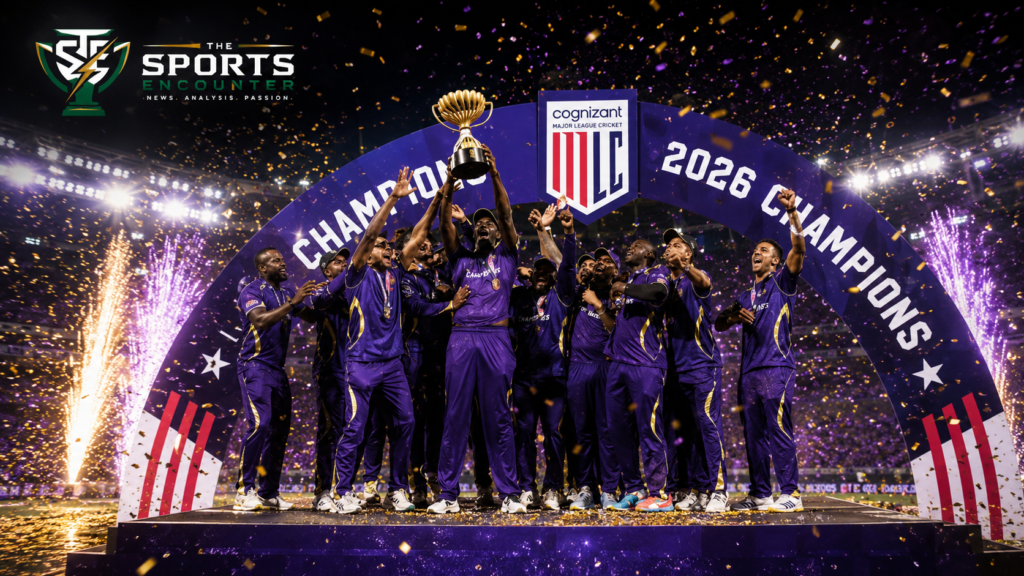
Sunil Narine dismantled Washington Freedom’s top order before Shadley van Schalkwyk and Jahmar Hamilton completed a championship-winning run-out from the final ball at the Oakland Coliseum.
Major League Cricket 2026 Final | Oakland Coliseum | July 18, 2026
Los Angeles Knight Riders waited three difficult seasons for a night like this.
Their first Major League Cricket final delivered tension until the final ball, a late Washington Freedom counterattack that appeared capable of stealing the trophy, and a run-out under pressure that will remain part of the franchise’s history.
Defending 164 at the Oakland Coliseum, the Knight Riders defeated Washington by one run after Lahiru Milantha failed to complete the second run that would have forced a Super Over. Shadley van Schalkwyk chased down the ball, sent a hurried throw toward wicketkeeper Jahmar Hamilton, and the stumps were broken before Milantha could make his ground.
For a moment, nobody seemed entirely sure what had happened. Then Los Angeles erupted.
Players sprinted onto the field. Dwayne Bravo danced among them. Fireworks lit the ground. Andre Russell sank to the turf as teammates raised their arms around him. Jason Holder later lifted the trophy beneath a burst of confetti, completing the Knight Riders’ recovery from years of frustration.
The one-run victory gave Los Angeles their first MLC championship in their first final. Washington, playing their third successive championship match, finished on 163 for 9 after Obus Pienaar’s extraordinary 53 from 24 balls had taken them within touching distance of another title.
Around 11,000 spectators witnessed a final that gave the 2026 tournament the dramatic ending it deserved. Readers can follow more tournament reports, tactical breakdowns, and player stories through The Sports Encounter’s cricket news and analysis hub.
TL;DR
Los Angeles Knight Riders beat Washington Freedom by one run in the 2026 Major League Cricket final at the Oakland Coliseum.
LAKR scored 164, led by Andre Fletcher’s 47, Colin Munro’s 40, and Matthew Tromp’s 39 from 21 balls. Sunil Narine then took 3 for 13 and removed Washington’s top three inside the powerplay.
Washington recovered through Andries Gous and Nikhil Chaudhary before Jason Holder claimed three wickets. Obus Pienaar smashed 53 from 24 balls to revive the chase, but the Knight Riders secured the title through a run-out from the final delivery.
Narine was named Player of the Match, tournament MVP, and joint leading wicket-taker with 18 wickets.
MLC 2026 Final: Key Information
| Match | Los Angeles Knight Riders vs Washington Freedom |
|---|---|
| Venue | Oakland Coliseum, Oakland |
| Los Angeles Knight Riders | 164 all out in 19.4 overs |
| Washington Freedom | 163/9 in 20 overs |
| Result | Los Angeles won by one run |
| Player of the Match | Sunil Narine |
| Player of the Tournament | Sunil Narine |
| Top scorer for LAKR | Andre Fletcher, 47 from 27 balls |
| Top scorer for Washington | Obus Pienaar, 53 from 24 balls |
| Best bowling | Sunil Narine, 3/13 |
| Final-ball moment | Lahiru Milantha run out attempting a second run |
| Attendance | Approximately 11,000 |
| Championship | LAKR’s first MLC title |
Fletcher and Munro Give Los Angeles the Ideal Start
Washington captain Steven Smith won the toss and chose to field, but his bowlers found little early reward.
Andre Fletcher and Colin Munro attacked the powerplay with confidence. Fletcher took the lead, using the pace available to strike seven fours and one six. Munro relied more heavily on aerial power, hitting four sixes without registering a four.
Their partnership reached 50 from 35 balls. Los Angeles closed the powerplay at 54 without loss, immediately placing Washington under pressure. Fletcher appeared especially comfortable, striking cleanly through the field and refusing to allow the bowlers to settle into defensive lengths.
Nikhil Chaudhary finally made the breakthrough in the eighth over. He bowled Fletcher for 47 from 27 balls, ending a 66-run opening stand. Two balls later, Andre Russell was bowled for a duck.
The double strike changed the momentum sharply. Washington had spent seven overs searching for one opening and suddenly found two.
Tromp Keeps the Knight Riders Moving
Matthew Tromp joined Munro with the innings at 66 for 2 and ensured the early momentum did not disappear.
The 2026 Under-23 Player of the Tournament played with the confidence of someone far more experienced than his age suggested. He struck three fours and three sixes in a 21-ball 39, maintaining a strike rate of 185.71 on the biggest stage of his career.
Munro continued supporting him until Rachin Ravindra dismissed the opener for 40 in the 12th over. Ravindra struck again two deliveries later when he bowled Narine for a duck. Los Angeles had moved from 109 for 2 to 111 for 4, leaving the middle order to rebuild again.
Tromp continued attacking, but Ben Dwarshuis removed him at 135. The Australian left-arm seamer then trapped Rovman Powell lbw for four in the same over.
Dwarshuis later dismissed Holder for eight to finish with 3 for 31. Los Angeles had reached 135 for 4 before losing four wickets for 19 runs. Washington’s bowling changes and fielding pressure had brought the innings back under control.
The fluctuations reflected the kind of pressure franchise cricketers now face across compressed competitions, a theme explored in The Sports Encounter’s analysis of how modern cricket workloads have changed the demands on elite players.
Washington Restrict LAKR to 164
The Knight Riders’ lower order pushed the score forward without creating a major final surge.
Hamilton made 10 from 10 balls. Saif Badar struck a six during his eight from four, while van Schalkwyk finished unbeaten on three.
Mitchell Owen dismissed Badar and Ali Khan from consecutive deliveries to complete the innings at 164 in 19.4 overs.
Washington had conceded 100 in the first 9.5 overs but allowed only 64 more while taking all 10 wickets. Dwarshuis claimed three, while Owen, Chaudhary, and Ravindra collected two apiece. Saurabh Netravalkar returned the most economical figures, taking 1 for 23 from four overs.
Smith later described the target as gettable, and his assessment made sense. Washington needed 8.25 runs per over, possessed an experienced batting order, and had pulled the match back impressively with the ball.
Narine changed that equation almost immediately.
Narine Destroys Washington’s Top Order
Holder handed Narine a major role inside the powerplay, an attacking decision influenced by head coach Bravo.

The move defined the final.
Mitchell Owen survived a first-ball review but fell in Narine’s second over for nine. Holder completed the catch, giving Los Angeles their first breakthrough at 12.
Ravindra made seven before Narine removed him in the fifth over, with Ali Khan taking the catch. Three deliveries later came the biggest wicket.
Narine bowled Smith for eight with a delivery the Washington captain failed to read. The ball defeated his defense and left the reigning finalists at 29 for 3.
Washington had lost their captain and two attacking top-order players within 29 runs. Narine had taken all three wickets, conceded almost nothing, and forced the chase into survival mode.
“Sunny’s exceptional. It’s hard to get him away on a pitch like that. You’ll struggle if you don’t read him.”
Steven Smith, Washington Freedom captain
Narine completed his four overs with 3 for 13, including 13 dot balls. His economy rate of 3.25 in a major final was remarkable. Across the tournament, he finished with 18 wickets and an economy rate of 4.74, comfortably the strongest among the leading wicket-takers.
The spell offered another example of how a specialist can control a T20 match through accuracy and tactical clarity, a pattern also seen across The Sports Encounter’s growing collection of cricket match reports and analysis.
Gous and Chaudhary Rebuild the Chase
Andries Gous and Nikhil Chaudhary responded with a patient 65-run partnership.
Their immediate task involved preventing a deeper collapse. Both batters accepted a slower scoring rate against Narine and focused on taking the chase into the second half.
Washington reached only 35 for 3 after six overs and 65 for 3 at the halfway point.
Gous used his experience to hold the innings together. Chaudhary struck three fours in his 25 from 24 balls and helped bring the equation back within reach.
Holder broke the partnership in the 14th over when Chaudhary was caught by substitute fielder Unmukt Chand. Two balls later, Holder removed Dwarshuis for one.
Washington had gone from 94 for 3 to 96 for 5. The required rate had climbed, Narine had already completed his spell, and Los Angeles appeared to be closing in.
Holder struck once more in the 16th over. Gous tried to accelerate but found Russell, departing for 40 from 35 balls.
At 109 for 6, Washington needed 56 runs from 26 deliveries. The final looked nearly settled.
Pienaar refused to accept that conclusion.
Obus Pienaar Turns the Final Upside Down
Pienaar launched one of the fiercest counterattacks of the tournament.
He targeted van Schalkwyk and Ali Khan, hitting cleanly through the arc and clearing the boundary five times. His fifty arrived from only 23 balls, with three fours alongside those five sixes.
Washington passed 150 in the 19th over. A chase that had appeared over became a genuine contest. The pressure moved back onto Los Angeles, whose bowlers began missing their lengths as Pienaar attacked without hesitation.
Van Schalkwyk carried the greatest punishment. His first three overs had been expensive, and his final figures would eventually read 2 for 50.
Holder still trusted him with the last over.
Washington needed eight runs from six balls. Pienaar had transformed the situation so dramatically that the final remained close even after he was dismissed.
Van Schalkwyk Recovers From Pienaar’s Assault
The final over began with the championship balanced between one batter’s momentum and one bowler’s nerve.
Van Schalkwyk bowled Pienaar with the second delivery, ending the innings at 53 from 24 balls. The next ball brought another wicket. Ian Holland was caught by Holder without scoring.
Washington were 157 for 8, but Lockie Ferguson kept the game alive by striking a boundary during his unbeaten five from two balls.
Three runs were required from the final delivery. Two would force a Super Over.
Van Schalkwyk delivered a yorker to Milantha, who reached forward and pushed it toward the vacant mid-on region. The first run came easily enough.
The second carried the trophy.
Van Schalkwyk sprinted after the ball and released an imperfect throw back toward the wicket. Hamilton reacted in front of the stumps and broke them as Milantha dived for safety.
The batter was short. Los Angeles had won by one run.
The finish evoked the pressure and confusion of cricket’s most famous final-ball run-outs. Players charged from the dugout while Bravo celebrated and danced across the field.
Van Schalkwyk had conceded 50 runs. He also took Pienaar’s wicket and helped complete the run-out that won the championship. His final over became a lesson in staying present after a difficult spell.
Holder Leads From the Front
Holder finished with 3 for 31, taking the wickets of Chaudhary, Dwarshuis, and Gous.
His spell carried tactical importance because it followed Washington’s recovery against the supporting bowlers. Narine had produced the initial damage, but Holder prevented Gous and Chaudhary from taking the chase into the closing overs with wickets in hand.
The captain also held two catches and remained involved throughout the defensive effort.
“Credit to each individual for playing their part. The crowd came out and supported us. My message to the boys is to have fun. One of the best ways to enjoy is by winning.”
Jason Holder, Los Angeles Knight Riders captain
Holder explained that belief had spread gradually across the team, with Bravo playing an important role in shaping the environment.
“We picked momentum at the right time after a dip in the middle,” Holder said. “We’ve had tough times in the past. Credit to each individual, and the win is a testament to our hard work and belief.”
Narine Completes a Historic Individual Season
Narine collected almost every major individual honor available.
He was named Player of the Match for his 3 for 13 in the final. He also won the tournament MVP award and shared the leading wicket-taker honor after finishing with 18 wickets.
His economy rate of 4.74 separated him from every other leading bowler.
“Words can’t describe how I’m feeling. I’m trying to embrace the moment. We struggled for three seasons. The team and support staff gelled together with plans, and we executed to the best of our ability.”
Sunil Narine
Narine also credited the work completed away from match days.
“No matter how much cricket you play, you have to put in the hours. Everyone bought in this year, which is amazing.”
Bowling three overs during the powerplay required him to accept an unusual tactical role. Narine said Bravo’s experience convinced him to trust the plan.
“Bowling in the powerplay was down to our crazy coach Bravo,” he said. “You have to buy in and trust his experience. Thankfully, it worked.”
The decision did more than work. It removed Washington’s top three and shaped the championship.
Bravo’s Influence Runs Through the Victory
Bravo’s fingerprints appeared throughout the Knight Riders’ campaign.
He encouraged Narine to attack inside the powerplay. He helped restore belief after the franchise’s difficult early seasons. During the final celebration, he moved through the team as coach, motivator, former teammate, and fellow champion.
Tromp said Bravo had challenged the players to win for the franchise’s senior Caribbean stars.
“Bravo said we’ll do it for the GOATs, Russell and Narine,” Tromp explained.
The younger player delivered with both bat and in the field. His 39 gave Los Angeles the middle-overs acceleration required after Russell fell for a duck. He also caught Dwarshuis during Holder’s key double-wicket over.
Tromp described the final as the biggest stage of his career.
“I’ve got the best coaches. They’ve given incredible confidence,” he said after receiving the Under-23 Player of the Tournament award. “I started at nine this season, and I felt ready when I got the opportunity. Biggest stage I’ve played on, but I kept things simple.”
The nerves were present. His execution remained clear.
Russell and Powell Finally Win With the Knight Riders
The title carried different meanings across the Los Angeles dressing room.
For Russell, the franchise represents more than another short-term T20 contract.
“Age is a number. Experience is everything,” he said. “We played well collectively as a team and deserve to celebrate.”
Russell admitted that winning with the franchise still affects him emotionally after more than a decade within the wider Knight Riders family.
“Every time I win for this franchise, I get teary-eyed,” he said. “You can’t take it for granted when you play for over a decade.”
Powell had also represented Knight Riders teams for years without winning a title.
“It means everything,” he said. “I’ve played for Knight Riders for many years, never won it. We planned and pulled it off.”
Ali Khan returned while still carrying stitches in his hand. He said the title reflected the combination of overseas experience and domestic contributions.
The celebration belonged to veterans and emerging players alike. The balance between established international names and developing talent is also visible across other franchise tournaments covered by The Sports Encounter, including its dedicated Lanka Premier League section.
Washington’s Third Final Ends in Heartbreak
Washington reached a third consecutive MLC final but could not complete the chase.
Smith remained proud of a team that had recovered from early trouble and reached another championship match.
“Three wickets in the powerplay always hurts,” he said. “But the guys have shown great character.”
The final came down to one run, one throw, and one attempted second.
Smith refused to shift attention away from the champions.
“Proud of the team,” he said. “We’ve played really good cricket to make three finals. Credit should go down to LA tonight.”
Gous Finishes as the Tournament’s Leading Scorer
Gous ended the season with 547 runs, the highest total in the competition.
His 40 in the final lacked the free-flowing quality of some of his earlier innings, but it gave Washington a foundation after Narine’s three-wicket burst.
Gous described the award as bittersweet.
“From the start, I felt I was batting well,” he said. “At the end, it clicked, and I just got going on a roll.”
He also received the Domestic Player of the Tournament award, recognition of his role in Washington’s run to another final.
MLC 2026 Awards
| Award | Winner |
|---|---|
| Champions | Los Angeles Knight Riders |
| Runners-up | Washington Freedom |
| Player of the Match | Sunil Narine |
| Tournament MVP | Sunil Narine |
| Leading run-scorer | Andries Gous, 547 runs |
| Leading wicket-taker | Sunil Narine, 18 wickets jointly |
| Domestic Player of the Tournament | Andries Gous |
| Under-23 Player of the Tournament | Matthew Tromp |
A Defining Night for Cricket in California
The final carried significance beyond the result.
Around 11,000 supporters filled the Oakland Coliseum for the tournament’s championship match. They watched a first-time finalist beat one of the league’s established powers through a finish that required no explanation of cricket’s emotional appeal.
MLC continues to combine established international stars with domestic players developing in the American system. That model has been central to the league’s growth and is reflected in the opportunities earned by players such as Tromp and Gous.
Fixtures, team information, official videos, and tournament updates are available through the official Major League Cricket website.
The final offered the strongest possible advertisement for the competition. There was tactical depth, elite individual skill, a young domestic player thriving under pressure, a veteran spinner controlling the powerplay, a late hitting assault, and a title decided by inches from the last ball.
For readers following the wider growth of international and franchise cricket, The Sports Encounter’s report on Galle Gallants’ emphatic LPL opening win offers another example of how emerging tournaments create new stages for experienced stars and younger players.
Where the Final Was Won
Narine’s Powerplay Spell
Removing Owen, Ravindra, and Smith reduced Washington to 29 for 3. His four overs created scoreboard pressure that remained relevant until the final delivery.
Tromp’s Counterattack
Tromp’s 39 from 21 balls prevented the Knight Riders’ innings from losing momentum after Fletcher and Russell departed in the same over.
Holder’s Middle-Overs Wickets
Washington rebuilt to 94 for 3, but Holder dismissed Chaudhary, Dwarshuis, and Gous before the chase could fully stabilize.
Van Schalkwyk’s Last-Over Recovery
Pienaar had punished him earlier, yet van Schalkwyk returned to bowl the match’s most demanding over. He dismissed the main threat and chased down the final ball to help complete the championship run-out.
The pressure management seen in Oakland also mirrors the decisive finishing explored in The Sports Encounter’s report on Bhanuka Rajapaksa’s rescue act for Jaffna Kings, where one senior batter controlled a chase after an early collapse.
Final Verdict
Los Angeles Knight Riders’ first MLC title came through belief that survived pressure from beginning to end.
Their opening partnership provided the platform. Tromp supplied the acceleration. Narine dismantled Washington’s top order. Holder broke the recovery.
Pienaar still threatened to take everything away.
That made the final delivery a test of instinct rather than planning. Van Schalkwyk chased the ball. Hamilton reached for the stumps. Milantha dived.
One run separated a trophy lift from a Super Over.
After three seasons of struggle, Los Angeles finally owned the decisive inch.
Holder lifted the trophy. Narine collected the tournament’s biggest awards. Russell fought back tears. Bravo danced beneath the confetti.
The Knight Riders had arrived at their first MLC final. They left Oakland as champions.
FAQs
Who won the Major League Cricket 2026 final?
Los Angeles Knight Riders defeated Washington Freedom by one run to win their first MLC title.
What was the score in the MLC 2026 final?
Los Angeles scored 164 before restricting Washington to 163 for 9.
Who was the Player of the Match?
Sunil Narine was named Player of the Match after taking 3 for 13 from four overs.
Who won the MLC 2026 MVP award?
Narine was also named the tournament MVP.
What happened on the final ball?
Washington needed three runs to win and two to force a Super Over. Milantha completed one run but was run out attempting the second after van Schalkwyk retrieved the ball and Hamilton broke the stumps.
How many runs did Obus Pienaar score?
Pienaar struck 53 from 24 balls, including three fours and five sixes.
Who scored the most runs in MLC 2026?
Andries Gous finished as the tournament’s leading scorer with 547 runs.
Who took the most wickets in MLC 2026?
Narine finished as joint leading wicket-taker with 18 wickets. His economy rate was 4.74.
How many people attended the MLC final?
Approximately 11,000 spectators attended the final at the Oakland Coliseum.
The Sports Encounter covers cricket match reports, player performances, tournament developments, tactical trends, and the stories shaping the global game.